Stay Ahead in Fast-Growing Economies.
Browse Reports Now




Fiber Cement Market – Global Industry Growth and Trend Analysis
Fibre cement is a composite material used mostly in roofing and facade products due to its strength and longevity in building and construction. Fiber cement siding for buildings is one frequent use.

IMR Group
Description
Fiber Cement Market Synopsis
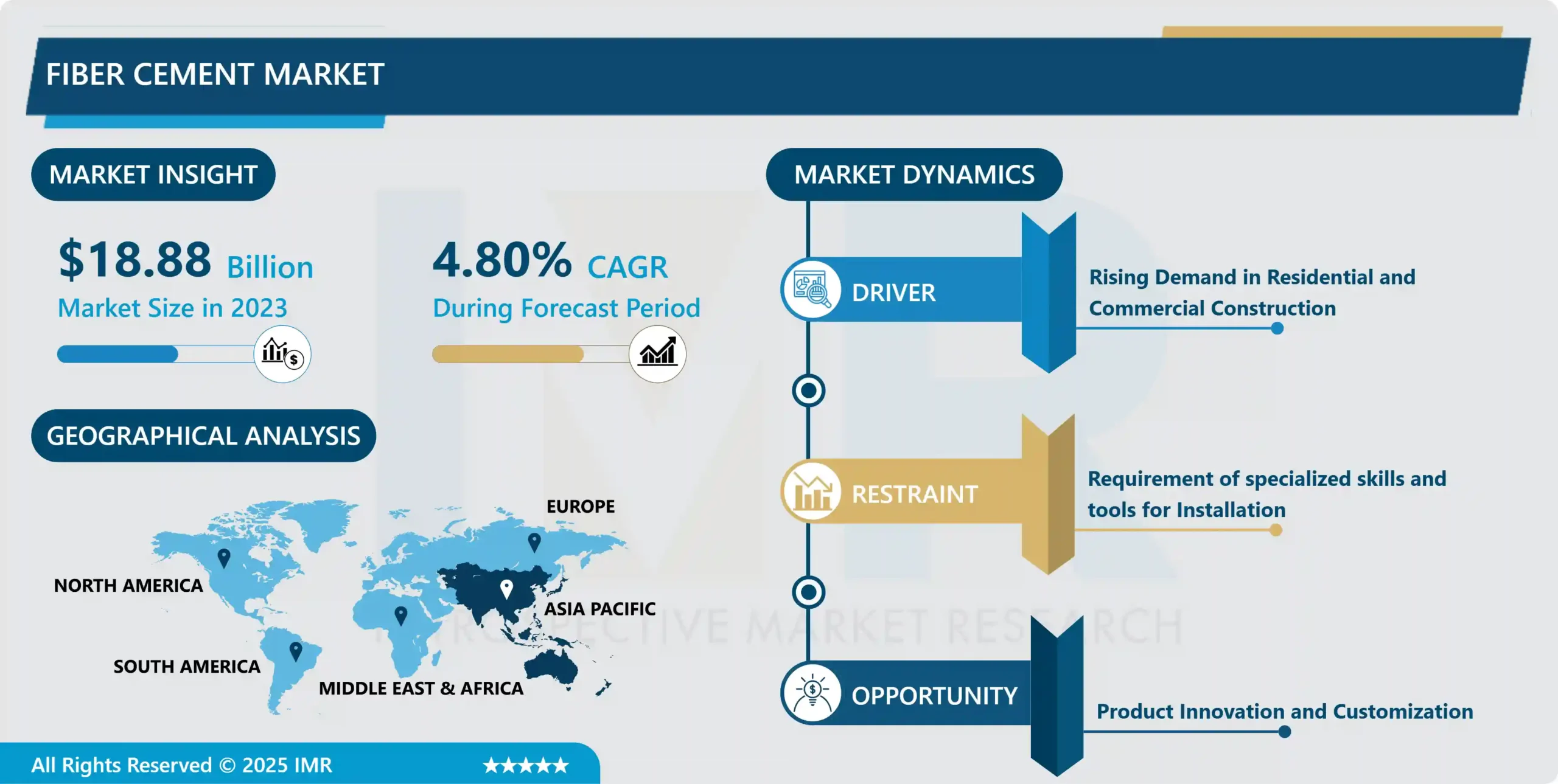
Fiber Cement Market Size Was Valued at USD 18.88 Billion in 2023 and is Projected to Reach USD 28.79 Billion by 2032, Growing at a CAGR of 4.8 % From 2024-2032.
Fibre cement is a composite material used mostly in roofing and facade products due to its strength and longevity in building and construction. Fiber cement siding for buildings is one frequent use. Fiber cement, a versatile building material made from cement, sand, cellulose fibers, and water, is suitable for various construction applications due to its durability, fire resistance, and low maintenance. Its eco-friendly composition makes it popular in residential and commercial projects.
Fibre cement tile backer board is a suitable tiling base for wet areas like bathrooms, kitchens, and showers due to its resistance to permanent water damage and lack of need for treatment. It is an alternative to Plywood and Plasterboard tiling bases. Installation is easy and can be done directly onto a stud wall or wooden or timber floor.
Fibre cement is also a durable and low-maintenance exterior cladding material, resisting termites, woodpeckers, and other pests. It is fire-resistant and non-combustible, making it non-combustible. It is easy to work with and install, with the appropriate tools allowing for one-person installation. Overall, fiber cement is a cost-effective and environmentally friendly alternative to traditional cladding materials.
Fiber cement cladding is a composite material made from cement reinforced with cellulose fibers, used in residential and commercial buildings as a protective and attractive exterior coating. It is manufactured in boards or sheets that lock together to form a weather-tight layer.
Fiber cement siding offers long-term durability with an average lifespan of 40 years. Its combination of cement and fiber provides versatility in style, fire and heat resistance, weather resistance, minimal maintenance, and environmental benefits. The material’s special curing process absorbs less moisture, reducing the risk of cracking or breaking. Fiber cement is made from recycled materials and other sustainable products, making it a great choice for DIY installation. It expands and contracts less than wood, requiring minimal expansion gaps. It comes in multiple colors, making it an excellent choice for homeowners looking to change their home’s exterior color. Fiber cement boards come in various textures, shares, and sizes, reflecting the homeowner’s style.
Fiber Cement Market Trend Analysis
Rising Demand in Residential and Commercial Construction
The fiber cement market is experiencing a surge in demand due to the increasing preference for durable, low-maintenance building materials in both residential and commercial sectors. Fiber cement products, such as siding, roofing, and trim, are popular due to their durability, resistance to moisture, pests, and fire, and their cost-saving properties. In the commercial construction sector, fiber cement is preferred for its durability, versatility, and aesthetic appeal, making it ideal for cladding, roofing, and architectural features in office buildings, retail spaces, and industrial facilities.
The growing focus on sustainable construction practices in both sectors further drives the demand for fiber cement, as its composition, often including recycled materials, aligns well with sustainability goals. Overall, fiber cement is a popular choice for both residential and commercial construction. Fiber cement offers design versatility due to its diverse textures, colors, and profiles, allowing architects to achieve various aesthetic styles. Its low-maintenance nature makes it appealing in residential and commercial settings.
Fiber cement’s resistance to fire, moisture, pests, and impact makes it suitable for construction projects in diverse climates. With increasing availability and accessibility in global markets, fiber cement is increasingly used in construction projects of varying scales and complexities worldwide.
Product Innovation and Customization
The fiber cement market is experiencing significant opportunities due to product innovation and customization. Manufacturers can differentiate their offerings, meet evolving customer needs, and gain a competitive edge in the construction industry. Innovations in formulations, manufacturing techniques, and fiber reinforcement can enhance the performance and properties of fiber cement products, improving durability, weather resistance, and installation ease. Customization allows manufacturers to tailor products to specific project requirements, design preferences, and regional considerations. This can include offering a wider range of colors, textures, sizes, and profiles to accommodate diverse architectural styles and aesthetic preferences.
Customization can lead to specialized solutions for unique applications. This approach also addresses emerging trends, such as sustainable construction materials, by incorporating recycled content, eco-friendly additives, and energy-efficient features into fiber cement products. Product innovation and customization in the construction industry foster collaboration between manufacturers, architects, and builders, resulting in innovative solutions. Advanced design software, 3D printing technology, and collaborative processes allow stakeholders to incorporate fiber cement into architectural designs. This position positions manufacturers as valuable partners, driving customer satisfaction, brand loyalty, and long-term success in the industry.
Fiber Cement Market Segment Analysis:
Fiber Cement Market Segmented on the basis of Product, Material, Production Process, Application, and End-User.
By Product, High-Density Board segment is expected to dominate the market during the forecast period
The High-Density Board segment is expected to dominate the fiber cement market due to its exceptional strength, durability, and dimensional stability. Compared with traditional building materials, these HD boards are not only lighter but also provide more strength with a reduced thickness. This High-Density cement board is pre-finished, easy to install, and durable, so it will shorten the time needed for construction.
These boards are suitable for residential and commercial construction due to their resistance to impact, moisture, fire, and pests. They also offer superior thermal and acoustic insulation properties, enhancing energy efficiency and indoor comfort. They come in various thicknesses, sizes, and surface finishes, offering versatility in design and application. Architects and builders appreciate the flexibility in customization projects. Regulatory requirements and industry standards regarding fire safety, structural integrity, and environmental sustainability drive the demand for high-density fiber cement boards. This segment’s dominance is expected to continue due to ongoing construction activities and increasing global demand for high-performance building materials.
By Application, Siding Segment Is Expected To Dominate The Market During The Forecast Period.
The fiber cement siding segment is expected to dominate the market due to its durability, low maintenance, and aesthetic appeal. Its resistance to rot, pests, fire, and harsh weather conditions ensures long-term performance and reduces the need for frequent repairs, saving property owners money. Fiber cement siding comes in various textures, colors, and profiles, allowing architects to achieve various design styles and enhance building curb appeal. Stringent building codes and regulations drive demand for fiber cement siding, as it meets or exceeds these standards.
Fiber cement’s eco-friendly composition, containing recycled materials and being recyclable itself, strengthens its position in the market. These factors position the siding segment as a dominant force in the fiber cement market, with sustained growth expected due to ongoing construction activities and renovation projects worldwide. Fiber cement siding is a durable and low-maintenance material commonly used to cover the exterior of houses and, in some cases, commercial buildings. It’s manufactured with cellulose fibers, cement, and sand, making it long-lasting and durable.
Fiber Cement Market Regional Insights:
Asia Pacific is Expected to Dominate the Market Over the Forecast period
The Asia Pacific region is poised to dominate the fiber cement market due to its growing population, urbanization, and increasing awareness of its benefits, such as durability, fire resistance, and low maintenance requirements. As consumers become more environmentally conscious, fiber cement becomes a preferred choice for various applications like siding, roofing, cladding, and trim.
Government policies and initiatives promoting sustainable construction practices further drive the adoption of fiber cement in the region. Governments across the region are implementing regulations and standards focused on energy efficiency, fire safety, and environmental protection, incentivizing the use of eco-friendly building materials like fiber cement.
Advancements in manufacturing technologies also improve the efficiency and quality of fiber cement production, enabling manufacturers to meet the growing demand while maintaining competitive pricing. With its expanding construction industry, increasing demand for sustainable building materials, supportive regulatory environment, and technological advancements, the Asia Pacific region is well-positioned to dominate the fiber cement market in the coming years.
Fiber Cement Market Top Key Players:
Allura (U.S.)
GAF Materials Corporation (U.S.)
Fry Reglet Corporation (U.S.)
American Fiber Cement Corporation (U.S.)
Plycem Corporation (Mexico)
Elementia, S.A.B. de C.V. (Mexico)
LATONIT (Russia)
Biele Group (Spain)
SWISSPEARL (Switzerland)
Saint-Gobain SA (France)
Etex Group (Belgium)
Etex Group (Belgium)
Cembrit Holding A/S (Denmark)
NICHIHA (Japan)
Toray Industries Inc. (Japan)
Copal Company Limited (Japan)
Everest Industries Ltd (India)
Visaka Industries Limited (India)
Soben International (China)
CSR Limited (Australia)
James Hardie Europe GmbH (Australia)
SHERA (Thailand)
SCG (Thailand)
Taisyou International Business Co., Ltd. (Taiwan)
Hume Cemboard Industries Sdn Bhd (Malaysia)
Other Major Players.
Key Industry Developments in the Fiber Cement Market:
In March 2022, James Hardie Industries advanced its expansion plans for fiber cement production by acquiring land in Melbourne, Victoria. The move aims to establish a new manufacturing facility in Victoria to meet the rising demand for premium building solutions in the Asia Pacific region.
In January 2022, Swisspearl Group AG completed the acquisition of Cembrit, a prominent fiber cement manufacturer based in Denmark. This acquisition positioned Swisspearl Group as the second-largest player in the European fiber cement market, bolstering its presence across geographical regions and facilitating the exploration of new market opportunities.
Chapter 1: Introduction
1.1 Scope and Coverage
Chapter 2:Executive Summary
Chapter 3: Market Landscape
3.1 Market Dynamics
3.1.1 Drivers
3.1.2 Restraints
3.1.3 Opportunities
3.1.4 Challenges
3.2 Market Trend Analysis
3.3 PESTLE Analysis
3.4 Porter’s Five Forces Analysis
3.5 Industry Value Chain Analysis
3.6 Ecosystem
3.7 Regulatory Landscape
3.8 Price Trend Analysis
3.9 Patent Analysis
3.10 Technology Evolution
3.11 Investment Pockets
3.12 Import-Export Analysis
Chapter 4: Fiber Cement Market by Product (2018-2032)
4.1 Fiber Cement Market Snapshot and Growth Engine
4.2 Market Overview
4.3 High-Density Board
4.3.1 Introduction and Market Overview
4.3.2 Historic and Forecasted Market Size in Value USD and Volume Units
4.3.3 Key Market Trends, Growth Factors, and Opportunities
4.3.4 Geographic Segmentation Analysis
4.4 Medium Density Board
4.5 Low-Density Board
Chapter 5: Fiber Cement Market by Material (2018-2032)
5.1 Fiber Cement Market Snapshot and Growth Engine
5.2 Market Overview
5.3 Portland Cement
5.3.1 Introduction and Market Overview
5.3.2 Historic and Forecasted Market Size in Value USD and Volume Units
5.3.3 Key Market Trends, Growth Factors, and Opportunities
5.3.4 Geographic Segmentation Analysis
5.4 Silica
5.5 Cellulosic Fibers
Chapter 6: Fiber Cement Market by Production Process (2018-2032)
6.1 Fiber Cement Market Snapshot and Growth Engine
6.2 Market Overview
6.3 Hatschek Process
6.3.1 Introduction and Market Overview
6.3.2 Historic and Forecasted Market Size in Value USD and Volume Units
6.3.3 Key Market Trends, Growth Factors, and Opportunities
6.3.4 Geographic Segmentation Analysis
6.4 Extrusion Process
6.5 Pertile Process
Chapter 7: Fiber Cement Market by Application (2018-2032)
7.1 Fiber Cement Market Snapshot and Growth Engine
7.2 Market Overview
7.3 Siding
7.3.1 Introduction and Market Overview
7.3.2 Historic and Forecasted Market Size in Value USD and Volume Units
7.3.3 Key Market Trends, Growth Factors, and Opportunities
7.3.4 Geographic Segmentation Analysis
7.4 Roofing
7.5 Cladding
7.6 Molding and Trimming
Chapter 8: Fiber Cement Market by End-User (2018-2032)
8.1 Fiber Cement Market Snapshot and Growth Engine
8.2 Market Overview
8.3 Residential Construction
8.3.1 Introduction and Market Overview
8.3.2 Historic and Forecasted Market Size in Value USD and Volume Units
8.3.3 Key Market Trends, Growth Factors, and Opportunities
8.3.4 Geographic Segmentation Analysis
8.4 Commercial Construction
8.5 Industrial Construction
Chapter 9: Company Profiles and Competitive Analysis
9.1 Competitive Landscape
9.1.1 Competitive Benchmarking
9.1.2 Fiber Cement Market Share by Manufacturer (2024)
9.1.3 Industry BCG Matrix
9.1.4 Heat Map Analysis
9.1.5 Mergers and Acquisitions
9.2 ALLURA (U.S.)
9.2.1 Company Overview
9.2.2 Key Executives
9.2.3 Company Snapshot
9.2.4 Role of the Company in the Market
9.2.5 Sustainability and Social Responsibility
9.2.6 Operating Business Segments
9.2.7 Product Portfolio
9.2.8 Business Performance
9.2.9 Key Strategic Moves and Recent Developments
9.2.10 SWOT Analysis
9.3 GAF MATERIALS CORPORATION (U.S.)
9.4 FRY REGLET CORPORATION (U.S.)
9.5 AMERICAN FIBER CEMENT CORPORATION (U.S.)
9.6 PLYCEM CORPORATION (MEXICO)
9.7 ELEMENTIA
9.8 S.A.B. DE C.V. (MEXICO)
9.9 LATONIT (RUSSIA)
9.10 BIELE GROUP (SPAIN)
9.11 SWISSPEARL (SWITZERLAND)
9.12 SAINT-GOBAIN SA (FRANCE)
9.13 ETEX GROUP (BELGIUM)
9.14 ETEX GROUP (BELGIUM)
9.15 CEMBRIT HOLDING A/S (DENMARK)
9.16 NICHIHA (JAPAN)
9.17 TORAY INDUSTRIES INC. (JAPAN)
9.18 COPAL COMPANY LIMITED (JAPAN)
9.19 EVEREST INDUSTRIES LTD (INDIA)
9.20 VISAKA INDUSTRIES LIMITED (INDIA)
9.21 SOBEN INTERNATIONAL (CHINA)
9.22 CSR LIMITED (AUSTRALIA)
9.23 JAMES HARDIE EUROPE GMBH (AUSTRALIA)
9.24 SHERA (THAILAND)
9.25 SCG (THAILAND)
9.26 TAISYOU INTERNATIONAL BUSINESS COLTD. (TAIWAN)
9.27 HUME CEMBOARD INDUSTRIES SDN BHD (MALAYSIA)
9.28
Chapter 10: Global Fiber Cement Market By Region
10.1 Overview
10.2. North America Fiber Cement Market
10.2.1 Key Market Trends, Growth Factors and Opportunities
10.2.2 Top Key Companies
10.2.3 Historic and Forecasted Market Size by Segments
10.2.4 Historic and Forecasted Market Size by Product
10.2.4.1 High-Density Board
10.2.4.2 Medium Density Board
10.2.4.3 Low-Density Board
10.2.5 Historic and Forecasted Market Size by Material
10.2.5.1 Portland Cement
10.2.5.2 Silica
10.2.5.3 Cellulosic Fibers
10.2.6 Historic and Forecasted Market Size by Production Process
10.2.6.1 Hatschek Process
10.2.6.2 Extrusion Process
10.2.6.3 Pertile Process
10.2.7 Historic and Forecasted Market Size by Application
10.2.7.1 Siding
10.2.7.2 Roofing
10.2.7.3 Cladding
10.2.7.4 Molding and Trimming
10.2.8 Historic and Forecasted Market Size by End-User
10.2.8.1 Residential Construction
10.2.8.2 Commercial Construction
10.2.8.3 Industrial Construction
10.2.9 Historic and Forecast Market Size by Country
10.2.9.1 US
10.2.9.2 Canada
10.2.9.3 Mexico
10.3. Eastern Europe Fiber Cement Market
10.3.1 Key Market Trends, Growth Factors and Opportunities
10.3.2 Top Key Companies
10.3.3 Historic and Forecasted Market Size by Segments
10.3.4 Historic and Forecasted Market Size by Product
10.3.4.1 High-Density Board
10.3.4.2 Medium Density Board
10.3.4.3 Low-Density Board
10.3.5 Historic and Forecasted Market Size by Material
10.3.5.1 Portland Cement
10.3.5.2 Silica
10.3.5.3 Cellulosic Fibers
10.3.6 Historic and Forecasted Market Size by Production Process
10.3.6.1 Hatschek Process
10.3.6.2 Extrusion Process
10.3.6.3 Pertile Process
10.3.7 Historic and Forecasted Market Size by Application
10.3.7.1 Siding
10.3.7.2 Roofing
10.3.7.3 Cladding
10.3.7.4 Molding and Trimming
10.3.8 Historic and Forecasted Market Size by End-User
10.3.8.1 Residential Construction
10.3.8.2 Commercial Construction
10.3.8.3 Industrial Construction
10.3.9 Historic and Forecast Market Size by Country
10.3.9.1 Russia
10.3.9.2 Bulgaria
10.3.9.3 The Czech Republic
10.3.9.4 Hungary
10.3.9.5 Poland
10.3.9.6 Romania
10.3.9.7 Rest of Eastern Europe
10.4. Western Europe Fiber Cement Market
10.4.1 Key Market Trends, Growth Factors and Opportunities
10.4.2 Top Key Companies
10.4.3 Historic and Forecasted Market Size by Segments
10.4.4 Historic and Forecasted Market Size by Product
10.4.4.1 High-Density Board
10.4.4.2 Medium Density Board
10.4.4.3 Low-Density Board
10.4.5 Historic and Forecasted Market Size by Material
10.4.5.1 Portland Cement
10.4.5.2 Silica
10.4.5.3 Cellulosic Fibers
10.4.6 Historic and Forecasted Market Size by Production Process
10.4.6.1 Hatschek Process
10.4.6.2 Extrusion Process
10.4.6.3 Pertile Process
10.4.7 Historic and Forecasted Market Size by Application
10.4.7.1 Siding
10.4.7.2 Roofing
10.4.7.3 Cladding
10.4.7.4 Molding and Trimming
10.4.8 Historic and Forecasted Market Size by End-User
10.4.8.1 Residential Construction
10.4.8.2 Commercial Construction
10.4.8.3 Industrial Construction
10.4.9 Historic and Forecast Market Size by Country
10.4.9.1 Germany
10.4.9.2 UK
10.4.9.3 France
10.4.9.4 The Netherlands
10.4.9.5 Italy
10.4.9.6 Spain
10.4.9.7 Rest of Western Europe
10.5. Asia Pacific Fiber Cement Market
10.5.1 Key Market Trends, Growth Factors and Opportunities
10.5.2 Top Key Companies
10.5.3 Historic and Forecasted Market Size by Segments
10.5.4 Historic and Forecasted Market Size by Product
10.5.4.1 High-Density Board
10.5.4.2 Medium Density Board
10.5.4.3 Low-Density Board
10.5.5 Historic and Forecasted Market Size by Material
10.5.5.1 Portland Cement
10.5.5.2 Silica
10.5.5.3 Cellulosic Fibers
10.5.6 Historic and Forecasted Market Size by Production Process
10.5.6.1 Hatschek Process
10.5.6.2 Extrusion Process
10.5.6.3 Pertile Process
10.5.7 Historic and Forecasted Market Size by Application
10.5.7.1 Siding
10.5.7.2 Roofing
10.5.7.3 Cladding
10.5.7.4 Molding and Trimming
10.5.8 Historic and Forecasted Market Size by End-User
10.5.8.1 Residential Construction
10.5.8.2 Commercial Construction
10.5.8.3 Industrial Construction
10.5.9 Historic and Forecast Market Size by Country
10.5.9.1 China
10.5.9.2 India
10.5.9.3 Japan
10.5.9.4 South Korea
10.5.9.5 Malaysia
10.5.9.6 Thailand
10.5.9.7 Vietnam
10.5.9.8 The Philippines
10.5.9.9 Australia
10.5.9.10 New Zealand
10.5.9.11 Rest of APAC
10.6. Middle East & Africa Fiber Cement Market
10.6.1 Key Market Trends, Growth Factors and Opportunities
10.6.2 Top Key Companies
10.6.3 Historic and Forecasted Market Size by Segments
10.6.4 Historic and Forecasted Market Size by Product
10.6.4.1 High-Density Board
10.6.4.2 Medium Density Board
10.6.4.3 Low-Density Board
10.6.5 Historic and Forecasted Market Size by Material
10.6.5.1 Portland Cement
10.6.5.2 Silica
10.6.5.3 Cellulosic Fibers
10.6.6 Historic and Forecasted Market Size by Production Process
10.6.6.1 Hatschek Process
10.6.6.2 Extrusion Process
10.6.6.3 Pertile Process
10.6.7 Historic and Forecasted Market Size by Application
10.6.7.1 Siding
10.6.7.2 Roofing
10.6.7.3 Cladding
10.6.7.4 Molding and Trimming
10.6.8 Historic and Forecasted Market Size by End-User
10.6.8.1 Residential Construction
10.6.8.2 Commercial Construction
10.6.8.3 Industrial Construction
10.6.9 Historic and Forecast Market Size by Country
10.6.9.1 Turkiye
10.6.9.2 Bahrain
10.6.9.3 Kuwait
10.6.9.4 Saudi Arabia
10.6.9.5 Qatar
10.6.9.6 UAE
10.6.9.7 Israel
10.6.9.8 South Africa
10.7. South America Fiber Cement Market
10.7.1 Key Market Trends, Growth Factors and Opportunities
10.7.2 Top Key Companies
10.7.3 Historic and Forecasted Market Size by Segments
10.7.4 Historic and Forecasted Market Size by Product
10.7.4.1 High-Density Board
10.7.4.2 Medium Density Board
10.7.4.3 Low-Density Board
10.7.5 Historic and Forecasted Market Size by Material
10.7.5.1 Portland Cement
10.7.5.2 Silica
10.7.5.3 Cellulosic Fibers
10.7.6 Historic and Forecasted Market Size by Production Process
10.7.6.1 Hatschek Process
10.7.6.2 Extrusion Process
10.7.6.3 Pertile Process
10.7.7 Historic and Forecasted Market Size by Application
10.7.7.1 Siding
10.7.7.2 Roofing
10.7.7.3 Cladding
10.7.7.4 Molding and Trimming
10.7.8 Historic and Forecasted Market Size by End-User
10.7.8.1 Residential Construction
10.7.8.2 Commercial Construction
10.7.8.3 Industrial Construction
10.7.9 Historic and Forecast Market Size by Country
10.7.9.1 Brazil
10.7.9.2 Argentina
10.7.9.3 Rest of SA
Chapter 11 Analyst Viewpoint and Conclusion
11.1 Recommendations and Concluding Analysis
11.2 Potential Market Strategies
Chapter 12 Research Methodology
12.1 Research Process
12.2 Primary Research
12.3 Secondary Research
Q1: What would be the forecast period in the Fiber Cement Market research report?
A1: The forecast period in the Fiber Cement Market research report is 2024-2032.
Q2: Who are the key players in the Fiber Cement Market?
A2: Allura (U.S.), GAF Materials Corporation (U.S.), Fry Reglet Corporation (U.S.), American Fiber Cement Corporation (U.S.), Plycem Corporation (Mexico), Elementia, S.A.B. de C.V. (Mexico), LATONIT (Russia), Biele Group (Spain), SWISSPEARL (Switzerland), Saint-Gobain SA (France), Etex Group (Belgium), Etex Group (Belgium), Cembrit Holding A/S (Denmark), NICHIHA (Japan), Toray Industries Inc. (Japan), Copal Company Limited (Japan), Everest Industries Ltd (India), Visaka Industries Limited (India), Soben International (China), CSR Limited (Australia), James Hardie Europe GmbH (Australia), SHERA (Thailand), SCG (Thailand), Taisyou International Business Co., Ltd. (Taiwan), Hume Cemboard Industries Sdn Bhd (Malaysia), and Other Major Players.
Q3: What are the segments of the Fiber Cement Market?
A3: The Fiber Cement Market is segmented into Product, Material, Production Process, Application, End-User, and region. By Product, the market is categorized into High-Density Board, Medium Density Board, and Low-Density Board. By Material, the market is categorized into Portland Cement, Silica, and Cellulosic Fibers. By Production Process, the market is categorized into Hatschek Process, Extrusion Process, and Pertile Process. By Application, the market is categorized into Siding, Roofing, Cladding, Molding and Trimming. By End-User, the market is categorized into Residential Construction, Commercial Construction, and Industrial Construction. By region, it is analyzed across North America (U.S.; Canada; Mexico), Eastern Europe (Bulgaria; The Czech Republic; Hungary; Poland; Romania; Rest of Eastern Europe), Western Europe (Germany; UK; France; Netherlands; Italy; Russia; Spain; Rest of Western Europe), Asia-Pacific (China; India; Japan; Southeast Asia, etc.), South America (Brazil; Argentina, etc.), Middle East & Africa (Saudi Arabia; South Africa, etc.).
Q4: What is the Fiber Cement Market?
A4: Fibre cement is a composite material used mostly in roofing and facade products due to its strength and longevity in building and construction. Fiber cement siding for buildings is one frequent use. Fiber cement, a versatile building material made from cement, sand, cellulose fibers, and water, is suitable for various construction applications due to its durability, fire resistance, and low maintenance. Its eco-friendly composition makes it popular in residential and commercial projects.
Q5: How big is the Fiber Cement Market?
A5: Fiber Cement Market Size Was Valued at USD 18.88 Billion in 2023 and is Projected to Reach USD 28.79 Billion by 2032, Growing at a CAGR of 4.8 % From 2024-2032.
How to Buy a Report from eminsights.jp
On the product page, choose the license you want: Single-User License, Multi-User License or Enterprise License.
If you required report in your native language, then you can click on Translated Report button and fill out the form with report name and language you want, then our team will contact you as soon as possible.
Click the Buy Now button.
You will be redirected to the checkout page. Enter your company details and payment information.
Click Place Order to complete the purchase.
Confirmation: You’ll receive an order confirmation and our team will contact you shortly with your ordered report.
If you have any questions, fill out the contact form below or email us at bizdev@eminsights.net.
Thank you for choosing eminsights.jp!