Stay Ahead in Fast-Growing Economies.
Browse Reports Now
Feed Pellet Machine Market Size, Share, Growth & Forecast (2024-2032)
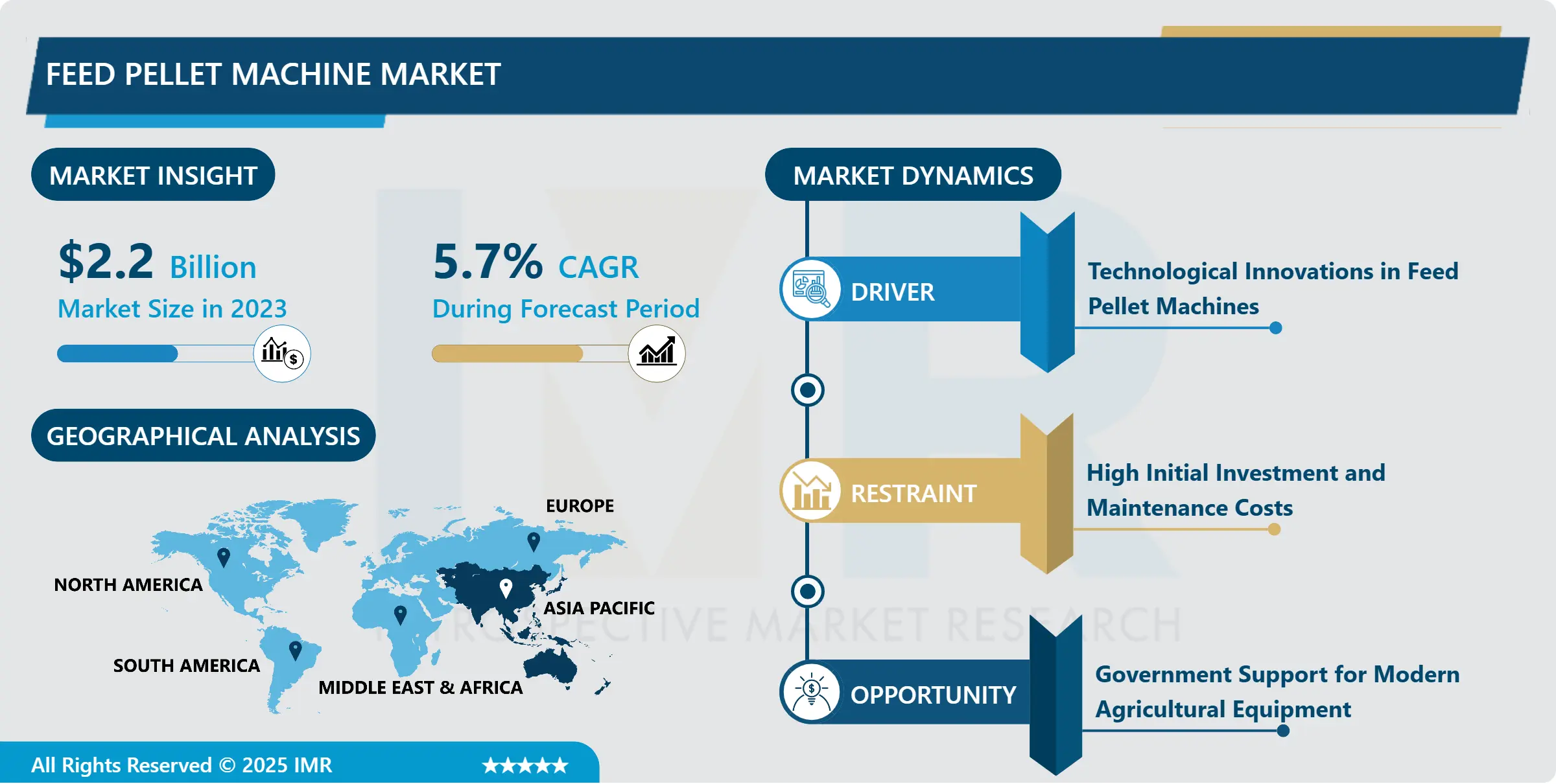
Feed Pellet Machine Market Size Was Valued at USD 2.20 Billion in 2023, and is Projected to Reach USD 3.62 Billion by 2032, Growing at a CAGR of 5.70% From 2024-2032.

IMR Group
Description
Feed Pellet Machine Market Synopsis:
Feed Pellet Machine Market Size Was Valued at USD 2.20 Billion in 2023, and is Projected to Reach USD 3.62 Billion by 2032, Growing at a CAGR of 5.70% From 2024-2032.
The feed pellet machine market is related to the product of machines which is used for producing feed pellets through the compacting process for livestock, poultry, aquaculture, and other animals. These machines are used to simplify the process of feed manufacturing, increase conversion efficiency, decrease losses, and facilitate feeding, storage, and distribution.
Effective demand has also been influenced by the growing global population as well as the changes of people’s eating habits from using more livestock and poultry products which are high in proteins. This has consequently increased the demand of well-produced feed, making many people to invest on feed pellet machines. Also, improvement in farming practices and the increase in the aquaculture segment have supported the market expansion.
The continuous developments implemented on the feed pellet machines are increasing the market’s productivity and efficiency of energy. Factor like auto control system, low energy requirement, modularity etc are getting highly appreciated by the commercial feed producers in addition to small farmers. These improvements help develop cost efficiencies to create these machines more affordable to a wider variety of consumers.
Feed Pellet Machine Market Trend Analysis:
Integration of IoT and Smart Technology
The Feed Pellet Machine Market is experiencing expansion due to the increased demand for precision and efficiency in animal feed production. The integration of IoT and smart technologies into pelletizing equipment allows manufacturers to optimize production processes by monitoring and adjusting parameters in real time. This technological advancement enhances machine performance, reduces downtime, and ensures consistent feed quality. As the agricultural sector emphasizes automation and data-driven decisions, the adoption of connected equipment is becoming a pivotal factor for producers seeking competitive advantages in feed production.
The growing emphasis on sustainability and cost efficiency in feed manufacturing also contributes to the market’s growth. Smart machines equipped with sensors and analytics capabilities enable better resource management, reducing energy consumption and waste. This shift towards intelligent systems aligns with the broader trend in manufacturing industries toward automation and smart technology, presenting long-term opportunities for stakeholders involved in the feed pellet machine market.
Emerging Markets and Government Initiatives
The feed pellet machine market is experiencing rapid growth due to the increasing demand for efficient and cost-effective animal feed production methods. The rising global population and the growing need for sustainable food sources have prompted a shift toward more advanced and automated systems in animal feed manufacturing. Government initiatives that focus on enhancing agricultural productivity and sustainability have encouraged the adoption of modern feed processing technologies, such as feed pellet machines, which improve feed quality, reduce waste, and lower energy consumption.
Emerging markets, particularly in Asia and Africa, are witnessing an expansion of the feed pellet machine industry as agricultural practices evolve to meet the demands of larger livestock populations. With more governments investing in infrastructure and technology to support the agricultural sector, the feed pellet machine market is expected to see continued growth. This expansion presents opportunities for manufacturers to capitalize on the increasing need for efficient, scalable solutions in animal feed production.
Feed Pellet Machine Market Segment Analysis:
Feed Pellet Machine Market Segmented on the basis of Product Type, By Capacity Application, End User, and Region
By Product Type, Flat Die Pellet Machines segment is expected to dominate the market during the forecast period
The Feed Pellet Machine Market is projected to experience substantial growth due to the increasing demand for efficient livestock and poultry feed production. With advancements in technology, the market is seeing a shift toward more automated and high-capacity machines, enabling producers to meet the rising global demand for animal feed. This transition is enhancing productivity and optimizing the formulation of feed, which directly supports industry expansion.
The Flat Die Pellet Machines segment, with its capacity to provide consistent and reliable output, is expected to lead market trends. These machines are highly sought after for their ease of use and low maintenance requirements, making them a preferred choice among feed producers. As more players enter the market, competition will drive innovation and the development of new, energy-efficient machines, further stimulating growth. The trend is also fueled by growing investments in agriculture and the need for cost-effective, scalable production methods in the feed manufacturing industry.
By Application, Poultry Feed segment expected to held the largest share
The Feed Pellet Machine Market is poised for substantial growth as the poultry feed segment expands. As poultry farming scales up globally, the demand for efficient and cost-effective feed processing solutions increases. This growth aligns with the need for high-quality feed products that improve animal health and productivity. Feed pellet machines enable uniform feed preparation, optimizing nutrient distribution and ensuring better feed conversion ratios, which is crucial for poultry farmers looking to enhance operational efficiency.
As the poultry industry continues to embrace automation, the adoption of advanced feed pellet machines rises, with a focus on energy efficiency, capacity, and scalability. The market is witnessing a surge in technological innovations, such as machines that offer higher throughput and reduced energy consumption. The growing need for processed, nutrient-rich feeds that cater to diverse poultry requirements further fuels the demand for these machines, establishing a robust link between feed production technology and the thriving poultry feed market.
Feed Pellet Machine Market Regional Insights:
Asia Pacific is Expected to Dominate the Market Over the Forecast period
Asia Pacific’s projected dominance in the feed pellet machine market is closely linked to the region’s expanding animal feed industry. The increasing demand for meat, dairy, and aquaculture products, fueled by a growing population and rising income levels, necessitates efficient feed production methods. Consequently, there is a surge in the adoption of feed pellet machines to meet the nutritional requirements of the burgeoning livestock and aquaculture sectors across Asia Pacific. Government initiatives supporting the agriculture and animal husbandry industries in several countries within this region further bolster this market growth.
The preference for pelleted feed over traditional mash feed due to its advantages, such as improved feed intake, reduced wastage, enhanced digestibility, and better handling, acts as a strong propellant for the feed pellet machine market. The Asia Pacific region, with its large livestock population, particularly in countries like China and India, represents a substantial consumer base for animal feed. This escalating demand for high-quality animal feed directly translates to greater utilization of feed pellet machines, establishing Asia Pacific as a key region in the global market landscape for these machine.
Active Key Players in the Feed Pellet Machine Market
ABC Machinery (China)
Andritz Group (Austria)
Buhler AG (Switzerland)
Clextral (France)
CPM Holdings Inc. (United States)
Henan Richi Machinery Co., Ltd. (China)
La Meccanica (Italy)
Muyang Group (China)
Van Aarsen International (Netherlands)
Zhengchang Group (China)
Other Active Players
Chapter 1: Introduction
1.1 Scope and Coverage
Chapter 2:Executive Summary
Chapter 3: Market Landscape
3.1 Market Dynamics
3.1.1 Drivers
3.1.2 Restraints
3.1.3 Opportunities
3.1.4 Challenges
3.2 Market Trend Analysis
3.3 PESTLE Analysis
3.4 Porter’s Five Forces Analysis
3.5 Industry Value Chain Analysis
3.6 Ecosystem
3.7 Regulatory Landscape
3.8 Price Trend Analysis
3.9 Patent Analysis
3.10 Technology Evolution
3.11 Investment Pockets
3.12 Import-Export Analysis
Chapter 4: Feed Pellet Machine Market by Product Type
4.1 Feed Pellet Machine Market Snapshot and Growth Engine
4.2 Feed Pellet Machine Market Overview
4.3 Flat Die Pellet Machines
4.3.1 Introduction and Market Overview
4.3.2 Historic and Forecasted Market Size in Value USD and Volume Units (2017-2032F)
4.3.3 Key Market Trends, Growth Factors and Opportunities
4.3.4 Flat Die Pellet Machines: Geographic Segmentation Analysis
4.4 Ring Die Pellet Machines
4.4.1 Introduction and Market Overview
4.4.2 Historic and Forecasted Market Size in Value USD and Volume Units (2017-2032F)
4.4.3 Key Market Trends, Growth Factors and Opportunities
4.4.4 Ring Die Pellet Machines: Geographic Segmentation Analysis
Chapter 5: Feed Pellet Machine Market by Capacity
5.1 Feed Pellet Machine Market Snapshot and Growth Engine
5.2 Feed Pellet Machine Market Overview
5.3 Small-Scale (Up to 1 ton/hour)
5.3.1 Introduction and Market Overview
5.3.2 Historic and Forecasted Market Size in Value USD and Volume Units (2017-2032F)
5.3.3 Key Market Trends, Growth Factors and Opportunities
5.3.4 Small-Scale (Up to 1 ton/hour): Geographic Segmentation Analysis
5.4 Medium-Scale (1–10 tons/hour)
5.4.1 Introduction and Market Overview
5.4.2 Historic and Forecasted Market Size in Value USD and Volume Units (2017-2032F)
5.4.3 Key Market Trends, Growth Factors and Opportunities
5.4.4 Medium-Scale (1–10 tons/hour): Geographic Segmentation Analysis
5.5 Large-Scale (Above 10 tons/hour)
5.5.1 Introduction and Market Overview
5.5.2 Historic and Forecasted Market Size in Value USD and Volume Units (2017-2032F)
5.5.3 Key Market Trends, Growth Factors and Opportunities
5.5.4 Large-Scale (Above 10 tons/hour): Geographic Segmentation Analysis
Chapter 6: Feed Pellet Machine Market by Application
6.1 Feed Pellet Machine Market Snapshot and Growth Engine
6.2 Feed Pellet Machine Market Overview
6.3 Poultry Feed
6.3.1 Introduction and Market Overview
6.3.2 Historic and Forecasted Market Size in Value USD and Volume Units (2017-2032F)
6.3.3 Key Market Trends, Growth Factors and Opportunities
6.3.4 Poultry Feed: Geographic Segmentation Analysis
6.4 Aquaculture Feed
6.4.1 Introduction and Market Overview
6.4.2 Historic and Forecasted Market Size in Value USD and Volume Units (2017-2032F)
6.4.3 Key Market Trends, Growth Factors and Opportunities
6.4.4 Aquaculture Feed: Geographic Segmentation Analysis
6.5 Livestock Feed
6.5.1 Introduction and Market Overview
6.5.2 Historic and Forecasted Market Size in Value USD and Volume Units (2017-2032F)
6.5.3 Key Market Trends, Growth Factors and Opportunities
6.5.4 Livestock Feed: Geographic Segmentation Analysis
6.6 Other Feeds
6.6.1 Introduction and Market Overview
6.6.2 Historic and Forecasted Market Size in Value USD and Volume Units (2017-2032F)
6.6.3 Key Market Trends, Growth Factors and Opportunities
6.6.4 Other Feeds: Geographic Segmentation Analysis
Chapter 7: Feed Pellet Machine Market by End User
7.1 Feed Pellet Machine Market Snapshot and Growth Engine
7.2 Feed Pellet Machine Market Overview
7.3 Commercial Feed Producers
7.3.1 Introduction and Market Overview
7.3.2 Historic and Forecasted Market Size in Value USD and Volume Units (2017-2032F)
7.3.3 Key Market Trends, Growth Factors and Opportunities
7.3.4 Commercial Feed Producers: Geographic Segmentation Analysis
7.4 Small-Scale Farmers
7.4.1 Introduction and Market Overview
7.4.2 Historic and Forecasted Market Size in Value USD and Volume Units (2017-2032F)
7.4.3 Key Market Trends, Growth Factors and Opportunities
7.4.4 Small-Scale Farmers: Geographic Segmentation Analysis
7.5 Others
7.5.1 Introduction and Market Overview
7.5.2 Historic and Forecasted Market Size in Value USD and Volume Units (2017-2032F)
7.5.3 Key Market Trends, Growth Factors and Opportunities
7.5.4 Others: Geographic Segmentation Analysis
Chapter 8: Company Profiles and Competitive Analysis
8.1 Competitive Landscape
8.1.1 Competitive Benchmarking
8.1.2 Feed Pellet Machine Market Share by Manufacturer (2023)
8.1.3 Industry BCG Matrix
8.1.4 Heat Map Analysis
8.1.5 Mergers and Acquisitions
8.2 ANDRITZ GROUP (AUSTRIA)
8.2.1 Company Overview
8.2.2 Key Executives
8.2.3 Company Snapshot
8.2.4 Role of the Company in the Market
8.2.5 Sustainability and Social Responsibility
8.2.6 Operating Business Segments
8.2.7 Product Portfolio
8.2.8 Business Performance
8.2.9 Key Strategic Moves and Recent Developments
8.2.10 SWOT Analysis
8.3 BUHLER AG (SWITZERLAND)
8.4 CLEXTRAL (FRANCE)
8.5 MUYANG GROUP (CHINA)
8.6 CPM HOLDINGS INC. (UNITED STATES)
8.7 ZHENGCHANG GROUP (CHINA)
8.8 VAN AARSEN INTERNATIONAL (NETHERLANDS)
8.9 HENAN RICHI MACHINERY CO. LTD. (CHINA)
8.10 ABC MACHINERY (CHINA)
8.11 LA MECCANICA (ITALY)
8.12 OTHER ACTIVE PLAYERS
Chapter 9: Global Feed Pellet Machine Market By Region
9.1 Overview
9.2. North America Feed Pellet Machine Market
9.2.1 Key Market Trends, Growth Factors and Opportunities
9.2.2 Top Key Companies
9.2.3 Historic and Forecasted Market Size by Segments
9.2.4 Historic and Forecasted Market Size By Product Type
9.2.4.1 Flat Die Pellet Machines
9.2.4.2 Ring Die Pellet Machines
9.2.5 Historic and Forecasted Market Size By Capacity
9.2.5.1 Small-Scale (Up to 1 ton/hour)
9.2.5.2 Medium-Scale (1–10 tons/hour)
9.2.5.3 Large-Scale (Above 10 tons/hour)
9.2.6 Historic and Forecasted Market Size By Application
9.2.6.1 Poultry Feed
9.2.6.2 Aquaculture Feed
9.2.6.3 Livestock Feed
9.2.6.4 Other Feeds
9.2.7 Historic and Forecasted Market Size By End User
9.2.7.1 Commercial Feed Producers
9.2.7.2 Small-Scale Farmers
9.2.7.3 Others
9.2.8 Historic and Forecast Market Size by Country
9.2.8.1 US
9.2.8.2 Canada
9.2.8.3 Mexico
9.3. Eastern Europe Feed Pellet Machine Market
9.3.1 Key Market Trends, Growth Factors and Opportunities
9.3.2 Top Key Companies
9.3.3 Historic and Forecasted Market Size by Segments
9.3.4 Historic and Forecasted Market Size By Product Type
9.3.4.1 Flat Die Pellet Machines
9.3.4.2 Ring Die Pellet Machines
9.3.5 Historic and Forecasted Market Size By Capacity
9.3.5.1 Small-Scale (Up to 1 ton/hour)
9.3.5.2 Medium-Scale (1–10 tons/hour)
9.3.5.3 Large-Scale (Above 10 tons/hour)
9.3.6 Historic and Forecasted Market Size By Application
9.3.6.1 Poultry Feed
9.3.6.2 Aquaculture Feed
9.3.6.3 Livestock Feed
9.3.6.4 Other Feeds
9.3.7 Historic and Forecasted Market Size By End User
9.3.7.1 Commercial Feed Producers
9.3.7.2 Small-Scale Farmers
9.3.7.3 Others
9.3.8 Historic and Forecast Market Size by Country
9.3.8.1 Russia
9.3.8.2 Bulgaria
9.3.8.3 The Czech Republic
9.3.8.4 Hungary
9.3.8.5 Poland
9.3.8.6 Romania
9.3.8.7 Rest of Eastern Europe
9.4. Western Europe Feed Pellet Machine Market
9.4.1 Key Market Trends, Growth Factors and Opportunities
9.4.2 Top Key Companies
9.4.3 Historic and Forecasted Market Size by Segments
9.4.4 Historic and Forecasted Market Size By Product Type
9.4.4.1 Flat Die Pellet Machines
9.4.4.2 Ring Die Pellet Machines
9.4.5 Historic and Forecasted Market Size By Capacity
9.4.5.1 Small-Scale (Up to 1 ton/hour)
9.4.5.2 Medium-Scale (1–10 tons/hour)
9.4.5.3 Large-Scale (Above 10 tons/hour)
9.4.6 Historic and Forecasted Market Size By Application
9.4.6.1 Poultry Feed
9.4.6.2 Aquaculture Feed
9.4.6.3 Livestock Feed
9.4.6.4 Other Feeds
9.4.7 Historic and Forecasted Market Size By End User
9.4.7.1 Commercial Feed Producers
9.4.7.2 Small-Scale Farmers
9.4.7.3 Others
9.4.8 Historic and Forecast Market Size by Country
9.4.8.1 Germany
9.4.8.2 UK
9.4.8.3 France
9.4.8.4 The Netherlands
9.4.8.5 Italy
9.4.8.6 Spain
9.4.8.7 Rest of Western Europe
9.5. Asia Pacific Feed Pellet Machine Market
9.5.1 Key Market Trends, Growth Factors and Opportunities
9.5.2 Top Key Companies
9.5.3 Historic and Forecasted Market Size by Segments
9.5.4 Historic and Forecasted Market Size By Product Type
9.5.4.1 Flat Die Pellet Machines
9.5.4.2 Ring Die Pellet Machines
9.5.5 Historic and Forecasted Market Size By Capacity
9.5.5.1 Small-Scale (Up to 1 ton/hour)
9.5.5.2 Medium-Scale (1–10 tons/hour)
9.5.5.3 Large-Scale (Above 10 tons/hour)
9.5.6 Historic and Forecasted Market Size By Application
9.5.6.1 Poultry Feed
9.5.6.2 Aquaculture Feed
9.5.6.3 Livestock Feed
9.5.6.4 Other Feeds
9.5.7 Historic and Forecasted Market Size By End User
9.5.7.1 Commercial Feed Producers
9.5.7.2 Small-Scale Farmers
9.5.7.3 Others
9.5.8 Historic and Forecast Market Size by Country
9.5.8.1 China
9.5.8.2 India
9.5.8.3 Japan
9.5.8.4 South Korea
9.5.8.5 Malaysia
9.5.8.6 Thailand
9.5.8.7 Vietnam
9.5.8.8 The Philippines
9.5.8.9 Australia
9.5.8.10 New Zealand
9.5.8.11 Rest of APAC
9.6. Middle East & Africa Feed Pellet Machine Market
9.6.1 Key Market Trends, Growth Factors and Opportunities
9.6.2 Top Key Companies
9.6.3 Historic and Forecasted Market Size by Segments
9.6.4 Historic and Forecasted Market Size By Product Type
9.6.4.1 Flat Die Pellet Machines
9.6.4.2 Ring Die Pellet Machines
9.6.5 Historic and Forecasted Market Size By Capacity
9.6.5.1 Small-Scale (Up to 1 ton/hour)
9.6.5.2 Medium-Scale (1–10 tons/hour)
9.6.5.3 Large-Scale (Above 10 tons/hour)
9.6.6 Historic and Forecasted Market Size By Application
9.6.6.1 Poultry Feed
9.6.6.2 Aquaculture Feed
9.6.6.3 Livestock Feed
9.6.6.4 Other Feeds
9.6.7 Historic and Forecasted Market Size By End User
9.6.7.1 Commercial Feed Producers
9.6.7.2 Small-Scale Farmers
9.6.7.3 Others
9.6.8 Historic and Forecast Market Size by Country
9.6.8.1 Turkiye
9.6.8.2 Bahrain
9.6.8.3 Kuwait
9.6.8.4 Saudi Arabia
9.6.8.5 Qatar
9.6.8.6 UAE
9.6.8.7 Israel
9.6.8.8 South Africa
9.7. South America Feed Pellet Machine Market
9.7.1 Key Market Trends, Growth Factors and Opportunities
9.7.2 Top Key Companies
9.7.3 Historic and Forecasted Market Size by Segments
9.7.4 Historic and Forecasted Market Size By Product Type
9.7.4.1 Flat Die Pellet Machines
9.7.4.2 Ring Die Pellet Machines
9.7.5 Historic and Forecasted Market Size By Capacity
9.7.5.1 Small-Scale (Up to 1 ton/hour)
9.7.5.2 Medium-Scale (1–10 tons/hour)
9.7.5.3 Large-Scale (Above 10 tons/hour)
9.7.6 Historic and Forecasted Market Size By Application
9.7.6.1 Poultry Feed
9.7.6.2 Aquaculture Feed
9.7.6.3 Livestock Feed
9.7.6.4 Other Feeds
9.7.7 Historic and Forecasted Market Size By End User
9.7.7.1 Commercial Feed Producers
9.7.7.2 Small-Scale Farmers
9.7.7.3 Others
9.7.8 Historic and Forecast Market Size by Country
9.7.8.1 Brazil
9.7.8.2 Argentina
9.7.8.3 Rest of SA
Chapter 10 Analyst Viewpoint and Conclusion
10.1 Recommendations and Concluding Analysis
10.2 Potential Market Strategies
Chapter 11 Research Methodology
11.1 Research Process
11.2 Primary Research
11.3 Secondary Research
Q1: What would be the forecast period in the Feed Pellet Machine Market research report?
A1: The forecast period in the Feed Pellet Machine Market research report is 2024-2032.
Q2: Who are the key players in the Feed Pellet Machine Market?
A2: Andritz Group (Austria), Buhler AG (Switzerland), Clextral (France), Muyang Group (China), CPM Holdings Inc. (United States), Zhengchang Group (China), Van Aarsen International (Netherlands), Henan Richi Machinery Co., Ltd. (China), ABC Machinery (China), La Meccanica (Italy), and Other Active Players.
Q3: What are the segments of the Feed Pellet Machine Market?
A3: The Feed Pellet Machine Market is segmented into by Product Type (Flat Die Pellet Machines, Ring Die Pellet Machines), By Capacity (Small-Scale (Up to 1 ton/hour), Medium-Scale (1–10 tons/hour), Large-Scale (Above 10 tons/hour)), Application (Poultry Feed, Aquaculture Feed, Livestock Feed, Other Feeds), End User (Commercial Feed Producers, Small-Scale Farmers, Others). By region, it is analyzed across North America (U.S., Canada, Mexico), Eastern Europe (Russia, Bulgaria, The Czech Republic, Hungary, Poland, Romania, Rest of Eastern Europe), Western Europe (Germany, UK, France, Netherlands, Italy, Spain, Rest of Western Europe), Asia Pacific (China, India, Japan, South Korea, Malaysia, Thailand, Vietnam, The Philippines, Australia, New-Zealand, Rest of APAC), Middle East & Africa (Turkiye, Bahrain, Kuwait, Saudi Arabia, Qatar, UAE, Israel, South Africa), South America (Brazil, Argentina, Rest of SA).
Q4: What is the Feed Pellet Machine Market?
A4: The feed pellet machine market is related to the product of machines which is used for producing feed pellets through the compacting process for livestock, poultry, aquaculture, and other animals. These machines are used to simplify the process of feed manufacturing, increase conversion efficiency, decrease losses, and facilitate feeding, storage and distribution.
Q5: How big is the Feed Pellet Machine Market?
A5: Feed Pellet Machine Market Size Was Valued at USD 2.20 Billion in 2023, and is Projected to Reach USD 3.62 Billion by 2032, Growing at a CAGR of 5.70% From 2024-2032.
How to Buy a Report from eminsights.jp
On the product page, choose the license you want: Single-User License, Multi-User License or Enterprise License.
If you required report in your native language, then you can click on Translated Report button and fill out the form with report name and language you want, then our team will contact you as soon as possible.
Click the Buy Now button.
You will be redirected to the checkout page. Enter your company details and payment information.
Click Place Order to complete the purchase.
Confirmation: You’ll receive an order confirmation and our team will contact you shortly with your ordered report.
If you have any questions, fill out the contact form below or email us at bizdev@eminsights.net.
Thank you for choosing eminsights.jp!