Stay Ahead in Fast-Growing Economies.
Browse Reports Now




Fecal Microbiota Transplantation (FMT) Market Emerging Trends, Competitive Landscape & Forecast (2024-2032)
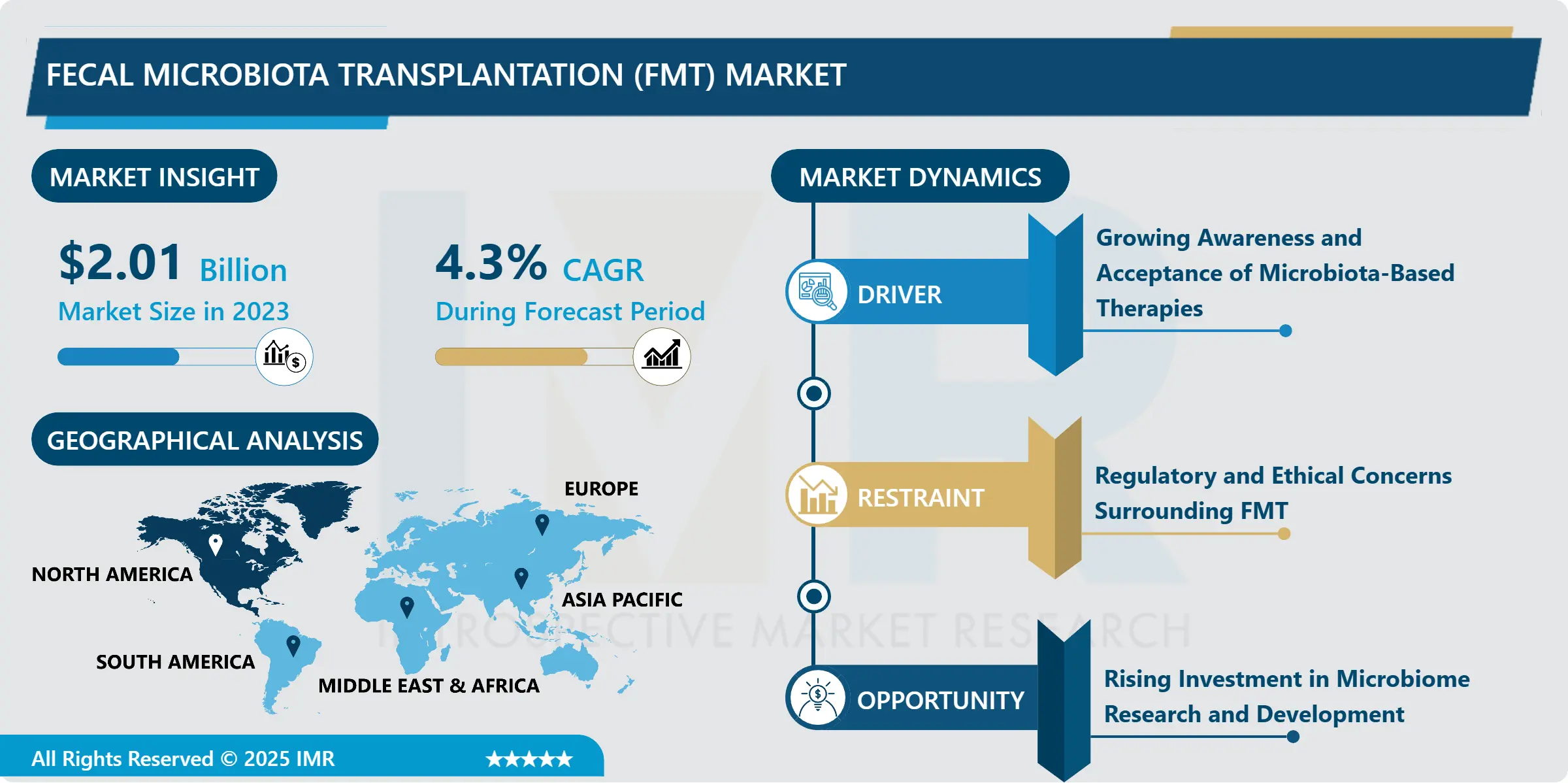
Fecal Microbiota Transplantation (FMT) Market Size Was Valued at USD 2.01 Billion in 2023, and is Projected to Reach USD 2.94 Billion by 2032, Growing at a CAGR of 4.3% From 2024-2032

IMR Group
Description
Fecal Microbiota Transplantation (FMT) Market Synopsis:
Fecal Microbiota Transplantation (FMT) Market Size Was Valued at USD 2.01 Billion in 2023, and is Projected to Reach USD 2.94 Billion by 2032, Growing at a CAGR of 4.3% From 2024-2032
Fecal Microbiota Transplantation (FMT) is the procedure whereby fecal material from a healthy donor is put into the GI tract of a patient to redress the imbalance in gut microbes. It is mainly prescribed for Clostridium difficile infection (CDI) and other gastrointestinal diseases to restore the healthy state of the gut and consequently reduce the death rate among patients.
The increasing number of gastrointestinal diseases worldwide, and more notably, C.diff infections is one of the main factors driving the FMT market. A rare condition of life-threatening Clostridium difficile-associated diarrhea hence, also known as antibiotic-associated colitis has seen a rise in the use of FMT as a treatment. FMT is widely used for recurrent CDI and has also been used in other conditions like IBD, which is why it has emerging markets. The slow shift in consumer demand towards fecal microbiota therapy along with the public’s or patient’s upgraded recognition on FMT has also boosted the market demand among the healthcare providers.
Recent findings on FMT including the use of the dried and encapsulated fecal matter have enhance the viability, availability and effectiveness of the treatment. Through these technologies, FMT has been made safer and effective to patients who may otherwise have problems with methods such as colonoscopy. As FMT grows on as a technique, possibilities of its applicability in other form of gastrointestinal maladies apart from CDI such as IBS and IBD has emerged an added factor in the growth of the market.
Fecal Microbiota Transplantation (FMT) Market Trend Analysis
Increasing adoption of non-invasive administration methods
The FMT market is shifting from invasive administration channels like trans-oral capsule and enema delivery which is improving patient satisfaction and extends the opportunity for the treatment’s application. This trend is also observed due to the increasing need for the noninvasive, and time and cost-effective modality as compare to the colonoscopy directed FMT. This is also true for lyophilized and frozen fecal material because substantial variation in the results and the need for quality treatment are also present in these kinds of FMT.
The efficiency of microbiota-based therapies, the task is being set to develop personalized therapy, which could fully consider the state of the patient’s microbiome. This trend fits into the new wave of precision medicine which seeks to bring more personalized treatment options. As FMT diversifies its applicability across different types of chronic and infectious gastrointestinal disease management in the future, the advances in microbiome-based therapies are anticipated to be the key driving force of the market’s growth.
The increasing global prevalence of gastrointestinal diseases
The acquisition of gastrointestinal diseases across the world means that their FMT market has a large potential. Owing to increasing incidence of CDI and increasing awareness of the efficacy of FMT, this therapy should become increasingly used in commonplace clinical care. And, with FMT expanding its prospects as a therapy for other illnesses, like IBD, IBS, or obesity, new market opportunities are being created. Authorities are also getting more open towards FMT as a reasonable therapeutic modality that may potentially create better market assimilation and approaches to reimbursement.
Many advancements including stool banks as well as automated preparation methods are to enhance the viability and affordability of FMT. Furthermore, growth in research and development expenditures for microbiome is expected to generate novel uses for FMT, grow market volume. Another clear indication of future growth prospects of FMT is the increasing attraction of pharmaceutical companies to microbiome-based interventions.
Fecal Microbiota Transplantation (FMT) Market Segment Analysis:
Fecal Microbiota Transplantation (FMT) Market Segmented on the basis of Product Type, Application, End User, and Region
By Product Type, Frozen FMT segment is expected to dominate the market during the forecast period
The Frozen Fecal Microbiota Transplantation (FMT) segment is projected to maintain a strong market position through the forecast period, due to its higher stability and easier transportation and storage capabilities. The demand for frozen FMT has surged as healthcare providers seek reliable, long-term solutions for managing gastrointestinal diseases like Clostridium difficile infections and inflammatory bowel diseases. The ability to store and distribute frozen samples enhances their appeal, especially in remote or underserved regions, where access to fresh samples may be limited.
As the healthcare sector increasingly recognizes the therapeutic benefits of FMT, the market for this treatment modality continues to expand. The frozen segment is expected to cater to the rising demand from hospitals and clinics globally, where cost-effectiveness and logistical convenience are key considerations. In this evolving landscape, advancements in cryopreservation technologies are expected to further boost the adoption of frozen FMT treatments across a broader patient base.
By Application, Clostridium difficile Infection (CDI) segment expected to held the largest share
Clostridium difficile Infection (CDI) remains a major concern in healthcare due to its increasing prevalence and the challenges it poses in terms of treatment and patient outcomes. As the number of CDI cases continues to rise, demand for effective therapeutic solutions is expanding. Fecal Microbiota Transplantation (FMT) is emerging as a preferred treatment modality for recurrent CDI, offering a promising alternative to traditional antibiotic regimens. The market for FMT is growing as healthcare providers recognize its potential to reduce relapse rates and improve patient recovery times.
The FMT market is benefiting from evolving regulatory frameworks and rising awareness about its benefits in treating recurrent CDI. This growth is supported by ongoing clinical trials and the approval of new treatment protocols. As healthcare systems focus on improving patient outcomes and reducing the economic burden of recurrent infections, the adoption of FMT is poised to increase, strengthening its position in the broader infectious disease treatment landscape.
Fecal Microbiota Transplantation (FMT) Market Regional Insights:
North America is Expected to Dominate the Market Over the Forecast period
North America hold largest market share in Fecal Microbiota Transplantation (FMT) market because, a large number of people are suffering from gastrointestinal diseases such as CDI along with the advancement in healthcare technology and medical research area. In the global market, especially the United States, has given a strategic leadership in the research and development of FMT, contributing to market development. Also, higher incidences of CDI and improved accesses to regulatory approvals for the costs practical applications of FMT will further enhance health care in North America.
The further approval of FMT products, as well as continued growth in the number of clinical trials and further developments in the field of microbiome, prescribes the further growth of the market in North America. This is in the view of key healthcare organizations that include healthcare organizations in the area as well as advancement in the need for effective treatment in long-term gastrointestinal diseases. That said, as the adoption of FMT continues to grow, North America is projected to be the biggest market in the long run.
Active Key Players in the Fecal Microbiota Transplantation (FMT) Market
BiomeBank (Australia)
Evolve Biosystems (USA)
Ferring Pharmaceuticals (Switzerland)
Medinet (Japan)
Microbiotica (UK)
OpenBiome (USA)
Rebiotix (USA)
Seres Therapeutics (USA)
Summit Therapeutics (UK)
Vedanta Biosciences (USA)
Other Active Players
Chapter 1: Introduction
1.1 Scope and Coverage
Chapter 2:Executive Summary
Chapter 3: Market Landscape
3.1 Market Dynamics
3.1.1 Drivers
3.1.2 Restraints
3.1.3 Opportunities
3.1.4 Challenges
3.2 Market Trend Analysis
3.3 PESTLE Analysis
3.4 Porter’s Five Forces Analysis
3.5 Industry Value Chain Analysis
3.6 Ecosystem
3.7 Regulatory Landscape
3.8 Price Trend Analysis
3.9 Patent Analysis
3.10 Technology Evolution
3.11 Investment Pockets
3.12 Import-Export Analysis
Chapter 4: Fecal Microbiota Transplantation (FMT) Market by Product Type
4.1 Fecal Microbiota Transplantation (FMT) Market Snapshot and Growth Engine
4.2 Fecal Microbiota Transplantation (FMT) Market Overview
4.3 Frozen FMT
4.3.1 Introduction and Market Overview
4.3.2 Historic and Forecasted Market Size in Value USD and Volume Units (2017-2032F)
4.3.3 Key Market Trends, Growth Factors and Opportunities
4.3.4 Frozen FMT: Geographic Segmentation Analysis
4.4 Lyophilized FMT
4.4.1 Introduction and Market Overview
4.4.2 Historic and Forecasted Market Size in Value USD and Volume Units (2017-2032F)
4.4.3 Key Market Trends, Growth Factors and Opportunities
4.4.4 Lyophilized FMT: Geographic Segmentation Analysis
4.5 Fresh FMT
4.5.1 Introduction and Market Overview
4.5.2 Historic and Forecasted Market Size in Value USD and Volume Units (2017-2032F)
4.5.3 Key Market Trends, Growth Factors and Opportunities
4.5.4 Fresh FMT: Geographic Segmentation Analysis
Chapter 5: Fecal Microbiota Transplantation (FMT) Market by Application
5.1 Fecal Microbiota Transplantation (FMT) Market Snapshot and Growth Engine
5.2 Fecal Microbiota Transplantation (FMT) Market Overview
5.3 Clostridium difficile Infection (CDI)
5.3.1 Introduction and Market Overview
5.3.2 Historic and Forecasted Market Size in Value USD and Volume Units (2017-2032F)
5.3.3 Key Market Trends, Growth Factors and Opportunities
5.3.4 Clostridium difficile Infection (CDI): Geographic Segmentation Analysis
5.4 Inflammatory Bowel
5.4.1 Introduction and Market Overview
5.4.2 Historic and Forecasted Market Size in Value USD and Volume Units (2017-2032F)
5.4.3 Key Market Trends, Growth Factors and Opportunities
5.4.4 Inflammatory Bowel : Geographic Segmentation Analysis
Chapter 6: Fecal Microbiota Transplantation (FMT) Market by Disease
6.1 Fecal Microbiota Transplantation (FMT) Market Snapshot and Growth Engine
6.2 Fecal Microbiota Transplantation (FMT) Market Overview
6.3 IBD
6.3.1 Introduction and Market Overview
6.3.2 Historic and Forecasted Market Size in Value USD and Volume Units (2017-2032F)
6.3.3 Key Market Trends, Growth Factors and Opportunities
6.3.4 IBD: Geographic Segmentation Analysis
6.4 bowel syndrome (IBS)
6.4.1 Introduction and Market Overview
6.4.2 Historic and Forecasted Market Size in Value USD and Volume Units (2017-2032F)
6.4.3 Key Market Trends, Growth Factors and Opportunities
6.4.4 bowel syndrome (IBS): Geographic Segmentation Analysis
6.5 Others
6.5.1 Introduction and Market Overview
6.5.2 Historic and Forecasted Market Size in Value USD and Volume Units (2017-2032F)
6.5.3 Key Market Trends, Growth Factors and Opportunities
6.5.4 Others: Geographic Segmentation Analysis
Chapter 7: Fecal Microbiota Transplantation (FMT) Market by End User
7.1 Fecal Microbiota Transplantation (FMT) Market Snapshot and Growth Engine
7.2 Fecal Microbiota Transplantation (FMT) Market Overview
7.3 Hospitals
7.3.1 Introduction and Market Overview
7.3.2 Historic and Forecasted Market Size in Value USD and Volume Units (2017-2032F)
7.3.3 Key Market Trends, Growth Factors and Opportunities
7.3.4 Hospitals: Geographic Segmentation Analysis
7.4 Specialty Clinics
7.4.1 Introduction and Market Overview
7.4.2 Historic and Forecasted Market Size in Value USD and Volume Units (2017-2032F)
7.4.3 Key Market Trends, Growth Factors and Opportunities
7.4.4 Specialty Clinics: Geographic Segmentation Analysis
7.5 Academic and Research Institutions
7.5.1 Introduction and Market Overview
7.5.2 Historic and Forecasted Market Size in Value USD and Volume Units (2017-2032F)
7.5.3 Key Market Trends, Growth Factors and Opportunities
7.5.4 Academic and Research Institutions: Geographic Segmentation Analysis
Chapter 8: Company Profiles and Competitive Analysis
8.1 Competitive Landscape
8.1.1 Competitive Benchmarking
8.1.2 Fecal Microbiota Transplantation (FMT) Market Share by Manufacturer (2023)
8.1.3 Industry BCG Matrix
8.1.4 Heat Map Analysis
8.1.5 Mergers and Acquisitions
8.2 REBIOTIX (USA)
8.2.1 Company Overview
8.2.2 Key Executives
8.2.3 Company Snapshot
8.2.4 Role of the Company in the Market
8.2.5 Sustainability and Social Responsibility
8.2.6 Operating Business Segments
8.2.7 Product Portfolio
8.2.8 Business Performance
8.2.9 Key Strategic Moves and Recent Developments
8.2.10 SWOT Analysis
8.3 OPENBIOME (USA)
8.4 FERRING PHARMACEUTICALS (SWITZERLAND)
8.5 MICROBIOTICA (UK)
8.6 SERES THERAPEUTICS (USA)
8.7 EVOLVE BIOSYSTEMS (USA)
8.8 VEDANTA BIOSCIENCES (USA)
8.9 SUMMIT THERAPEUTICS (UK)
8.10 MEDINET (JAPAN)
8.11 BIOMEBANK (AUSTRALIA)
8.12 OTHER ACTIVE PLAYERS
Chapter 9: Global Fecal Microbiota Transplantation (FMT) Market By Region
9.1 Overview
9.2. North America Fecal Microbiota Transplantation (FMT) Market
9.2.1 Key Market Trends, Growth Factors and Opportunities
9.2.2 Top Key Companies
9.2.3 Historic and Forecasted Market Size by Segments
9.2.4 Historic and Forecasted Market Size By Product Type
9.2.4.1 Frozen FMT
9.2.4.2 Lyophilized FMT
9.2.4.3 Fresh FMT
9.2.5 Historic and Forecasted Market Size By Application
9.2.5.1 Clostridium difficile Infection (CDI)
9.2.5.2 Inflammatory Bowel
9.2.6 Historic and Forecasted Market Size By Disease
9.2.6.1 IBD
9.2.6.2 bowel syndrome (IBS)
9.2.6.3 Others
9.2.7 Historic and Forecasted Market Size By End User
9.2.7.1 Hospitals
9.2.7.2 Specialty Clinics
9.2.7.3 Academic and Research Institutions
9.2.8 Historic and Forecast Market Size by Country
9.2.8.1 US
9.2.8.2 Canada
9.2.8.3 Mexico
9.3. Eastern Europe Fecal Microbiota Transplantation (FMT) Market
9.3.1 Key Market Trends, Growth Factors and Opportunities
9.3.2 Top Key Companies
9.3.3 Historic and Forecasted Market Size by Segments
9.3.4 Historic and Forecasted Market Size By Product Type
9.3.4.1 Frozen FMT
9.3.4.2 Lyophilized FMT
9.3.4.3 Fresh FMT
9.3.5 Historic and Forecasted Market Size By Application
9.3.5.1 Clostridium difficile Infection (CDI)
9.3.5.2 Inflammatory Bowel
9.3.6 Historic and Forecasted Market Size By Disease
9.3.6.1 IBD
9.3.6.2 bowel syndrome (IBS)
9.3.6.3 Others
9.3.7 Historic and Forecasted Market Size By End User
9.3.7.1 Hospitals
9.3.7.2 Specialty Clinics
9.3.7.3 Academic and Research Institutions
9.3.8 Historic and Forecast Market Size by Country
9.3.8.1 Russia
9.3.8.2 Bulgaria
9.3.8.3 The Czech Republic
9.3.8.4 Hungary
9.3.8.5 Poland
9.3.8.6 Romania
9.3.8.7 Rest of Eastern Europe
9.4. Western Europe Fecal Microbiota Transplantation (FMT) Market
9.4.1 Key Market Trends, Growth Factors and Opportunities
9.4.2 Top Key Companies
9.4.3 Historic and Forecasted Market Size by Segments
9.4.4 Historic and Forecasted Market Size By Product Type
9.4.4.1 Frozen FMT
9.4.4.2 Lyophilized FMT
9.4.4.3 Fresh FMT
9.4.5 Historic and Forecasted Market Size By Application
9.4.5.1 Clostridium difficile Infection (CDI)
9.4.5.2 Inflammatory Bowel
9.4.6 Historic and Forecasted Market Size By Disease
9.4.6.1 IBD
9.4.6.2 bowel syndrome (IBS)
9.4.6.3 Others
9.4.7 Historic and Forecasted Market Size By End User
9.4.7.1 Hospitals
9.4.7.2 Specialty Clinics
9.4.7.3 Academic and Research Institutions
9.4.8 Historic and Forecast Market Size by Country
9.4.8.1 Germany
9.4.8.2 UK
9.4.8.3 France
9.4.8.4 The Netherlands
9.4.8.5 Italy
9.4.8.6 Spain
9.4.8.7 Rest of Western Europe
9.5. Asia Pacific Fecal Microbiota Transplantation (FMT) Market
9.5.1 Key Market Trends, Growth Factors and Opportunities
9.5.2 Top Key Companies
9.5.3 Historic and Forecasted Market Size by Segments
9.5.4 Historic and Forecasted Market Size By Product Type
9.5.4.1 Frozen FMT
9.5.4.2 Lyophilized FMT
9.5.4.3 Fresh FMT
9.5.5 Historic and Forecasted Market Size By Application
9.5.5.1 Clostridium difficile Infection (CDI)
9.5.5.2 Inflammatory Bowel
9.5.6 Historic and Forecasted Market Size By Disease
9.5.6.1 IBD
9.5.6.2 bowel syndrome (IBS)
9.5.6.3 Others
9.5.7 Historic and Forecasted Market Size By End User
9.5.7.1 Hospitals
9.5.7.2 Specialty Clinics
9.5.7.3 Academic and Research Institutions
9.5.8 Historic and Forecast Market Size by Country
9.5.8.1 China
9.5.8.2 India
9.5.8.3 Japan
9.5.8.4 South Korea
9.5.8.5 Malaysia
9.5.8.6 Thailand
9.5.8.7 Vietnam
9.5.8.8 The Philippines
9.5.8.9 Australia
9.5.8.10 New Zealand
9.5.8.11 Rest of APAC
9.6. Middle East & Africa Fecal Microbiota Transplantation (FMT) Market
9.6.1 Key Market Trends, Growth Factors and Opportunities
9.6.2 Top Key Companies
9.6.3 Historic and Forecasted Market Size by Segments
9.6.4 Historic and Forecasted Market Size By Product Type
9.6.4.1 Frozen FMT
9.6.4.2 Lyophilized FMT
9.6.4.3 Fresh FMT
9.6.5 Historic and Forecasted Market Size By Application
9.6.5.1 Clostridium difficile Infection (CDI)
9.6.5.2 Inflammatory Bowel
9.6.6 Historic and Forecasted Market Size By Disease
9.6.6.1 IBD
9.6.6.2 bowel syndrome (IBS)
9.6.6.3 Others
9.6.7 Historic and Forecasted Market Size By End User
9.6.7.1 Hospitals
9.6.7.2 Specialty Clinics
9.6.7.3 Academic and Research Institutions
9.6.8 Historic and Forecast Market Size by Country
9.6.8.1 Turkiye
9.6.8.2 Bahrain
9.6.8.3 Kuwait
9.6.8.4 Saudi Arabia
9.6.8.5 Qatar
9.6.8.6 UAE
9.6.8.7 Israel
9.6.8.8 South Africa
9.7. South America Fecal Microbiota Transplantation (FMT) Market
9.7.1 Key Market Trends, Growth Factors and Opportunities
9.7.2 Top Key Companies
9.7.3 Historic and Forecasted Market Size by Segments
9.7.4 Historic and Forecasted Market Size By Product Type
9.7.4.1 Frozen FMT
9.7.4.2 Lyophilized FMT
9.7.4.3 Fresh FMT
9.7.5 Historic and Forecasted Market Size By Application
9.7.5.1 Clostridium difficile Infection (CDI)
9.7.5.2 Inflammatory Bowel
9.7.6 Historic and Forecasted Market Size By Disease
9.7.6.1 IBD
9.7.6.2 bowel syndrome (IBS)
9.7.6.3 Others
9.7.7 Historic and Forecasted Market Size By End User
9.7.7.1 Hospitals
9.7.7.2 Specialty Clinics
9.7.7.3 Academic and Research Institutions
9.7.8 Historic and Forecast Market Size by Country
9.7.8.1 Brazil
9.7.8.2 Argentina
9.7.8.3 Rest of SA
Chapter 10 Analyst Viewpoint and Conclusion
10.1 Recommendations and Concluding Analysis
10.2 Potential Market Strategies
Chapter 11 Research Methodology
11.1 Research Process
11.2 Primary Research
11.3 Secondary Research
Q1: What would be the forecast period in the Fecal Microbiota Transplantation (FMT) Market research report?
A1: The forecast period in the Fecal Microbiota Transplantation (FMT) Market research report is 2024-2032.
Q2: Who are the key players in the Fecal Microbiota Transplantation (FMT) Market?
A2: •Rebiotix (USA), OpenBiome (USA), Ferring Pharmaceuticals (Switzerland), Microbiotica (UK), Seres Therapeutics (USA), Evolve Biosystems (USA), Vedanta Biosciences (USA), Summit Therapeutics (UK), Medinet (Japan), BiomeBank (Australia), and Other Active Players.
Q3: What are the segments of the Fecal Microbiota Transplantation (FMT) Market?
A3: The Fecal Microbiota Transplantation (FMT) Market is segmented by Product Type (Frozen FMT, Lyophilized FMT, Fresh FMT), Application (Clostridium difficile Infection (CDI), Inflammatory Bowel Disease (IBD), irritable bowel syndrome (IBS), Others), End User (Hospitals, Specialty Clinics, Academic and Research Institutions). By region, it is analyzed across North America (U.S., Canada, Mexico),Eastern Europe (Russia, Bulgaria, The Czech Republic, Hungary, Poland, Romania, Rest of Eastern Europe),Western Europe (Germany, UK, France, Netherlands, Italy, Spain, Rest of Western Europe), Asia Pacific (China, India, Japan, South Korea, Malaysia, Thailand, Vietnam, The Philippines, Australia, New-Zealand, Rest of APAC), Middle East & Africa (Turkiye, Bahrain, Kuwait, Saudi Arabia, Qatar, UAE, Israel, South Africa), South America (Brazil, Argentina, Rest of SA).
Q4: What is the Fecal Microbiota Transplantation (FMT) Market?
A4: Fecal Microbiota Transplantation (FMT) is the procedure whereby fecal material from a healthy donor is put into the GI tract of a patient to redress the imbalance in gut microbes. It is mainly prescribed for Clostridium difficile infection (CDI) and other gastrointestinal diseases to restore the healthy state of the gut and consequently reduce the death rate among patients.
Q5: How big is the Fecal Microbiota Transplantation (FMT) Market?
A5: Fecal Microbiota Transplantation (FMT) Market Size Was Valued at USD 2.01 Billion in 2023, and is Projected to Reach USD 2.94 Billion by 2032, Growing at a CAGR of 4.3% From 2024-2032
How to Buy a Report from eminsights.jp
On the product page, choose the license you want: Single-User License, Multi-User License or Enterprise License.
If you required report in your native language, then you can click on Translated Report button and fill out the form with report name and language you want, then our team will contact you as soon as possible.
Click the Buy Now button.
You will be redirected to the checkout page. Enter your company details and payment information.
Click Place Order to complete the purchase.
Confirmation: You’ll receive an order confirmation and our team will contact you shortly with your ordered report.
If you have any questions, fill out the contact form below or email us at bizdev@eminsights.net.
Thank you for choosing eminsights.jp!