Stay Ahead in Fast-Growing Economies.
Browse Reports Now
Facial Recognition Market Size, Trends, and Forecast Analysis (2024-2032)
Facial recognition is a type of biometric that analyze the facial structure and compare the obtained data with an image or a video of the individual to authenticate him/her.

IMR Group
Description
Facial Recognition Market Synopsis:
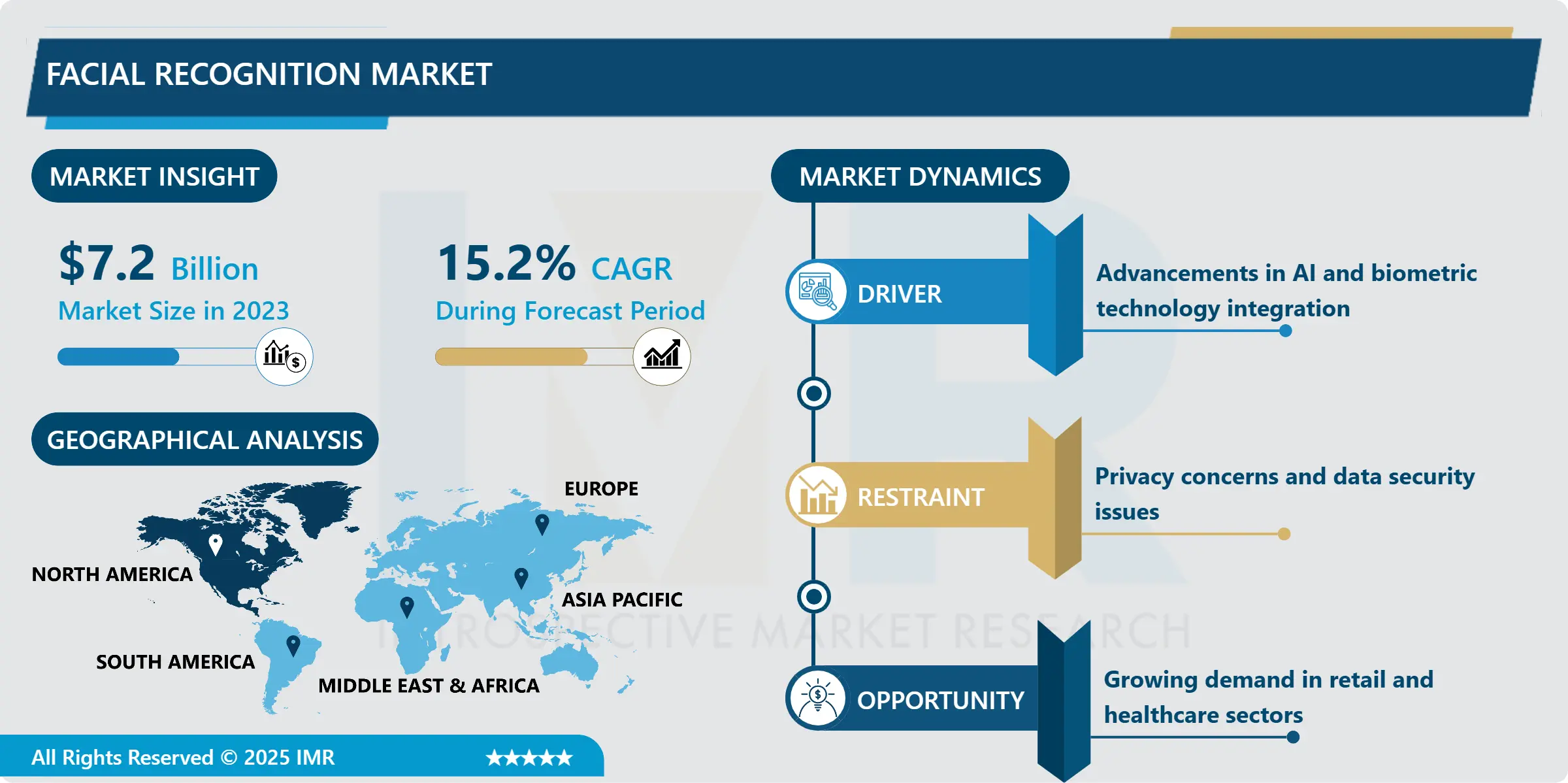
Facial Recognition Market Size Was Valued at USD 7.2 Billion in 2023, and is Projected to Reach USD 25.73 Billion by 2032, Growing at a CAGR of 15.2% From 2024-2032.
Facial recognition is a type of biometric that analyze the facial structure and compare the obtained data with an image or a video of the individual to authenticate him/her. Using algorithms and specifically machine learning it maps facial structures into a data format for comparison with databases for near-instantaneous identification in real-time or post event scenario. It covers varieties of sectors like security, law enforcement, healthcare, retail, and banking due to its accuracy and fast results as well as the elasticity for scaling up. The demand of facial recognition grows globally because governments and organizations use it for surveillance, fraud prevention, and identification.
Successful advancement has been observed in the facial recognition market owing to enhancement in machine learning and artificial intelligence. Increased demand for security, both personal and organizational, has greatly enhanced the overall use of the technology. Some of the applications of this technology includes: Governments employ this technology for surveillance of the public areas and security of the nation; enterprises employ the technology to identify customers and check out for frauds. Facial recognition technology has now extended beyond simple usage as a biometric security feature for passports, and has been integrated into smartphones, smart devices, and many more, thus becoming a routine in our lives.
The market is also driven by the growing investments in AI solutions and the growing need for the automation of processes by several industries. The integration of facial recognition with IoT and cloud computing has extended the utility of the technology making possible deployment in various large networks. Privacy, tampering with data, as well as privacy violation and misuse are, therefore, important factors of concern. These issues are currently being addressed by new rules and regulations and formal ethical codes across the world.
Facial Recognition Market Trend Analysis:
AI-Powered Facial Recognition
The best example of the integration of artificial intelligence and facial recognition technology is that the new neural networks of deep learning are changing the market. Technological advancements helps to improve the facial recognition software and their capabilities, and that AI can analyse data in real-time.
In emerging capabilities for solutions in implementing and sensing facial recognition solutions for detecting emotions, expressions and even behaviors. Healthcare is looking at it in the realms of diagnosis and more importantly in patient management, and retail as an industry is using it to bring customized shopping experiences. It is seen that as AI advances the integration with facial recognition will further emerge novel functionalities and use cases.
Rising Adoption in Retail and Healthcare
The application sector that sheds light on potential of the facial recognition market includes retail and healthcare sector. In retail, such as facial recognition deals with the return customer and taking into account the specifics of the purchasing activity. This makes customer engagement better and results in sales.
In the healthcare sector, it employs the technology for patient identification, secure areas access as well as emotional recognition for diagnosis. These applications guide illustrate how the technology holds great promise for enhancing the consumers’ experiences and organisational effectiveness in these industry segments, thereby constituting promising business development opportunities for the market.
Facial Recognition Market Segment Analysis:
Facial Recognition Market Segmented on the basis of Technology, Application, End User, and Region
By Technology, 3D segment is expected to dominate the market during the forecast period
Analysis of the current market trends along with the expected future trends reveals that the 3D facial recognition technology is likely to account for the greatest proportion of the global market over the forecast period owing to the increased dependability on 3D over 2D technology enabled recognition systems. Benefitting from its ability to take measure of the depth and contour of a face, 3D systems are capable of recognizing a person in different lighting conditions as well as physical orientation; this essentially makes them ideal for use in security and surveillance. Further, the development of the 3D imaging sensor and the AI algorithm has increased the use of this technology in smartphones and other biometrics.
The newly emerging need for reliable methods of identification and the expansion of high-quality 3D facial recognition in the spheres of banking services, governments, and enterprises are adding to the development of new technologies. Because of this factor it has been deemed to minimize false positive, a factor that has made it to be accepted widely in sensitive applications. Among all these industries, it is anticipated that 3D technology will be sought after by industries in search for high-end solutions to meet challenging security demands.
By Application, Emotion Recognition segment expected to held the largest share
Based on the application, emotion recognition, which employs facial recognition, is anticipated to account for the largest market share because of its vast applications in marketing, healthcare, education, etc. In the corporate world, technology such as emotion recognition from the face aids an organization in identifying the feeling of its customers, so as to meet their needs. In health care, it is used in mental health diagnosis and treatment to recognize feelings.
The expansion of the entertainment industry is also attributed to the gradual use of emotion recognition in interactive and game gaming and analyzing the audience. Indeed, with the development of artificial intelligence and machine learning, emotion recognition systems have become more accurate and carry out real-time analysis, which causes their demand to grow worldwide.
Facial Recognition Market Regional Insights:
North America is Expected to Dominate the Market Over the Forecast period
North America is poised to lead the growth of the Facial Recognition Market, with expanding applications across security, retail, and healthcare sectors. The increasing adoption of AI-driven technologies for surveillance, identity verification, and fraud detection has created a demand for sophisticated facial recognition systems. This trend is further supported by government initiatives aiming to improve national security and streamline processes across various industries.
The market’s growth is fueled by the rising need for advanced authentication mechanisms in both private and public sectors. Organizations are increasingly deploying facial recognition for enhanced customer experience, automated access control, and safety measures. The region’s strong technological infrastructure, coupled with a favorable regulatory environment, plays a pivotal role in accelerating the integration of facial recognition systems. As consumer awareness of biometric security increases, the market is set to experience rapid expansion in North America.
Active Key Players in the Facial Recognition Market
Amazon Web Services (USA)
Apple Inc. (USA)
Aware Inc. (USA)
Cognitec Systems (Germany)
Fujitsu Limited (Japan)
Google LLC (USA)
IBM Corporation (USA)
IDEMIA (France)
Intel Corporation (USA)
NEC Corporation (Japan)
Microsoft Corporation (USA)
Panasonic Corporation (Japan)
SAFR (RealNetworks, Inc.) (USA)
Thales Group (France)
Trueface (USA)
Other Active Players
Chapter 1: Introduction
1.1 Scope and Coverage
Chapter 2:Executive Summary
Chapter 3: Market Landscape
3.1 Market Dynamics
3.1.1 Drivers
3.1.2 Restraints
3.1.3 Opportunities
3.1.4 Challenges
3.2 Market Trend Analysis
3.3 PESTLE Analysis
3.4 Porter’s Five Forces Analysis
3.5 Industry Value Chain Analysis
3.6 Ecosystem
3.7 Regulatory Landscape
3.8 Price Trend Analysis
3.9 Patent Analysis
3.10 Technology Evolution
3.11 Investment Pockets
3.12 Import-Export Analysis
Chapter 4: Facial Recognition Market by Technology
4.1 Facial Recognition Market Snapshot and Growth Engine
4.2 Facial Recognition Market Overview
4.3 2D
4.3.1 Introduction and Market Overview
4.3.2 Historic and Forecasted Market Size in Value USD and Volume Units (2017-2032F)
4.3.3 Key Market Trends, Growth Factors and Opportunities
4.3.4 2D: Geographic Segmentation Analysis
4.4 3D
4.4.1 Introduction and Market Overview
4.4.2 Historic and Forecasted Market Size in Value USD and Volume Units (2017-2032F)
4.4.3 Key Market Trends, Growth Factors and Opportunities
4.4.4 3D: Geographic Segmentation Analysis
4.5 Facial Analytics
4.5.1 Introduction and Market Overview
4.5.2 Historic and Forecasted Market Size in Value USD and Volume Units (2017-2032F)
4.5.3 Key Market Trends, Growth Factors and Opportunities
4.5.4 Facial Analytics: Geographic Segmentation Analysis
Chapter 5: Facial Recognition Market by Application
5.1 Facial Recognition Market Snapshot and Growth Engine
5.2 Facial Recognition Market Overview
5.3 Emotion Recognition
5.3.1 Introduction and Market Overview
5.3.2 Historic and Forecasted Market Size in Value USD and Volume Units (2017-2032F)
5.3.3 Key Market Trends, Growth Factors and Opportunities
5.3.4 Emotion Recognition: Geographic Segmentation Analysis
5.4 Attendance Tracking and Monitoring
5.4.1 Introduction and Market Overview
5.4.2 Historic and Forecasted Market Size in Value USD and Volume Units (2017-2032F)
5.4.3 Key Market Trends, Growth Factors and Opportunities
5.4.4 Attendance Tracking and Monitoring: Geographic Segmentation Analysis
5.5 Access Control
5.5.1 Introduction and Market Overview
5.5.2 Historic and Forecasted Market Size in Value USD and Volume Units (2017-2032F)
5.5.3 Key Market Trends, Growth Factors and Opportunities
5.5.4 Access Control: Geographic Segmentation Analysis
5.6 Security & Surveillance
5.6.1 Introduction and Market Overview
5.6.2 Historic and Forecasted Market Size in Value USD and Volume Units (2017-2032F)
5.6.3 Key Market Trends, Growth Factors and Opportunities
5.6.4 Security & Surveillance: Geographic Segmentation Analysis
5.7 Others
5.7.1 Introduction and Market Overview
5.7.2 Historic and Forecasted Market Size in Value USD and Volume Units (2017-2032F)
5.7.3 Key Market Trends, Growth Factors and Opportunities
5.7.4 Others: Geographic Segmentation Analysis
Chapter 6: Facial Recognition Market by End User
6.1 Facial Recognition Market Snapshot and Growth Engine
6.2 Facial Recognition Market Overview
6.3 Retail & E-commerce
6.3.1 Introduction and Market Overview
6.3.2 Historic and Forecasted Market Size in Value USD and Volume Units (2017-2032F)
6.3.3 Key Market Trends, Growth Factors and Opportunities
6.3.4 Retail & E-commerce: Geographic Segmentation Analysis
6.4 Media & Entertainment
6.4.1 Introduction and Market Overview
6.4.2 Historic and Forecasted Market Size in Value USD and Volume Units (2017-2032F)
6.4.3 Key Market Trends, Growth Factors and Opportunities
6.4.4 Media & Entertainment: Geographic Segmentation Analysis
6.5 BFSI
6.5.1 Introduction and Market Overview
6.5.2 Historic and Forecasted Market Size in Value USD and Volume Units (2017-2032F)
6.5.3 Key Market Trends, Growth Factors and Opportunities
6.5.4 BFSI: Geographic Segmentation Analysis
6.6 Automobile & Transportation
6.6.1 Introduction and Market Overview
6.6.2 Historic and Forecasted Market Size in Value USD and Volume Units (2017-2032F)
6.6.3 Key Market Trends, Growth Factors and Opportunities
6.6.4 Automobile & Transportation: Geographic Segmentation Analysis
6.7 Telecom & IT
6.7.1 Introduction and Market Overview
6.7.2 Historic and Forecasted Market Size in Value USD and Volume Units (2017-2032F)
6.7.3 Key Market Trends, Growth Factors and Opportunities
6.7.4 Telecom & IT: Geographic Segmentation Analysis
6.8 Government
6.8.1 Introduction and Market Overview
6.8.2 Historic and Forecasted Market Size in Value USD and Volume Units (2017-2032F)
6.8.3 Key Market Trends, Growth Factors and Opportunities
6.8.4 Government: Geographic Segmentation Analysis
6.9 Healthcare
6.9.1 Introduction and Market Overview
6.9.2 Historic and Forecasted Market Size in Value USD and Volume Units (2017-2032F)
6.9.3 Key Market Trends, Growth Factors and Opportunities
6.9.4 Healthcare: Geographic Segmentation Analysis
6.10 Others
6.10.1 Introduction and Market Overview
6.10.2 Historic and Forecasted Market Size in Value USD and Volume Units (2017-2032F)
6.10.3 Key Market Trends, Growth Factors and Opportunities
6.10.4 Others: Geographic Segmentation Analysis
Chapter 7: Company Profiles and Competitive Analysis
7.1 Competitive Landscape
7.1.1 Competitive Benchmarking
7.1.2 Facial Recognition Market Share by Manufacturer (2023)
7.1.3 Industry BCG Matrix
7.1.4 Heat Map Analysis
7.1.5 Mergers and Acquisitions
7.2 AMAZON WEB SERVICES (USA)
7.2.1 Company Overview
7.2.2 Key Executives
7.2.3 Company Snapshot
7.2.4 Role of the Company in the Market
7.2.5 Sustainability and Social Responsibility
7.2.6 Operating Business Segments
7.2.7 Product Portfolio
7.2.8 Business Performance
7.2.9 Key Strategic Moves and Recent Developments
7.2.10 SWOT Analysis
7.3 APPLE INC. (USA)
7.4 AWARE INC. (USA)
7.5 COGNITEC SYSTEMS (GERMANY)
7.6 FUJITSU LIMITED (JAPAN)
7.7 GOOGLE LLC (USA)
7.8 IBM CORPORATION (USA)
7.9 IDEMIA (FRANCE)
7.10 INTEL CORPORATION (USA)
7.11 NEC CORPORATION (JAPAN)
7.12 MICROSOFT CORPORATION (USA)
7.13 PANASONIC CORPORATION (JAPAN)
7.14 SAFR (REALNETWORKS INC.) (USA)
7.15 THALES GROUP (FRANCE)
7.16 TRUEFACE (USA)
7.17 OTHER ACTIVE PLAYERS
Chapter 8: Global Facial Recognition Market By Region
8.1 Overview
8.2. North America Facial Recognition Market
8.2.1 Key Market Trends, Growth Factors and Opportunities
8.2.2 Top Key Companies
8.2.3 Historic and Forecasted Market Size by Segments
8.2.4 Historic and Forecasted Market Size By Technology
8.2.4.1 2D
8.2.4.2 3D
8.2.4.3 Facial Analytics
8.2.5 Historic and Forecasted Market Size By Application
8.2.5.1 Emotion Recognition
8.2.5.2 Attendance Tracking and Monitoring
8.2.5.3 Access Control
8.2.5.4 Security & Surveillance
8.2.5.5 Others
8.2.6 Historic and Forecasted Market Size By End User
8.2.6.1 Retail & E-commerce
8.2.6.2 Media & Entertainment
8.2.6.3 BFSI
8.2.6.4 Automobile & Transportation
8.2.6.5 Telecom & IT
8.2.6.6 Government
8.2.6.7 Healthcare
8.2.6.8 Others
8.2.7 Historic and Forecast Market Size by Country
8.2.7.1 US
8.2.7.2 Canada
8.2.7.3 Mexico
8.3. Eastern Europe Facial Recognition Market
8.3.1 Key Market Trends, Growth Factors and Opportunities
8.3.2 Top Key Companies
8.3.3 Historic and Forecasted Market Size by Segments
8.3.4 Historic and Forecasted Market Size By Technology
8.3.4.1 2D
8.3.4.2 3D
8.3.4.3 Facial Analytics
8.3.5 Historic and Forecasted Market Size By Application
8.3.5.1 Emotion Recognition
8.3.5.2 Attendance Tracking and Monitoring
8.3.5.3 Access Control
8.3.5.4 Security & Surveillance
8.3.5.5 Others
8.3.6 Historic and Forecasted Market Size By End User
8.3.6.1 Retail & E-commerce
8.3.6.2 Media & Entertainment
8.3.6.3 BFSI
8.3.6.4 Automobile & Transportation
8.3.6.5 Telecom & IT
8.3.6.6 Government
8.3.6.7 Healthcare
8.3.6.8 Others
8.3.7 Historic and Forecast Market Size by Country
8.3.7.1 Russia
8.3.7.2 Bulgaria
8.3.7.3 The Czech Republic
8.3.7.4 Hungary
8.3.7.5 Poland
8.3.7.6 Romania
8.3.7.7 Rest of Eastern Europe
8.4. Western Europe Facial Recognition Market
8.4.1 Key Market Trends, Growth Factors and Opportunities
8.4.2 Top Key Companies
8.4.3 Historic and Forecasted Market Size by Segments
8.4.4 Historic and Forecasted Market Size By Technology
8.4.4.1 2D
8.4.4.2 3D
8.4.4.3 Facial Analytics
8.4.5 Historic and Forecasted Market Size By Application
8.4.5.1 Emotion Recognition
8.4.5.2 Attendance Tracking and Monitoring
8.4.5.3 Access Control
8.4.5.4 Security & Surveillance
8.4.5.5 Others
8.4.6 Historic and Forecasted Market Size By End User
8.4.6.1 Retail & E-commerce
8.4.6.2 Media & Entertainment
8.4.6.3 BFSI
8.4.6.4 Automobile & Transportation
8.4.6.5 Telecom & IT
8.4.6.6 Government
8.4.6.7 Healthcare
8.4.6.8 Others
8.4.7 Historic and Forecast Market Size by Country
8.4.7.1 Germany
8.4.7.2 UK
8.4.7.3 France
8.4.7.4 The Netherlands
8.4.7.5 Italy
8.4.7.6 Spain
8.4.7.7 Rest of Western Europe
8.5. Asia Pacific Facial Recognition Market
8.5.1 Key Market Trends, Growth Factors and Opportunities
8.5.2 Top Key Companies
8.5.3 Historic and Forecasted Market Size by Segments
8.5.4 Historic and Forecasted Market Size By Technology
8.5.4.1 2D
8.5.4.2 3D
8.5.4.3 Facial Analytics
8.5.5 Historic and Forecasted Market Size By Application
8.5.5.1 Emotion Recognition
8.5.5.2 Attendance Tracking and Monitoring
8.5.5.3 Access Control
8.5.5.4 Security & Surveillance
8.5.5.5 Others
8.5.6 Historic and Forecasted Market Size By End User
8.5.6.1 Retail & E-commerce
8.5.6.2 Media & Entertainment
8.5.6.3 BFSI
8.5.6.4 Automobile & Transportation
8.5.6.5 Telecom & IT
8.5.6.6 Government
8.5.6.7 Healthcare
8.5.6.8 Others
8.5.7 Historic and Forecast Market Size by Country
8.5.7.1 China
8.5.7.2 India
8.5.7.3 Japan
8.5.7.4 South Korea
8.5.7.5 Malaysia
8.5.7.6 Thailand
8.5.7.7 Vietnam
8.5.7.8 The Philippines
8.5.7.9 Australia
8.5.7.10 New Zealand
8.5.7.11 Rest of APAC
8.6. Middle East & Africa Facial Recognition Market
8.6.1 Key Market Trends, Growth Factors and Opportunities
8.6.2 Top Key Companies
8.6.3 Historic and Forecasted Market Size by Segments
8.6.4 Historic and Forecasted Market Size By Technology
8.6.4.1 2D
8.6.4.2 3D
8.6.4.3 Facial Analytics
8.6.5 Historic and Forecasted Market Size By Application
8.6.5.1 Emotion Recognition
8.6.5.2 Attendance Tracking and Monitoring
8.6.5.3 Access Control
8.6.5.4 Security & Surveillance
8.6.5.5 Others
8.6.6 Historic and Forecasted Market Size By End User
8.6.6.1 Retail & E-commerce
8.6.6.2 Media & Entertainment
8.6.6.3 BFSI
8.6.6.4 Automobile & Transportation
8.6.6.5 Telecom & IT
8.6.6.6 Government
8.6.6.7 Healthcare
8.6.6.8 Others
8.6.7 Historic and Forecast Market Size by Country
8.6.7.1 Turkiye
8.6.7.2 Bahrain
8.6.7.3 Kuwait
8.6.7.4 Saudi Arabia
8.6.7.5 Qatar
8.6.7.6 UAE
8.6.7.7 Israel
8.6.7.8 South Africa
8.7. South America Facial Recognition Market
8.7.1 Key Market Trends, Growth Factors and Opportunities
8.7.2 Top Key Companies
8.7.3 Historic and Forecasted Market Size by Segments
8.7.4 Historic and Forecasted Market Size By Technology
8.7.4.1 2D
8.7.4.2 3D
8.7.4.3 Facial Analytics
8.7.5 Historic and Forecasted Market Size By Application
8.7.5.1 Emotion Recognition
8.7.5.2 Attendance Tracking and Monitoring
8.7.5.3 Access Control
8.7.5.4 Security & Surveillance
8.7.5.5 Others
8.7.6 Historic and Forecasted Market Size By End User
8.7.6.1 Retail & E-commerce
8.7.6.2 Media & Entertainment
8.7.6.3 BFSI
8.7.6.4 Automobile & Transportation
8.7.6.5 Telecom & IT
8.7.6.6 Government
8.7.6.7 Healthcare
8.7.6.8 Others
8.7.7 Historic and Forecast Market Size by Country
8.7.7.1 Brazil
8.7.7.2 Argentina
8.7.7.3 Rest of SA
Chapter 9 Analyst Viewpoint and Conclusion
9.1 Recommendations and Concluding Analysis
9.2 Potential Market Strategies
Chapter 10 Research Methodology
10.1 Research Process
10.2 Primary Research
10.3 Secondary Research
Q1: What would be the forecast period in the Facial Recognition Market research report?
A1: The forecast period in the Facial Recognition Market research report is 2024-2032.
Q2: Who are the key players in the Facial Recognition Market?
A2: Amazon Web Services (USA), Apple Inc. (USA), Aware Inc. (USA), Cognitec Systems (Germany), Fujitsu Limited (Japan), Google LLC (USA), IBM Corporation (USA), IDEMIA (France), Intel Corporation (USA), NEC Corporation (Japan), Microsoft Corporation (USA), Panasonic Corporation (Japan), SAFR (RealNetworks, Inc.) (USA), Thales Group (France), Trueface (USA, and Other Active Players.
Q3: What are the segments of the Facial Recognition Market?
A3: The Facial Recognition Market is segmented into Technology, Application, End User and region. By Technology, the market is categorized into 2D, 3D, and Facial Analytics. By Application, the market is categorized into Emotion Recognition, Attendance Tracking and Monitoring, Access Control, Security & Surveillance, Others. By End User, the market is categorized into Retail & E-commerce, Media & Entertainment, BFSI, Automobile & Transportation, Telecom & IT, Government, Healthcare, and Others. By region, it is analyzed across North America (U.S., Canada, Mexico),Eastern Europe (Russia, Bulgaria, The Czech Republic, Hungary, Poland, Romania, Rest of Eastern Europe),Western Europe (Germany, UK, France, Netherlands, Italy, Spain, Rest of Western Europe), Asia Pacific (China, India, Japan, South Korea, Malaysia, Thailand, Vietnam, The Philippines, Australia, New-Zealand, Rest of APAC), Middle East & Africa (Turkiye, Bahrain, Kuwait, Saudi Arabia, Qatar, UAE, Israel, South Africa), South America (Brazil, Argentina, Rest of SA).
Q4: What is the Facial Recognition Market?
A4: Facial recognition is a type of biometric that analyze the facial structure and compare the obtained data with an image or a video of the individual to authenticate him/her. Using algorithms and specifically machine learning it maps facial structures into a data format for comparison with databases for near-instantaneous identification in real-time or post event scenario. It covers varieties of sectors like security, law enforcement, healthcare, retail, and banking due to its accuracy and fast results as well as the elasticity for scaling up. The demand of facial recognition grows globally because governments and organizations use it for surveillance, fraud prevention, and identification.
Q5: How big is the Facial Recognition Market?
A5: Facial Recognition Market Size Was Valued at USD 7.2 Billion in 2023, and is Projected to Reach USD 25.73 Billion by 2032, Growing at a CAGR of 15.2% From 2024-2032.
How to Buy a Report from eminsights.jp
On the product page, choose the license you want: Single-User License, Multi-User License or Enterprise License.
If you required report in your native language, then you can click on Translated Report button and fill out the form with report name and language you want, then our team will contact you as soon as possible.
Click the Buy Now button.
You will be redirected to the checkout page. Enter your company details and payment information.
Click Place Order to complete the purchase.
Confirmation: You’ll receive an order confirmation and our team will contact you shortly with your ordered report.
If you have any questions, fill out the contact form below or email us at bizdev@eminsights.net.
Thank you for choosing eminsights.jp!