Stay Ahead in Fast-Growing Economies.
Browse Reports Now




Estrogen Blockers Market Size, Share, Growth & Forecast (2024-2032)
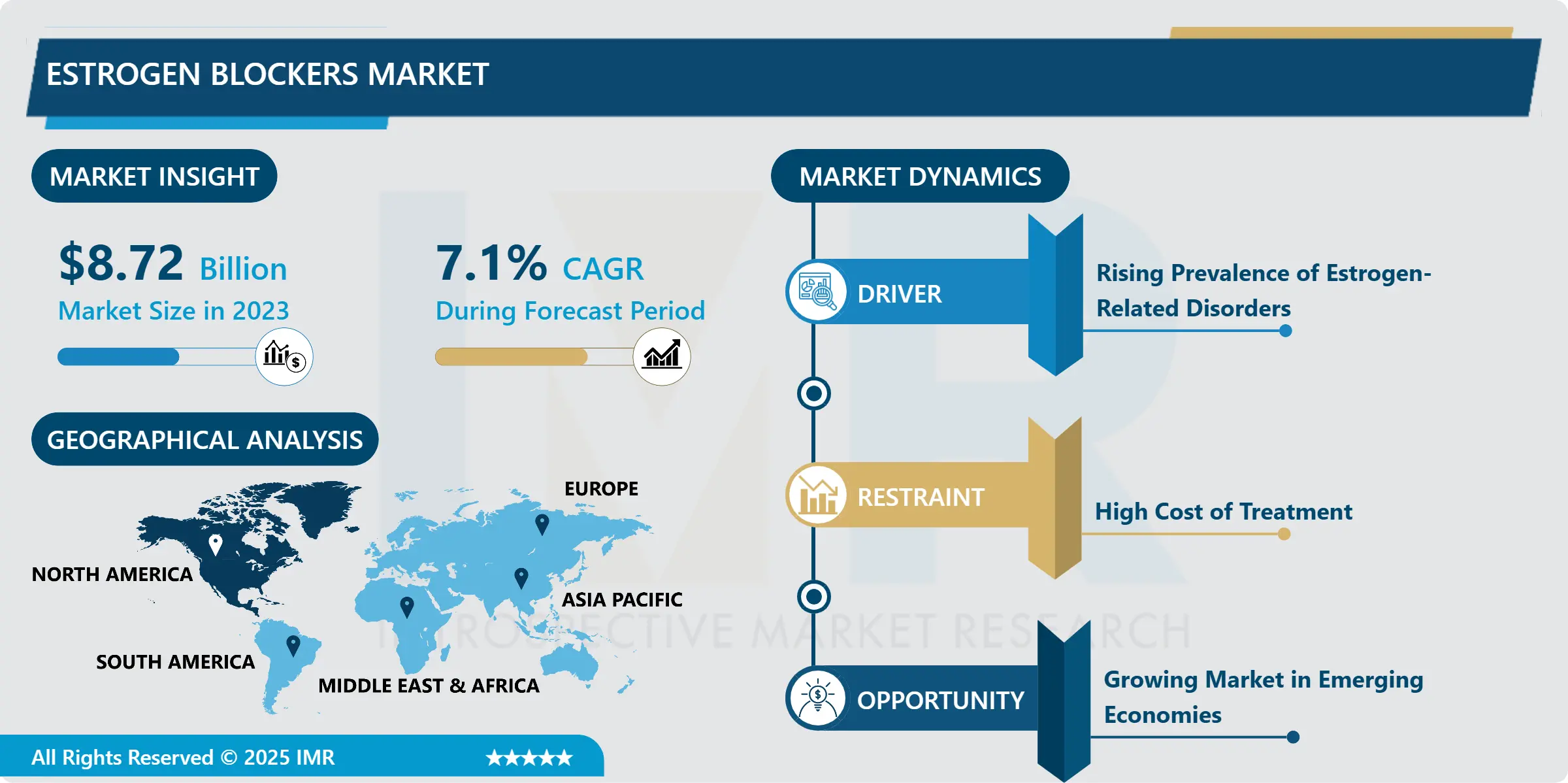
Estrogen Blockers Market Size Was Valued at USD 8.72 Billion in 2023, and is Projected to Reach USD 16.16 Billion by 2032, Growing at a CAGR of 7.1% From 2024-2032.

IMR Group
Description
Estrogen Blockers Market Synopsis:
Estrogen Blockers Market Size Was Valued at USD 8.72 Billion in 2023, and is Projected to Reach USD 16.16 Billion by 2032, Growing at a CAGR of 7.1% From 2024-2032.
Selective estrogen blockers or estrogen receptor antagonists are molecules, which acts like estrogens and at the same time prevent the effects of estrogen in the body. These blockers are used in the management of estrogen sensitive diseases such as; breast cancer, endometriosis and uterine fibroid diseases. They act by blocking the estrogenic stimulation by competing with estrogen which binds to its receptors on target tissues.
The current market products of the estrogen blockers are one of the most promising segments within the largest and fast-growing industry in the world the pharmaceutical and health care industry. Many people are affected by estrogen-dependent illnesses for instance, breast cancer, diseases of the uterus lining and fibroids hence the need for estrogen blockers. These drugs are more used for treatment in cancer therapy especially in hormonal receptor positive breast cancer. While there is better understanding and new developments in the role of estrogen in several diseases the market for estrogen blockers remains highly innovative with the newer generation of blockers generally reported to be more effective and have fewer side effects than the earlier brands marketed.
The increasing rate of occurrence of several estrogen associated diseases other factor which has aided in the growth of global market for estrogen blockers is the increasing awareness among women about the importance of estrogen blockers. Most nations are aiming at reducing health inequalities in terms of healthcare provision, more specially in cancer and reproductive health. In addition, patronship by governments, higher levels of funding to healthcare facilities, and extending focus towards individualized treatment give positive impetus towards the development of the market. Besides, the need for therapeutic sites for various hormone-sensitive cancers and other diseases has encouraged the emergence of numerous ERD, which are being embraced internationally by clinicians and patients.
Estrogen Blockers Market Trend Analysis
Increased Adoption of Personalized Medicine
Another trend likely to persist across the estrogen blockers market is the increasing use of individualized treatment in estrogen-receptor related diseases. Such a model with them as patients is already on the rise due to the progression of pharmacogenomics/omics, thus allowing for a more directed, patient-specific approach to diseases include but not limited to breast cancer, AIDS, sickle cell anaemia, cardiac arrest, and more. It is increasing the call for highly selective estrogen blockers suited to some genetic profiles or states of an illness.
For instance Hormone receptor positive breast cancer is treated with SERMs or aromatase inhibitors depending on the hormonal status of the patient. While more research will be done in this area the market for estrogen blockers is expected to become more advanced with a focus on drugs that will be tailored for specific patients. Long-term audience growth involving personalized treatments is anticipated, and overall treatment efficacy is bound to improve as well.
Emerging Markets and Expanding Healthcare Access
Another major growth opportunity of the estrogen blockers market was found to be emerging market access to healthcare particularly in Asia-Pacific, Latin America and some of the African region states. Such products are drugs that are used to block estrogen and as the health care facilities in these regions advance there is a high demand for cancer products among them those that block estrogen. In addition, improving economic status, awareness level of killers diseases, urbanization, aging populations and a rise in estrogen related diseases are expected to propel the growth of the market in these regions.
Subnational governments and international organisations are putting resources into health facilities and so ensure that people can procure essential medicines. It brought about new wide market opportunities for development of new drugs and other cost-effective solutions by the leading pharmaceutical firms which can meet these regions’ specific needs. With the progressing development of these regions in terms of economy, the estrogen blockers market is expected to grow rapidly having local production and partnerships with foreign companies.
Estrogen Blockers Market Segment Analysis:
Estrogen Blockers Market is Segmented on the basis of Type, Application, End User, And Region
By Type, Aromatase Inhibitors segment is expected to dominate the market during the forecast period
The Aromatase Inhibitors segment is projected to maintain a leading position in the Estrogen Blockers Market throughout the forecast period. This dominance is associated with the expanding use of aromatase inhibitors in hormone-sensitive breast cancer therapies, particularly among postmenopausal patients. The preference for these inhibitors stems from their targeted mechanism of action, which effectively reduces estrogen levels and supports long-term disease management strategies in oncology. Pharmaceutical advancements and growing adoption in clinical protocols continue to influence market dynamics in favor of this segment.
Increased awareness among healthcare professionals about treatment efficacy, along with an evolving clinical landscape, supports the wider integration of aromatase inhibitors into therapeutic regimens. Prescription trends in oncology practices and updated treatment guidelines across various regions reflect the strengthened position of this class of drugs. These developments are expected to reinforce the segment’s performance and shape future investments across pharmaceutical portfolios targeting hormone-responsive conditions.
By Application, Breast Cancer segment expected to held the largest share
The breast cancer segment is anticipated to account for the largest share of the estrogen blockers market, supported by increasing global incidences and the clinical relevance of hormone therapy in treatment protocols. Estrogen blockers are a key component in managing estrogen receptor-positive breast cancers, where limiting estrogen activity helps prevent tumor growth. Market participants are focusing on expanding product offerings and aligning with evolving treatment guidelines to strengthen their position in this category.
Regulatory approvals and continued research into hormonal therapies have contributed to broader adoption across oncology settings. Healthcare providers are emphasizing evidence-based regimens, resulting in increased reliance on estrogen-blocking agents within comprehensive cancer care. The segment’s dominance is also shaped by a consistent demand from both early-stage and recurrent breast cancer cases, reinforcing its role in long-term treatment strategies. Manufacturers are expected to maintain a sharp focus on product development and clinical efficacy to meet ongoing therapeutic needs.
Estrogen Blockers Market Regional Insights:
North America is Expected to Dominate the Market Over the Forecast period
North America is projected to hold the leading position in the market throughout the forecast period, supported by strong industrial infrastructure, advanced technological capabilities, and high demand across key sectors. The region benefits from well-established supply chains and regulatory frameworks that support innovation and market expansion. Companies operating in North America are actively investing in research and development, which enhances product offerings and reinforces their competitive positioning on a global scale.
The presence of major industry players and a robust end-user base contributes to the region’s dominant market share. Strategic partnerships, expansions, and new product launches across sectors such as healthcare, manufacturing, and energy further enhance market stability. In particular, the United States continues to serve as a focal point for innovation, with enterprises leveraging cutting-edge technologies to meet evolving customer requirements and operational efficiencies. These market conditions create a favorable environment for sustained growth over the forecast timeline.
Active Key Players in the Estrogen Blockers Market
AstraZeneca (United Kingdom)
Bayer AG (Germany)
BioMarin Pharmaceutical (United States)
Bristol-Myers Squibb (United States)
Eli Lilly and Company (United States)
Ferring Pharmaceuticals (Switzerland)
Glenmark Pharmaceuticals (India)
Hologic, Inc. (United States)
Johnson & Johnson (United States)
Mylan N.V. (United States)
Novartis AG (Switzerland)
Pfizer Inc. (United States)
Roche Holding AG (Switzerland)
Teva Pharmaceuticals (Israel)
Viatris (United States)
Other Active Players
Chapter 1: Introduction
1.1 Scope and Coverage
Chapter 2:Executive Summary
Chapter 3: Market Landscape
3.1 Market Dynamics
3.1.1 Drivers
3.1.2 Restraints
3.1.3 Opportunities
3.1.4 Challenges
3.2 Market Trend Analysis
3.3 PESTLE Analysis
3.4 Porter’s Five Forces Analysis
3.5 Industry Value Chain Analysis
3.6 Ecosystem
3.7 Regulatory Landscape
3.8 Price Trend Analysis
3.9 Patent Analysis
3.10 Technology Evolution
3.11 Investment Pockets
3.12 Import-Export Analysis
Chapter 4: Estrogen Blockers Market by Type
4.1 Estrogen Blockers Market Snapshot and Growth Engine
4.2 Estrogen Blockers Market Overview
4.3 Selective Estrogen Receptor Modulators (SERMs)
4.3.1 Introduction and Market Overview
4.3.2 Historic and Forecasted Market Size in Value USD and Volume Units (2017-2032F)
4.3.3 Key Market Trends, Growth Factors and Opportunities
4.3.4 Selective Estrogen Receptor Modulators (SERMs): Geographic Segmentation Analysis
4.4 Aromatase Inhibitors
4.4.1 Introduction and Market Overview
4.4.2 Historic and Forecasted Market Size in Value USD and Volume Units (2017-2032F)
4.4.3 Key Market Trends, Growth Factors and Opportunities
4.4.4 Aromatase Inhibitors: Geographic Segmentation Analysis
4.5 Estrogen Receptor Antagonists
4.5.1 Introduction and Market Overview
4.5.2 Historic and Forecasted Market Size in Value USD and Volume Units (2017-2032F)
4.5.3 Key Market Trends, Growth Factors and Opportunities
4.5.4 Estrogen Receptor Antagonists: Geographic Segmentation Analysis
Chapter 5: Estrogen Blockers Market by Application
5.1 Estrogen Blockers Market Snapshot and Growth Engine
5.2 Estrogen Blockers Market Overview
5.3 Breast Cancer
5.3.1 Introduction and Market Overview
5.3.2 Historic and Forecasted Market Size in Value USD and Volume Units (2017-2032F)
5.3.3 Key Market Trends, Growth Factors and Opportunities
5.3.4 Breast Cancer: Geographic Segmentation Analysis
5.4 Endometriosis
5.4.1 Introduction and Market Overview
5.4.2 Historic and Forecasted Market Size in Value USD and Volume Units (2017-2032F)
5.4.3 Key Market Trends, Growth Factors and Opportunities
5.4.4 Endometriosis: Geographic Segmentation Analysis
5.5 Uterine Fibroids
5.5.1 Introduction and Market Overview
5.5.2 Historic and Forecasted Market Size in Value USD and Volume Units (2017-2032F)
5.5.3 Key Market Trends, Growth Factors and Opportunities
5.5.4 Uterine Fibroids: Geographic Segmentation Analysis
5.6 Prostate Cancer
5.6.1 Introduction and Market Overview
5.6.2 Historic and Forecasted Market Size in Value USD and Volume Units (2017-2032F)
5.6.3 Key Market Trends, Growth Factors and Opportunities
5.6.4 Prostate Cancer: Geographic Segmentation Analysis
5.7 Others
5.7.1 Introduction and Market Overview
5.7.2 Historic and Forecasted Market Size in Value USD and Volume Units (2017-2032F)
5.7.3 Key Market Trends, Growth Factors and Opportunities
5.7.4 Others: Geographic Segmentation Analysis
Chapter 6: Estrogen Blockers Market by End User
6.1 Estrogen Blockers Market Snapshot and Growth Engine
6.2 Estrogen Blockers Market Overview
6.3 Hospitals
6.3.1 Introduction and Market Overview
6.3.2 Historic and Forecasted Market Size in Value USD and Volume Units (2017-2032F)
6.3.3 Key Market Trends, Growth Factors and Opportunities
6.3.4 Hospitals: Geographic Segmentation Analysis
6.4 Cancer Treatment Centers
6.4.1 Introduction and Market Overview
6.4.2 Historic and Forecasted Market Size in Value USD and Volume Units (2017-2032F)
6.4.3 Key Market Trends, Growth Factors and Opportunities
6.4.4 Cancer Treatment Centers: Geographic Segmentation Analysis
6.5 Homecare Settings
6.5.1 Introduction and Market Overview
6.5.2 Historic and Forecasted Market Size in Value USD and Volume Units (2017-2032F)
6.5.3 Key Market Trends, Growth Factors and Opportunities
6.5.4 Homecare Settings: Geographic Segmentation Analysis
6.6 Research Institutes
6.6.1 Introduction and Market Overview
6.6.2 Historic and Forecasted Market Size in Value USD and Volume Units (2017-2032F)
6.6.3 Key Market Trends, Growth Factors and Opportunities
6.6.4 Research Institutes: Geographic Segmentation Analysis
Chapter 7: Company Profiles and Competitive Analysis
7.1 Competitive Landscape
7.1.1 Competitive Benchmarking
7.1.2 Estrogen Blockers Market Share by Manufacturer (2023)
7.1.3 Industry BCG Matrix
7.1.4 Heat Map Analysis
7.1.5 Mergers and Acquisitions
7.2 ASTRAZENECA (UNITED KINGDOM)
7.2.1 Company Overview
7.2.2 Key Executives
7.2.3 Company Snapshot
7.2.4 Role of the Company in the Market
7.2.5 Sustainability and Social Responsibility
7.2.6 Operating Business Segments
7.2.7 Product Portfolio
7.2.8 Business Performance
7.2.9 Key Strategic Moves and Recent Developments
7.2.10 SWOT Analysis
7.3 BAYER AG (GERMANY)
7.4 BIOMARIN PHARMACEUTICAL (UNITED STATES)
7.5 BRISTOL-MYERS SQUIBB (UNITED STATES)
7.6 ELI LILLY AND COMPANY (UNITED STATES)
7.7 FERRING PHARMACEUTICALS (SWITZERLAND)
7.8 GLENMARK PHARMACEUTICALS (INDIA)
7.9 HOLOGIC INC. (UNITED STATES)
7.10 JOHNSON & JOHNSON (UNITED STATES)
7.11 MYLAN N.V. (UNITED STATES)
7.12 NOVARTIS AG (SWITZERLAND)
7.13 PFIZER INC. (UNITED STATES)
7.14 ROCHE HOLDING AG (SWITZERLAND)
7.15 TEVA PHARMACEUTICALS (ISRAEL)
7.16 VIATRIS (UNITED STATES)
7.17 OTHER ACTIVE PLAYERS
Chapter 8: Global Estrogen Blockers Market By Region
8.1 Overview
8.2. North America Estrogen Blockers Market
8.2.1 Key Market Trends, Growth Factors and Opportunities
8.2.2 Top Key Companies
8.2.3 Historic and Forecasted Market Size by Segments
8.2.4 Historic and Forecasted Market Size By Type
8.2.4.1 Selective Estrogen Receptor Modulators (SERMs)
8.2.4.2 Aromatase Inhibitors
8.2.4.3 Estrogen Receptor Antagonists
8.2.5 Historic and Forecasted Market Size By Application
8.2.5.1 Breast Cancer
8.2.5.2 Endometriosis
8.2.5.3 Uterine Fibroids
8.2.5.4 Prostate Cancer
8.2.5.5 Others
8.2.6 Historic and Forecasted Market Size By End User
8.2.6.1 Hospitals
8.2.6.2 Cancer Treatment Centers
8.2.6.3 Homecare Settings
8.2.6.4 Research Institutes
8.2.7 Historic and Forecast Market Size by Country
8.2.7.1 US
8.2.7.2 Canada
8.2.7.3 Mexico
8.3. Eastern Europe Estrogen Blockers Market
8.3.1 Key Market Trends, Growth Factors and Opportunities
8.3.2 Top Key Companies
8.3.3 Historic and Forecasted Market Size by Segments
8.3.4 Historic and Forecasted Market Size By Type
8.3.4.1 Selective Estrogen Receptor Modulators (SERMs)
8.3.4.2 Aromatase Inhibitors
8.3.4.3 Estrogen Receptor Antagonists
8.3.5 Historic and Forecasted Market Size By Application
8.3.5.1 Breast Cancer
8.3.5.2 Endometriosis
8.3.5.3 Uterine Fibroids
8.3.5.4 Prostate Cancer
8.3.5.5 Others
8.3.6 Historic and Forecasted Market Size By End User
8.3.6.1 Hospitals
8.3.6.2 Cancer Treatment Centers
8.3.6.3 Homecare Settings
8.3.6.4 Research Institutes
8.3.7 Historic and Forecast Market Size by Country
8.3.7.1 Russia
8.3.7.2 Bulgaria
8.3.7.3 The Czech Republic
8.3.7.4 Hungary
8.3.7.5 Poland
8.3.7.6 Romania
8.3.7.7 Rest of Eastern Europe
8.4. Western Europe Estrogen Blockers Market
8.4.1 Key Market Trends, Growth Factors and Opportunities
8.4.2 Top Key Companies
8.4.3 Historic and Forecasted Market Size by Segments
8.4.4 Historic and Forecasted Market Size By Type
8.4.4.1 Selective Estrogen Receptor Modulators (SERMs)
8.4.4.2 Aromatase Inhibitors
8.4.4.3 Estrogen Receptor Antagonists
8.4.5 Historic and Forecasted Market Size By Application
8.4.5.1 Breast Cancer
8.4.5.2 Endometriosis
8.4.5.3 Uterine Fibroids
8.4.5.4 Prostate Cancer
8.4.5.5 Others
8.4.6 Historic and Forecasted Market Size By End User
8.4.6.1 Hospitals
8.4.6.2 Cancer Treatment Centers
8.4.6.3 Homecare Settings
8.4.6.4 Research Institutes
8.4.7 Historic and Forecast Market Size by Country
8.4.7.1 Germany
8.4.7.2 UK
8.4.7.3 France
8.4.7.4 The Netherlands
8.4.7.5 Italy
8.4.7.6 Spain
8.4.7.7 Rest of Western Europe
8.5. Asia Pacific Estrogen Blockers Market
8.5.1 Key Market Trends, Growth Factors and Opportunities
8.5.2 Top Key Companies
8.5.3 Historic and Forecasted Market Size by Segments
8.5.4 Historic and Forecasted Market Size By Type
8.5.4.1 Selective Estrogen Receptor Modulators (SERMs)
8.5.4.2 Aromatase Inhibitors
8.5.4.3 Estrogen Receptor Antagonists
8.5.5 Historic and Forecasted Market Size By Application
8.5.5.1 Breast Cancer
8.5.5.2 Endometriosis
8.5.5.3 Uterine Fibroids
8.5.5.4 Prostate Cancer
8.5.5.5 Others
8.5.6 Historic and Forecasted Market Size By End User
8.5.6.1 Hospitals
8.5.6.2 Cancer Treatment Centers
8.5.6.3 Homecare Settings
8.5.6.4 Research Institutes
8.5.7 Historic and Forecast Market Size by Country
8.5.7.1 China
8.5.7.2 India
8.5.7.3 Japan
8.5.7.4 South Korea
8.5.7.5 Malaysia
8.5.7.6 Thailand
8.5.7.7 Vietnam
8.5.7.8 The Philippines
8.5.7.9 Australia
8.5.7.10 New Zealand
8.5.7.11 Rest of APAC
8.6. Middle East & Africa Estrogen Blockers Market
8.6.1 Key Market Trends, Growth Factors and Opportunities
8.6.2 Top Key Companies
8.6.3 Historic and Forecasted Market Size by Segments
8.6.4 Historic and Forecasted Market Size By Type
8.6.4.1 Selective Estrogen Receptor Modulators (SERMs)
8.6.4.2 Aromatase Inhibitors
8.6.4.3 Estrogen Receptor Antagonists
8.6.5 Historic and Forecasted Market Size By Application
8.6.5.1 Breast Cancer
8.6.5.2 Endometriosis
8.6.5.3 Uterine Fibroids
8.6.5.4 Prostate Cancer
8.6.5.5 Others
8.6.6 Historic and Forecasted Market Size By End User
8.6.6.1 Hospitals
8.6.6.2 Cancer Treatment Centers
8.6.6.3 Homecare Settings
8.6.6.4 Research Institutes
8.6.7 Historic and Forecast Market Size by Country
8.6.7.1 Turkiye
8.6.7.2 Bahrain
8.6.7.3 Kuwait
8.6.7.4 Saudi Arabia
8.6.7.5 Qatar
8.6.7.6 UAE
8.6.7.7 Israel
8.6.7.8 South Africa
8.7. South America Estrogen Blockers Market
8.7.1 Key Market Trends, Growth Factors and Opportunities
8.7.2 Top Key Companies
8.7.3 Historic and Forecasted Market Size by Segments
8.7.4 Historic and Forecasted Market Size By Type
8.7.4.1 Selective Estrogen Receptor Modulators (SERMs)
8.7.4.2 Aromatase Inhibitors
8.7.4.3 Estrogen Receptor Antagonists
8.7.5 Historic and Forecasted Market Size By Application
8.7.5.1 Breast Cancer
8.7.5.2 Endometriosis
8.7.5.3 Uterine Fibroids
8.7.5.4 Prostate Cancer
8.7.5.5 Others
8.7.6 Historic and Forecasted Market Size By End User
8.7.6.1 Hospitals
8.7.6.2 Cancer Treatment Centers
8.7.6.3 Homecare Settings
8.7.6.4 Research Institutes
8.7.7 Historic and Forecast Market Size by Country
8.7.7.1 Brazil
8.7.7.2 Argentina
8.7.7.3 Rest of SA
Chapter 9 Analyst Viewpoint and Conclusion
9.1 Recommendations and Concluding Analysis
9.2 Potential Market Strategies
Chapter 10 Research Methodology
10.1 Research Process
10.2 Primary Research
10.3 Secondary Research
Chapter 1: Introduction
1.1 Scope and Coverage
Chapter 2:Executive Summary
Chapter 3: Market Landscape
3.1 Market Dynamics
3.1.1 Drivers
3.1.2 Restraints
3.1.3 Opportunities
3.1.4 Challenges
3.2 Market Trend Analysis
3.3 PESTLE Analysis
3.4 Porter’s Five Forces Analysis
3.5 Industry Value Chain Analysis
3.6 Ecosystem
3.7 Regulatory Landscape
3.8 Price Trend Analysis
3.9 Patent Analysis
3.10 Technology Evolution
3.11 Investment Pockets
3.12 Import-Export Analysis
Chapter 4: Estrogen Blockers Market by Type
4.1 Estrogen Blockers Market Snapshot and Growth Engine
4.2 Estrogen Blockers Market Overview
4.3 Selective Estrogen Receptor Modulators (SERMs)
4.3.1 Introduction and Market Overview
4.3.2 Historic and Forecasted Market Size in Value USD and Volume Units (2017-2032F)
4.3.3 Key Market Trends, Growth Factors and Opportunities
4.3.4 Selective Estrogen Receptor Modulators (SERMs): Geographic Segmentation Analysis
4.4 Aromatase Inhibitors
4.4.1 Introduction and Market Overview
4.4.2 Historic and Forecasted Market Size in Value USD and Volume Units (2017-2032F)
4.4.3 Key Market Trends, Growth Factors and Opportunities
4.4.4 Aromatase Inhibitors: Geographic Segmentation Analysis
4.5 Estrogen Receptor Antagonists
4.5.1 Introduction and Market Overview
4.5.2 Historic and Forecasted Market Size in Value USD and Volume Units (2017-2032F)
4.5.3 Key Market Trends, Growth Factors and Opportunities
4.5.4 Estrogen Receptor Antagonists: Geographic Segmentation Analysis
Chapter 5: Estrogen Blockers Market by Application
5.1 Estrogen Blockers Market Snapshot and Growth Engine
5.2 Estrogen Blockers Market Overview
5.3 Breast Cancer
5.3.1 Introduction and Market Overview
5.3.2 Historic and Forecasted Market Size in Value USD and Volume Units (2017-2032F)
5.3.3 Key Market Trends, Growth Factors and Opportunities
5.3.4 Breast Cancer: Geographic Segmentation Analysis
5.4 Endometriosis
5.4.1 Introduction and Market Overview
5.4.2 Historic and Forecasted Market Size in Value USD and Volume Units (2017-2032F)
5.4.3 Key Market Trends, Growth Factors and Opportunities
5.4.4 Endometriosis: Geographic Segmentation Analysis
5.5 Uterine Fibroids
5.5.1 Introduction and Market Overview
5.5.2 Historic and Forecasted Market Size in Value USD and Volume Units (2017-2032F)
5.5.3 Key Market Trends, Growth Factors and Opportunities
5.5.4 Uterine Fibroids: Geographic Segmentation Analysis
5.6 Prostate Cancer
5.6.1 Introduction and Market Overview
5.6.2 Historic and Forecasted Market Size in Value USD and Volume Units (2017-2032F)
5.6.3 Key Market Trends, Growth Factors and Opportunities
5.6.4 Prostate Cancer: Geographic Segmentation Analysis
5.7 Others
5.7.1 Introduction and Market Overview
5.7.2 Historic and Forecasted Market Size in Value USD and Volume Units (2017-2032F)
5.7.3 Key Market Trends, Growth Factors and Opportunities
5.7.4 Others: Geographic Segmentation Analysis
Chapter 6: Estrogen Blockers Market by End User
6.1 Estrogen Blockers Market Snapshot and Growth Engine
6.2 Estrogen Blockers Market Overview
6.3 Hospitals
6.3.1 Introduction and Market Overview
6.3.2 Historic and Forecasted Market Size in Value USD and Volume Units (2017-2032F)
6.3.3 Key Market Trends, Growth Factors and Opportunities
6.3.4 Hospitals: Geographic Segmentation Analysis
6.4 Cancer Treatment Centers
6.4.1 Introduction and Market Overview
6.4.2 Historic and Forecasted Market Size in Value USD and Volume Units (2017-2032F)
6.4.3 Key Market Trends, Growth Factors and Opportunities
6.4.4 Cancer Treatment Centers: Geographic Segmentation Analysis
6.5 Homecare Settings
6.5.1 Introduction and Market Overview
6.5.2 Historic and Forecasted Market Size in Value USD and Volume Units (2017-2032F)
6.5.3 Key Market Trends, Growth Factors and Opportunities
6.5.4 Homecare Settings: Geographic Segmentation Analysis
6.6 Research Institutes
6.6.1 Introduction and Market Overview
6.6.2 Historic and Forecasted Market Size in Value USD and Volume Units (2017-2032F)
6.6.3 Key Market Trends, Growth Factors and Opportunities
6.6.4 Research Institutes: Geographic Segmentation Analysis
Chapter 7: Company Profiles and Competitive Analysis
7.1 Competitive Landscape
7.1.1 Competitive Benchmarking
7.1.2 Estrogen Blockers Market Share by Manufacturer (2023)
7.1.3 Industry BCG Matrix
7.1.4 Heat Map Analysis
7.1.5 Mergers and Acquisitions
7.2 ASTRAZENECA (UNITED KINGDOM)
7.2.1 Company Overview
7.2.2 Key Executives
7.2.3 Company Snapshot
7.2.4 Role of the Company in the Market
7.2.5 Sustainability and Social Responsibility
7.2.6 Operating Business Segments
7.2.7 Product Portfolio
7.2.8 Business Performance
7.2.9 Key Strategic Moves and Recent Developments
7.2.10 SWOT Analysis
7.3 BAYER AG (GERMANY)
7.4 BIOMARIN PHARMACEUTICAL (UNITED STATES)
7.5 BRISTOL-MYERS SQUIBB (UNITED STATES)
7.6 ELI LILLY AND COMPANY (UNITED STATES)
7.7 FERRING PHARMACEUTICALS (SWITZERLAND)
7.8 GLENMARK PHARMACEUTICALS (INDIA)
7.9 HOLOGIC INC. (UNITED STATES)
7.10 JOHNSON & JOHNSON (UNITED STATES)
7.11 MYLAN N.V. (UNITED STATES)
7.12 NOVARTIS AG (SWITZERLAND)
7.13 PFIZER INC. (UNITED STATES)
7.14 ROCHE HOLDING AG (SWITZERLAND)
7.15 TEVA PHARMACEUTICALS (ISRAEL)
7.16 VIATRIS (UNITED STATES)
7.17 OTHER ACTIVE PLAYERS
Chapter 8: Global Estrogen Blockers Market By Region
8.1 Overview
8.2. North America Estrogen Blockers Market
8.2.1 Key Market Trends, Growth Factors and Opportunities
8.2.2 Top Key Companies
8.2.3 Historic and Forecasted Market Size by Segments
8.2.4 Historic and Forecasted Market Size By Type
8.2.4.1 Selective Estrogen Receptor Modulators (SERMs)
8.2.4.2 Aromatase Inhibitors
8.2.4.3 Estrogen Receptor Antagonists
8.2.5 Historic and Forecasted Market Size By Application
8.2.5.1 Breast Cancer
8.2.5.2 Endometriosis
8.2.5.3 Uterine Fibroids
8.2.5.4 Prostate Cancer
8.2.5.5 Others
8.2.6 Historic and Forecasted Market Size By End User
8.2.6.1 Hospitals
8.2.6.2 Cancer Treatment Centers
8.2.6.3 Homecare Settings
8.2.6.4 Research Institutes
8.2.7 Historic and Forecast Market Size by Country
8.2.7.1 US
8.2.7.2 Canada
8.2.7.3 Mexico
8.3. Eastern Europe Estrogen Blockers Market
8.3.1 Key Market Trends, Growth Factors and Opportunities
8.3.2 Top Key Companies
8.3.3 Historic and Forecasted Market Size by Segments
8.3.4 Historic and Forecasted Market Size By Type
8.3.4.1 Selective Estrogen Receptor Modulators (SERMs)
8.3.4.2 Aromatase Inhibitors
8.3.4.3 Estrogen Receptor Antagonists
8.3.5 Historic and Forecasted Market Size By Application
8.3.5.1 Breast Cancer
8.3.5.2 Endometriosis
8.3.5.3 Uterine Fibroids
8.3.5.4 Prostate Cancer
8.3.5.5 Others
8.3.6 Historic and Forecasted Market Size By End User
8.3.6.1 Hospitals
8.3.6.2 Cancer Treatment Centers
8.3.6.3 Homecare Settings
8.3.6.4 Research Institutes
8.3.7 Historic and Forecast Market Size by Country
8.3.7.1 Russia
8.3.7.2 Bulgaria
8.3.7.3 The Czech Republic
8.3.7.4 Hungary
8.3.7.5 Poland
8.3.7.6 Romania
8.3.7.7 Rest of Eastern Europe
8.4. Western Europe Estrogen Blockers Market
8.4.1 Key Market Trends, Growth Factors and Opportunities
8.4.2 Top Key Companies
8.4.3 Historic and Forecasted Market Size by Segments
8.4.4 Historic and Forecasted Market Size By Type
8.4.4.1 Selective Estrogen Receptor Modulators (SERMs)
8.4.4.2 Aromatase Inhibitors
8.4.4.3 Estrogen Receptor Antagonists
8.4.5 Historic and Forecasted Market Size By Application
8.4.5.1 Breast Cancer
8.4.5.2 Endometriosis
8.4.5.3 Uterine Fibroids
8.4.5.4 Prostate Cancer
8.4.5.5 Others
8.4.6 Historic and Forecasted Market Size By End User
8.4.6.1 Hospitals
8.4.6.2 Cancer Treatment Centers
8.4.6.3 Homecare Settings
8.4.6.4 Research Institutes
8.4.7 Historic and Forecast Market Size by Country
8.4.7.1 Germany
8.4.7.2 UK
8.4.7.3 France
8.4.7.4 The Netherlands
8.4.7.5 Italy
8.4.7.6 Spain
8.4.7.7 Rest of Western Europe
8.5. Asia Pacific Estrogen Blockers Market
8.5.1 Key Market Trends, Growth Factors and Opportunities
8.5.2 Top Key Companies
8.5.3 Historic and Forecasted Market Size by Segments
8.5.4 Historic and Forecasted Market Size By Type
8.5.4.1 Selective Estrogen Receptor Modulators (SERMs)
8.5.4.2 Aromatase Inhibitors
8.5.4.3 Estrogen Receptor Antagonists
8.5.5 Historic and Forecasted Market Size By Application
8.5.5.1 Breast Cancer
8.5.5.2 Endometriosis
8.5.5.3 Uterine Fibroids
8.5.5.4 Prostate Cancer
8.5.5.5 Others
8.5.6 Historic and Forecasted Market Size By End User
8.5.6.1 Hospitals
8.5.6.2 Cancer Treatment Centers
8.5.6.3 Homecare Settings
8.5.6.4 Research Institutes
8.5.7 Historic and Forecast Market Size by Country
8.5.7.1 China
8.5.7.2 India
8.5.7.3 Japan
8.5.7.4 South Korea
8.5.7.5 Malaysia
8.5.7.6 Thailand
8.5.7.7 Vietnam
8.5.7.8 The Philippines
8.5.7.9 Australia
8.5.7.10 New Zealand
8.5.7.11 Rest of APAC
8.6. Middle East & Africa Estrogen Blockers Market
8.6.1 Key Market Trends, Growth Factors and Opportunities
8.6.2 Top Key Companies
8.6.3 Historic and Forecasted Market Size by Segments
8.6.4 Historic and Forecasted Market Size By Type
8.6.4.1 Selective Estrogen Receptor Modulators (SERMs)
8.6.4.2 Aromatase Inhibitors
8.6.4.3 Estrogen Receptor Antagonists
8.6.5 Historic and Forecasted Market Size By Application
8.6.5.1 Breast Cancer
8.6.5.2 Endometriosis
8.6.5.3 Uterine Fibroids
8.6.5.4 Prostate Cancer
8.6.5.5 Others
8.6.6 Historic and Forecasted Market Size By End User
8.6.6.1 Hospitals
8.6.6.2 Cancer Treatment Centers
8.6.6.3 Homecare Settings
8.6.6.4 Research Institutes
8.6.7 Historic and Forecast Market Size by Country
8.6.7.1 Turkiye
8.6.7.2 Bahrain
8.6.7.3 Kuwait
8.6.7.4 Saudi Arabia
8.6.7.5 Qatar
8.6.7.6 UAE
8.6.7.7 Israel
8.6.7.8 South Africa
8.7. South America Estrogen Blockers Market
8.7.1 Key Market Trends, Growth Factors and Opportunities
8.7.2 Top Key Companies
8.7.3 Historic and Forecasted Market Size by Segments
8.7.4 Historic and Forecasted Market Size By Type
8.7.4.1 Selective Estrogen Receptor Modulators (SERMs)
8.7.4.2 Aromatase Inhibitors
8.7.4.3 Estrogen Receptor Antagonists
8.7.5 Historic and Forecasted Market Size By Application
8.7.5.1 Breast Cancer
8.7.5.2 Endometriosis
8.7.5.3 Uterine Fibroids
8.7.5.4 Prostate Cancer
8.7.5.5 Others
8.7.6 Historic and Forecasted Market Size By End User
8.7.6.1 Hospitals
8.7.6.2 Cancer Treatment Centers
8.7.6.3 Homecare Settings
8.7.6.4 Research Institutes
8.7.7 Historic and Forecast Market Size by Country
8.7.7.1 Brazil
8.7.7.2 Argentina
8.7.7.3 Rest of SA
Chapter 9 Analyst Viewpoint and Conclusion
9.1 Recommendations and Concluding Analysis
9.2 Potential Market Strategies
Chapter 10 Research Methodology
10.1 Research Process
10.2 Primary Research
10.3 Secondary Research
Q1: What would be the forecast period in the Estrogen Blockers Market research report?
A1: The forecast period in the Estrogen Blockers Market research report is 2024-2032.
Q2: Who are the key players in the Estrogen Blockers Market?
A2: AstraZeneca (United Kingdom), Bayer AG (Germany), BioMarin Pharmaceutical (United States), Bristol-Myers Squibb (United States), Eli Lilly and Company (United States), Ferring Pharmaceuticals (Switzerland), Glenmark Pharmaceuticals (India), Hologic, Inc. (United States), Johnson & Johnson (United States), Mylan N.V. (United States),Novartis AG (Switzerland),Pfizer Inc. (United States),Roche Holding AG (Switzerland),Teva Pharmaceuticals (Israel),Viatris (United States), and Other Active Players.
Q3: What are the segments of the Estrogen Blockers Market?
A3: The Estrogen Blockers Market is segmented into Type, Application, End User and region. By Type, the market is categorized into (Selective Estrogen Receptor Modulators (SERMs), Aromatase Inhibitors, Estrogen Receptor Antagonists), Application, the market is categorized into (Breast Cancer, Endometriosis, Uterine Fibroids, Prostate Cancer, Others), End User, the market is categorized into (Hospitals, Cancer Treatment Centers, Homecare Settings, Research Institutes). By Region, it is analyzed across North America (U.S., Canada, Mexico),Eastern Europe (Russia, Bulgaria, The Czech Republic, Hungary, Poland, Romania, Rest of Eastern Europe),Western Europe (Germany, UK, France, Netherlands, Italy, Spain, Rest of Western Europe),Asia Pacific (China, India, Japan, South Korea, Malaysia, Thailand, Vietnam, The Philippines, Australia, New-Zealand, Rest of APAC),Middle East & Africa (Turkiye, Bahrain, Kuwait, Saudi Arabia, Qatar, UAE, Israel, South Africa), South America (Brazil, Argentina, Rest of SA).
Q4: What is the Estrogen Blockers Market?
A4: Selective estrogen blockers or estrogen receptor antagonists are molecules, which acts like estrogens and at the same time prevent the effects of estrogen in the body. These blockers are used in the management of estrogen sensitive diseases such as; breast cancer, endometriosis and uterine fibroid diseases. They act by blocking the estrogenic stimulation by competing with estrogen which binds to its receptors on target tissues.
Q5: How big is the Estrogen Blockers Market?
A5: Estrogen Blockers Market Size Was Valued at USD 8.72 Billion in 2023, and is Projected to Reach USD 16.16 Billion by 2032, Growing at a CAGR of 7.1% From 2024-2032.
How to Buy a Report from eminsights.jp
On the product page, choose the license you want: Single-User License, Multi-User License or Enterprise License.
If you required report in your native language, then you can click on Translated Report button and fill out the form with report name and language you want, then our team will contact you as soon as possible.
Click the Buy Now button.
You will be redirected to the checkout page. Enter your company details and payment information.
Click Place Order to complete the purchase.
Confirmation: You’ll receive an order confirmation and our team will contact you shortly with your ordered report.
If you have any questions, fill out the contact form below or email us at bizdev@eminsights.net.
Thank you for choosing eminsights.jp!