Stay Ahead in Fast-Growing Economies.
Browse Reports Now
Epidermolysis Bullosa Market Insights, Dynamics, and Growth Forecast (2024-2032)
Epidermolysis Bullosa (EB) is a rare group of skin diseases that tends to make the skin very delicate such that it develops blisters or even tears from simple rubbing. The market for EB means the pharma and health related industry including diagnosis, treatment, management, therapies, drugs, clinical research and care services relating to EB.

IMR Group
Description
Epidermolysis Bullosa Market Synopsis:
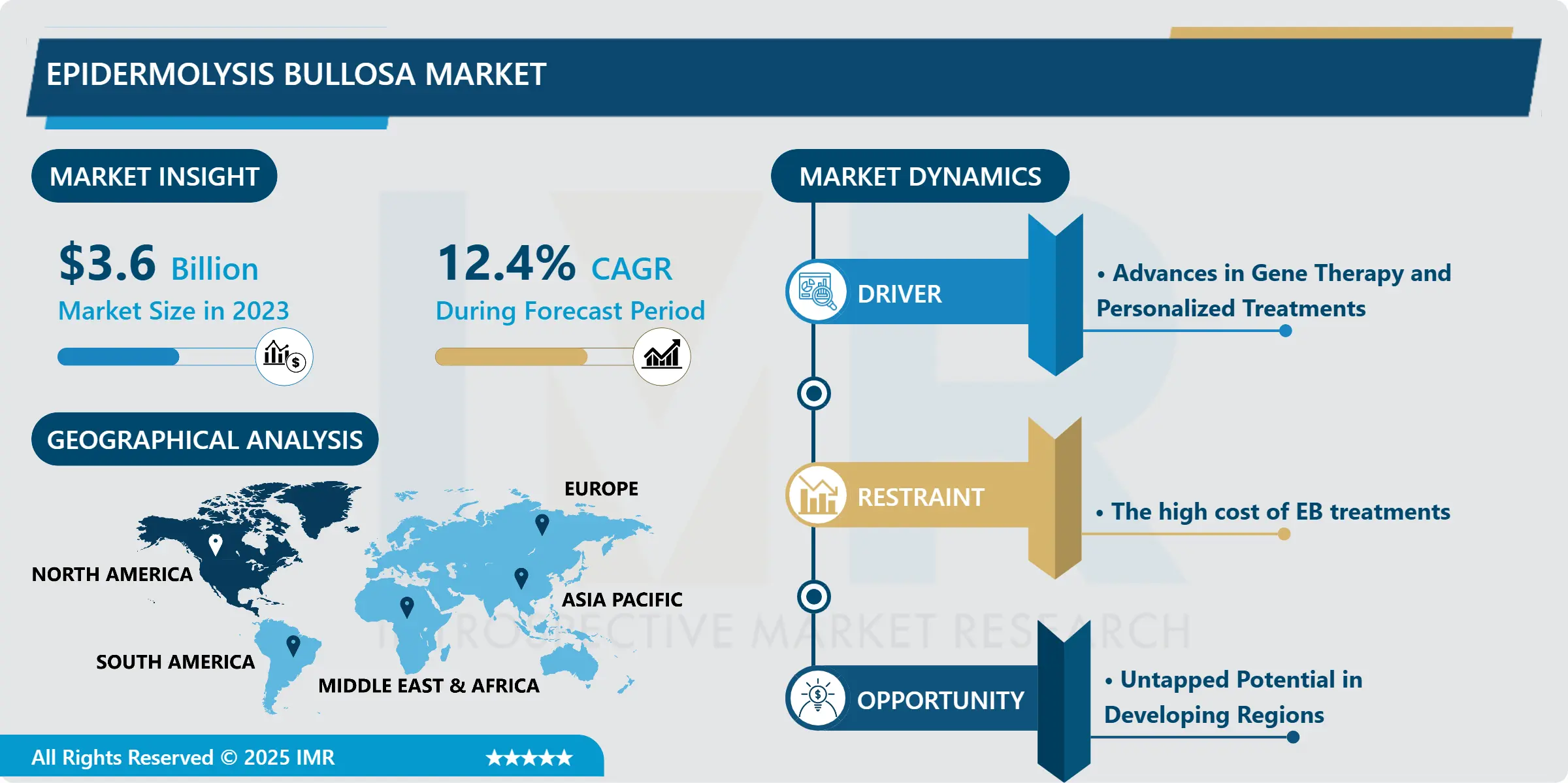
Epidermolysis Bullosa Market Size Was Valued at USD 3.6 Billion in 2023, and is Projected to Reach USD 11 Billion by 2032, Growing at a CAGR of 12.40% From 2024-2032.
Epidermolysis Bullosa (EB) is a rare group of skin diseases that tends to make the skin very delicate such that it develops blisters or even tears from simple rubbing. The market for EB means the pharma and health related industry including diagnosis, treatment, management, therapies, drugs, clinical research and care services relating to EB.
The Epidermolysis Bullosa (EB) market has been steadily rising as further developments in the field of medical science present new possibilities with treatments. EB is an erosive, fulfilment congenital dermatosis that produces severe pain and disability due to formation of blisters in the skin and mucous membrane. Such a disease is extremely rare, and therefore a considerable amount of people is not even aware of its existence, especially if is still does not have therapies that target the genetic mutations which cause it. Many drug manufacturers and bio-techs are working on new approaches such as Gene therapy and Protein replacement therapy to palliate the symptoms and in some cases provide remedies for the disease.
It is also seeing the major pharma players, emerging new firms and academics to collaborate to introduce new molecules into the market. As more people know about EB and more solutions are out in the market, especially those that focus on genetics of the disease, there is increasing interest from investors, health care givers, and patient organizations. However, the market comes coupled with challenges such treatment is expensive, and accessibility in the developing word is very limited. In addition, EB is rather a rare disease, and patient populations are not large which may reduce the possibilities of receiving great revenues for developers of new drugs.
Epidermolysis Bullosa Market Trend Analysis:
Advances in Gene Therapy and Personalized Treatments
The overall size of the market for Epidermolysis Bullosa (EB) is relatively small but expanding as discoveries in medical science present new possibilities for treatment. EB is a fatal disease that starts at birth and interferes with the basic functioning as a result of painful blisters on the skin and mucosa. This decidedly makes it a niche market disease, and there is a serious lack of treatment for the genetic disorders that the disease is a manifestation of. The drug makers and the biosciences are developing many new treatment regimens to address the ailment and even aspiring to treat it with gene therapy and protein replacement therapy
The market is also experiencing the participation of key global pharmaceutical players, start-ups and academic institutions connecting to deliver new drugs and therapy solutions to the market. With increased knowledge of EB and the development of additional treatment solutions that target the genetic nature of the disease, there is interest from investors, healthcare services and patients associations. However, there are challenges experienced in the market they include; They are very expensive, and in certain parts of the developing world, they are rare to find. Additionally, EB is a very rare disease, and patient pockets are often significantly small, which poses a threat to the returns investors can expect from drugs being developed. Essential advancements in curing diseases are likely to provide the impetus to the growth of the market, especially because fresh possibilities for advancement in the treatment domain are slated to arrive in the form of gene therapy, stem cell research, and even the field of personalized medicine.
Untapped Potential in Developing Regions
In the Epidermolysis Bullosa (EB) market is the fact that the growth of these markets is still weak in developed countries as it is in the developing countries. Despite the fact EB is a world-wide disease, there is still inadequate reimbursement for accurate diagnosis and management of rare disorders in many developing countries. This has left a void in care, and scaling up reparation of such a void could go a long way in extending the EB therapies market. In these regions healthcare investments are rising, diagnostic facilities are getting improved and awareness about rare diseases is also rising and all these factors can contribute towards the growth of the said EB market.
Relations between international pharma and local stakeholders in developing countries provide an opportunity to deliver new therapy options. Therefore, geographical locations like Asia-Pacific, Latin America and Middle East has massive market opportunities for care treatment by EB due to increasing healthcare access and investment. The pharmaceutical companies that can establish effective networks in such zones with relatively cheap and easily accessible treatment options are most likely to reap from a large unserved population.
Epidermolysis Bullosa Market Segment Analysis:
Epidermolysis Bullosa Market is Segmented on the basis of Type, Treatment, End User, and Region
By Type, Epidermolysis Bullosa Simplex (EBS) segment is expected to dominate the market during the forecast period
The Epidermolysis Bullosa Simplex (EBS) segment is anticipated to lead the Epidermolysis Bullosa (EB) market during the forecast period due to its higher prevalence and the significant unmet medical needs associated with this subtype. EBS, characterized by skin blistering caused by genetic mutations affecting the keratin protein, has become a focal point for pharmaceutical research and development. The growing number of clinical trials aimed at finding effective therapies, coupled with the increasing awareness of the disease, is expected to drive market growth within this segment.
Advancements in gene therapy, topical treatments, and systemic medications tailored to manage EBS symptoms have spurred the demand for specialized treatment options. As a result, several key players are investing in the development of new drugs and therapies targeting EBS, which further supports the segment’s dominance. With ongoing clinical developments and a growing patient base, the EBS segment is projected to maintain a prominent position in the global Epidermolysis Bullosa market.
By Treatment, Wound care segment expected to held the largest share
The Epidermolysis Bullosa (EB) market is expected to witness significant growth, with the wound care segment holding the largest market share. This is primarily driven by the critical need for specialized wound management in EB patients, whose fragile skin is prone to severe blistering and open wounds. Advanced wound care solutions, including dressings, ointments, and bandages, are essential for reducing infection risks and promoting skin regeneration. The increased adoption of these products, alongside advancements in wound healing technologies, is expected to further propel the segment’s growth.
The rising prevalence of Epidermolysis Bullosa, coupled with increased awareness and advancements in wound care treatments, is boosting the demand for specialized products in the market. Companies are investing in innovative wound healing technologies tailored to EB patients’ unique needs, further driving the segment’s market share. The ongoing development of more effective, customized wound care solutions continues to enhance patient quality of life, solidifying the wound care segment’s dominant position in the EB market.
Epidermolysis Bullosa Market Regional Insights:
North America is Expected to Dominate the Market Over the Forecast period
North America is anticipated to maintain dominance in the Epidermolysis Bullosa (EB) market throughout the forecast period, driven by robust healthcare infrastructure, increased awareness, and higher diagnostic rates. The region benefits from strong R&D investments and active involvement of pharmaceutical companies in developing targeted therapies. Additionally, regulatory support from agencies like the FDA accelerates drug approvals and access to orphan drugs, further solidifying North America’s market leadership.
The growing prevalence of EB, coupled with favorable reimbursement policies and early adoption of innovative treatment options, positions North America as a key contributor to global market revenues. Strategic collaborations between research institutions and biotech firms, particularly in the U.S., continue to fuel advancements in gene therapy and biologics. These market dynamics, supported by a proactive regulatory environment and patient advocacy efforts, underscore North America’s critical role in shaping the future landscape of EB treatment.
Active Key Players in the Epidermolysis Bullosa Market:
Amgen (USA)
AstraZeneca (UK)
Avita Medical (Australia)
Bellicum Pharmaceuticals (USA)
BioCryst Pharmaceuticals (USA)
Bristol-Myers Squibb (USA)
Castle Creek Biosciences (USA)
Dompé Farmaceutici (Italy)
Genzyme Corporation (USA)
Healx (UK)
Integra LifeSciences (USA)
Maruho Co. Ltd. (Japan)
Mereo BioPharma Group (UK)
Orchid Chemicals & Pharmaceuticals Ltd. (India)
Regeneron Pharmaceuticals (USA)
Other Active Players
Chapter 1: Introduction
1.1 Scope and Coverage
Chapter 2:Executive Summary
Chapter 3: Market Landscape
3.1 Market Dynamics
3.1.1 Drivers
3.1.2 Restraints
3.1.3 Opportunities
3.1.4 Challenges
3.2 Market Trend Analysis
3.3 PESTLE Analysis
3.4 Porter’s Five Forces Analysis
3.5 Industry Value Chain Analysis
3.6 Ecosystem
3.7 Regulatory Landscape
3.8 Price Trend Analysis
3.9 Patent Analysis
3.10 Technology Evolution
3.11 Investment Pockets
3.12 Import-Export Analysis
Chapter 4: Epidermolysis Bullosa Market by Type
4.1 Epidermolysis Bullosa Market Snapshot and Growth Engine
4.2 Epidermolysis Bullosa Market Overview
4.3 Epidermolysis Bullosa Simplex (EBS)
4.3.1 Introduction and Market Overview
4.3.2 Historic and Forecasted Market Size in Value USD and Volume Units (2017-2032F)
4.3.3 Key Market Trends, Growth Factors and Opportunities
4.3.4 Epidermolysis Bullosa Simplex (EBS): Geographic Segmentation Analysis
4.4 Junctional Epidermolysis Bullosa (JEB)
4.4.1 Introduction and Market Overview
4.4.2 Historic and Forecasted Market Size in Value USD and Volume Units (2017-2032F)
4.4.3 Key Market Trends, Growth Factors and Opportunities
4.4.4 Junctional Epidermolysis Bullosa (JEB): Geographic Segmentation Analysis
4.5 Dystrophic Epidermolysis Bullosa (DEB)
4.5.1 Introduction and Market Overview
4.5.2 Historic and Forecasted Market Size in Value USD and Volume Units (2017-2032F)
4.5.3 Key Market Trends, Growth Factors and Opportunities
4.5.4 Dystrophic Epidermolysis Bullosa (DEB): Geographic Segmentation Analysis
4.6 Kindler Syndrome (KS)
4.6.1 Introduction and Market Overview
4.6.2 Historic and Forecasted Market Size in Value USD and Volume Units (2017-2032F)
4.6.3 Key Market Trends, Growth Factors and Opportunities
4.6.4 Kindler Syndrome (KS): Geographic Segmentation Analysis
Chapter 5: Epidermolysis Bullosa Market by Treatment
5.1 Epidermolysis Bullosa Market Snapshot and Growth Engine
5.2 Epidermolysis Bullosa Market Overview
5.3 Wound Care
5.3.1 Introduction and Market Overview
5.3.2 Historic and Forecasted Market Size in Value USD and Volume Units (2017-2032F)
5.3.3 Key Market Trends, Growth Factors and Opportunities
5.3.4 Wound Care: Geographic Segmentation Analysis
5.4 Gene Therapy
5.4.1 Introduction and Market Overview
5.4.2 Historic and Forecasted Market Size in Value USD and Volume Units (2017-2032F)
5.4.3 Key Market Trends, Growth Factors and Opportunities
5.4.4 Gene Therapy: Geographic Segmentation Analysis
5.5 Drug Therapy
5.5.1 Introduction and Market Overview
5.5.2 Historic and Forecasted Market Size in Value USD and Volume Units (2017-2032F)
5.5.3 Key Market Trends, Growth Factors and Opportunities
5.5.4 Drug Therapy: Geographic Segmentation Analysis
Chapter 6: Epidermolysis Bullosa Market by End User
6.1 Epidermolysis Bullosa Market Snapshot and Growth Engine
6.2 Epidermolysis Bullosa Market Overview
6.3 Hospitals
6.3.1 Introduction and Market Overview
6.3.2 Historic and Forecasted Market Size in Value USD and Volume Units (2017-2032F)
6.3.3 Key Market Trends, Growth Factors and Opportunities
6.3.4 Hospitals: Geographic Segmentation Analysis
6.4 Clinics
6.4.1 Introduction and Market Overview
6.4.2 Historic and Forecasted Market Size in Value USD and Volume Units (2017-2032F)
6.4.3 Key Market Trends, Growth Factors and Opportunities
6.4.4 Clinics: Geographic Segmentation Analysis
6.5 Home Care Settings
6.5.1 Introduction and Market Overview
6.5.2 Historic and Forecasted Market Size in Value USD and Volume Units (2017-2032F)
6.5.3 Key Market Trends, Growth Factors and Opportunities
6.5.4 Home Care Settings: Geographic Segmentation Analysis
6.6 Research & Academic Institutes
6.6.1 Introduction and Market Overview
6.6.2 Historic and Forecasted Market Size in Value USD and Volume Units (2017-2032F)
6.6.3 Key Market Trends, Growth Factors and Opportunities
6.6.4 Research & Academic Institutes: Geographic Segmentation Analysis
Chapter 7: Company Profiles and Competitive Analysis
7.1 Competitive Landscape
7.1.1 Competitive Benchmarking
7.1.2 Epidermolysis Bullosa Market Share by Manufacturer (2023)
7.1.3 Industry BCG Matrix
7.1.4 Heat Map Analysis
7.1.5 Mergers and Acquisitions
7.2 AMGEN (USA)
7.2.1 Company Overview
7.2.2 Key Executives
7.2.3 Company Snapshot
7.2.4 Role of the Company in the Market
7.2.5 Sustainability and Social Responsibility
7.2.6 Operating Business Segments
7.2.7 Product Portfolio
7.2.8 Business Performance
7.2.9 Key Strategic Moves and Recent Developments
7.2.10 SWOT Analysis
7.3 ASTRAZENECA (UK)
7.4 AVITA MEDICAL (AUSTRALIA)
7.5 BELLICUM PHARMACEUTICALS (USA)
7.6 BIOCRYST PHARMACEUTICALS (USA)
7.7 BRISTOL-MYERS SQUIBB (USA)
7.8 CASTLE CREEK BIOSCIENCES (USA)
7.9 DOMPÉ FARMACEUTICI (ITALY)
7.10 GENZYME CORPORATION (USA)
7.11 HEALX (UK)
7.12 INTEGRA LIFESCIENCES (USA)
7.13 MARUHO CO. LTD. (JAPAN)
7.14 MEREO BIOPHARMA GROUP (UK)
7.15 ORCHID CHEMICALS & PHARMACEUTICALS LTD. (INDIA)
7.16 REGENERON PHARMACEUTICALS (USA)
7.17 OTHER ACTIVE PLAYERS
Chapter 8: Global Epidermolysis Bullosa Market By Region
8.1 Overview
8.2. North America Epidermolysis Bullosa Market
8.2.1 Key Market Trends, Growth Factors and Opportunities
8.2.2 Top Key Companies
8.2.3 Historic and Forecasted Market Size by Segments
8.2.4 Historic and Forecasted Market Size By Type
8.2.4.1 Epidermolysis Bullosa Simplex (EBS)
8.2.4.2 Junctional Epidermolysis Bullosa (JEB)
8.2.4.3 Dystrophic Epidermolysis Bullosa (DEB)
8.2.4.4 Kindler Syndrome (KS)
8.2.5 Historic and Forecasted Market Size By Treatment
8.2.5.1 Wound Care
8.2.5.2 Gene Therapy
8.2.5.3 Drug Therapy
8.2.6 Historic and Forecasted Market Size By End User
8.2.6.1 Hospitals
8.2.6.2 Clinics
8.2.6.3 Home Care Settings
8.2.6.4 Research & Academic Institutes
8.2.7 Historic and Forecast Market Size by Country
8.2.7.1 US
8.2.7.2 Canada
8.2.7.3 Mexico
8.3. Eastern Europe Epidermolysis Bullosa Market
8.3.1 Key Market Trends, Growth Factors and Opportunities
8.3.2 Top Key Companies
8.3.3 Historic and Forecasted Market Size by Segments
8.3.4 Historic and Forecasted Market Size By Type
8.3.4.1 Epidermolysis Bullosa Simplex (EBS)
8.3.4.2 Junctional Epidermolysis Bullosa (JEB)
8.3.4.3 Dystrophic Epidermolysis Bullosa (DEB)
8.3.4.4 Kindler Syndrome (KS)
8.3.5 Historic and Forecasted Market Size By Treatment
8.3.5.1 Wound Care
8.3.5.2 Gene Therapy
8.3.5.3 Drug Therapy
8.3.6 Historic and Forecasted Market Size By End User
8.3.6.1 Hospitals
8.3.6.2 Clinics
8.3.6.3 Home Care Settings
8.3.6.4 Research & Academic Institutes
8.3.7 Historic and Forecast Market Size by Country
8.3.7.1 Russia
8.3.7.2 Bulgaria
8.3.7.3 The Czech Republic
8.3.7.4 Hungary
8.3.7.5 Poland
8.3.7.6 Romania
8.3.7.7 Rest of Eastern Europe
8.4. Western Europe Epidermolysis Bullosa Market
8.4.1 Key Market Trends, Growth Factors and Opportunities
8.4.2 Top Key Companies
8.4.3 Historic and Forecasted Market Size by Segments
8.4.4 Historic and Forecasted Market Size By Type
8.4.4.1 Epidermolysis Bullosa Simplex (EBS)
8.4.4.2 Junctional Epidermolysis Bullosa (JEB)
8.4.4.3 Dystrophic Epidermolysis Bullosa (DEB)
8.4.4.4 Kindler Syndrome (KS)
8.4.5 Historic and Forecasted Market Size By Treatment
8.4.5.1 Wound Care
8.4.5.2 Gene Therapy
8.4.5.3 Drug Therapy
8.4.6 Historic and Forecasted Market Size By End User
8.4.6.1 Hospitals
8.4.6.2 Clinics
8.4.6.3 Home Care Settings
8.4.6.4 Research & Academic Institutes
8.4.7 Historic and Forecast Market Size by Country
8.4.7.1 Germany
8.4.7.2 UK
8.4.7.3 France
8.4.7.4 The Netherlands
8.4.7.5 Italy
8.4.7.6 Spain
8.4.7.7 Rest of Western Europe
8.5. Asia Pacific Epidermolysis Bullosa Market
8.5.1 Key Market Trends, Growth Factors and Opportunities
8.5.2 Top Key Companies
8.5.3 Historic and Forecasted Market Size by Segments
8.5.4 Historic and Forecasted Market Size By Type
8.5.4.1 Epidermolysis Bullosa Simplex (EBS)
8.5.4.2 Junctional Epidermolysis Bullosa (JEB)
8.5.4.3 Dystrophic Epidermolysis Bullosa (DEB)
8.5.4.4 Kindler Syndrome (KS)
8.5.5 Historic and Forecasted Market Size By Treatment
8.5.5.1 Wound Care
8.5.5.2 Gene Therapy
8.5.5.3 Drug Therapy
8.5.6 Historic and Forecasted Market Size By End User
8.5.6.1 Hospitals
8.5.6.2 Clinics
8.5.6.3 Home Care Settings
8.5.6.4 Research & Academic Institutes
8.5.7 Historic and Forecast Market Size by Country
8.5.7.1 China
8.5.7.2 India
8.5.7.3 Japan
8.5.7.4 South Korea
8.5.7.5 Malaysia
8.5.7.6 Thailand
8.5.7.7 Vietnam
8.5.7.8 The Philippines
8.5.7.9 Australia
8.5.7.10 New Zealand
8.5.7.11 Rest of APAC
8.6. Middle East & Africa Epidermolysis Bullosa Market
8.6.1 Key Market Trends, Growth Factors and Opportunities
8.6.2 Top Key Companies
8.6.3 Historic and Forecasted Market Size by Segments
8.6.4 Historic and Forecasted Market Size By Type
8.6.4.1 Epidermolysis Bullosa Simplex (EBS)
8.6.4.2 Junctional Epidermolysis Bullosa (JEB)
8.6.4.3 Dystrophic Epidermolysis Bullosa (DEB)
8.6.4.4 Kindler Syndrome (KS)
8.6.5 Historic and Forecasted Market Size By Treatment
8.6.5.1 Wound Care
8.6.5.2 Gene Therapy
8.6.5.3 Drug Therapy
8.6.6 Historic and Forecasted Market Size By End User
8.6.6.1 Hospitals
8.6.6.2 Clinics
8.6.6.3 Home Care Settings
8.6.6.4 Research & Academic Institutes
8.6.7 Historic and Forecast Market Size by Country
8.6.7.1 Turkiye
8.6.7.2 Bahrain
8.6.7.3 Kuwait
8.6.7.4 Saudi Arabia
8.6.7.5 Qatar
8.6.7.6 UAE
8.6.7.7 Israel
8.6.7.8 South Africa
8.7. South America Epidermolysis Bullosa Market
8.7.1 Key Market Trends, Growth Factors and Opportunities
8.7.2 Top Key Companies
8.7.3 Historic and Forecasted Market Size by Segments
8.7.4 Historic and Forecasted Market Size By Type
8.7.4.1 Epidermolysis Bullosa Simplex (EBS)
8.7.4.2 Junctional Epidermolysis Bullosa (JEB)
8.7.4.3 Dystrophic Epidermolysis Bullosa (DEB)
8.7.4.4 Kindler Syndrome (KS)
8.7.5 Historic and Forecasted Market Size By Treatment
8.7.5.1 Wound Care
8.7.5.2 Gene Therapy
8.7.5.3 Drug Therapy
8.7.6 Historic and Forecasted Market Size By End User
8.7.6.1 Hospitals
8.7.6.2 Clinics
8.7.6.3 Home Care Settings
8.7.6.4 Research & Academic Institutes
8.7.7 Historic and Forecast Market Size by Country
8.7.7.1 Brazil
8.7.7.2 Argentina
8.7.7.3 Rest of SA
Chapter 9 Analyst Viewpoint and Conclusion
9.1 Recommendations and Concluding Analysis
9.2 Potential Market Strategies
Chapter 10 Research Methodology
10.1 Research Process
10.2 Primary Research
10.3 Secondary Research
Q1: What would be the forecast period in the Epidermolysis Bullosa Market research report?
A1: The forecast period in the Epidermolysis Bullosa Market research report is 2024-2032.
Q2: Who are the key players in the Epidermolysis Bullosa Market?
A2: Amgen (USA), AstraZeneca (UK), Avita Medical (Australia), Bellicum Pharmaceuticals (USA), BioCryst Pharmaceuticals (USA), Bristol-Myers Squibb (USA), Castle Creek Biosciences (USA), Dompé Farmaceutici (Italy), Genzyme Corporation (USA), Healx (UK), Integra LifeSciences (USA), Maruho Co. Ltd. (Japan), Mereo BioPharma Group (UK), Orchid Chemicals & Pharmaceuticals Ltd. (India), Regeneron Pharmaceuticals (USA), and Other Active Players.
Q3: What are the segments of the Epidermolysis Bullosa Market?
A3: The Epidermolysis Bullosa Market is segmented into Type, Treatment, End User and region. By Type, the market is categorized into (Epidermolysis Bullosa Simplex (EBS), Junctional Epidermolysis Bullosa (JEB), Dystrophic Epidermolysis Bullosa (DEB), Kindler Syndrome (KS)), By Treatment, the market is categorized into (Wound Care, Gene Therapy, Drug Therapy), End User, the market is categorized into (Hospitals, Clinics, Home Care Settings, Research & Academic Institutes)By region, it is analyzed across North America (U.S., Canada, Mexico),Eastern Europe (Russia, Bulgaria, The Czech Republic, Hungary, Poland, Romania, Rest of Eastern Europe),Western Europe (Germany, UK, France, Netherlands, Italy, Spain, Rest of Western Europe),Asia Pacific (China, India, Japan, South Korea, Malaysia, Thailand, Vietnam, The Philippines, Australia, New-Zealand, Rest of APAC),Middle East & Africa (Turkiye, Bahrain, Kuwait, Saudi Arabia, Qatar, UAE, Israel, South Africa),South America (Brazil, Argentina, Rest of SA).
Q4: What is the Epidermolysis Bullosa Market?
A4: Epidermolysis Bullosa (EB) is a rare group of skin diseases that tends to make the skin very delicate such that it develops blisters or even tears from simple rubbing. The market for EB means the pharma and health related industry including diagnosis, treatment, management, therapies, drugs, clinical research and care services relating to EB.
Q5: How big is the Epidermolysis Bullosa Market?
A5: Epidermolysis Bullosa Market Size Was Valued at USD 3.6 Billion in 2023, and is Projected to Reach USD 11 Billion by 2032, Growing at a CAGR of 12.40% From 2024-2032.
How to Buy a Report from eminsights.jp
On the product page, choose the license you want: Single-User License, Multi-User License or Enterprise License.
If you required report in your native language, then you can click on Translated Report button and fill out the form with report name and language you want, then our team will contact you as soon as possible.
Click the Buy Now button.
You will be redirected to the checkout page. Enter your company details and payment information.
Click Place Order to complete the purchase.
Confirmation: You’ll receive an order confirmation and our team will contact you shortly with your ordered report.
If you have any questions, fill out the contact form below or email us at bizdev@eminsights.net.
Thank you for choosing eminsights.jp!