Stay Ahead in Fast-Growing Economies.
Browse Reports Now
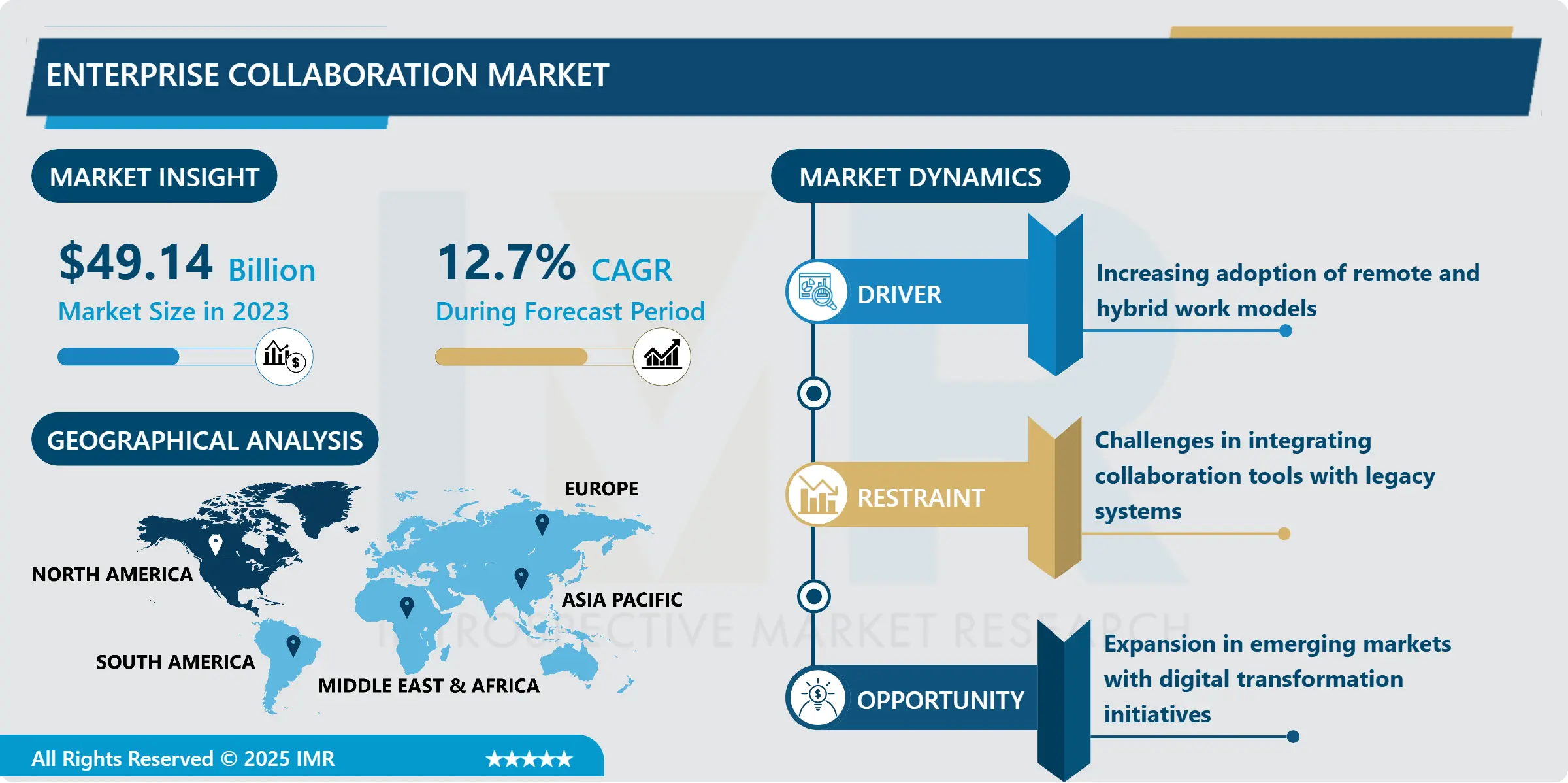
Enterprise Collaboration Market Segment Analysis, Share, and Forecast Report (2024-2032)
Enterprise Collaboration Market Size Was Valued at USD 49.14 Billion in 2023, and is Projected to Reach USD 132.64 Billion by 2032, Growing at a CAGR of 12.7% From 2024-2032.

IMR Group
Description
Enterprise Collaboration Market Synopsis:
Enterprise Collaboration Market Size Was Valued at USD 49.14 Billion in 2023, and is Projected to Reach USD 132.64 Billion by 2032, Growing at a CAGR of 12.7% From 2024-2032.
The enterprise collaboration markets itself on tools and solutions that aim at enhancing communication and work on organization-based enterprise. Such technologies include messaging, video conferencing, cloud collaboration, and integrate work flow platforms for the purpose of inter connectiveness for the employees, partners and even customers.
Businesses and other institutions irrespective of the fields of their operation are gradually understanding the importance of having efficient communication and cooperation instruments for ensuring company sustainability, operational effectiveness, and employees’ motivation. The adoption of cloud services and the introduction of artificial intelligence have extended enterprise collaboration bringing in user-specific experience and recommendation, and business intelligence services. They enable firms to function effectively by improving on the manner in which teams operate and make decisions.
The exponentially growing collaborative technologies have been needed most of all in industries with higher compliance and data safety requirements. Specifically, firms are focusing on those solutions that are equipped with essential tools from encryption to compliance requirements to integration with existing solutions. The continuous expansion of international and intercompany cooperation and the global focus on real-time collaboration strengthen the market’s growth. The market for enterprise collaboration remains a focal point of major investments in technology from service providers who seek to tap into this highly promising and developing field.
Enterprise Collaboration Market Trend Analysis:
AI-Powered Collaboration Tools
Possibly one of the most revolutionary changes occurring now in the enterprise collaboration market is the addition of artificial intelligence (AI) to the capabilities of the platforms. Cognitive technologies are changing the way employees interact with one another through options such as calendar management for meetings that make the process so easy, real-time translation services to ensure that everyone communicating is on the same page, and best of all, analytics.
AI can look at communication history to suggest the best time for a meeting or suggest social learning interactions between individuals in a team. Such tools as Virtual Legal Assistants or Chatbots became genuinely a must-have for business when it comes to daily operational work, saving employees’ time for more significant business-oriented activities. It’s therefore expected that with the adoption of of these innovations, AI will be the bedrock for next generation collaborative systems and applications for work productivity and people customization.
Rising Demand in Emerging Markets
New markets are the most promising for the further development of the enterprise collaboration sector. Currently, the Asia-Pacific, Latin America, and Middle Eastern countries are implementing the digital strategies supported by the governments, higher Internet availability, and learning organizations’ focus on digital transformation.
Companies located within these regions are now engaging the cloud-based solutions in collaboration to overcome issues of infrastructure and increase innovation. At the same time, these markets contain a vast opportunity in the form of small and medium-sized enterprises (SMEs), as affordable and scalable solutions are their only chance to challenge the major players. This directs provider’s attention to the most growth-oriented markets along with compromising a stable position in the competitive environment.
Enterprise Collaboration Market Segment Analysis:
Enterprise Collaboration Market is Segmented on the basis of Component, Application, Industry Vertical, and Region
By Component, Solution segment is expected to dominate the market during the forecast period
The Solutions segment in the enterprise collaboration market includes software that helps enterprises to have effective communication aids and to optimize business processes and teamwork. Such solutions include end-user communication tools like instant messaging, web-conferencing, unified messaging; file-sharing methods, project collaboration tools and documents sharing.
New collaboration solutions that are based on the cloud environment are becoming more and more popular thanks to their flexibility, availability, and consideration of current remote work trends. Companies, small or large scale implement these solutions within their entities to facilitate their functioning, engage their employees and sustain themselves within a world that is becoming a global village.
By Application, Communication Tools segment expected to held the largest share
Business project management and analytical instruments enable organizations to monitor, control, and assess different tasks and projects in teams. Techniques like Asana, Trello, and Jira are used maximally in different organizations, as they help to assign work, set deadlines, and control the pace of work, increasing team efficacy. Also conducting features that come with the platforms allow businessmen to track results of particular projects, distribution of resources and efficiency of teams. These tools have over the years become valuable assets in the management of projects especially when they require several teams in organization.
Adopting single solution that encapsulate multiple modes of communication such as e-mail, instant messaging, video-telephony and VoIP are widely used as unification of communication tools in order to minimize the gap of communication and facilitate team work. Kinds of collaborative messaging include; Cisco WebEx, Microsoft Teams, RingCentral and among others, petition of unified messaging tools ensure that an employee is able to switch to different types of messaging without having to pull out his/her notes. It enlarges more coordinated and timelier team collaboration, which is crucial for organizations with geographically distributed and or remote teams.
Enterprise Collaboration Market Regional Insights:
North America is Expected to Dominate the Market Over the Forecast period
North America is Expected to Dominate the Market value across the globe. This is attributed to the strong technological environment, high adoption levels of technologically sophisticated collaboration solutions, and key players’ base.
The United States has experienced massive funding in innovative collaboration platforms specifically developed for the large enterprise and remote workforce. People operating at these organisations have higher digital literacy and with the shift towards hybrid working these solutions have been further encouraged. Moreover, the compliance and privacy importance factor are well established in North America, and compliance-driven industries including healthcare, finance, and government make North America vital for the enterprise collaboration providers.
Active Key Players in the Enterprise Collaboration Market:
Atlassian (Australia)
Avaya (United States)
Cisco Systems (United States)
Citrix Systems (United States)
Google (United States)
IBM (United States)
Microsoft (United States)
Mitel Networks (Canada)
RingCentral (United States)
Salesforce (United States)
Slack Technologies (United States)
Smartsheet (United States)
TeamViewer (Germany)
Zoom Video Communications (United States)
Zoho Corporation (India)
Other Active Players
Chapter 1: Introduction
1.1 Scope and Coverage
Chapter 2:Executive Summary
Chapter 3: Market Landscape
3.1 Market Dynamics
3.1.1 Drivers
3.1.2 Restraints
3.1.3 Opportunities
3.1.4 Challenges
3.2 Market Trend Analysis
3.3 PESTLE Analysis
3.4 Porter’s Five Forces Analysis
3.5 Industry Value Chain Analysis
3.6 Ecosystem
3.7 Regulatory Landscape
3.8 Price Trend Analysis
3.9 Patent Analysis
3.10 Technology Evolution
3.11 Investment Pockets
3.12 Import-Export Analysis
Chapter 4: Enterprise Collaboration Market by Component
4.1 Enterprise Collaboration Market Snapshot and Growth Engine
4.2 Enterprise Collaboration Market Overview
4.3 Solutions
4.3.1 Introduction and Market Overview
4.3.2 Historic and Forecasted Market Size in Value USD and Volume Units (2017-2032F)
4.3.3 Key Market Trends, Growth Factors and Opportunities
4.3.4 Solutions: Geographic Segmentation Analysis
4.4 Services
4.4.1 Introduction and Market Overview
4.4.2 Historic and Forecasted Market Size in Value USD and Volume Units (2017-2032F)
4.4.3 Key Market Trends, Growth Factors and Opportunities
4.4.4 Services: Geographic Segmentation Analysis
Chapter 5: Enterprise Collaboration Market by Application
5.1 Enterprise Collaboration Market Snapshot and Growth Engine
5.2 Enterprise Collaboration Market Overview
5.3 Communication Tools
5.3.1 Introduction and Market Overview
5.3.2 Historic and Forecasted Market Size in Value USD and Volume Units (2017-2032F)
5.3.3 Key Market Trends, Growth Factors and Opportunities
5.3.4 Communication Tools: Geographic Segmentation Analysis
5.4 File Sharing & Document Management
5.4.1 Introduction and Market Overview
5.4.2 Historic and Forecasted Market Size in Value USD and Volume Units (2017-2032F)
5.4.3 Key Market Trends, Growth Factors and Opportunities
5.4.4 File Sharing & Document Management: Geographic Segmentation Analysis
5.5 Project Management & Analytics
5.5.1 Introduction and Market Overview
5.5.2 Historic and Forecasted Market Size in Value USD and Volume Units (2017-2032F)
5.5.3 Key Market Trends, Growth Factors and Opportunities
5.5.4 Project Management & Analytics: Geographic Segmentation Analysis
5.6 Unified Messaging
5.6.1 Introduction and Market Overview
5.6.2 Historic and Forecasted Market Size in Value USD and Volume Units (2017-2032F)
5.6.3 Key Market Trends, Growth Factors and Opportunities
5.6.4 Unified Messaging: Geographic Segmentation Analysis
Chapter 6: Enterprise Collaboration Market by Industry Vertical
6.1 Enterprise Collaboration Market Snapshot and Growth Engine
6.2 Enterprise Collaboration Market Overview
6.3 (IT & Telecommunications
6.3.1 Introduction and Market Overview
6.3.2 Historic and Forecasted Market Size in Value USD and Volume Units (2017-2032F)
6.3.3 Key Market Trends, Growth Factors and Opportunities
6.3.4 (IT & Telecommunications: Geographic Segmentation Analysis
6.4 BFSI (Banking
6.4.1 Introduction and Market Overview
6.4.2 Historic and Forecasted Market Size in Value USD and Volume Units (2017-2032F)
6.4.3 Key Market Trends, Growth Factors and Opportunities
6.4.4 BFSI (Banking: Geographic Segmentation Analysis
6.5 Financial Services
6.5.1 Introduction and Market Overview
6.5.2 Historic and Forecasted Market Size in Value USD and Volume Units (2017-2032F)
6.5.3 Key Market Trends, Growth Factors and Opportunities
6.5.4 Financial Services: Geographic Segmentation Analysis
6.6 and Insurance)
6.6.1 Introduction and Market Overview
6.6.2 Historic and Forecasted Market Size in Value USD and Volume Units (2017-2032F)
6.6.3 Key Market Trends, Growth Factors and Opportunities
6.6.4 and Insurance): Geographic Segmentation Analysis
6.7 Healthcare
6.7.1 Introduction and Market Overview
6.7.2 Historic and Forecasted Market Size in Value USD and Volume Units (2017-2032F)
6.7.3 Key Market Trends, Growth Factors and Opportunities
6.7.4 Healthcare: Geographic Segmentation Analysis
6.8 Retail & Consumer Goods
6.8.1 Introduction and Market Overview
6.8.2 Historic and Forecasted Market Size in Value USD and Volume Units (2017-2032F)
6.8.3 Key Market Trends, Growth Factors and Opportunities
6.8.4 Retail & Consumer Goods: Geographic Segmentation Analysis
6.9 Manufacturing
6.9.1 Introduction and Market Overview
6.9.2 Historic and Forecasted Market Size in Value USD and Volume Units (2017-2032F)
6.9.3 Key Market Trends, Growth Factors and Opportunities
6.9.4 Manufacturing: Geographic Segmentation Analysis
6.10 Government & Public Sector
6.10.1 Introduction and Market Overview
6.10.2 Historic and Forecasted Market Size in Value USD and Volume Units (2017-2032F)
6.10.3 Key Market Trends, Growth Factors and Opportunities
6.10.4 Government & Public Sector: Geographic Segmentation Analysis
6.11 Education
6.11.1 Introduction and Market Overview
6.11.2 Historic and Forecasted Market Size in Value USD and Volume Units (2017-2032F)
6.11.3 Key Market Trends, Growth Factors and Opportunities
6.11.4 Education: Geographic Segmentation Analysis
6.12 Others
6.12.1 Introduction and Market Overview
6.12.2 Historic and Forecasted Market Size in Value USD and Volume Units (2017-2032F)
6.12.3 Key Market Trends, Growth Factors and Opportunities
6.12.4 Others: Geographic Segmentation Analysis
Chapter 7: Company Profiles and Competitive Analysis
7.1 Competitive Landscape
7.1.1 Competitive Benchmarking
7.1.2 Enterprise Collaboration Market Share by Manufacturer (2023)
7.1.3 Industry BCG Matrix
7.1.4 Heat Map Analysis
7.1.5 Mergers and Acquisitions
7.2 ATLASSIAN
7.2.1 Company Overview
7.2.2 Key Executives
7.2.3 Company Snapshot
7.2.4 Role of the Company in the Market
7.2.5 Sustainability and Social Responsibility
7.2.6 Operating Business Segments
7.2.7 Product Portfolio
7.2.8 Business Performance
7.2.9 Key Strategic Moves and Recent Developments
7.2.10 SWOT Analysis
7.3 AVAYA
7.4 CISCO SYSTEMS
7.5 CITRIX SYSTEMS
7.6 GOOGLE
7.7 IBM
7.8 MICROSOFT
7.9 MITEL NETWORKS
7.10 RINGCENTRAL
7.11 SALESFORCE
7.12 SLACK TECHNOLOGIES
7.13 SMARTSHEET
7.14 TEAMVIEWER
7.15 ZOOM VIDEO COMMUNICATIONS
7.16 ZOHO CORPORATION
7.17 OTHER ACTIVE PLAYERS
Chapter 8: Global Enterprise Collaboration Market By Region
8.1 Overview
8.2. North America Enterprise Collaboration Market
8.2.1 Key Market Trends, Growth Factors and Opportunities
8.2.2 Top Key Companies
8.2.3 Historic and Forecasted Market Size by Segments
8.2.4 Historic and Forecasted Market Size By Component
8.2.4.1 Solutions
8.2.4.2 Services
8.2.5 Historic and Forecasted Market Size By Application
8.2.5.1 Communication Tools
8.2.5.2 File Sharing & Document Management
8.2.5.3 Project Management & Analytics
8.2.5.4 Unified Messaging
8.2.6 Historic and Forecasted Market Size By Industry Vertical
8.2.6.1 (IT & Telecommunications
8.2.6.2 BFSI (Banking
8.2.6.3 Financial Services
8.2.6.4 and Insurance)
8.2.6.5 Healthcare
8.2.6.6 Retail & Consumer Goods
8.2.6.7 Manufacturing
8.2.6.8 Government & Public Sector
8.2.6.9 Education
8.2.6.10 Others
8.2.7 Historic and Forecast Market Size by Country
8.2.7.1 US
8.2.7.2 Canada
8.2.7.3 Mexico
8.3. Eastern Europe Enterprise Collaboration Market
8.3.1 Key Market Trends, Growth Factors and Opportunities
8.3.2 Top Key Companies
8.3.3 Historic and Forecasted Market Size by Segments
8.3.4 Historic and Forecasted Market Size By Component
8.3.4.1 Solutions
8.3.4.2 Services
8.3.5 Historic and Forecasted Market Size By Application
8.3.5.1 Communication Tools
8.3.5.2 File Sharing & Document Management
8.3.5.3 Project Management & Analytics
8.3.5.4 Unified Messaging
8.3.6 Historic and Forecasted Market Size By Industry Vertical
8.3.6.1 (IT & Telecommunications
8.3.6.2 BFSI (Banking
8.3.6.3 Financial Services
8.3.6.4 and Insurance)
8.3.6.5 Healthcare
8.3.6.6 Retail & Consumer Goods
8.3.6.7 Manufacturing
8.3.6.8 Government & Public Sector
8.3.6.9 Education
8.3.6.10 Others
8.3.7 Historic and Forecast Market Size by Country
8.3.7.1 Russia
8.3.7.2 Bulgaria
8.3.7.3 The Czech Republic
8.3.7.4 Hungary
8.3.7.5 Poland
8.3.7.6 Romania
8.3.7.7 Rest of Eastern Europe
8.4. Western Europe Enterprise Collaboration Market
8.4.1 Key Market Trends, Growth Factors and Opportunities
8.4.2 Top Key Companies
8.4.3 Historic and Forecasted Market Size by Segments
8.4.4 Historic and Forecasted Market Size By Component
8.4.4.1 Solutions
8.4.4.2 Services
8.4.5 Historic and Forecasted Market Size By Application
8.4.5.1 Communication Tools
8.4.5.2 File Sharing & Document Management
8.4.5.3 Project Management & Analytics
8.4.5.4 Unified Messaging
8.4.6 Historic and Forecasted Market Size By Industry Vertical
8.4.6.1 (IT & Telecommunications
8.4.6.2 BFSI (Banking
8.4.6.3 Financial Services
8.4.6.4 and Insurance)
8.4.6.5 Healthcare
8.4.6.6 Retail & Consumer Goods
8.4.6.7 Manufacturing
8.4.6.8 Government & Public Sector
8.4.6.9 Education
8.4.6.10 Others
8.4.7 Historic and Forecast Market Size by Country
8.4.7.1 Germany
8.4.7.2 UK
8.4.7.3 France
8.4.7.4 The Netherlands
8.4.7.5 Italy
8.4.7.6 Spain
8.4.7.7 Rest of Western Europe
8.5. Asia Pacific Enterprise Collaboration Market
8.5.1 Key Market Trends, Growth Factors and Opportunities
8.5.2 Top Key Companies
8.5.3 Historic and Forecasted Market Size by Segments
8.5.4 Historic and Forecasted Market Size By Component
8.5.4.1 Solutions
8.5.4.2 Services
8.5.5 Historic and Forecasted Market Size By Application
8.5.5.1 Communication Tools
8.5.5.2 File Sharing & Document Management
8.5.5.3 Project Management & Analytics
8.5.5.4 Unified Messaging
8.5.6 Historic and Forecasted Market Size By Industry Vertical
8.5.6.1 (IT & Telecommunications
8.5.6.2 BFSI (Banking
8.5.6.3 Financial Services
8.5.6.4 and Insurance)
8.5.6.5 Healthcare
8.5.6.6 Retail & Consumer Goods
8.5.6.7 Manufacturing
8.5.6.8 Government & Public Sector
8.5.6.9 Education
8.5.6.10 Others
8.5.7 Historic and Forecast Market Size by Country
8.5.7.1 China
8.5.7.2 India
8.5.7.3 Japan
8.5.7.4 South Korea
8.5.7.5 Malaysia
8.5.7.6 Thailand
8.5.7.7 Vietnam
8.5.7.8 The Philippines
8.5.7.9 Australia
8.5.7.10 New Zealand
8.5.7.11 Rest of APAC
8.6. Middle East & Africa Enterprise Collaboration Market
8.6.1 Key Market Trends, Growth Factors and Opportunities
8.6.2 Top Key Companies
8.6.3 Historic and Forecasted Market Size by Segments
8.6.4 Historic and Forecasted Market Size By Component
8.6.4.1 Solutions
8.6.4.2 Services
8.6.5 Historic and Forecasted Market Size By Application
8.6.5.1 Communication Tools
8.6.5.2 File Sharing & Document Management
8.6.5.3 Project Management & Analytics
8.6.5.4 Unified Messaging
8.6.6 Historic and Forecasted Market Size By Industry Vertical
8.6.6.1 (IT & Telecommunications
8.6.6.2 BFSI (Banking
8.6.6.3 Financial Services
8.6.6.4 and Insurance)
8.6.6.5 Healthcare
8.6.6.6 Retail & Consumer Goods
8.6.6.7 Manufacturing
8.6.6.8 Government & Public Sector
8.6.6.9 Education
8.6.6.10 Others
8.6.7 Historic and Forecast Market Size by Country
8.6.7.1 Turkiye
8.6.7.2 Bahrain
8.6.7.3 Kuwait
8.6.7.4 Saudi Arabia
8.6.7.5 Qatar
8.6.7.6 UAE
8.6.7.7 Israel
8.6.7.8 South Africa
8.7. South America Enterprise Collaboration Market
8.7.1 Key Market Trends, Growth Factors and Opportunities
8.7.2 Top Key Companies
8.7.3 Historic and Forecasted Market Size by Segments
8.7.4 Historic and Forecasted Market Size By Component
8.7.4.1 Solutions
8.7.4.2 Services
8.7.5 Historic and Forecasted Market Size By Application
8.7.5.1 Communication Tools
8.7.5.2 File Sharing & Document Management
8.7.5.3 Project Management & Analytics
8.7.5.4 Unified Messaging
8.7.6 Historic and Forecasted Market Size By Industry Vertical
8.7.6.1 (IT & Telecommunications
8.7.6.2 BFSI (Banking
8.7.6.3 Financial Services
8.7.6.4 and Insurance)
8.7.6.5 Healthcare
8.7.6.6 Retail & Consumer Goods
8.7.6.7 Manufacturing
8.7.6.8 Government & Public Sector
8.7.6.9 Education
8.7.6.10 Others
8.7.7 Historic and Forecast Market Size by Country
8.7.7.1 Brazil
8.7.7.2 Argentina
8.7.7.3 Rest of SA
Chapter 9 Analyst Viewpoint and Conclusion
9.1 Recommendations and Concluding Analysis
9.2 Potential Market Strategies
Chapter 10 Research Methodology
10.1 Research Process
10.2 Primary Research
10.3 Secondary Research
Q1: What would be the forecast period in the Enterprise Collaboration Market research report?
A1: The forecast period in the Enterprise Collaboration Market research report is 2024-2032.
Q2: Who are the key players in the Enterprise Collaboration Market?
A2: Atlassian (Australia),Avaya (United States),Cisco Systems (United States),Citrix Systems (United States),Google (United States),IBM (United States),Microsoft (United States),Mitel Networks (Canada),RingCentral (United States),Salesforce (United States),Slack Technologies (United States),Smartsheet (United States),TeamViewer (Germany),Zoom Video Communications (United States),Zoho Corporation (India), and Other Active Players.
Q3: What are the segments of the Enterprise Collaboration Market?
A3: The Enterprise Collaboration Market is segmented into Component, Application, Industry Vertical and Region. by Component, market is categorized into (Solutions, Services), Application, market is categorized into (Communication Tools, File Sharing & Document Management, Project Management & Analytics, Unified Messaging), By Industry Vertical, market is categorized into (IT & Telecommunications, BFSI (Banking, Financial Services, and Insurance), Healthcare, Retail & Consumer Goods, Manufacturing, Government & Public Sector, Education, Others) By Region, it is analyzed across North America (U.S., Canada, Mexico),Eastern Europe (Russia, Bulgaria, The Czech Republic, Hungary, Poland, Romania, Rest of Eastern Europe),Western Europe (Germany, UK, France, Netherlands, Italy, Spain, Rest of Western Europe),Asia Pacific (China, India, Japan, South Korea, Malaysia, Thailand, Vietnam, The Philippines, Australia, New-Zealand, Rest of APAC),Middle East & Africa (Turkiye, Bahrain, Kuwait, Saudi Arabia, Qatar, UAE, Israel, South Africa),South America (Brazil, Argentina, Rest of SA).
Q4: What is the Enterprise Collaboration Market?
A4: The enterprise collaboration markets itself on tools and solutions that aim at enhancing communication and work on organization-based enterprise. Such technologies include messaging, video conferencing, cloud collaboration, and integrate work –flow platforms for the purpose of inter connectiveness for the employees, partners and even customers.
Q5: How big is the Enterprise Collaboration Market?
A5: Enterprise Collaboration Market Size Was Valued at USD 49.14 Billion in 2023, and is Projected to Reach USD 132.64 Billion by 2032, Growing at a CAGR of 12.7% From 2024-2032.
How to Buy a Report from eminsights.jp
On the product page, choose the license you want: Single-User License, Multi-User License or Enterprise License.
If you required report in your native language, then you can click on Translated Report button and fill out the form with report name and language you want, then our team will contact you as soon as possible.
Click the Buy Now button.
You will be redirected to the checkout page. Enter your company details and payment information.
Click Place Order to complete the purchase.
Confirmation: You’ll receive an order confirmation and our team will contact you shortly with your ordered report.
If you have any questions, fill out the contact form below or email us at bizdev@eminsights.net.
Thank you for choosing eminsights.jp!