Stay Ahead in Fast-Growing Economies.
Browse Reports Now
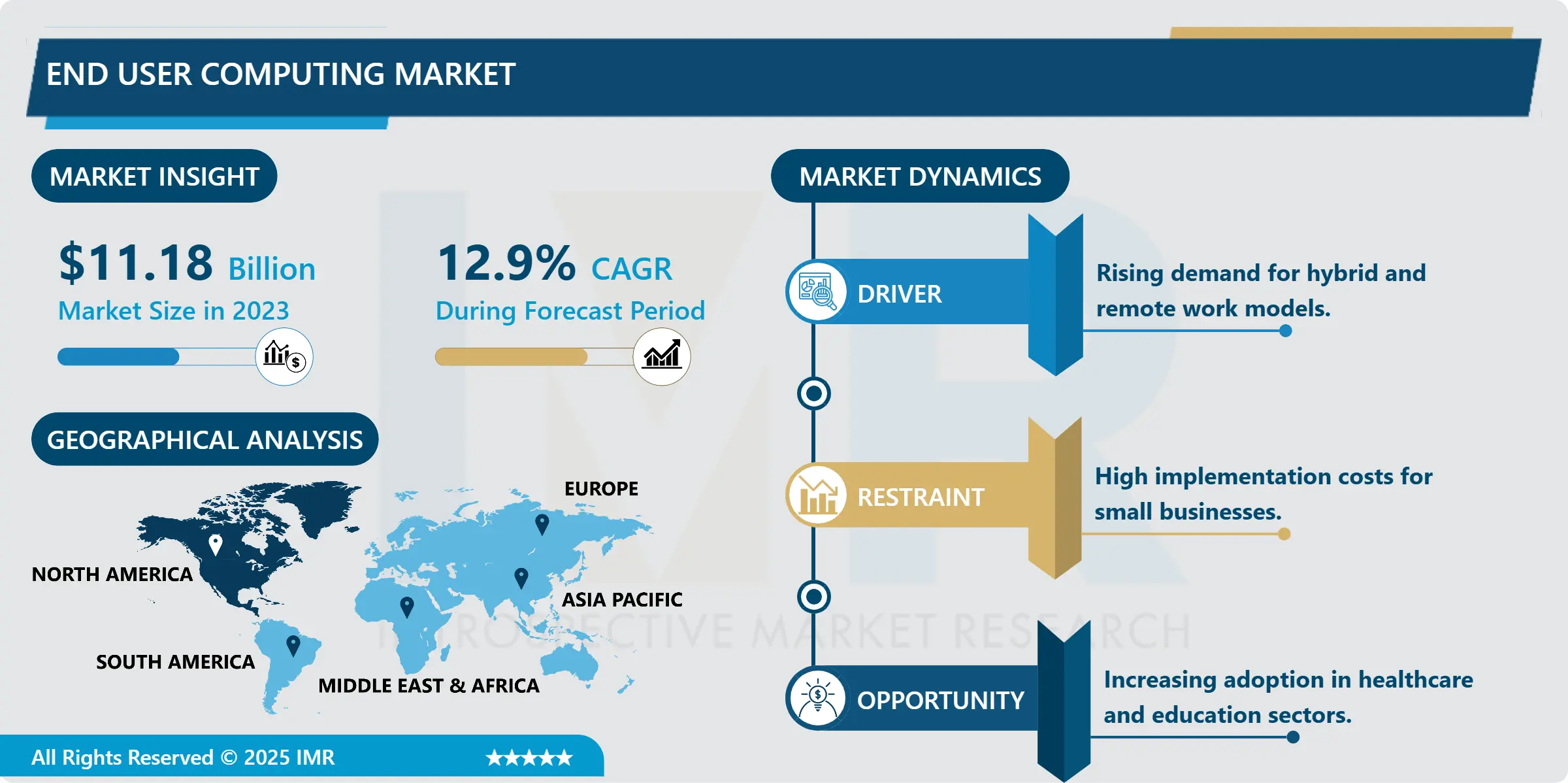
End User Computing Market Share, Trends & Market Forecast (2024-2032)
The End User Computing (EUC) market encompasses hardware, software and services designed to deliver, manage and secure end-user digital workspaces.

IMR Group
Description
End User Computing Market Synopsis:
End User Computing Market Size Was Valued at USD 11.18 Billion in 2023, and is Projected to Reach USD 33.32 Billion by 2032, Growing at a CAGR of 12.9 % From 2024-2032.
The End User Computing (EUC) market encompasses hardware, software and services designed to deliver, manage and secure end-user digital workspaces. It covers devices (PCs, laptops, tablets), operating systems, virtualization platforms, endpoint management, collaboration tools and support services that enable seamless, secure access to applications and data.
The end-user computing market is experiencing tremendous growth due to the advanced integration of digital transformations into their operations for increased performance. The current transition to a flexible work environment where employees work from home or in combination with from an office has increased the need for virtual desktop solutions and ways of accessing data securely. EUC technologies enable users to communicate within the enterprise effectively and obtain resources and information conveniently, and is used across industries.
The end-user computing domain has been expanded through the advancement of cloud solutions to address scalability and cost challenges. Companies are utilizing cloud based VDI and DaaS solution to provide support to a number of employees with reduced investment in IT networks. Steady advancements in the application of AI and machine learning in end-user computing tools such as one-time-download for tailored user interface and user experience and advanced analytics for prediction are also contributing to growth of this market. The rise in the need to create engagement among employees and to reduce the complexity of IT solutions is fueling the market for end-user computing globally.
End User Computing Market Trend Analysis:
Rise of Cloud-Based Virtual Desktop Solutions
Another primary phenomenon in the end-user computing market is the higher speed of moving to cloud-based VDI solutions like DaaS. Such solutions have emerged and are widely used being easy to use, inexpensive and suitable for working under new conditions, with remote work arrangements. Cloud-based VDI doesn’t require huge infractions on the organizational premises because it allows users to access centralized virtual operating environments of desktops and applications over the cloud.
The trend has been further fueled with the adoption of hybrid working models, the need to provide business continuity solutions and a shift to cloud service providers who offer high degree of security and compliance. It has become a popular model from which organizations are learning their employees’ computer and operating system access to make the workplace more secure and alleviate IT infrastructure costs.
Growing Demand in the Healthcare Sector
The largest growth opportunity for end user computing is seen in the healthcare packaging industry. Given the rise of telemedicine, EHRs, and other RPM devices, healthcare facilities must provide secure, efficient EUCs for practitioners. These solutions allow caregivers to work from anywhere, and on any device, to access patient data and their required applications to ensure patient care remains smooth and uninterrupted.
Strict requirements to control data, as well as compliance with legal acts and standards, such as the HIPAA Act, make the healthcare industry have effective and reliable end-user computing tools. This growing demand means that providers who can offer solutions meeting the specific needs of the healthcare industry are in a good position to lock into this space.
End User Computing Market Segment Analysis:
End User Computing Market is Segmented on the basis of Type, Deployment, End User, and Region
By Type, Solution segment is expected to dominate the market during the forecast period
The End User Computing (EUC) market is witnessing significant growth, with the solution segment projected to dominate during the forecast period. This dominance can be attributed to the increasing demand for centralized, secure, and scalable solutions that empower employees while enabling IT teams to manage endpoints efficiently. EUC solutions, such as virtual desktop infrastructure (VDI), desktop-as-a-service (DaaS), and application virtualization, are gaining traction across industries as organizations strive for greater flexibility, business continuity, and remote workforce enablement.
The shift towards digital transformation and hybrid work models has further accelerated the adoption of these technologies. Enterprises are increasingly prioritizing user experience, data security, and regulatory compliance, making robust EUC solutions a strategic imperative. Additionally, the growing reliance on cloud-based platforms and the need for cost-effective, agile IT infrastructure reinforce the solution segment’s leadership within the EUC market landscape. This trend is expected to continue, driven by innovation and evolving workplace demands.
By Deployment, the Cloud segment expected to held the largest share
The End User Computing (EUC) market is witnessing a significant shift towards cloud-based deployment, with the cloud segment expected to command the largest market share. This trend is driven by the growing demand for scalable, flexible, and cost-effective IT infrastructure across enterprises. Cloud deployment enables organizations to provide remote access to computing resources, ensuring seamless collaboration and workforce mobility, critical in the era of hybrid and remote work environments.
Cloud platforms offer enhanced data security, real-time updates, and easier maintenance compared to traditional on-premise systems. Businesses are increasingly leveraging cloud-based EUC solutions to streamline IT operations, reduce capital expenditure, and improve user experience. The scalability of cloud services also allows companies to respond more efficiently to dynamic workloads and evolving business needs. As digital transformation accelerates, the adoption of cloud-based EUC solutions is expected to further rise, positioning this deployment model as a strategic enabler of agility and operational efficiency in the enterprise landscape.
End User Computing Market Regional Insights:
North America is Expected to Dominate the Market Over the Forecast period
The End User Computing (EUC) market in North America is poised to dominate the global landscape over the forecast period, driven by robust digital infrastructure, high cloud adoption rates, and the widespread implementation of remote and hybrid work models. Enterprises across the region are increasingly investing in EUC solutions to enhance workforce mobility, improve user experience, and streamline IT management.
The presence of major technology providers, coupled with strong demand from sectors such as finance, healthcare, and manufacturing, further accelerates market growth. Additionally, the region’s regulatory focus on data security and compliance supports the adoption of virtual desktop infrastructure (VDI) and desktop-as-a-service (DaaS) offerings. North America’s leadership in innovation, combined with a mature enterprise IT ecosystem, positions it as a key driver of advancements in EUC platforms. As organizations prioritize operational flexibility and employee productivity, the region is expected to maintain a significant share of the global EUC market.
Active Key Players in the End User Computing Market
Amazon Web Services (United States)
Broadcom Inc. (United States)
Cisco Systems (United States)
Citrix Systems (United States)
Dell Technologies (United States)
Google LLC (United States)
Hewlett Packard Enterprise (United States)
IGEL Technology (Germany)
Lenovo Group (China)
Microsoft Corporation (United States)
NetApp (United States)
Nutanix (United States)
Parallels International (United States)
VMware Inc. (United States))
Workspot Inc. (United States
Other Active Players
Chapter 1: Introduction
1.1 Scope and Coverage
Chapter 2:Executive Summary
Chapter 3: Market Landscape
3.1 Market Dynamics
3.1.1 Drivers
3.1.2 Restraints
3.1.3 Opportunities
3.1.4 Challenges
3.2 Market Trend Analysis
3.3 PESTLE Analysis
3.4 Porter’s Five Forces Analysis
3.5 Industry Value Chain Analysis
3.6 Ecosystem
3.7 Regulatory Landscape
3.8 Price Trend Analysis
3.9 Patent Analysis
3.10 Technology Evolution
3.11 Investment Pockets
3.12 Import-Export Analysis
Chapter 4: End User Computing Market by Type
4.1 End User Computing Market Snapshot and Growth Engine
4.2 End User Computing Market Overview
4.3 Solution
4.3.1 Introduction and Market Overview
4.3.2 Historic and Forecasted Market Size in Value USD and Volume Units (2017-2032F)
4.3.3 Key Market Trends, Growth Factors and Opportunities
4.3.4 Solution: Geographic Segmentation Analysis
4.4 Service
4.4.1 Introduction and Market Overview
4.4.2 Historic and Forecasted Market Size in Value USD and Volume Units (2017-2032F)
4.4.3 Key Market Trends, Growth Factors and Opportunities
4.4.4 Service: Geographic Segmentation Analysis
Chapter 5: End User Computing Market by Deployment
5.1 End User Computing Market Snapshot and Growth Engine
5.2 End User Computing Market Overview
5.3 Cloud-based
5.3.1 Introduction and Market Overview
5.3.2 Historic and Forecasted Market Size in Value USD and Volume Units (2017-2032F)
5.3.3 Key Market Trends, Growth Factors and Opportunities
5.3.4 Cloud-based: Geographic Segmentation Analysis
5.4 On-Premises
5.4.1 Introduction and Market Overview
5.4.2 Historic and Forecasted Market Size in Value USD and Volume Units (2017-2032F)
5.4.3 Key Market Trends, Growth Factors and Opportunities
5.4.4 On-Premises: Geographic Segmentation Analysis
Chapter 6: End User Computing Market by End User
6.1 End User Computing Market Snapshot and Growth Engine
6.2 End User Computing Market Overview
6.3 IT and telecom
6.3.1 Introduction and Market Overview
6.3.2 Historic and Forecasted Market Size in Value USD and Volume Units (2017-2032F)
6.3.3 Key Market Trends, Growth Factors and Opportunities
6.3.4 IT and telecom: Geographic Segmentation Analysis
6.4 BFSI
6.4.1 Introduction and Market Overview
6.4.2 Historic and Forecasted Market Size in Value USD and Volume Units (2017-2032F)
6.4.3 Key Market Trends, Growth Factors and Opportunities
6.4.4 BFSI: Geographic Segmentation Analysis
6.5 Healthcare
6.5.1 Introduction and Market Overview
6.5.2 Historic and Forecasted Market Size in Value USD and Volume Units (2017-2032F)
6.5.3 Key Market Trends, Growth Factors and Opportunities
6.5.4 Healthcare: Geographic Segmentation Analysis
6.6 Retail
6.6.1 Introduction and Market Overview
6.6.2 Historic and Forecasted Market Size in Value USD and Volume Units (2017-2032F)
6.6.3 Key Market Trends, Growth Factors and Opportunities
6.6.4 Retail: Geographic Segmentation Analysis
6.7 Others
6.7.1 Introduction and Market Overview
6.7.2 Historic and Forecasted Market Size in Value USD and Volume Units (2017-2032F)
6.7.3 Key Market Trends, Growth Factors and Opportunities
6.7.4 Others: Geographic Segmentation Analysis
Chapter 7: Company Profiles and Competitive Analysis
7.1 Competitive Landscape
7.1.1 Competitive Benchmarking
7.1.2 End User Computing Market Share by Manufacturer (2023)
7.1.3 Industry BCG Matrix
7.1.4 Heat Map Analysis
7.1.5 Mergers and Acquisitions
7.2 AMAZON WEB SERVICES (UNITED STATES)
7.2.1 Company Overview
7.2.2 Key Executives
7.2.3 Company Snapshot
7.2.4 Role of the Company in the Market
7.2.5 Sustainability and Social Responsibility
7.2.6 Operating Business Segments
7.2.7 Product Portfolio
7.2.8 Business Performance
7.2.9 Key Strategic Moves and Recent Developments
7.2.10 SWOT Analysis
7.3 BROADCOM INC. (UNITED STATES)
7.4 CISCO SYSTEMS (UNITED STATES)
7.5 CITRIX SYSTEMS (UNITED STATES)
7.6 DELL TECHNOLOGIES (UNITED STATES)
7.7 GOOGLE LLC (UNITED STATES)
7.8 HEWLETT PACKARD ENTERPRISE (UNITED STATES)
7.9 IGEL TECHNOLOGY (GERMANY)
7.10 LENOVO GROUP (CHINA)
7.11 MICROSOFT CORPORATION (UNITED STATES)
7.12 NETAPP (UNITED STATES)
7.13 NUTANIX (UNITED STATES)
7.14 PARALLELS INTERNATIONAL (UNITED STATES)
7.15 VMWARE INC. (UNITED STATES))
7.16 WORKSPOT INC. (UNITED STATES)
7.17 OTHER ACTIVE PLAYERS
Chapter 8: Global End User Computing Market By Region
8.1 Overview
8.2. North America End User Computing Market
8.2.1 Key Market Trends, Growth Factors and Opportunities
8.2.2 Top Key Companies
8.2.3 Historic and Forecasted Market Size by Segments
8.2.4 Historic and Forecasted Market Size By Type
8.2.4.1 Solution
8.2.4.2 Service
8.2.5 Historic and Forecasted Market Size By Deployment
8.2.5.1 Cloud-based
8.2.5.2 On-Premises
8.2.6 Historic and Forecasted Market Size By End User
8.2.6.1 IT and telecom
8.2.6.2 BFSI
8.2.6.3 Healthcare
8.2.6.4 Retail
8.2.6.5 Others
8.2.7 Historic and Forecast Market Size by Country
8.2.7.1 US
8.2.7.2 Canada
8.2.7.3 Mexico
8.3. Eastern Europe End User Computing Market
8.3.1 Key Market Trends, Growth Factors and Opportunities
8.3.2 Top Key Companies
8.3.3 Historic and Forecasted Market Size by Segments
8.3.4 Historic and Forecasted Market Size By Type
8.3.4.1 Solution
8.3.4.2 Service
8.3.5 Historic and Forecasted Market Size By Deployment
8.3.5.1 Cloud-based
8.3.5.2 On-Premises
8.3.6 Historic and Forecasted Market Size By End User
8.3.6.1 IT and telecom
8.3.6.2 BFSI
8.3.6.3 Healthcare
8.3.6.4 Retail
8.3.6.5 Others
8.3.7 Historic and Forecast Market Size by Country
8.3.7.1 Russia
8.3.7.2 Bulgaria
8.3.7.3 The Czech Republic
8.3.7.4 Hungary
8.3.7.5 Poland
8.3.7.6 Romania
8.3.7.7 Rest of Eastern Europe
8.4. Western Europe End User Computing Market
8.4.1 Key Market Trends, Growth Factors and Opportunities
8.4.2 Top Key Companies
8.4.3 Historic and Forecasted Market Size by Segments
8.4.4 Historic and Forecasted Market Size By Type
8.4.4.1 Solution
8.4.4.2 Service
8.4.5 Historic and Forecasted Market Size By Deployment
8.4.5.1 Cloud-based
8.4.5.2 On-Premises
8.4.6 Historic and Forecasted Market Size By End User
8.4.6.1 IT and telecom
8.4.6.2 BFSI
8.4.6.3 Healthcare
8.4.6.4 Retail
8.4.6.5 Others
8.4.7 Historic and Forecast Market Size by Country
8.4.7.1 Germany
8.4.7.2 UK
8.4.7.3 France
8.4.7.4 The Netherlands
8.4.7.5 Italy
8.4.7.6 Spain
8.4.7.7 Rest of Western Europe
8.5. Asia Pacific End User Computing Market
8.5.1 Key Market Trends, Growth Factors and Opportunities
8.5.2 Top Key Companies
8.5.3 Historic and Forecasted Market Size by Segments
8.5.4 Historic and Forecasted Market Size By Type
8.5.4.1 Solution
8.5.4.2 Service
8.5.5 Historic and Forecasted Market Size By Deployment
8.5.5.1 Cloud-based
8.5.5.2 On-Premises
8.5.6 Historic and Forecasted Market Size By End User
8.5.6.1 IT and telecom
8.5.6.2 BFSI
8.5.6.3 Healthcare
8.5.6.4 Retail
8.5.6.5 Others
8.5.7 Historic and Forecast Market Size by Country
8.5.7.1 China
8.5.7.2 India
8.5.7.3 Japan
8.5.7.4 South Korea
8.5.7.5 Malaysia
8.5.7.6 Thailand
8.5.7.7 Vietnam
8.5.7.8 The Philippines
8.5.7.9 Australia
8.5.7.10 New Zealand
8.5.7.11 Rest of APAC
8.6. Middle East & Africa End User Computing Market
8.6.1 Key Market Trends, Growth Factors and Opportunities
8.6.2 Top Key Companies
8.6.3 Historic and Forecasted Market Size by Segments
8.6.4 Historic and Forecasted Market Size By Type
8.6.4.1 Solution
8.6.4.2 Service
8.6.5 Historic and Forecasted Market Size By Deployment
8.6.5.1 Cloud-based
8.6.5.2 On-Premises
8.6.6 Historic and Forecasted Market Size By End User
8.6.6.1 IT and telecom
8.6.6.2 BFSI
8.6.6.3 Healthcare
8.6.6.4 Retail
8.6.6.5 Others
8.6.7 Historic and Forecast Market Size by Country
8.6.7.1 Turkiye
8.6.7.2 Bahrain
8.6.7.3 Kuwait
8.6.7.4 Saudi Arabia
8.6.7.5 Qatar
8.6.7.6 UAE
8.6.7.7 Israel
8.6.7.8 South Africa
8.7. South America End User Computing Market
8.7.1 Key Market Trends, Growth Factors and Opportunities
8.7.2 Top Key Companies
8.7.3 Historic and Forecasted Market Size by Segments
8.7.4 Historic and Forecasted Market Size By Type
8.7.4.1 Solution
8.7.4.2 Service
8.7.5 Historic and Forecasted Market Size By Deployment
8.7.5.1 Cloud-based
8.7.5.2 On-Premises
8.7.6 Historic and Forecasted Market Size By End User
8.7.6.1 IT and telecom
8.7.6.2 BFSI
8.7.6.3 Healthcare
8.7.6.4 Retail
8.7.6.5 Others
8.7.7 Historic and Forecast Market Size by Country
8.7.7.1 Brazil
8.7.7.2 Argentina
8.7.7.3 Rest of SA
Chapter 9 Analyst Viewpoint and Conclusion
9.1 Recommendations and Concluding Analysis
9.2 Potential Market Strategies
Chapter 10 Research Methodology
10.1 Research Process
10.2 Primary Research
10.3 Secondary Research
Q1: What would be the forecast period in the End User Computing Market Research report?
A1: The forecast period in the End User Computing Market research report is 2024-2032.
Q2: Who are the key players in the End User Computing Market?
A2: Amazon Web Services (United States), Broadcom Inc. (United States), Cisco Systems (United States), Citrix Systems (United States), Dell Technologies (United States), Google LLC (United States), Hewlett Packard Enterprise (United States), IGEL Technology (Germany), Lenovo Group (China), Microsoft Corporation (United States), NetApp (United States), Nutanix (United States), Parallels International (United States), VMware Inc. (United States), Workspot Inc. (United States), and Other Active Players
Q3: What are the segments of the End User Computing Market?
A3: The End User Computing market is segmented into Type, Deployment, End User, and region. By Type, the market is categorized into Solutions and services. By Deployment, the market is categorized into Cloud-based and on-premises. By End User, the market is categorized into IT and telecom, BFSI, Healthcare, Retail, and Others. By Region, it is analyzed across North America (U.S., Canada, Mexico), Eastern Europe (Russia, Bulgaria, The Czech Republic, Hungary, Poland, Romania, Rest of Eastern Europe), Western Europe (Germany, UK, France, Netherlands, Italy, Spain, Rest of Western Europe), Asia Pacific (China, India, Japan, South Korea, Malaysia, Thailand, Vietnam, The Philippines, Australia, New-Zealand, Rest of APAC), Middle East & Africa (Turkiye, Bahrain, Kuwait, Saudi Arabia, Qatar, UAE, Israel, South Africa), South America (Brazil, Argentina, Rest of SA).
Q4: What is the End User Computing Market?
A4: The End User Computing (EUC) market encompasses hardware, software and services designed to deliver, manage and secure end-user digital workspaces. It covers devices (PCs, laptops, tablets), operating systems, virtualization platforms, endpoint management, collaboration tools and support services that enable seamless, secure access to applications and data.
Q5: How big is the End User Computing Market?
A5: End User Computing Market Size Was Valued at USD 11.18 Billion in 2023, and is Projected to Reach USD 33.32 Billion by 2032, Growing at a CAGR of 12.9% From 2024-2032.
How to Buy a Report from eminsights.jp
On the product page, choose the license you want: Single-User License, Multi-User License or Enterprise License.
If you required report in your native language, then you can click on Translated Report button and fill out the form with report name and language you want, then our team will contact you as soon as possible.
Click the Buy Now button.
You will be redirected to the checkout page. Enter your company details and payment information.
Click Place Order to complete the purchase.
Confirmation: You’ll receive an order confirmation and our team will contact you shortly with your ordered report.
If you have any questions, fill out the contact form below or email us at bizdev@eminsights.net.
Thank you for choosing eminsights.jp!