Stay Ahead in Fast-Growing Economies.
Browse Reports Now
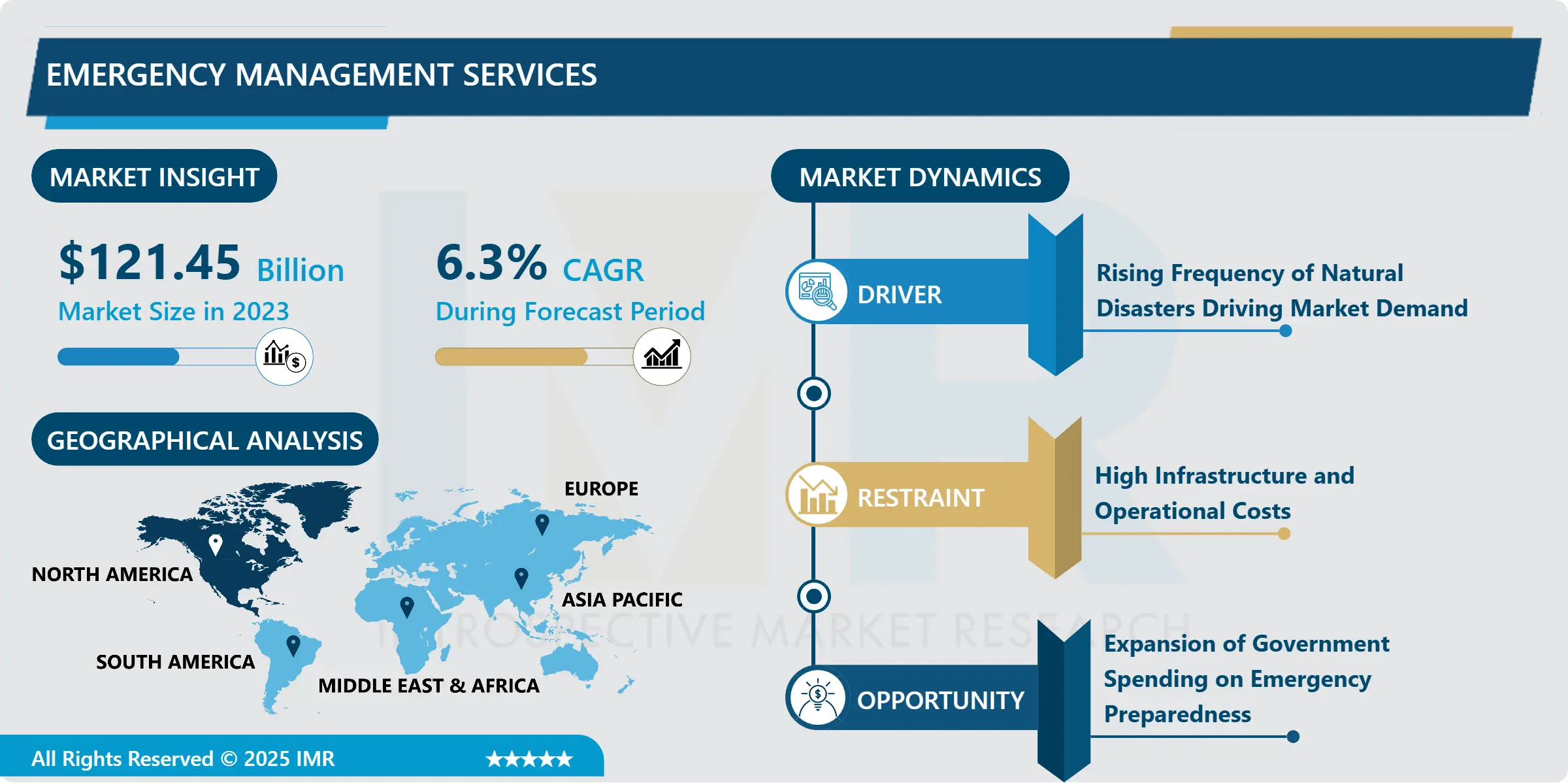
Emergency Management Services Market Outlook & Forecast to 2032
Emergency Management Services Market Size Was Valued at USD 121.45 Billion in 2023, and is Projected to Reach USD 210.47 Billion by 2032, Growing at a CAGR of 6.3% From 2024-2032 The EMS market of services refers to those services that are in some way related to the prevention, preparedness, response, and recovery from emergencies and disasters.

IMR Group
Description
Emergency Management Services Market Synopsis
Emergency Management Services Market Size Was Valued at USD 121.45 Billion in 2023, and is Projected to Reach USD 210.47 Billion by 2032, Growing at a CAGR of 6.3% From 2024-2032
The EMS market of services refers to those services that are in some way related to the prevention, preparedness, response, and recovery from emergencies and disasters. These services are crucial in providing protective, healthy and sustainable societies during both natural and manmade disasters. EMS is a process that encompasses the preparedness, response, recovery, and mitigation activities.
The EMS is one of the key subsectors in the disaster management value chain that acts as a link between the life safety and property protection and the environment in case of emergencies. This market has especially tended to expand over the past few years because of higher instances of natural disasters like hurricanes, earthquakes and floods as well as wildfires. Moreover, those emergencies that are created by people, for example, industrial disasters, acts of terrorism, and other disease outbreaks such as pandemics, press on the use of emergency management services.
AI, big data analytics, and IoT are the technologies used whereby people have come up with new ways of implementing emergency management services through technology. These innovations give timely information, probable solutions and intelligent response that improves disaster operations management. Additionally, climate change has also contributed to increasing the number and intensity of natural disasters that complicated the aspect of disaster management leading to or is characterized by increased investment in aspects related to disaster preparedness and measures against risks of disasters. With urbanization rates on the rise in cities, globally there is a need to improve on the use of smart city solutions in disaster response and management.
Emergency Management Services Market Trend Analysis
Increasing Role of Technology in Emergency Management
The EMS market is the augment application of foremost technologies inclusive of AI, machine learning, big data, and IoT in the procedures of disaster management. These make it easier to gather, process and use real time data to make quick decisions especially in emergencies since response time is cut short. For instance, one can predict cyclones, floods or quakes through the help of advanced Artificial intelligence-based technology to prevent the possible calamities.
It is also noticeable that the application of drones and other UAVs is also increasingly used in the context of disaster management. These technologies assist in evaluating damage, identifying survivors and in providing important resources to places that cannot be reached by conventional means due to barriers in access. In totality, technological improvements are improving the flow of operations, decreasing the impact of human errors and offering superior results in emergency handling, which is a trend among the buyers.
Expansion of Government Spending on Emergency Preparedness
The Emergency Management Services Market is the growing funds allocated to coherent disaster mitigation and reacting frameworks by the government. Ministers across the globe are widening their understanding of developing capacities in this area and addressing the growing number of natural disasters, terrorism risks, and pandemics. Hence, they are investing more in enhancing the emergency management systems, capacity and systems, and efficient innovation systems. This trend presents a growth opportunity for companies in the emergency management industry most of which offer new technologies for disaster prediction and management.
In addition, more governments are aligning themselves with private business and non-governmental organizations in order to develop more elaborate emergency management plans. These partnerships are typically the hybrid implementation partnerships that involve the use of private sector solutions in disaster response, reconstruction of structures and other related resources. Such collaborations provide a number of potential benefits to companies involved in emergency management services market development and thus stimulate the market growth.
Emergency Management Services Market Segment Analysis:
Emergency Management Services Market is Segmented on the basis of Type of Service, Deployment, Component, End User, and Region
By Type of Service, Response & Rescue segment is expected to dominate the market during the forecast period
The Emergency Management Services Market can be divided into four primary service types: Mitigation, Preparedness, Response & Rescue, and Recovery. In this context, each of these services is charged with the essential responsibility in the general coordination of emergencies and disasters.
They are the Immediate intervention procedures that follow the disaster or emergency incident, appropriate to save lives, protect other victims from further perils, and perform emergency First Aid This among other tasks includes search and rescue activities, providing first aid services and providing overall control and coordination of evacuation exercises. These services are critically important to reduce the number of fatalities and protect the endangered persons at the beginning of catastrophe.
By End User, Government Agencies segment expected to held the largest share
Emergency management services are needed by various categories of end users such as disaster management governments, emergency health care facility & healthcare providers, private and commercial clients, non-governmental organizations (INGOs) and others.
Government related agencies are considered the key consumers of emergency management services mainly because they act as the main disaster coordination organs as well as the source of necessary supplies during calamity. Communities at the local, state or national level may involve several emergency management organizations in order to enhance organization and implementation of disaster response policies. Significant monies are allocated by public sector by disaster management services, as these agencies are responsible for protecting people and property.
Emergency Management Services Market Regional Insights:
North America is Expected to Dominate the Market Over the Forecast period
North America is the leading region of the Emergency Management Services Market mainly because of the developed EMS systems in the countries, including USA and Canada. The regional position is favourable in terms of infrastructure, access to hi-tech equipment, and well-developed mechanisms for managing urgent situations. To protect their citizens, North American governments spend a considerable amount of money on preparedness for, response to, and recovery from disasters.
There is a strong emphasis on the government in emergency management, while the private sector also makes a significant contribution in North America. There are many players in the market that have developed solutions for disaster alerting, communication about disasters, and post-disaster management. Consequently, North America remains the largest market for emergency management services in the Western World, with the investment in infrastructure and technology.
Active Key Players in the Emergency Management Services Market
Honeywell International Inc. (USA)
IBM Corporation (USA)
Siemens AG (Germany)
CGI Group Inc. (Canada)
Tetra Tech, Inc. (USA)
Raytheon Technologies Corporation (USA)
Lockheed Martin Corporation (USA)
Booz Allen Hamilton Inc. (USA)
S&P Global (USA)
Thales Group (France)
ERGO Group (Germany)
Accenture plc (Ireland)
Other Active Players
Chapter 1: Introduction
1.1 Scope and Coverage
Chapter 2:Executive Summary
Chapter 3: Market Landscape
3.1 Market Dynamics
3.1.1 Drivers
3.1.2 Restraints
3.1.3 Opportunities
3.1.4 Challenges
3.2 Market Trend Analysis
3.3 PESTLE Analysis
3.4 Porter’s Five Forces Analysis
3.5 Industry Value Chain Analysis
3.6 Ecosystem
3.7 Regulatory Landscape
3.8 Price Trend Analysis
3.9 Patent Analysis
3.10 Technology Evolution
3.11 Investment Pockets
3.12 Import-Export Analysis
Chapter 4: Emergency Management Services Market by Type of Service
4.1 Emergency Management Services Market Snapshot and Growth Engine
4.2 Emergency Management Services Market Overview
4.3 Response & Rescue
4.3.1 Introduction and Market Overview
4.3.2 Historic and Forecasted Market Size in Value USD and Volume Units (2017-2032F)
4.3.3 Key Market Trends, Growth Factors and Opportunities
4.3.4 Response & Rescue: Geographic Segmentation Analysis
4.4 Mitigation
4.4.1 Introduction and Market Overview
4.4.2 Historic and Forecasted Market Size in Value USD and Volume Units (2017-2032F)
4.4.3 Key Market Trends, Growth Factors and Opportunities
4.4.4 Mitigation: Geographic Segmentation Analysis
4.5 Preparedness
4.5.1 Introduction and Market Overview
4.5.2 Historic and Forecasted Market Size in Value USD and Volume Units (2017-2032F)
4.5.3 Key Market Trends, Growth Factors and Opportunities
4.5.4 Preparedness: Geographic Segmentation Analysis
4.6 Recovery
4.6.1 Introduction and Market Overview
4.6.2 Historic and Forecasted Market Size in Value USD and Volume Units (2017-2032F)
4.6.3 Key Market Trends, Growth Factors and Opportunities
4.6.4 Recovery: Geographic Segmentation Analysis
Chapter 5: Emergency Management Services Market by End-User
5.1 Emergency Management Services Market Snapshot and Growth Engine
5.2 Emergency Management Services Market Overview
5.3 Government Agencies
5.3.1 Introduction and Market Overview
5.3.2 Historic and Forecasted Market Size in Value USD and Volume Units (2017-2032F)
5.3.3 Key Market Trends, Growth Factors and Opportunities
5.3.4 Government Agencies: Geographic Segmentation Analysis
5.4 Hospitals & Healthcare Providers
5.4.1 Introduction and Market Overview
5.4.2 Historic and Forecasted Market Size in Value USD and Volume Units (2017-2032F)
5.4.3 Key Market Trends, Growth Factors and Opportunities
5.4.4 Hospitals & Healthcare Providers: Geographic Segmentation Analysis
5.5 Private & Commercial Organizations
5.5.1 Introduction and Market Overview
5.5.2 Historic and Forecasted Market Size in Value USD and Volume Units (2017-2032F)
5.5.3 Key Market Trends, Growth Factors and Opportunities
5.5.4 Private & Commercial Organizations: Geographic Segmentation Analysis
5.6 Non-governmental Organizations (NGOs)
5.6.1 Introduction and Market Overview
5.6.2 Historic and Forecasted Market Size in Value USD and Volume Units (2017-2032F)
5.6.3 Key Market Trends, Growth Factors and Opportunities
5.6.4 Non-governmental Organizations (NGOs): Geographic Segmentation Analysis
5.7 Others
5.7.1 Introduction and Market Overview
5.7.2 Historic and Forecasted Market Size in Value USD and Volume Units (2017-2032F)
5.7.3 Key Market Trends, Growth Factors and Opportunities
5.7.4 Others: Geographic Segmentation Analysis
Chapter 6: Emergency Management Services Market by Deployment
6.1 Emergency Management Services Market Snapshot and Growth Engine
6.2 Emergency Management Services Market Overview
6.3 On-Premise
6.3.1 Introduction and Market Overview
6.3.2 Historic and Forecasted Market Size in Value USD and Volume Units (2017-2032F)
6.3.3 Key Market Trends, Growth Factors and Opportunities
6.3.4 On-Premise: Geographic Segmentation Analysis
6.4 Cloud-Based
6.4.1 Introduction and Market Overview
6.4.2 Historic and Forecasted Market Size in Value USD and Volume Units (2017-2032F)
6.4.3 Key Market Trends, Growth Factors and Opportunities
6.4.4 Cloud-Based: Geographic Segmentation Analysis
Chapter 7: Emergency Management Services Market by Component
7.1 Emergency Management Services Market Snapshot and Growth Engine
7.2 Emergency Management Services Market Overview
7.3 Software
7.3.1 Introduction and Market Overview
7.3.2 Historic and Forecasted Market Size in Value USD and Volume Units (2017-2032F)
7.3.3 Key Market Trends, Growth Factors and Opportunities
7.3.4 Software: Geographic Segmentation Analysis
7.4 Services
7.4.1 Introduction and Market Overview
7.4.2 Historic and Forecasted Market Size in Value USD and Volume Units (2017-2032F)
7.4.3 Key Market Trends, Growth Factors and Opportunities
7.4.4 Services: Geographic Segmentation Analysis
7.5 Hardware
7.5.1 Introduction and Market Overview
7.5.2 Historic and Forecasted Market Size in Value USD and Volume Units (2017-2032F)
7.5.3 Key Market Trends, Growth Factors and Opportunities
7.5.4 Hardware: Geographic Segmentation Analysis
Chapter 8: Company Profiles and Competitive Analysis
8.1 Competitive Landscape
8.1.1 Competitive Benchmarking
8.1.2 Emergency Management Services Market Share by Manufacturer (2023)
8.1.3 Industry BCG Matrix
8.1.4 Heat Map Analysis
8.1.5 Mergers and Acquisitions
8.2 HONEYWELL INTERNATIONAL INC. (USA)
8.2.1 Company Overview
8.2.2 Key Executives
8.2.3 Company Snapshot
8.2.4 Role of the Company in the Market
8.2.5 Sustainability and Social Responsibility
8.2.6 Operating Business Segments
8.2.7 Product Portfolio
8.2.8 Business Performance
8.2.9 Key Strategic Moves and Recent Developments
8.2.10 SWOT Analysis
8.3 IBM CORPORATION (USA)
8.4 SIEMENS AG (GERMANY)
8.5 CGI GROUP INC. (CANADA)
8.6 TETRA TECH INC. (USA)
8.7 RAYTHEON TECHNOLOGIES CORPORATION (USA)
8.8 LOCKHEED MARTIN CORPORATION (USA)
8.9 BOOZ ALLEN HAMILTON INC. (USA)
8.10 S&P GLOBAL (USA)
8.11 THALES GROUP (FRANCE)
8.12 ERGO GROUP (GERMANY)
8.13 ACCENTURE PLC (IRELAND)
8.14 OTHER ACTIVE PLAYERS
Chapter 9: Global Emergency Management Services Market By Region
9.1 Overview
9.2. North America Emergency Management Services Market
9.2.1 Key Market Trends, Growth Factors and Opportunities
9.2.2 Top Key Companies
9.2.3 Historic and Forecasted Market Size by Segments
9.2.4 Historic and Forecasted Market Size By Type of Service
9.2.4.1 Response & Rescue
9.2.4.2 Mitigation
9.2.4.3 Preparedness
9.2.4.4 Recovery
9.2.5 Historic and Forecasted Market Size By End-User
9.2.5.1 Government Agencies
9.2.5.2 Hospitals & Healthcare Providers
9.2.5.3 Private & Commercial Organizations
9.2.5.4 Non-governmental Organizations (NGOs)
9.2.5.5 Others
9.2.6 Historic and Forecasted Market Size By Deployment
9.2.6.1 On-Premise
9.2.6.2 Cloud-Based
9.2.7 Historic and Forecasted Market Size By Component
9.2.7.1 Software
9.2.7.2 Services
9.2.7.3 Hardware
9.2.8 Historic and Forecast Market Size by Country
9.2.8.1 US
9.2.8.2 Canada
9.2.8.3 Mexico
9.3. Eastern Europe Emergency Management Services Market
9.3.1 Key Market Trends, Growth Factors and Opportunities
9.3.2 Top Key Companies
9.3.3 Historic and Forecasted Market Size by Segments
9.3.4 Historic and Forecasted Market Size By Type of Service
9.3.4.1 Response & Rescue
9.3.4.2 Mitigation
9.3.4.3 Preparedness
9.3.4.4 Recovery
9.3.5 Historic and Forecasted Market Size By End-User
9.3.5.1 Government Agencies
9.3.5.2 Hospitals & Healthcare Providers
9.3.5.3 Private & Commercial Organizations
9.3.5.4 Non-governmental Organizations (NGOs)
9.3.5.5 Others
9.3.6 Historic and Forecasted Market Size By Deployment
9.3.6.1 On-Premise
9.3.6.2 Cloud-Based
9.3.7 Historic and Forecasted Market Size By Component
9.3.7.1 Software
9.3.7.2 Services
9.3.7.3 Hardware
9.3.8 Historic and Forecast Market Size by Country
9.3.8.1 Russia
9.3.8.2 Bulgaria
9.3.8.3 The Czech Republic
9.3.8.4 Hungary
9.3.8.5 Poland
9.3.8.6 Romania
9.3.8.7 Rest of Eastern Europe
9.4. Western Europe Emergency Management Services Market
9.4.1 Key Market Trends, Growth Factors and Opportunities
9.4.2 Top Key Companies
9.4.3 Historic and Forecasted Market Size by Segments
9.4.4 Historic and Forecasted Market Size By Type of Service
9.4.4.1 Response & Rescue
9.4.4.2 Mitigation
9.4.4.3 Preparedness
9.4.4.4 Recovery
9.4.5 Historic and Forecasted Market Size By End-User
9.4.5.1 Government Agencies
9.4.5.2 Hospitals & Healthcare Providers
9.4.5.3 Private & Commercial Organizations
9.4.5.4 Non-governmental Organizations (NGOs)
9.4.5.5 Others
9.4.6 Historic and Forecasted Market Size By Deployment
9.4.6.1 On-Premise
9.4.6.2 Cloud-Based
9.4.7 Historic and Forecasted Market Size By Component
9.4.7.1 Software
9.4.7.2 Services
9.4.7.3 Hardware
9.4.8 Historic and Forecast Market Size by Country
9.4.8.1 Germany
9.4.8.2 UK
9.4.8.3 France
9.4.8.4 The Netherlands
9.4.8.5 Italy
9.4.8.6 Spain
9.4.8.7 Rest of Western Europe
9.5. Asia Pacific Emergency Management Services Market
9.5.1 Key Market Trends, Growth Factors and Opportunities
9.5.2 Top Key Companies
9.5.3 Historic and Forecasted Market Size by Segments
9.5.4 Historic and Forecasted Market Size By Type of Service
9.5.4.1 Response & Rescue
9.5.4.2 Mitigation
9.5.4.3 Preparedness
9.5.4.4 Recovery
9.5.5 Historic and Forecasted Market Size By End-User
9.5.5.1 Government Agencies
9.5.5.2 Hospitals & Healthcare Providers
9.5.5.3 Private & Commercial Organizations
9.5.5.4 Non-governmental Organizations (NGOs)
9.5.5.5 Others
9.5.6 Historic and Forecasted Market Size By Deployment
9.5.6.1 On-Premise
9.5.6.2 Cloud-Based
9.5.7 Historic and Forecasted Market Size By Component
9.5.7.1 Software
9.5.7.2 Services
9.5.7.3 Hardware
9.5.8 Historic and Forecast Market Size by Country
9.5.8.1 China
9.5.8.2 India
9.5.8.3 Japan
9.5.8.4 South Korea
9.5.8.5 Malaysia
9.5.8.6 Thailand
9.5.8.7 Vietnam
9.5.8.8 The Philippines
9.5.8.9 Australia
9.5.8.10 New Zealand
9.5.8.11 Rest of APAC
9.6. Middle East & Africa Emergency Management Services Market
9.6.1 Key Market Trends, Growth Factors and Opportunities
9.6.2 Top Key Companies
9.6.3 Historic and Forecasted Market Size by Segments
9.6.4 Historic and Forecasted Market Size By Type of Service
9.6.4.1 Response & Rescue
9.6.4.2 Mitigation
9.6.4.3 Preparedness
9.6.4.4 Recovery
9.6.5 Historic and Forecasted Market Size By End-User
9.6.5.1 Government Agencies
9.6.5.2 Hospitals & Healthcare Providers
9.6.5.3 Private & Commercial Organizations
9.6.5.4 Non-governmental Organizations (NGOs)
9.6.5.5 Others
9.6.6 Historic and Forecasted Market Size By Deployment
9.6.6.1 On-Premise
9.6.6.2 Cloud-Based
9.6.7 Historic and Forecasted Market Size By Component
9.6.7.1 Software
9.6.7.2 Services
9.6.7.3 Hardware
9.6.8 Historic and Forecast Market Size by Country
9.6.8.1 Turkiye
9.6.8.2 Bahrain
9.6.8.3 Kuwait
9.6.8.4 Saudi Arabia
9.6.8.5 Qatar
9.6.8.6 UAE
9.6.8.7 Israel
9.6.8.8 South Africa
9.7. South America Emergency Management Services Market
9.7.1 Key Market Trends, Growth Factors and Opportunities
9.7.2 Top Key Companies
9.7.3 Historic and Forecasted Market Size by Segments
9.7.4 Historic and Forecasted Market Size By Type of Service
9.7.4.1 Response & Rescue
9.7.4.2 Mitigation
9.7.4.3 Preparedness
9.7.4.4 Recovery
9.7.5 Historic and Forecasted Market Size By End-User
9.7.5.1 Government Agencies
9.7.5.2 Hospitals & Healthcare Providers
9.7.5.3 Private & Commercial Organizations
9.7.5.4 Non-governmental Organizations (NGOs)
9.7.5.5 Others
9.7.6 Historic and Forecasted Market Size By Deployment
9.7.6.1 On-Premise
9.7.6.2 Cloud-Based
9.7.7 Historic and Forecasted Market Size By Component
9.7.7.1 Software
9.7.7.2 Services
9.7.7.3 Hardware
9.7.8 Historic and Forecast Market Size by Country
9.7.8.1 Brazil
9.7.8.2 Argentina
9.7.8.3 Rest of SA
Chapter 10 Analyst Viewpoint and Conclusion
10.1 Recommendations and Concluding Analysis
10.2 Potential Market Strategies
Chapter 11 Research Methodology
11.1 Research Process
11.2 Primary Research
11.3 Secondary Research
Q1: What would be the forecast period in the Emergency Management Services Market research report?
A1: The forecast period in the Emergency Management Services Market research report is 2024-2032.
Q2: Who are the key players in the Emergency Management Services Market?
A2: Honeywell International Inc. (USA), IBM Corporation (USA), Siemens AG (Germany), CGI Group Inc. (Canada), Tetra Tech, Inc. (USA), Raytheon Technologies Corporation (USA), Lockheed Martin Corporation (USA), Booz Allen Hamilton Inc. (USA), S&P Global (USA), Thales Group (France), ERGO Group (Germany), Accenture plc (Ireland), and Other Active Players.
Q3: What are the segments of the Emergency Management Services Market?
A3: The Emergency Management Services Market is segmented into Type of Service, Deployment, Component, End User, and Region. By Type of Service, the market is categorized into Response & Rescue, Mitigation, Preparedness, and Recovery. By End-User, the market is categorized into Government Agencies, Hospitals & Healthcare Providers, Private & Commercial Organizations, Non-governmental Organizations (NGOs), and Others. By Deployment, the market is categorized into On-Premise and cloud-based. By Component, the market is categorized into Software, Services, and Hardware. By Region, it is analyzed across North America (U.S., Canada, Mexico), Eastern Europe (Russia, Bulgaria, The Czech Republic, Hungary, Poland, Romania, Rest of Eastern Europe), Western Europe (Germany, UK, France, Netherlands, Italy, Spain, Rest of Western Europe), Asia Pacific (China, India, Japan, South Korea, Malaysia, Thailand, Vietnam, The Philippines, Australia, New-Zealand, Rest of APAC), Middle East & Africa (Turkiye, Bahrain, Kuwait, Saudi Arabia, Qatar, UAE, Israel, South Africa), South America (Brazil, Argentina, Rest of SA).
Q4: What is the Emergency Management Services Market?
A4: The EMS market of services refers to those services that are in some way related to the prevention, preparedness, response, and recovery from emergencies and disasters. These services are crucial in providing protective, healthy and sustainable societies during both natural and manmade disasters. EMS is a process that encompasses the preparedness, response, recovery, and mitigation activities.
Q5: How big is the Emergency Management Services Market?
A5: Emergency Management Services Market Size Was Valued at USD 121.45 Billion in 2023, and is Projected to Reach USD 210.47 Billion by 2032, Growing at a CAGR of 6.3% From 2024-2032
How to Buy a Report from eminsights.jp
On the product page, choose the license you want: Single-User License, Multi-User License or Enterprise License.
If you required report in your native language, then you can click on Translated Report button and fill out the form with report name and language you want, then our team will contact you as soon as possible.
Click the Buy Now button.
You will be redirected to the checkout page. Enter your company details and payment information.
Click Place Order to complete the purchase.
Confirmation: You’ll receive an order confirmation and our team will contact you shortly with your ordered report.
If you have any questions, fill out the contact form below or email us at bizdev@eminsights.net.
Thank you for choosing eminsights.jp!