Stay Ahead in Fast-Growing Economies.
Browse Reports Now
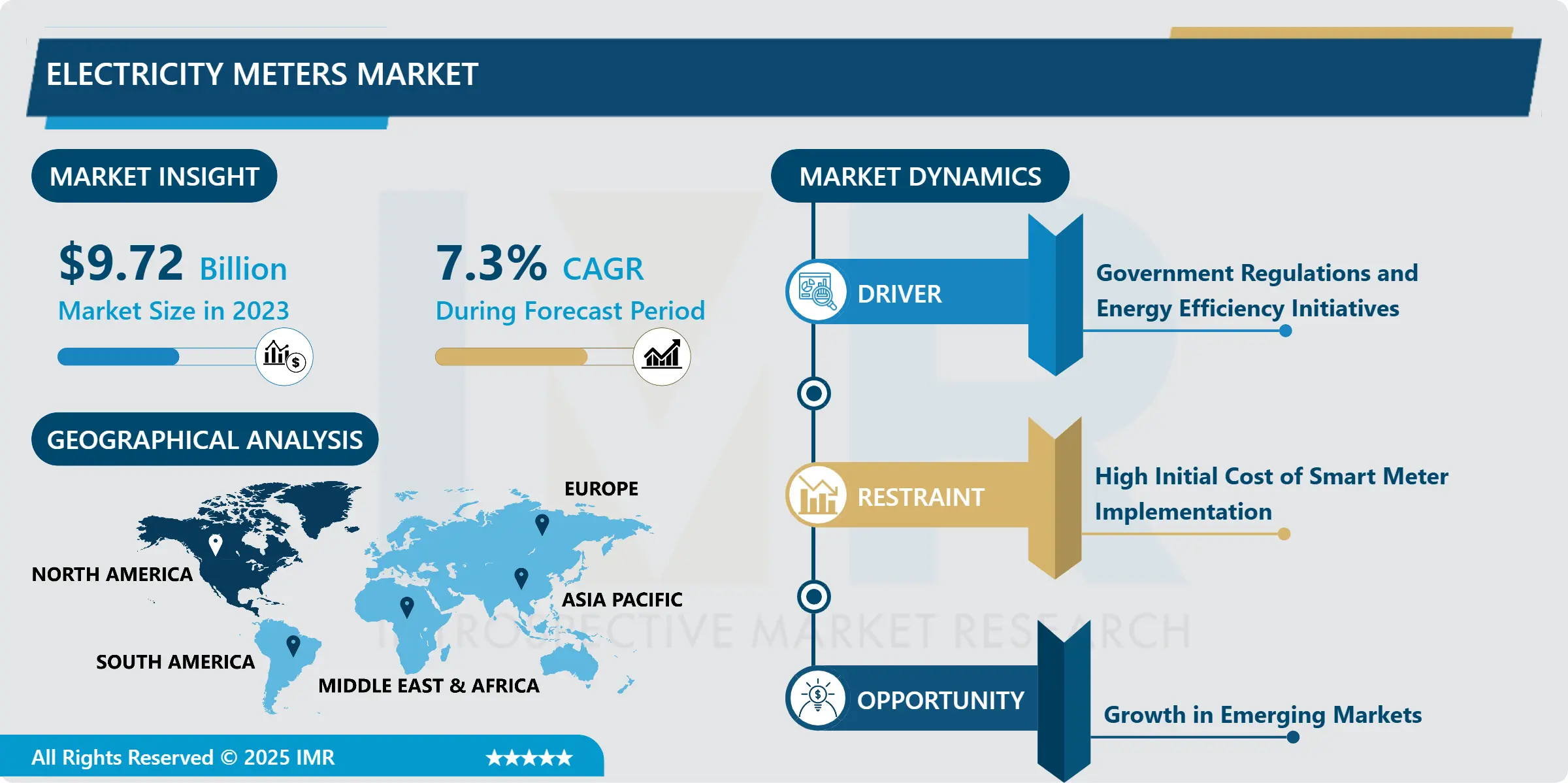
Electricity Meters Market Size, Share, Growth & Forecast (2024-2032)
Electricity Meters Market Size Was Valued at USD 9.72 Billion in 2023, and is Projected to Reach USD 18.33 Billion by 2032, Growing at a CAGR of 7.3% From 2024-2032.

IMR Group
Description
Electricity Meters Market Synopsis:
Electricity Meters Market Size Was Valued at USD 9.72 Billion in 2023, and is Projected to Reach USD 18.33 Billion by 2032, Growing at a CAGR of 7.3% From 2024-2032.
The Electricity Meters Market involves the production and sale of devices that measure electric energy consumption. It includes traditional analogue meters and advanced smart meters enabling real-time data monitoring, energy management, and billing. The growing demand for energy efficiency and smart grids drives market growth globally.
The Electricity Meters Market has evolved significantly driven by advancements in technology, regulatory demands for energy efficiency, and the rise of smart cities and grids. Initially, analog meters were the standard, but digital and smart meters are now gaining ground due to their accuracy, convenience, and the integration of IoT capabilities. Smart meters, in particular, have garnered interest due to their ability to provide real-time data, allowing for improved energy management and enabling consumers to monitor and optimize their energy usage.
The market’s growth is further fueled by the increasing global demand for energy, urbanization, and industrialization. Governments and utility companies are shifting towards digital solutions for better energy distribution and management, which has led to a surge in demand for smart meters. Additionally, with the rise in renewable energy sources and the need for better energy storage solutions, smart meters play an integral role in ensuring the efficient integration of these new energy sources into the grid. With the rise of sustainability concerns and the push for energy conservation, the market for electricity meters continues to grow, and its focus is shifting towards more efficient and sustainable alternatives.
Emerging markets, particularly in Asia-Pacific, are expected to see significant growth as urbanization rates increase and more people gain access to electricity. These regions are witnessing a surge in demand for electricity meters, especially digital and smart meters. Additionally, with regulatory frameworks pushing for the integration of smart grids and energy-saving initiatives, the market’s future is closely tied to the development of advanced metering infrastructure (AMI) and the rise of energy management systems (EMS).
Electricity Meters Market Trend Analysis:
Integration of Smart Meters with IoT and Smart Grids
The use of smart meters with IoT is becoming more popular in the Electricity Meters market. IoT meters make it possible to gather data in real time and also facilitate the interaction between consumers and utilities. This connectivity provides a boost in grid control since utilities can determine faults, consumption patterns and energy distribution on the fly. IoT integration, when applied to smart meters, also serves its purpose of reducing cost for utilities since frequent physical meter readings are eliminated and the effectiveness of the grid is improved.
Smart meters enabled by IoT technology play an important role in smart grid integration and development, as smart grids are critical for the contemporary energy systems. Intelligently improved potential of out-of-service identification, managing the loads of energy, and utilizing renewable energy. Real-time collection of data from smart meters enables utilities to act in advance and bring positive impacts in terms of energy efficiency.
Growth in Emerging Markets
There is also remarkable potential for the expansion of the developing markets within the electricity meters industry, especially South and Central America and the Asia-Pacific region, and Africa. With increasing trend in urbanization and the increase in access to electricity by many people, there is likely to be increasing demand for advanced metering systems including the digital and smart meters. Energy providers within these regions are now focused on the modernization of aging networks designed for power distribution and minimizing losses, presenting an attractive business proposition to manufactures of electricity meters. Besides, the identified markets have tremendous growth potential mainly in smart meters which are regarded as crucial for the upgrade of energy infrastructure and convenience of grids.
Apart from infrastructure upgrading, other important aspects that emerged markets are developing are energy efficiency and sustainability. With growth of other renewable energy sources which has been widely installed the importance of smart meters that can effectively manage the available variable energy sources will also blossom. Instead of trying to update and fortify older metering technologies for efficiency, these regions can advance their metering technologies to Smarter ones that meet group energy goals through the right frameworks and technologies.
Electricity Meters Market Segment Analysis:
Electricity Meters Market is Segmented on the basis of Type, Technology, Component, Application, End User, and Region
By Type, Analog Meters segment is expected to dominate the market during the forecast period
These meters use parts like rotating dials and the rate of rotation is relative to the energy consumption. Is used less accurately and requires reading by a technician but is still seen in the developed regions or in new facilities which often cannot afford to put more develop type of meter into service. But their capability of offering accurate data only in batch form or connected to traditional grid networks makes them less appropriate to the new needs required by the smart grid environment and energy efficiency requirements.
These meters display electricity use through LEDs, tend to be more accurate than analog meters and give detailed usage information. They also do not require manual readings and this reduces human interfence and hence cost of doing business. But although a significant improvement over their analog counterparts, current digital meters are not as sophisticated as smart meters as they do not include, for instance, remote reading, smart grid compatibility, and real-time control.
By Application, Utility segment expected to held the largest share
The electricity meters play perhaps one of the most significant roles in the measurement and regulation of use of electricity in residential, commercial and industrial segments. In billing, load shedding, and as tools to optimize the delivery of energy, utilities substantially depend on these meters. Out of all the smart grid technologies, however, smart meters cost utilities the most to implement and are the most relevant to the AMI system’s objective of collecting data in real time and lowering operations costs and customer service expenses through usage data.
The non-utility categories of electricity metering include in the residential and commercial building for those consumers or business entities that need more sophisticated measurement and recording of consumption. Smart meters are becoming more or less incorporated in these applications because of the nature of providing accurate real time energy usage information to maximize energy consumption in a given facility. The smart meters in non-utility applications also facilitate various energy saving schemes apart from offering billing data to the consumers and service providers.
Electricity Meters Market Regional Insights:
North America is Expected to Dominate the Market Over the Forecast period
North America together with Europe holds the largest shares in the global electricity meters market especially in the smart meters sector. This has been encouraged by the fact that the region has developed infrastructure, high energy usage and has implemented policies that encourage the use of smart metering solutions. USA and Canada are the pioneers to adopt smart grids and installing smart meters are part of their national energy policies. However, increasing consciousness of sustainable development and green energy solutions has gone further to provide additional stimulus to smart meters in the region.
Another factor that goes to the position of the North American region is the requirement of leading market players in the region. These companies are consistently improving themselves and offering superior Logging & Metering solutions that facilitate a smart grid infrastructure, renewables and energy saving all around. AMI is used in North America for metering electricity, water, gas and other utilities and its leadership can also be attributed to supportive regulatory policies that exist in this region to reduce energy consumption, upgrade the grid and encourage IAM/AMI usage. Thus, as these trends will go on in future, North America is expected to remain among the main driving forces of the global electricity meters market.
Active Key Players in the Electricity Meters Market
Itron Inc. (USA)
Landis+Gyr (Switzerland)
Siemens AG (Germany)
Schneider Electric (France)
Honeywell International Inc. (USA)
General Electric Company (USA)
Sensus (USA)
Kamstrup (Denmark)
Elster Group (Germany)
Aclara Technologies LLC (USA)
Badger Meter, Inc. (USA)
GE Digital Energy (USA)
Other Active Players
Chapter 1: Introduction
1.1 Scope and Coverage
Chapter 2:Executive Summary
Chapter 3: Market Landscape
3.1 Market Dynamics
3.1.1 Drivers
3.1.2 Restraints
3.1.3 Opportunities
3.1.4 Challenges
3.2 Market Trend Analysis
3.3 PESTLE Analysis
3.4 Porter’s Five Forces Analysis
3.5 Industry Value Chain Analysis
3.6 Ecosystem
3.7 Regulatory Landscape
3.8 Price Trend Analysis
3.9 Patent Analysis
3.10 Technology Evolution
3.11 Investment Pockets
3.12 Import-Export Analysis
Chapter 4: Electricity Meters Market by Type
4.1 Electricity Meters Market Snapshot and Growth Engine
4.2 Electricity Meters Market Overview
4.3 Analog Meters
4.3.1 Introduction and Market Overview
4.3.2 Historic and Forecasted Market Size in Value USD and Volume Units (2017-2032F)
4.3.3 Key Market Trends, Growth Factors and Opportunities
4.3.4 Analog Meters: Geographic Segmentation Analysis
4.4 Digital Meters
4.4.1 Introduction and Market Overview
4.4.2 Historic and Forecasted Market Size in Value USD and Volume Units (2017-2032F)
4.4.3 Key Market Trends, Growth Factors and Opportunities
4.4.4 Digital Meters: Geographic Segmentation Analysis
4.5 Smart Meters
4.5.1 Introduction and Market Overview
4.5.2 Historic and Forecasted Market Size in Value USD and Volume Units (2017-2032F)
4.5.3 Key Market Trends, Growth Factors and Opportunities
4.5.4 Smart Meters: Geographic Segmentation Analysis
Chapter 5: Electricity Meters Market by Technology
5.1 Electricity Meters Market Snapshot and Growth Engine
5.2 Electricity Meters Market Overview
5.3 Electromechanical Meters
5.3.1 Introduction and Market Overview
5.3.2 Historic and Forecasted Market Size in Value USD and Volume Units (2017-2032F)
5.3.3 Key Market Trends, Growth Factors and Opportunities
5.3.4 Electromechanical Meters: Geographic Segmentation Analysis
5.4 Electronic Meters
5.4.1 Introduction and Market Overview
5.4.2 Historic and Forecasted Market Size in Value USD and Volume Units (2017-2032F)
5.4.3 Key Market Trends, Growth Factors and Opportunities
5.4.4 Electronic Meters: Geographic Segmentation Analysis
5.5 Smart Meters
5.5.1 Introduction and Market Overview
5.5.2 Historic and Forecasted Market Size in Value USD and Volume Units (2017-2032F)
5.5.3 Key Market Trends, Growth Factors and Opportunities
5.5.4 Smart Meters: Geographic Segmentation Analysis
Chapter 6: Electricity Meters Market by End-User
6.1 Electricity Meters Market Snapshot and Growth Engine
6.2 Electricity Meters Market Overview
6.3 Residential
6.3.1 Introduction and Market Overview
6.3.2 Historic and Forecasted Market Size in Value USD and Volume Units (2017-2032F)
6.3.3 Key Market Trends, Growth Factors and Opportunities
6.3.4 Residential: Geographic Segmentation Analysis
6.4 Commercial
6.4.1 Introduction and Market Overview
6.4.2 Historic and Forecasted Market Size in Value USD and Volume Units (2017-2032F)
6.4.3 Key Market Trends, Growth Factors and Opportunities
6.4.4 Commercial: Geographic Segmentation Analysis
6.5 Industrial
6.5.1 Introduction and Market Overview
6.5.2 Historic and Forecasted Market Size in Value USD and Volume Units (2017-2032F)
6.5.3 Key Market Trends, Growth Factors and Opportunities
6.5.4 Industrial: Geographic Segmentation Analysis
Chapter 7: Electricity Meters Market by Component
7.1 Electricity Meters Market Snapshot and Growth Engine
7.2 Electricity Meters Market Overview
7.3 Hardware
7.3.1 Introduction and Market Overview
7.3.2 Historic and Forecasted Market Size in Value USD and Volume Units (2017-2032F)
7.3.3 Key Market Trends, Growth Factors and Opportunities
7.3.4 Hardware: Geographic Segmentation Analysis
7.4 Software
7.4.1 Introduction and Market Overview
7.4.2 Historic and Forecasted Market Size in Value USD and Volume Units (2017-2032F)
7.4.3 Key Market Trends, Growth Factors and Opportunities
7.4.4 Software: Geographic Segmentation Analysis
7.5 Services
7.5.1 Introduction and Market Overview
7.5.2 Historic and Forecasted Market Size in Value USD and Volume Units (2017-2032F)
7.5.3 Key Market Trends, Growth Factors and Opportunities
7.5.4 Services: Geographic Segmentation Analysis
Chapter 8: Electricity Meters Market by Application
8.1 Electricity Meters Market Snapshot and Growth Engine
8.2 Electricity Meters Market Overview
8.3 Utility
8.3.1 Introduction and Market Overview
8.3.2 Historic and Forecasted Market Size in Value USD and Volume Units (2017-2032F)
8.3.3 Key Market Trends, Growth Factors and Opportunities
8.3.4 Utility: Geographic Segmentation Analysis
8.4 Non-Utility
8.4.1 Introduction and Market Overview
8.4.2 Historic and Forecasted Market Size in Value USD and Volume Units (2017-2032F)
8.4.3 Key Market Trends, Growth Factors and Opportunities
8.4.4 Non-Utility: Geographic Segmentation Analysis
Chapter 9: Company Profiles and Competitive Analysis
9.1 Competitive Landscape
9.1.1 Competitive Benchmarking
9.1.2 Electricity Meters Market Share by Manufacturer (2023)
9.1.3 Industry BCG Matrix
9.1.4 Heat Map Analysis
9.1.5 Mergers and Acquisitions
9.2 ITRON INC. (USA)
9.2.1 Company Overview
9.2.2 Key Executives
9.2.3 Company Snapshot
9.2.4 Role of the Company in the Market
9.2.5 Sustainability and Social Responsibility
9.2.6 Operating Business Segments
9.2.7 Product Portfolio
9.2.8 Business Performance
9.2.9 Key Strategic Moves and Recent Developments
9.2.10 SWOT Analysis
9.3 LANDIS+GYR (SWITZERLAND)
9.4 SIEMENS AG (GERMANY)
9.5 SCHNEIDER ELECTRIC (FRANCE)
9.6 HONEYWELL INTERNATIONAL INC. (USA)
9.7 GENERAL ELECTRIC COMPANY (USA)
9.8 SENSUS (USA)
9.9 KAMSTRUP (DENMARK)
9.10 ELSTER GROUP (GERMANY)
9.11 ACLARA TECHNOLOGIES LLC (USA)
9.12 BADGER METER INC. (USA)
9.13 GE DIGITAL ENERGY (USA)
9.14 OTHER ACTIVE PLAYERS
Chapter 10: Global Electricity Meters Market By Region
10.1 Overview
10.2. North America Electricity Meters Market
10.2.1 Key Market Trends, Growth Factors and Opportunities
10.2.2 Top Key Companies
10.2.3 Historic and Forecasted Market Size by Segments
10.2.4 Historic and Forecasted Market Size By Type
10.2.4.1 Analog Meters
10.2.4.2 Digital Meters
10.2.4.3 Smart Meters
10.2.5 Historic and Forecasted Market Size By Technology
10.2.5.1 Electromechanical Meters
10.2.5.2 Electronic Meters
10.2.5.3 Smart Meters
10.2.6 Historic and Forecasted Market Size By End-User
10.2.6.1 Residential
10.2.6.2 Commercial
10.2.6.3 Industrial
10.2.7 Historic and Forecasted Market Size By Component
10.2.7.1 Hardware
10.2.7.2 Software
10.2.7.3 Services
10.2.8 Historic and Forecasted Market Size By Application
10.2.8.1 Utility
10.2.8.2 Non-Utility
10.2.9 Historic and Forecast Market Size by Country
10.2.9.1 US
10.2.9.2 Canada
10.2.9.3 Mexico
10.3. Eastern Europe Electricity Meters Market
10.3.1 Key Market Trends, Growth Factors and Opportunities
10.3.2 Top Key Companies
10.3.3 Historic and Forecasted Market Size by Segments
10.3.4 Historic and Forecasted Market Size By Type
10.3.4.1 Analog Meters
10.3.4.2 Digital Meters
10.3.4.3 Smart Meters
10.3.5 Historic and Forecasted Market Size By Technology
10.3.5.1 Electromechanical Meters
10.3.5.2 Electronic Meters
10.3.5.3 Smart Meters
10.3.6 Historic and Forecasted Market Size By End-User
10.3.6.1 Residential
10.3.6.2 Commercial
10.3.6.3 Industrial
10.3.7 Historic and Forecasted Market Size By Component
10.3.7.1 Hardware
10.3.7.2 Software
10.3.7.3 Services
10.3.8 Historic and Forecasted Market Size By Application
10.3.8.1 Utility
10.3.8.2 Non-Utility
10.3.9 Historic and Forecast Market Size by Country
10.3.9.1 Russia
10.3.9.2 Bulgaria
10.3.9.3 The Czech Republic
10.3.9.4 Hungary
10.3.9.5 Poland
10.3.9.6 Romania
10.3.9.7 Rest of Eastern Europe
10.4. Western Europe Electricity Meters Market
10.4.1 Key Market Trends, Growth Factors and Opportunities
10.4.2 Top Key Companies
10.4.3 Historic and Forecasted Market Size by Segments
10.4.4 Historic and Forecasted Market Size By Type
10.4.4.1 Analog Meters
10.4.4.2 Digital Meters
10.4.4.3 Smart Meters
10.4.5 Historic and Forecasted Market Size By Technology
10.4.5.1 Electromechanical Meters
10.4.5.2 Electronic Meters
10.4.5.3 Smart Meters
10.4.6 Historic and Forecasted Market Size By End-User
10.4.6.1 Residential
10.4.6.2 Commercial
10.4.6.3 Industrial
10.4.7 Historic and Forecasted Market Size By Component
10.4.7.1 Hardware
10.4.7.2 Software
10.4.7.3 Services
10.4.8 Historic and Forecasted Market Size By Application
10.4.8.1 Utility
10.4.8.2 Non-Utility
10.4.9 Historic and Forecast Market Size by Country
10.4.9.1 Germany
10.4.9.2 UK
10.4.9.3 France
10.4.9.4 The Netherlands
10.4.9.5 Italy
10.4.9.6 Spain
10.4.9.7 Rest of Western Europe
10.5. Asia Pacific Electricity Meters Market
10.5.1 Key Market Trends, Growth Factors and Opportunities
10.5.2 Top Key Companies
10.5.3 Historic and Forecasted Market Size by Segments
10.5.4 Historic and Forecasted Market Size By Type
10.5.4.1 Analog Meters
10.5.4.2 Digital Meters
10.5.4.3 Smart Meters
10.5.5 Historic and Forecasted Market Size By Technology
10.5.5.1 Electromechanical Meters
10.5.5.2 Electronic Meters
10.5.5.3 Smart Meters
10.5.6 Historic and Forecasted Market Size By End-User
10.5.6.1 Residential
10.5.6.2 Commercial
10.5.6.3 Industrial
10.5.7 Historic and Forecasted Market Size By Component
10.5.7.1 Hardware
10.5.7.2 Software
10.5.7.3 Services
10.5.8 Historic and Forecasted Market Size By Application
10.5.8.1 Utility
10.5.8.2 Non-Utility
10.5.9 Historic and Forecast Market Size by Country
10.5.9.1 China
10.5.9.2 India
10.5.9.3 Japan
10.5.9.4 South Korea
10.5.9.5 Malaysia
10.5.9.6 Thailand
10.5.9.7 Vietnam
10.5.9.8 The Philippines
10.5.9.9 Australia
10.5.9.10 New Zealand
10.5.9.11 Rest of APAC
10.6. Middle East & Africa Electricity Meters Market
10.6.1 Key Market Trends, Growth Factors and Opportunities
10.6.2 Top Key Companies
10.6.3 Historic and Forecasted Market Size by Segments
10.6.4 Historic and Forecasted Market Size By Type
10.6.4.1 Analog Meters
10.6.4.2 Digital Meters
10.6.4.3 Smart Meters
10.6.5 Historic and Forecasted Market Size By Technology
10.6.5.1 Electromechanical Meters
10.6.5.2 Electronic Meters
10.6.5.3 Smart Meters
10.6.6 Historic and Forecasted Market Size By End-User
10.6.6.1 Residential
10.6.6.2 Commercial
10.6.6.3 Industrial
10.6.7 Historic and Forecasted Market Size By Component
10.6.7.1 Hardware
10.6.7.2 Software
10.6.7.3 Services
10.6.8 Historic and Forecasted Market Size By Application
10.6.8.1 Utility
10.6.8.2 Non-Utility
10.6.9 Historic and Forecast Market Size by Country
10.6.9.1 Turkiye
10.6.9.2 Bahrain
10.6.9.3 Kuwait
10.6.9.4 Saudi Arabia
10.6.9.5 Qatar
10.6.9.6 UAE
10.6.9.7 Israel
10.6.9.8 South Africa
10.7. South America Electricity Meters Market
10.7.1 Key Market Trends, Growth Factors and Opportunities
10.7.2 Top Key Companies
10.7.3 Historic and Forecasted Market Size by Segments
10.7.4 Historic and Forecasted Market Size By Type
10.7.4.1 Analog Meters
10.7.4.2 Digital Meters
10.7.4.3 Smart Meters
10.7.5 Historic and Forecasted Market Size By Technology
10.7.5.1 Electromechanical Meters
10.7.5.2 Electronic Meters
10.7.5.3 Smart Meters
10.7.6 Historic and Forecasted Market Size By End-User
10.7.6.1 Residential
10.7.6.2 Commercial
10.7.6.3 Industrial
10.7.7 Historic and Forecasted Market Size By Component
10.7.7.1 Hardware
10.7.7.2 Software
10.7.7.3 Services
10.7.8 Historic and Forecasted Market Size By Application
10.7.8.1 Utility
10.7.8.2 Non-Utility
10.7.9 Historic and Forecast Market Size by Country
10.7.9.1 Brazil
10.7.9.2 Argentina
10.7.9.3 Rest of SA
Chapter 11 Analyst Viewpoint and Conclusion
11.1 Recommendations and Concluding Analysis
11.2 Potential Market Strategies
Chapter 12 Research Methodology
12.1 Research Process
12.2 Primary Research
12.3 Secondary Research
Q1: What would be the forecast period in the Electricity Meters Market research report?
A1: The forecast period in the Electricity Meters Market research report is 2024-2032.
Q2: Who are the key players in the Electricity Meters Market?
A2: Itron Inc. (USA), Landis+Gyr (Switzerland), Siemens AG (Germany), Schneider Electric (France), Honeywell International Inc. (USA), General Electric Company (USA), Sensus (USA), Kamstrup (Denmark), Elster Group (Germany), Aclara Technologies LLC (USA), Badger Meter, Inc. (USA), GE Digital Energy (USA), and Other Active Players
Q3: What are the segments of the Electricity Meters Market?
A3: The Electricity Meters Market is segmented into Type, Technology, Component, Application, End User and region. By Type, the market is categorized into Analog Meters, Digital Meters, and Smart Meters. By Technology, the market is categorized into Electromechanical Meters, Electronic Meters, and Smart Meters. By End-User, the market is categorized into Residential, Commercial, and Industrial. By Component, the market is categorized into Hardware, Software, and Services. By Application, the market is categorized into Utility, Non-Utility. By region, it is analyzed across North America (U.S., Canada, Mexico), Eastern Europe (Russia, Bulgaria, The Czech Republic, Hungary, Poland, Romania, Rest of Eastern Europe), Western Europe (Germany, UK, France, Netherlands, Italy, Spain, Rest of Western Europe), Asia Pacific (China, India, Japan, South Korea, Malaysia, Thailand, Vietnam, The Philippines, Australia, New-Zealand, Rest of APAC), Middle East & Africa (Turkiye, Bahrain, Kuwait, Saudi Arabia, Qatar, UAE, Israel, South Africa), South America (Brazil, Argentina, Rest of SA).
Q4: What is the Electricity Meters Market?
A4: The Electricity Meters Market involves the production and sale of devices that measure electric energy consumption. It includes traditional analog meters and advanced smart meters enabling real-time data monitoring, energy management, and billing. Growing demand for energy efficiency and smart grids drives market growth globally.
Q5: How big is the Electricity Meters Market?
A5: Electricity Meters Market Size Was Valued at USD 9.72 Billion in 2023, and is Projected to Reach USD 18.33 Billion by 2032, Growing at a CAGR of 7.3% From 2024-2032.
How to Buy a Report from eminsights.jp
On the product page, choose the license you want: Single-User License, Multi-User License or Enterprise License.
If you required report in your native language, then you can click on Translated Report button and fill out the form with report name and language you want, then our team will contact you as soon as possible.
Click the Buy Now button.
You will be redirected to the checkout page. Enter your company details and payment information.
Click Place Order to complete the purchase.
Confirmation: You’ll receive an order confirmation and our team will contact you shortly with your ordered report.
If you have any questions, fill out the contact form below or email us at bizdev@eminsights.net.
Thank you for choosing eminsights.jp!