Stay Ahead in Fast-Growing Economies.
Browse Reports Now


Electric Tile Cutter Market Growth Insights & Forecast Report to 2032
The Electric Tile Cutter market is defined as the global market for machines used to cut ceramic, porcelain, stone and other types of tiles which are employed in construction and home improvement projects. This cutting tool operates with electrical power, widely accurate and efficient in tile cutting and come with wet / dry cutting features for use at households, business and industries.

IMR Group
Description
Electric Tile Cutter Market Synopsis:
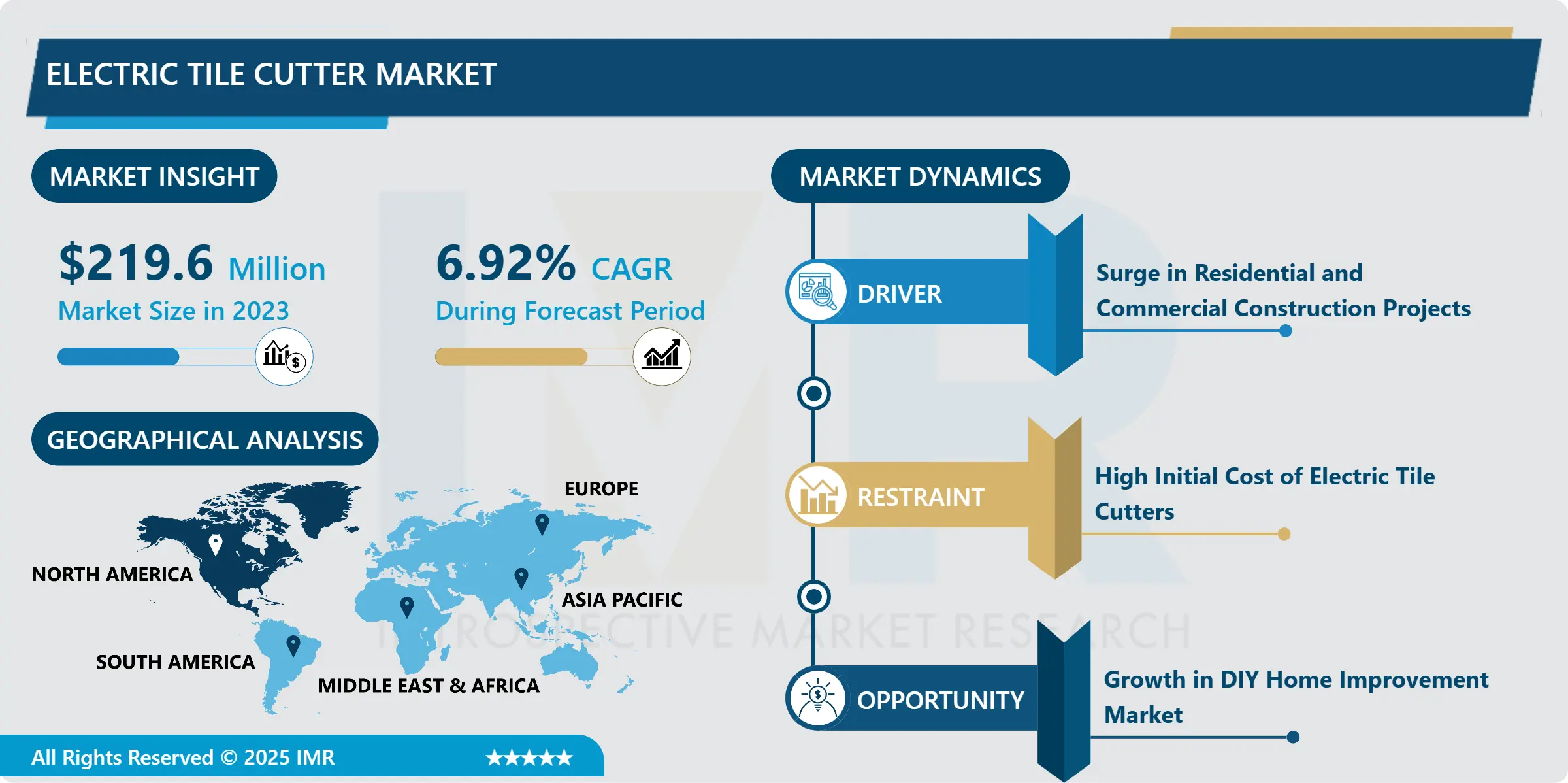
Electric Tile Cutter Market Size Was Valued at USD 219.60 Million in 2023, and is Projected to Reach USD 401.02 Million by 2032, Growing at a CAGR of 6.92% From 2024-2032.
The Electric Tile Cutter market is defined as the global market for machines used to cut ceramic, porcelain, stone and other types of tiles which are employed in construction and home improvement projects. This cutting tool operates with electrical power, widely accurate and efficient in tile cutting and come with wet / dry cutting features for use at households, business and industries.
The global market for Electric Tile Cutters has been on an upward trend in recent years because there is gradually rising need in the global market for quality construction and home improvement tiles. These cutters are indispensable for the craftsmen and for those who is engaged in work at home and needs perfect, fast and easy to use tools for cutting tiles. It is available with different models; it has a wet and dry cutter that will make it flexible for cutting tiles of different materials with conditions. Wet electric tile cutters that sort of have a water source because they cool and lubricate the blade are best suited for harder material cutting more so to minimize on dust production and also improve on the longevity of the blade. Dry cutters, however, are used where the work is faster and dirtier and often in small domestic building projects where having to deal with water may be undesirable.
The global construction industry but especially the one in the emergent countries has been the primary engine of the market. With development extending and construction work rising, the request for straight, well-cut tiles is providing additionally high. Again, an increase in home improvement and do-it-yourself (DIY) trend in developed countries is yet again an added advantage to the market. Other factors for its growth include the evidence of high-tech integration on these tools including laser guide, high powered motors and blades that tend to be long lasting. These changes enhance the usability and effectiveness of electric tile cutting thus making electric tile cutters increasingly attractive to the using groups.
Market is also experiencing the shift towards green building materials where using electric tile cutters is crucial in preventing damage of tiles and guaranteeing that they will not be chipped off during construction. Due to the increased awareness of the effects of the environment on society, firms are developing cutters that are energy consumers, producers of little or no dust, and recyclable. The COVID-19 pandemic also significantly affected it since demand for home renovation soon rose, but construction sites were slowed down too. Although there is a problem in the world today, there is a possibility for further growth as the world recovers and people turn to urbanization.
Electric Tile Cutter Market Trend Analysis:
Increasing Demand for Wet Electric Tile Cutters
Wet electric tile cutters are very slowly replacing the traditional wet tile saws because of their ability to cut a lot of hard tiles including porcelain tiles, granite tiles, and marble tiles. This kind of machines employs water cooling of the blade to prevent the buildup of heat on the blade and consequent wear and tear which is vital for high precision work. Another advantage of the wet system is that there is little dust which is produced when cutting; this enhances safety and the quality of air – especially indoors.
The growing concern with the hygiene of the workplaces, including safety requirements for preventing accidents when cutting tiles is another reason for the demand growth of wet electric tile cutters. Growing rules and regulations on dust control mainly in residential and commercial buildings make these tools a viable solution for the clean workspace. Second, wet tile cutters are capable of processing the required number of tiles in one project without the risk of overheating. It is foresight that the environmental preservation and health consciousness in construction and rebuild industry will prop up the demand for wet electric tile cutters.
Growth in DIY Home Improvement Market
The opportunity to expand remains evident in the do it yourself home improvement known by the acronym DIY. As homeowners assume more of DIY projects to remodel their homes, there is increased demand for tools that are simple to use and within reach of the do it yourself homeowner that may not be a professional carpenter. Modern electric tile cutters are fabricated to give consideration to DIY consumer and comprise among others; simple controls, safety measures and cheap. Since more homeowners opt to do their own tiling, including renovations of the bathroom and the kitchen, the electric tile cutter is a tool necessary for the creation of home improvement that looks like it was done by a professional.
This change in consumer preference is linked to a corresponding rise in the ease of access to the tile cutter through the internet and more so, guidance on its application. The influx of e-business platforms in home improvement inspires manufacturers of electric tile cutter to create market with more consumer access. If firms target the non-professional consumers specifically, the industry can have further market expansion since DIY market is continually expanding. Also, the market is experiencing a trend in house improvements, which means that there are more clients than only contractor organizations, which could use the tools for their professional purposes.
Electric Tile Cutter Market Segment Analysis:
Electric Tile Cutter Market is Segmented on the basis of Type, Power Source, Blade Material, Application, Distribution Channel, End User, and Region.
By Type, Wet Electric Tile Cutter segment is expected to dominate the market during the forecast period
The electric tile cutter market is primarily divided into two types: Wet electric tile cutter and the dry electric tile cutter. Wet electric tile cutters are great when cutting hard surface tile such as porcelain, granite, and marble since they have water to cool the blade and lessen the dust created by the tile cutter.
The water also cool the blade which makes it stay durable to offer the best cutting services and ensure that the cuts are accurate. Wet cutters are ideal for use in mass or commercial use projects since they give perfect outcomes and safety.
By Application, Residential segment expected to held the largest share
The electric tile cutter market primarily serves three application segments: residential, commercial, and industrial use. In the residential sector, electric tile cutters are widely utilized by homeowners, especially during home renovation projects such as kitchen and bathroom remodeling. These tools are essential for cutting tiles with accuracy and ease, ensuring clean, professional-looking results even for non-experts.
With the growing popularity of DIY culture, more individuals are taking on small renovation tasks themselves, prompting increased demand for user-friendly tile cutting equipment. Electric tile cutters offer an ideal solution for these users, delivering precision cuts that help them achieve high-quality finishes. Their affordability, ease of operation, and adaptability to various tile materials make them indispensable in domestic settings. As modern homeowners place greater emphasis on aesthetics and customization, tile cutters have become a common feature in personal tool collections, further fueling market growth in the residential segment.
Electric Tile Cutter Market Regional Insights:
North America is Expected to Dominate the Market Over the Forecast period
As of now, the electric tile cutter market is being mostly controlled by the North American region. The region has already developed construction industry which creates the demand for tile cutting tools in civil as well as in private construction projects. Also, the do-it-your-self (DIY) trend greatly contributes to the growth of the market as more and more consumers across North America prefer to use the electric tile cutters to perform self-remodeling activities. North America has been placed as leaders in the industry due to many factors such as; high disposable incomes, and easy access to quite advanced tools and equipment.
Increased attention to the application of superior construction technologies and the utilization of quality materials, the region’s utility of electric tile cutters rises as these instruments entail the accuracy and speed needed for specific specialty projects. Owing to the continuing market development in the United States and Canada, North America is expected to maintain its market position in the global electric tile cutter market helped by both, the increasing technological innovation as well as a growing number of new residential/commercial establishments.
Active Key Players in the Electric Tile Cutter Market:
Bosch (Germany)
Makita Corporation (Japan)
DEWALT (USA)
Hitachi Koki Co., Ltd. (Japan)
RIDGID (USA)
QEP (USA)
Rubi Tools (Spain)
SKIL (USA)
Evolution Power Tools (UK)
Fein Power Tools (Germany)
STANLEY (USA)
Hilti (Liechtenstein)
Other Active Players
Chapter 1: Introduction
1.1 Scope and Coverage
Chapter 2:Executive Summary
Chapter 3: Market Landscape
3.1 Market Dynamics
3.1.1 Drivers
3.1.2 Restraints
3.1.3 Opportunities
3.1.4 Challenges
3.2 Market Trend Analysis
3.3 PESTLE Analysis
3.4 Porter’s Five Forces Analysis
3.5 Industry Value Chain Analysis
3.6 Ecosystem
3.7 Regulatory Landscape
3.8 Price Trend Analysis
3.9 Patent Analysis
3.10 Technology Evolution
3.11 Investment Pockets
3.12 Import-Export Analysis
Chapter 4: Electric Tile Cutter Market by Type
4.1 Electric Tile Cutter Market Snapshot and Growth Engine
4.2 Electric Tile Cutter Market Overview
4.3 Wet Electric Tile Cutter
4.3.1 Introduction and Market Overview
4.3.2 Historic and Forecasted Market Size in Value USD and Volume Units (2017-2032F)
4.3.3 Key Market Trends, Growth Factors and Opportunities
4.3.4 Wet Electric Tile Cutter: Geographic Segmentation Analysis
4.4 Dry Electric Tile Cutter
4.4.1 Introduction and Market Overview
4.4.2 Historic and Forecasted Market Size in Value USD and Volume Units (2017-2032F)
4.4.3 Key Market Trends, Growth Factors and Opportunities
4.4.4 Dry Electric Tile Cutter: Geographic Segmentation Analysis
Chapter 5: Electric Tile Cutter Market by Power Source
5.1 Electric Tile Cutter Market Snapshot and Growth Engine
5.2 Electric Tile Cutter Market Overview
5.3 Corded Electric Tile Cutter
5.3.1 Introduction and Market Overview
5.3.2 Historic and Forecasted Market Size in Value USD and Volume Units (2017-2032F)
5.3.3 Key Market Trends, Growth Factors and Opportunities
5.3.4 Corded Electric Tile Cutter: Geographic Segmentation Analysis
5.4 Cordless Electric Tile Cutter
5.4.1 Introduction and Market Overview
5.4.2 Historic and Forecasted Market Size in Value USD and Volume Units (2017-2032F)
5.4.3 Key Market Trends, Growth Factors and Opportunities
5.4.4 Cordless Electric Tile Cutter: Geographic Segmentation Analysis
Chapter 6: Electric Tile Cutter Market by Blade Material
6.1 Electric Tile Cutter Market Snapshot and Growth Engine
6.2 Electric Tile Cutter Market Overview
6.3 Diamond Blade
6.3.1 Introduction and Market Overview
6.3.2 Historic and Forecasted Market Size in Value USD and Volume Units (2017-2032F)
6.3.3 Key Market Trends, Growth Factors and Opportunities
6.3.4 Diamond Blade: Geographic Segmentation Analysis
6.4 Tungsten Carbide Blade
6.4.1 Introduction and Market Overview
6.4.2 Historic and Forecasted Market Size in Value USD and Volume Units (2017-2032F)
6.4.3 Key Market Trends, Growth Factors and Opportunities
6.4.4 Tungsten Carbide Blade: Geographic Segmentation Analysis
6.5 Others
6.5.1 Introduction and Market Overview
6.5.2 Historic and Forecasted Market Size in Value USD and Volume Units (2017-2032F)
6.5.3 Key Market Trends, Growth Factors and Opportunities
6.5.4 Others: Geographic Segmentation Analysis
Chapter 7: Electric Tile Cutter Market by Application
7.1 Electric Tile Cutter Market Snapshot and Growth Engine
7.2 Electric Tile Cutter Market Overview
7.3 Residential
7.3.1 Introduction and Market Overview
7.3.2 Historic and Forecasted Market Size in Value USD and Volume Units (2017-2032F)
7.3.3 Key Market Trends, Growth Factors and Opportunities
7.3.4 Residential: Geographic Segmentation Analysis
7.4 Commercial
7.4.1 Introduction and Market Overview
7.4.2 Historic and Forecasted Market Size in Value USD and Volume Units (2017-2032F)
7.4.3 Key Market Trends, Growth Factors and Opportunities
7.4.4 Commercial: Geographic Segmentation Analysis
7.5 Industrial
7.5.1 Introduction and Market Overview
7.5.2 Historic and Forecasted Market Size in Value USD and Volume Units (2017-2032F)
7.5.3 Key Market Trends, Growth Factors and Opportunities
7.5.4 Industrial: Geographic Segmentation Analysis
Chapter 8: Electric Tile Cutter Market by End-User
8.1 Electric Tile Cutter Market Snapshot and Growth Engine
8.2 Electric Tile Cutter Market Overview
8.3 Professional Contractors
8.3.1 Introduction and Market Overview
8.3.2 Historic and Forecasted Market Size in Value USD and Volume Units (2017-2032F)
8.3.3 Key Market Trends, Growth Factors and Opportunities
8.3.4 Professional Contractors: Geographic Segmentation Analysis
8.4 DIY Enthusiasts
8.4.1 Introduction and Market Overview
8.4.2 Historic and Forecasted Market Size in Value USD and Volume Units (2017-2032F)
8.4.3 Key Market Trends, Growth Factors and Opportunities
8.4.4 DIY Enthusiasts: Geographic Segmentation Analysis
Chapter 9: Electric Tile Cutter Market by Distribution Channel
9.1 Electric Tile Cutter Market Snapshot and Growth Engine
9.2 Electric Tile Cutter Market Overview
9.3 Online
9.3.1 Introduction and Market Overview
9.3.2 Historic and Forecasted Market Size in Value USD and Volume Units (2017-2032F)
9.3.3 Key Market Trends, Growth Factors and Opportunities
9.3.4 Online: Geographic Segmentation Analysis
9.4 Offline
9.4.1 Introduction and Market Overview
9.4.2 Historic and Forecasted Market Size in Value USD and Volume Units (2017-2032F)
9.4.3 Key Market Trends, Growth Factors and Opportunities
9.4.4 Offline: Geographic Segmentation Analysis
Chapter 10: Company Profiles and Competitive Analysis
10.1 Competitive Landscape
10.1.1 Competitive Benchmarking
10.1.2 Electric Tile Cutter Market Share by Manufacturer (2023)
10.1.3 Industry BCG Matrix
10.1.4 Heat Map Analysis
10.1.5 Mergers and Acquisitions
10.2 BOSCH (GERMANY)
10.2.1 Company Overview
10.2.2 Key Executives
10.2.3 Company Snapshot
10.2.4 Role of the Company in the Market
10.2.5 Sustainability and Social Responsibility
10.2.6 Operating Business Segments
10.2.7 Product Portfolio
10.2.8 Business Performance
10.2.9 Key Strategic Moves and Recent Developments
10.2.10 SWOT Analysis
10.3 MAKITA CORPORATION (JAPAN)
10.4 DEWALT (USA)
10.5 HITACHI KOKI CO. LTD. (JAPAN)
10.6 RIDGID (USA)
10.7 QEP (USA)
10.8 RUBI TOOLS (SPAIN)
10.9 SKIL (USA)
10.10 EVOLUTION POWER TOOLS (UK)
10.11 FEIN POWER TOOLS (GERMANY)
10.12 STANLEY (USA)
10.13 HILTI (LIECHTENSTEIN)
10.14 OTHER ACTIVE PLAYERS
Chapter 11: Global Electric Tile Cutter Market By Region
11.1 Overview
11.2. North America Electric Tile Cutter Market
11.2.1 Key Market Trends, Growth Factors and Opportunities
11.2.2 Top Key Companies
11.2.3 Historic and Forecasted Market Size by Segments
11.2.4 Historic and Forecasted Market Size By Type
11.2.4.1 Wet Electric Tile Cutter
11.2.4.2 Dry Electric Tile Cutter
11.2.5 Historic and Forecasted Market Size By Power Source
11.2.5.1 Corded Electric Tile Cutter
11.2.5.2 Cordless Electric Tile Cutter
11.2.6 Historic and Forecasted Market Size By Blade Material
11.2.6.1 Diamond Blade
11.2.6.2 Tungsten Carbide Blade
11.2.6.3 Others
11.2.7 Historic and Forecasted Market Size By Application
11.2.7.1 Residential
11.2.7.2 Commercial
11.2.7.3 Industrial
11.2.8 Historic and Forecasted Market Size By End-User
11.2.8.1 Professional Contractors
11.2.8.2 DIY Enthusiasts
11.2.9 Historic and Forecasted Market Size By Distribution Channel
11.2.9.1 Online
11.2.9.2 Offline
11.2.10 Historic and Forecast Market Size by Country
11.2.10.1 US
11.2.10.2 Canada
11.2.10.3 Mexico
11.3. Eastern Europe Electric Tile Cutter Market
11.3.1 Key Market Trends, Growth Factors and Opportunities
11.3.2 Top Key Companies
11.3.3 Historic and Forecasted Market Size by Segments
11.3.4 Historic and Forecasted Market Size By Type
11.3.4.1 Wet Electric Tile Cutter
11.3.4.2 Dry Electric Tile Cutter
11.3.5 Historic and Forecasted Market Size By Power Source
11.3.5.1 Corded Electric Tile Cutter
11.3.5.2 Cordless Electric Tile Cutter
11.3.6 Historic and Forecasted Market Size By Blade Material
11.3.6.1 Diamond Blade
11.3.6.2 Tungsten Carbide Blade
11.3.6.3 Others
11.3.7 Historic and Forecasted Market Size By Application
11.3.7.1 Residential
11.3.7.2 Commercial
11.3.7.3 Industrial
11.3.8 Historic and Forecasted Market Size By End-User
11.3.8.1 Professional Contractors
11.3.8.2 DIY Enthusiasts
11.3.9 Historic and Forecasted Market Size By Distribution Channel
11.3.9.1 Online
11.3.9.2 Offline
11.3.10 Historic and Forecast Market Size by Country
11.3.10.1 Russia
11.3.10.2 Bulgaria
11.3.10.3 The Czech Republic
11.3.10.4 Hungary
11.3.10.5 Poland
11.3.10.6 Romania
11.3.10.7 Rest of Eastern Europe
11.4. Western Europe Electric Tile Cutter Market
11.4.1 Key Market Trends, Growth Factors and Opportunities
11.4.2 Top Key Companies
11.4.3 Historic and Forecasted Market Size by Segments
11.4.4 Historic and Forecasted Market Size By Type
11.4.4.1 Wet Electric Tile Cutter
11.4.4.2 Dry Electric Tile Cutter
11.4.5 Historic and Forecasted Market Size By Power Source
11.4.5.1 Corded Electric Tile Cutter
11.4.5.2 Cordless Electric Tile Cutter
11.4.6 Historic and Forecasted Market Size By Blade Material
11.4.6.1 Diamond Blade
11.4.6.2 Tungsten Carbide Blade
11.4.6.3 Others
11.4.7 Historic and Forecasted Market Size By Application
11.4.7.1 Residential
11.4.7.2 Commercial
11.4.7.3 Industrial
11.4.8 Historic and Forecasted Market Size By End-User
11.4.8.1 Professional Contractors
11.4.8.2 DIY Enthusiasts
11.4.9 Historic and Forecasted Market Size By Distribution Channel
11.4.9.1 Online
11.4.9.2 Offline
11.4.10 Historic and Forecast Market Size by Country
11.4.10.1 Germany
11.4.10.2 UK
11.4.10.3 France
11.4.10.4 The Netherlands
11.4.10.5 Italy
11.4.10.6 Spain
11.4.10.7 Rest of Western Europe
11.5. Asia Pacific Electric Tile Cutter Market
11.5.1 Key Market Trends, Growth Factors and Opportunities
11.5.2 Top Key Companies
11.5.3 Historic and Forecasted Market Size by Segments
11.5.4 Historic and Forecasted Market Size By Type
11.5.4.1 Wet Electric Tile Cutter
11.5.4.2 Dry Electric Tile Cutter
11.5.5 Historic and Forecasted Market Size By Power Source
11.5.5.1 Corded Electric Tile Cutter
11.5.5.2 Cordless Electric Tile Cutter
11.5.6 Historic and Forecasted Market Size By Blade Material
11.5.6.1 Diamond Blade
11.5.6.2 Tungsten Carbide Blade
11.5.6.3 Others
11.5.7 Historic and Forecasted Market Size By Application
11.5.7.1 Residential
11.5.7.2 Commercial
11.5.7.3 Industrial
11.5.8 Historic and Forecasted Market Size By End-User
11.5.8.1 Professional Contractors
11.5.8.2 DIY Enthusiasts
11.5.9 Historic and Forecasted Market Size By Distribution Channel
11.5.9.1 Online
11.5.9.2 Offline
11.5.10 Historic and Forecast Market Size by Country
11.5.10.1 China
11.5.10.2 India
11.5.10.3 Japan
11.5.10.4 South Korea
11.5.10.5 Malaysia
11.5.10.6 Thailand
11.5.10.7 Vietnam
11.5.10.8 The Philippines
11.5.10.9 Australia
11.5.10.10 New Zealand
11.5.10.11 Rest of APAC
11.6. Middle East & Africa Electric Tile Cutter Market
11.6.1 Key Market Trends, Growth Factors and Opportunities
11.6.2 Top Key Companies
11.6.3 Historic and Forecasted Market Size by Segments
11.6.4 Historic and Forecasted Market Size By Type
11.6.4.1 Wet Electric Tile Cutter
11.6.4.2 Dry Electric Tile Cutter
11.6.5 Historic and Forecasted Market Size By Power Source
11.6.5.1 Corded Electric Tile Cutter
11.6.5.2 Cordless Electric Tile Cutter
11.6.6 Historic and Forecasted Market Size By Blade Material
11.6.6.1 Diamond Blade
11.6.6.2 Tungsten Carbide Blade
11.6.6.3 Others
11.6.7 Historic and Forecasted Market Size By Application
11.6.7.1 Residential
11.6.7.2 Commercial
11.6.7.3 Industrial
11.6.8 Historic and Forecasted Market Size By End-User
11.6.8.1 Professional Contractors
11.6.8.2 DIY Enthusiasts
11.6.9 Historic and Forecasted Market Size By Distribution Channel
11.6.9.1 Online
11.6.9.2 Offline
11.6.10 Historic and Forecast Market Size by Country
11.6.10.1 Turkiye
11.6.10.2 Bahrain
11.6.10.3 Kuwait
11.6.10.4 Saudi Arabia
11.6.10.5 Qatar
11.6.10.6 UAE
11.6.10.7 Israel
11.6.10.8 South Africa
11.7. South America Electric Tile Cutter Market
11.7.1 Key Market Trends, Growth Factors and Opportunities
11.7.2 Top Key Companies
11.7.3 Historic and Forecasted Market Size by Segments
11.7.4 Historic and Forecasted Market Size By Type
11.7.4.1 Wet Electric Tile Cutter
11.7.4.2 Dry Electric Tile Cutter
11.7.5 Historic and Forecasted Market Size By Power Source
11.7.5.1 Corded Electric Tile Cutter
11.7.5.2 Cordless Electric Tile Cutter
11.7.6 Historic and Forecasted Market Size By Blade Material
11.7.6.1 Diamond Blade
11.7.6.2 Tungsten Carbide Blade
11.7.6.3 Others
11.7.7 Historic and Forecasted Market Size By Application
11.7.7.1 Residential
11.7.7.2 Commercial
11.7.7.3 Industrial
11.7.8 Historic and Forecasted Market Size By End-User
11.7.8.1 Professional Contractors
11.7.8.2 DIY Enthusiasts
11.7.9 Historic and Forecasted Market Size By Distribution Channel
11.7.9.1 Online
11.7.9.2 Offline
11.7.10 Historic and Forecast Market Size by Country
11.7.10.1 Brazil
11.7.10.2 Argentina
11.7.10.3 Rest of SA
Chapter 12 Analyst Viewpoint and Conclusion
12.1 Recommendations and Concluding Analysis
12.2 Potential Market Strategies
Chapter 13 Research Methodology
13.1 Research Process
13.2 Primary Research
13.3 Secondary Research
Q1: What would be the forecast period in the Electric Tile Cutter Market research report?
A1: The forecast period in the Electric Tile Cutter Market research report is 2024-2032.
Q2: Who are the key players in the Electric Tile Cutter Market?
A2: Bosch (Germany), Makita Corporation (Japan), DEWALT (USA), Hitachi Koki Co., Ltd. (Japan), RIDGID (USA), QEP (USA), Rubi Tools (Spain), SKIL (USA), Evolution Power Tools (UK), Fein Power Tools (Germany), STANLEY (USA), Hilti (Liechtenstein), and Other Active Players
Q3: What are the segments of the Electric Tile Cutter Market?
A3: The Electric Tile Cutter Market is segmented into Type, Power Source, Blade Material, Application, Distribution Channel, End User and region. Type, the market is categorized into Wet Electric Tile Cutter, Dry Electric Tile Cutter. By Power Source, the market is categorized into Corded Electric Tile Cutter, Cordless Electric Tile Cutter. By Blade Material, the market is categorized into Diamond Blade, Tungsten Carbide Blade, Others. By Application, the market is categorized into Residential, Commercial, Industrial. By End-User, the market is categorized into Professional Contractors, DIY Enthusiasts. By Distribution Channel, the market is categorized into Online, Offline. By region, it is analyzed across North America (U.S., Canada, Mexico), Eastern Europe (Russia, Bulgaria, The Czech Republic, Hungary, Poland, Romania, Rest of Eastern Europe), Western Europe (Germany, UK, France, Netherlands, Italy, Spain, Rest of Western Europe), Asia Pacific (China, India, Japan, South Korea, Malaysia, Thailand, Vietnam, The Philippines, Australia, New Zealand, Rest of APAC), Middle East & Africa (Turkiye, Bahrain, Kuwait, Saudi Arabia, Qatar, UAE, Israel, South Africa), South America (Brazil, Argentina, Rest of SA).
Q4: What is the Electric Tile Cutter Market?
A4: The Electric Tile Cutter market is defined as the global market for machines used to cut ceramic, porcelain, stone and other types of tiles which are employed in construction and home improvement projects. This cutting tool operates with electrical power, widely accurate and efficient in tile cutting and come with wet / dry cutting features for use at households, business and industries.
Q5: How big is the Electric Tile Cutter Market?
A5: Electric Tile Cutter Market Size Was Valued at USD 219.60 Million in 2023, and is Projected to Reach USD 401.02 Million by 2032, Growing at a CAGR of 6.92% From 2024-2032.
How to Buy a Report from eminsights.jp
On the product page, choose the license you want: Single-User License, Multi-User License or Enterprise License.
If you required report in your native language, then you can click on Translated Report button and fill out the form with report name and language you want, then our team will contact you as soon as possible.
Click the Buy Now button.
You will be redirected to the checkout page. Enter your company details and payment information.
Click Place Order to complete the purchase.
Confirmation: You’ll receive an order confirmation and our team will contact you shortly with your ordered report.
If you have any questions, fill out the contact form below or email us at bizdev@eminsights.net.
Thank you for choosing eminsights.jp!