Stay Ahead in Fast-Growing Economies.
Browse Reports Now




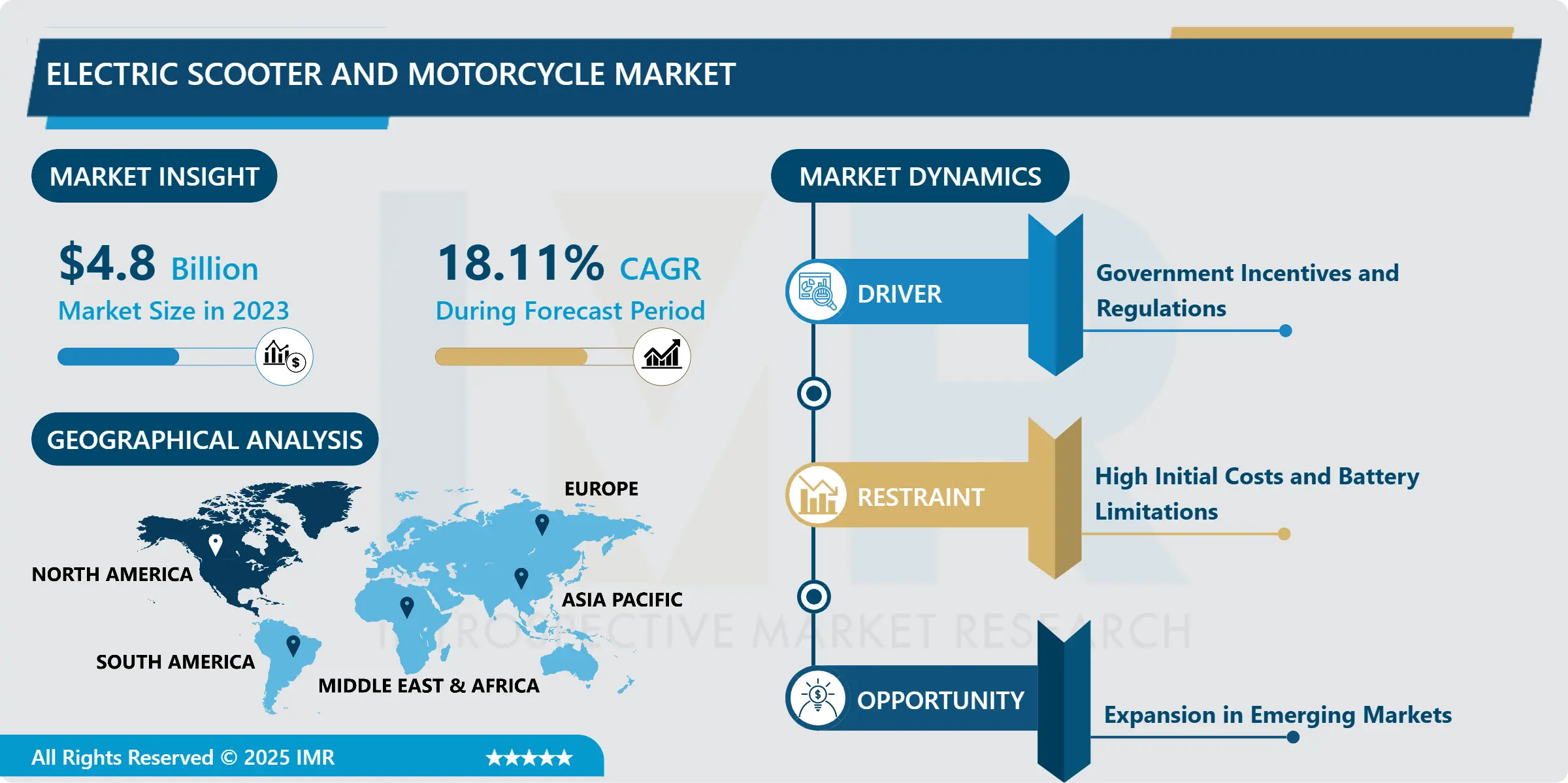
Electric Scooter and Motorcycle Market Insights, Dynamics, and Growth Forecast (2024-2032)
Special attention was paid to such transport having electric power in the Electric Scooter and Motorcycle Market as it has a low environmental impact compared to ICE vehicles. These vehicles use electric motors, rechargeable batteries and electronic to deliver efficient, low emission and cost-effective means of transport for individuals and businesses.

IMR Group
Description
Electric Scooter and Motorcycle Market Synopsis:
Electric Scooter and Motorcycle Market Size Was Valued at USD 4.80 Billion in 2023, and is Projected to Reach USD 21.47 Billion by 2032, Growing at a CAGR of 18.11% From 2024-2032.
Special attention was paid to such transport having electric power in the Electric Scooter and Motorcycle Market as it has a low environmental impact compared to ICE vehicles. These vehicles use electric motors, rechargeable batteries and electronic to deliver efficient, low emission and cost-effective means of transport for individuals and businesses.
The Global Electric Scooter and Motorcycle Market has evolved over time appreciably because of environmental sensitization, gradually rising fuel costs and enabling government policies that have spurred jazzy and efficient mobility. These vehicles are useful to meet increasing market needs for efficient, minimum emission urban mobility especially within high-population density areas. The market is underpinned by improvements to battery systems, such as lithium-ion batteries, for higher range and quicker recharge times.
ESMs and EWs are being adopted by different people and in different capacities including as personal means and transit for cost savings and as delivery avenue for minimizing carbon footprint. Other keys factors regulating adoption include subsidies and tax incentives in place in areas including Europe, North America, and Asia-Pacific. Moreover, IoT and other related technologies like GPS for navigation, smartphone application for battery and tracking and theft alert too add on the usability of electric scooters.
Electric Scooter and Motorcycle Market Trend Analysis:
Rise of Swappable Battery Technology
Battery sharing solution is one of the disrupting innovations in the Electric Scooter and Motorcycle Market as it relates to the problems of charging network. This innovation enables a user to swap an exhausted battery with a charged one from a swapping center thus cutting on costs due to power outages The innovation enables a user to exchange the exhausted battery for a charged one in a swapping center and thus cuts time due to power shortage.
Specs of this technology are well embraced in cities since the issue of the limited range of the vehicle’s battery charge, time, and charging centers is a significant concern. Two-wheelers are to be made more accessible through the current partnerships of the binding manufacturing and service providers to set battery swapping networks. This should help increase market share in areas with a lack of charging stations in the developing world as well as advancing sustainability through battery recycling.
Expansion in Emerging Markets
New CAPEs in Asia Pacific, Africa and South American areas hold immense prospects for Electric Scooter and Motorcycle Market. These regions suffer from air pollution, high fuel costs and poor public transport facilities; therefore, electric two-wheelers are beneficial.
Governments of these markets are coming up with incentives in the form of subsidies and tax exemptions as well as infrastructure to boost electric mobility. Further, the components of cost such as the price and cost of operating the electric scooter and motorcycles make the product strategically viable in these regions due to its affordability. E-Commerce expansion and consequent growth in last mile delivery services are the two factors that add onto the likelihood of market expansion.
Electric Scooter and Motorcycle Market Segment Analysis:
Electric Scooter and Motorcycle Market is Segmented on the basis of Product Type, Battery Type, Power Output, Range, Voltage, Application, and Region.
By Product Type, Electric Scooters segment is expected to dominate the market during the forecast period
It is widely used in accident due to the economical nature, small size and convenience of use primarily for short distance travels. Because of the light weight and easy to maintenance, it has been chosen by single users and fleet owners in large cities.
scriptures electric motorcycles are common for customers demanding higher velocities per charge as well as longer range; ordinarily used by passionades and commerial delivery scooterists. Their use is currently still constrained by their relatively higher costs than scooters, though innovations in motor and battery production are slowly bridging the gap, increasing their sales
By Application, Commercial segment expected to held the largest share
The delivery segment – delivery companies, ride-sharing apps, and corporate fleets – is expanding quickly. The need for cost-effective and sustainable means of transport both in the last mile delivery and among corporate companies has boosted segment growth.
The personal segment continues to be a dominant market contributor due to consumers’ growing concern for the environment and the high savings of electric vehicles. Of them, electric scooters have widely been used for personal purposes because of the level of ease and affordability.
Electric Scooter and Motorcycle Market Regional Insights:
Asia Pacific is Expected to Dominate the Market Over the Forecast period
The market for electric scooters and motorcycles is biggest in Asia-Pacific region thanks to high population density, urbanization rate and government support. China and India are the leaders here having massive levels of production capacity, infrastructural development, and subsidies fostering the use of EVs.
The leader China has strong manufacturing industry and adequate charging infrastructure to fuel the electric vehicles. On the other hand, India Owns a Growing Middle-Class Population and FAME (Faster Adoption and Manufacturing of Hybrid and Electric Vehicles) that are driving the market at present. The major factor of location advantage is underlined by the presence of a large number of key manufacturers and supplies of the region.
Active Key Players in the Electric Scooter and Motorcycle Market:
NIU Technologies (China)
Yadea Group Holdings Ltd. (China)
Hero Electric (India)
Ather Energy (India)
Gogoro Inc. (Taiwan)
Energica Motor Company S.p.A. (Italy)
Zero Motorcycles, Inc. (United States)
BMW Motorrad (Germany)
Harley-Davidson (LiveWire) (United States)
Segway Inc. (United States)
Vmoto Limited (Australia)
Okinawa Autotech Pvt. Ltd. (India)
Other Active Players
Key Industry Developments in the Electric Scooter and Motorcycle Market:
In December 2023, Yamaha invested in the battery-swapping company, Swapping Battery Network to establish a robust battery-swapping infrastructure across Europe for its upcoming electric scooters. This move will boost the overall charging ecosystem and will drive the market.
In June 2023, Hero MotoCorp announced to invest up to USD 181.6 million in the development of premium bikes and EVs in India. The company stated that this decision is in line with the evolving framework regarding electric vehicles (EVs).
Chapter 1: Introduction
1.1 Scope and Coverage
Chapter 2:Executive Summary
Chapter 3: Market Landscape
3.1 Market Dynamics
3.1.1 Drivers
3.1.2 Restraints
3.1.3 Opportunities
3.1.4 Challenges
3.2 Market Trend Analysis
3.3 PESTLE Analysis
3.4 Porter’s Five Forces Analysis
3.5 Industry Value Chain Analysis
3.6 Ecosystem
3.7 Regulatory Landscape
3.8 Price Trend Analysis
3.9 Patent Analysis
3.10 Technology Evolution
3.11 Investment Pockets
3.12 Import-Export Analysis
Chapter 4: Electric Scooter and Motorcycle Market by Product Type
4.1 Electric Scooter and Motorcycle Market Snapshot and Growth Engine
4.2 Electric Scooter and Motorcycle Market Overview
4.3 Electric Scooters
4.3.1 Introduction and Market Overview
4.3.2 Historic and Forecasted Market Size in Value USD and Volume Units (2017-2032F)
4.3.3 Key Market Trends, Growth Factors and Opportunities
4.3.4 Electric Scooters: Geographic Segmentation Analysis
4.4 Electric Motorcycles
4.4.1 Introduction and Market Overview
4.4.2 Historic and Forecasted Market Size in Value USD and Volume Units (2017-2032F)
4.4.3 Key Market Trends, Growth Factors and Opportunities
4.4.4 Electric Motorcycles: Geographic Segmentation Analysis
Chapter 5: Electric Scooter and Motorcycle Market by Battery Type
5.1 Electric Scooter and Motorcycle Market Snapshot and Growth Engine
5.2 Electric Scooter and Motorcycle Market Overview
5.3 Lithium-ion
5.3.1 Introduction and Market Overview
5.3.2 Historic and Forecasted Market Size in Value USD and Volume Units (2017-2032F)
5.3.3 Key Market Trends, Growth Factors and Opportunities
5.3.4 Lithium-ion: Geographic Segmentation Analysis
5.4 Lead-acid
5.4.1 Introduction and Market Overview
5.4.2 Historic and Forecasted Market Size in Value USD and Volume Units (2017-2032F)
5.4.3 Key Market Trends, Growth Factors and Opportunities
5.4.4 Lead-acid: Geographic Segmentation Analysis
5.5 Nickel-metal Hydride
5.5.1 Introduction and Market Overview
5.5.2 Historic and Forecasted Market Size in Value USD and Volume Units (2017-2032F)
5.5.3 Key Market Trends, Growth Factors and Opportunities
5.5.4 Nickel-metal Hydride: Geographic Segmentation Analysis
5.6 Others
5.6.1 Introduction and Market Overview
5.6.2 Historic and Forecasted Market Size in Value USD and Volume Units (2017-2032F)
5.6.3 Key Market Trends, Growth Factors and Opportunities
5.6.4 Others: Geographic Segmentation Analysis
Chapter 6: Electric Scooter and Motorcycle Market by Power Output
6.1 Electric Scooter and Motorcycle Market Snapshot and Growth Engine
6.2 Electric Scooter and Motorcycle Market Overview
6.3 Below 3 kW
6.3.1 Introduction and Market Overview
6.3.2 Historic and Forecasted Market Size in Value USD and Volume Units (2017-2032F)
6.3.3 Key Market Trends, Growth Factors and Opportunities
6.3.4 Below 3 kW: Geographic Segmentation Analysis
6.4 3-6 kW
6.4.1 Introduction and Market Overview
6.4.2 Historic and Forecasted Market Size in Value USD and Volume Units (2017-2032F)
6.4.3 Key Market Trends, Growth Factors and Opportunities
6.4.4 3-6 kW: Geographic Segmentation Analysis
6.5 Above 6 kW
6.5.1 Introduction and Market Overview
6.5.2 Historic and Forecasted Market Size in Value USD and Volume Units (2017-2032F)
6.5.3 Key Market Trends, Growth Factors and Opportunities
6.5.4 Above 6 kW: Geographic Segmentation Analysis
Chapter 7: Electric Scooter and Motorcycle Market by Range
7.1 Electric Scooter and Motorcycle Market Snapshot and Growth Engine
7.2 Electric Scooter and Motorcycle Market Overview
7.3 Below 50 km
7.3.1 Introduction and Market Overview
7.3.2 Historic and Forecasted Market Size in Value USD and Volume Units (2017-2032F)
7.3.3 Key Market Trends, Growth Factors and Opportunities
7.3.4 Below 50 km: Geographic Segmentation Analysis
7.4 50-100 km
7.4.1 Introduction and Market Overview
7.4.2 Historic and Forecasted Market Size in Value USD and Volume Units (2017-2032F)
7.4.3 Key Market Trends, Growth Factors and Opportunities
7.4.4 50-100 km: Geographic Segmentation Analysis
7.5 Above 100 km
7.5.1 Introduction and Market Overview
7.5.2 Historic and Forecasted Market Size in Value USD and Volume Units (2017-2032F)
7.5.3 Key Market Trends, Growth Factors and Opportunities
7.5.4 Above 100 km: Geographic Segmentation Analysis
Chapter 8: Electric Scooter and Motorcycle Market by Voltage
8.1 Electric Scooter and Motorcycle Market Snapshot and Growth Engine
8.2 Electric Scooter and Motorcycle Market Overview
8.3 48V
8.3.1 Introduction and Market Overview
8.3.2 Historic and Forecasted Market Size in Value USD and Volume Units (2017-2032F)
8.3.3 Key Market Trends, Growth Factors and Opportunities
8.3.4 48V: Geographic Segmentation Analysis
8.4 60V
8.4.1 Introduction and Market Overview
8.4.2 Historic and Forecasted Market Size in Value USD and Volume Units (2017-2032F)
8.4.3 Key Market Trends, Growth Factors and Opportunities
8.4.4 60V: Geographic Segmentation Analysis
8.5 72V
8.5.1 Introduction and Market Overview
8.5.2 Historic and Forecasted Market Size in Value USD and Volume Units (2017-2032F)
8.5.3 Key Market Trends, Growth Factors and Opportunities
8.5.4 72V: Geographic Segmentation Analysis
8.6 Others
8.6.1 Introduction and Market Overview
8.6.2 Historic and Forecasted Market Size in Value USD and Volume Units (2017-2032F)
8.6.3 Key Market Trends, Growth Factors and Opportunities
8.6.4 Others: Geographic Segmentation Analysis
Chapter 9: Electric Scooter and Motorcycle Market by Application
9.1 Electric Scooter and Motorcycle Market Snapshot and Growth Engine
9.2 Electric Scooter and Motorcycle Market Overview
9.3 Commercial
9.3.1 Introduction and Market Overview
9.3.2 Historic and Forecasted Market Size in Value USD and Volume Units (2017-2032F)
9.3.3 Key Market Trends, Growth Factors and Opportunities
9.3.4 Commercial: Geographic Segmentation Analysis
9.4 Personal
9.4.1 Introduction and Market Overview
9.4.2 Historic and Forecasted Market Size in Value USD and Volume Units (2017-2032F)
9.4.3 Key Market Trends, Growth Factors and Opportunities
9.4.4 Personal: Geographic Segmentation Analysis
Chapter 10: Company Profiles and Competitive Analysis
10.1 Competitive Landscape
10.1.1 Competitive Benchmarking
10.1.2 Electric Scooter and Motorcycle Market Share by Manufacturer (2023)
10.1.3 Industry BCG Matrix
10.1.4 Heat Map Analysis
10.1.5 Mergers and Acquisitions
10.2 NIU TECHNOLOGIES (CHINA)
10.2.1 Company Overview
10.2.2 Key Executives
10.2.3 Company Snapshot
10.2.4 Role of the Company in the Market
10.2.5 Sustainability and Social Responsibility
10.2.6 Operating Business Segments
10.2.7 Product Portfolio
10.2.8 Business Performance
10.2.9 Key Strategic Moves and Recent Developments
10.2.10 SWOT Analysis
10.3 YADEA GROUP HOLDINGS LTD. (CHINA)
10.4 HERO ELECTRIC (INDIA)
10.5 ATHER ENERGY (INDIA)
10.6 GOGORO INC. (TAIWAN)
10.7 ENERGICA MOTOR COMPANY S.P.A. (ITALY)
10.8 ZERO MOTORCYCLES INC. (UNITED STATES)
10.9 BMW MOTORRAD (GERMANY)
10.10 HARLEY-DAVIDSON (LIVEWIRE) (UNITED STATES)
10.11 SEGWAY INC. (UNITED STATES)
10.12 VMOTO LIMITED (AUSTRALIA)
10.13 OKINAWA AUTOTECH PVT. LTD. (INDIA)
10.14 OTHER ACTIVE PLAYERS
Chapter 11: Global Electric Scooter and Motorcycle Market By Region
11.1 Overview
11.2. North America Electric Scooter and Motorcycle Market
11.2.1 Key Market Trends, Growth Factors and Opportunities
11.2.2 Top Key Companies
11.2.3 Historic and Forecasted Market Size by Segments
11.2.4 Historic and Forecasted Market Size By Product Type
11.2.4.1 Electric Scooters
11.2.4.2 Electric Motorcycles
11.2.5 Historic and Forecasted Market Size By Battery Type
11.2.5.1 Lithium-ion
11.2.5.2 Lead-acid
11.2.5.3 Nickel-metal Hydride
11.2.5.4 Others
11.2.6 Historic and Forecasted Market Size By Power Output
11.2.6.1 Below 3 kW
11.2.6.2 3-6 kW
11.2.6.3 Above 6 kW
11.2.7 Historic and Forecasted Market Size By Range
11.2.7.1 Below 50 km
11.2.7.2 50-100 km
11.2.7.3 Above 100 km
11.2.8 Historic and Forecasted Market Size By Voltage
11.2.8.1 48V
11.2.8.2 60V
11.2.8.3 72V
11.2.8.4 Others
11.2.9 Historic and Forecasted Market Size By Application
11.2.9.1 Commercial
11.2.9.2 Personal
11.2.10 Historic and Forecast Market Size by Country
11.2.10.1 US
11.2.10.2 Canada
11.2.10.3 Mexico
11.3. Eastern Europe Electric Scooter and Motorcycle Market
11.3.1 Key Market Trends, Growth Factors and Opportunities
11.3.2 Top Key Companies
11.3.3 Historic and Forecasted Market Size by Segments
11.3.4 Historic and Forecasted Market Size By Product Type
11.3.4.1 Electric Scooters
11.3.4.2 Electric Motorcycles
11.3.5 Historic and Forecasted Market Size By Battery Type
11.3.5.1 Lithium-ion
11.3.5.2 Lead-acid
11.3.5.3 Nickel-metal Hydride
11.3.5.4 Others
11.3.6 Historic and Forecasted Market Size By Power Output
11.3.6.1 Below 3 kW
11.3.6.2 3-6 kW
11.3.6.3 Above 6 kW
11.3.7 Historic and Forecasted Market Size By Range
11.3.7.1 Below 50 km
11.3.7.2 50-100 km
11.3.7.3 Above 100 km
11.3.8 Historic and Forecasted Market Size By Voltage
11.3.8.1 48V
11.3.8.2 60V
11.3.8.3 72V
11.3.8.4 Others
11.3.9 Historic and Forecasted Market Size By Application
11.3.9.1 Commercial
11.3.9.2 Personal
11.3.10 Historic and Forecast Market Size by Country
11.3.10.1 Russia
11.3.10.2 Bulgaria
11.3.10.3 The Czech Republic
11.3.10.4 Hungary
11.3.10.5 Poland
11.3.10.6 Romania
11.3.10.7 Rest of Eastern Europe
11.4. Western Europe Electric Scooter and Motorcycle Market
11.4.1 Key Market Trends, Growth Factors and Opportunities
11.4.2 Top Key Companies
11.4.3 Historic and Forecasted Market Size by Segments
11.4.4 Historic and Forecasted Market Size By Product Type
11.4.4.1 Electric Scooters
11.4.4.2 Electric Motorcycles
11.4.5 Historic and Forecasted Market Size By Battery Type
11.4.5.1 Lithium-ion
11.4.5.2 Lead-acid
11.4.5.3 Nickel-metal Hydride
11.4.5.4 Others
11.4.6 Historic and Forecasted Market Size By Power Output
11.4.6.1 Below 3 kW
11.4.6.2 3-6 kW
11.4.6.3 Above 6 kW
11.4.7 Historic and Forecasted Market Size By Range
11.4.7.1 Below 50 km
11.4.7.2 50-100 km
11.4.7.3 Above 100 km
11.4.8 Historic and Forecasted Market Size By Voltage
11.4.8.1 48V
11.4.8.2 60V
11.4.8.3 72V
11.4.8.4 Others
11.4.9 Historic and Forecasted Market Size By Application
11.4.9.1 Commercial
11.4.9.2 Personal
11.4.10 Historic and Forecast Market Size by Country
11.4.10.1 Germany
11.4.10.2 UK
11.4.10.3 France
11.4.10.4 The Netherlands
11.4.10.5 Italy
11.4.10.6 Spain
11.4.10.7 Rest of Western Europe
11.5. Asia Pacific Electric Scooter and Motorcycle Market
11.5.1 Key Market Trends, Growth Factors and Opportunities
11.5.2 Top Key Companies
11.5.3 Historic and Forecasted Market Size by Segments
11.5.4 Historic and Forecasted Market Size By Product Type
11.5.4.1 Electric Scooters
11.5.4.2 Electric Motorcycles
11.5.5 Historic and Forecasted Market Size By Battery Type
11.5.5.1 Lithium-ion
11.5.5.2 Lead-acid
11.5.5.3 Nickel-metal Hydride
11.5.5.4 Others
11.5.6 Historic and Forecasted Market Size By Power Output
11.5.6.1 Below 3 kW
11.5.6.2 3-6 kW
11.5.6.3 Above 6 kW
11.5.7 Historic and Forecasted Market Size By Range
11.5.7.1 Below 50 km
11.5.7.2 50-100 km
11.5.7.3 Above 100 km
11.5.8 Historic and Forecasted Market Size By Voltage
11.5.8.1 48V
11.5.8.2 60V
11.5.8.3 72V
11.5.8.4 Others
11.5.9 Historic and Forecasted Market Size By Application
11.5.9.1 Commercial
11.5.9.2 Personal
11.5.10 Historic and Forecast Market Size by Country
11.5.10.1 China
11.5.10.2 India
11.5.10.3 Japan
11.5.10.4 South Korea
11.5.10.5 Malaysia
11.5.10.6 Thailand
11.5.10.7 Vietnam
11.5.10.8 The Philippines
11.5.10.9 Australia
11.5.10.10 New Zealand
11.5.10.11 Rest of APAC
11.6. Middle East & Africa Electric Scooter and Motorcycle Market
11.6.1 Key Market Trends, Growth Factors and Opportunities
11.6.2 Top Key Companies
11.6.3 Historic and Forecasted Market Size by Segments
11.6.4 Historic and Forecasted Market Size By Product Type
11.6.4.1 Electric Scooters
11.6.4.2 Electric Motorcycles
11.6.5 Historic and Forecasted Market Size By Battery Type
11.6.5.1 Lithium-ion
11.6.5.2 Lead-acid
11.6.5.3 Nickel-metal Hydride
11.6.5.4 Others
11.6.6 Historic and Forecasted Market Size By Power Output
11.6.6.1 Below 3 kW
11.6.6.2 3-6 kW
11.6.6.3 Above 6 kW
11.6.7 Historic and Forecasted Market Size By Range
11.6.7.1 Below 50 km
11.6.7.2 50-100 km
11.6.7.3 Above 100 km
11.6.8 Historic and Forecasted Market Size By Voltage
11.6.8.1 48V
11.6.8.2 60V
11.6.8.3 72V
11.6.8.4 Others
11.6.9 Historic and Forecasted Market Size By Application
11.6.9.1 Commercial
11.6.9.2 Personal
11.6.10 Historic and Forecast Market Size by Country
11.6.10.1 Turkiye
11.6.10.2 Bahrain
11.6.10.3 Kuwait
11.6.10.4 Saudi Arabia
11.6.10.5 Qatar
11.6.10.6 UAE
11.6.10.7 Israel
11.6.10.8 South Africa
11.7. South America Electric Scooter and Motorcycle Market
11.7.1 Key Market Trends, Growth Factors and Opportunities
11.7.2 Top Key Companies
11.7.3 Historic and Forecasted Market Size by Segments
11.7.4 Historic and Forecasted Market Size By Product Type
11.7.4.1 Electric Scooters
11.7.4.2 Electric Motorcycles
11.7.5 Historic and Forecasted Market Size By Battery Type
11.7.5.1 Lithium-ion
11.7.5.2 Lead-acid
11.7.5.3 Nickel-metal Hydride
11.7.5.4 Others
11.7.6 Historic and Forecasted Market Size By Power Output
11.7.6.1 Below 3 kW
11.7.6.2 3-6 kW
11.7.6.3 Above 6 kW
11.7.7 Historic and Forecasted Market Size By Range
11.7.7.1 Below 50 km
11.7.7.2 50-100 km
11.7.7.3 Above 100 km
11.7.8 Historic and Forecasted Market Size By Voltage
11.7.8.1 48V
11.7.8.2 60V
11.7.8.3 72V
11.7.8.4 Others
11.7.9 Historic and Forecasted Market Size By Application
11.7.9.1 Commercial
11.7.9.2 Personal
11.7.10 Historic and Forecast Market Size by Country
11.7.10.1 Brazil
11.7.10.2 Argentina
11.7.10.3 Rest of SA
Chapter 12 Analyst Viewpoint and Conclusion
12.1 Recommendations and Concluding Analysis
12.2 Potential Market Strategies
Chapter 13 Research Methodology
13.1 Research Process
13.2 Primary Research
13.3 Secondary Research
Q1: What would be the forecast period in the Electric Scooter and Motorcycle Market research report?
A1: The forecast period in the Electric Scooter and Motorcycle Market research report is 2024-2032.
Q2: Who are the key players in the Electric Scooter and Motorcycle Market?
A2: NIU Technologies (China), Yadea Group Holdings Ltd. (China), Hero Electric (India), Ather Energy (India), Gogoro Inc. (Taiwan), Energica Motor Company S.p.A. (Italy), Zero Motorcycles, Inc. (United States), BMW Motorrad (Germany), Harley-Davidson (LiveWire) (United States), Segway Inc. (United States), Vmoto Limited (Australia), Okinawa Autotech Pvt. Ltd. (India), and Other Active Players.
Q3: What are the segments of the Electric Scooter and Motorcycle Market?
A3: The Electric Scooter and Motorcycle Market is segmented into Product Type, Battery Type, Power Output, Range, Voltage, Application and region. By Product Type, the market is categorized into Electric Scooters, Electric Motorcycles. By Battery Type, the market is categorized into Lithium-ion, Lead-acid, Nickel-metal Hydride, Others. By Power Output, the market is categorized into Below 3 kW, 3-6 kW, Above 6 kW. By Range, the market is categorized into Below 50 km, 50-100 km, Above 100 km. By Voltage, the market is categorized into 48V, 60V, 72V, Others. By Application, the market is categorized into Commercial, Personal. By region, it is analyzed across North America (U.S., Canada, Mexico), Eastern Europe (Russia, Bulgaria, The Czech Republic, Hungary, Poland, Romania, Rest of Eastern Europe), Western Europe (Germany, UK, France, Netherlands, Italy, Spain, Rest of Western Europe), Asia Pacific (China, India, Japan, South Korea, Malaysia, Thailand, Vietnam, The Philippines, Australia, New Zealand, Rest of APAC), Middle East & Africa (Turkiye, Bahrain, Kuwait, Saudi Arabia, Qatar, UAE, Israel, South Africa), South America (Brazil, Argentina, Rest of SA).
Q4: What is the Electric Scooter and Motorcycle Market?
A4: Special attention was paid to such transport having electric power in the Electric Scooter and Motorcycle Market as it has a low environmental impact compared to ICE vehicles. These vehicles use electric motors, rechargeable batteries and electronic to deliver efficient, low emission and cost-effective means of transport for individuals and businesses.
Q5: How big is the Electric Scooter and Motorcycle Market?
A5: Electric Scooter and Motorcycle Market Size Was Valued at USD 4.80 Billion in 2023, and is Projected to Reach USD 21.47 Billion by 2032, Growing at a CAGR of 18.11% From 2024-2032.
How to Buy a Report from eminsights.jp
On the product page, choose the license you want: Single-User License, Multi-User License or Enterprise License.
If you required report in your native language, then you can click on Translated Report button and fill out the form with report name and language you want, then our team will contact you as soon as possible.
Click the Buy Now button.
You will be redirected to the checkout page. Enter your company details and payment information.
Click Place Order to complete the purchase.
Confirmation: You’ll receive an order confirmation and our team will contact you shortly with your ordered report.
If you have any questions, fill out the contact form below or email us at bizdev@eminsights.net.
Thank you for choosing eminsights.jp!