Stay Ahead in Fast-Growing Economies.
Browse Reports Now
Electric Motor Market Size, Share, Growth & Forecast (2024-2032)
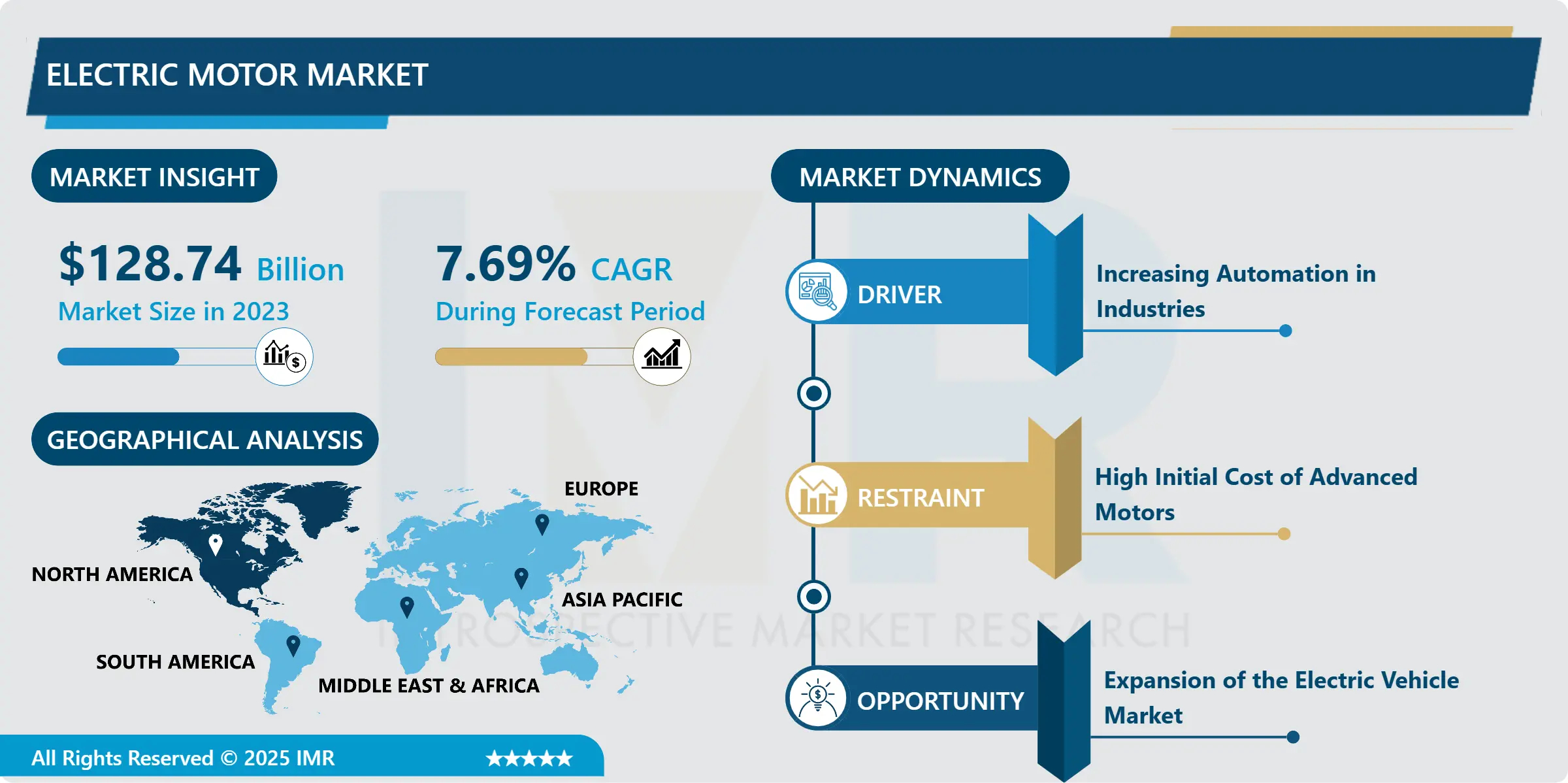
Electric Motor Market Size Was Valued at USD 128.74 Billion in 2023, and is Projected to Reach USD 250.78 Billion by 2032, Growing at a CAGR of 7.69% From 2024-2032.

IMR Group
Description
Electric Motor Market Synopsis:
Electric Motor Market Size Was Valued at USD 128.74 Billion in 2023, and is Projected to Reach USD 250.78 Billion by 2032, Growing at a CAGR of 7.69% From 2024-2032.
Electric motor market is defined as the world market of electric motors which is a component that converts electrical energy into mechanical energy. These motors are widely used in diverse equipment throughout the industrial, commercial, residential, automobile, aviation, and aerospace industries due to improvements in power, software control, and environmental management in the industrial world.
The electric motor market is one of the most important facets in the current industrial structure due to its role within manufacturing, transportation, HVAC systems, and the consumer electronics industry. The industry has experienced steady growth because of the escalating industrial applications, the growing sales of electric cars, and pressing standards and norms on energy efficiency and CO2 emissions. Technology innovations, including high-performance motors and smart motor technologies containing IoT are increasing the proposition of the market even more.
Fluctuations in the demand of electric motors depend on factors such as flexibility of use, reliability and efficiency. In industrial applications, these motors enable different machinery and pumps; in the automotive industry, the switch to electric vehicles is driving demand for specific motors to a great extent. In commercial uses electrical motor assist HVAC systems and lifts boosting their efficiency. In the residential sector they are found in appliances and smart products within homes. Today, the aerospace and the transport sectors are benefiting from electricity such as electric motors in inventions like the hybrid electric power and automatic power systems.
There are growth opportunities from emerging markets in Asia-Pacific as well as rising investments in the renewable energy projects globally. Nevertheless, the market has its issues, such as high initial investment for improved motor technologies and some challenges of supply chain. Nevertheless, the global electric motor market is anticipated to increase its growth in the future due to the development of technologies and the proclamation of sustainable development.
Electric Motor Market Trend Analysis:
Rising Adoption of Energy-Efficient Motors
Due to emerging environmental consciousness, the use of energy saving electric motors has increasingly emerged as a modern trend. Energy losses are minimal in these motors and they are developed to be cost-effective to manage, thus meeting the ascertained Eco-design Directive of the European Union as well as the stipulated U.S Department of Energy standards.
Trend is most pronounced in power consuming business areas including manufacturing and HVAC. PMSMs and BLDC are more efficient motors than traditional standard motors and contribute to low carbon emission by saving energy. Governments and organisations are also offering motivators for corporate entities to transfer regular motors with efficient motors more growingly, contributing to the market advancement. With increasing concern towards environmental conservation, energy efficient electric motors are most likely to replace those dominating the market today.
Expansion of the Electric Vehicle Market
Consumers’ demand for electric vehicles (EVs) can also be considered as one of the best opportunities for the electric motor market. In the current and transitioning automobile environment where manufacturing companies are embracing sustainable production and mobility, the especially electric motors have become a crucial factor. Components like traction motors are part of electric vehicle drive train and electric powertrain affecting the performance and energy usage of the vehicle.
Global governments are encouraging EV utilization through incentives such as subsidies and investments in charging network, which in turn f ultrasound motor demand. There is also a focus on developing new motor technologies including axial flux motors as well as integrated motor controller sets which help cater to companies specializing in the production of EVs. This opportunity is expected to grow with the development of market and growth EVs as consumers looking for electric motors will provide a good market segment.
Electric Motor Market Segment Analysis:
Electric Motor Market is Segmented on the basis of Type, Power Output, Voltage, Application, End Use Industry, and Region.
By Type, AC Motors segment is expected to dominate the market during the forecast period
In the classification of electric motors, common type that could be seen are those that belong to the category of AC Motors, DC Motors, and Hermetic Motors. AC Motors are dominant because of flexibility, reliability, and fuel economy hence commonly used for power tools like conveyors, HVAC requirements, etc. DC Motors also known for fine speed control are used in certified applications like for instance robotics and EVs. Hermetic Motors are particularly suited for refrigeration and HVAC to a large extent because they cannot leak and are designed for longevity.
Different types of motors operate in various applications; the most predominant market type is being the AC motor because of its versatility. However, the use of DC motors is gradually increasing due to the increased production of EVs while hermetic motors are essential in specific sectors including, refrigeration and healthcare.
By Application, Industrial segment expected to held the largest share
New Analysis on Electric Motor Market by its application is given as Industrial, Commercial, Residential, Automotive, Aerospace & Transportation. Industrial uses dominate this market particularly in powering equipment’s; motors, pumps among others and conveyors. The automotive industry is also a significant contributor is a result of the expanding trend of electric mobility. A wide range is currently experienced in the commercial use which comprises of HVAC systems and elevators tracing from urbanization and infrastructure development.
Some applications include increase demand of motors in home appliances and smart home use, and in aerospace and transportation application the motors are used for building hybrid planes and other self absorbing systems. The versatility provided by different applications guarantees the consistent expansion of the market in various industries.
Electric Motor Market Regional Insights:
Asia Pacific is Expected to Dominate the Market Over the Forecast period
It demonstrates that Asia-Pacific leads the electric motor market growth due to the increased rate of industrialization, urbanization, and automobile production. For instance, China, India and Japan are ramping up manufacturing, infrastructure and renewable energy; which drives motor usage. Also, the growing number of EVs in the region also contributes to this argument.
Universally accessible cheap labor and raw materials are major pulls that make Asia-Pacific the preferred destination for electric motor manufacturers. Such government policies as energy conservation and industrialization should sustain the Asia-Pacific region as the dominant market for electric motors.
Active Key Players in the Electric Motor Market:
ABB Ltd (Switzerland)
Siemens AG (Germany)
Nidec Corporation (Japan)
WEG Industries (Brazil)
Regal Rexnord Corporation (USA)
Toshiba Corporation (Japan)
Rockwell Automation, Inc. (USA)
Schneider Electric SE (France)
Mitsubishi Electric Corporation (Japan)
Johnson Electric Holdings Limited (Hong Kong)
Allied Motion Technologies, Inc. (USA)
Hyosung Corporation (South Korea)
Other Active Players
Key Industry Developments in the Electric Motor Market:
In October 2024, ABB, a major market participant declared that the company had signed an agreement with Aurora Motors, one of the key companies in vertical pump motors. The acquisition is projected to enhance ABB’s existing portfolio and strengthen its global footprint.
In September 2024, WEG, one of the key companies in the motors market announced that it had signed an agreement to acquire a Turkish manufacturing company of commercial and industrial electric motors, Volt Electric Motors (“Volt”). The acquisition will enable WEG to control over 290,000 square feet of facility. The deal is also expected to facilitate WEG’s plans to strengthen its position in the European and Asian markets with its Izmir, Türkiye location, which has access to large ports and the potential to offer faster transit times.
In May 2024, ABB, one of the prime companies operating in multiple markets, such as electrification, motion, process automation, robotics, and others, added the AMXE250 motor and HES580 inverter to its extensive portfolio, specially tailored for modern mobility solutions and electric buses. A compact newly introduced AMXE250 is a permanent magnet synchronous motor with improved efficiency.
Chapter 1: Introduction
1.1 Scope and Coverage
Chapter 2:Executive Summary
Chapter 3: Market Landscape
3.1 Market Dynamics
3.1.1 Drivers
3.1.2 Restraints
3.1.3 Opportunities
3.1.4 Challenges
3.2 Market Trend Analysis
3.3 PESTLE Analysis
3.4 Porter’s Five Forces Analysis
3.5 Industry Value Chain Analysis
3.6 Ecosystem
3.7 Regulatory Landscape
3.8 Price Trend Analysis
3.9 Patent Analysis
3.10 Technology Evolution
3.11 Investment Pockets
3.12 Import-Export Analysis
Chapter 4: Electric Motor Market by Type
4.1 Electric Motor Market Snapshot and Growth Engine
4.2 Electric Motor Market Overview
4.3 AC Motors
4.3.1 Introduction and Market Overview
4.3.2 Historic and Forecasted Market Size in Value USD and Volume Units (2017-2032F)
4.3.3 Key Market Trends, Growth Factors and Opportunities
4.3.4 AC Motors: Geographic Segmentation Analysis
4.4 DC Motors
4.4.1 Introduction and Market Overview
4.4.2 Historic and Forecasted Market Size in Value USD and Volume Units (2017-2032F)
4.4.3 Key Market Trends, Growth Factors and Opportunities
4.4.4 DC Motors: Geographic Segmentation Analysis
4.5 Hermetic Motors
4.5.1 Introduction and Market Overview
4.5.2 Historic and Forecasted Market Size in Value USD and Volume Units (2017-2032F)
4.5.3 Key Market Trends, Growth Factors and Opportunities
4.5.4 Hermetic Motors: Geographic Segmentation Analysis
Chapter 5: Electric Motor Market by Power Output
5.1 Electric Motor Market Snapshot and Growth Engine
5.2 Electric Motor Market Overview
5.3 Fractional Horsepower (FHP) Motors
5.3.1 Introduction and Market Overview
5.3.2 Historic and Forecasted Market Size in Value USD and Volume Units (2017-2032F)
5.3.3 Key Market Trends, Growth Factors and Opportunities
5.3.4 Fractional Horsepower (FHP) Motors: Geographic Segmentation Analysis
5.4 Integral Horsepower (IHP) Motors
5.4.1 Introduction and Market Overview
5.4.2 Historic and Forecasted Market Size in Value USD and Volume Units (2017-2032F)
5.4.3 Key Market Trends, Growth Factors and Opportunities
5.4.4 Integral Horsepower (IHP) Motors: Geographic Segmentation Analysis
Chapter 6: Electric Motor Market by Voltage
6.1 Electric Motor Market Snapshot and Growth Engine
6.2 Electric Motor Market Overview
6.3 Low Voltage
6.3.1 Introduction and Market Overview
6.3.2 Historic and Forecasted Market Size in Value USD and Volume Units (2017-2032F)
6.3.3 Key Market Trends, Growth Factors and Opportunities
6.3.4 Low Voltage: Geographic Segmentation Analysis
6.4 Medium Voltage
6.4.1 Introduction and Market Overview
6.4.2 Historic and Forecasted Market Size in Value USD and Volume Units (2017-2032F)
6.4.3 Key Market Trends, Growth Factors and Opportunities
6.4.4 Medium Voltage: Geographic Segmentation Analysis
6.5 High Voltage
6.5.1 Introduction and Market Overview
6.5.2 Historic and Forecasted Market Size in Value USD and Volume Units (2017-2032F)
6.5.3 Key Market Trends, Growth Factors and Opportunities
6.5.4 High Voltage: Geographic Segmentation Analysis
Chapter 7: Electric Motor Market by Application
7.1 Electric Motor Market Snapshot and Growth Engine
7.2 Electric Motor Market Overview
7.3 Industrial
7.3.1 Introduction and Market Overview
7.3.2 Historic and Forecasted Market Size in Value USD and Volume Units (2017-2032F)
7.3.3 Key Market Trends, Growth Factors and Opportunities
7.3.4 Industrial: Geographic Segmentation Analysis
7.4 Commercial
7.4.1 Introduction and Market Overview
7.4.2 Historic and Forecasted Market Size in Value USD and Volume Units (2017-2032F)
7.4.3 Key Market Trends, Growth Factors and Opportunities
7.4.4 Commercial: Geographic Segmentation Analysis
7.5 Residential
7.5.1 Introduction and Market Overview
7.5.2 Historic and Forecasted Market Size in Value USD and Volume Units (2017-2032F)
7.5.3 Key Market Trends, Growth Factors and Opportunities
7.5.4 Residential: Geographic Segmentation Analysis
7.6 Automotive
7.6.1 Introduction and Market Overview
7.6.2 Historic and Forecasted Market Size in Value USD and Volume Units (2017-2032F)
7.6.3 Key Market Trends, Growth Factors and Opportunities
7.6.4 Automotive: Geographic Segmentation Analysis
7.7 Aerospace & Transportation
7.7.1 Introduction and Market Overview
7.7.2 Historic and Forecasted Market Size in Value USD and Volume Units (2017-2032F)
7.7.3 Key Market Trends, Growth Factors and Opportunities
7.7.4 Aerospace & Transportation: Geographic Segmentation Analysis
Chapter 8: Electric Motor Market by End-Use Industry
8.1 Electric Motor Market Snapshot and Growth Engine
8.2 Electric Motor Market Overview
8.3 Automotive
8.3.1 Introduction and Market Overview
8.3.2 Historic and Forecasted Market Size in Value USD and Volume Units (2017-2032F)
8.3.3 Key Market Trends, Growth Factors and Opportunities
8.3.4 Automotive: Geographic Segmentation Analysis
8.4 HVAC
8.4.1 Introduction and Market Overview
8.4.2 Historic and Forecasted Market Size in Value USD and Volume Units (2017-2032F)
8.4.3 Key Market Trends, Growth Factors and Opportunities
8.4.4 HVAC: Geographic Segmentation Analysis
8.5 Oil & Gas
8.5.1 Introduction and Market Overview
8.5.2 Historic and Forecasted Market Size in Value USD and Volume Units (2017-2032F)
8.5.3 Key Market Trends, Growth Factors and Opportunities
8.5.4 Oil & Gas: Geographic Segmentation Analysis
8.6 Power Generation
8.6.1 Introduction and Market Overview
8.6.2 Historic and Forecasted Market Size in Value USD and Volume Units (2017-2032F)
8.6.3 Key Market Trends, Growth Factors and Opportunities
8.6.4 Power Generation: Geographic Segmentation Analysis
8.7 Mining
8.7.1 Introduction and Market Overview
8.7.2 Historic and Forecasted Market Size in Value USD and Volume Units (2017-2032F)
8.7.3 Key Market Trends, Growth Factors and Opportunities
8.7.4 Mining: Geographic Segmentation Analysis
8.8 Water & Wastewater
8.8.1 Introduction and Market Overview
8.8.2 Historic and Forecasted Market Size in Value USD and Volume Units (2017-2032F)
8.8.3 Key Market Trends, Growth Factors and Opportunities
8.8.4 Water & Wastewater: Geographic Segmentation Analysis
8.9 Agriculture
8.9.1 Introduction and Market Overview
8.9.2 Historic and Forecasted Market Size in Value USD and Volume Units (2017-2032F)
8.9.3 Key Market Trends, Growth Factors and Opportunities
8.9.4 Agriculture: Geographic Segmentation Analysis
Chapter 9: Company Profiles and Competitive Analysis
9.1 Competitive Landscape
9.1.1 Competitive Benchmarking
9.1.2 Electric Motor Market Share by Manufacturer (2023)
9.1.3 Industry BCG Matrix
9.1.4 Heat Map Analysis
9.1.5 Mergers and Acquisitions
9.2 ABB LTD (SWITZERLAND)
9.2.1 Company Overview
9.2.2 Key Executives
9.2.3 Company Snapshot
9.2.4 Role of the Company in the Market
9.2.5 Sustainability and Social Responsibility
9.2.6 Operating Business Segments
9.2.7 Product Portfolio
9.2.8 Business Performance
9.2.9 Key Strategic Moves and Recent Developments
9.2.10 SWOT Analysis
9.3 SIEMENS AG (GERMANY)
9.4 NIDEC CORPORATION (JAPAN)
9.5 WEG INDUSTRIES (BRAZIL)
9.6 REGAL REXNORD CORPORATION (USA)
9.7 TOSHIBA CORPORATION (JAPAN)
9.8 ROCKWELL AUTOMATION INC. (USA)
9.9 SCHNEIDER ELECTRIC SE (FRANCE)
9.10 MITSUBISHI ELECTRIC CORPORATION (JAPAN)
9.11 JOHNSON ELECTRIC HOLDINGS LIMITED (HONG KONG)
9.12 ALLIED MOTION TECHNOLOGIES INC. (USA)
9.13 HYOSUNG CORPORATION (SOUTH KOREA)
9.14 OTHER ACTIVE PLAYERS
Chapter 10: Global Electric Motor Market By Region
10.1 Overview
10.2. North America Electric Motor Market
10.2.1 Key Market Trends, Growth Factors and Opportunities
10.2.2 Top Key Companies
10.2.3 Historic and Forecasted Market Size by Segments
10.2.4 Historic and Forecasted Market Size By Type
10.2.4.1 AC Motors
10.2.4.2 DC Motors
10.2.4.3 Hermetic Motors
10.2.5 Historic and Forecasted Market Size By Power Output
10.2.5.1 Fractional Horsepower (FHP) Motors
10.2.5.2 Integral Horsepower (IHP) Motors
10.2.6 Historic and Forecasted Market Size By Voltage
10.2.6.1 Low Voltage
10.2.6.2 Medium Voltage
10.2.6.3 High Voltage
10.2.7 Historic and Forecasted Market Size By Application
10.2.7.1 Industrial
10.2.7.2 Commercial
10.2.7.3 Residential
10.2.7.4 Automotive
10.2.7.5 Aerospace & Transportation
10.2.8 Historic and Forecasted Market Size By End-Use Industry
10.2.8.1 Automotive
10.2.8.2 HVAC
10.2.8.3 Oil & Gas
10.2.8.4 Power Generation
10.2.8.5 Mining
10.2.8.6 Water & Wastewater
10.2.8.7 Agriculture
10.2.9 Historic and Forecast Market Size by Country
10.2.9.1 US
10.2.9.2 Canada
10.2.9.3 Mexico
10.3. Eastern Europe Electric Motor Market
10.3.1 Key Market Trends, Growth Factors and Opportunities
10.3.2 Top Key Companies
10.3.3 Historic and Forecasted Market Size by Segments
10.3.4 Historic and Forecasted Market Size By Type
10.3.4.1 AC Motors
10.3.4.2 DC Motors
10.3.4.3 Hermetic Motors
10.3.5 Historic and Forecasted Market Size By Power Output
10.3.5.1 Fractional Horsepower (FHP) Motors
10.3.5.2 Integral Horsepower (IHP) Motors
10.3.6 Historic and Forecasted Market Size By Voltage
10.3.6.1 Low Voltage
10.3.6.2 Medium Voltage
10.3.6.3 High Voltage
10.3.7 Historic and Forecasted Market Size By Application
10.3.7.1 Industrial
10.3.7.2 Commercial
10.3.7.3 Residential
10.3.7.4 Automotive
10.3.7.5 Aerospace & Transportation
10.3.8 Historic and Forecasted Market Size By End-Use Industry
10.3.8.1 Automotive
10.3.8.2 HVAC
10.3.8.3 Oil & Gas
10.3.8.4 Power Generation
10.3.8.5 Mining
10.3.8.6 Water & Wastewater
10.3.8.7 Agriculture
10.3.9 Historic and Forecast Market Size by Country
10.3.9.1 Russia
10.3.9.2 Bulgaria
10.3.9.3 The Czech Republic
10.3.9.4 Hungary
10.3.9.5 Poland
10.3.9.6 Romania
10.3.9.7 Rest of Eastern Europe
10.4. Western Europe Electric Motor Market
10.4.1 Key Market Trends, Growth Factors and Opportunities
10.4.2 Top Key Companies
10.4.3 Historic and Forecasted Market Size by Segments
10.4.4 Historic and Forecasted Market Size By Type
10.4.4.1 AC Motors
10.4.4.2 DC Motors
10.4.4.3 Hermetic Motors
10.4.5 Historic and Forecasted Market Size By Power Output
10.4.5.1 Fractional Horsepower (FHP) Motors
10.4.5.2 Integral Horsepower (IHP) Motors
10.4.6 Historic and Forecasted Market Size By Voltage
10.4.6.1 Low Voltage
10.4.6.2 Medium Voltage
10.4.6.3 High Voltage
10.4.7 Historic and Forecasted Market Size By Application
10.4.7.1 Industrial
10.4.7.2 Commercial
10.4.7.3 Residential
10.4.7.4 Automotive
10.4.7.5 Aerospace & Transportation
10.4.8 Historic and Forecasted Market Size By End-Use Industry
10.4.8.1 Automotive
10.4.8.2 HVAC
10.4.8.3 Oil & Gas
10.4.8.4 Power Generation
10.4.8.5 Mining
10.4.8.6 Water & Wastewater
10.4.8.7 Agriculture
10.4.9 Historic and Forecast Market Size by Country
10.4.9.1 Germany
10.4.9.2 UK
10.4.9.3 France
10.4.9.4 The Netherlands
10.4.9.5 Italy
10.4.9.6 Spain
10.4.9.7 Rest of Western Europe
10.5. Asia Pacific Electric Motor Market
10.5.1 Key Market Trends, Growth Factors and Opportunities
10.5.2 Top Key Companies
10.5.3 Historic and Forecasted Market Size by Segments
10.5.4 Historic and Forecasted Market Size By Type
10.5.4.1 AC Motors
10.5.4.2 DC Motors
10.5.4.3 Hermetic Motors
10.5.5 Historic and Forecasted Market Size By Power Output
10.5.5.1 Fractional Horsepower (FHP) Motors
10.5.5.2 Integral Horsepower (IHP) Motors
10.5.6 Historic and Forecasted Market Size By Voltage
10.5.6.1 Low Voltage
10.5.6.2 Medium Voltage
10.5.6.3 High Voltage
10.5.7 Historic and Forecasted Market Size By Application
10.5.7.1 Industrial
10.5.7.2 Commercial
10.5.7.3 Residential
10.5.7.4 Automotive
10.5.7.5 Aerospace & Transportation
10.5.8 Historic and Forecasted Market Size By End-Use Industry
10.5.8.1 Automotive
10.5.8.2 HVAC
10.5.8.3 Oil & Gas
10.5.8.4 Power Generation
10.5.8.5 Mining
10.5.8.6 Water & Wastewater
10.5.8.7 Agriculture
10.5.9 Historic and Forecast Market Size by Country
10.5.9.1 China
10.5.9.2 India
10.5.9.3 Japan
10.5.9.4 South Korea
10.5.9.5 Malaysia
10.5.9.6 Thailand
10.5.9.7 Vietnam
10.5.9.8 The Philippines
10.5.9.9 Australia
10.5.9.10 New Zealand
10.5.9.11 Rest of APAC
10.6. Middle East & Africa Electric Motor Market
10.6.1 Key Market Trends, Growth Factors and Opportunities
10.6.2 Top Key Companies
10.6.3 Historic and Forecasted Market Size by Segments
10.6.4 Historic and Forecasted Market Size By Type
10.6.4.1 AC Motors
10.6.4.2 DC Motors
10.6.4.3 Hermetic Motors
10.6.5 Historic and Forecasted Market Size By Power Output
10.6.5.1 Fractional Horsepower (FHP) Motors
10.6.5.2 Integral Horsepower (IHP) Motors
10.6.6 Historic and Forecasted Market Size By Voltage
10.6.6.1 Low Voltage
10.6.6.2 Medium Voltage
10.6.6.3 High Voltage
10.6.7 Historic and Forecasted Market Size By Application
10.6.7.1 Industrial
10.6.7.2 Commercial
10.6.7.3 Residential
10.6.7.4 Automotive
10.6.7.5 Aerospace & Transportation
10.6.8 Historic and Forecasted Market Size By End-Use Industry
10.6.8.1 Automotive
10.6.8.2 HVAC
10.6.8.3 Oil & Gas
10.6.8.4 Power Generation
10.6.8.5 Mining
10.6.8.6 Water & Wastewater
10.6.8.7 Agriculture
10.6.9 Historic and Forecast Market Size by Country
10.6.9.1 Turkiye
10.6.9.2 Bahrain
10.6.9.3 Kuwait
10.6.9.4 Saudi Arabia
10.6.9.5 Qatar
10.6.9.6 UAE
10.6.9.7 Israel
10.6.9.8 South Africa
10.7. South America Electric Motor Market
10.7.1 Key Market Trends, Growth Factors and Opportunities
10.7.2 Top Key Companies
10.7.3 Historic and Forecasted Market Size by Segments
10.7.4 Historic and Forecasted Market Size By Type
10.7.4.1 AC Motors
10.7.4.2 DC Motors
10.7.4.3 Hermetic Motors
10.7.5 Historic and Forecasted Market Size By Power Output
10.7.5.1 Fractional Horsepower (FHP) Motors
10.7.5.2 Integral Horsepower (IHP) Motors
10.7.6 Historic and Forecasted Market Size By Voltage
10.7.6.1 Low Voltage
10.7.6.2 Medium Voltage
10.7.6.3 High Voltage
10.7.7 Historic and Forecasted Market Size By Application
10.7.7.1 Industrial
10.7.7.2 Commercial
10.7.7.3 Residential
10.7.7.4 Automotive
10.7.7.5 Aerospace & Transportation
10.7.8 Historic and Forecasted Market Size By End-Use Industry
10.7.8.1 Automotive
10.7.8.2 HVAC
10.7.8.3 Oil & Gas
10.7.8.4 Power Generation
10.7.8.5 Mining
10.7.8.6 Water & Wastewater
10.7.8.7 Agriculture
10.7.9 Historic and Forecast Market Size by Country
10.7.9.1 Brazil
10.7.9.2 Argentina
10.7.9.3 Rest of SA
Chapter 11 Analyst Viewpoint and Conclusion
11.1 Recommendations and Concluding Analysis
11.2 Potential Market Strategies
Chapter 12 Research Methodology
12.1 Research Process
12.2 Primary Research
12.3 Secondary Research
Q1: What would be the forecast period in the Electric Motor Market research report?
A1: The forecast period in the Electric Motor Market research report is 2024-2032.
Q2: Who are the key players in the Electric Motor Market?
A2: ABB Ltd (Switzerland), Siemens AG (Germany), Nidec Corporation (Japan), WEG Industries (Brazil), Regal Rexnord Corporation (USA), Toshiba Corporation (Japan), Rockwell Automation, Inc. (USA), Schneider Electric SE (France), Mitsubishi Electric Corporation (Japan), Johnson Electric Holdings Limited (Hong Kong), Allied Motion Technologies, Inc. (USA), Hyosung Corporation (South Korea), and Other Active Players.
Q3: What are the segments of the Electric Motor Market?
A3: The Electric Motor Market is segmented into Type, Power Output, Voltage, Application, End Use Industry and region. By Type, the market is categorized into AC Motors, DC Motors, Hermetic Motors. By Power Output, the market is categorized into Fractional Horsepower (FHP) Motors, Integral Horsepower (IHP) Motors. By Voltage, Low Voltage, Medium Voltage, High Voltage. By Application, the market is categorized into Industrial, Commercial, Residential, Automotive, Aerospace & Transportation. By End-Use Industry, the market is categorized into Automotive, HVAC, Oil & Gas, Power Generation, Mining, Water & Wastewater, Agriculture. By Region, it is analyzed across North America (U.S., Canada, Mexico), Eastern Europe (Russia, Bulgaria, The Czech Republic, Hungary, Poland, Romania, Rest of Eastern Europe), Western Europe (Germany, UK, France, Netherlands, Italy, Spain, Rest of Western Europe), Asia Pacific (China, India, Japan, South Korea, Malaysia, Thailand, Vietnam, The Philippines, Australia, New Zealand, Rest of APAC), Middle East & Africa (Turkiye, Bahrain, Kuwait, Saudi Arabia, Qatar, UAE, Israel, South Africa), South America (Brazil, Argentina, Rest of SA).
Q4: What is the Electric Motor Market?
A4: Electric motor market is defined as the world market of electric motors which is a component that converts electrical energy into mechanical energy. These motors are widely used in diverse equipment throughout the industrial, commercial, residential, automobile, aviation, and aerospace industries due to improvements in power, software control, and environmental management in the industrial world.
Q5: How big is the Electric Motor Market?
A5: Electric Motor Market Size Was Valued at USD 128.74 Billion in 2023, and is Projected to Reach USD 250.78 Billion by 2032, Growing at a CAGR of 7.69% From 2024-2032.
How to Buy a Report from eminsights.jp
On the product page, choose the license you want: Single-User License, Multi-User License or Enterprise License.
If you required report in your native language, then you can click on Translated Report button and fill out the form with report name and language you want, then our team will contact you as soon as possible.
Click the Buy Now button.
You will be redirected to the checkout page. Enter your company details and payment information.
Click Place Order to complete the purchase.
Confirmation: You’ll receive an order confirmation and our team will contact you shortly with your ordered report.
If you have any questions, fill out the contact form below or email us at bizdev@eminsights.net.
Thank you for choosing eminsights.jp!