Stay Ahead in Fast-Growing Economies.
Browse Reports Now

Electric Massagers Market Size, Share, Growth & Forecast (2024-2032)
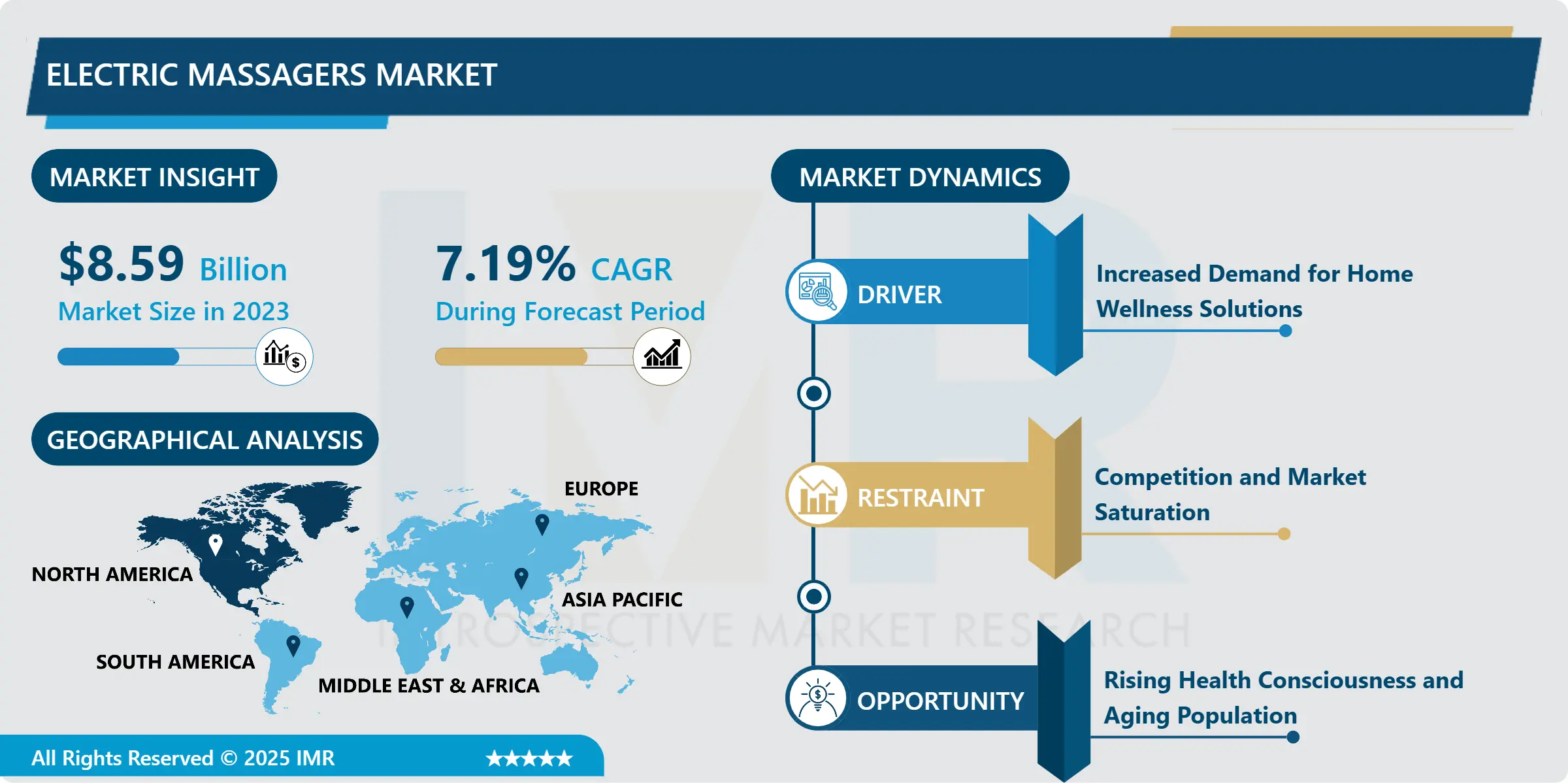
Electric Massagers Market Size Was Valued at USD 8.59 Billion in 2023, and is Projected to Reach USD 16.05 Billion by 2032, Growing at a CAGR of 7.19% From 2024-2032.

IMR Group
Description
Electric Massagers Market Synopsis:
Electric Massagers Market Size Was Valued at USD 8.59 Billion in 2023, and is Projected to Reach USD 16.05 Billion by 2032, Growing at a CAGR of 7.19% From 2024-2032.
The electric massagers market segment concerns personal care industry firms specifically specializing in the conception, development, and implementation of devices designed to bring forth therapeutic massage using electrical mechanisms. Using such devices enables benefits, which otherwise would require consulting professionals in massage therapy for receiving similar effects. Such benefits include relieving tension, reducing or abolishing pain, as well as reducing stress among those using the device. This includes handheld, foot massagers, neck, back, and full body machines.
With growth steady, the market of electric massagers increases. Due to increased demand in terms of convenient and low-priced solutions for wellness from the consumer, electric massagers have been popular and continue gaining popularity in search for better methods of easing the muscular tensions, improving the circulations and relieving stresses, especially in a household environment as well as commercial one. From very handheld portable massagers, their options vary from much larger electric massagers on shoulders or even feet. They have become a standard in households and wellness centers because of their ease of use, affordability, and the fact that they can be used for immediate relief.
Advancements in technology have been very significant in the growth of this market. For example, with the development of smart massagers that can be controlled using mobile applications, as well as the inclusion of heat and vibration, it has increased the user experience. Also, the increasing health-consciousness of the older population of the world and awareness about well-being are responsible for increasing demand for electrical massagers in maintaining physical wellness. There is also awareness of self-care and stress relief that contributes to the overall demand.
Electric Massagers Market Trend Analysis:
Integration of Smart Technology
Some of the main trends identified for electric massagers include the implementation of smart technology. Electric massagers are designed for consumers who have evolved with technology. Over the past few years, it has been noted that most customers request electric massagers that incorporate newer features like Bluetooth and smartphone applications. Such massagers enable a user to personalise the massage with adjustable intensities, speed, and duration from an app. Some even offer voice control and integration with other smart devices in the house for better comfort and convenience. These trends seem to resonate well with people preferring smart solutions in health products, allowing them to enjoy a convenient experience with more adaptability.
Increasingly, electric massagers now deploy smart sensors. Such sensors detect tension in the muscles, thus the electric massager can respond accordingly. This is not only making the massage more effective but also allowing users to have a much more personalized and therapeutic experience. The integration of AI-driven features and data analytics makes electric massagers more attractive to younger, tech-savvy consumers. This development is a significant milestone in the market, as it integrates technology, wellness, and convenience for consumers.
Rising Health Consciousness and Aging Population
An important opportunity for the electric massagers market is found in the health consciousness and the aging population. When more and more people are becoming health conscious, as well as understand the need to maintain their physical health and wellbeing, they tend to seek products that help relax muscles and reduce stress. The global aging population is important in this context because the older adults often suffer from chronic pain, joint stiffness, and muscle tension-all of which can be relieved by regular massage. Electric massagers are non-invasive, convenient, and affordable to use to relieve common issues for seniors, thus making them an appealing option for those seeking mobility and discomfort relief.
The growing number of people searching for ways to cope with stress has brought a huge increase in demand for wellness products, including electric massagers. Increasingly popular at-home exercise and self-care activities provide the perfect environment for further expansion of the market. Companies that can position their products as essential tools for a healthy lifestyle, which offer targeted relief for a specific need, such as for neck and shoulder pain, or foot relaxation, can capitalise on this opportunity to attract a wide range of consumers, from seniors to young professionals looking to improve their physical and mental health.
Electric Massagers Market Segment Analysis:
Electric Massagers Market is Segmented on the basis of Product Type, Technology, Distribution Channel, Application, End User, and Region.
By Product Type, Handheld Massagers segment is expected to dominate the market during the forecast period
Electric massagers come in a variety of types, each tailored to specific customer needs. Handheld massagers are the most popular due to their lightweight, portable, and versatile nature, making them suitable for use on various body parts. These compact devices are easy to use and offer great convenience for home use.
On the other hand, neck and shoulder massagers focus on relieving tension in the upper body. These massagers are ideal for individuals experiencing pain or stiffness from poor posture, stress, or long hours at a desk. Designed to be worn around the neck or shoulders, they often deliver targeted, soothing relief to the muscles, helping to alleviate discomfort and promote relaxation.
By Application, Personal Use segment expected to held the largest share
Electric massagers are increasingly popular for both personal and commercial use, with personal use making up the dominant application segment. Many consumers are seeking affordable and convenient self-care solutions, particularly in their busy daily lives. With the growing trend of wellness and stress reduction, people are turning to electric massagers as an accessible way to relieve muscle fatigue, reduce tension, and enhance relaxation at home. These devices are particularly favored by individuals who have hectic schedules, allowing them to enjoy a quick massage after work or physical activity.
The personal use segment encompasses a wide range of devices, from compact handheld options to more advanced models, offering users flexibility in terms of features, intensity settings, and portability. The convenience and ease of use make these products an attractive choice for at-home self-care routines.
Electric Massagers Market Regional Insights:
North America is Expected to Dominate the Market Over the Forecast period
North America is the biggest market for electric massagers mainly due to the high disposable income, emphasis on well-being, and an older population. Consumers in North America are increasingly looking for non-invasive ways to deal with stress, pain, and improved health, thereby creating much demand for electric massagers. The region has a strong health care infrastructure and consumer awareness of the benefits of physical therapy and relaxation techniques. This drives the market for electric massagers further.
In North America, the growth of e-commerce has further helped in increasing the market by making electric massagers easy to access for a larger customer base. Because health and self-care will always be a priority for the consumer, companies offering high-quality innovative products will likely flourish in this competitive region. The North American market will probably still hold first position because the electric massagers’ market will continue to expand as consumers’ demand health, wellness, and convenience grow.
Active Key Players in the Electric Massagers Market:
Panasonic (Japan)
Philips (Netherlands)
Homedics (USA)
OSIM (Singapore)
Brookstone (USA)
Naipo (China)
TheraGun (USA)
Wahl Clipper Corporation (USA)
Beurer GmbH (Germany)
InvoSpa (USA)
Comfier (China)
iReliev (USA), and Other Active Players
Chapter 1: Introduction
1.1 Scope and Coverage
Chapter 2:Executive Summary
Chapter 3: Market Landscape
3.1 Market Dynamics
3.1.1 Drivers
3.1.2 Restraints
3.1.3 Opportunities
3.1.4 Challenges
3.2 Market Trend Analysis
3.3 PESTLE Analysis
3.4 Porter’s Five Forces Analysis
3.5 Industry Value Chain Analysis
3.6 Ecosystem
3.7 Regulatory Landscape
3.8 Price Trend Analysis
3.9 Patent Analysis
3.10 Technology Evolution
3.11 Investment Pockets
3.12 Import-Export Analysis
Chapter 4: Electric Massagers Market by Product Type
4.1 Electric Massagers Market Snapshot and Growth Engine
4.2 Electric Massagers Market Overview
4.3 Handheld Massagers
4.3.1 Introduction and Market Overview
4.3.2 Historic and Forecasted Market Size in Value USD and Volume Units (2017-2032F)
4.3.3 Key Market Trends, Growth Factors and Opportunities
4.3.4 Handheld Massagers: Geographic Segmentation Analysis
4.4 Neck and Shoulder Massagers
4.4.1 Introduction and Market Overview
4.4.2 Historic and Forecasted Market Size in Value USD and Volume Units (2017-2032F)
4.4.3 Key Market Trends, Growth Factors and Opportunities
4.4.4 Neck and Shoulder Massagers: Geographic Segmentation Analysis
4.5 Foot Massagers
4.5.1 Introduction and Market Overview
4.5.2 Historic and Forecasted Market Size in Value USD and Volume Units (2017-2032F)
4.5.3 Key Market Trends, Growth Factors and Opportunities
4.5.4 Foot Massagers: Geographic Segmentation Analysis
4.6 Back Massagers
4.6.1 Introduction and Market Overview
4.6.2 Historic and Forecasted Market Size in Value USD and Volume Units (2017-2032F)
4.6.3 Key Market Trends, Growth Factors and Opportunities
4.6.4 Back Massagers: Geographic Segmentation Analysis
4.7 Full-Body Massagers
4.7.1 Introduction and Market Overview
4.7.2 Historic and Forecasted Market Size in Value USD and Volume Units (2017-2032F)
4.7.3 Key Market Trends, Growth Factors and Opportunities
4.7.4 Full-Body Massagers: Geographic Segmentation Analysis
4.8 Face Massagers
4.8.1 Introduction and Market Overview
4.8.2 Historic and Forecasted Market Size in Value USD and Volume Units (2017-2032F)
4.8.3 Key Market Trends, Growth Factors and Opportunities
4.8.4 Face Massagers: Geographic Segmentation Analysis
Chapter 5: Electric Massagers Market by Application
5.1 Electric Massagers Market Snapshot and Growth Engine
5.2 Electric Massagers Market Overview
5.3 Personal Use
5.3.1 Introduction and Market Overview
5.3.2 Historic and Forecasted Market Size in Value USD and Volume Units (2017-2032F)
5.3.3 Key Market Trends, Growth Factors and Opportunities
5.3.4 Personal Use: Geographic Segmentation Analysis
5.4 Commercial Use
5.4.1 Introduction and Market Overview
5.4.2 Historic and Forecasted Market Size in Value USD and Volume Units (2017-2032F)
5.4.3 Key Market Trends, Growth Factors and Opportunities
5.4.4 Commercial Use: Geographic Segmentation Analysis
Chapter 6: Electric Massagers Market by Technology
6.1 Electric Massagers Market Snapshot and Growth Engine
6.2 Electric Massagers Market Overview
6.3 Vibration-based Massagers
6.3.1 Introduction and Market Overview
6.3.2 Historic and Forecasted Market Size in Value USD and Volume Units (2017-2032F)
6.3.3 Key Market Trends, Growth Factors and Opportunities
6.3.4 Vibration-based Massagers: Geographic Segmentation Analysis
6.4 Percussion-based Massagers
6.4.1 Introduction and Market Overview
6.4.2 Historic and Forecasted Market Size in Value USD and Volume Units (2017-2032F)
6.4.3 Key Market Trends, Growth Factors and Opportunities
6.4.4 Percussion-based Massagers: Geographic Segmentation Analysis
6.5 Infrared-based Massagers
6.5.1 Introduction and Market Overview
6.5.2 Historic and Forecasted Market Size in Value USD and Volume Units (2017-2032F)
6.5.3 Key Market Trends, Growth Factors and Opportunities
6.5.4 Infrared-based Massagers: Geographic Segmentation Analysis
6.6 Air Compression Massagers
6.6.1 Introduction and Market Overview
6.6.2 Historic and Forecasted Market Size in Value USD and Volume Units (2017-2032F)
6.6.3 Key Market Trends, Growth Factors and Opportunities
6.6.4 Air Compression Massagers: Geographic Segmentation Analysis
Chapter 7: Electric Massagers Market by Distribution Channel
7.1 Electric Massagers Market Snapshot and Growth Engine
7.2 Electric Massagers Market Overview
7.3 Online Retail
7.3.1 Introduction and Market Overview
7.3.2 Historic and Forecasted Market Size in Value USD and Volume Units (2017-2032F)
7.3.3 Key Market Trends, Growth Factors and Opportunities
7.3.4 Online Retail: Geographic Segmentation Analysis
7.4 Offline Retail
7.4.1 Introduction and Market Overview
7.4.2 Historic and Forecasted Market Size in Value USD and Volume Units (2017-2032F)
7.4.3 Key Market Trends, Growth Factors and Opportunities
7.4.4 Offline Retail: Geographic Segmentation Analysis
Chapter 8: Electric Massagers Market by End User
8.1 Electric Massagers Market Snapshot and Growth Engine
8.2 Electric Massagers Market Overview
8.3 Household
8.3.1 Introduction and Market Overview
8.3.2 Historic and Forecasted Market Size in Value USD and Volume Units (2017-2032F)
8.3.3 Key Market Trends, Growth Factors and Opportunities
8.3.4 Household: Geographic Segmentation Analysis
8.4 Healthcare Facilities
8.4.1 Introduction and Market Overview
8.4.2 Historic and Forecasted Market Size in Value USD and Volume Units (2017-2032F)
8.4.3 Key Market Trends, Growth Factors and Opportunities
8.4.4 Healthcare Facilities: Geographic Segmentation Analysis
8.5 Wellness & Fitness Centers
8.5.1 Introduction and Market Overview
8.5.2 Historic and Forecasted Market Size in Value USD and Volume Units (2017-2032F)
8.5.3 Key Market Trends, Growth Factors and Opportunities
8.5.4 Wellness & Fitness Centers: Geographic Segmentation Analysis
8.6 Professional Therapists
8.6.1 Introduction and Market Overview
8.6.2 Historic and Forecasted Market Size in Value USD and Volume Units (2017-2032F)
8.6.3 Key Market Trends, Growth Factors and Opportunities
8.6.4 Professional Therapists: Geographic Segmentation Analysis
Chapter 9: Company Profiles and Competitive Analysis
9.1 Competitive Landscape
9.1.1 Competitive Benchmarking
9.1.2 Electric Massagers Market Share by Manufacturer (2023)
9.1.3 Industry BCG Matrix
9.1.4 Heat Map Analysis
9.1.5 Mergers and Acquisitions
9.2 PANASONIC (JAPAN)
9.2.1 Company Overview
9.2.2 Key Executives
9.2.3 Company Snapshot
9.2.4 Role of the Company in the Market
9.2.5 Sustainability and Social Responsibility
9.2.6 Operating Business Segments
9.2.7 Product Portfolio
9.2.8 Business Performance
9.2.9 Key Strategic Moves and Recent Developments
9.2.10 SWOT Analysis
9.3 PHILIPS (NETHERLANDS)
9.4 HOMEDICS (USA)
9.5 OSIM (SINGAPORE)
9.6 BROOKSTONE (USA)
9.7 NAIPO (CHINA)
9.8 THERAGUN (USA)
9.9 WAHL CLIPPER CORPORATION (USA)
9.10 BEURER GMBH (GERMANY)
9.11 INVOSPA (USA)
9.12 COMFIER (CHINA)
9.13 IRELIEV (USA)
9.14 OTHER ACTIVE PLAYERS
Chapter 10: Global Electric Massagers Market By Region
10.1 Overview
10.2. North America Electric Massagers Market
10.2.1 Key Market Trends, Growth Factors and Opportunities
10.2.2 Top Key Companies
10.2.3 Historic and Forecasted Market Size by Segments
10.2.4 Historic and Forecasted Market Size By Product Type
10.2.4.1 Handheld Massagers
10.2.4.2 Neck and Shoulder Massagers
10.2.4.3 Foot Massagers
10.2.4.4 Back Massagers
10.2.4.5 Full-Body Massagers
10.2.4.6 Face Massagers
10.2.5 Historic and Forecasted Market Size By Application
10.2.5.1 Personal Use
10.2.5.2 Commercial Use
10.2.6 Historic and Forecasted Market Size By Technology
10.2.6.1 Vibration-based Massagers
10.2.6.2 Percussion-based Massagers
10.2.6.3 Infrared-based Massagers
10.2.6.4 Air Compression Massagers
10.2.7 Historic and Forecasted Market Size By Distribution Channel
10.2.7.1 Online Retail
10.2.7.2 Offline Retail
10.2.8 Historic and Forecasted Market Size By End User
10.2.8.1 Household
10.2.8.2 Healthcare Facilities
10.2.8.3 Wellness & Fitness Centers
10.2.8.4 Professional Therapists
10.2.9 Historic and Forecast Market Size by Country
10.2.9.1 US
10.2.9.2 Canada
10.2.9.3 Mexico
10.3. Eastern Europe Electric Massagers Market
10.3.1 Key Market Trends, Growth Factors and Opportunities
10.3.2 Top Key Companies
10.3.3 Historic and Forecasted Market Size by Segments
10.3.4 Historic and Forecasted Market Size By Product Type
10.3.4.1 Handheld Massagers
10.3.4.2 Neck and Shoulder Massagers
10.3.4.3 Foot Massagers
10.3.4.4 Back Massagers
10.3.4.5 Full-Body Massagers
10.3.4.6 Face Massagers
10.3.5 Historic and Forecasted Market Size By Application
10.3.5.1 Personal Use
10.3.5.2 Commercial Use
10.3.6 Historic and Forecasted Market Size By Technology
10.3.6.1 Vibration-based Massagers
10.3.6.2 Percussion-based Massagers
10.3.6.3 Infrared-based Massagers
10.3.6.4 Air Compression Massagers
10.3.7 Historic and Forecasted Market Size By Distribution Channel
10.3.7.1 Online Retail
10.3.7.2 Offline Retail
10.3.8 Historic and Forecasted Market Size By End User
10.3.8.1 Household
10.3.8.2 Healthcare Facilities
10.3.8.3 Wellness & Fitness Centers
10.3.8.4 Professional Therapists
10.3.9 Historic and Forecast Market Size by Country
10.3.9.1 Russia
10.3.9.2 Bulgaria
10.3.9.3 The Czech Republic
10.3.9.4 Hungary
10.3.9.5 Poland
10.3.9.6 Romania
10.3.9.7 Rest of Eastern Europe
10.4. Western Europe Electric Massagers Market
10.4.1 Key Market Trends, Growth Factors and Opportunities
10.4.2 Top Key Companies
10.4.3 Historic and Forecasted Market Size by Segments
10.4.4 Historic and Forecasted Market Size By Product Type
10.4.4.1 Handheld Massagers
10.4.4.2 Neck and Shoulder Massagers
10.4.4.3 Foot Massagers
10.4.4.4 Back Massagers
10.4.4.5 Full-Body Massagers
10.4.4.6 Face Massagers
10.4.5 Historic and Forecasted Market Size By Application
10.4.5.1 Personal Use
10.4.5.2 Commercial Use
10.4.6 Historic and Forecasted Market Size By Technology
10.4.6.1 Vibration-based Massagers
10.4.6.2 Percussion-based Massagers
10.4.6.3 Infrared-based Massagers
10.4.6.4 Air Compression Massagers
10.4.7 Historic and Forecasted Market Size By Distribution Channel
10.4.7.1 Online Retail
10.4.7.2 Offline Retail
10.4.8 Historic and Forecasted Market Size By End User
10.4.8.1 Household
10.4.8.2 Healthcare Facilities
10.4.8.3 Wellness & Fitness Centers
10.4.8.4 Professional Therapists
10.4.9 Historic and Forecast Market Size by Country
10.4.9.1 Germany
10.4.9.2 UK
10.4.9.3 France
10.4.9.4 The Netherlands
10.4.9.5 Italy
10.4.9.6 Spain
10.4.9.7 Rest of Western Europe
10.5. Asia Pacific Electric Massagers Market
10.5.1 Key Market Trends, Growth Factors and Opportunities
10.5.2 Top Key Companies
10.5.3 Historic and Forecasted Market Size by Segments
10.5.4 Historic and Forecasted Market Size By Product Type
10.5.4.1 Handheld Massagers
10.5.4.2 Neck and Shoulder Massagers
10.5.4.3 Foot Massagers
10.5.4.4 Back Massagers
10.5.4.5 Full-Body Massagers
10.5.4.6 Face Massagers
10.5.5 Historic and Forecasted Market Size By Application
10.5.5.1 Personal Use
10.5.5.2 Commercial Use
10.5.6 Historic and Forecasted Market Size By Technology
10.5.6.1 Vibration-based Massagers
10.5.6.2 Percussion-based Massagers
10.5.6.3 Infrared-based Massagers
10.5.6.4 Air Compression Massagers
10.5.7 Historic and Forecasted Market Size By Distribution Channel
10.5.7.1 Online Retail
10.5.7.2 Offline Retail
10.5.8 Historic and Forecasted Market Size By End User
10.5.8.1 Household
10.5.8.2 Healthcare Facilities
10.5.8.3 Wellness & Fitness Centers
10.5.8.4 Professional Therapists
10.5.9 Historic and Forecast Market Size by Country
10.5.9.1 China
10.5.9.2 India
10.5.9.3 Japan
10.5.9.4 South Korea
10.5.9.5 Malaysia
10.5.9.6 Thailand
10.5.9.7 Vietnam
10.5.9.8 The Philippines
10.5.9.9 Australia
10.5.9.10 New Zealand
10.5.9.11 Rest of APAC
10.6. Middle East & Africa Electric Massagers Market
10.6.1 Key Market Trends, Growth Factors and Opportunities
10.6.2 Top Key Companies
10.6.3 Historic and Forecasted Market Size by Segments
10.6.4 Historic and Forecasted Market Size By Product Type
10.6.4.1 Handheld Massagers
10.6.4.2 Neck and Shoulder Massagers
10.6.4.3 Foot Massagers
10.6.4.4 Back Massagers
10.6.4.5 Full-Body Massagers
10.6.4.6 Face Massagers
10.6.5 Historic and Forecasted Market Size By Application
10.6.5.1 Personal Use
10.6.5.2 Commercial Use
10.6.6 Historic and Forecasted Market Size By Technology
10.6.6.1 Vibration-based Massagers
10.6.6.2 Percussion-based Massagers
10.6.6.3 Infrared-based Massagers
10.6.6.4 Air Compression Massagers
10.6.7 Historic and Forecasted Market Size By Distribution Channel
10.6.7.1 Online Retail
10.6.7.2 Offline Retail
10.6.8 Historic and Forecasted Market Size By End User
10.6.8.1 Household
10.6.8.2 Healthcare Facilities
10.6.8.3 Wellness & Fitness Centers
10.6.8.4 Professional Therapists
10.6.9 Historic and Forecast Market Size by Country
10.6.9.1 Turkiye
10.6.9.2 Bahrain
10.6.9.3 Kuwait
10.6.9.4 Saudi Arabia
10.6.9.5 Qatar
10.6.9.6 UAE
10.6.9.7 Israel
10.6.9.8 South Africa
10.7. South America Electric Massagers Market
10.7.1 Key Market Trends, Growth Factors and Opportunities
10.7.2 Top Key Companies
10.7.3 Historic and Forecasted Market Size by Segments
10.7.4 Historic and Forecasted Market Size By Product Type
10.7.4.1 Handheld Massagers
10.7.4.2 Neck and Shoulder Massagers
10.7.4.3 Foot Massagers
10.7.4.4 Back Massagers
10.7.4.5 Full-Body Massagers
10.7.4.6 Face Massagers
10.7.5 Historic and Forecasted Market Size By Application
10.7.5.1 Personal Use
10.7.5.2 Commercial Use
10.7.6 Historic and Forecasted Market Size By Technology
10.7.6.1 Vibration-based Massagers
10.7.6.2 Percussion-based Massagers
10.7.6.3 Infrared-based Massagers
10.7.6.4 Air Compression Massagers
10.7.7 Historic and Forecasted Market Size By Distribution Channel
10.7.7.1 Online Retail
10.7.7.2 Offline Retail
10.7.8 Historic and Forecasted Market Size By End User
10.7.8.1 Household
10.7.8.2 Healthcare Facilities
10.7.8.3 Wellness & Fitness Centers
10.7.8.4 Professional Therapists
10.7.9 Historic and Forecast Market Size by Country
10.7.9.1 Brazil
10.7.9.2 Argentina
10.7.9.3 Rest of SA
Chapter 11 Analyst Viewpoint and Conclusion
11.1 Recommendations and Concluding Analysis
11.2 Potential Market Strategies
Chapter 12 Research Methodology
12.1 Research Process
12.2 Primary Research
12.3 Secondary Research
Q1: What would be the forecast period in the Electric Massagers Market research report?
A1: The forecast period in the Electric Massagers Market research report is 2024-2032.
Q2: Who are the key players in the Electric Massagers Market?
A2: Panasonic (Japan), Philips (Netherlands), Homedics (USA), OSIM (Singapore), Brookstone (USA), Naipo (China), TheraGun (USA), Wahl Clipper Corporation (USA), Beurer GmbH (Germany), InvoSpa (USA), Comfier (China), iReliev (USA), and Other Active Players.
Q3: What are the segments of the Electric Massagers Market?
A3: The Electric Massagers Market is segmented into Product Type, Technology, Distribution Channel, Application, End User and region. By Product Type, the market is categorized into Handheld Massagers, Neck and Shoulder Massagers, Foot Massagers, Back Massagers, Full-Body Massagers, Face Massagers. By Application, the market is categorized into Personal Use, Commercial Use. By Technology, the market is categorized into Vibration-based Massagers, Percussion-based Massagers, Infrared-based Massagers, Air Compression Massagers. By Distribution Channel, the market is categorized into Online Retail, Offline Retail. By End User, the market is categorized into Household, Healthcare Facilities, Wellness & Fitness Centers, Professional Therapists. By region, it is analyzed across North America (U.S., Canada, Mexico), Eastern Europe (Russia, Bulgaria, The Czech Republic, Hungary, Poland, Romania, Rest of Eastern Europe), Western Europe (Germany, UK, France, Netherlands, Italy, Spain, Rest of Western Europe), Asia Pacific (China, India, Japan, South Korea, Malaysia, Thailand, Vietnam, The Philippines, Australia, New Zealand, Rest of APAC), Middle East & Africa (Turkiye, Bahrain, Kuwait, Saudi Arabia, Qatar, UAE, Israel, South Africa), South America (Brazil, Argentina, Rest of SA).
Q4: What is the Electric Massagers Market?
A4: The electric massagers market segment concerns personal care industry firms specifically specializing in the conception, development, and implementation of devices designed to bring forth therapeutic massage using electrical mechanisms. Using such devices enables benefits, which otherwise would require consulting professionals in massage therapy for receiving similar effects. Such benefits include relieving tension, reducing or abolishing pain, as well as reducing stress among those using the device. This includes handheld, foot massagers, neck, back, and full body machines.
Q5: How big is the Electric Massagers Market?
A5: Electric Massagers Market Size Was Valued at USD 8.59 Billion in 2023, and is Projected to Reach USD 16.05 Billion by 2032, Growing at a CAGR of 7.19% From 2024-2032.
How to Buy a Report from eminsights.jp
On the product page, choose the license you want: Single-User License, Multi-User License or Enterprise License.
If you required report in your native language, then you can click on Translated Report button and fill out the form with report name and language you want, then our team will contact you as soon as possible.
Click the Buy Now button.
You will be redirected to the checkout page. Enter your company details and payment information.
Click Place Order to complete the purchase.
Confirmation: You’ll receive an order confirmation and our team will contact you shortly with your ordered report.
If you have any questions, fill out the contact form below or email us at bizdev@eminsights.net.
Thank you for choosing eminsights.jp!