Stay Ahead in Fast-Growing Economies.
Browse Reports Now
Electric Aircraft Market
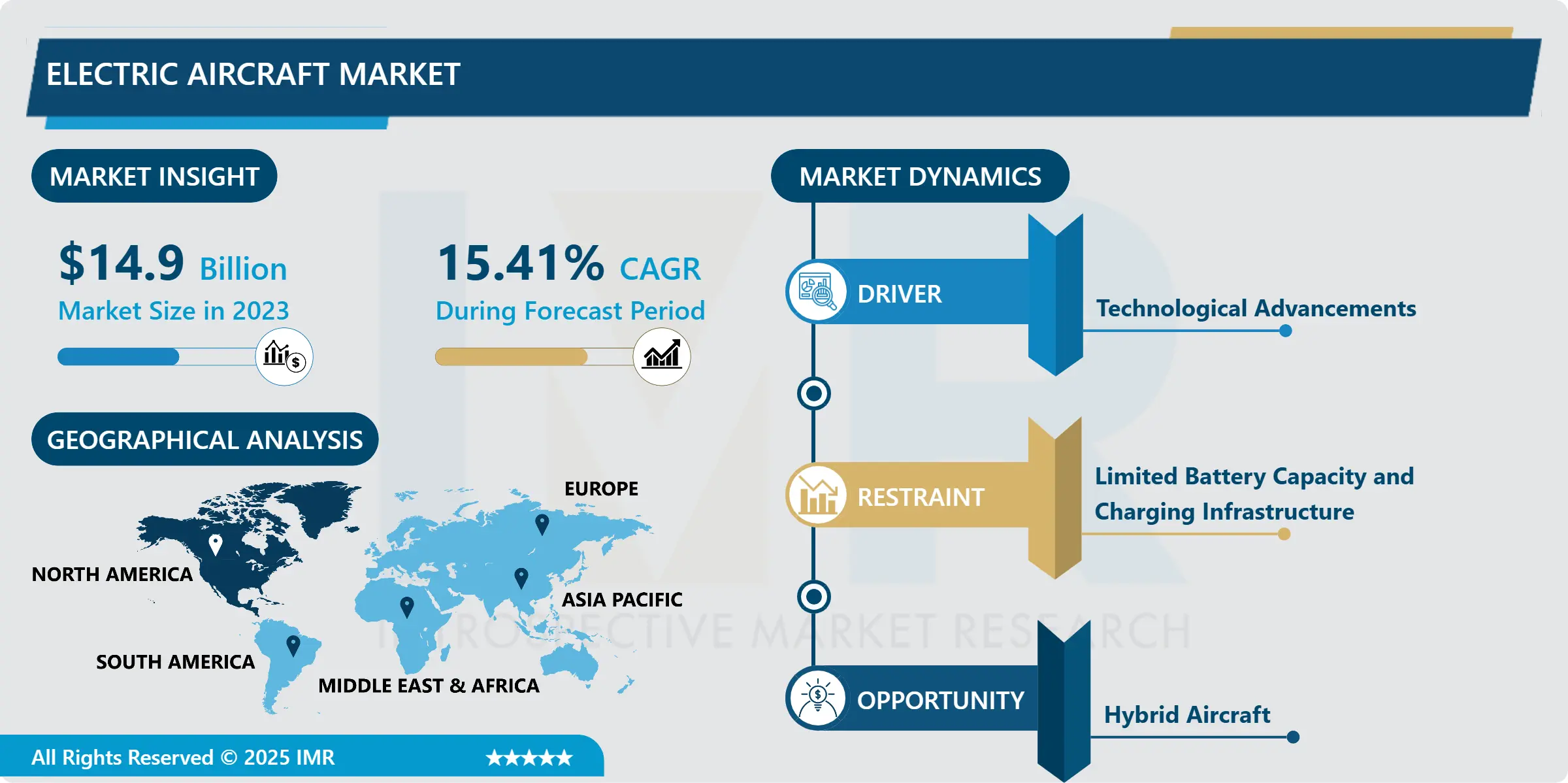
Electric Aircraft Market Size Was Valued at USD 14.9 Billion in 2023, and is Projected to Reach USD 40.4 Billion by 2032, Growing at a CAGR of 15.41% From 2024-2032.

IMR Group
Description
Electric Aircraft Market Synopsis:
Electric Aircraft Market Size Was Valued at USD 14.9 Billion in 2023, and is Projected to Reach USD 40.4 Billion by 2032, Growing at a CAGR of 15.41% From 2024-2032.
Market pertains to the development and deployment of aircraft powered by electric propulsion systems. It refers either to single electric sources or hybrid electric solutions, thus including fixed-wing aircraft, rotary-wing aircraft, which are called eVTOL, and hybrid aircraft aimed at cutting down carbon emissions and lowering costs for operations as well as developing a more sustainable means of air travel. Multiple applications have been under scrutiny for these aircraft, including commercial aviation, military, and private use, with an emerging interest in Urban Air Mobility solutions.
The electric aircraft industry has experienced tremendous growth recently due to increasing concerns surrounding the environmental impact of classical aviation and the aviation industries’ shift toward sustainable and ecological-friendly alternatives. The main approach in this direction focuses on the integration of an electric propulsion system, deemed as one of the chief ways to reduce carbon emissions from the aircraft, minimize their fuel consumption, and reduce the noise levels experienced in air travel. Electric aircraft would also allow for lower costs of operation and efficiency better than fossil-fuel-operated aircraft. Companies, as well as startups, have been investing in electric aircraft technologies, and several governments have initiatives and regulations set up to encourage research and development in this area.
In the light of growing demand for greener transportation solutions, batter technology, aerodynamics, and electric propulsion systems are pushing the boundary of electric aircraft as a commercially viable one. For instance, lithium-ion battery improvements and fuel cells extend flight ranges and introduce better power-to-weight ratios, something indispensable for long-distance flights. The market for eVTOL aircraft is particularly promising where different urban air mobility solutions are being explored as parts of smart city projects. Companies are now focusing to design eVTOL, enabling on-demand short flights in urban areas, cutting down congestion on the road and opening new avenues through the air.
Regulatory frameworks and government support too are helping accelerate the work on electric aircraft. Agencies like the FAA in the U.S. and EASA in the European Union are working towards the development of safety and certification standards specific to electric aircraft. These developments will change the way people travel and transport goods, especially in urban environments, as eVTOLs and other electric aircraft become commercially available. Even though the market is in its early stages, massive investments coupled with the collaboration of leading aviation players, technology giants, and governments are furthering the pace for adopting electric aircraft towards a sustainable future in aviation.
Electric Aircraft Market Trend Analysis:
Urban Air Mobility (UAM)
Emergence in the Electric Aircraft Market- Urban Air Mobility is now one of the prominent trends, where electric vertical take-off and landing aircraft eVTOL are coming as its precursors. These aircraft shall be flying within urban airspaces offering fast, unobstructed, congestion-free passage for passengers as well as cargo. The chief driver here is the up-surging need for efficient and more environmentally friendly rapid transportation for highly populous cities. With electric engines, eVTOLs offer an alternative solution to the problems of urban congestion and dependence on ground-based transportation systems. Companies and governments alike are sinking huge sums of money into UAM infrastructure, from air traffic management systems to designated landing pads, in order to bring these aircraft into the city.
Development also spurred the adoption of UAM as improvements in battery technology make for longer flight ranges and improved performance of eVTOL aircraft. For instance, the electric aircraft could fly up to distances that suit the urban setting and recharge immediately so it could carry out on-demand flights. In addition, the UAM is a means of answering environmental questions due to its cleaner and less noisy alternative to helicopters, among other aircraft. There is potential for changing the ways by which people move about inside cities with an efficient mode of transport that happens to be green and economical for complementing traditional transportation infrastructure. This includes leading players in the aviation industry, such as manufacturers, governments, and technology firms, working together to create the ecosystem and appropriate regulations to facilitate the adoption of UAM.
Hybrid Aircraft
Hybrid aircraft, combining electric propulsion systems with conventional fuel-based engines, offer a big opportunity in the electric aircraft market. Hybrid aircraft is a perfect combination that offers eco-friendly electric propulsion for short-range flights and the range and power of conventional engines for long-range travel. It is also an attractive choice for commercial and cargo transport. The ability to fly further and without the limitations of existing battery technologies removes one of the major barriers to the penetration of purely electric aircraft in the market.
As hybrid aircraft continue to evolve, this category is likely to attract considerable investments from traditional aviation companies and startups wishing to enter the electric aviation space. Hybrid aircraft can, thus become a transitional solution with a growing demand for sustainability and efficiency in air travel toward full electrification. Hybrid aircrafts can revolutionize regional and short-haul flights, where they can operate economically and sustainably while meeting the needs of regulatory and operational demands. The market for hybrid electric aircraft is likely to grow in regions where infrastructure is poor for charging and purely electric flight solutions.
Electric Aircraft Market Segment Analysis:
Electric Aircraft Market is Segmented on the basis of Aircraft Type, Range, Propulsion Type, Power Source, Technology, End User, and Region.
By Aircraft Type, Fixed-Wing Aircraft segment is expected to dominate the market during the forecast period
Fixed-wing electric aircraft are poised to become the leading type of electric aircraft for commercial use, primarily due to their design optimized for longer ranges and higher efficiency. These aircraft utilize the aerodynamic advantages of fixed wings, allowing them to transport passengers and cargo over considerable distances, which is a significant edge over other electric aircraft designs like vertical takeoff and landing (VTOL) models. Most of these aircraft are currently under development with a focus on regional air travel and cargo delivery. They promise to offer substantial benefits, including reduced operational costs and lower emissions compared to conventional fossil fuel-powered aircraft. This makes them an attractive alternative, particularly in sectors where short to medium-haul flights are common, driving the future of sustainable aviation.
By End User, Commercial segment expected to held the largest share
The commercial sector is poised to be a key driver in the growth of the electric aircraft market, as there is an increasing push for sustainable and cost-effective aviation solutions. With airlines aiming to reduce operational costs and minimize their environmental footprint, electric and hybrid-electric aircraft are becoming a more attractive alternative, especially for short-haul flights. This trend is being bolstered by the growing interest in electric vertical takeoff and landing (eVTOL) aircraft, which could revolutionize urban mobility by enabling fast, low-cost travel between city centers and airports. As urban air mobility systems gain momentum, regulations and environmental concerns play a significant role in pushing airlines toward adopting electric solutions. Governments and regulatory bodies are offering incentives to accelerate this transition, aligning with the global shift toward cleaner, greener air travel. This sector’s potential is immense as it meets the dual demand for eco-friendly alternatives and affordable travel options.
Electric Aircraft Market Regional Insights:
North America is Expected to Dominate the Market Over the Forecast period
North America currently leads the way in the electric aircraft market, with its robust technological infrastructure and strong aerospace industry, while the government is supporting clean energy. The United States is really leading the electric aircraft way, with numerous startups as well as established aerospace companies investing in electric and hybrid propulsion technologies. In addition, the market for aviation in North America is very responsive to innovations related to environmental impact reduction and there is a huge interest from the private and commercial sectors of adopting electric aircraft for regional and short-haul travel.
The dominance of the North American region in electric aircraft can be attributed to the strategic initiatives taken towards reducing carbon emissions and fulfilling sustainability goals. The U.S. Federal Aviation Administration (FAA) has been working on making certification processes for electric aircraft, and federal incentives at the state level are encouraging a growth in clean aviation technology. As technical capabilities continue to advance and as regulatory frameworks evolve, North America is seen to be leading the development of electric aircraft.
Active Key Players in the Electric Aircraft Market:
Joby Aviation (USA)
Lilium (Germany)
Vertical Aerospace (UK)
Eviation Aircraft (Israel)
Boeing (USA)
Airbus (France)
Zunum Aero (USA)
Terrafugia (USA)
Rolls-Royce (UK)
Aurora Flight Sciences (USA)
Bell Helicopter (USA), and Other Active Players
Chapter 1: Introduction
1.1 Scope and Coverage
Chapter 2:Executive Summary
Chapter 3: Market Landscape
3.1 Market Dynamics
3.1.1 Drivers
3.1.2 Restraints
3.1.3 Opportunities
3.1.4 Challenges
3.2 Market Trend Analysis
3.3 PESTLE Analysis
3.4 Porter’s Five Forces Analysis
3.5 Industry Value Chain Analysis
3.6 Ecosystem
3.7 Regulatory Landscape
3.8 Price Trend Analysis
3.9 Patent Analysis
3.10 Technology Evolution
3.11 Investment Pockets
3.12 Import-Export Analysis
Chapter 4: Electric Aircraft Market by Aircraft Type
4.1 Electric Aircraft Market Snapshot and Growth Engine
4.2 Electric Aircraft Market Overview
4.3 Fixed-Wing Aircraft
4.3.1 Introduction and Market Overview
4.3.2 Historic and Forecasted Market Size in Value USD and Volume Units (2017-2032F)
4.3.3 Key Market Trends, Growth Factors and Opportunities
4.3.4 Fixed-Wing Aircraft: Geographic Segmentation Analysis
4.4 Rotary-Wing Aircraft
4.4.1 Introduction and Market Overview
4.4.2 Historic and Forecasted Market Size in Value USD and Volume Units (2017-2032F)
4.4.3 Key Market Trends, Growth Factors and Opportunities
4.4.4 Rotary-Wing Aircraft: Geographic Segmentation Analysis
Chapter 5: Electric Aircraft Market by Range
5.1 Electric Aircraft Market Snapshot and Growth Engine
5.2 Electric Aircraft Market Overview
5.3 Short-Range
5.3.1 Introduction and Market Overview
5.3.2 Historic and Forecasted Market Size in Value USD and Volume Units (2017-2032F)
5.3.3 Key Market Trends, Growth Factors and Opportunities
5.3.4 Short-Range: Geographic Segmentation Analysis
5.4 Medium-Range
5.4.1 Introduction and Market Overview
5.4.2 Historic and Forecasted Market Size in Value USD and Volume Units (2017-2032F)
5.4.3 Key Market Trends, Growth Factors and Opportunities
5.4.4 Medium-Range: Geographic Segmentation Analysis
5.5 Long-Range
5.5.1 Introduction and Market Overview
5.5.2 Historic and Forecasted Market Size in Value USD and Volume Units (2017-2032F)
5.5.3 Key Market Trends, Growth Factors and Opportunities
5.5.4 Long-Range: Geographic Segmentation Analysis
Chapter 6: Electric Aircraft Market by End Use
6.1 Electric Aircraft Market Snapshot and Growth Engine
6.2 Electric Aircraft Market Overview
6.3 Commercial
6.3.1 Introduction and Market Overview
6.3.2 Historic and Forecasted Market Size in Value USD and Volume Units (2017-2032F)
6.3.3 Key Market Trends, Growth Factors and Opportunities
6.3.4 Commercial: Geographic Segmentation Analysis
6.4 Military
6.4.1 Introduction and Market Overview
6.4.2 Historic and Forecasted Market Size in Value USD and Volume Units (2017-2032F)
6.4.3 Key Market Trends, Growth Factors and Opportunities
6.4.4 Military: Geographic Segmentation Analysis
6.5 Cargo
6.5.1 Introduction and Market Overview
6.5.2 Historic and Forecasted Market Size in Value USD and Volume Units (2017-2032F)
6.5.3 Key Market Trends, Growth Factors and Opportunities
6.5.4 Cargo: Geographic Segmentation Analysis
6.6 Private/Leisure
6.6.1 Introduction and Market Overview
6.6.2 Historic and Forecasted Market Size in Value USD and Volume Units (2017-2032F)
6.6.3 Key Market Trends, Growth Factors and Opportunities
6.6.4 Private/Leisure: Geographic Segmentation Analysis
Chapter 7: Electric Aircraft Market by Propulsion Type
7.1 Electric Aircraft Market Snapshot and Growth Engine
7.2 Electric Aircraft Market Overview
7.3 Fully Electric Propulsion
7.3.1 Introduction and Market Overview
7.3.2 Historic and Forecasted Market Size in Value USD and Volume Units (2017-2032F)
7.3.3 Key Market Trends, Growth Factors and Opportunities
7.3.4 Fully Electric Propulsion: Geographic Segmentation Analysis
7.4 Hybrid-Electric Propulsion
7.4.1 Introduction and Market Overview
7.4.2 Historic and Forecasted Market Size in Value USD and Volume Units (2017-2032F)
7.4.3 Key Market Trends, Growth Factors and Opportunities
7.4.4 Hybrid-Electric Propulsion: Geographic Segmentation Analysis
Chapter 8: Electric Aircraft Market by Power Source
8.1 Electric Aircraft Market Snapshot and Growth Engine
8.2 Electric Aircraft Market Overview
8.3 Battery Electric
8.3.1 Introduction and Market Overview
8.3.2 Historic and Forecasted Market Size in Value USD and Volume Units (2017-2032F)
8.3.3 Key Market Trends, Growth Factors and Opportunities
8.3.4 Battery Electric: Geographic Segmentation Analysis
8.4 Fuel Cell Electric
8.4.1 Introduction and Market Overview
8.4.2 Historic and Forecasted Market Size in Value USD and Volume Units (2017-2032F)
8.4.3 Key Market Trends, Growth Factors and Opportunities
8.4.4 Fuel Cell Electric: Geographic Segmentation Analysis
8.5 Hybrid Electric
8.5.1 Introduction and Market Overview
8.5.2 Historic and Forecasted Market Size in Value USD and Volume Units (2017-2032F)
8.5.3 Key Market Trends, Growth Factors and Opportunities
8.5.4 Hybrid Electric: Geographic Segmentation Analysis
Chapter 9: Electric Aircraft Market by Technology
9.1 Electric Aircraft Market Snapshot and Growth Engine
9.2 Electric Aircraft Market Overview
9.3 Lithium-Ion Battery
9.3.1 Introduction and Market Overview
9.3.2 Historic and Forecasted Market Size in Value USD and Volume Units (2017-2032F)
9.3.3 Key Market Trends, Growth Factors and Opportunities
9.3.4 Lithium-Ion Battery: Geographic Segmentation Analysis
9.4 Hydrogen Fuel Cells
9.4.1 Introduction and Market Overview
9.4.2 Historic and Forecasted Market Size in Value USD and Volume Units (2017-2032F)
9.4.3 Key Market Trends, Growth Factors and Opportunities
9.4.4 Hydrogen Fuel Cells: Geographic Segmentation Analysis
9.5 Other
9.5.1 Introduction and Market Overview
9.5.2 Historic and Forecasted Market Size in Value USD and Volume Units (2017-2032F)
9.5.3 Key Market Trends, Growth Factors and Opportunities
9.5.4 Other: Geographic Segmentation Analysis
Chapter 10: Company Profiles and Competitive Analysis
10.1 Competitive Landscape
10.1.1 Competitive Benchmarking
10.1.2 Electric Aircraft Market Share by Manufacturer (2023)
10.1.3 Industry BCG Matrix
10.1.4 Heat Map Analysis
10.1.5 Mergers and Acquisitions
10.2 JOBY AVIATION (USA)
10.2.1 Company Overview
10.2.2 Key Executives
10.2.3 Company Snapshot
10.2.4 Role of the Company in the Market
10.2.5 Sustainability and Social Responsibility
10.2.6 Operating Business Segments
10.2.7 Product Portfolio
10.2.8 Business Performance
10.2.9 Key Strategic Moves and Recent Developments
10.2.10 SWOT Analysis
10.3 LILIUM (GERMANY)
10.4 VERTICAL AEROSPACE (UK)
10.5 EVIATION AIRCRAFT (ISRAEL)
10.6 BOEING (USA)
10.7 AIRBUS (FRANCE)
10.8 ZUNUM AERO (USA)
10.9 TERRAFUGIA (USA)
10.10 ROLLS-ROYCE (UK)
10.11 AURORA FLIGHT SCIENCES (USA)
10.12 BELL HELICOPTER (USA)
10.13 OTHER ACTIVE PLAYERS
Chapter 11: Global Electric Aircraft Market By Region
11.1 Overview
11.2. North America Electric Aircraft Market
11.2.1 Key Market Trends, Growth Factors and Opportunities
11.2.2 Top Key Companies
11.2.3 Historic and Forecasted Market Size by Segments
11.2.4 Historic and Forecasted Market Size By Aircraft Type
11.2.4.1 Fixed-Wing Aircraft
11.2.4.2 Rotary-Wing Aircraft
11.2.5 Historic and Forecasted Market Size By Range
11.2.5.1 Short-Range
11.2.5.2 Medium-Range
11.2.5.3 Long-Range
11.2.6 Historic and Forecasted Market Size By End Use
11.2.6.1 Commercial
11.2.6.2 Military
11.2.6.3 Cargo
11.2.6.4 Private/Leisure
11.2.7 Historic and Forecasted Market Size By Propulsion Type
11.2.7.1 Fully Electric Propulsion
11.2.7.2 Hybrid-Electric Propulsion
11.2.8 Historic and Forecasted Market Size By Power Source
11.2.8.1 Battery Electric
11.2.8.2 Fuel Cell Electric
11.2.8.3 Hybrid Electric
11.2.9 Historic and Forecasted Market Size By Technology
11.2.9.1 Lithium-Ion Battery
11.2.9.2 Hydrogen Fuel Cells
11.2.9.3 Other
11.2.10 Historic and Forecast Market Size by Country
11.2.10.1 US
11.2.10.2 Canada
11.2.10.3 Mexico
11.3. Eastern Europe Electric Aircraft Market
11.3.1 Key Market Trends, Growth Factors and Opportunities
11.3.2 Top Key Companies
11.3.3 Historic and Forecasted Market Size by Segments
11.3.4 Historic and Forecasted Market Size By Aircraft Type
11.3.4.1 Fixed-Wing Aircraft
11.3.4.2 Rotary-Wing Aircraft
11.3.5 Historic and Forecasted Market Size By Range
11.3.5.1 Short-Range
11.3.5.2 Medium-Range
11.3.5.3 Long-Range
11.3.6 Historic and Forecasted Market Size By End Use
11.3.6.1 Commercial
11.3.6.2 Military
11.3.6.3 Cargo
11.3.6.4 Private/Leisure
11.3.7 Historic and Forecasted Market Size By Propulsion Type
11.3.7.1 Fully Electric Propulsion
11.3.7.2 Hybrid-Electric Propulsion
11.3.8 Historic and Forecasted Market Size By Power Source
11.3.8.1 Battery Electric
11.3.8.2 Fuel Cell Electric
11.3.8.3 Hybrid Electric
11.3.9 Historic and Forecasted Market Size By Technology
11.3.9.1 Lithium-Ion Battery
11.3.9.2 Hydrogen Fuel Cells
11.3.9.3 Other
11.3.10 Historic and Forecast Market Size by Country
11.3.10.1 Russia
11.3.10.2 Bulgaria
11.3.10.3 The Czech Republic
11.3.10.4 Hungary
11.3.10.5 Poland
11.3.10.6 Romania
11.3.10.7 Rest of Eastern Europe
11.4. Western Europe Electric Aircraft Market
11.4.1 Key Market Trends, Growth Factors and Opportunities
11.4.2 Top Key Companies
11.4.3 Historic and Forecasted Market Size by Segments
11.4.4 Historic and Forecasted Market Size By Aircraft Type
11.4.4.1 Fixed-Wing Aircraft
11.4.4.2 Rotary-Wing Aircraft
11.4.5 Historic and Forecasted Market Size By Range
11.4.5.1 Short-Range
11.4.5.2 Medium-Range
11.4.5.3 Long-Range
11.4.6 Historic and Forecasted Market Size By End Use
11.4.6.1 Commercial
11.4.6.2 Military
11.4.6.3 Cargo
11.4.6.4 Private/Leisure
11.4.7 Historic and Forecasted Market Size By Propulsion Type
11.4.7.1 Fully Electric Propulsion
11.4.7.2 Hybrid-Electric Propulsion
11.4.8 Historic and Forecasted Market Size By Power Source
11.4.8.1 Battery Electric
11.4.8.2 Fuel Cell Electric
11.4.8.3 Hybrid Electric
11.4.9 Historic and Forecasted Market Size By Technology
11.4.9.1 Lithium-Ion Battery
11.4.9.2 Hydrogen Fuel Cells
11.4.9.3 Other
11.4.10 Historic and Forecast Market Size by Country
11.4.10.1 Germany
11.4.10.2 UK
11.4.10.3 France
11.4.10.4 The Netherlands
11.4.10.5 Italy
11.4.10.6 Spain
11.4.10.7 Rest of Western Europe
11.5. Asia Pacific Electric Aircraft Market
11.5.1 Key Market Trends, Growth Factors and Opportunities
11.5.2 Top Key Companies
11.5.3 Historic and Forecasted Market Size by Segments
11.5.4 Historic and Forecasted Market Size By Aircraft Type
11.5.4.1 Fixed-Wing Aircraft
11.5.4.2 Rotary-Wing Aircraft
11.5.5 Historic and Forecasted Market Size By Range
11.5.5.1 Short-Range
11.5.5.2 Medium-Range
11.5.5.3 Long-Range
11.5.6 Historic and Forecasted Market Size By End Use
11.5.6.1 Commercial
11.5.6.2 Military
11.5.6.3 Cargo
11.5.6.4 Private/Leisure
11.5.7 Historic and Forecasted Market Size By Propulsion Type
11.5.7.1 Fully Electric Propulsion
11.5.7.2 Hybrid-Electric Propulsion
11.5.8 Historic and Forecasted Market Size By Power Source
11.5.8.1 Battery Electric
11.5.8.2 Fuel Cell Electric
11.5.8.3 Hybrid Electric
11.5.9 Historic and Forecasted Market Size By Technology
11.5.9.1 Lithium-Ion Battery
11.5.9.2 Hydrogen Fuel Cells
11.5.9.3 Other
11.5.10 Historic and Forecast Market Size by Country
11.5.10.1 China
11.5.10.2 India
11.5.10.3 Japan
11.5.10.4 South Korea
11.5.10.5 Malaysia
11.5.10.6 Thailand
11.5.10.7 Vietnam
11.5.10.8 The Philippines
11.5.10.9 Australia
11.5.10.10 New Zealand
11.5.10.11 Rest of APAC
11.6. Middle East & Africa Electric Aircraft Market
11.6.1 Key Market Trends, Growth Factors and Opportunities
11.6.2 Top Key Companies
11.6.3 Historic and Forecasted Market Size by Segments
11.6.4 Historic and Forecasted Market Size By Aircraft Type
11.6.4.1 Fixed-Wing Aircraft
11.6.4.2 Rotary-Wing Aircraft
11.6.5 Historic and Forecasted Market Size By Range
11.6.5.1 Short-Range
11.6.5.2 Medium-Range
11.6.5.3 Long-Range
11.6.6 Historic and Forecasted Market Size By End Use
11.6.6.1 Commercial
11.6.6.2 Military
11.6.6.3 Cargo
11.6.6.4 Private/Leisure
11.6.7 Historic and Forecasted Market Size By Propulsion Type
11.6.7.1 Fully Electric Propulsion
11.6.7.2 Hybrid-Electric Propulsion
11.6.8 Historic and Forecasted Market Size By Power Source
11.6.8.1 Battery Electric
11.6.8.2 Fuel Cell Electric
11.6.8.3 Hybrid Electric
11.6.9 Historic and Forecasted Market Size By Technology
11.6.9.1 Lithium-Ion Battery
11.6.9.2 Hydrogen Fuel Cells
11.6.9.3 Other
11.6.10 Historic and Forecast Market Size by Country
11.6.10.1 Turkiye
11.6.10.2 Bahrain
11.6.10.3 Kuwait
11.6.10.4 Saudi Arabia
11.6.10.5 Qatar
11.6.10.6 UAE
11.6.10.7 Israel
11.6.10.8 South Africa
11.7. South America Electric Aircraft Market
11.7.1 Key Market Trends, Growth Factors and Opportunities
11.7.2 Top Key Companies
11.7.3 Historic and Forecasted Market Size by Segments
11.7.4 Historic and Forecasted Market Size By Aircraft Type
11.7.4.1 Fixed-Wing Aircraft
11.7.4.2 Rotary-Wing Aircraft
11.7.5 Historic and Forecasted Market Size By Range
11.7.5.1 Short-Range
11.7.5.2 Medium-Range
11.7.5.3 Long-Range
11.7.6 Historic and Forecasted Market Size By End Use
11.7.6.1 Commercial
11.7.6.2 Military
11.7.6.3 Cargo
11.7.6.4 Private/Leisure
11.7.7 Historic and Forecasted Market Size By Propulsion Type
11.7.7.1 Fully Electric Propulsion
11.7.7.2 Hybrid-Electric Propulsion
11.7.8 Historic and Forecasted Market Size By Power Source
11.7.8.1 Battery Electric
11.7.8.2 Fuel Cell Electric
11.7.8.3 Hybrid Electric
11.7.9 Historic and Forecasted Market Size By Technology
11.7.9.1 Lithium-Ion Battery
11.7.9.2 Hydrogen Fuel Cells
11.7.9.3 Other
11.7.10 Historic and Forecast Market Size by Country
11.7.10.1 Brazil
11.7.10.2 Argentina
11.7.10.3 Rest of SA
Chapter 12 Analyst Viewpoint and Conclusion
12.1 Recommendations and Concluding Analysis
12.2 Potential Market Strategies
Chapter 13 Research Methodology
13.1 Research Process
13.2 Primary Research
13.3 Secondary Research
Q1: What would be the forecast period in the Electric Aircraft Market research report?
A1: The forecast period in the Electric Aircraft Market research report is 2024-2032.
Q2: Who are the key players in the Electric Aircraft Market?
A2: Joby Aviation (USA), Lilium (Germany), Vertical Aerospace (UK), Eviation Aircraft (Israel), Boeing (USA), Airbus (France), Zunum Aero (USA), Terrafugia (USA), Rolls-Royce (UK), Aurora Flight Sciences (USA), Bell Helicopter (USA), and Other Active Players.
Q3: What are the segments of the Electric Aircraft Market?
A3: The Electric Aircraft Market is segmented into Aircraft Type, Range, Propulsion Type, Power Source, Technology, End User and region. By Aircraft Type, the market is categorized into Fixed-Wing Aircraft, Rotary-Wing Aircraft (eVTOL), Hybrid Aircraft. By Range, the market is categorized into Short-Range, Medium-Range, Long-Range. By End Use, the market is categorized into Commercial, Military, Cargo, Private/Leisure. By Propulsion Type, the market is categorized into Fully Electric Propulsion, Hybrid-Electric Propulsion. By Power Source, the market is categorized into Battery Electric, Fuel Cell Electric, Hybrid Electric. By Technology, the market is categorized into Lithium-Ion Battery, Hydrogen Fuel Cells, Other. By region, it is analyzed across North America (U.S., Canada, Mexico), Eastern Europe (Russia, Bulgaria, The Czech Republic, Hungary, Poland, Romania, Rest of Eastern Europe), Western Europe (Germany, UK, France, Netherlands, Italy, Spain, Rest of Western Europe), Asia Pacific (China, India, Japan, South Korea, Malaysia, Thailand, Vietnam, The Philippines, Australia, New Zealand, Rest of APAC), Middle East & Africa (Turkiye, Bahrain, Kuwait, Saudi Arabia, Qatar, UAE, Israel, South Africa), South America (Brazil, Argentina, Rest of SA).
Q4: What is the Electric Aircraft Market?
A4: This market pertains to the development and deployment of aircraft powered by electric propulsion systems. It refers either to single electric sources or hybrid electric solutions, thus including fixed-wing aircraft, rotary-wing aircraft, which are called eVTOL, and hybrid aircraft aimed at cutting down carbon emissions and lowering costs for operations as well as developing a more sustainable means of air travel. Multiple applications have been under scrutiny for these aircraft, including commercial aviation, military, and private use, with an emerging interest in Urban Air Mobility solutions.
Q5: How big is the Electric Aircraft Market?
A5: Electric Aircraft Market Size Was Valued at USD 14.9 Billion in 2023, and is Projected to Reach USD 40.4 Billion by 2032, Growing at a CAGR of 15.41% From 2024-2032.
How to Buy a Report from eminsights.jp
On the product page, choose the license you want: Single-User License, Multi-User License or Enterprise License.
If you required report in your native language, then you can click on Translated Report button and fill out the form with report name and language you want, then our team will contact you as soon as possible.
Click the Buy Now button.
You will be redirected to the checkout page. Enter your company details and payment information.
Click Place Order to complete the purchase.
Confirmation: You’ll receive an order confirmation and our team will contact you shortly with your ordered report.
If you have any questions, fill out the contact form below or email us at bizdev@eminsights.net.
Thank you for choosing eminsights.jp!