Stay Ahead in Fast-Growing Economies.
Browse Reports Now




Edutainment Market Size, Trends, and Forecast Analysis (2024-2032)
The Edutainment market involves combining educational content with entertainment in order to engage and teach individuals in an interactive, enjoyable manner.

IMR Group
Description
Edutainment Market Synopsis:
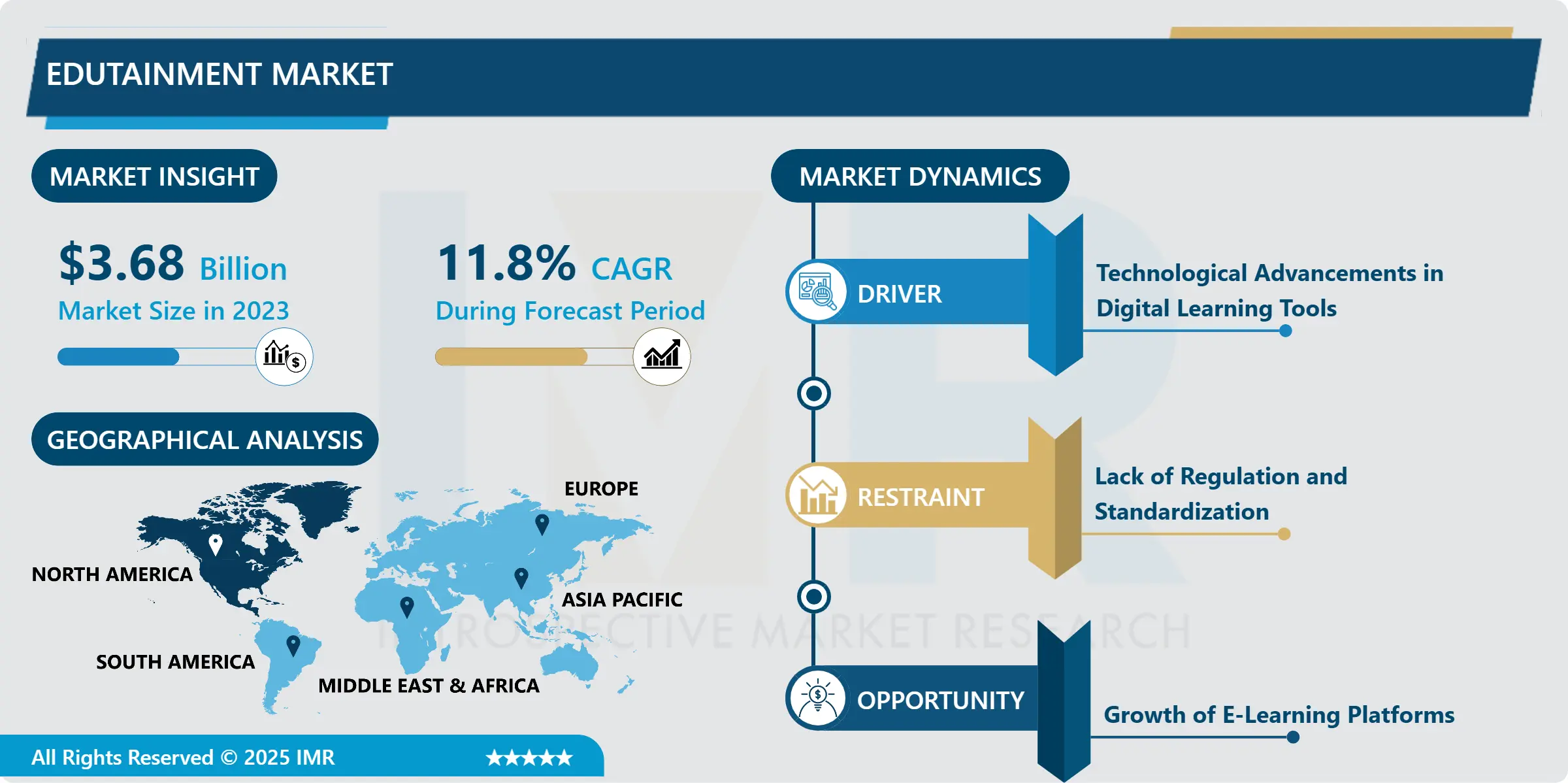
Edutainment Market Size Was Valued at USD 3.68 Billion in 2023, and is Projected to Reach USD 10.04 Billion by 2032, Growing at a CAGR of 11.8% From 2024-2032.
The Edutainment market involves combining educational content with entertainment in order to engage and teach individuals in an interactive, enjoyable manner. This segment utilizes several media platforms, including games, apps, physical activities, and multimedia content, in order to make learning entertaining. Edutainment reaches a broad audience from the very young to adults, aiming to create a dynamic learning experience that encourages retention and engagement.
Edutainment recently has grown rapidly, having been spurred by increasing consumer need for innovative and entertaining materials during learning. As technology expands, physical and digital products about edutainment are more easily achieved throughout learning, making edutainment as good a way to learn skill sets like problem solving and other critical thinking and creative qualities. This market has thrived in areas of education, corporate training, and personal development, due to the increasing awareness of having good and fun learning experiences.
In the last ten years, Edutainment has been rapidly shaped by digital technologies such as interactive apps, e-learning platforms, and gamified learning systems. These platforms most commonly use artificial intelligence, AR, and VR in delivering immersive learning experiences. With the advent of educational apps and online learning games, Edutainment reached new heights, crossing its boundaries beyond traditional classroom environments toward personalization and on-demand learning. Moreover, digital education has become the new mode of learning during the pandemic with a shift toward Edutainment in online schooling, virtual tutoring, and even corporate training places.
Edutainment Market Trend Analysis:
Interactive Learning through Augmented Reality (AR)
One of the trends in the Edutainment market is the upsurge of augmented reality as a means to enhance experiences. Augmented reality enables traditional learning by integrating the virtual into the real; hence, making lessons more stimulating and interactive. For instance, in museums and educational applications, AR enables students to interact with 3D models of historical artifacts or biological specimens so that learning can be more holistic. This is most significant in educational games and applications for children, where it can be superimposed on the real world with mobile devices or AR glasses.
Application of AR in Edutainment also fosters experiential learning where learners will be able to explore and visualize complex concepts in real life. For example, in corporate learning, AR can be used in simulating real-life scenarios for employees. This way, employees have the opportunity to practice acquired skills in a safe and controlled environment. This trend also makes learning more fun; learners are able to apply concepts firsthand, thus the retention of knowledge is improved. As AR technology improves and comes within reach, its involvement in Edutainment may expand, offering new and exciting means of teaching and engaging learners.
Growth of E-Learning Platforms
An exciting opportunity within the Edutainment market is e-learning platforms expansion, mainly in emerging markets. E-learning platforms are reaching new demographics where internet access and mobile phone penetration are increasing, even to areas where traditional educational infrastructure is not yet developed. These platforms that deliver educational games, interactive content, and multimedia lessons are becoming more popular for learners of all ages. This allows access to material at any given time, tearing down barriers between geographies and socio-economic barriers.
Especially promising in Edutainment for the e-learning space are the domains of lifelong learning and corporate training. In light of increasing requirements for upskilling and reskilling, the need for educating the workforce with a holistic approach through a digital learning medium that can both educate and entertain is in vogue these days. These platforms can well engage employees through such features, leading to a higher completion rate and better retention of skills. The subsequent popularity in remote and hybrid working models propels online Edutainment platforms as the easy solution for organizations when it comes to investing in employee development.
Edutainment Market Segment Analysis:
Edutainment Market is Segmented on the basis of Type, Platform, Content Type, Age Group, Application, End User, and Region.
By Type, Physical Edutainment segment is expected to dominate the market during the forecast period
Physical Edutainment provides interactive learning through hands-on experiences that combine education and entertainment. These activities are designed to engage participants by encouraging them to explore concepts through direct interaction, such as solving puzzles, playing games, or engaging with exhibits.
Popular in settings like children’s museums, science centers, and theme parks, these environments foster a sense of wonder while imparting knowledge in subjects like science, history, or art. By making learning fun and interactive, physical edutainment appeals particularly to younger children, offering a more immersive and effective way of learning. This type of learning is not only educational but also promotes physical activity, problem-solving, and social interaction, creating a dynamic space for both individual and group engagement.
By Application, Preschool and Kindergarten segment expected to held the largest share
The Edutainment market has become a powerful tool in supporting early childhood education. For preschool and kindergarten-aged children, it offers a diverse range of learning opportunities designed to introduce foundational concepts such as numbers, letters, shapes, and colors. These interactive games and activities are specially designed to make learning both fun and effective, while helping young children develop important cognitive, motor, and social skills. By integrating play with learning, Edutainment fosters an engaging and non-traditional educational environment that encourages exploration and creativity.
The use of technology allows children to engage in dynamic and hands-on activities that enhance their understanding of basic concepts. These early learning tools are critical as they lay the groundwork for more advanced education and help children build confidence in their ability to learn.
Edutainment Market Regional Insights:
North America is Expected to Dominate the Market Over the Forecast period
North America dominates the Edutainment market, fueled by strong demand for educational innovation, widespread access to technology, and significant investments in digital learning solutions. The region has a well-developed infrastructure for digital learning, with high penetration of internet services, smartphones, and personal computers, facilitating the rapid adoption of Edutainment platforms. The United States and Canada have some of the leading companies developing cutting-edge Edutainment products, including interactive learning apps, games, and immersive training solutions.
North America is also promoted by significant educational institutions and technology firms besides venture capital investments. Thus, the edutainment market in the region would be further increased by it. Gamification of learning along with interactive contents of educational value have, of recent, gained great importance across educational institutions as well as at a corporate level; thus the North America leads in adopting solutions in Edutainment. While the pace of development in educational technologies is likely to continue; it would ensure a leadership in North America in terms of edutainment markets.
Active Key Players in the Edutainment Market:
The Walt Disney Company (USA)
LeapFrog Enterprises, Inc. (USA)
Nickelodeon (USA)
Sony Interactive Entertainment (Japan)
Mattel, Inc. (USA)
MindWare (USA)
Houghton Mifflin Harcourt (USA)
Rovio Entertainment (Finland)
Kahoot! (Norway)
Tynker (USA), and Other Active Players
Key Industry Developments in the Edutainment Market:
In May 2023, Pororo Parks launched a new interactive digital platform aimed at enhancing children’s learning experiences through virtual reality. This platform incorporates augmented reality games that focus on educational content.
In September 2023, Legoland Discovery Center opened a new facility in Tokyo, Japan. This center features innovative educational exhibits and hands-on activities designed to stimulate children’s creativity and learning.
In March 2023, CurioCity launched a new series of educational workshops focused on STEM (Science, Technology, Engineering, and Mathematics) education. These workshops aim to foster interest in STEM fields among young learners through interactive and engaging activities.
In June 2023, Mattel Play! Town introduced a new “Play and Learn” initiative, featuring interactive exhibits that combine physical play with digital learning tools. This initiative is designed to help children develop cognitive and motor skills.
In July 2023, Totter’s Otterville revamped its facilities to include more digital and interactive play zones. These new zones use touch screens and interactive projections to provide educational content in a fun and engaging manner.
Chapter 1: Introduction
1.1 Scope and Coverage
Chapter 2:Executive Summary
Chapter 3: Market Landscape
3.1 Market Dynamics
3.1.1 Drivers
3.1.2 Restraints
3.1.3 Opportunities
3.1.4 Challenges
3.2 Market Trend Analysis
3.3 PESTLE Analysis
3.4 Porter’s Five Forces Analysis
3.5 Industry Value Chain Analysis
3.6 Ecosystem
3.7 Regulatory Landscape
3.8 Price Trend Analysis
3.9 Patent Analysis
3.10 Technology Evolution
3.11 Investment Pockets
3.12 Import-Export Analysis
Chapter 4: Edutainment Market by Type
4.1 Edutainment Market Snapshot and Growth Engine
4.2 Edutainment Market Overview
4.3 Physical Edutainment
4.3.1 Introduction and Market Overview
4.3.2 Historic and Forecasted Market Size in Value USD and Volume Units (2017-2032F)
4.3.3 Key Market Trends, Growth Factors and Opportunities
4.3.4 Physical Edutainment: Geographic Segmentation Analysis
4.4 Digital Edutainment
4.4.1 Introduction and Market Overview
4.4.2 Historic and Forecasted Market Size in Value USD and Volume Units (2017-2032F)
4.4.3 Key Market Trends, Growth Factors and Opportunities
4.4.4 Digital Edutainment: Geographic Segmentation Analysis
Chapter 5: Edutainment Market by Platform
5.1 Edutainment Market Snapshot and Growth Engine
5.2 Edutainment Market Overview
5.3 Online Platforms
5.3.1 Introduction and Market Overview
5.3.2 Historic and Forecasted Market Size in Value USD and Volume Units (2017-2032F)
5.3.3 Key Market Trends, Growth Factors and Opportunities
5.3.4 Online Platforms: Geographic Segmentation Analysis
5.4 Offline Platforms
5.4.1 Introduction and Market Overview
5.4.2 Historic and Forecasted Market Size in Value USD and Volume Units (2017-2032F)
5.4.3 Key Market Trends, Growth Factors and Opportunities
5.4.4 Offline Platforms: Geographic Segmentation Analysis
Chapter 6: Edutainment Market by Application
6.1 Edutainment Market Snapshot and Growth Engine
6.2 Edutainment Market Overview
6.3 Preschool and Kindergarten
6.3.1 Introduction and Market Overview
6.3.2 Historic and Forecasted Market Size in Value USD and Volume Units (2017-2032F)
6.3.3 Key Market Trends, Growth Factors and Opportunities
6.3.4 Preschool and Kindergarten: Geographic Segmentation Analysis
6.4 School Age
6.4.1 Introduction and Market Overview
6.4.2 Historic and Forecasted Market Size in Value USD and Volume Units (2017-2032F)
6.4.3 Key Market Trends, Growth Factors and Opportunities
6.4.4 School Age: Geographic Segmentation Analysis
6.5 Adult Learning
6.5.1 Introduction and Market Overview
6.5.2 Historic and Forecasted Market Size in Value USD and Volume Units (2017-2032F)
6.5.3 Key Market Trends, Growth Factors and Opportunities
6.5.4 Adult Learning: Geographic Segmentation Analysis
6.6 Corporate Training
6.6.1 Introduction and Market Overview
6.6.2 Historic and Forecasted Market Size in Value USD and Volume Units (2017-2032F)
6.6.3 Key Market Trends, Growth Factors and Opportunities
6.6.4 Corporate Training: Geographic Segmentation Analysis
Chapter 7: Edutainment Market by Content Type
7.1 Edutainment Market Snapshot and Growth Engine
7.2 Edutainment Market Overview
7.3 Games
7.3.1 Introduction and Market Overview
7.3.2 Historic and Forecasted Market Size in Value USD and Volume Units (2017-2032F)
7.3.3 Key Market Trends, Growth Factors and Opportunities
7.3.4 Games: Geographic Segmentation Analysis
7.4 Apps
7.4.1 Introduction and Market Overview
7.4.2 Historic and Forecasted Market Size in Value USD and Volume Units (2017-2032F)
7.4.3 Key Market Trends, Growth Factors and Opportunities
7.4.4 Apps: Geographic Segmentation Analysis
7.5 TV Shows and Movies
7.5.1 Introduction and Market Overview
7.5.2 Historic and Forecasted Market Size in Value USD and Volume Units (2017-2032F)
7.5.3 Key Market Trends, Growth Factors and Opportunities
7.5.4 TV Shows and Movies: Geographic Segmentation Analysis
7.6 Books
7.6.1 Introduction and Market Overview
7.6.2 Historic and Forecasted Market Size in Value USD and Volume Units (2017-2032F)
7.6.3 Key Market Trends, Growth Factors and Opportunities
7.6.4 Books: Geographic Segmentation Analysis
Chapter 8: Edutainment Market by Age Group
8.1 Edutainment Market Snapshot and Growth Engine
8.2 Edutainment Market Overview
8.3 Children
8.3.1 Introduction and Market Overview
8.3.2 Historic and Forecasted Market Size in Value USD and Volume Units (2017-2032F)
8.3.3 Key Market Trends, Growth Factors and Opportunities
8.3.4 Children: Geographic Segmentation Analysis
8.4 Teenagers
8.4.1 Introduction and Market Overview
8.4.2 Historic and Forecasted Market Size in Value USD and Volume Units (2017-2032F)
8.4.3 Key Market Trends, Growth Factors and Opportunities
8.4.4 Teenagers: Geographic Segmentation Analysis
8.5 Adults
8.5.1 Introduction and Market Overview
8.5.2 Historic and Forecasted Market Size in Value USD and Volume Units (2017-2032F)
8.5.3 Key Market Trends, Growth Factors and Opportunities
8.5.4 Adults: Geographic Segmentation Analysis
Chapter 9: Edutainment Market by End-User
9.1 Edutainment Market Snapshot and Growth Engine
9.2 Edutainment Market Overview
9.3 Educational Institutions
9.3.1 Introduction and Market Overview
9.3.2 Historic and Forecasted Market Size in Value USD and Volume Units (2017-2032F)
9.3.3 Key Market Trends, Growth Factors and Opportunities
9.3.4 Educational Institutions: Geographic Segmentation Analysis
9.4 Corporate
9.4.1 Introduction and Market Overview
9.4.2 Historic and Forecasted Market Size in Value USD and Volume Units (2017-2032F)
9.4.3 Key Market Trends, Growth Factors and Opportunities
9.4.4 Corporate: Geographic Segmentation Analysis
9.5 Individual Learners
9.5.1 Introduction and Market Overview
9.5.2 Historic and Forecasted Market Size in Value USD and Volume Units (2017-2032F)
9.5.3 Key Market Trends, Growth Factors and Opportunities
9.5.4 Individual Learners: Geographic Segmentation Analysis
Chapter 10: Company Profiles and Competitive Analysis
10.1 Competitive Landscape
10.1.1 Competitive Benchmarking
10.1.2 Edutainment Market Share by Manufacturer (2023)
10.1.3 Industry BCG Matrix
10.1.4 Heat Map Analysis
10.1.5 Mergers and Acquisitions
10.2 THE WALT DISNEY COMPANY (USA)
10.2.1 Company Overview
10.2.2 Key Executives
10.2.3 Company Snapshot
10.2.4 Role of the Company in the Market
10.2.5 Sustainability and Social Responsibility
10.2.6 Operating Business Segments
10.2.7 Product Portfolio
10.2.8 Business Performance
10.2.9 Key Strategic Moves and Recent Developments
10.2.10 SWOT Analysis
10.3 LEAPFROG ENTERPRISES INC. (USA)
10.4 NICKELODEON (USA)
10.5 SONY INTERACTIVE ENTERTAINMENT (JAPAN)
10.6 MATTEL INC. (USA)
10.7 MINDWARE (USA)
10.8 HOUGHTON MIFFLIN HARCOURT (USA)
10.9 ROVIO ENTERTAINMENT (FINLAND)
10.10 KAHOOT! (NORWAY)
10.11 TYNKER (USA)
10.12 OTHER ACTIVE PLAYERS
Chapter 11: Global Edutainment Market By Region
11.1 Overview
11.2. North America Edutainment Market
11.2.1 Key Market Trends, Growth Factors and Opportunities
11.2.2 Top Key Companies
11.2.3 Historic and Forecasted Market Size by Segments
11.2.4 Historic and Forecasted Market Size By Type
11.2.4.1 Physical Edutainment
11.2.4.2 Digital Edutainment
11.2.5 Historic and Forecasted Market Size By Platform
11.2.5.1 Online Platforms
11.2.5.2 Offline Platforms
11.2.6 Historic and Forecasted Market Size By Application
11.2.6.1 Preschool and Kindergarten
11.2.6.2 School Age
11.2.6.3 Adult Learning
11.2.6.4 Corporate Training
11.2.7 Historic and Forecasted Market Size By Content Type
11.2.7.1 Games
11.2.7.2 Apps
11.2.7.3 TV Shows and Movies
11.2.7.4 Books
11.2.8 Historic and Forecasted Market Size By Age Group
11.2.8.1 Children
11.2.8.2 Teenagers
11.2.8.3 Adults
11.2.9 Historic and Forecasted Market Size By End-User
11.2.9.1 Educational Institutions
11.2.9.2 Corporate
11.2.9.3 Individual Learners
11.2.10 Historic and Forecast Market Size by Country
11.2.10.1 US
11.2.10.2 Canada
11.2.10.3 Mexico
11.3. Eastern Europe Edutainment Market
11.3.1 Key Market Trends, Growth Factors and Opportunities
11.3.2 Top Key Companies
11.3.3 Historic and Forecasted Market Size by Segments
11.3.4 Historic and Forecasted Market Size By Type
11.3.4.1 Physical Edutainment
11.3.4.2 Digital Edutainment
11.3.5 Historic and Forecasted Market Size By Platform
11.3.5.1 Online Platforms
11.3.5.2 Offline Platforms
11.3.6 Historic and Forecasted Market Size By Application
11.3.6.1 Preschool and Kindergarten
11.3.6.2 School Age
11.3.6.3 Adult Learning
11.3.6.4 Corporate Training
11.3.7 Historic and Forecasted Market Size By Content Type
11.3.7.1 Games
11.3.7.2 Apps
11.3.7.3 TV Shows and Movies
11.3.7.4 Books
11.3.8 Historic and Forecasted Market Size By Age Group
11.3.8.1 Children
11.3.8.2 Teenagers
11.3.8.3 Adults
11.3.9 Historic and Forecasted Market Size By End-User
11.3.9.1 Educational Institutions
11.3.9.2 Corporate
11.3.9.3 Individual Learners
11.3.10 Historic and Forecast Market Size by Country
11.3.10.1 Russia
11.3.10.2 Bulgaria
11.3.10.3 The Czech Republic
11.3.10.4 Hungary
11.3.10.5 Poland
11.3.10.6 Romania
11.3.10.7 Rest of Eastern Europe
11.4. Western Europe Edutainment Market
11.4.1 Key Market Trends, Growth Factors and Opportunities
11.4.2 Top Key Companies
11.4.3 Historic and Forecasted Market Size by Segments
11.4.4 Historic and Forecasted Market Size By Type
11.4.4.1 Physical Edutainment
11.4.4.2 Digital Edutainment
11.4.5 Historic and Forecasted Market Size By Platform
11.4.5.1 Online Platforms
11.4.5.2 Offline Platforms
11.4.6 Historic and Forecasted Market Size By Application
11.4.6.1 Preschool and Kindergarten
11.4.6.2 School Age
11.4.6.3 Adult Learning
11.4.6.4 Corporate Training
11.4.7 Historic and Forecasted Market Size By Content Type
11.4.7.1 Games
11.4.7.2 Apps
11.4.7.3 TV Shows and Movies
11.4.7.4 Books
11.4.8 Historic and Forecasted Market Size By Age Group
11.4.8.1 Children
11.4.8.2 Teenagers
11.4.8.3 Adults
11.4.9 Historic and Forecasted Market Size By End-User
11.4.9.1 Educational Institutions
11.4.9.2 Corporate
11.4.9.3 Individual Learners
11.4.10 Historic and Forecast Market Size by Country
11.4.10.1 Germany
11.4.10.2 UK
11.4.10.3 France
11.4.10.4 The Netherlands
11.4.10.5 Italy
11.4.10.6 Spain
11.4.10.7 Rest of Western Europe
11.5. Asia Pacific Edutainment Market
11.5.1 Key Market Trends, Growth Factors and Opportunities
11.5.2 Top Key Companies
11.5.3 Historic and Forecasted Market Size by Segments
11.5.4 Historic and Forecasted Market Size By Type
11.5.4.1 Physical Edutainment
11.5.4.2 Digital Edutainment
11.5.5 Historic and Forecasted Market Size By Platform
11.5.5.1 Online Platforms
11.5.5.2 Offline Platforms
11.5.6 Historic and Forecasted Market Size By Application
11.5.6.1 Preschool and Kindergarten
11.5.6.2 School Age
11.5.6.3 Adult Learning
11.5.6.4 Corporate Training
11.5.7 Historic and Forecasted Market Size By Content Type
11.5.7.1 Games
11.5.7.2 Apps
11.5.7.3 TV Shows and Movies
11.5.7.4 Books
11.5.8 Historic and Forecasted Market Size By Age Group
11.5.8.1 Children
11.5.8.2 Teenagers
11.5.8.3 Adults
11.5.9 Historic and Forecasted Market Size By End-User
11.5.9.1 Educational Institutions
11.5.9.2 Corporate
11.5.9.3 Individual Learners
11.5.10 Historic and Forecast Market Size by Country
11.5.10.1 China
11.5.10.2 India
11.5.10.3 Japan
11.5.10.4 South Korea
11.5.10.5 Malaysia
11.5.10.6 Thailand
11.5.10.7 Vietnam
11.5.10.8 The Philippines
11.5.10.9 Australia
11.5.10.10 New Zealand
11.5.10.11 Rest of APAC
11.6. Middle East & Africa Edutainment Market
11.6.1 Key Market Trends, Growth Factors and Opportunities
11.6.2 Top Key Companies
11.6.3 Historic and Forecasted Market Size by Segments
11.6.4 Historic and Forecasted Market Size By Type
11.6.4.1 Physical Edutainment
11.6.4.2 Digital Edutainment
11.6.5 Historic and Forecasted Market Size By Platform
11.6.5.1 Online Platforms
11.6.5.2 Offline Platforms
11.6.6 Historic and Forecasted Market Size By Application
11.6.6.1 Preschool and Kindergarten
11.6.6.2 School Age
11.6.6.3 Adult Learning
11.6.6.4 Corporate Training
11.6.7 Historic and Forecasted Market Size By Content Type
11.6.7.1 Games
11.6.7.2 Apps
11.6.7.3 TV Shows and Movies
11.6.7.4 Books
11.6.8 Historic and Forecasted Market Size By Age Group
11.6.8.1 Children
11.6.8.2 Teenagers
11.6.8.3 Adults
11.6.9 Historic and Forecasted Market Size By End-User
11.6.9.1 Educational Institutions
11.6.9.2 Corporate
11.6.9.3 Individual Learners
11.6.10 Historic and Forecast Market Size by Country
11.6.10.1 Turkiye
11.6.10.2 Bahrain
11.6.10.3 Kuwait
11.6.10.4 Saudi Arabia
11.6.10.5 Qatar
11.6.10.6 UAE
11.6.10.7 Israel
11.6.10.8 South Africa
11.7. South America Edutainment Market
11.7.1 Key Market Trends, Growth Factors and Opportunities
11.7.2 Top Key Companies
11.7.3 Historic and Forecasted Market Size by Segments
11.7.4 Historic and Forecasted Market Size By Type
11.7.4.1 Physical Edutainment
11.7.4.2 Digital Edutainment
11.7.5 Historic and Forecasted Market Size By Platform
11.7.5.1 Online Platforms
11.7.5.2 Offline Platforms
11.7.6 Historic and Forecasted Market Size By Application
11.7.6.1 Preschool and Kindergarten
11.7.6.2 School Age
11.7.6.3 Adult Learning
11.7.6.4 Corporate Training
11.7.7 Historic and Forecasted Market Size By Content Type
11.7.7.1 Games
11.7.7.2 Apps
11.7.7.3 TV Shows and Movies
11.7.7.4 Books
11.7.8 Historic and Forecasted Market Size By Age Group
11.7.8.1 Children
11.7.8.2 Teenagers
11.7.8.3 Adults
11.7.9 Historic and Forecasted Market Size By End-User
11.7.9.1 Educational Institutions
11.7.9.2 Corporate
11.7.9.3 Individual Learners
11.7.10 Historic and Forecast Market Size by Country
11.7.10.1 Brazil
11.7.10.2 Argentina
11.7.10.3 Rest of SA
Chapter 12 Analyst Viewpoint and Conclusion
12.1 Recommendations and Concluding Analysis
12.2 Potential Market Strategies
Chapter 13 Research Methodology
13.1 Research Process
13.2 Primary Research
13.3 Secondary Research
Q1: What would be the forecast period in the Edutainment Market research report?
A1: The forecast period in the Edutainment Market research report is 2024-2032.
Q2: Who are the key players in the Edutainment Market?
A2: The Walt Disney Company (USA), LeapFrog Enterprises, Inc. (USA), Nickelodeon (USA), Sony Interactive Entertainment (Japan), Mattel, Inc. (USA), MindWare (USA), Houghton Mifflin Harcourt (USA), Rovio Entertainment (Finland), Kahoot! (Norway), Tynker (USA), and Other Active Players.
Q3: What are the segments of the Edutainment Market?
A3: The Edutainment Market is segmented into Type, Platform, Application, Content Type, Age Group, End User and Region. By Type, the market is categorized into Physical Edutainment, Digital Edutainment. By Platform, the market is categorized into Online Platforms, Offline Platforms, By Application, the market is categorized into Preschool and Kindergarten, School Age, Adult Learning, Corporate Training. By Content Type, the market is categorized into Games, Apps, TV Shows and Movies, Books. By Age Group, the market is categorized into Children, Teenagers, Adults. By End-User, the market is categorized into Educational Institutions, Corporate, Individual Learners. By region, it is analyzed across North America (U.S., Canada, Mexico), Eastern Europe (Russia, Bulgaria, The Czech Republic, Hungary, Poland, Romania, Rest of Eastern Europe), Western Europe (Germany, UK, France, Netherlands, Italy, Spain, Rest of Western Europe), Asia Pacific (China, India, Japan, South Korea, Malaysia, Thailand, Vietnam, The Philippines, Australia, New Zealand, Rest of APAC), Middle East & Africa (Turkiye, Bahrain, Kuwait, Saudi Arabia, Qatar, UAE, Israel, South Africa), South America (Brazil, Argentina, Rest of SA).
Q4: What is the Edutainment Market?
A4: The Edutainment market involves combining educational content with entertainment in order to engage and teach individuals in an interactive, enjoyable manner. This segment utilizes several media platforms, including games, apps, physical activities, and multimedia content, in order to make learning entertaining. Edutainment reaches a broad audience from the very young to adults, aiming to create a dynamic learning experience that encourages retention and engagement.
Q5: How big is the Edutainment Market?
A5: Edutainment Market Size Was Valued at USD 3.68 Billion in 2023, and is Projected to Reach USD 10.04 Billion by 2032, Growing at a CAGR of 11.8% From 2024-2032.
How to Buy a Report from eminsights.jp
On the product page, choose the license you want: Single-User License, Multi-User License or Enterprise License.
If you required report in your native language, then you can click on Translated Report button and fill out the form with report name and language you want, then our team will contact you as soon as possible.
Click the Buy Now button.
You will be redirected to the checkout page. Enter your company details and payment information.
Click Place Order to complete the purchase.
Confirmation: You’ll receive an order confirmation and our team will contact you shortly with your ordered report.
If you have any questions, fill out the contact form below or email us at bizdev@eminsights.net.
Thank you for choosing eminsights.jp!