Stay Ahead in Fast-Growing Economies.
Browse Reports Now




e-Government Identity Management Market | Research Report
e-Government Identity Management is a digital system used by government agencies to authenticate and manage individual identities online. It uses technologies like biometrics, smart cards, and encryption to enhance security, efficiency, and compliance with regulations. It also ensures the protection of sensitive data and seamless user identity management throughout their lifecycle. e-Government Identity Management brings about heightened security and efficiency in digital interactions between citizens and government services.

IMR Group
Description
e-Government Identity Management Market Synopsis
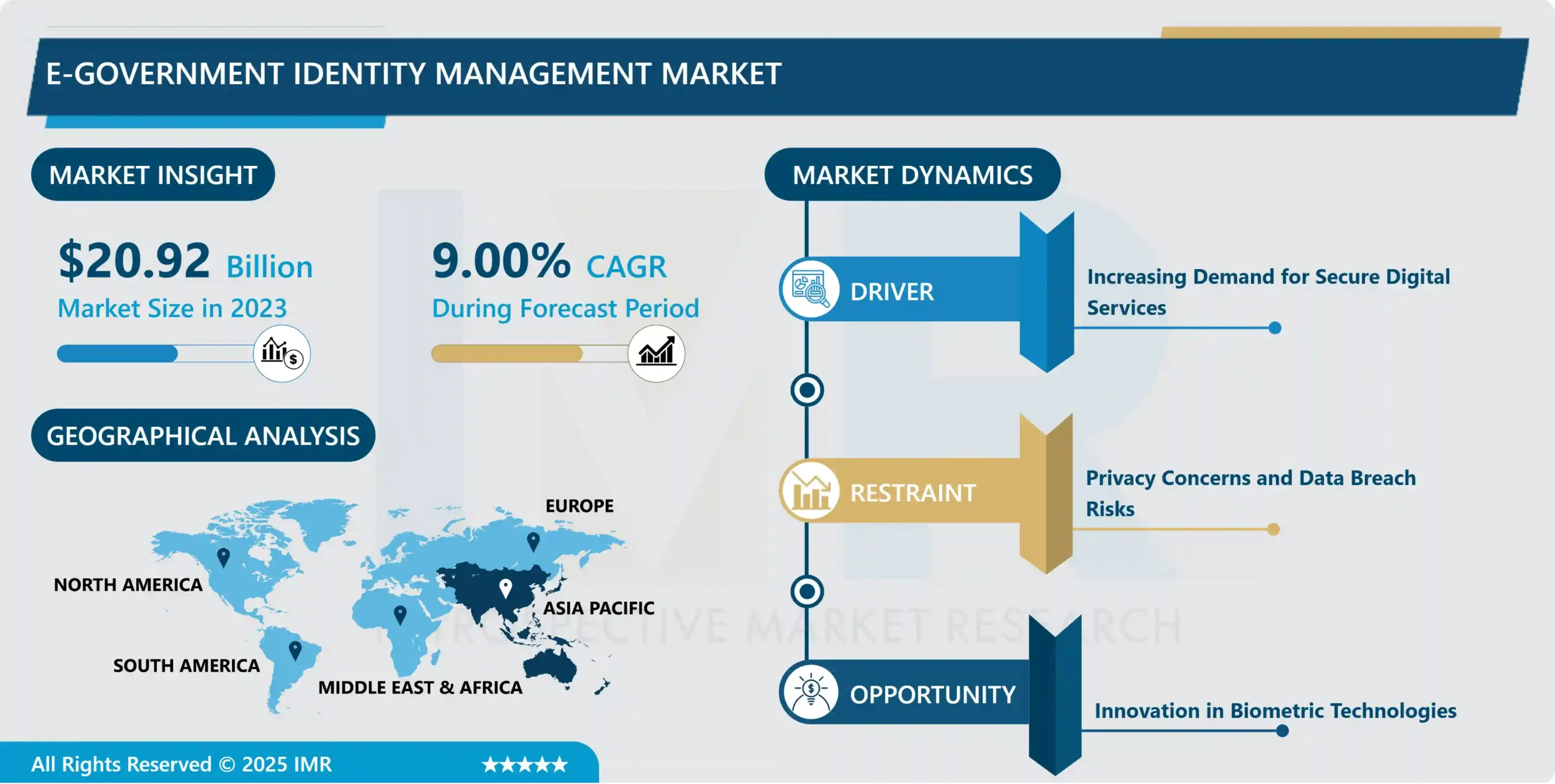
E-Government Identity Management Market Size Was Valued at USD 20.92 Billion in 2023 and is Projected to Reach USD 45.44 Billion by 2032, Growing at a CAGR of 9.0% From 2024-2032.
e-Government Identity Management brings about heightened security and efficiency in digital interactions between citizens and government services. Robust identity verification through multi-factor authentication, biometrics, and secure access controls enhances the reliability of online transactions, safeguarding sensitive information and fostering trust in e-government platforms. Furthermore, it streamlines processes, reducing bureaucratic obstacles and elevating the overall citizen experience. e-Government Identity Management is a digital system used by government agencies to authenticate and manage individual identities online. It uses technologies like biometrics, smart cards, and encryption to enhance security, efficiency, and compliance with regulations. It also ensures the protection of sensitive data and seamless user identity management throughout their lifecycle.
Current trends in e-Government Identity Management underscore a growing focus on biometric technologies like facial recognition and fingerprint scanning for secure authentication. A noticeable shift towards cloud-based identity solutions is observed, promoting scalability and accessibility. Governments are increasingly embracing mobile identity management to accommodate the rising use of smartphones. Adherence to data protection regulations, such as GDPR, is a prevailing trend, ensuring citizen privacy and rights. The market witnesses ongoing innovations in federated identity management and collaboration platforms to facilitate secure information sharing among government entities.
The escalating demand for seamless and secure online government services is a primary driver. The increasing prevalence of cyber threats accentuates the necessity for robust identity management solutions. Citizens’ expectations for user-friendly and efficient digital experiences contribute significantly to the demand. Governments worldwide are acknowledging the benefits of digitizing identity management for enhanced service delivery, cost-efficiency, and alignment with evolving regulatory frameworks, propelling the expansion of the e-Government Identity Management market.
e-Government Identity Management Market Trend Analysis
Increasing Demand for Secure Digital Services
The growing need for secure digital services plays a pivotal role in propelling the advancement and adoption of e-government Identity Management. Citizens and businesses are increasingly relying on government online platforms for various services, from tax submissions to accessing healthcare. The surge in cyber threats, identity theft, and fraudulent activities has heightened the importance of robust identity management solutions. Governments acknowledge the necessity to protect sensitive citizen information, ensuring privacy and mitigating risks related to unauthorized access.
Expanding landscape of digital government services, there is an imperative demand for secure and dependable identity verification. E-Government Identity Management addresses this demand by incorporating advanced authentication methods like biometrics and multi-factor authentication, enhancing the security of online interactions. This not only in stills confidence among users but also aligns with regulatory standards, fostering a secure digital atmosphere. Essentially, the increasing demand for secure digital services acts as a driving force, prompting the development and implementation of sophisticated e-Government Identity Management systems to cater to the evolving requirements of a digitally interconnected society
Innovation in Biometric Technologies
The opportunities in e-government Identity Management are notably amplified by the ongoing innovation in biometric technologies. This evolution promises a transformative impact on the accuracy and reliability of identity verification processes. Beyond conventional methods like fingerprints and facial recognition, there are opportunities to explore novel biometric modalities such as voice recognition, behavioral biometrics, and retinal scans. These technological advancements contribute to the fortification of identity verification, making it more resilient against fraudulent activities.
Continuous research and development in biometrics offer avenues to refine algorithms, enhance system response times, and overcome existing limitations. Governments can seize these opportunities by integrating state-of-the-art biometric technologies into their identity management systems. This not only strengthens security measures but also aligns with the e-government objective of ensuring secure and efficient digital interactions. The ongoing innovation in biometric technologies positions e-government Identity Management as a cutting-edge solution in the dynamic landscape of digital identity verification, enhancing security and elevating the overall user experience for citizens accessing government services online.
e-Government Identity Management Market Segment Analysis:
e-Government Identity Management Market Segmented on the basis of Type, Application, Deployment Model, and End-Users.
By Type, Public Cloud segment is expected to dominate the market during the forecast period
The anticipated dominance of the Public Cloud segment in the e-government Identity Management market throughout the forecast period is driven by several pivotal factors. Public Cloud solutions excel in scalability, cost-effectiveness, and flexibility, making them exceptionally appealing for government entities seeking to modernize and digitize their services. The shared resource model inherent in public cloud environments ensures efficient utilization of computing power and storage capacities.
Public cloud aligns seamlessly with the overarching trend of governments transitioning away from traditional on-premise infrastructures toward more agile and responsive cloud-based models. This shift facilitates the swift deployment of identity management solutions, ensuring timely responses to evolving citizen needs and the dynamic landscape of cybersecurity challenges. The accessibility and seamless integration capabilities of the Public Cloud contribute significantly to its anticipated dominance, empowering government agencies to concentrate on delivering secure and user-friendly e-government services while benefiting from the continuous advancements and innovations offered by cloud service providers.
By Application, Large Enterprise segment is expected to dominate the market during the forecast period
The expected dominance of the Large Enterprise segment in the e-government Identity Management market throughout the forecast period is influenced by various crucial factors. Large enterprises, given their expansive scale and intricate operations, demand comprehensive and scalable identity management solutions. These solutions are designed to meet the complex needs of a substantial user base, ensuring secure and effective digital interactions. The prevalence of the Large Enterprise segment is also shaped by the significant financial capabilities these organizations possess, enabling them to invest in advanced identity management technologies, fostering innovation and tailored solutions.
Growing adoption of e-government services by large enterprises aligns with the global trend of digital transformation, where organizations prioritize secure and streamlined interactions with governmental entities. The heightened demand for sophisticated identity management systems in large enterprises, driven by their diverse workforce and complex organizational structures, establishes the dominance of this segment in the forecast period. The focus on delivering seamless, compliant, and user-centric e-government services further underscores the importance of robust identity management solutions within large enterprises.
e-Government Identity Management Market Regional Insights:
Asia Pacific is Expected to Dominate the Market Over the Forecast Period
The expectation of Asia Pacific assuming dominance in the e-government Identity Management market throughout the forecast period is grounded in several compelling factors. The region has experienced a rapid acceleration in digital transformation initiatives, with governments in countries like India, China, and South Korea actively investing in advanced technologies. The sheer magnitude of the population in Asia Pacific, coupled with a rising prevalence of internet access, propels the demand for secure and efficient e-government services, necessitating robust identity management solutions.
Asia Pacific’s dynamic economic landscape and the widespread adoption of mobile technology contribute to the region’s leading position in digital governance. Governments in the region are strategically focusing on smart city initiatives and elevating public services through technology, fostering the adoption of sophisticated identity management systems. The ascendancy of Asia Pacific in the e-government Identity Management market underscores the region’s commitment to harnessing technology for improved governance, enhanced citizen experiences, and the assurance of security in online interactions.
e-Government Identity Management Market Top Key Players:
Centrify Corporation (US)
Dell Technologies Inc (US)
ForgeRock (US)
GlobalSign (US)
HID Global (US)
IBM Corporation (US)
Oracle (US)
Ping Identity (US)
Entrust Datacard (US)
OneSpan (US)
T-Systems (Germany)
Veridos Identity Solutions (Germany)
SAP (Germany)
Gemalto (France)
Thales Group (France)
Morpho (France)
NEC Corporation (Japan)
Wipro Limited (India), and Other Major Players.
Key Industry Development: –
In April 2023, Saviynt partnered with the world’s leading technology and consulting companies, including IBM, to launch the Saviynt Solution Exchange. It is a marketplace of prebuilt solutions that accelerate and optimize organizations’ journey to Cloud Identity security.
In February 2023, Route Mobile Limited (“Route Mobile”), a leading communications platform as a service (CPaaS) provider to enterprises, over-the-top (OTT) players, and mobile operators, announced the launch of TruSense, a digital identity and security software essential to secure digital transactions in a trusted ecosystem by enabling businesses to seamlessly authenticate the end user.
Chapter 1: Introduction
1.1 Scope and Coverage
Chapter 2:Executive Summary
Chapter 3: Market Landscape
3.1 Market Dynamics
3.1.1 Drivers
3.1.2 Restraints
3.1.3 Opportunities
3.1.4 Challenges
3.2 Market Trend Analysis
3.3 PESTLE Analysis
3.4 Porter’s Five Forces Analysis
3.5 Industry Value Chain Analysis
3.6 Ecosystem
3.7 Regulatory Landscape
3.8 Price Trend Analysis
3.9 Patent Analysis
3.10 Technology Evolution
3.11 Investment Pockets
3.12 Import-Export Analysis
Chapter 4: e-Government Identity Management Market by Type (2018-2032)
4.1 e-Government Identity Management Market Snapshot and Growth Engine
4.2 Market Overview
4.3 Private Cloud
4.3.1 Introduction and Market Overview
4.3.2 Historic and Forecasted Market Size in Value USD and Volume Units
4.3.3 Key Market Trends, Growth Factors, and Opportunities
4.3.4 Geographic Segmentation Analysis
4.4 Public Cloud
4.5 Mixed Cloud
Chapter 5: e-Government Identity Management Market by Application (2018-2032)
5.1 e-Government Identity Management Market Snapshot and Growth Engine
5.2 Market Overview
5.3 Small & Medium Enterprise
5.3.1 Introduction and Market Overview
5.3.2 Historic and Forecasted Market Size in Value USD and Volume Units
5.3.3 Key Market Trends, Growth Factors, and Opportunities
5.3.4 Geographic Segmentation Analysis
5.4 Large Enterprise
Chapter 6: e-Government Identity Management Market by Deployment Model (2018-2032)
6.1 e-Government Identity Management Market Snapshot and Growth Engine
6.2 Market Overview
6.3 On-premise
6.3.1 Introduction and Market Overview
6.3.2 Historic and Forecasted Market Size in Value USD and Volume Units
6.3.3 Key Market Trends, Growth Factors, and Opportunities
6.3.4 Geographic Segmentation Analysis
6.4 Cloud-based
6.5 Hybrid
Chapter 7: e-Government Identity Management Market by End-User (2018-2032)
7.1 e-Government Identity Management Market Snapshot and Growth Engine
7.2 Market Overview
7.3 National Government
7.3.1 Introduction and Market Overview
7.3.2 Historic and Forecasted Market Size in Value USD and Volume Units
7.3.3 Key Market Trends, Growth Factors, and Opportunities
7.3.4 Geographic Segmentation Analysis
7.4 State & Local Governments
7.5 Public Sector Enterprises
Chapter 8: Company Profiles and Competitive Analysis
8.1 Competitive Landscape
8.1.1 Competitive Benchmarking
8.1.2 e-Government Identity Management Market Share by Manufacturer (2024)
8.1.3 Industry BCG Matrix
8.1.4 Heat Map Analysis
8.1.5 Mergers and Acquisitions
8.2 BYJU’S(INDIA)
8.2.1 Company Overview
8.2.2 Key Executives
8.2.3 Company Snapshot
8.2.4 Role of the Company in the Market
8.2.5 Sustainability and Social Responsibility
8.2.6 Operating Business Segments
8.2.7 Product Portfolio
8.2.8 Business Performance
8.2.9 Key Strategic Moves and Recent Developments
8.2.10 SWOT Analysis
8.3 VEDANTU (INDIA)
8.4 AMBOW EDUCATION HOLDING (CHINA)
8.5 BEIJING MAGIC EARS TECHNOLOGY (CHINA)
8.6 CHEGG (US)
8.7 CLUB Z! INC. (US)
8.8 ITUTORGROUP (CHINA)
8.9 STRIDE INC. (US)
8.10 PEARSON PLC (UK)
8.11 QKIDS TEACHER (CHINA)
8.12 TAL EDUCATION GROUP (CHINA)
8.13 VARSITY TUTORS (US)
8.14 ETUTORWORLD (INDIA)
8.15 KHAN ACADEMY (US)
8.16 ANDOTHERS MAJOR PLAYERS.
Chapter 9: Global e-Government Identity Management Market By Region
9.1 Overview
9.2. North America e-Government Identity Management Market
9.2.1 Key Market Trends, Growth Factors and Opportunities
9.2.2 Top Key Companies
9.2.3 Historic and Forecasted Market Size by Segments
9.2.4 Historic and Forecasted Market Size by Type
9.2.4.1 Private Cloud
9.2.4.2 Public Cloud
9.2.4.3 Mixed Cloud
9.2.5 Historic and Forecasted Market Size by Application
9.2.5.1 Small & Medium Enterprise
9.2.5.2 Large Enterprise
9.2.6 Historic and Forecasted Market Size by Deployment Model
9.2.6.1 On-premise
9.2.6.2 Cloud-based
9.2.6.3 Hybrid
9.2.7 Historic and Forecasted Market Size by End-User
9.2.7.1 National Government
9.2.7.2 State & Local Governments
9.2.7.3 Public Sector Enterprises
9.2.8 Historic and Forecast Market Size by Country
9.2.8.1 US
9.2.8.2 Canada
9.2.8.3 Mexico
9.3. Eastern Europe e-Government Identity Management Market
9.3.1 Key Market Trends, Growth Factors and Opportunities
9.3.2 Top Key Companies
9.3.3 Historic and Forecasted Market Size by Segments
9.3.4 Historic and Forecasted Market Size by Type
9.3.4.1 Private Cloud
9.3.4.2 Public Cloud
9.3.4.3 Mixed Cloud
9.3.5 Historic and Forecasted Market Size by Application
9.3.5.1 Small & Medium Enterprise
9.3.5.2 Large Enterprise
9.3.6 Historic and Forecasted Market Size by Deployment Model
9.3.6.1 On-premise
9.3.6.2 Cloud-based
9.3.6.3 Hybrid
9.3.7 Historic and Forecasted Market Size by End-User
9.3.7.1 National Government
9.3.7.2 State & Local Governments
9.3.7.3 Public Sector Enterprises
9.3.8 Historic and Forecast Market Size by Country
9.3.8.1 Russia
9.3.8.2 Bulgaria
9.3.8.3 The Czech Republic
9.3.8.4 Hungary
9.3.8.5 Poland
9.3.8.6 Romania
9.3.8.7 Rest of Eastern Europe
9.4. Western Europe e-Government Identity Management Market
9.4.1 Key Market Trends, Growth Factors and Opportunities
9.4.2 Top Key Companies
9.4.3 Historic and Forecasted Market Size by Segments
9.4.4 Historic and Forecasted Market Size by Type
9.4.4.1 Private Cloud
9.4.4.2 Public Cloud
9.4.4.3 Mixed Cloud
9.4.5 Historic and Forecasted Market Size by Application
9.4.5.1 Small & Medium Enterprise
9.4.5.2 Large Enterprise
9.4.6 Historic and Forecasted Market Size by Deployment Model
9.4.6.1 On-premise
9.4.6.2 Cloud-based
9.4.6.3 Hybrid
9.4.7 Historic and Forecasted Market Size by End-User
9.4.7.1 National Government
9.4.7.2 State & Local Governments
9.4.7.3 Public Sector Enterprises
9.4.8 Historic and Forecast Market Size by Country
9.4.8.1 Germany
9.4.8.2 UK
9.4.8.3 France
9.4.8.4 The Netherlands
9.4.8.5 Italy
9.4.8.6 Spain
9.4.8.7 Rest of Western Europe
9.5. Asia Pacific e-Government Identity Management Market
9.5.1 Key Market Trends, Growth Factors and Opportunities
9.5.2 Top Key Companies
9.5.3 Historic and Forecasted Market Size by Segments
9.5.4 Historic and Forecasted Market Size by Type
9.5.4.1 Private Cloud
9.5.4.2 Public Cloud
9.5.4.3 Mixed Cloud
9.5.5 Historic and Forecasted Market Size by Application
9.5.5.1 Small & Medium Enterprise
9.5.5.2 Large Enterprise
9.5.6 Historic and Forecasted Market Size by Deployment Model
9.5.6.1 On-premise
9.5.6.2 Cloud-based
9.5.6.3 Hybrid
9.5.7 Historic and Forecasted Market Size by End-User
9.5.7.1 National Government
9.5.7.2 State & Local Governments
9.5.7.3 Public Sector Enterprises
9.5.8 Historic and Forecast Market Size by Country
9.5.8.1 China
9.5.8.2 India
9.5.8.3 Japan
9.5.8.4 South Korea
9.5.8.5 Malaysia
9.5.8.6 Thailand
9.5.8.7 Vietnam
9.5.8.8 The Philippines
9.5.8.9 Australia
9.5.8.10 New Zealand
9.5.8.11 Rest of APAC
9.6. Middle East & Africa e-Government Identity Management Market
9.6.1 Key Market Trends, Growth Factors and Opportunities
9.6.2 Top Key Companies
9.6.3 Historic and Forecasted Market Size by Segments
9.6.4 Historic and Forecasted Market Size by Type
9.6.4.1 Private Cloud
9.6.4.2 Public Cloud
9.6.4.3 Mixed Cloud
9.6.5 Historic and Forecasted Market Size by Application
9.6.5.1 Small & Medium Enterprise
9.6.5.2 Large Enterprise
9.6.6 Historic and Forecasted Market Size by Deployment Model
9.6.6.1 On-premise
9.6.6.2 Cloud-based
9.6.6.3 Hybrid
9.6.7 Historic and Forecasted Market Size by End-User
9.6.7.1 National Government
9.6.7.2 State & Local Governments
9.6.7.3 Public Sector Enterprises
9.6.8 Historic and Forecast Market Size by Country
9.6.8.1 Turkiye
9.6.8.2 Bahrain
9.6.8.3 Kuwait
9.6.8.4 Saudi Arabia
9.6.8.5 Qatar
9.6.8.6 UAE
9.6.8.7 Israel
9.6.8.8 South Africa
9.7. South America e-Government Identity Management Market
9.7.1 Key Market Trends, Growth Factors and Opportunities
9.7.2 Top Key Companies
9.7.3 Historic and Forecasted Market Size by Segments
9.7.4 Historic and Forecasted Market Size by Type
9.7.4.1 Private Cloud
9.7.4.2 Public Cloud
9.7.4.3 Mixed Cloud
9.7.5 Historic and Forecasted Market Size by Application
9.7.5.1 Small & Medium Enterprise
9.7.5.2 Large Enterprise
9.7.6 Historic and Forecasted Market Size by Deployment Model
9.7.6.1 On-premise
9.7.6.2 Cloud-based
9.7.6.3 Hybrid
9.7.7 Historic and Forecasted Market Size by End-User
9.7.7.1 National Government
9.7.7.2 State & Local Governments
9.7.7.3 Public Sector Enterprises
9.7.8 Historic and Forecast Market Size by Country
9.7.8.1 Brazil
9.7.8.2 Argentina
9.7.8.3 Rest of SA
Chapter 10 Analyst Viewpoint and Conclusion
10.1 Recommendations and Concluding Analysis
10.2 Potential Market Strategies
Chapter 11 Research Methodology
11.1 Research Process
11.2 Primary Research
11.3 Secondary Research
Q1: What would be the forecast period in the e-Government Identity Management Market research report?
A1: The forecast period in the e-Government Identity Management Market research report is 2024-2032.
Q2: Who are the key players in the e-government Identity Management Market?
A2: Centrify Corporation (US), Dell Technologies Inc (US), ForgeRock (US), GlobalSign (US), HID Global (US), IBM Corporation (US), Oracle (US), Ping Identity (US), Entrust Datacard (US), OneSpan (US), T-Systems (Germany), Veridos Identity Solutions (Germany), SAP (Germany), Gemalto (France), Thales Group (France), Morpho (France), NEC Corporation (Japan), Wipro Limited (India), and Other Major Players.
Q3: What are the segments of the e-Government Identity Management Market?
A3: The e-Government Identity Management Market is segmented into Type, Application, Deployment Model, End-User, and region. By Type, the market is categorized into Private Cloud, Public Cloud, and Mixed Cloud. By Application, the market is categorized into Small & Medium Enterprise and Large Enterprise. By Deployment Model, the market is categorized into On-premise, Cloud-based, and Hybrid. By End-User, the market is categorized into National Governments, State & Local Governments, and Public Sector Enterprises. By region, it is analyzed across North America (U.S.; Canada; Mexico), Eastern Europe (Bulgaria; The Czech Republic; Hungary; Poland; Romania; Rest of Eastern Europe), Western Europe (Germany; UK; France; Netherlands; Italy; Russia; Spain; Rest of Western Europe), Asia-Pacific (China; India; Japan; Southeast Asia, etc.), South America (Brazil; Argentina, etc.), Middle East & Africa (Saudi Arabia; South Africa, etc.).
Q4: What is the e-Government Identity Management Market?
A4: e-Government Identity Management is a digital system used by government agencies to authenticate and manage individual identities online. It uses technologies like biometrics, smart cards, and encryption to enhance security, efficiency, and compliance with regulations. It also ensures the protection of sensitive data and seamless user identity management throughout their lifecycle.
Q5: How big is the e-Government Identity Management Market?
A5: Global E-Government Identity Management Market Size Was Valued at USD 20.92 Billion in 2023 and is Projected to Reach USD 45.44 Billion by 2032, Growing at a CAGR of 9.0% From 2024-2032.
How to Buy a Report from eminsights.jp
On the product page, choose the license you want: Single-User License, Multi-User License or Enterprise License.
If you required report in your native language, then you can click on Translated Report button and fill out the form with report name and language you want, then our team will contact you as soon as possible.
Click the Buy Now button.
You will be redirected to the checkout page. Enter your company details and payment information.
Click Place Order to complete the purchase.
Confirmation: You’ll receive an order confirmation and our team will contact you shortly with your ordered report.
If you have any questions, fill out the contact form below or email us at bizdev@eminsights.net.
Thank you for choosing eminsights.jp!