Stay Ahead in Fast-Growing Economies.
Browse Reports Now




Drone Package Delivery Market – In-Depth Insights & Analysis
A Drone Package Delivery is a type of unmanned aerial vehicle (UAV) that is used to deliver products to customers during the last mile delivery process. These drones typically feature four to eight propellers, rechargeable batteries, and the capacity to transport lightweight cargo. They can be controlled independently or remotely, with distribution centers and personnel monitoring the flight. Drone technology is already capable of avoiding collisions with other drones in flight, navigating through metropolitan areas, and applying clever landing tactics.

IMR Group
Description
Global Drone Package Delivery Market Overview
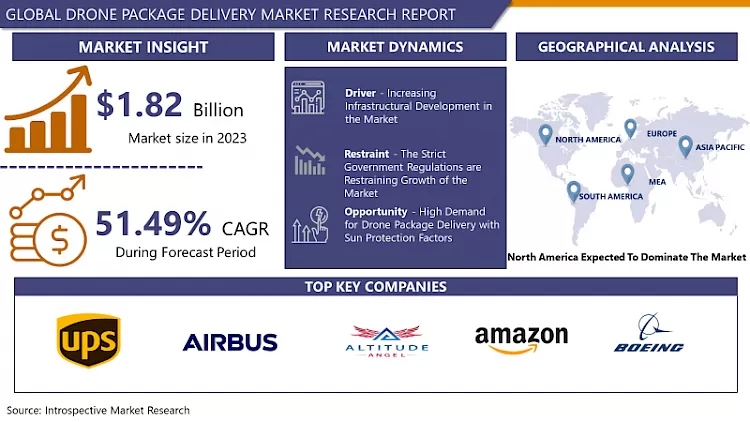
Drone Package Delivery Market Size Was Valued at USD 1.82 Billion in 2023 and is Projected to Reach USD 76.86 Billion by 2032, Growing at a CAGR of 51.49% From 2024-2032.
Drone Package Delivery involves the use of unmanned aerial vehicles (UAVs), commonly known as drones, to transport goods directly from distribution hubs to end customers or designated locations. This innovative delivery method leverages autonomous and semi-autonomous technologies to streamline logistics, enhance delivery speeds, and reduce operational costs, particularly in the crucial last mile of delivery networks. Drones equipped with advanced navigation systems, robust payload capacities, and reliable safety mechanisms are increasingly being integrated into supply chains to address the rising consumer demand for rapid and flexible delivery options.
The e-commerce boom has escalated the demand for faster and more efficient delivery solutions, making drones an attractive option for businesses looking to enhance their delivery capabilities. Technological advancements in drone design, such as extended battery life, sophisticated navigation systems, and autonomous flying capabilities, are enabling more practical and scalable deployment. The cost efficiency of drones, which can significantly reduce labor and fuel expenses, positions them as a competitive alternative to traditional delivery methods. Environmental concerns also play a role, as drones offer a lower carbon footprint compared to conventional delivery vehicles, aligning with global sustainability goals.
Market Dynamics and Factors for the Drone Package Delivery Market:
Drivers:
Infrastructural Development to Increase Market Growth
The abrupt advent of a coronavirus pandemic, along with rising global temperatures, has provided profitable chances for the business. During the epidemic, the commercialization of UAV services produced an enormous demand for the platform. It has created a huge demand for drone package delivery, particularly for some items’ last-mile delivery. With cargo transportation innovation and increased investments from logistics and transportation firms, the usage of delivery drones in e-commerce, fast service restaurants, convenience shops, and the healthcare sector, among other areas, is growing. Drone package delivery of small consumer products and fast-food meals has the potential to significantly contribute to urban mobility. Drones are a flexible and sustainable form of transportation for e-commerce enterprises and quick-service restaurants, particularly when high-volume, high-speed deliveries are necessary. Drone-based deliveries might help to alleviate traffic congestion in our already crowded metropolitan areas. Aside from that, several organizations in the logistics and transportation, retail, and agriculture sectors are incorporating drone delivery into their business models, which helps the delivery’s seamless and effective implementation. Amazon and Dominos, for example, employ drone packing delivery services to deliver items to their customers in a timely and efficient manner. Furthermore, the rapid spread of the coronavirus disease (COVID-19) pandemic has expanded the use of drones for the transportation of a variety of medical equipment, freight, and parcels to emphasize contactless delivery while adhering to social distancing standards. As a result of these reasons, the increased development of drone package delivery infrastructure is expected to boost the worldwide drone package delivery market growth in the approaching years.
Restraints:
Rules and Regulations
While the government originally prohibited the testing and deployment of drone package delivery in the United States, fresh laws on the subject have since been issued. The Federal Aviation Administration (FAA) issued guidelines for commercial drone usage in 2016. The restrictions stipulated a maximum weight of 55 pounds, a maximum height of 400 feet, and a top speed of 100 miles per hour. It also required that drone package delivery be used exclusively during the day by operators who have a flying certificate and are at least sixteen years old. The United States Senate decided in 2017 to collaborate with local leaders to explore drone delivery efforts. While this technology has not yet reached the general market, it is being extensively evaluated in a variety of areas and application cases.
Challenges:
Range
Obviously, one of the most significant issues with electronic gadgets is battery power. The weakest link in every electrical solution must be overcome. Weather conditions, aerodynamics, size, weight, and other factors all have an impact on drone battery power. Due to weather circumstances, the range is also highly erratic. A windy day, for example, will significantly reduce the drone’s range. Companies must perform precise calculations in order for the delivery system to function properly, and they may need to adjust the packing method in order to make it more resistant to weather conditions and more aerodynamic.
Drone Abuse
Unfortunately, for unknown reasons, some people are shooting down drones. People appear to have too much spare time on their hands or, for whatever reason, are dissatisfied with the concept of self-flying drones. This is a significant setback for the drone delivery system, and corporations are struggling to find a solution. Drones are not inexpensive, and organizations must find a method to avoid such situations in order to protect them from abuse or theft.
Opportunities:
Charting the Future of Drone Delivery
The Federal Aviation Administration (FAA) promotes innovation and collaborates with business, state, municipal, and tribal governments to realize the benefits of drones and shape future laws and regulations. The Unmanned Aircraft Systems (UAS) Integration Pilot Program (IPP) tested and evaluated the integration of private and public drone operations into our national airspace system from 2017 to 2020. This study continues under the UAS BEYOND initiative, which focuses on the remaining problems of UAS integration, such as BVLOS operations, societal and economic advantages of UAS operations, and community participation. Amazon has shown that delivery by drone, technically defined as an unmanned aircraft system (UAS), is not only feasible but also symbolizes the future of last-mile delivery. Amazon’s PrimeAir service, which debuted in 2016, will eventually be capable of delivering products from Amazon’s warehouses to consumers in 30 minutes or less using tiny, unmanned planes. And they are not alone. Google is developing Wing, a service that will employ UAS to transport items, while established firms including UPS and Domino’s Pizza have begun to invest in this technology. Even the current COVID-19 situation has increased customer demand for UAS services as they seek new, contactless delivery options for the things they require. Unmanned aircraft services tout lower costs for the delivery, improved reliability, and even reduced carbon emissions as benefits, and may well open the door to a future in which on-demand delivery of consumer products is the norm.
Market Segmentation
Based on the type, the hybrid segment is expected to hold the maximum drone package delivery market share over the forecast period. Drone producers all around the world are working on the development of drones for use in package delivery within city limits, as well as the progress of drone technology. The hybrid type category is expected to grow at the fastest rate. Vertical landing and AI-based collision avoidance will expand the market for hybrid drones. For example, in June 2019, Amazon.com, Inc. introduced its Prime Air delivery drone, a hybrid drone capable of delivering products weighing up to 3 kilos to clients within a 25-kilometer range in 30 minutes.
Based on the package size, the
Chapter 1: Introduction
1.1 Scope and Coverage
Chapter 2:Executive Summary
Chapter 3: Market Landscape
3.1 Market Dynamics
3.1.1 Drivers
3.1.2 Restraints
3.1.3 Opportunities
3.1.4 Challenges
3.2 Market Trend Analysis
3.3 PESTLE Analysis
3.4 Porter’s Five Forces Analysis
3.5 Industry Value Chain Analysis
3.6 Ecosystem
3.7 Regulatory Landscape
3.8 Price Trend Analysis
3.9 Patent Analysis
3.10 Technology Evolution
3.11 Investment Pockets
3.12 Import-Export Analysis
Chapter 4: Drone Package Delivery Market by Duration (2018-2032)
4.1 Drone Package Delivery Market Snapshot and Growth Engine
4.2 Market Overview
4.3 Long Duration {>30 Minutes}
4.3.1 Introduction and Market Overview
4.3.2 Historic and Forecasted Market Size in Value USD and Volume Units
4.3.3 Key Market Trends, Growth Factors, and Opportunities
4.3.4 Geographic Segmentation Analysis
4.4 Short Duration {30 Minutes}
8.2.4.2 Short Duration {30 Minutes}
8.3.4.2 Short Duration {30 Minutes}
8.4.4.2 Short Duration {30 Minutes}
8.5.4.2 Short Duration {30 Minutes}
8.6.4.2 Short Duration {30 Minutes}
8.7.4.2 Short Duration {
Q1: What would be the forecast period in the Drone Package Delivery Market research report?
A1: The forecast period in the Drone Package Delivery Market research report is 2024-2032.
Q2: Who are the key players in Drone Package Delivery Market?
A2: United Parcel Service of America Inc., Airbus S.A.S., Altitude Angel, Amazon.Com Inc., Zipline, Bizzby, Boeing, Cheetah Logistics Technology, Flirtey, DHL International GmbH, EHang, Drone Delivery Canada Corp., Dronescan, Edronic, Fedex, FLI Drone, Flytrex, Matternet Inc., Skycart Inc., Wing Aviation LLC, Workhorse Group Inc., Matternet Inc. and Other Major Players.
Q3: What are the segments of Drone Package Delivery Market?
A3: Drone Package Delivery Market is segmented into Duration, Package Size, Range and region. By Duration, the market is categorized into Long Duration {>30 Minutes}, Short Duration {
Q4: What is the Drone Package Delivery Market?
A4: A Drone Package Delivery is a type of unmanned aerial vehicle (UAV) that is used to deliver products to customers during the last mile delivery process. These drones typically feature four to eight propellers, rechargeable batteries, and the capacity to transport lightweight cargo.
Q5: How big is Drone Package Delivery Market?
A5: Drone Package Delivery Market Size Was Valued at USD 1.82 Billion in 2023 and is Projected to Reach USD 76.86 Billion by 2032, Growing at a CAGR of 51.49% From 2024-2032.
How to Buy a Report from eminsights.jp
On the product page, choose the license you want: Single-User License, Multi-User License or Enterprise License.
If you required report in your native language, then you can click on Translated Report button and fill out the form with report name and language you want, then our team will contact you as soon as possible.
Click the Buy Now button.
You will be redirected to the checkout page. Enter your company details and payment information.
Click Place Order to complete the purchase.
Confirmation: You’ll receive an order confirmation and our team will contact you shortly with your ordered report.
If you have any questions, fill out the contact form below or email us at bizdev@eminsights.net.
Thank you for choosing eminsights.jp!