Stay Ahead in Fast-Growing Economies.
Browse Reports Now




Depression Therapeutics Market – Analysis and Future Forecast 2024-2032
The depression therapeutics market means the creation, manufacturing, and sales of medications and therapies that address the mental disorder known as depression. They include several medications like antidepressants (SSRIs, and SNRIs, MAOIs, etc.) mood stabilizers and other novel approaches such as ketamine treatments combined with psychological therapies including CBT. The market also includes additional treatment approaches such as transcranial magnetic stimulation (TMS) and electroconvulsive therapy (ECT). The primary goal of this market is to enhance patient well-being and find a cure to depression in order to help patients live a better life.

IMR Group
Description
Depression Therapeutics Market Synopsis:
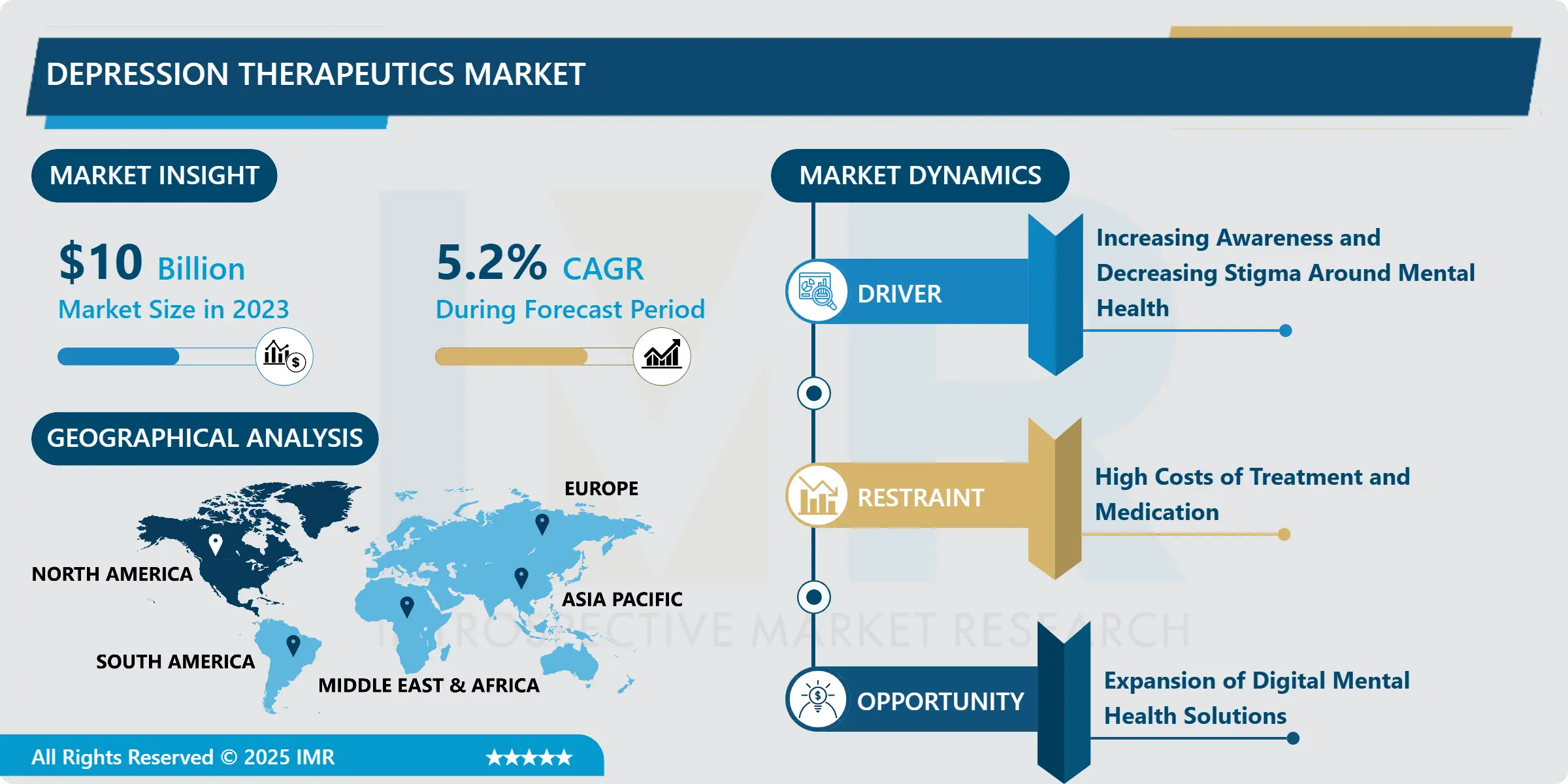
Depression Therapeutics Market Size Was Valued at USD 10 Billion in 2023, and is Projected to Reach USD 16.8 Billion by 2032, Growing at a CAGR of 5.2% From 2024-2032.
The depression therapeutics market means the creation, manufacturing, and sales of medications and therapies that address the mental disorder known as depression. They include several medications like antidepressants (SSRIs, and SNRIs, MAOIs, etc.) mood stabilizers and other novel approaches such as ketamine treatments combined with psychological therapies including CBT. The market also includes additional treatment approaches such as transcranial magnetic stimulation (TMS) and electroconvulsive therapy (ECT). The primary goal of this market is to enhance patient well-being and find a cure to depression in order to help patients live a better life.
The depression therapeutics market is on the rise, fueled by a growing global burden of depression, which owes its causality to changes in life’s demands, the social media, and the stressors of the current century. Mental health issues such as depression which has cut across millions of people across the globe has created a need for new therapies that can be administered through the typical pharmacological anti-depressive medications and other new novel techniques. Consumer awareness about mental health is increasing around the world and the prevalence of mental illness is reducing, which is driving the demand for treatment. This has boosted the market growth even further due to the increasing popularity of other treatments like ketamine in individuals that do not respond to other treatments for depression. Also, the fact that the recognition of mental disorders on an international level is growing constant, governments as well as healthcare bodies are disbursing more funds in the finding of respective treatment procedures.
On the same note, it is clear that in the market segmentation aspect, the antidepressants are the biggest market in the overall depression therapeutics market. Such market is currently occupied by drugs such as selective serotonin reuptake inhibitors (SSRIs) and serotonin-norepinephrine reuptake inhibitors (SNRIs). Though most of the advances made with traditional treatments, there is slowly creeping interest in newer treatment methods such as psychedelic therapy and digital health interventions. The largest market for depression therapeutics is in North America, especially in the United States due to high prevalence of depression, highly developed state of the health care sector, and relatively high funds allocation towards research in the sphere of mental disorder.
Depression Therapeutics Market Trend Analysis:
Rise in Personalized Depression Therapies
One of the most significant unadulterated trends witnessed in the depression therapeutics market today is the paradigm change to more personalised systems of treatment. It means that therapy is based on the genetic characteristics of the organism, individual’s habits, and the symptoms manifested, which can increase the effectiveness and exclude side effects. This is in contrast to the earlier conventional approaches to taking antidepressants were seen under as a standard therapy.
Personalization here, could include the testing of the individual for the most suitable antidepressants or deploying other mental health apps that provide continuous data on the client and adjust treatment correspondingly. This is also creating a model of teamwork for treating depression through a combination of psychotherapy and pharmacological treatment. Further, understanding that applying specific treatments generates certain reactions in patients through the use of machine learning algorithms, it is possible to enhance the accuracy of interventions and advance the knowledge of the biological sampling of depression.
Expansion of Digital Mental Health Solutions
The emerging trend in depression therapeutics market that holds great potential is that of digital mental health solutions like, online counselling ECPs, mobile applications and telemedicine services. Since telehealth is becoming the new way of dispensing care and as the use of smartphones shoots up, digital therapeutics are cheaper ways of addressing depression. These platforms can provide CBT therapy, mood tracking, and possibly the support groups for patients, all from the comforts of one’s home.
It is especially more advantageous because it is convenient for those with limited or no access to conventional pharmacies or hospitals they have private issues. However, other digital tools employed in the assessment and treatment of mental health provide a chance for consistent tracking of the respondent’s well-being, thus providing the professionals with a wide range of opportunities to tweak the care plan. Therefore, the market will see impressive growth of the digital mental health solutions as new opportunities for treating patients emerge.
Depression Therapeutics Market Segment Analysis:
Depression Therapeutics Market Segmented on the basis of Drug Class, Therapy Type, End User, and Region.
By Drug Class, Mood stabilizers segment is expected to dominate the market during the forecast period
This report categorizes the depression therapeutics market by drug classes highlighting mood stabilizers and antipsychotics as significant products for the treatment of depression. Depressive mood stabilisers are normally used in cases of bipolar depression or in patients with bipolar disorder who are exhibiting mood swings; it resembles with those patients who are not likely to be treated by normal antidepressants. They are useful in preventing mood swings, maniac or depressive ones. Mood stabilizers are lithium and anticonvulsant such as valproate. A number of these treatments are indicated for clients who do not have response to first line anti depressants.
Another big segment of the market is antipsychotics; they are used in clients who experience depression accompanied by psychotic features, severe mood disorders, or depression that fails to respond to other treatments. Aripiprazole and quetiapine are used as additional antidepressants for patients who receive poor results from typical anti-depressive therapy. Besides such conventional courses, the market moreover has other classes such as ketamine, and psychedelics like psilocybin which has benefits in curing a depressive disorder that is unresponsive to different treatments. Dissociative aesthetic ketamine is getting attention for its instantaneous anti-depressants properties, and psychedelic are being investigated for their ability to provide remission to chronic depression patients. These newer treatments are defining the new generation of depression therapeutics, providing help for those who have not been helped before.
By Application, pharmacotherapy segment expected to held the largest share
This treatment approach is one of the most dominant approaches to treatment of depression and involves the administration of different pharmacological substances. This includes Counter’s depression medications commonly used like select serotonin reuptake inhibitors SSRIs, serotonin norepinephrine reuptake inhibitor SNRIs, tricyclic antidepressants TCA’s and more recently ketamine. Although it is known that patients suffering from moderate to severe depression normally require pharmacotherapy as the first treatment choice, the option is very effective in providing the patient with a fairly rapid means of symptom relief. The medication often used for treating clinical depressions also includes mood stabilizers and antipsychotics if the symptoms are severe or pertain to the certain type of depression. It is very applicable for severe or chronic character of depression when mere psychotherapy cannot help much.
Besides pharmacotherapy, psychotherapy is an important element of treatment for depression aimed at the modification of psychological and emotional processes which cause the disorder. Cognitive Behaviourally Therapy(CBT) is probably one of the most widely practiced forms of therapy, which helps people change unfavourable thought patterns that are linked to depression. The other types of psychotherapy are psychodynamic therapy whereby clients are confronted with disturbing memories and Synaptic therapy which deals with disturbed thinking patterns, another type of psychotherapy is the IPT, which tends to focus on interpersonal relationships and how people communicate. Psychotherapy therapy has been found to have lasting positive effects for giving reliable results and preventing relapse. Psychotherapy is therefore a relevant, though supplementary and less pharmacological, approach to the treatment of depression in both new and long-term patients where mild to moderate severity or no desire for chronic pharmacologic therapy are involved.
Depression Therapeutics Market Regional Insights:
North America is Expected to Dominate the Market Over the Forecast period
A part of the growing list of regional market insights, the depression therapeutics market from North America is anticipated to hold a significant revenue share in the global market in 2023. This mainly due to high rate of depression in the region, well developed health care system and more emphasis on mental health issues. Specific country representation is especially offered by the United States as the country with high investment in likable treatments and progressive therapies such as ketamine and digital health.
The growth of the North American market is also supported by a high level of awareness of mental health problems and reduced prejudice regarding the use of products for the treatment of depression. It is home to approximately 45 to 50% of the global market of depression therapeutics. Besides, the strong political endorsement of mental health through measures and policies also boosts this market dominance. This dominance is seen to persist in future, though out other parts of the world, especially Europe, and Asia-Pacific are also fast developing the mental health systems and are therefore fostering the market growth.
Active Key Players in the Depression Therapeutics Market:
AbbVie (USA)
Allergan (USA)
Amgen (USA)
Axsome Therapeutics (USA)
Bristol-Myers Squibb (USA)
Celgene (USA)
Eli Lilly and Co. (USA)
GSK (UK)
H. Lundbeck A/S (Denmark)
Johnson & Johnson (USA)
Merck & Co. (USA)
Mylan N.V. (USA)
Otsuka Pharmaceutical Co. (Japan)
Pfizer Inc. (USA)
Sun Pharmaceutical Industries Ltd. (India)
Other Active Players
Chapter 1: Introduction
1.1 Scope and Coverage
Chapter 2:Executive Summary
Chapter 3: Market Landscape
3.1 Market Dynamics
3.1.1 Drivers
3.1.2 Restraints
3.1.3 Opportunities
3.1.4 Challenges
3.2 Market Trend Analysis
3.3 PESTLE Analysis
3.4 Porter’s Five Forces Analysis
3.5 Industry Value Chain Analysis
3.6 Ecosystem
3.7 Regulatory Landscape
3.8 Price Trend Analysis
3.9 Patent Analysis
3.10 Technology Evolution
3.11 Investment Pockets
3.12 Import-Export Analysis
Chapter 4: Depression Therapeutics Market by Drug Class
4.1 Depression Therapeutics Market Snapshot and Growth Engine
4.2 Depression Therapeutics Market Overview
4.3 Mood Stabilizers
4.3.1 Introduction and Market Overview
4.3.2 Historic and Forecasted Market Size in Value USD and Volume Units (2017-2032F)
4.3.3 Key Market Trends, Growth Factors and Opportunities
4.3.4 Mood Stabilizers: Geographic Segmentation Analysis
4.4 Antipsychotics
4.4.1 Introduction and Market Overview
4.4.2 Historic and Forecasted Market Size in Value USD and Volume Units (2017-2032F)
4.4.3 Key Market Trends, Growth Factors and Opportunities
4.4.4 Antipsychotics: Geographic Segmentation Analysis
4.5 Others (Ketamine
4.5.1 Introduction and Market Overview
4.5.2 Historic and Forecasted Market Size in Value USD and Volume Units (2017-2032F)
4.5.3 Key Market Trends, Growth Factors and Opportunities
4.5.4 Others (Ketamine: Geographic Segmentation Analysis
4.6 psychedelics
4.6.1 Introduction and Market Overview
4.6.2 Historic and Forecasted Market Size in Value USD and Volume Units (2017-2032F)
4.6.3 Key Market Trends, Growth Factors and Opportunities
4.6.4 psychedelics: Geographic Segmentation Analysis
4.7 etc.)
4.7.1 Introduction and Market Overview
4.7.2 Historic and Forecasted Market Size in Value USD and Volume Units (2017-2032F)
4.7.3 Key Market Trends, Growth Factors and Opportunities
4.7.4 etc.): Geographic Segmentation Analysis
Chapter 5: Depression Therapeutics Market by Therapy Type
5.1 Depression Therapeutics Market Snapshot and Growth Engine
5.2 Depression Therapeutics Market Overview
5.3 Pharmacotherapy
5.3.1 Introduction and Market Overview
5.3.2 Historic and Forecasted Market Size in Value USD and Volume Units (2017-2032F)
5.3.3 Key Market Trends, Growth Factors and Opportunities
5.3.4 Pharmacotherapy: Geographic Segmentation Analysis
5.4 Psychotherapy
5.4.1 Introduction and Market Overview
5.4.2 Historic and Forecasted Market Size in Value USD and Volume Units (2017-2032F)
5.4.3 Key Market Trends, Growth Factors and Opportunities
5.4.4 Psychotherapy: Geographic Segmentation Analysis
5.5 Physical Therapy
5.5.1 Introduction and Market Overview
5.5.2 Historic and Forecasted Market Size in Value USD and Volume Units (2017-2032F)
5.5.3 Key Market Trends, Growth Factors and Opportunities
5.5.4 Physical Therapy: Geographic Segmentation Analysis
Chapter 6: Depression Therapeutics Market by End User
6.1 Depression Therapeutics Market Snapshot and Growth Engine
6.2 Depression Therapeutics Market Overview
6.3 Hospitals
6.3.1 Introduction and Market Overview
6.3.2 Historic and Forecasted Market Size in Value USD and Volume Units (2017-2032F)
6.3.3 Key Market Trends, Growth Factors and Opportunities
6.3.4 Hospitals: Geographic Segmentation Analysis
6.4 Homecare Settings
6.4.1 Introduction and Market Overview
6.4.2 Historic and Forecasted Market Size in Value USD and Volume Units (2017-2032F)
6.4.3 Key Market Trends, Growth Factors and Opportunities
6.4.4 Homecare Settings: Geographic Segmentation Analysis
6.5 Specialty Clinics
6.5.1 Introduction and Market Overview
6.5.2 Historic and Forecasted Market Size in Value USD and Volume Units (2017-2032F)
6.5.3 Key Market Trends, Growth Factors and Opportunities
6.5.4 Specialty Clinics: Geographic Segmentation Analysis
Chapter 7: Company Profiles and Competitive Analysis
7.1 Competitive Landscape
7.1.1 Competitive Benchmarking
7.1.2 Depression Therapeutics Market Share by Manufacturer (2023)
7.1.3 Industry BCG Matrix
7.1.4 Heat Map Analysis
7.1.5 Mergers and Acquisitions
7.2 ABBVIE (USA)
7.2.1 Company Overview
7.2.2 Key Executives
7.2.3 Company Snapshot
7.2.4 Role of the Company in the Market
7.2.5 Sustainability and Social Responsibility
7.2.6 Operating Business Segments
7.2.7 Product Portfolio
7.2.8 Business Performance
7.2.9 Key Strategic Moves and Recent Developments
7.2.10 SWOT Analysis
7.3 ALLERGAN (USA)
7.4 AMGEN (USA)
7.5 AXSOME THERAPEUTICS (USA)
7.6 BRISTOL-MYERS SQUIBB (USA)
7.7 CELGENE (USA)
7.8 ELI LILLY AND CO. (USA)
7.9 GSK (UK)
7.10 H. LUNDBECK A/S (DENMARK)
7.11 JOHNSON & JOHNSON (USA)
7.12 MERCK & CO. (USA)
7.13 MYLAN N.V. (USA)
7.14 OTSUKA PHARMACEUTICAL CO. (JAPAN)
7.15 PFIZER INC. (USA)
7.16 SUN PHARMACEUTICAL INDUSTRIES LTD. (INDIA)
7.17 OTHER ACTIVE PLAYERS
Chapter 8: Global Depression Therapeutics Market By Region
8.1 Overview
8.2. North America Depression Therapeutics Market
8.2.1 Key Market Trends, Growth Factors and Opportunities
8.2.2 Top Key Companies
8.2.3 Historic and Forecasted Market Size by Segments
8.2.4 Historic and Forecasted Market Size By Drug Class
8.2.4.1 Mood Stabilizers
8.2.4.2 Antipsychotics
8.2.4.3 Others (Ketamine
8.2.4.4 psychedelics
8.2.4.5 etc.)
8.2.5 Historic and Forecasted Market Size By Therapy Type
8.2.5.1 Pharmacotherapy
8.2.5.2 Psychotherapy
8.2.5.3 Physical Therapy
8.2.6 Historic and Forecasted Market Size By End User
8.2.6.1 Hospitals
8.2.6.2 Homecare Settings
8.2.6.3 Specialty Clinics
8.2.7 Historic and Forecast Market Size by Country
8.2.7.1 US
8.2.7.2 Canada
8.2.7.3 Mexico
8.3. Eastern Europe Depression Therapeutics Market
8.3.1 Key Market Trends, Growth Factors and Opportunities
8.3.2 Top Key Companies
8.3.3 Historic and Forecasted Market Size by Segments
8.3.4 Historic and Forecasted Market Size By Drug Class
8.3.4.1 Mood Stabilizers
8.3.4.2 Antipsychotics
8.3.4.3 Others (Ketamine
8.3.4.4 psychedelics
8.3.4.5 etc.)
8.3.5 Historic and Forecasted Market Size By Therapy Type
8.3.5.1 Pharmacotherapy
8.3.5.2 Psychotherapy
8.3.5.3 Physical Therapy
8.3.6 Historic and Forecasted Market Size By End User
8.3.6.1 Hospitals
8.3.6.2 Homecare Settings
8.3.6.3 Specialty Clinics
8.3.7 Historic and Forecast Market Size by Country
8.3.7.1 Bulgaria
8.3.7.2 The Czech Republic
8.3.7.3 Hungary
8.3.7.4 Poland
8.3.7.5 Romania
8.3.7.6 Rest of Eastern Europe
8.4. Western Europe Depression Therapeutics Market
8.4.1 Key Market Trends, Growth Factors and Opportunities
8.4.2 Top Key Companies
8.4.3 Historic and Forecasted Market Size by Segments
8.4.4 Historic and Forecasted Market Size By Drug Class
8.4.4.1 Mood Stabilizers
8.4.4.2 Antipsychotics
8.4.4.3 Others (Ketamine
8.4.4.4 psychedelics
8.4.4.5 etc.)
8.4.5 Historic and Forecasted Market Size By Therapy Type
8.4.5.1 Pharmacotherapy
8.4.5.2 Psychotherapy
8.4.5.3 Physical Therapy
8.4.6 Historic and Forecasted Market Size By End User
8.4.6.1 Hospitals
8.4.6.2 Homecare Settings
8.4.6.3 Specialty Clinics
8.4.7 Historic and Forecast Market Size by Country
8.4.7.1 Germany
8.4.7.2 UK
8.4.7.3 France
8.4.7.4 Netherlands
8.4.7.5 Italy
8.4.7.6 Russia
8.4.7.7 Spain
8.4.7.8 Rest of Western Europe
8.5. Asia Pacific Depression Therapeutics Market
8.5.1 Key Market Trends, Growth Factors and Opportunities
8.5.2 Top Key Companies
8.5.3 Historic and Forecasted Market Size by Segments
8.5.4 Historic and Forecasted Market Size By Drug Class
8.5.4.1 Mood Stabilizers
8.5.4.2 Antipsychotics
8.5.4.3 Others (Ketamine
8.5.4.4 psychedelics
8.5.4.5 etc.)
8.5.5 Historic and Forecasted Market Size By Therapy Type
8.5.5.1 Pharmacotherapy
8.5.5.2 Psychotherapy
8.5.5.3 Physical Therapy
8.5.6 Historic and Forecasted Market Size By End User
8.5.6.1 Hospitals
8.5.6.2 Homecare Settings
8.5.6.3 Specialty Clinics
8.5.7 Historic and Forecast Market Size by Country
8.5.7.1 China
8.5.7.2 India
8.5.7.3 Japan
8.5.7.4 South Korea
8.5.7.5 Malaysia
8.5.7.6 Thailand
8.5.7.7 Vietnam
8.5.7.8 The Philippines
8.5.7.9 Australia
8.5.7.10 New Zealand
8.5.7.11 Rest of APAC
8.6. Middle East & Africa Depression Therapeutics Market
8.6.1 Key Market Trends, Growth Factors and Opportunities
8.6.2 Top Key Companies
8.6.3 Historic and Forecasted Market Size by Segments
8.6.4 Historic and Forecasted Market Size By Drug Class
8.6.4.1 Mood Stabilizers
8.6.4.2 Antipsychotics
8.6.4.3 Others (Ketamine
8.6.4.4 psychedelics
8.6.4.5 etc.)
8.6.5 Historic and Forecasted Market Size By Therapy Type
8.6.5.1 Pharmacotherapy
8.6.5.2 Psychotherapy
8.6.5.3 Physical Therapy
8.6.6 Historic and Forecasted Market Size By End User
8.6.6.1 Hospitals
8.6.6.2 Homecare Settings
8.6.6.3 Specialty Clinics
8.6.7 Historic and Forecast Market Size by Country
8.6.7.1 Turkey
8.6.7.2 Bahrain
8.6.7.3 Kuwait
8.6.7.4 Saudi Arabia
8.6.7.5 Qatar
8.6.7.6 UAE
8.6.7.7 Israel
8.6.7.8 South Africa
8.7. South America Depression Therapeutics Market
8.7.1 Key Market Trends, Growth Factors and Opportunities
8.7.2 Top Key Companies
8.7.3 Historic and Forecasted Market Size by Segments
8.7.4 Historic and Forecasted Market Size By Drug Class
8.7.4.1 Mood Stabilizers
8.7.4.2 Antipsychotics
8.7.4.3 Others (Ketamine
8.7.4.4 psychedelics
8.7.4.5 etc.)
8.7.5 Historic and Forecasted Market Size By Therapy Type
8.7.5.1 Pharmacotherapy
8.7.5.2 Psychotherapy
8.7.5.3 Physical Therapy
8.7.6 Historic and Forecasted Market Size By End User
8.7.6.1 Hospitals
8.7.6.2 Homecare Settings
8.7.6.3 Specialty Clinics
8.7.7 Historic and Forecast Market Size by Country
8.7.7.1 Brazil
8.7.7.2 Argentina
8.7.7.3 Rest of SA
Chapter 9 Analyst Viewpoint and Conclusion
9.1 Recommendations and Concluding Analysis
9.2 Potential Market Strategies
Chapter 10 Research Methodology
10.1 Research Process
10.2 Primary Research
10.3 Secondary Research
Q1: What would be the forecast period in the Depression Therapeutics Market research report?
A1: The forecast period in the Depression Therapeutics Market research report is 2024-2032.
Q2: Who are the key players in the Depression Therapeutics Market?
A2: AbbVie (USA), Allergan (USA), Amgen (USA), Axsome Therapeutics (USA), Bristol-Myers Squibb (USA), Celgene (USA), Eli Lilly and Co. (USA), GSK (UK), H. Lundbeck A/S (Denmark), Johnson & Johnson (USA), Merck & Co. (USA), Mylan N.V. (USA), Otsuka Pharmaceutical Co. (Japan), Pfizer Inc. (USA), Sun Pharmaceutical Industries Ltd. (India) and Other Active Players
Q3: What are the segments of the Depression Therapeutics Market?
A3: The Depression Therapeutics Market is segmented into by Drug Class, the market is categorized into (Mood Stabilizers, Antipsychotics, Others (Ketamine, psychedelics, etc.)), By Therapy Type, the market is categorized into (Pharmacotherapy, Psychotherapy, Physical Therapy), End User, the market is categorized into (Hospitals, Homecare Settings, Specialty Clinics) By region, it is analyzed across North America (U.S., Canada, Mexico), Eastern Europe (Russia, Bulgaria, The Czech Republic, Hungary, Poland, Romania, Rest of Eastern Europe), Western Europe (Germany, UK, France, The Netherlands, Italy, Spain, Rest of Western Europe), Asia Pacific (China, India, Japan, South Korea, Malaysia, Thailand, Vietnam, The Philippines, Australia, New-Zealand, Rest of APAC), Middle East & Africa (Turkiye, Bahrain, Kuwait, Saudi Arabia, Qatar, UAE, Israel, South Africa), South America (Brazil, Argentina, Rest of SA).
Q4: What is the Depression Therapeutics Market?
A4: The depression therapeutics market means the creation, manufacturing, and sales of medications and therapies that address the mental disorder known as depression. They include several medications like antidepressants (SSRIs, and SNRIs, MAOIs, etc.) mood stabilizers and other novel approaches such as ketamine treatments combined with psychological therapies including CBT. The market also includes additional treatment approaches such as transcranial magnetic stimulation (TMS) and electroconvulsive therapy (ECT). The primary goal of this market is to enhance patient well-being and find a cure to depression in order to help patients live a better life.
Q5: How big is the Depression Therapeutics Market?
A5: Depression Therapeutics Market Size Was Valued at USD 10 Billion in 2023, and is Projected to Reach USD 16.8 Billion by 2032, Growing at a CAGR of 5.2% From 2024-2032.
How to Buy a Report from eminsights.jp
On the product page, choose the license you want: Single-User License, Multi-User License or Enterprise License.
If you required report in your native language, then you can click on Translated Report button and fill out the form with report name and language you want, then our team will contact you as soon as possible.
Click the Buy Now button.
You will be redirected to the checkout page. Enter your company details and payment information.
Click Place Order to complete the purchase.
Confirmation: You’ll receive an order confirmation and our team will contact you shortly with your ordered report.
If you have any questions, fill out the contact form below or email us at bizdev@eminsights.net.
Thank you for choosing eminsights.jp!