Stay Ahead in Fast-Growing Economies.
Browse Reports Now
Data Governance Software Market – Current Analysis by Market Share
Global Data Governance Software Market Report 2021 comes with the extensive industry analysis of development components, patterns, flows and sizes. The report also calculates present and past market values to forecast potential market management through the forecast period between 2021-2025. The report may be the best of what is a geographic area which expands the competitive landscape and industry perspective of the market.

IMR Group
Description
Data Governance Software Market Synopsis
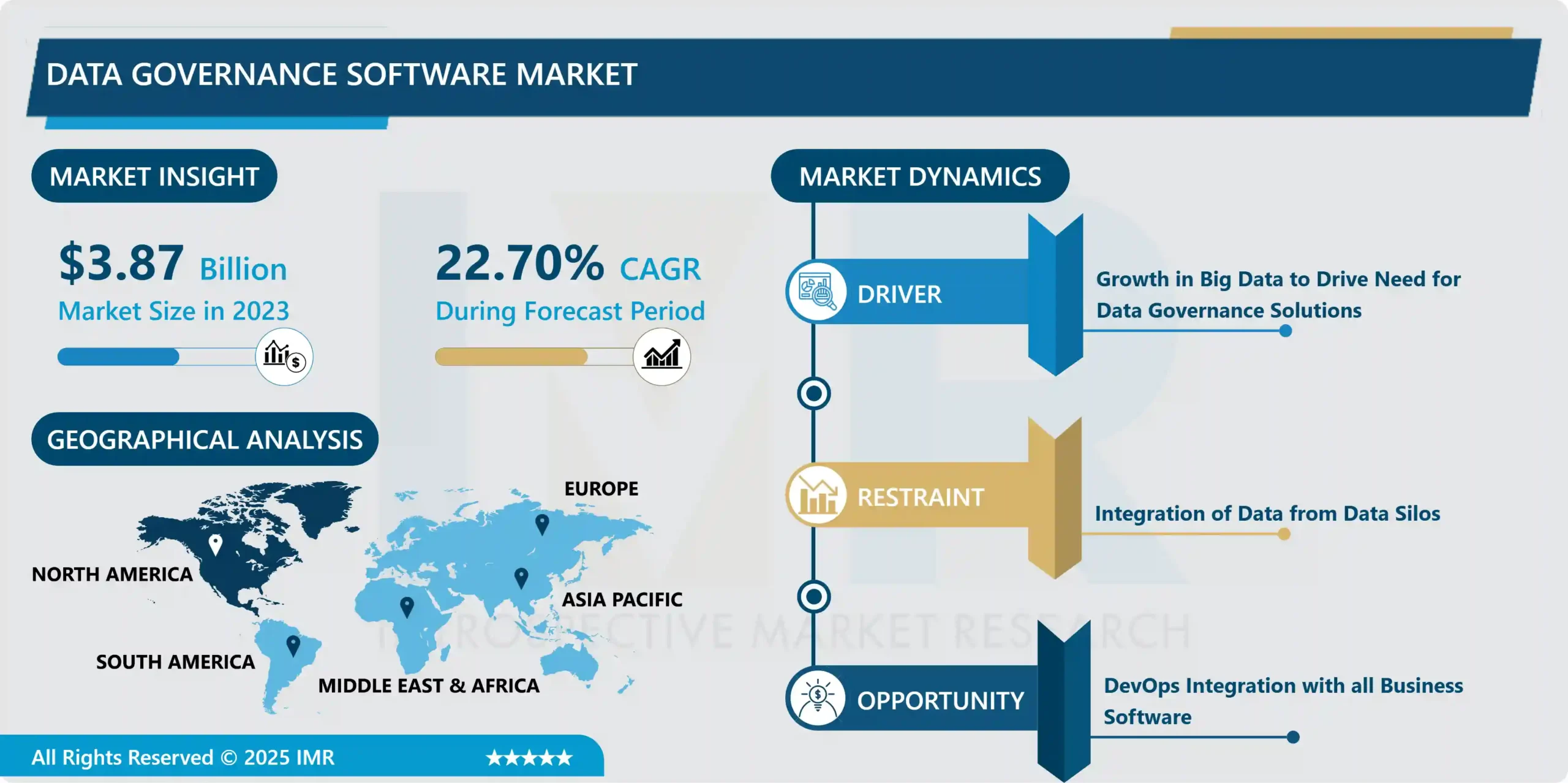
Global Data Governance Software Market size is expected to grow from USD 3.87 Billion in 2023 to USD 24.40 Billion by 2032, at a CAGR of 22.7% during the forecast period (2024-2032).
A complete suite of tools and technology called data governance software is intended to manage, regulate, and maximize an organization’s data during its whole lifespan. By making it easier to create and implement data management rules, this software guarantees data security, integrity, and adherence to legal standards. It offers a centralized and methodical approach to data governance with capabilities including metadata management, data lineage tracing, access controls, and data quality monitoring. Organizations may reduce risks related to data breaches, mistakes, and regulatory non-compliance while improving collaboration, standardizing data processes, and extracting meaningful insights from their data assets by employing Data Governance Software.
Data governance software is crucial for managing key data entities in an organization, ensuring consistency and accuracy across applications. Tools like SAP Master Data Governance and Stibosystems Master Data Management help manage analytics data, ensuring quality, access control, and lineage for reliable insights. Informatica Axon Data Governance ensures accurate customer data in CRMs like Salesforce. Platforms like Collibra and Ethyca offer built-in applications for data quality monitoring, lineage mapping, and access request management. For sensitive data applications like healthcare or financial, data governance principles should be incorporated to comply with regulations and protect user privacy.
Data governance software offers numerous benefits, including improved data quality, compliance with data regulations and privacy laws, improved collaboration across departments, and enhanced data security. It establishes standardized processes for data entry, storage, and retrieval, resulting in more accurate and reliable information. It also helps organizations comply with privacy laws by tracking and managing sensitive data. Furthermore, it enforces access controls and monitors data usage, reducing the risk of unauthorized access or data breaches. Overall, data governance software ensures organizations utilize their data effectively.
Data Governance Software Market Trend Analysis:
Growth in Big Data to Drive Need for Data Governance Solutions
Strong data governance solutions are becoming more and more in demand as a result of the big data explosion. Large datasets are being gathered by organizations from a variety of sources, underscoring the vital necessity to handle, safeguard, and extract valuable insights from this data. The volume, velocity, and variety of big data create distinct governance difficulties that call for specialist data governance tools. These solutions enable businesses to set up all-encompassing frameworks for data management, guaranteeing not just accessibility but also quality standards and legal compliance.
Businesses in the field of big data analytics are beginning to understand the significance it is to having strong data governance to extract useful information from enormous databases. Software for data governance is essential for classifying and organizing data and delivering a consistent view throughout the company. This facilitates data-driven corporate growth plans and enhances decision-making processes.
Furthermore, as data volume and complexity increase, data governance solutions perform a crucial role in reducing the likelihood of data breaches and illegal access, therefore fostering a reliable and secure data environment. In the end, as enterprises seek to maximize the value of their data assets while guaranteeing compliance, security, and competitive advantage in a data-driven environment, the rise of big data is driving the growth of the data governance software industry.
DevOps Integration with all Business Software
A significant possibility for market expansion in data governance software is the combination of DevOps principles with various business applications. Application delivery is accelerated and the software development lifecycle is streamlined via DevOps, a collaborative process that combines IT operations and software development. As more businesses turn to DevOps to achieve more speed and flexibility, strong data governance is becoming more and more necessary. Software for data governance plays a crucial part in making sure that data used in the DevOps pipeline is securely maintained, compliant with regulations, and operated efficiently.
Data governance software helps maintain data integrity and quality at various phases of the development process in the DevOps environment, where speed and cooperation are critical. It provides a consolidated platform for managing information, defining and enforcing data policies, and ensuring compliance with corporate standards.
Furthermore, as companies incorporate DevOps into their operational frameworks, there is an increasing need for data governance solutions to address the difficulties presented by the large amounts of data produced during quick development cycles. This gives vendors of data governance software a chance to offer solutions that are easily linked with DevOps technologies, enabling a safe and easy flow of data throughout the development process. Ultimately, as companies increasingly realize the inherent benefit of a well-governed data infrastructure inside their agile development processes, the seamless integration of DevOps and data governance software not only assures data dependability but also opens up avenues for market expansion.
Data Governance Software Market Segment Analysis:
Data Governance Software Market is Segmented Based on By Deployment, Organization Size, Component Application, and Industry Vertical
By Deployment, Cloud Segment Is Expected to Dominate the Market During the Forecast Period
The cloud sector, driven by the increasing trend of enterprises switching to cloud-based solutions for their data governance needs, is expected to dominate the market. Unmatched accessibility, scalability, and flexibility are provided by cloud-centric data governance, which easily adapts to the changing needs of modern enterprises. Organizations may provide seamless communication, immediate updates, and centralized control over their data governance policies by utilizing the cloud to store, process, and manage large datasets.
The intrinsic advantages of cloud computing, such as its low cost, quick implementation, and flexibility to handle varying data quantities, are driving this change. The cloud sector is expected to have a significant impact on how the data governance software market develops in the future as companies continue to embrace digital transformation. It gives businesses a solid and adaptable base on which to manage their data effectively and securely.
By Application, Compliance Management Segment Held the Largest Share of 40.25% In 2022
The Compliance Management category leads the market, indicating its critical importance in the data governance domain. The necessity for firms to adhere to strict regulatory requirements and the constantly changing regulatory landscape are the primary causes of this leadership role. Businesses may create, monitor, and enforce policies by integrating compliance management solutions with data governance software. This guarantees that data handling complies with industry and regulatory requirements.
Organizations are strategically prioritizing compliance activities to preserve and reinforce trust while also mitigating risks in response to growing worldwide concerns about data privacy and security. Offering complete solutions for the tracking, reporting, and administration of compliance-related operations further emphasizes the relevance of the Compliance administration sector. With the advent of increased scrutiny in data governance, Compliance Management solutions’ strong features make them essential components, driving their significant market domination in the larger data governance software environment.
Data Governance Software Market Regional Insights:
North America is Expected to Dominate the Market Over the Forecast Period
North America has emerged as a leader in the adoption of data governance solutions and is well-positioned to dominate the industry. Some factors, including the region’s sophisticated technology infrastructure, a growing understanding of the need for data stewardship, and strict legal frameworks, support this supremacy. Modern data governance software is being actively purchased by businesses across North America to meet regulatory obligations, improve data security, and take advantage of actionable insights.
North America’s leading position is further reinforced by the significant presence of important market participants and a strong emphasis on digital transformation activities. The region’s dominance in data governance is expected to continue as organizations recognize the critical role that data governance performs in guaranteeing data quality, integrity, and regulatory compliance. This will also have an impact on how data governance solutions evolve.
Key Players Covered in Data Governance Software Market:
Collibra NV (US)
SAS Institute Inc. (US)
TIBCO Software Inc. (US)
Alation Inc. (US)
Alfresco Software Inc. (US)
Informatica Inc. (US)
Microsoft Corporation (US)
IBM Corporation (US)
Oracle Corporation (US)
Talend SA (US)
Varonis Systems Inc. (US)
Data Advantage Group (US)
Infogix (US)
Magnitude Software (US)
Ataccama (US)
Global Data Excellence (Switzerland)
Reltio (US)
Innovative Routines International (US)
Alex Solutions (Australia)
Microfocus (UK)
SAP SE (Germany), and Other Major Players
Key Industry Development in The Data Governance Software Market:
In February 2024, Mailing firm boss Nigel Copp launched a new software company, Safe Data Governance (SDG), that helps businesses manage their data security accreditation processes. Co-founded with consultant data protection officer Steve Gibson in 2019, SDG emerges from a rigorous five-year development and beta-testing phase to mark its full launch in late 2023. SDG’s Prism software offers clients a comprehensive platform to manage accreditation processes for standards like ISO 27001, Cyber Essentials, UK GDPR, and the upcoming ISO 27002 update, ensuring robust data governance.
In June 2023, Oracle announced its plans to develop powerful, generative AI services for organizations across the world. The company will provide native generative AI services to help organizations automate end-to-end business processes, improve decision-making, and enhance customer experiences, in collaboration with Cohere, a leading AI platform for enterprise.
In September 2023, IBM launched Wastonx AI with generative AI models for data governance. The aim is to offer enterprises the tools essential to measure and accelerate the impact of AI in their operations.
Chapter 1: Introduction
1.1 Scope and Coverage
Chapter 2:Executive Summary
Chapter 3: Market Landscape
3.1 Market Dynamics
3.1.1 Drivers
3.1.2 Restraints
3.1.3 Opportunities
3.1.4 Challenges
3.2 Market Trend Analysis
3.3 PESTLE Analysis
3.4 Porter’s Five Forces Analysis
3.5 Industry Value Chain Analysis
3.6 Ecosystem
3.7 Regulatory Landscape
3.8 Price Trend Analysis
3.9 Patent Analysis
3.10 Technology Evolution
3.11 Investment Pockets
3.12 Import-Export Analysis
Chapter 4: Data Governance Software Market by Deployment (2018-2032)
4.1 Data Governance Software Market Snapshot and Growth Engine
4.2 Market Overview
4.3 Cloud
4.3.1 Introduction and Market Overview
4.3.2 Historic and Forecasted Market Size in Value USD and Volume Units
4.3.3 Key Market Trends, Growth Factors, and Opportunities
4.3.4 Geographic Segmentation Analysis
4.4 On-Premise
Chapter 5: Data Governance Software Market by Organization Size (2018-2032)
5.1 Data Governance Software Market Snapshot and Growth Engine
5.2 Market Overview
5.3 Large-Scale Business
5.3.1 Introduction and Market Overview
5.3.2 Historic and Forecasted Market Size in Value USD and Volume Units
5.3.3 Key Market Trends, Growth Factors, and Opportunities
5.3.4 Geographic Segmentation Analysis
5.4 Small and Medium-Scale Business
Chapter 6: Data Governance Software Market by Component (2018-2032)
6.1 Data Governance Software Market Snapshot and Growth Engine
6.2 Market Overview
6.3 Software
6.3.1 Introduction and Market Overview
6.3.2 Historic and Forecasted Market Size in Value USD and Volume Units
6.3.3 Key Market Trends, Growth Factors, and Opportunities
6.3.4 Geographic Segmentation Analysis
6.4 Service
Chapter 7: Data Governance Software Market by Application (2018-2032)
7.1 Data Governance Software Market Snapshot and Growth Engine
7.2 Market Overview
7.3 Audit Management
7.3.1 Introduction and Market Overview
7.3.2 Historic and Forecasted Market Size in Value USD and Volume Units
7.3.3 Key Market Trends, Growth Factors, and Opportunities
7.3.4 Geographic Segmentation Analysis
7.4 Risk Management
7.5 Compliance Management
7.6 Incident Management
7.7 Process Management
7.8 Others
Chapter 8: Data Governance Software Market by Industry Vertical (2018-2032)
8.1 Data Governance Software Market Snapshot and Growth Engine
8.2 Market Overview
8.3 Banking
8.3.1 Introduction and Market Overview
8.3.2 Historic and Forecasted Market Size in Value USD and Volume Units
8.3.3 Key Market Trends, Growth Factors, and Opportunities
8.3.4 Geographic Segmentation Analysis
8.4 Financial Services
8.5 And Insurance (BFSI)
8.6 Retail & Consumer Goods
8.7 Healthcare
8.8 Manufacturing
8.9 IT & Telecom
8.10 Others
Chapter 9: Company Profiles and Competitive Analysis
9.1 Competitive Landscape
9.1.1 Competitive Benchmarking
9.1.2 Data Governance Software Market Share by Manufacturer (2024)
9.1.3 Industry BCG Matrix
9.1.4 Heat Map Analysis
9.1.5 Mergers and Acquisitions
9.2 DEERE & COMPANY (US)
9.2.1 Company Overview
9.2.2 Key Executives
9.2.3 Company Snapshot
9.2.4 Role of the Company in the Market
9.2.5 Sustainability and Social Responsibility
9.2.6 Operating Business Segments
9.2.7 Product Portfolio
9.2.8 Business Performance
9.2.9 Key Strategic Moves and Recent Developments
9.2.10 SWOT Analysis
9.3 TRIMBLE INC. (US)
9.4 AGJUNCTION INC. (CANADA)
9.5 RAVEN INDUSTRIES INC. (US)
9.6 ITERIS INC. (US)
9.7 AG LEADER TECHNOLOGY (IOWA)
9.8 DICKEY-JOHN CORPORATION (US)
9.9 SST DEVELOPMENT GROUP (CALIFORNIA)
9.10 TOPCON POSITIONING SYSTEMS INC (US)
9.11 THE CLIMATE CORPORATION (US)
9.12 CONSERVIS CORPORATION (US)
9.13 FARMERS EDGE INC. (US)
9.14 DELAVAL (SWEDEN)
9.15 GEA GROUP AG (GERMANY)
9.16 BOUMATIC LLC (US)
Chapter 10: Global Data Governance Software Market By Region
10.1 Overview
10.2. North America Data Governance Software Market
10.2.1 Key Market Trends, Growth Factors and Opportunities
10.2.2 Top Key Companies
10.2.3 Historic and Forecasted Market Size by Segments
10.2.4 Historic and Forecasted Market Size by Deployment
10.2.4.1 Cloud
10.2.4.2 On-Premise
10.2.5 Historic and Forecasted Market Size by Organization Size
10.2.5.1 Large-Scale Business
10.2.5.2 Small and Medium-Scale Business
10.2.6 Historic and Forecasted Market Size by Component
10.2.6.1 Software
10.2.6.2 Service
10.2.7 Historic and Forecasted Market Size by Application
10.2.7.1 Audit Management
10.2.7.2 Risk Management
10.2.7.3 Compliance Management
10.2.7.4 Incident Management
10.2.7.5 Process Management
10.2.7.6 Others
10.2.8 Historic and Forecasted Market Size by Industry Vertical
10.2.8.1 Banking
10.2.8.2 Financial Services
10.2.8.3 And Insurance (BFSI)
10.2.8.4 Retail & Consumer Goods
10.2.8.5 Healthcare
10.2.8.6 Manufacturing
10.2.8.7 IT & Telecom
10.2.8.8 Others
10.2.9 Historic and Forecast Market Size by Country
10.2.9.1 US
10.2.9.2 Canada
10.2.9.3 Mexico
10.3. Eastern Europe Data Governance Software Market
10.3.1 Key Market Trends, Growth Factors and Opportunities
10.3.2 Top Key Companies
10.3.3 Historic and Forecasted Market Size by Segments
10.3.4 Historic and Forecasted Market Size by Deployment
10.3.4.1 Cloud
10.3.4.2 On-Premise
10.3.5 Historic and Forecasted Market Size by Organization Size
10.3.5.1 Large-Scale Business
10.3.5.2 Small and Medium-Scale Business
10.3.6 Historic and Forecasted Market Size by Component
10.3.6.1 Software
10.3.6.2 Service
10.3.7 Historic and Forecasted Market Size by Application
10.3.7.1 Audit Management
10.3.7.2 Risk Management
10.3.7.3 Compliance Management
10.3.7.4 Incident Management
10.3.7.5 Process Management
10.3.7.6 Others
10.3.8 Historic and Forecasted Market Size by Industry Vertical
10.3.8.1 Banking
10.3.8.2 Financial Services
10.3.8.3 And Insurance (BFSI)
10.3.8.4 Retail & Consumer Goods
10.3.8.5 Healthcare
10.3.8.6 Manufacturing
10.3.8.7 IT & Telecom
10.3.8.8 Others
10.3.9 Historic and Forecast Market Size by Country
10.3.9.1 Russia
10.3.9.2 Bulgaria
10.3.9.3 The Czech Republic
10.3.9.4 Hungary
10.3.9.5 Poland
10.3.9.6 Romania
10.3.9.7 Rest of Eastern Europe
10.4. Western Europe Data Governance Software Market
10.4.1 Key Market Trends, Growth Factors and Opportunities
10.4.2 Top Key Companies
10.4.3 Historic and Forecasted Market Size by Segments
10.4.4 Historic and Forecasted Market Size by Deployment
10.4.4.1 Cloud
10.4.4.2 On-Premise
10.4.5 Historic and Forecasted Market Size by Organization Size
10.4.5.1 Large-Scale Business
10.4.5.2 Small and Medium-Scale Business
10.4.6 Historic and Forecasted Market Size by Component
10.4.6.1 Software
10.4.6.2 Service
10.4.7 Historic and Forecasted Market Size by Application
10.4.7.1 Audit Management
10.4.7.2 Risk Management
10.4.7.3 Compliance Management
10.4.7.4 Incident Management
10.4.7.5 Process Management
10.4.7.6 Others
10.4.8 Historic and Forecasted Market Size by Industry Vertical
10.4.8.1 Banking
10.4.8.2 Financial Services
10.4.8.3 And Insurance (BFSI)
10.4.8.4 Retail & Consumer Goods
10.4.8.5 Healthcare
10.4.8.6 Manufacturing
10.4.8.7 IT & Telecom
10.4.8.8 Others
10.4.9 Historic and Forecast Market Size by Country
10.4.9.1 Germany
10.4.9.2 UK
10.4.9.3 France
10.4.9.4 The Netherlands
10.4.9.5 Italy
10.4.9.6 Spain
10.4.9.7 Rest of Western Europe
10.5. Asia Pacific Data Governance Software Market
10.5.1 Key Market Trends, Growth Factors and Opportunities
10.5.2 Top Key Companies
10.5.3 Historic and Forecasted Market Size by Segments
10.5.4 Historic and Forecasted Market Size by Deployment
10.5.4.1 Cloud
10.5.4.2 On-Premise
10.5.5 Historic and Forecasted Market Size by Organization Size
10.5.5.1 Large-Scale Business
10.5.5.2 Small and Medium-Scale Business
10.5.6 Historic and Forecasted Market Size by Component
10.5.6.1 Software
10.5.6.2 Service
10.5.7 Historic and Forecasted Market Size by Application
10.5.7.1 Audit Management
10.5.7.2 Risk Management
10.5.7.3 Compliance Management
10.5.7.4 Incident Management
10.5.7.5 Process Management
10.5.7.6 Others
10.5.8 Historic and Forecasted Market Size by Industry Vertical
10.5.8.1 Banking
10.5.8.2 Financial Services
10.5.8.3 And Insurance (BFSI)
10.5.8.4 Retail & Consumer Goods
10.5.8.5 Healthcare
10.5.8.6 Manufacturing
10.5.8.7 IT & Telecom
10.5.8.8 Others
10.5.9 Historic and Forecast Market Size by Country
10.5.9.1 China
10.5.9.2 India
10.5.9.3 Japan
10.5.9.4 South Korea
10.5.9.5 Malaysia
10.5.9.6 Thailand
10.5.9.7 Vietnam
10.5.9.8 The Philippines
10.5.9.9 Australia
10.5.9.10 New Zealand
10.5.9.11 Rest of APAC
10.6. Middle East & Africa Data Governance Software Market
10.6.1 Key Market Trends, Growth Factors and Opportunities
10.6.2 Top Key Companies
10.6.3 Historic and Forecasted Market Size by Segments
10.6.4 Historic and Forecasted Market Size by Deployment
10.6.4.1 Cloud
10.6.4.2 On-Premise
10.6.5 Historic and Forecasted Market Size by Organization Size
10.6.5.1 Large-Scale Business
10.6.5.2 Small and Medium-Scale Business
10.6.6 Historic and Forecasted Market Size by Component
10.6.6.1 Software
10.6.6.2 Service
10.6.7 Historic and Forecasted Market Size by Application
10.6.7.1 Audit Management
10.6.7.2 Risk Management
10.6.7.3 Compliance Management
10.6.7.4 Incident Management
10.6.7.5 Process Management
10.6.7.6 Others
10.6.8 Historic and Forecasted Market Size by Industry Vertical
10.6.8.1 Banking
10.6.8.2 Financial Services
10.6.8.3 And Insurance (BFSI)
10.6.8.4 Retail & Consumer Goods
10.6.8.5 Healthcare
10.6.8.6 Manufacturing
10.6.8.7 IT & Telecom
10.6.8.8 Others
10.6.9 Historic and Forecast Market Size by Country
10.6.9.1 Turkiye
10.6.9.2 Bahrain
10.6.9.3 Kuwait
10.6.9.4 Saudi Arabia
10.6.9.5 Qatar
10.6.9.6 UAE
10.6.9.7 Israel
10.6.9.8 South Africa
10.7. South America Data Governance Software Market
10.7.1 Key Market Trends, Growth Factors and Opportunities
10.7.2 Top Key Companies
10.7.3 Historic and Forecasted Market Size by Segments
10.7.4 Historic and Forecasted Market Size by Deployment
10.7.4.1 Cloud
10.7.4.2 On-Premise
10.7.5 Historic and Forecasted Market Size by Organization Size
10.7.5.1 Large-Scale Business
10.7.5.2 Small and Medium-Scale Business
10.7.6 Historic and Forecasted Market Size by Component
10.7.6.1 Software
10.7.6.2 Service
10.7.7 Historic and Forecasted Market Size by Application
10.7.7.1 Audit Management
10.7.7.2 Risk Management
10.7.7.3 Compliance Management
10.7.7.4 Incident Management
10.7.7.5 Process Management
10.7.7.6 Others
10.7.8 Historic and Forecasted Market Size by Industry Vertical
10.7.8.1 Banking
10.7.8.2 Financial Services
10.7.8.3 And Insurance (BFSI)
10.7.8.4 Retail & Consumer Goods
10.7.8.5 Healthcare
10.7.8.6 Manufacturing
10.7.8.7 IT & Telecom
10.7.8.8 Others
10.7.9 Historic and Forecast Market Size by Country
10.7.9.1 Brazil
10.7.9.2 Argentina
10.7.9.3 Rest of SA
Chapter 11 Analyst Viewpoint and Conclusion
11.1 Recommendations and Concluding Analysis
11.2 Potential Market Strategies
Chapter 12 Research Methodology
12.1 Research Process
12.2 Primary Research
12.3 Secondary Research
Q1: What would be forecast period in the market research report?
A1: The forecast period in the market research report is 2024-2032.
Q2: Who are the key players in Data Governance Software market?
A2: The key players mentioned are IBM, Magnitude Software, SAP America, Segment, Syncsort, Melissa, Cloudera, ASG Technologies, Netwrix, Triniti, SailPoint Technologies Holdings, Introv, SAS Institute, Hitachi Vantara, Adaptive, TMMData, Sagit Solutions, Simplity.
Q3: What are the segments of Data Governance Software market?
A3: The Data Governance Software Market is segmented into Deployment, Organization Size, Component, Application, Industry Vertical, and Region. By Deployment, the market is categorized into Cloud and on-premise. By Organization Size, the market is categorized into Large-Scale Business and Small and Medium-Scale Business. By Component, the market is categorized into Software and Services. By Application, the market is categorized into Audit Management, Risk Management, Compliance Management, Incident Management, Process Management, and Others. By Industry Vertical, the market is categorized into Banking, Financial Services, And Insurance (BFSI), Retail & Consumer Goods, Healthcare, Manufacturing, IT & Telecom, and Others. By region, it is analyzed across North America (U.S.; Canada; Mexico), Eastern Europe (Bulgaria; The Czech Republic; Hungary; Poland; Romania; Rest of Eastern Europe), Western Europe (Germany; UK; France; Netherlands; Italy; Russia; Spain; Rest of Western Europe), Asia-Pacific (China; India; Japan; Southeast Asia, etc.), South America (Brazil; Argentina, etc.), Middle East & Africa (Saudi Arabia; South Africa, etc.).
Q4: What is the Data Governance Software market?
A4: A complete suite of tools and technology called data governance software is intended to manage, regulate, and maximize an organization's data during its whole lifespan. By making it easier to create and implement data management rules, this software guarantees data security, integrity, and adherence to legal standards
Q5: How big is the Data Governance Software market?
A5: Global Data Governance Software Market size is expected to grow from USD 3.87 Billion in 2023 to USD 24.40 Billion by 2032, at a CAGR of 22.7% during the forecast period (2024-2032).
How to Buy a Report from eminsights.jp
On the product page, choose the license you want: Single-User License, Multi-User License or Enterprise License.
If you required report in your native language, then you can click on Translated Report button and fill out the form with report name and language you want, then our team will contact you as soon as possible.
Click the Buy Now button.
You will be redirected to the checkout page. Enter your company details and payment information.
Click Place Order to complete the purchase.
Confirmation: You’ll receive an order confirmation and our team will contact you shortly with your ordered report.
If you have any questions, fill out the contact form below or email us at bizdev@eminsights.net.
Thank you for choosing eminsights.jp!