Stay Ahead in Fast-Growing Economies.
Browse Reports Now
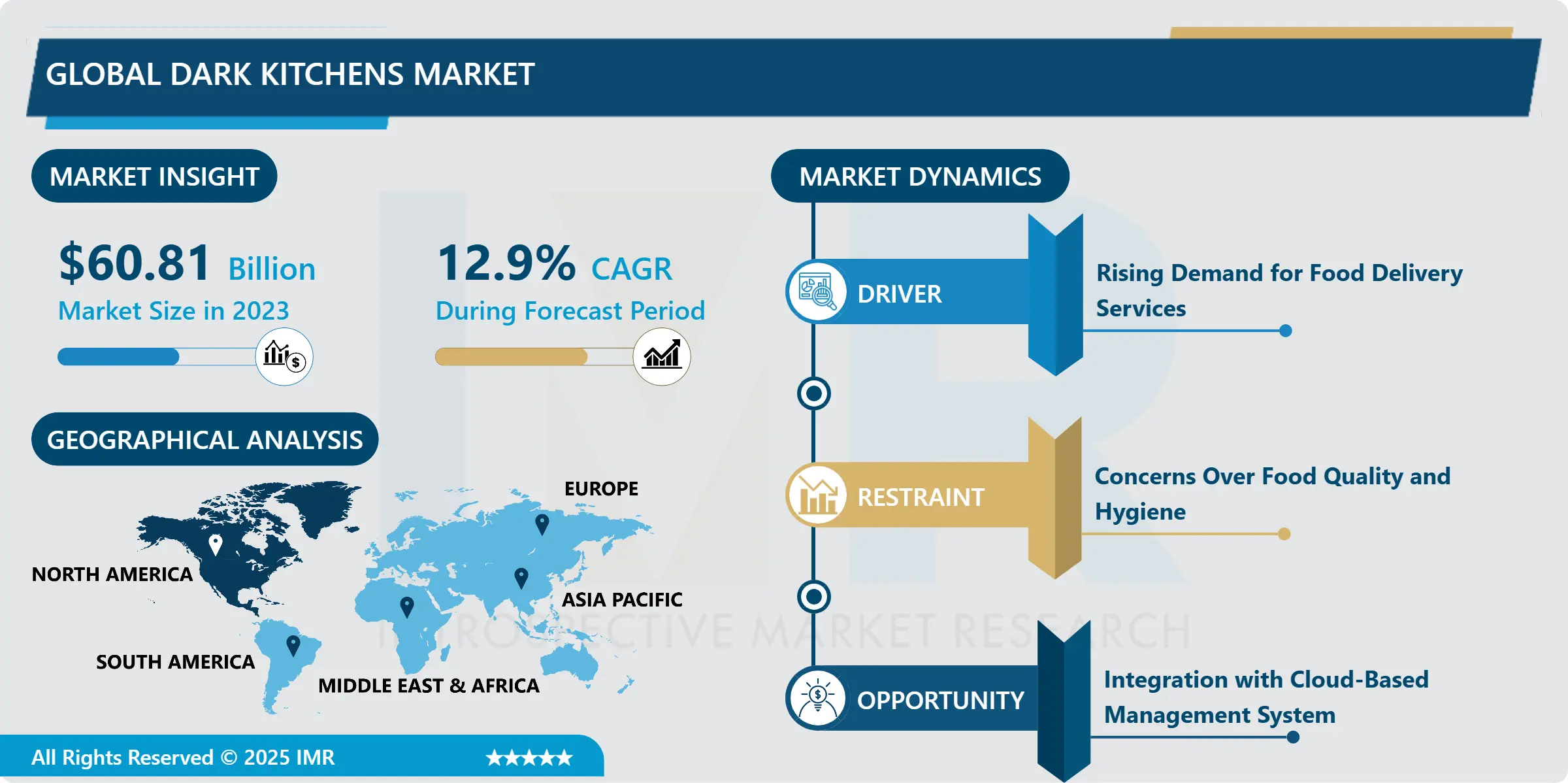
Dark Kitchens Market Size, Share, Growth & Forecast (2024-2032)
Dark Kitchens Market Size Was Valued at USD 60.81 Billion in 2023, and is Projected to Reach USD 181.23 Billion by 2032, Growing at a CAGR of 12.9% From 2024-2032.

IMR Group
Description
Dark Kitchens Market Synopsis:
Dark Kitchens Market Size Was Valued at USD 60.81 Billion in 2023, and is Projected to Reach USD 181.23 Billion by 2032, Growing at a CAGR of 12.9% From 2024-2032.
The dark kitchens market, also known as ghost kitchens or virtual kitchens, refers to commercial food preparation facilities that operate exclusively for delivery or takeaway services without a traditional dine-in option. These kitchens often support multiple food brands or menus, leveraging the rise of online food delivery platforms and consumer demand for convenience. By eliminating the need for a physical restaurant space, dark kitchens offer a cost-effective and scalable solution for food businesses to expand their reach and experiment with new culinary concepts, making them a key player in the evolving food service industry.
The dark kitchens market, also known as ghost kitchens or cloud kitchens, is rapidly evolving as a transformative segment within the global food delivery ecosystem. These commercial kitchen spaces are designed solely to prepare food for delivery, leveraging the increasing consumer preference for online food ordering and the convenience of app-based delivery platforms. The market has witnessed exponential growth, fueled by rising urbanization, a shift toward digital lifestyles, and the proliferation of food delivery platforms like Uber Eats, DoorDash, and Deliveroo. Furthermore, the COVID-19 pandemic acted as a catalyst for the sector’s expansion, as restrictions on dine-in services prompted restaurants to explore delivery-only models, significantly boosting demand for dark kitchen operations.
The market is characterized by diverse business models, including shared kitchens, kitchen pods, and independent facilities operated by established restaurant chains. This versatility allows businesses to cater to various demographics, reduce operational costs, and optimize delivery logistics. Technological advancements such as AI-based route optimization, inventory management systems, and data analytics are further enhancing operational efficiency and consumer satisfaction.
Dark Kitchens Market Trend Analysis:
Increasing Demand and Technological Advancements Driving Dark Kitchens Market Expansion
The growing consumer preference for online food delivery is a major driver of the dark kitchens market. This preference stems from the convenience of ordering food from home, access to a diverse range of cuisines, and competitive pricing offered by delivery platforms. Dark kitchens, also known as ghost or cloud kitchens, capitalize on these trends by operating without the need for traditional dine-in spaces, significantly lowering overhead costs such as rent and utilities. This cost-efficiency makes them an attractive option for restaurateurs looking to expand their reach or enter the market with minimal financial risk.
The proliferation of delivery platforms like Uber Eats, DoorDash, and Deliveroo has further bolstered the viability of dark kitchens. These platforms connect restaurants to a broad customer base, enabling them to scale operations without physical expansion. Additionally, advancements in technology, including integrated ordering systems and AI-driven demand forecasting, are revolutionizing dark kitchen operations. These technologies enhance efficiency by optimizing order management and delivery routes, ensuring faster service and reducing waste. As a result, dark kitchens have become increasingly appealing to both investors and restaurateurs seeking scalable and efficient business models in the rapidly evolving food delivery landscape.
Growth in the Dark Kitchens Market
The growing preference for convenience among consumers has fueled a significant surge in demand for delivery-only restaurants and cloud kitchens. This shift is strongly supported by advancements in online food ordering platforms and delivery apps, which simplify the process for customers and make access to a wide variety of cuisines more seamless than ever. As food delivery becomes an integral part of modern lifestyles, the efficiency and agility of dark kitchens offer a competitive edge in meeting the high volume of delivery orders without the overhead costs of traditional dine-in establishments. This model particularly appeals to urban populations that prioritize time savings and convenience in their dining choices.
Emerging markets such as Asia-Pacific and Latin America offer immense growth potential for dark kitchens due to their rapidly urbanizing populations and increasing internet penetration. These regions have seen a rise in digitally savvy consumers and a booming middle class that embraces food delivery services as part of their lifestyle. Additionally, the relatively low investment and operational costs associated with dark kitchens make them highly attractive for startups and small-scale restaurateurs aiming to enter the competitive food service market. By eliminating the need for prime real estate and front-of-house expenses, dark kitchens enable entrepreneurs to focus on delivering quality food while maintaining cost efficiency, creating a fertile ground for innovation and market expansion.
Dark Kitchens Market Segment Analysis:
Dark Kitchens Market Segmented on the basis of By Type, Business Model, Ownership, End User, and region.
By Type, Independent Dark Kitchens segment is expected to dominate the market during the forecast period
Independent dark kitchens are standalone commercial kitchens specifically designed for ghost or dark kitchen operations. These kitchens operate without a front-of-house area, such as a dining room or customer-facing counter, and focus entirely on food preparation for delivery and takeout services. This setup allows restaurant operators to test new menu items, concepts, or even cuisines without the overhead costs associated with a traditional restaurant. Independent dark kitchens provide the flexibility needed to experiment and refine food offerings in a low-risk environment. They are particularly beneficial for scaling delivery operations in urban and suburban areas where space and rental costs can be prohibitively high, making them a cost-effective solution for expanding into new markets or reaching a broader customer base.
These kitchens cater primarily to delivery- and takeout-only services, eliminating the need for a dine-in area, which allows operators to focus on optimizing food quality, delivery speed, and operational efficiency. The absence of a front-of-house setup reduces overhead expenses and enables operators to allocate resources more effectively towards high-quality ingredients and efficient food preparation processes. This model is ideal for meeting the growing demand for quick-service food delivery, especially in densely populated urban areas where convenience is key. Independent dark kitchens are an essential part of the modern food delivery ecosystem, offering a streamlined solution for brands looking to enter the market without the significant investment of a traditional restaurant setup.
By End User, Established Restaurant Chains segment expected to held the largest share
For established restaurant chains, dark kitchens offer a strategic solution to extend their market reach beyond traditional brick-and-mortar locations. This model allows chains to explore new markets without the need for significant capital investments in new restaurant spaces. By focusing exclusively on delivery and takeout services, dark kitchens enable chains to test new menu items, experiment with delivery-only concepts, and fine-tune their delivery processes. This flexibility is especially advantageous in urban areas where space is limited and rental costs can be high, making traditional restaurant expansion less viable. Dark kitchens allow chains to quickly adapt to changing consumer preferences and delivery trends, enabling them to respond effectively to shifts in the market.
Dark kitchens provide a platform for established restaurant chains to gather valuable data on delivery patterns, customer preferences, and operational efficiencies. This data-driven approach allows chains to refine their offerings and optimize their delivery services to meet customer demands. By leveraging insights gained from dark kitchen operations, chains can make informed decisions about menu development, marketing strategies, and potential future expansions. This model not only helps chains maintain competitive advantage but also enables them to scale their delivery business efficiently, enhancing profitability and customer satisfaction in an increasingly delivery-centric food industry.
Dark Kitchens Market Regional Insights:
North America is Expected to Dominate the Market Over the Forecast period
In North America, the Dark Kitchens market is dominated by established players who are leveraging technology and data analytics to streamline operations and enhance delivery efficiency. Major urban centers in the U.S. and Canada, including New York, Los Angeles, Toronto, and Vancouver, serve as hubs for dark kitchens. These cities feature a high concentration of cloud kitchens that offer diverse cuisine options tailored to the growing demand for convenient food delivery services. The region benefits from a robust digital infrastructure, which supports seamless online ordering and delivery, making it a key market for dark kitchens. As consumer preferences continue to shift towards on-demand services, dark kitchens in North America are capitalizing on technological advancements to meet these needs and drive market growth.
The increasing reliance on technology and digital platforms in North America is fostering an ideal environment for dark kitchens. Operators are using data analytics to better understand customer preferences, optimize kitchen layouts, and manage inventory more effectively. This enables them to maintain high-quality food standards and quick service times, which are critical for success in the competitive food delivery market. The market’s expansion in North America is further fueled by strong support from venture capitalists and food delivery platforms, who see dark kitchens as a viable business model that aligns with changing consumer habits and preferences. As these trends continue, North America is expected to remain a key region for the growth of the dark kitchens market.
Active Key Players in the Dark Kitchens Market:
REEF Technology (USA)
CloudKitchens (USA)
Kitchen United (USA)
Deliveroo Editions (UK)
Zuul Kitchens (USA)
DoorDash Kitchens (USA)
Karma Kitchen (USA)
Ghost Kitchen Brands (Canada)
FoodStars (USA)
Franklin Junction (USA)
Other Active Players
Chapter 1: Introduction
1.1 Scope and Coverage
Chapter 2:Executive Summary
Chapter 3: Market Landscape
3.1 Market Dynamics
3.1.1 Drivers
3.1.2 Restraints
3.1.3 Opportunities
3.1.4 Challenges
3.2 Market Trend Analysis
3.3 PESTLE Analysis
3.4 Porter’s Five Forces Analysis
3.5 Industry Value Chain Analysis
3.6 Ecosystem
3.7 Regulatory Landscape
3.8 Price Trend Analysis
3.9 Patent Analysis
3.10 Technology Evolution
3.11 Investment Pockets
3.12 Import-Export Analysis
Chapter 4: Dark Kitchens Market by Type
4.1 Dark Kitchens Market Snapshot and Growth Engine
4.2 Dark Kitchens Market Overview
4.3 Independent Dark Kitchens
4.3.1 Introduction and Market Overview
4.3.2 Historic and Forecasted Market Size in Value USD and Volume Units (2017-2032F)
4.3.3 Key Market Trends, Growth Factors and Opportunities
4.3.4 Independent Dark Kitchens: Geographic Segmentation Analysis
4.4 Commissary/Shared Dark Kitchens and Kitchen Pods
4.4.1 Introduction and Market Overview
4.4.2 Historic and Forecasted Market Size in Value USD and Volume Units (2017-2032F)
4.4.3 Key Market Trends, Growth Factors and Opportunities
4.4.4 Commissary/Shared Dark Kitchens and Kitchen Pods: Geographic Segmentation Analysis
Chapter 5: Dark Kitchens Market by Business Model
5.1 Dark Kitchens Market Snapshot and Growth Engine
5.2 Dark Kitchens Market Overview
5.3 Delivery-Only Dark Kitchens
5.3.1 Introduction and Market Overview
5.3.2 Historic and Forecasted Market Size in Value USD and Volume Units (2017-2032F)
5.3.3 Key Market Trends, Growth Factors and Opportunities
5.3.4 Delivery-Only Dark Kitchens: Geographic Segmentation Analysis
5.4 Hybrid Dark Kitchens and Franchise-Based Dark Kitchens
5.4.1 Introduction and Market Overview
5.4.2 Historic and Forecasted Market Size in Value USD and Volume Units (2017-2032F)
5.4.3 Key Market Trends, Growth Factors and Opportunities
5.4.4 Hybrid Dark Kitchens and Franchise-Based Dark Kitchens: Geographic Segmentation Analysis
Chapter 6: Dark Kitchens Market by Ownership
6.1 Dark Kitchens Market Snapshot and Growth Engine
6.2 Dark Kitchens Market Overview
6.3 Brand-Owned Dark Kitchens and Third-Party-Owned Dark Kitchens
6.3.1 Introduction and Market Overview
6.3.2 Historic and Forecasted Market Size in Value USD and Volume Units (2017-2032F)
6.3.3 Key Market Trends, Growth Factors and Opportunities
6.3.4 Brand-Owned Dark Kitchens and Third-Party-Owned Dark Kitchens: Geographic Segmentation Analysis
Chapter 7: Dark Kitchens Market by End User
7.1 Dark Kitchens Market Snapshot and Growth Engine
7.2 Dark Kitchens Market Overview
7.3 Established Restaurant Chains
7.3.1 Introduction and Market Overview
7.3.2 Historic and Forecasted Market Size in Value USD and Volume Units (2017-2032F)
7.3.3 Key Market Trends, Growth Factors and Opportunities
7.3.4 Established Restaurant Chains: Geographic Segmentation Analysis
7.4 Startup/Virtual Restaurant Brands and Food Aggregators
7.4.1 Introduction and Market Overview
7.4.2 Historic and Forecasted Market Size in Value USD and Volume Units (2017-2032F)
7.4.3 Key Market Trends, Growth Factors and Opportunities
7.4.4 Startup/Virtual Restaurant Brands and Food Aggregators: Geographic Segmentation Analysis
Chapter 8: Company Profiles and Competitive Analysis
8.1 Competitive Landscape
8.1.1 Competitive Benchmarking
8.1.2 Dark Kitchens Market Share by Manufacturer (2023)
8.1.3 Industry BCG Matrix
8.1.4 Heat Map Analysis
8.1.5 Mergers and Acquisitions
8.2 REEF TECHNOLOGY
8.2.1 Company Overview
8.2.2 Key Executives
8.2.3 Company Snapshot
8.2.4 Role of the Company in the Market
8.2.5 Sustainability and Social Responsibility
8.2.6 Operating Business Segments
8.2.7 Product Portfolio
8.2.8 Business Performance
8.2.9 Key Strategic Moves and Recent Developments
8.2.10 SWOT Analysis
8.3 CLOUDKITCHENS
8.4 KITCHEN UNITED
8.5 DELIVEROO EDITIONS
8.6 ZUUL KITCHENS
8.7 DOORDASH KITCHENS
8.8 KARMA KITCHEN
8.9 GHOST KITCHEN BRANDS
8.10 FOODSTARS
8.11 FRANKLIN JUNCTION
8.12 OTHER ACTIVE PLAYERS
Chapter 9: Global Dark Kitchens Market By Region
9.1 Overview
9.2. North America Dark Kitchens Market
9.2.1 Key Market Trends, Growth Factors and Opportunities
9.2.2 Top Key Companies
9.2.3 Historic and Forecasted Market Size by Segments
9.2.4 Historic and Forecasted Market Size By Type
9.2.4.1 Independent Dark Kitchens
9.2.4.2 Commissary/Shared Dark Kitchens and Kitchen Pods
9.2.5 Historic and Forecasted Market Size By Business Model
9.2.5.1 Delivery-Only Dark Kitchens
9.2.5.2 Hybrid Dark Kitchens and Franchise-Based Dark Kitchens
9.2.6 Historic and Forecasted Market Size By Ownership
9.2.6.1 Brand-Owned Dark Kitchens and Third-Party-Owned Dark Kitchens
9.2.7 Historic and Forecasted Market Size By End User
9.2.7.1 Established Restaurant Chains
9.2.7.2 Startup/Virtual Restaurant Brands and Food Aggregators
9.2.8 Historic and Forecast Market Size by Country
9.2.8.1 US
9.2.8.2 Canada
9.2.8.3 Mexico
9.3. Eastern Europe Dark Kitchens Market
9.3.1 Key Market Trends, Growth Factors and Opportunities
9.3.2 Top Key Companies
9.3.3 Historic and Forecasted Market Size by Segments
9.3.4 Historic and Forecasted Market Size By Type
9.3.4.1 Independent Dark Kitchens
9.3.4.2 Commissary/Shared Dark Kitchens and Kitchen Pods
9.3.5 Historic and Forecasted Market Size By Business Model
9.3.5.1 Delivery-Only Dark Kitchens
9.3.5.2 Hybrid Dark Kitchens and Franchise-Based Dark Kitchens
9.3.6 Historic and Forecasted Market Size By Ownership
9.3.6.1 Brand-Owned Dark Kitchens and Third-Party-Owned Dark Kitchens
9.3.7 Historic and Forecasted Market Size By End User
9.3.7.1 Established Restaurant Chains
9.3.7.2 Startup/Virtual Restaurant Brands and Food Aggregators
9.3.8 Historic and Forecast Market Size by Country
9.3.8.1 Russia
9.3.8.2 Bulgaria
9.3.8.3 The Czech Republic
9.3.8.4 Hungary
9.3.8.5 Poland
9.3.8.6 Romania
9.3.8.7 Rest of Eastern Europe
9.4. Western Europe Dark Kitchens Market
9.4.1 Key Market Trends, Growth Factors and Opportunities
9.4.2 Top Key Companies
9.4.3 Historic and Forecasted Market Size by Segments
9.4.4 Historic and Forecasted Market Size By Type
9.4.4.1 Independent Dark Kitchens
9.4.4.2 Commissary/Shared Dark Kitchens and Kitchen Pods
9.4.5 Historic and Forecasted Market Size By Business Model
9.4.5.1 Delivery-Only Dark Kitchens
9.4.5.2 Hybrid Dark Kitchens and Franchise-Based Dark Kitchens
9.4.6 Historic and Forecasted Market Size By Ownership
9.4.6.1 Brand-Owned Dark Kitchens and Third-Party-Owned Dark Kitchens
9.4.7 Historic and Forecasted Market Size By End User
9.4.7.1 Established Restaurant Chains
9.4.7.2 Startup/Virtual Restaurant Brands and Food Aggregators
9.4.8 Historic and Forecast Market Size by Country
9.4.8.1 Germany
9.4.8.2 UK
9.4.8.3 France
9.4.8.4 The Netherlands
9.4.8.5 Italy
9.4.8.6 Spain
9.4.8.7 Rest of Western Europe
9.5. Asia Pacific Dark Kitchens Market
9.5.1 Key Market Trends, Growth Factors and Opportunities
9.5.2 Top Key Companies
9.5.3 Historic and Forecasted Market Size by Segments
9.5.4 Historic and Forecasted Market Size By Type
9.5.4.1 Independent Dark Kitchens
9.5.4.2 Commissary/Shared Dark Kitchens and Kitchen Pods
9.5.5 Historic and Forecasted Market Size By Business Model
9.5.5.1 Delivery-Only Dark Kitchens
9.5.5.2 Hybrid Dark Kitchens and Franchise-Based Dark Kitchens
9.5.6 Historic and Forecasted Market Size By Ownership
9.5.6.1 Brand-Owned Dark Kitchens and Third-Party-Owned Dark Kitchens
9.5.7 Historic and Forecasted Market Size By End User
9.5.7.1 Established Restaurant Chains
9.5.7.2 Startup/Virtual Restaurant Brands and Food Aggregators
9.5.8 Historic and Forecast Market Size by Country
9.5.8.1 China
9.5.8.2 India
9.5.8.3 Japan
9.5.8.4 South Korea
9.5.8.5 Malaysia
9.5.8.6 Thailand
9.5.8.7 Vietnam
9.5.8.8 The Philippines
9.5.8.9 Australia
9.5.8.10 New Zealand
9.5.8.11 Rest of APAC
9.6. Middle East & Africa Dark Kitchens Market
9.6.1 Key Market Trends, Growth Factors and Opportunities
9.6.2 Top Key Companies
9.6.3 Historic and Forecasted Market Size by Segments
9.6.4 Historic and Forecasted Market Size By Type
9.6.4.1 Independent Dark Kitchens
9.6.4.2 Commissary/Shared Dark Kitchens and Kitchen Pods
9.6.5 Historic and Forecasted Market Size By Business Model
9.6.5.1 Delivery-Only Dark Kitchens
9.6.5.2 Hybrid Dark Kitchens and Franchise-Based Dark Kitchens
9.6.6 Historic and Forecasted Market Size By Ownership
9.6.6.1 Brand-Owned Dark Kitchens and Third-Party-Owned Dark Kitchens
9.6.7 Historic and Forecasted Market Size By End User
9.6.7.1 Established Restaurant Chains
9.6.7.2 Startup/Virtual Restaurant Brands and Food Aggregators
9.6.8 Historic and Forecast Market Size by Country
9.6.8.1 Turkiye
9.6.8.2 Bahrain
9.6.8.3 Kuwait
9.6.8.4 Saudi Arabia
9.6.8.5 Qatar
9.6.8.6 UAE
9.6.8.7 Israel
9.6.8.8 South Africa
9.7. South America Dark Kitchens Market
9.7.1 Key Market Trends, Growth Factors and Opportunities
9.7.2 Top Key Companies
9.7.3 Historic and Forecasted Market Size by Segments
9.7.4 Historic and Forecasted Market Size By Type
9.7.4.1 Independent Dark Kitchens
9.7.4.2 Commissary/Shared Dark Kitchens and Kitchen Pods
9.7.5 Historic and Forecasted Market Size By Business Model
9.7.5.1 Delivery-Only Dark Kitchens
9.7.5.2 Hybrid Dark Kitchens and Franchise-Based Dark Kitchens
9.7.6 Historic and Forecasted Market Size By Ownership
9.7.6.1 Brand-Owned Dark Kitchens and Third-Party-Owned Dark Kitchens
9.7.7 Historic and Forecasted Market Size By End User
9.7.7.1 Established Restaurant Chains
9.7.7.2 Startup/Virtual Restaurant Brands and Food Aggregators
9.7.8 Historic and Forecast Market Size by Country
9.7.8.1 Brazil
9.7.8.2 Argentina
9.7.8.3 Rest of SA
Chapter 10 Analyst Viewpoint and Conclusion
10.1 Recommendations and Concluding Analysis
10.2 Potential Market Strategies
Chapter 11 Research Methodology
11.1 Research Process
11.2 Primary Research
11.3 Secondary Research
Q1: What would be the forecast period in the Dark Kitchens Market research report?
A1: The forecast period in the Market research report is 2024-2032.
Q2: Who are the key players in the Dark Kitchens Market?
A2: REEF Technology (USA), CloudKitchens (USA), Kitchen United (USA), Deliveroo Editions (UK), Zuul Kitchens (USA), DoorDash Kitchens (USA), Karma Kitchen (USA), Ghost Kitchen Brands (Canada), FoodStars (USA), Franklin Junction (USA), and Other Active Players.
Q3: What are the segments of the Dark Kitchens Market?
A3: The Dark Kitchens Market is segmented into By Type, Business Model, Ownership, End User and region. By Type, the market is categorized into Independent Dark Kitchens, Commissary/Shared Dark Kitchens and Kitchen Pods. By Business Model, the market is categorized into Delivery-Only Dark Kitchens, Hybrid Dark Kitchens and Franchise-Based Dark Kitchens. By Ownership, the market is categorized into Brand-Owned Dark Kitchens and Third-Party-Owned Dark Kitchens. By End User, the market is categorized into Established Restaurant Chains, Startup/Virtual Restaurant Brands and Food Aggregators. By region, it is analyzed across North America (U.S.; Canada; Mexico), Eastern Europe (Russia; Bulgaria; The Czech Republic; Hungary; Poland; Romania; Rest of Eastern Europe), Western Europe (Germany; UK; France; Netherlands; Italy; Spain; Rest of Western Europe), Asia-Pacific (China; India; Japan; Southeast Asia, etc.), South America (Brazil; Argentina, etc.), Middle East & Africa (Saudi Arabia; South Africa, etc.).
Q4: What is the Dark Kitchens Market?
A4: The dark kitchens market, also known as ghost kitchens or virtual kitchens, refers to commercial food preparation facilities that operate exclusively for delivery or takeaway services without a traditional dine-in option. These kitchens often support multiple food brands or menus, leveraging the rise of online food delivery platforms and consumer demand for convenience. By eliminating the need for a physical restaurant space, dark kitchens offer a cost-effective and scalable solution for food businesses to expand their reach and experiment with new culinary concepts, making them a key player in the evolving food service industry.
Q5: How big is the Dark Kitchens Market?
A5: Dark Kitchens Market Size Was Valued at USD 60.81 Billion in 2023, and is Projected to Reach USD 181.23 Billion by 2032, Growing at a CAGR of 12.9% From 2024-2032.
How to Buy a Report from eminsights.jp
On the product page, choose the license you want: Single-User License, Multi-User License or Enterprise License.
If you required report in your native language, then you can click on Translated Report button and fill out the form with report name and language you want, then our team will contact you as soon as possible.
Click the Buy Now button.
You will be redirected to the checkout page. Enter your company details and payment information.
Click Place Order to complete the purchase.
Confirmation: You’ll receive an order confirmation and our team will contact you shortly with your ordered report.
If you have any questions, fill out the contact form below or email us at bizdev@eminsights.net.
Thank you for choosing eminsights.jp!