Stay Ahead in Fast-Growing Economies.
Browse Reports Now
Cutaneous Squamous Cell Carcinoma Treatment Market Size, Share & Forecast (2024-2032)
The Cutaneous Squamous Cell Carcinoma (cSCC) Treatment Market refers to all the therapeutic options medical professional can offer cSCC, a type of skin cancer that develops in the epidermoid cells of the skin, such as surgery, systems, radiosurgery, immunotherapy that is in development.

IMR Group
Description
Cutaneous Squamous Cell Carcinoma Treatment Market Synopsis:
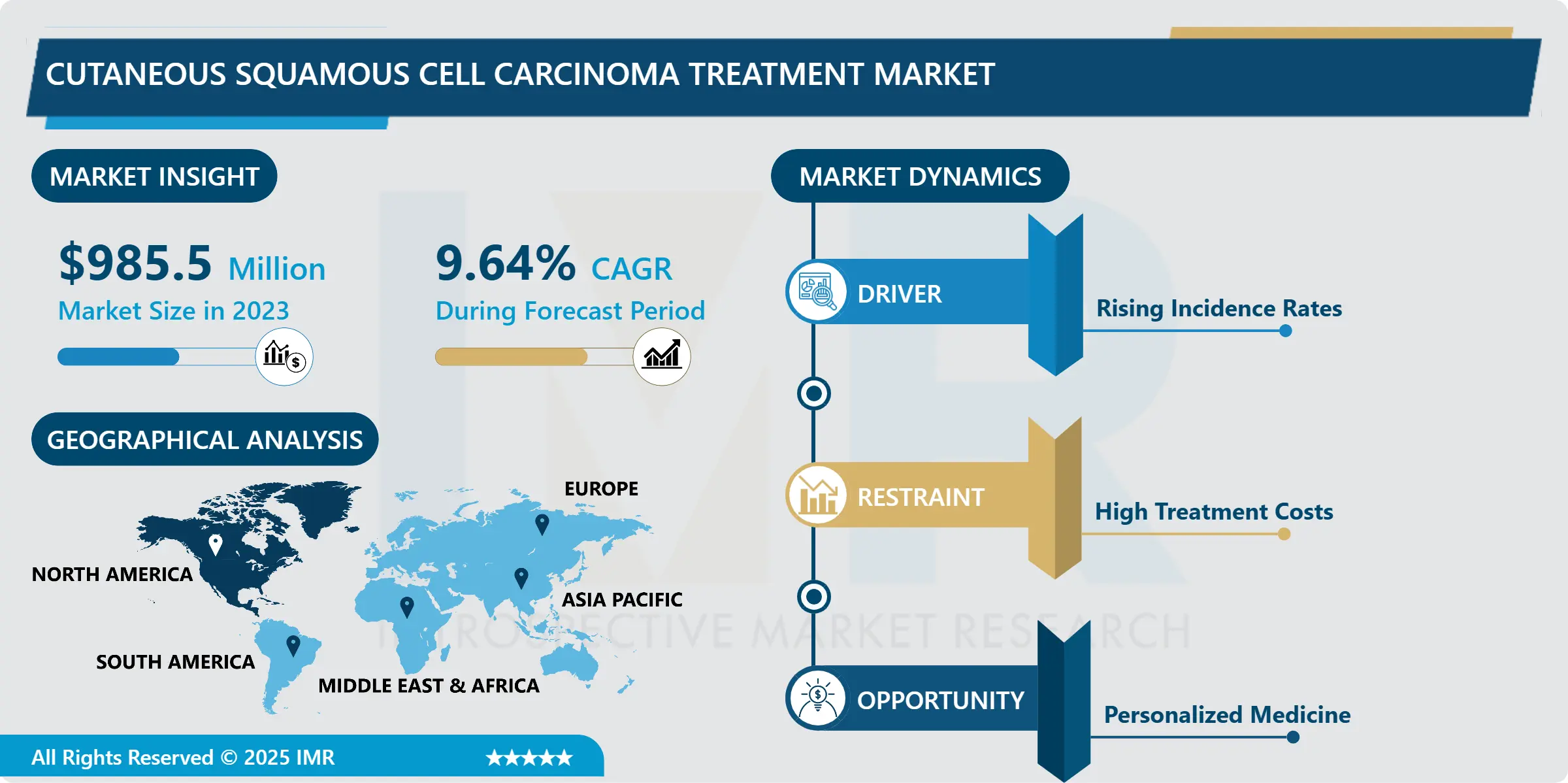
Cutaneous Squamous Cell Carcinoma Treatment Market Size Was Valued at USD 985.5 Million in 2023, and is Projected to Reach USD 2256.2 Million by 2032, Growing at a CAGR of 9.64% From 2024-2032.
The Cutaneous Squamous Cell Carcinoma (cSCC) Treatment Market refers to all the therapeutic options medical professional can offer cSCC, a type of skin cancer that develops in the epidermoid cells of the skin, such as surgery, systems, radiosurgery, immunotherapy that is in development.
The treatment of cutaneous squamous cell carcinoma, involving flesh colored and scaly growths on the skin, has been regarded as a promising market opportunity to invest in, regarding dermatological therapeutics globally, essentially because skin cancer is more and more frequently diagnosed and because research in dermatology have offered new therapeutic solutions for several types of skin diseases. Growing concern regarding deleterious impacts of UV rays together with enhanced global population age that is prone to skin malignancies has expanded the need for efficient therapies. However, advancement in technology has led to increase in the diagnosing techniques thus increasing cases of early diagnoses which again requires that treatments be unique and more specialized. This dynamic landscape is backed with increasing expenditure on R & D that intends to offer targeted therapy, which has indicated better clinical efficacy and less side reactions.
The options for cSCC management have evolved widely and include surgery, radiation therapy, systemic therapy, and currently immunotherapy. The primary treatment of localized cSCC has been surgery and Mohs micrographic surgery are considered the standard of care. However, more interest has been paid on systemic therapy including targeted drugs and immune checkpoint inhibitors in the advanced or metastatic setting. Monoclonal antibodies and small molecule inhibitors are two major classes of biologics and small molecules that biopharmaceutical industry is now looking at as the potential in-clination for the cSCC stages. These changes accompanied by good number of drugs in pipeline for clinical trials are expected to build up the therapeutic option and will lead to increase in overall survival rates and better quality of life of the patients.
Cutaneous Squamous Cell Carcinoma Treatment Market Trend Analysis:
Advances in Immunotherapy and Combination Therapies Driving Growth in cSCC Treatment
The treatment of advanced or metastatic cutaneous squamous cell carcinoma (cSCC), immunotherapies particularly immune checkpoint inhibitors like programmed cell death protein 1 (PD-1) and programmed cell death ligand 1 (PD-L1) inhibitors have revolutionalized the treatment paradigm. These therapies have been proved to be effective significant in increasing survival rate; this is good news to the patients who have severe type of the disease. These inhibitors have therefore assumed an indispensable role in the current management of cSCC because of their capacity to boost the immune system of the body to pin down cancerous cells. The marked improvement they have demonstrated has stimulated more research and development of other extended treatment methods that provide better results to patients.
Apart from a distinct immunotherapy, the increasing numbers of combinations change the tendencies within the cSCC treatment. The combination of immunotherapy to traditional treatments that include surgery or radiation brings about a combined effect of improving the treatment outcome and the performance status of the patient. Altogether such improvements in the sphere linked with the earlier diagnostics and the opportunities brought by therapeutic practices also contribute to the market progress. The perception of diverse innovative possibilities by healthcare providar and patients keeps on increasing and thus the need for appropriate, efficient treatment modalities.
Advancing Immunotherapy and Personalized Medicine in cSCC Treatment
Immune modulation therapy, especially immunotherapeutic agents such as anti-PD-1 and anti-CTLA-4 monoclonal antibodies in patients with cSCC. These therapies have further great promise in boosting immunity to attack cancer cells especially in the current complex and metastatic cancers where the normal therapies are ineffective. The usefulness of those agents has been confirmed through studies with human participants, which makes them more often used as an important element of the treatment plan of cSCC. From this perspective, one can make the conclusion that these serves should remain priorities in combating this emergent health issue given their impact towards increasing survival and quality of life among the patients.
The promise of immuno-oncology continuing to move forward is also supported by clinical trials which are currently underway to identify other possible synergistic combinations with immune checkpoint inhibitors and chemotherapy, radiation and targeted therapy. This integration will make a call to advance the therapeutic results and decrease the therapeutic complications. However, it is obvious that the progressive shift of cSCC treatment has brought significant change on the development of biomarker-based personalized medicine. Such therapies are not only more effective than the traditional standard medical treatments or chemotherapy but also free from many unwanted side effects since the patients are treated according to their genetic and molecular makeup. As these factors come into play, there has been enhanced research on the development of better treatments, innovation is being stimulated as well as the hastened popularity of new therapies in the market.
Cutaneous Squamous Cell Carcinoma Treatment Market Segment Analysis:
Cutaneous Squamous Cell Carcinoma Treatment Market is Segmented on the basis of By Treatment Type, End-User, and Region.
By Treatment Type, Surgical Treatments segment is expected to dominate the market during the forecast period
Surgical interventions are medical procedures involving the cutting, reshaping, or repositioning of tissues or organs for the treatment of disease. The other surgical procedures in the dermatological and skin cancer management are excision, Mohs micrographic surgery, cryosurgery, and laser surgery. These procedures are aimed at eradicating the tumor, any irregular skin cells or lesion; so that after histological examination, there will be confidence that they are not cancerous and therefore the chances of them reemerging is minimal. Surgical treatments are normally considered for early-stage skin cancer, since these methods allow the surgeon to operate on the affected vicinity and demonstrate a high degree of exactness in terms of area removal. The course of recovery depends with the type of surgery and the general health status of the individual and some factors the following factors; wound management and postoperative care are very important in determining the length of recovery process.
The procedures that take place in the operating room offer a cure for skin cancer as the doctor surgically removes the cancerous skin cells. The excision is basically a simple surgery where the tumor is removed, along with a small amount of healthy tissue in order to get well demarcated margins. Mohs micrographic surgery, in turn, is a more effective method as the cancerous tissue is removed in layers while the healthy cells are left mostly unaffected making it suitable for cancers developing in areas, such as the face. Cryotherapy employs very low temperatures to freeze cells and obliterate the abnormal ones while laser therapy employs light radiation to excise tumors much as one would use a laser cutter on wood.
By End-User, Hospitals segment expected to held the largest share
Community hospitals are crucial in delivering total skin cancer services because of the services and services offered by professional care providers. They have well-equipped surgical theatre; radiation therapy machinery; endoscopic and ultrasound facilities; and histopathological lab for diagnosis and treatment of diverse skin malignancies. The administration of hospitals also embraces a blend of treatment procedures including surgeries, radiation therapies, systemic therapies and photodynamic therapy (PDT). This approach is important in the management of later stage skin cancers that might need a combination of modalities in order to achieve an optimal result. Availability and the strict implementation of professional rules and guidelines by different experienced oncologists, dermatologists, radiologists, and other supporting personnel guarantee that patients will always be given consistent and quality healthcare treatment during diagnosis, through treatment procedures and even after the treatment is done.
The hospital environment offers a concept where patients can receive early and ongoing treatment, follow-up and monitoring for the emergence of side effects after the treatment. These include day 8, 15, and 22 post operation, as well as weekly for the next 4 weeks and then every 2 weeks for the first 3 months after the surgery Furthermore, continued follow-up is needed for the management of possible complications and side effects as well as assessment of the outcome of interventions in the advanced skin cancers. The physical facilities in the hospitals enhance complex diagnostic procedures and enhanced surgical procedures to guarantee that patients gain the appropriate treatment methods that meet their needs. This is because a hospital environment enables the quick access to specialized methods, which is more important for skin cancer patients as most of them may require several units of treatments. There is indication that such an approach to managing patients enhances better patients’ status and quality of life.
Cutaneous Squamous Cell Carcinoma Treatment Market Regional Insights:
North America is Expected to Dominate the Market Over the Forecast period
In North America, this market for treatment of Cutaneous Squamous Cell Carcinoma (CSCC) holds a strong potential especially because of the high prevalence of skin cancer in this region indicative of an unmet clinical need. The United States and Canada specifically reflect comparatively higher development of healthcare systems and large healthcare spending that contribute to the manufacturing and delivery of new therapeutic measures to CSCC. This is augmented with the growing concern amongst the population about the onset of the diseases and the favourable environment being created to support the market. Furthermore, the increased elderly population in North America is another driving factor to the market because the elders are more vulnerable to skin cancer by exposure to the sun for many years. This age demographics added to an overall increased focus on preventative care is leading to the use of more innovative therapies, which in turn is sure to aid the expansion of the CSCC treatment market in the region.
Further, owing to lifestyle and climate conditions in North America, risk factors like excessive sun exposure are easily found among the population that also significantly boost the market growth. Skin cancer prevention campaigns, and public health approaches also add on the degree of awareness of early detection and treatment campaigns. Immunotherapy and targeted therapies used in serving CSCC are of special importance together with the progress in dermatological treatments for meeting the increasing requirements. Therefore, the NA market is still important for CSCC treatment development due to both the growing number of patients and the active approach to healthcare.
Active Key Players in the Cutaneous Squamous Cell Carcinoma Treatment Market:
Regeneron Pharmaceuticals and Sanofi
Merck & Co
Amgen
Eli Lilly
Mohs Surgery Centers
Other Active Players
Chapter 1: Introduction
1.1 Scope and Coverage
Chapter 2:Executive Summary
Chapter 3: Market Landscape
3.1 Market Dynamics
3.1.1 Drivers
3.1.2 Restraints
3.1.3 Opportunities
3.1.4 Challenges
3.2 Market Trend Analysis
3.3 PESTLE Analysis
3.4 Porter’s Five Forces Analysis
3.5 Industry Value Chain Analysis
3.6 Ecosystem
3.7 Regulatory Landscape
3.8 Price Trend Analysis
3.9 Patent Analysis
3.10 Technology Evolution
3.11 Investment Pockets
3.12 Import-Export Analysis
Chapter 4: Cutaneous Squamous Cell Carcinoma Treatment Market by Treatment Type
4.1 Cutaneous Squamous Cell Carcinoma Treatment Market Snapshot and Growth Engine
4.2 Cutaneous Squamous Cell Carcinoma Treatment Market Overview
4.3 Surgical Treatments
4.3.1 Introduction and Market Overview
4.3.2 Historic and Forecasted Market Size in Value USD and Volume Units (2017-2032F)
4.3.3 Key Market Trends, Growth Factors and Opportunities
4.3.4 Surgical Treatments: Geographic Segmentation Analysis
4.4 Radiation Therapy
4.4.1 Introduction and Market Overview
4.4.2 Historic and Forecasted Market Size in Value USD and Volume Units (2017-2032F)
4.4.3 Key Market Trends, Growth Factors and Opportunities
4.4.4 Radiation Therapy: Geographic Segmentation Analysis
4.5 Systemic Therapies
4.5.1 Introduction and Market Overview
4.5.2 Historic and Forecasted Market Size in Value USD and Volume Units (2017-2032F)
4.5.3 Key Market Trends, Growth Factors and Opportunities
4.5.4 Systemic Therapies: Geographic Segmentation Analysis
4.6 Topical Therapies and Photodynamic Therapy
4.6.1 Introduction and Market Overview
4.6.2 Historic and Forecasted Market Size in Value USD and Volume Units (2017-2032F)
4.6.3 Key Market Trends, Growth Factors and Opportunities
4.6.4 Topical Therapies and Photodynamic Therapy: Geographic Segmentation Analysis
Chapter 5: Cutaneous Squamous Cell Carcinoma Treatment Market by End-User
5.1 Cutaneous Squamous Cell Carcinoma Treatment Market Snapshot and Growth Engine
5.2 Cutaneous Squamous Cell Carcinoma Treatment Market Overview
5.3 Hospitals
5.3.1 Introduction and Market Overview
5.3.2 Historic and Forecasted Market Size in Value USD and Volume Units (2017-2032F)
5.3.3 Key Market Trends, Growth Factors and Opportunities
5.3.4 Hospitals: Geographic Segmentation Analysis
5.4 Specialty Clinics
5.4.1 Introduction and Market Overview
5.4.2 Historic and Forecasted Market Size in Value USD and Volume Units (2017-2032F)
5.4.3 Key Market Trends, Growth Factors and Opportunities
5.4.4 Specialty Clinics: Geographic Segmentation Analysis
5.5 Ambulatory Surgical Centers (ASCs) and Homecare Settings
5.5.1 Introduction and Market Overview
5.5.2 Historic and Forecasted Market Size in Value USD and Volume Units (2017-2032F)
5.5.3 Key Market Trends, Growth Factors and Opportunities
5.5.4 Ambulatory Surgical Centers (ASCs) and Homecare Settings: Geographic Segmentation Analysis
Chapter 6: Company Profiles and Competitive Analysis
6.1 Competitive Landscape
6.1.1 Competitive Benchmarking
6.1.2 Cutaneous Squamous Cell Carcinoma Treatment Market Share by Manufacturer (2023)
6.1.3 Industry BCG Matrix
6.1.4 Heat Map Analysis
6.1.5 Mergers and Acquisitions
6.2 REGENERON PHARMACEUTICALS AND SANOFI
6.2.1 Company Overview
6.2.2 Key Executives
6.2.3 Company Snapshot
6.2.4 Role of the Company in the Market
6.2.5 Sustainability and Social Responsibility
6.2.6 Operating Business Segments
6.2.7 Product Portfolio
6.2.8 Business Performance
6.2.9 Key Strategic Moves and Recent Developments
6.2.10 SWOT Analysis
6.3 MERCK & CO
6.4 AMGEN
6.5 ELI LILLY
6.6 MOHS SURGERY CENTERS
6.7 OTHER ACTIVE PLAYERS
Chapter 7: Global Cutaneous Squamous Cell Carcinoma Treatment Market By Region
7.1 Overview
7.2. North America Cutaneous Squamous Cell Carcinoma Treatment Market
7.2.1 Key Market Trends, Growth Factors and Opportunities
7.2.2 Top Key Companies
7.2.3 Historic and Forecasted Market Size by Segments
7.2.4 Historic and Forecasted Market Size By Treatment Type
7.2.4.1 Surgical Treatments
7.2.4.2 Radiation Therapy
7.2.4.3 Systemic Therapies
7.2.4.4 Topical Therapies and Photodynamic Therapy
7.2.5 Historic and Forecasted Market Size By End-User
7.2.5.1 Hospitals
7.2.5.2 Specialty Clinics
7.2.5.3 Ambulatory Surgical Centers (ASCs) and Homecare Settings
7.2.6 Historic and Forecast Market Size by Country
7.2.6.1 US
7.2.6.2 Canada
7.2.6.3 Mexico
7.3. Eastern Europe Cutaneous Squamous Cell Carcinoma Treatment Market
7.3.1 Key Market Trends, Growth Factors and Opportunities
7.3.2 Top Key Companies
7.3.3 Historic and Forecasted Market Size by Segments
7.3.4 Historic and Forecasted Market Size By Treatment Type
7.3.4.1 Surgical Treatments
7.3.4.2 Radiation Therapy
7.3.4.3 Systemic Therapies
7.3.4.4 Topical Therapies and Photodynamic Therapy
7.3.5 Historic and Forecasted Market Size By End-User
7.3.5.1 Hospitals
7.3.5.2 Specialty Clinics
7.3.5.3 Ambulatory Surgical Centers (ASCs) and Homecare Settings
7.3.6 Historic and Forecast Market Size by Country
7.3.6.1 Russia
7.3.6.2 Bulgaria
7.3.6.3 The Czech Republic
7.3.6.4 Hungary
7.3.6.5 Poland
7.3.6.6 Romania
7.3.6.7 Rest of Eastern Europe
7.4. Western Europe Cutaneous Squamous Cell Carcinoma Treatment Market
7.4.1 Key Market Trends, Growth Factors and Opportunities
7.4.2 Top Key Companies
7.4.3 Historic and Forecasted Market Size by Segments
7.4.4 Historic and Forecasted Market Size By Treatment Type
7.4.4.1 Surgical Treatments
7.4.4.2 Radiation Therapy
7.4.4.3 Systemic Therapies
7.4.4.4 Topical Therapies and Photodynamic Therapy
7.4.5 Historic and Forecasted Market Size By End-User
7.4.5.1 Hospitals
7.4.5.2 Specialty Clinics
7.4.5.3 Ambulatory Surgical Centers (ASCs) and Homecare Settings
7.4.6 Historic and Forecast Market Size by Country
7.4.6.1 Germany
7.4.6.2 UK
7.4.6.3 France
7.4.6.4 The Netherlands
7.4.6.5 Italy
7.4.6.6 Spain
7.4.6.7 Rest of Western Europe
7.5. Asia Pacific Cutaneous Squamous Cell Carcinoma Treatment Market
7.5.1 Key Market Trends, Growth Factors and Opportunities
7.5.2 Top Key Companies
7.5.3 Historic and Forecasted Market Size by Segments
7.5.4 Historic and Forecasted Market Size By Treatment Type
7.5.4.1 Surgical Treatments
7.5.4.2 Radiation Therapy
7.5.4.3 Systemic Therapies
7.5.4.4 Topical Therapies and Photodynamic Therapy
7.5.5 Historic and Forecasted Market Size By End-User
7.5.5.1 Hospitals
7.5.5.2 Specialty Clinics
7.5.5.3 Ambulatory Surgical Centers (ASCs) and Homecare Settings
7.5.6 Historic and Forecast Market Size by Country
7.5.6.1 China
7.5.6.2 India
7.5.6.3 Japan
7.5.6.4 South Korea
7.5.6.5 Malaysia
7.5.6.6 Thailand
7.5.6.7 Vietnam
7.5.6.8 The Philippines
7.5.6.9 Australia
7.5.6.10 New Zealand
7.5.6.11 Rest of APAC
7.6. Middle East & Africa Cutaneous Squamous Cell Carcinoma Treatment Market
7.6.1 Key Market Trends, Growth Factors and Opportunities
7.6.2 Top Key Companies
7.6.3 Historic and Forecasted Market Size by Segments
7.6.4 Historic and Forecasted Market Size By Treatment Type
7.6.4.1 Surgical Treatments
7.6.4.2 Radiation Therapy
7.6.4.3 Systemic Therapies
7.6.4.4 Topical Therapies and Photodynamic Therapy
7.6.5 Historic and Forecasted Market Size By End-User
7.6.5.1 Hospitals
7.6.5.2 Specialty Clinics
7.6.5.3 Ambulatory Surgical Centers (ASCs) and Homecare Settings
7.6.6 Historic and Forecast Market Size by Country
7.6.6.1 Turkiye
7.6.6.2 Bahrain
7.6.6.3 Kuwait
7.6.6.4 Saudi Arabia
7.6.6.5 Qatar
7.6.6.6 UAE
7.6.6.7 Israel
7.6.6.8 South Africa
7.7. South America Cutaneous Squamous Cell Carcinoma Treatment Market
7.7.1 Key Market Trends, Growth Factors and Opportunities
7.7.2 Top Key Companies
7.7.3 Historic and Forecasted Market Size by Segments
7.7.4 Historic and Forecasted Market Size By Treatment Type
7.7.4.1 Surgical Treatments
7.7.4.2 Radiation Therapy
7.7.4.3 Systemic Therapies
7.7.4.4 Topical Therapies and Photodynamic Therapy
7.7.5 Historic and Forecasted Market Size By End-User
7.7.5.1 Hospitals
7.7.5.2 Specialty Clinics
7.7.5.3 Ambulatory Surgical Centers (ASCs) and Homecare Settings
7.7.6 Historic and Forecast Market Size by Country
7.7.6.1 Brazil
7.7.6.2 Argentina
7.7.6.3 Rest of SA
Chapter 8 Analyst Viewpoint and Conclusion
8.1 Recommendations and Concluding Analysis
8.2 Potential Market Strategies
Chapter 9 Research Methodology
9.1 Research Process
9.2 Primary Research
9.3 Secondary Research
Q1: What would be the forecast period in the Cutaneous Squamous Cell Carcinoma Treatment Market research report?
A1: The forecast period in the Market research report is 2024-2032.
Q2: Who are the key players in the Cutaneous Squamous Cell Carcinoma Treatment Market?
A2: Regeneron Pharmaceuticals and Sanofi, Merck & Co, Amgen, Eli Lilly, Mohs Surgery Centers and Other Major Players.
Q3: What are the segments of the Cutaneous Squamous Cell Carcinoma Treatment Market?
A3: The Cutaneous Squamous Cell Carcinoma Treatment Market is segmented into By Treatment Type, By End-User and region. By Treatment Type, the market is categorized into Surgical Treatments, Radiation Therapy, Systemic Therapies, Topical Therapies and Photodynamic Therapy (PDT). By End-User, the market is categorized into Hospitals, Specialty Clinics, Ambulatory Surgical Centers (ASCs) and Homecare Settings. By region, it is analyzed across North America (U.S.; Canada; Mexico), Eastern Europe (Bulgaria; The Czech Republic; Hungary; Poland; Romania; Rest of Eastern Europe), Western Europe (Germany; UK; France; Netherlands; Italy; Russia; Spain; Rest of Western Europe), Asia-Pacific (China; India; Japan; Southeast Asia, etc.), South America (Brazil; Argentina, etc.), Middle East & Africa (Saudi Arabia; South Africa, etc.).
Q4: What is the Cutaneous Squamous Cell Carcinoma Treatment Market?
A4: The Cutaneous Squamous Cell Carcinoma (cSCC) Treatment Market refers to all the therapeutic options medical professional can offer cSCC, a type of skin cancer that develops in the epidermoid cells of the skin, such as surgery, systems, radiosurgery, immunotherapy that is in development.
Q5: How big is the Cutaneous Squamous Cell Carcinoma Treatment Market?
A5: Cutaneous Squamous Cell Carcinoma Treatment Market Size Was Valued at USD 985.5 Million in 2023, and is Projected to Reach USD 2256.2 Million by 2032, Growing at a CAGR of 9.64% From 2024-2032.
How to Buy a Report from eminsights.jp
On the product page, choose the license you want: Single-User License, Multi-User License or Enterprise License.
If you required report in your native language, then you can click on Translated Report button and fill out the form with report name and language you want, then our team will contact you as soon as possible.
Click the Buy Now button.
You will be redirected to the checkout page. Enter your company details and payment information.
Click Place Order to complete the purchase.
Confirmation: You’ll receive an order confirmation and our team will contact you shortly with your ordered report.
If you have any questions, fill out the contact form below or email us at bizdev@eminsights.net.
Thank you for choosing eminsights.jp!