Stay Ahead in Fast-Growing Economies.
Browse Reports Now
Cross Docking Services Market Size, Share, Growth & Forecast (2024-2032)
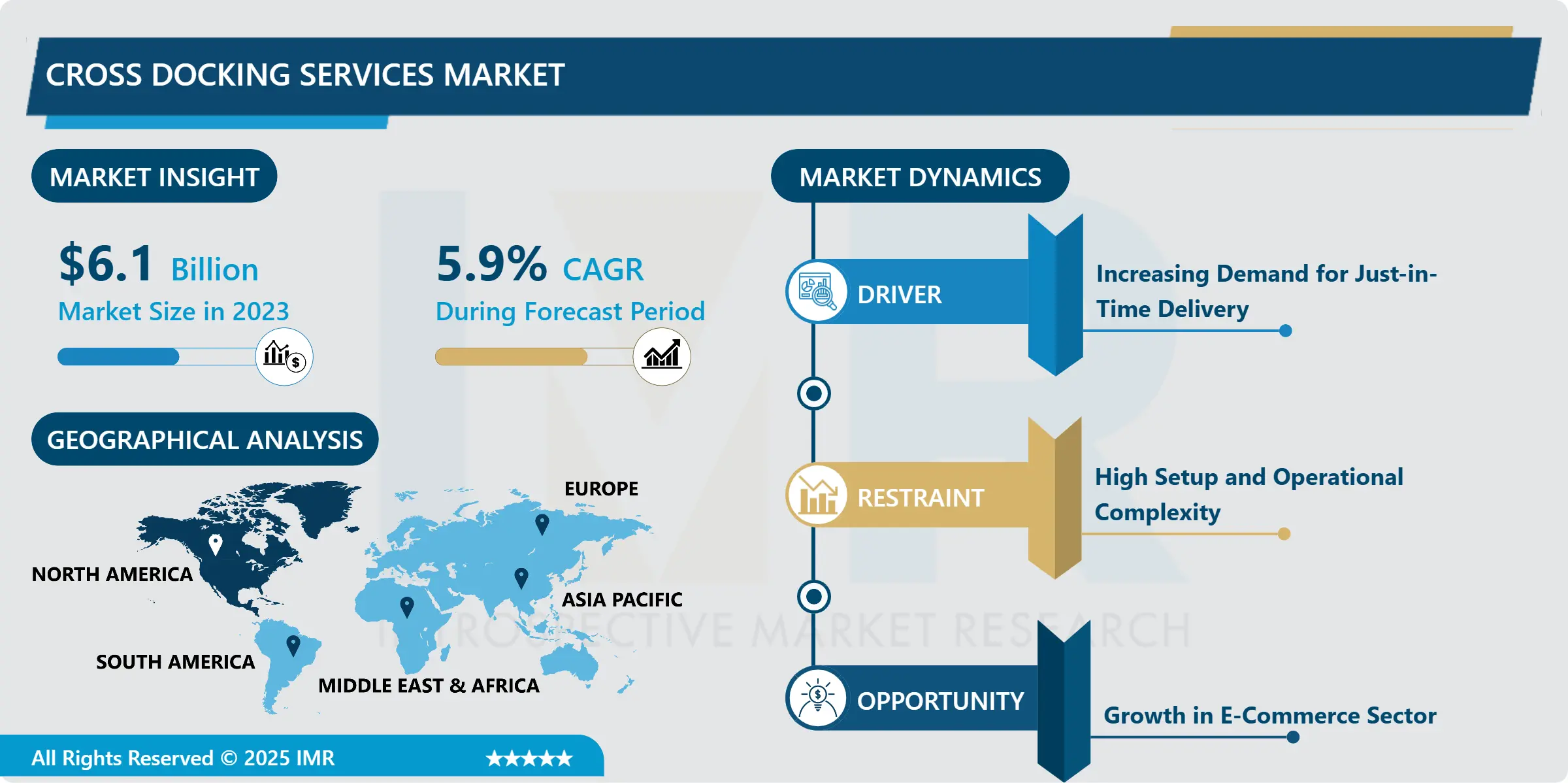
Cross Docking Services Market Size Was Valued at USD 6.1 Billion in 2023, and is Projected to Reach USD 10.2 Billion by 2032, Growing at a CAGR of 5.9% From 2024-2032.

IMR Group
Description
Cross Docking Services Market Synopsis:
Cross Docking Services Market Size Was Valued at USD 6.1 Billion in 2023, and is Projected to Reach USD 10.2 Billion by 2032, Growing at a CAGR of 5.9% From 2024-2032.
Cross docking services is a type of logistics process in which goods are transferred directly from incoming transportation to outgoing transportation with very little or no storage in between. This method increases efficiency because it reduces warehouse costs, shortens delivery times, and optimizes supply chain operations.
The practice is a fast logistics solution set up with the objective of reducing handlings and storage in a supply chain. It’s different from the warehousing system because the goods have to wait before they’re delivered, whereas cross-dock allows for the quick transfer between one form of transportation and another. And at such speeds, this is increasingly becoming an available solution for the retail trade; food and beverage, or even an e-commerce business.
Due to the growing demands for fast delivery services and the efficient management of the supply chain over the last few years, the markets for cross docking services are growing significantly. It includes the overall growth of e-commerce, new consumer expectations on same- or next-day delivery, and the urge to have lower-cost logistics. Automation of sortation, Internet of things integration, and real-time tracking increase cross docking even further. However, the market also faces challenges, including a high initial setup cost and reliance on precise coordination among supply chain stakeholders.
The increasing importance of agility and cost-cutting in industries is continuously changing the market for cross docking. Companies are investing in customized solutions that cater to specific verticals, such as healthcare and automotive, while also looking into sustainable practices like energy-efficient transport systems. The dual focus on speed and sustainability places cross docking at the heart of modern logistics.
Cross Docking Services Market Trend Analysis:
Integration of Advanced Technologies
Advanced integration of technologies like robotics, IoT, and AI can be seen to create smart cross-docking sites through automation. Automated sorters, guided robots, as well as real-time visibility systems, have dramatically lowered human error and improved output within the cross-docking yards. Artificial intelligence tools, on an example, can predict which lanes would be delayed and even manage to optimise resource usage as available on IoT devices that gives an actual time visibility for moving goods.
The company is capable of being efficient and processing more volumes of goods accurately. Moreover, automation cuts labour dependency and the eventual operational costs in the long run. Smart technologies, in general, are reshaping cross docking by giving a more agile and scalable form for such solutions to respond to growing demands across global supply chains.
Growth in E-Commerce Sector
The rapid expansion of the e-commerce sector presents a major opportunity for the cross-docking services market. With increasing consumer demand for faster and more cost-effective deliveries, online retailers are under pressure to streamline their supply chains. Cross docking offers an efficient solution by minimizing storage time and allowing goods to move directly from inbound to outbound transportation. This approach supports lean inventory management and accelerates order fulfillment, making it ideal for the fast-paced e-commerce environment. As a result, more retailers are adopting cross-docking strategies to enhance operational efficiency and meet growing customer expectations in a competitive market.
Cross Docking Services Market Segment Analysis:
Cross Docking Services Market Segmented on the basis of Service Type, Industry Vertical and Mode of Transportation.
By Service Type, Manufacturing Cross Docking segment is expected to dominate the market during the forecast period
The Manufacturing Cross Docking segment is expected to dominate the market during the forecast period. This type of cross docking is especially valuable in industries like automotive manufacturing, where various components from multiple suppliers are consolidated and delivered directly to the assembly line. It enhances production efficiency by reducing storage needs and improving inventory turnover. Unlike Distributor Cross Docking, which focuses on consolidating goods for streamlined delivery to retailers, Manufacturing Cross Docking supports just-in-time production models. Its ability to lower warehousing costs and accelerate production cycles makes it the preferred choice in manufacturing-driven supply chains.
By Industry Vertical, Retail segment expected to held the largest share
By industry vertical, the Retail segment is expected to hold the largest share in the Cross-Docking Services Market. Retailers face constant pressure to manage high product volumes, reduce delivery times, and control inventory costs. Cross docking enables them to streamline logistics by transferring goods directly from suppliers to outbound transportation with minimal storage. This approach supports just-in-time inventory, faster restocking, and lower warehousing expenses critical for meeting dynamic consumer demands. As e-commerce and omnichannel retailing expand, retailers increasingly adopt cross-docking strategies to enhance supply chain agility and customer satisfaction, driving significant growth in this segment of the market.
Cross Docking Services Market Regional Insights:
North America is Expected to Dominate the Market Over the Forecast period
The largest region for cross-docking services market is North America. Its infrastructure of advanced logistics, increasing e-commerce adoption, and greater emphasis on supply chain efficiency contribute to this reason. More advantages to the United States include having a bigger distribution center network as well as highly advanced technological facility.
The focus on sustainability and innovation in the region has attracted investment in automated and energy-efficient cross docking solutions. North America is a highly significant market for cross docking services on a global level because of the integration of leading technologies and growing demand for fast delivery services.
Active Key Players in the Cross-Docking Services Market:
XPO Logistics (USA)
Kuehne + Nagel (Switzerland)
DHL Supply Chain (Germany)
FedEx Supply Chain (USA)
C.H. Robinson (USA)
DB Schenker (Germany)
UPS Supply Chain Solutions (USA)
NFI Industries (USA)
GEODIS (France)
Ryder System, Inc. (USA)
Ceva Logistics (France)
Expeditors International (USA)
Other Active Players
Key Industry Developments in the Cross-Docking Services Market:
In November 2023, Maersk started building a big new cold storage place in Rotterdam, the Netherlands. This special warehouse, next to the Maasvlakte II terminal owned by Maersk’s APM Terminals, is 40,000 square meters and will start working in late 2024.
In October 2023, Samskip expanded its business in the Baltic Sea area by starting a new direct short-sea service between Finland, Latvia, the U.K., and the Netherlands. They will also provide extra services like help with customs and land transport to make sure things go smoothly from door to door.
In September 2023, C.H. Robinson opened one of the biggest logistics centers near the border in Laredo, Texas. This big place, which is 400,000 square feet and has 154 doors and space for 700 trailers, is meant to speed up trade between the U.S. and Mexico.
Chapter 1: Introduction
1.1 Scope and Coverage
Chapter 2:Executive Summary
Chapter 3: Market Landscape
3.1 Market Dynamics
3.1.1 Drivers
3.1.2 Restraints
3.1.3 Opportunities
3.1.4 Challenges
3.2 Market Trend Analysis
3.3 PESTLE Analysis
3.4 Porter’s Five Forces Analysis
3.5 Industry Value Chain Analysis
3.6 Ecosystem
3.7 Regulatory Landscape
3.8 Price Trend Analysis
3.9 Patent Analysis
3.10 Technology Evolution
3.11 Investment Pockets
3.12 Import-Export Analysis
Chapter 4: Cross Docking Services Market by Service Type
4.1 Cross Docking Services Market Snapshot and Growth Engine
4.2 Cross Docking Services Market Overview
4.3 Manufacturing Cross Docking
4.3.1 Introduction and Market Overview
4.3.2 Historic and Forecasted Market Size in Value USD and Volume Units (2017-2032F)
4.3.3 Key Market Trends, Growth Factors and Opportunities
4.3.4 Manufacturing Cross Docking: Geographic Segmentation Analysis
4.4 Distributor Cross Docking
4.4.1 Introduction and Market Overview
4.4.2 Historic and Forecasted Market Size in Value USD and Volume Units (2017-2032F)
4.4.3 Key Market Trends, Growth Factors and Opportunities
4.4.4 Distributor Cross Docking: Geographic Segmentation Analysis
4.5 Retail Cross Docking
4.5.1 Introduction and Market Overview
4.5.2 Historic and Forecasted Market Size in Value USD and Volume Units (2017-2032F)
4.5.3 Key Market Trends, Growth Factors and Opportunities
4.5.4 Retail Cross Docking: Geographic Segmentation Analysis
4.6 Transportation Cross Docking
4.6.1 Introduction and Market Overview
4.6.2 Historic and Forecasted Market Size in Value USD and Volume Units (2017-2032F)
4.6.3 Key Market Trends, Growth Factors and Opportunities
4.6.4 Transportation Cross Docking: Geographic Segmentation Analysis
Chapter 5: Cross Docking Services Market by Industry Vertical
5.1 Cross Docking Services Market Snapshot and Growth Engine
5.2 Cross Docking Services Market Overview
5.3 Retail
5.3.1 Introduction and Market Overview
5.3.2 Historic and Forecasted Market Size in Value USD and Volume Units (2017-2032F)
5.3.3 Key Market Trends, Growth Factors and Opportunities
5.3.4 Retail: Geographic Segmentation Analysis
5.4 Automotive
5.4.1 Introduction and Market Overview
5.4.2 Historic and Forecasted Market Size in Value USD and Volume Units (2017-2032F)
5.4.3 Key Market Trends, Growth Factors and Opportunities
5.4.4 Automotive: Geographic Segmentation Analysis
5.5 Food & Beverage
5.5.1 Introduction and Market Overview
5.5.2 Historic and Forecasted Market Size in Value USD and Volume Units (2017-2032F)
5.5.3 Key Market Trends, Growth Factors and Opportunities
5.5.4 Food & Beverage: Geographic Segmentation Analysis
5.6 Healthcare
5.6.1 Introduction and Market Overview
5.6.2 Historic and Forecasted Market Size in Value USD and Volume Units (2017-2032F)
5.6.3 Key Market Trends, Growth Factors and Opportunities
5.6.4 Healthcare: Geographic Segmentation Analysis
5.7 E-commerce
5.7.1 Introduction and Market Overview
5.7.2 Historic and Forecasted Market Size in Value USD and Volume Units (2017-2032F)
5.7.3 Key Market Trends, Growth Factors and Opportunities
5.7.4 E-commerce: Geographic Segmentation Analysis
5.8 Others
5.8.1 Introduction and Market Overview
5.8.2 Historic and Forecasted Market Size in Value USD and Volume Units (2017-2032F)
5.8.3 Key Market Trends, Growth Factors and Opportunities
5.8.4 Others: Geographic Segmentation Analysis
Chapter 6: Cross Docking Services Market by Mode of Transportation
6.1 Cross Docking Services Market Snapshot and Growth Engine
6.2 Cross Docking Services Market Overview
6.3 Railways
6.3.1 Introduction and Market Overview
6.3.2 Historic and Forecasted Market Size in Value USD and Volume Units (2017-2032F)
6.3.3 Key Market Trends, Growth Factors and Opportunities
6.3.4 Railways: Geographic Segmentation Analysis
6.4 Roadways
6.4.1 Introduction and Market Overview
6.4.2 Historic and Forecasted Market Size in Value USD and Volume Units (2017-2032F)
6.4.3 Key Market Trends, Growth Factors and Opportunities
6.4.4 Roadways: Geographic Segmentation Analysis
6.5 Airways
6.5.1 Introduction and Market Overview
6.5.2 Historic and Forecasted Market Size in Value USD and Volume Units (2017-2032F)
6.5.3 Key Market Trends, Growth Factors and Opportunities
6.5.4 Airways: Geographic Segmentation Analysis
6.6 Seaways
6.6.1 Introduction and Market Overview
6.6.2 Historic and Forecasted Market Size in Value USD and Volume Units (2017-2032F)
6.6.3 Key Market Trends, Growth Factors and Opportunities
6.6.4 Seaways: Geographic Segmentation Analysis
Chapter 7: Company Profiles and Competitive Analysis
7.1 Competitive Landscape
7.1.1 Competitive Benchmarking
7.1.2 Cross Docking Services Market Share by Manufacturer (2023)
7.1.3 Industry BCG Matrix
7.1.4 Heat Map Analysis
7.1.5 Mergers and Acquisitions
7.2 XPO LOGISTICS (USA)
7.2.1 Company Overview
7.2.2 Key Executives
7.2.3 Company Snapshot
7.2.4 Role of the Company in the Market
7.2.5 Sustainability and Social Responsibility
7.2.6 Operating Business Segments
7.2.7 Product Portfolio
7.2.8 Business Performance
7.2.9 Key Strategic Moves and Recent Developments
7.2.10 SWOT Analysis
7.3 KUEHNE + NAGEL (SWITZERLAND)
7.4 DHL SUPPLY CHAIN (GERMANY)
7.5 FEDEX SUPPLY CHAIN (USA)
7.6 C.H. ROBINSON (USA)
7.7 DB SCHENKER (GERMANY)
7.8 UPS SUPPLY CHAIN SOLUTIONS (USA)
7.9 NFI INDUSTRIES (USA)
7.10 GEODIS (FRANCE)
7.11 RYDER SYSTEM INC. (USA)
7.12 CEVA LOGISTICS (FRANCE)
7.13 EXPEDITORS INTERNATIONAL (USA)
7.14 OTHER ACTIVE PLAYERS
Chapter 8: Global Cross Docking Services Market By Region
8.1 Overview
8.2. North America Cross Docking Services Market
8.2.1 Key Market Trends, Growth Factors and Opportunities
8.2.2 Top Key Companies
8.2.3 Historic and Forecasted Market Size by Segments
8.2.4 Historic and Forecasted Market Size By Service Type
8.2.4.1 Manufacturing Cross Docking
8.2.4.2 Distributor Cross Docking
8.2.4.3 Retail Cross Docking
8.2.4.4 Transportation Cross Docking
8.2.5 Historic and Forecasted Market Size By Industry Vertical
8.2.5.1 Retail
8.2.5.2 Automotive
8.2.5.3 Food & Beverage
8.2.5.4 Healthcare
8.2.5.5 E-commerce
8.2.5.6 Others
8.2.6 Historic and Forecasted Market Size By Mode of Transportation
8.2.6.1 Railways
8.2.6.2 Roadways
8.2.6.3 Airways
8.2.6.4 Seaways
8.2.7 Historic and Forecast Market Size by Country
8.2.7.1 US
8.2.7.2 Canada
8.2.7.3 Mexico
8.3. Eastern Europe Cross Docking Services Market
8.3.1 Key Market Trends, Growth Factors and Opportunities
8.3.2 Top Key Companies
8.3.3 Historic and Forecasted Market Size by Segments
8.3.4 Historic and Forecasted Market Size By Service Type
8.3.4.1 Manufacturing Cross Docking
8.3.4.2 Distributor Cross Docking
8.3.4.3 Retail Cross Docking
8.3.4.4 Transportation Cross Docking
8.3.5 Historic and Forecasted Market Size By Industry Vertical
8.3.5.1 Retail
8.3.5.2 Automotive
8.3.5.3 Food & Beverage
8.3.5.4 Healthcare
8.3.5.5 E-commerce
8.3.5.6 Others
8.3.6 Historic and Forecasted Market Size By Mode of Transportation
8.3.6.1 Railways
8.3.6.2 Roadways
8.3.6.3 Airways
8.3.6.4 Seaways
8.3.7 Historic and Forecast Market Size by Country
8.3.7.1 Russia
8.3.7.2 Bulgaria
8.3.7.3 The Czech Republic
8.3.7.4 Hungary
8.3.7.5 Poland
8.3.7.6 Romania
8.3.7.7 Rest of Eastern Europe
8.4. Western Europe Cross Docking Services Market
8.4.1 Key Market Trends, Growth Factors and Opportunities
8.4.2 Top Key Companies
8.4.3 Historic and Forecasted Market Size by Segments
8.4.4 Historic and Forecasted Market Size By Service Type
8.4.4.1 Manufacturing Cross Docking
8.4.4.2 Distributor Cross Docking
8.4.4.3 Retail Cross Docking
8.4.4.4 Transportation Cross Docking
8.4.5 Historic and Forecasted Market Size By Industry Vertical
8.4.5.1 Retail
8.4.5.2 Automotive
8.4.5.3 Food & Beverage
8.4.5.4 Healthcare
8.4.5.5 E-commerce
8.4.5.6 Others
8.4.6 Historic and Forecasted Market Size By Mode of Transportation
8.4.6.1 Railways
8.4.6.2 Roadways
8.4.6.3 Airways
8.4.6.4 Seaways
8.4.7 Historic and Forecast Market Size by Country
8.4.7.1 Germany
8.4.7.2 UK
8.4.7.3 France
8.4.7.4 The Netherlands
8.4.7.5 Italy
8.4.7.6 Spain
8.4.7.7 Rest of Western Europe
8.5. Asia Pacific Cross Docking Services Market
8.5.1 Key Market Trends, Growth Factors and Opportunities
8.5.2 Top Key Companies
8.5.3 Historic and Forecasted Market Size by Segments
8.5.4 Historic and Forecasted Market Size By Service Type
8.5.4.1 Manufacturing Cross Docking
8.5.4.2 Distributor Cross Docking
8.5.4.3 Retail Cross Docking
8.5.4.4 Transportation Cross Docking
8.5.5 Historic and Forecasted Market Size By Industry Vertical
8.5.5.1 Retail
8.5.5.2 Automotive
8.5.5.3 Food & Beverage
8.5.5.4 Healthcare
8.5.5.5 E-commerce
8.5.5.6 Others
8.5.6 Historic and Forecasted Market Size By Mode of Transportation
8.5.6.1 Railways
8.5.6.2 Roadways
8.5.6.3 Airways
8.5.6.4 Seaways
8.5.7 Historic and Forecast Market Size by Country
8.5.7.1 China
8.5.7.2 India
8.5.7.3 Japan
8.5.7.4 South Korea
8.5.7.5 Malaysia
8.5.7.6 Thailand
8.5.7.7 Vietnam
8.5.7.8 The Philippines
8.5.7.9 Australia
8.5.7.10 New Zealand
8.5.7.11 Rest of APAC
8.6. Middle East & Africa Cross Docking Services Market
8.6.1 Key Market Trends, Growth Factors and Opportunities
8.6.2 Top Key Companies
8.6.3 Historic and Forecasted Market Size by Segments
8.6.4 Historic and Forecasted Market Size By Service Type
8.6.4.1 Manufacturing Cross Docking
8.6.4.2 Distributor Cross Docking
8.6.4.3 Retail Cross Docking
8.6.4.4 Transportation Cross Docking
8.6.5 Historic and Forecasted Market Size By Industry Vertical
8.6.5.1 Retail
8.6.5.2 Automotive
8.6.5.3 Food & Beverage
8.6.5.4 Healthcare
8.6.5.5 E-commerce
8.6.5.6 Others
8.6.6 Historic and Forecasted Market Size By Mode of Transportation
8.6.6.1 Railways
8.6.6.2 Roadways
8.6.6.3 Airways
8.6.6.4 Seaways
8.6.7 Historic and Forecast Market Size by Country
8.6.7.1 Turkiye
8.6.7.2 Bahrain
8.6.7.3 Kuwait
8.6.7.4 Saudi Arabia
8.6.7.5 Qatar
8.6.7.6 UAE
8.6.7.7 Israel
8.6.7.8 South Africa
8.7. South America Cross Docking Services Market
8.7.1 Key Market Trends, Growth Factors and Opportunities
8.7.2 Top Key Companies
8.7.3 Historic and Forecasted Market Size by Segments
8.7.4 Historic and Forecasted Market Size By Service Type
8.7.4.1 Manufacturing Cross Docking
8.7.4.2 Distributor Cross Docking
8.7.4.3 Retail Cross Docking
8.7.4.4 Transportation Cross Docking
8.7.5 Historic and Forecasted Market Size By Industry Vertical
8.7.5.1 Retail
8.7.5.2 Automotive
8.7.5.3 Food & Beverage
8.7.5.4 Healthcare
8.7.5.5 E-commerce
8.7.5.6 Others
8.7.6 Historic and Forecasted Market Size By Mode of Transportation
8.7.6.1 Railways
8.7.6.2 Roadways
8.7.6.3 Airways
8.7.6.4 Seaways
8.7.7 Historic and Forecast Market Size by Country
8.7.7.1 Brazil
8.7.7.2 Argentina
8.7.7.3 Rest of SA
Chapter 9 Analyst Viewpoint and Conclusion
9.1 Recommendations and Concluding Analysis
9.2 Potential Market Strategies
Chapter 10 Research Methodology
10.1 Research Process
10.2 Primary Research
10.3 Secondary Research
Q1: What would be the forecast period in the Cross-Docking Services Market research report?
A1: The forecast period in the Cross-Docking Services Market research report is 2024-2032.
Q2: Who are the key players in the Cross-Docking Services Market?
A2: XPO Logistics (USA), Kuehne + Nagel (Switzerland), DHL Supply Chain (Germany), FedEx Supply Chain (USA), C.H. Robinson (USA), DB Schenker (Germany), UPS Supply Chain Solutions (USA), NFI Industries (USA), GEODIS (France), Ryder System, Inc. (USA), Ceva Logistics (France), Expeditors International (USA), Other Active Players.
Q3: What are the segments of the Cross-Docking Services Market?
A3: The Cross-Docking Services Market is segmented into Service Type, Industry Vertical, Mode of Transportation and region. By Service Type, the market is categorized into Manufacturing Cross Docking, Distributor Cross Docking, Retail Cross Docking, Transportation Cross Docking. By Industry Vertical, the market is categorized into Retail, Automotive, Food & Beverage, Healthcare, E-commerce, Others. By Mode of Transportation, the market is categorized into Railways, Roadways, Airways, Seaways. By region, it is analyzed across North America (U.S.; Canada; Mexico), Eastern Europe (Bulgaria; The Czech Republic; Hungary; Poland; Romania; Rest of Eastern Europe), Western Europe (Germany; UK; France; Netherlands; Italy; Russia; Spain; Rest of Western Europe), Asia-Pacific (China; India; Japan; Southeast Asia, etc.), South America (Brazil; Argentina, etc.), Middle East & Africa (Saudi Arabia; South Africa, etc.).
Q4: What is the Cross-Docking Services Market?
A4: Cross docking services is a type of logistics process in which goods are transferred directly from incoming transportation to outgoing transportation with very little or no storage in between. This method increases efficiency because it reduces warehouse costs, shortens delivery times, and optimizes supply chain operations.
Q5: How big is the Cross-Docking Services Market?
A5: Cross Docking Services Market Size Was Valued at USD 6.1 Billion in 2023, and is Projected to Reach USD 10.2 Billion by 2032, Growing at a CAGR of 5.9% From 2024-2032.
How to Buy a Report from eminsights.jp
On the product page, choose the license you want: Single-User License, Multi-User License or Enterprise License.
If you required report in your native language, then you can click on Translated Report button and fill out the form with report name and language you want, then our team will contact you as soon as possible.
Click the Buy Now button.
You will be redirected to the checkout page. Enter your company details and payment information.
Click Place Order to complete the purchase.
Confirmation: You’ll receive an order confirmation and our team will contact you shortly with your ordered report.
If you have any questions, fill out the contact form below or email us at bizdev@eminsights.net.
Thank you for choosing eminsights.jp!