Stay Ahead in Fast-Growing Economies.
Browse Reports Now
Crohn’s Disease Treatment Market Trends, Analysis & Future Outlook (2024-2032)
The Crohn’s disease treatment market covers all types of therapies, drugs, surgical interventions, and nutritional approaches that will help manage the disease, a type of chronic inflammatory bowel disease that causes inflammation of the digestive tract. It is in reducing symptoms, inducing remission, and preventing the worsening of the disease to achieve a better quality of life for patients.

IMR Group
Description
Crohn’s Disease Treatment Market Synopsis:
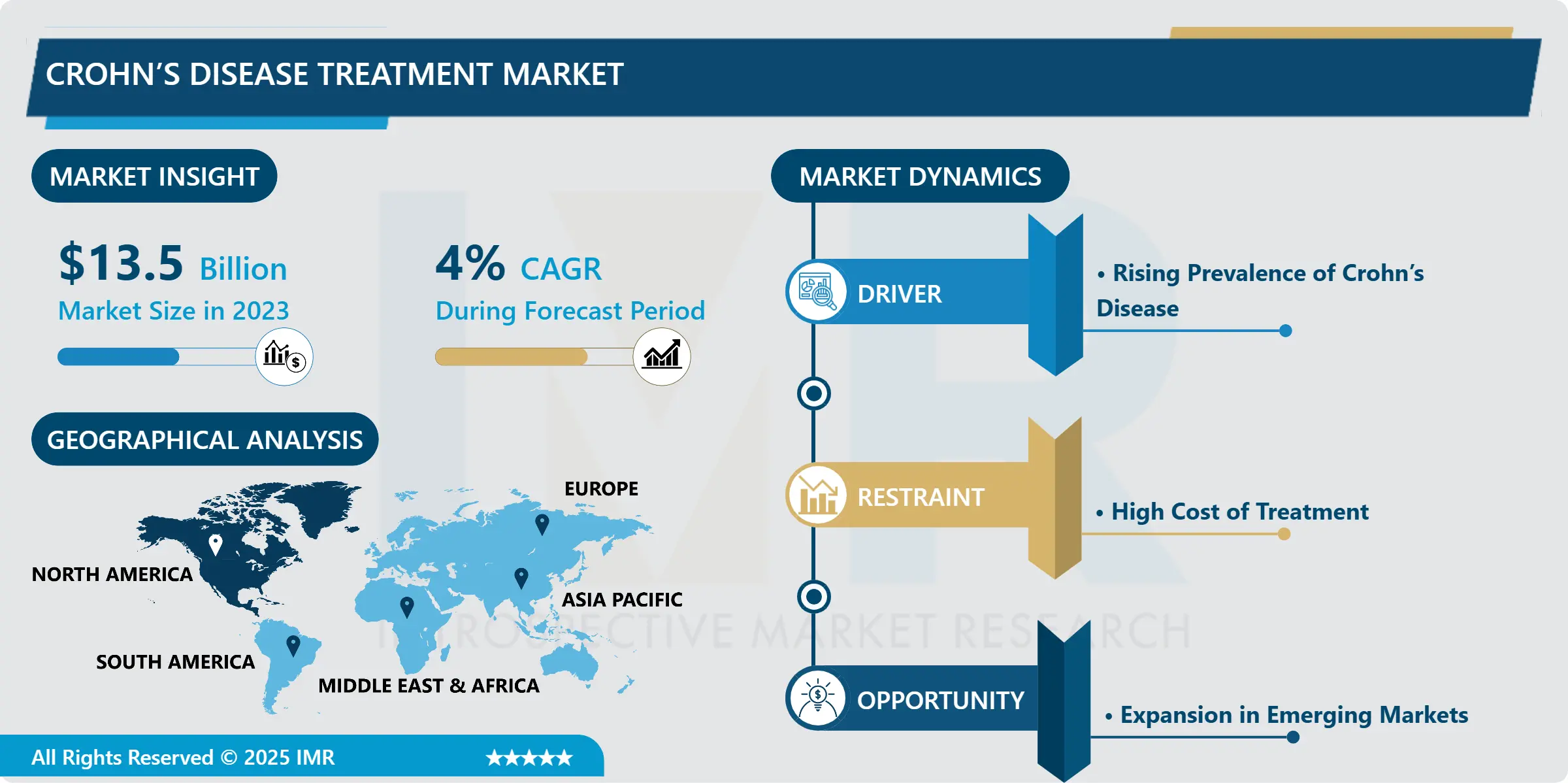
Crohn’s Disease Treatment Market Size Was Valued at USD 13.5 Billion in 2023, and is Projected to Reach USD 19.2 Billion by 2032, Growing at a CAGR of 4% From 2024-2032.
The Crohn’s disease treatment market covers all types of therapies, drugs, surgical interventions, and nutritional approaches that will help manage the disease, a type of chronic inflammatory bowel disease that causes inflammation of the digestive tract. It is in reducing symptoms, inducing remission, and preventing the worsening of the disease to achieve a better quality of life for patients.
Millions are affected by Crohn’s disease, which exhibits severe abdominal pain, diarrhea, fatigue, and weight loss among symptoms. Its cause is yet to be identified, but some cases are attributed to a predisposed genetic condition, immunity dysfunction, and environmental exposures. The market for treatment for Crohn’s disease has been growing rapidly over time, driven by a growth in the prevalence of disease, advances in biologic therapies, and heightened awareness of gastrointestinal disorders.
These strategies include pharmacological therapy with anti-inflammatory drugs, immunosuppressive drugs, antibiotics, and biologic therapies in the severe condition, there are also surgical and nutritional treatments. Given the need for each solution in every patient as the level of disease progression varies with that patient, the market is very dynamic and has high fragmentation. Personalized medicine and advanced biologics have shaped the future of the market growth. Telemedicine and digital health platforms also expand, creating space for innovative solutions in the improvement of disease management.
Crohn’s Disease Treatment Market Trend Analysis:
Growing Adoption of Biologic Therapies
Biologic therapy is now the cornerstone of Crohn’s disease treatment, by targeting specific points within the inflammation process. Advanced drugs, including TNF inhibitor, integrin inhibitor, and interleukin antagonist, demonstrate greater efficacy and improved control over the disease than traditional remedies do.
This is largely because of induction and maintenance of remission, the decrease in the hospitalization rates, and betterment of the quality of life in patients. Due to the continuous progression in the biotechnology fields, approvals for biosimilars are also increased; this would make access to the market as well as affordability through the better use of biologics. Many companies have invested very highly in next-generation biologics that promote this trend even further.
Expansion in Emerging Markets
Improving health care infrastructure and disease awareness has created ample scope for the Crohn’s Disease Treatment Market in emerging markets. With all these, the countries from Asia-Pacific, Latin America, and the Middle East region are now experiencing an increased rate of prevalence of Crohn’s disease due to urbanization, lifestyle changes, and improved diagnostic capabilities.
The governments and health care systems of these regions have focused on increasing access to biologics and immune-modulating therapies. The adoption of telemedicine and digital health also is growing in these regions, which is a great opportunity for the market players to increase their footprints and cater to this population’s unmet medical needs.
Crohn’s Disease Treatment Market Segment Analysis:
Crohn’s Disease Treatment Market Segmented on the basis of Treatment Type, Drug Class, Route of Administration, Distribution Channel, End User, and Region.
By Treatment Type, Anti-inflammatory Drugs segment is expected to dominate the market during the forecast period
Anti-inflammatory drugs and immune system suppressors remain as the first line of treatment and long-term management, antibiotics treat secondary infections, and nutritional therapy and surgery are used as an adjunct treatment wherein other treatments are not tolerated or complications set in that ensure holistic patient care.
This diversification of options ensures that treatment can be given to patients as their individual needs suit them best. Biologic therapies are most likely to expand much larger, while surgery continues to have stable demand for complex cases.
By End User, Hospitals segment expected to held the largest share
Hospitals are preferred in the end-user category since the management of the disease is complex and requires high-level equipment and multidisciplinary teams. Clinics are the preferred outpatient site and follow-up visit center because patients need to have frequent monitoring and medication titration.
These factors are driven by advancements in telehealth and remote monitoring, and there is indeed a growing preference for convenience and cost-effectiveness; patients are being cared for at home increasingly, primarily for nutritional therapy and also for medication administration.
Crohn’s Disease Treatment Market Regional Insights:
North America is Expected to Dominate the Market Over the Forecast period
North America dominated the Crohn’s Disease Treatment Market, primarily attributed to its advanced healthcare structure, high prevalence of IBD, and strong focus on research and development. Robust pharmaceutical industries in this region have helped in developing as well as commercializing the innovative therapies.
Positive reimbursement policies and increasing awareness about gastrointestinal disorders are driving the market. The participation of major players and adoption of biologics among the masses has further strengthened the North American position in the global market.
Active Key Players in the Crohn’s Disease Treatment Market:
AbbVie Inc. (United States)
Johnson & Johnson (Janssen Biotech) (United States)
Pfizer Inc. (United States)
Takeda Pharmaceutical Company Limited (Japan)
Eli Lilly and Company (United States)
Bristol-Myers Squibb (United States)
Amgen Inc. (United States)
UCB S.A. (Belgium)
Celltrion Healthcare (South Korea)
Roche Holding AG (Switzerland)
Novartis AG (Switzerland)
Biogen Inc. (United States)
Other Active Players
Chapter 1: Introduction
1.1 Scope and Coverage
Chapter 2:Executive Summary
Chapter 3: Market Landscape
3.1 Market Dynamics
3.1.1 Drivers
3.1.2 Restraints
3.1.3 Opportunities
3.1.4 Challenges
3.2 Market Trend Analysis
3.3 PESTLE Analysis
3.4 Porter’s Five Forces Analysis
3.5 Industry Value Chain Analysis
3.6 Ecosystem
3.7 Regulatory Landscape
3.8 Price Trend Analysis
3.9 Patent Analysis
3.10 Technology Evolution
3.11 Investment Pockets
3.12 Import-Export Analysis
Chapter 4: Crohn’s Disease Treatment Market by Treatment Type
4.1 Crohn’s Disease Treatment Market Snapshot and Growth Engine
4.2 Crohn’s Disease Treatment Market Overview
4.3 Anti-inflammatory Drugs
4.3.1 Introduction and Market Overview
4.3.2 Historic and Forecasted Market Size in Value USD and Volume Units (2017-2032F)
4.3.3 Key Market Trends, Growth Factors and Opportunities
4.3.4 Anti-inflammatory Drugs: Geographic Segmentation Analysis
4.4 Immune System Suppressors
4.4.1 Introduction and Market Overview
4.4.2 Historic and Forecasted Market Size in Value USD and Volume Units (2017-2032F)
4.4.3 Key Market Trends, Growth Factors and Opportunities
4.4.4 Immune System Suppressors: Geographic Segmentation Analysis
4.5 Antibiotics
4.5.1 Introduction and Market Overview
4.5.2 Historic and Forecasted Market Size in Value USD and Volume Units (2017-2032F)
4.5.3 Key Market Trends, Growth Factors and Opportunities
4.5.4 Antibiotics: Geographic Segmentation Analysis
4.6 Biologic Therapies
4.6.1 Introduction and Market Overview
4.6.2 Historic and Forecasted Market Size in Value USD and Volume Units (2017-2032F)
4.6.3 Key Market Trends, Growth Factors and Opportunities
4.6.4 Biologic Therapies: Geographic Segmentation Analysis
4.7 Surgery
4.7.1 Introduction and Market Overview
4.7.2 Historic and Forecasted Market Size in Value USD and Volume Units (2017-2032F)
4.7.3 Key Market Trends, Growth Factors and Opportunities
4.7.4 Surgery: Geographic Segmentation Analysis
4.8 Nutritional Therapy
4.8.1 Introduction and Market Overview
4.8.2 Historic and Forecasted Market Size in Value USD and Volume Units (2017-2032F)
4.8.3 Key Market Trends, Growth Factors and Opportunities
4.8.4 Nutritional Therapy: Geographic Segmentation Analysis
Chapter 5: Crohn’s Disease Treatment Market by Drug Class
5.1 Crohn’s Disease Treatment Market Snapshot and Growth Engine
5.2 Crohn’s Disease Treatment Market Overview
5.3 Aminosalicylates
5.3.1 Introduction and Market Overview
5.3.2 Historic and Forecasted Market Size in Value USD and Volume Units (2017-2032F)
5.3.3 Key Market Trends, Growth Factors and Opportunities
5.3.4 Aminosalicylates: Geographic Segmentation Analysis
5.4 Corticosteroids
5.4.1 Introduction and Market Overview
5.4.2 Historic and Forecasted Market Size in Value USD and Volume Units (2017-2032F)
5.4.3 Key Market Trends, Growth Factors and Opportunities
5.4.4 Corticosteroids: Geographic Segmentation Analysis
5.5 Immunomodulators
5.5.1 Introduction and Market Overview
5.5.2 Historic and Forecasted Market Size in Value USD and Volume Units (2017-2032F)
5.5.3 Key Market Trends, Growth Factors and Opportunities
5.5.4 Immunomodulators: Geographic Segmentation Analysis
5.6 TNF Inhibitors
5.6.1 Introduction and Market Overview
5.6.2 Historic and Forecasted Market Size in Value USD and Volume Units (2017-2032F)
5.6.3 Key Market Trends, Growth Factors and Opportunities
5.6.4 TNF Inhibitors: Geographic Segmentation Analysis
5.7 IL Inhibitors
5.7.1 Introduction and Market Overview
5.7.2 Historic and Forecasted Market Size in Value USD and Volume Units (2017-2032F)
5.7.3 Key Market Trends, Growth Factors and Opportunities
5.7.4 IL Inhibitors: Geographic Segmentation Analysis
Chapter 6: Crohn’s Disease Treatment Market by Route of Administration
6.1 Crohn’s Disease Treatment Market Snapshot and Growth Engine
6.2 Crohn’s Disease Treatment Market Overview
6.3 Oral
6.3.1 Introduction and Market Overview
6.3.2 Historic and Forecasted Market Size in Value USD and Volume Units (2017-2032F)
6.3.3 Key Market Trends, Growth Factors and Opportunities
6.3.4 Oral: Geographic Segmentation Analysis
6.4 Injectable
6.4.1 Introduction and Market Overview
6.4.2 Historic and Forecasted Market Size in Value USD and Volume Units (2017-2032F)
6.4.3 Key Market Trends, Growth Factors and Opportunities
6.4.4 Injectable: Geographic Segmentation Analysis
Chapter 7: Crohn’s Disease Treatment Market by Distribution Channel
7.1 Crohn’s Disease Treatment Market Snapshot and Growth Engine
7.2 Crohn’s Disease Treatment Market Overview
7.3 Hospital Pharmacies
7.3.1 Introduction and Market Overview
7.3.2 Historic and Forecasted Market Size in Value USD and Volume Units (2017-2032F)
7.3.3 Key Market Trends, Growth Factors and Opportunities
7.3.4 Hospital Pharmacies: Geographic Segmentation Analysis
7.4 Retail Pharmacies
7.4.1 Introduction and Market Overview
7.4.2 Historic and Forecasted Market Size in Value USD and Volume Units (2017-2032F)
7.4.3 Key Market Trends, Growth Factors and Opportunities
7.4.4 Retail Pharmacies: Geographic Segmentation Analysis
7.5 Online Pharmacies
7.5.1 Introduction and Market Overview
7.5.2 Historic and Forecasted Market Size in Value USD and Volume Units (2017-2032F)
7.5.3 Key Market Trends, Growth Factors and Opportunities
7.5.4 Online Pharmacies: Geographic Segmentation Analysis
Chapter 8: Crohn’s Disease Treatment Market by End User
8.1 Crohn’s Disease Treatment Market Snapshot and Growth Engine
8.2 Crohn’s Disease Treatment Market Overview
8.3 Hospitals
8.3.1 Introduction and Market Overview
8.3.2 Historic and Forecasted Market Size in Value USD and Volume Units (2017-2032F)
8.3.3 Key Market Trends, Growth Factors and Opportunities
8.3.4 Hospitals: Geographic Segmentation Analysis
8.4 Clinics
8.4.1 Introduction and Market Overview
8.4.2 Historic and Forecasted Market Size in Value USD and Volume Units (2017-2032F)
8.4.3 Key Market Trends, Growth Factors and Opportunities
8.4.4 Clinics: Geographic Segmentation Analysis
8.5 Homecare Settings
8.5.1 Introduction and Market Overview
8.5.2 Historic and Forecasted Market Size in Value USD and Volume Units (2017-2032F)
8.5.3 Key Market Trends, Growth Factors and Opportunities
8.5.4 Homecare Settings: Geographic Segmentation Analysis
Chapter 9: Company Profiles and Competitive Analysis
9.1 Competitive Landscape
9.1.1 Competitive Benchmarking
9.1.2 Crohn’s Disease Treatment Market Share by Manufacturer (2023)
9.1.3 Industry BCG Matrix
9.1.4 Heat Map Analysis
9.1.5 Mergers and Acquisitions
9.2 ABBVIE INC. (UNITED STATES)
9.2.1 Company Overview
9.2.2 Key Executives
9.2.3 Company Snapshot
9.2.4 Role of the Company in the Market
9.2.5 Sustainability and Social Responsibility
9.2.6 Operating Business Segments
9.2.7 Product Portfolio
9.2.8 Business Performance
9.2.9 Key Strategic Moves and Recent Developments
9.2.10 SWOT Analysis
9.3 JOHNSON & JOHNSON (JANSSEN BIOTECH) (UNITED STATES)
9.4 PFIZER INC. (UNITED STATES)
9.5 TAKEDA PHARMACEUTICAL COMPANY LIMITED (JAPAN)
9.6 ELI LILLY AND COMPANY (UNITED STATES)
9.7 BRISTOL-MYERS SQUIBB (UNITED STATES)
9.8 AMGEN INC. (UNITED STATES)
9.9 UCB S.A. (BELGIUM)
9.10 CELLTRION HEALTHCARE (SOUTH KOREA)
9.11 ROCHE HOLDING AG (SWITZERLAND)
9.12 NOVARTIS AG (SWITZERLAND)
9.13 BIOGEN INC. (UNITED STATES)
9.14 OTHER ACTIVE PLAYERS
Chapter 10: Global Crohn’s Disease Treatment Market By Region
10.1 Overview
10.2. North America Crohn’s Disease Treatment Market
10.2.1 Key Market Trends, Growth Factors and Opportunities
10.2.2 Top Key Companies
10.2.3 Historic and Forecasted Market Size by Segments
10.2.4 Historic and Forecasted Market Size By Treatment Type
10.2.4.1 Anti-inflammatory Drugs
10.2.4.2 Immune System Suppressors
10.2.4.3 Antibiotics
10.2.4.4 Biologic Therapies
10.2.4.5 Surgery
10.2.4.6 Nutritional Therapy
10.2.5 Historic and Forecasted Market Size By Drug Class
10.2.5.1 Aminosalicylates
10.2.5.2 Corticosteroids
10.2.5.3 Immunomodulators
10.2.5.4 TNF Inhibitors
10.2.5.5 IL Inhibitors
10.2.6 Historic and Forecasted Market Size By Route of Administration
10.2.6.1 Oral
10.2.6.2 Injectable
10.2.7 Historic and Forecasted Market Size By Distribution Channel
10.2.7.1 Hospital Pharmacies
10.2.7.2 Retail Pharmacies
10.2.7.3 Online Pharmacies
10.2.8 Historic and Forecasted Market Size By End User
10.2.8.1 Hospitals
10.2.8.2 Clinics
10.2.8.3 Homecare Settings
10.2.9 Historic and Forecast Market Size by Country
10.2.9.1 US
10.2.9.2 Canada
10.2.9.3 Mexico
10.3. Eastern Europe Crohn’s Disease Treatment Market
10.3.1 Key Market Trends, Growth Factors and Opportunities
10.3.2 Top Key Companies
10.3.3 Historic and Forecasted Market Size by Segments
10.3.4 Historic and Forecasted Market Size By Treatment Type
10.3.4.1 Anti-inflammatory Drugs
10.3.4.2 Immune System Suppressors
10.3.4.3 Antibiotics
10.3.4.4 Biologic Therapies
10.3.4.5 Surgery
10.3.4.6 Nutritional Therapy
10.3.5 Historic and Forecasted Market Size By Drug Class
10.3.5.1 Aminosalicylates
10.3.5.2 Corticosteroids
10.3.5.3 Immunomodulators
10.3.5.4 TNF Inhibitors
10.3.5.5 IL Inhibitors
10.3.6 Historic and Forecasted Market Size By Route of Administration
10.3.6.1 Oral
10.3.6.2 Injectable
10.3.7 Historic and Forecasted Market Size By Distribution Channel
10.3.7.1 Hospital Pharmacies
10.3.7.2 Retail Pharmacies
10.3.7.3 Online Pharmacies
10.3.8 Historic and Forecasted Market Size By End User
10.3.8.1 Hospitals
10.3.8.2 Clinics
10.3.8.3 Homecare Settings
10.3.9 Historic and Forecast Market Size by Country
10.3.9.1 Russia
10.3.9.2 Bulgaria
10.3.9.3 The Czech Republic
10.3.9.4 Hungary
10.3.9.5 Poland
10.3.9.6 Romania
10.3.9.7 Rest of Eastern Europe
10.4. Western Europe Crohn’s Disease Treatment Market
10.4.1 Key Market Trends, Growth Factors and Opportunities
10.4.2 Top Key Companies
10.4.3 Historic and Forecasted Market Size by Segments
10.4.4 Historic and Forecasted Market Size By Treatment Type
10.4.4.1 Anti-inflammatory Drugs
10.4.4.2 Immune System Suppressors
10.4.4.3 Antibiotics
10.4.4.4 Biologic Therapies
10.4.4.5 Surgery
10.4.4.6 Nutritional Therapy
10.4.5 Historic and Forecasted Market Size By Drug Class
10.4.5.1 Aminosalicylates
10.4.5.2 Corticosteroids
10.4.5.3 Immunomodulators
10.4.5.4 TNF Inhibitors
10.4.5.5 IL Inhibitors
10.4.6 Historic and Forecasted Market Size By Route of Administration
10.4.6.1 Oral
10.4.6.2 Injectable
10.4.7 Historic and Forecasted Market Size By Distribution Channel
10.4.7.1 Hospital Pharmacies
10.4.7.2 Retail Pharmacies
10.4.7.3 Online Pharmacies
10.4.8 Historic and Forecasted Market Size By End User
10.4.8.1 Hospitals
10.4.8.2 Clinics
10.4.8.3 Homecare Settings
10.4.9 Historic and Forecast Market Size by Country
10.4.9.1 Germany
10.4.9.2 UK
10.4.9.3 France
10.4.9.4 The Netherlands
10.4.9.5 Italy
10.4.9.6 Spain
10.4.9.7 Rest of Western Europe
10.5. Asia Pacific Crohn’s Disease Treatment Market
10.5.1 Key Market Trends, Growth Factors and Opportunities
10.5.2 Top Key Companies
10.5.3 Historic and Forecasted Market Size by Segments
10.5.4 Historic and Forecasted Market Size By Treatment Type
10.5.4.1 Anti-inflammatory Drugs
10.5.4.2 Immune System Suppressors
10.5.4.3 Antibiotics
10.5.4.4 Biologic Therapies
10.5.4.5 Surgery
10.5.4.6 Nutritional Therapy
10.5.5 Historic and Forecasted Market Size By Drug Class
10.5.5.1 Aminosalicylates
10.5.5.2 Corticosteroids
10.5.5.3 Immunomodulators
10.5.5.4 TNF Inhibitors
10.5.5.5 IL Inhibitors
10.5.6 Historic and Forecasted Market Size By Route of Administration
10.5.6.1 Oral
10.5.6.2 Injectable
10.5.7 Historic and Forecasted Market Size By Distribution Channel
10.5.7.1 Hospital Pharmacies
10.5.7.2 Retail Pharmacies
10.5.7.3 Online Pharmacies
10.5.8 Historic and Forecasted Market Size By End User
10.5.8.1 Hospitals
10.5.8.2 Clinics
10.5.8.3 Homecare Settings
10.5.9 Historic and Forecast Market Size by Country
10.5.9.1 China
10.5.9.2 India
10.5.9.3 Japan
10.5.9.4 South Korea
10.5.9.5 Malaysia
10.5.9.6 Thailand
10.5.9.7 Vietnam
10.5.9.8 The Philippines
10.5.9.9 Australia
10.5.9.10 New Zealand
10.5.9.11 Rest of APAC
10.6. Middle East & Africa Crohn’s Disease Treatment Market
10.6.1 Key Market Trends, Growth Factors and Opportunities
10.6.2 Top Key Companies
10.6.3 Historic and Forecasted Market Size by Segments
10.6.4 Historic and Forecasted Market Size By Treatment Type
10.6.4.1 Anti-inflammatory Drugs
10.6.4.2 Immune System Suppressors
10.6.4.3 Antibiotics
10.6.4.4 Biologic Therapies
10.6.4.5 Surgery
10.6.4.6 Nutritional Therapy
10.6.5 Historic and Forecasted Market Size By Drug Class
10.6.5.1 Aminosalicylates
10.6.5.2 Corticosteroids
10.6.5.3 Immunomodulators
10.6.5.4 TNF Inhibitors
10.6.5.5 IL Inhibitors
10.6.6 Historic and Forecasted Market Size By Route of Administration
10.6.6.1 Oral
10.6.6.2 Injectable
10.6.7 Historic and Forecasted Market Size By Distribution Channel
10.6.7.1 Hospital Pharmacies
10.6.7.2 Retail Pharmacies
10.6.7.3 Online Pharmacies
10.6.8 Historic and Forecasted Market Size By End User
10.6.8.1 Hospitals
10.6.8.2 Clinics
10.6.8.3 Homecare Settings
10.6.9 Historic and Forecast Market Size by Country
10.6.9.1 Turkiye
10.6.9.2 Bahrain
10.6.9.3 Kuwait
10.6.9.4 Saudi Arabia
10.6.9.5 Qatar
10.6.9.6 UAE
10.6.9.7 Israel
10.6.9.8 South Africa
10.7. South America Crohn’s Disease Treatment Market
10.7.1 Key Market Trends, Growth Factors and Opportunities
10.7.2 Top Key Companies
10.7.3 Historic and Forecasted Market Size by Segments
10.7.4 Historic and Forecasted Market Size By Treatment Type
10.7.4.1 Anti-inflammatory Drugs
10.7.4.2 Immune System Suppressors
10.7.4.3 Antibiotics
10.7.4.4 Biologic Therapies
10.7.4.5 Surgery
10.7.4.6 Nutritional Therapy
10.7.5 Historic and Forecasted Market Size By Drug Class
10.7.5.1 Aminosalicylates
10.7.5.2 Corticosteroids
10.7.5.3 Immunomodulators
10.7.5.4 TNF Inhibitors
10.7.5.5 IL Inhibitors
10.7.6 Historic and Forecasted Market Size By Route of Administration
10.7.6.1 Oral
10.7.6.2 Injectable
10.7.7 Historic and Forecasted Market Size By Distribution Channel
10.7.7.1 Hospital Pharmacies
10.7.7.2 Retail Pharmacies
10.7.7.3 Online Pharmacies
10.7.8 Historic and Forecasted Market Size By End User
10.7.8.1 Hospitals
10.7.8.2 Clinics
10.7.8.3 Homecare Settings
10.7.9 Historic and Forecast Market Size by Country
10.7.9.1 Brazil
10.7.9.2 Argentina
10.7.9.3 Rest of SA
Chapter 11 Analyst Viewpoint and Conclusion
11.1 Recommendations and Concluding Analysis
11.2 Potential Market Strategies
Chapter 12 Research Methodology
12.1 Research Process
12.2 Primary Research
12.3 Secondary Research
Q1: What would be the forecast period in the Crohn’s Disease Treatment Market research report?
A1: The forecast period in the Crohn’s Disease Treatment Market research report is 2024-2032.
Q2: Who are the key players in the Crohn’s Disease Treatment Market?
A2: AbbVie Inc. (United States), Johnson & Johnson (Janssen Biotech) (United States), Pfizer Inc. (United States), Takeda Pharmaceutical Company Limited (Japan), Eli Lilly and Company (United States), Bristol-Myers Squibb (United States), Amgen Inc. (United States), UCB S.A. (Belgium), Celltrion Healthcare (South Korea), Roche Holding AG (Switzerland), Novartis AG (Switzerland), Biogen Inc. (United States), Other Active Players.
Q3: What are the segments of the Crohn’s Disease Treatment Market?
A3: The Crohn’s Disease Treatment Market is segmented into Treatment Type, Drug Class, Route of Administration, Distribution Channel, End User and region. By Treatment Type, the market is categorized into Anti-inflammatory Drugs, Immune System Suppressors, Antibiotics, Biologic Therapies, Surgery, Nutritional Therapy. By Drug Class, the market is categorized into Aminosalicylates, Corticosteroids, Immunomodulators, TNF Inhibitors, IL Inhibitors. By Route of Administration, the market is categorized into Oral, Injectable. By Distribution Channel, the market is categorized into Hospital Pharmacies, Retail Pharmacies, Online Pharmacies. By End User, the market is categorized into Hospitals,Clinics, Homecare Settings. By region, it is analyzed across North America (U.S.; Canada; Mexico), Eastern Europe (Russia; Bulgaria; The Czech Republic; Hungary; Poland; Romania; Rest of Eastern Europe), Western Europe (Germany; UK; France; Netherlands; Italy; Spain; Rest of Western Europe), Asia-Pacific (China; India; Japan; Southeast Asia, etc.), South America (Brazil; Argentina, etc.), Middle East & Africa (Saudi Arabia; South Africa, etc.).
Q4: What is the Crohn’s Disease Treatment Market?
A4: The Crohn's disease treatment market covers all types of therapies, drugs, surgical interventions, and nutritional approaches that will help manage the disease: a type of chronic inflammatory bowel disease that causes inflammation of the digestive tract. It is in reducing symptoms, inducing remission, and preventing the worsening of the disease to achieve a better quality of life for patients.
Q5: How big is the Crohn’s Disease Treatment Market?
A5: Crohn’s Disease Treatment Market Size Was Valued at USD 13.5 Billion in 2023, and is Projected to Reach USD 19.2 Billion by 2032, Growing at a CAGR of 4% From 2024-2032.
How to Buy a Report from eminsights.jp
On the product page, choose the license you want: Single-User License, Multi-User License or Enterprise License.
If you required report in your native language, then you can click on Translated Report button and fill out the form with report name and language you want, then our team will contact you as soon as possible.
Click the Buy Now button.
You will be redirected to the checkout page. Enter your company details and payment information.
Click Place Order to complete the purchase.
Confirmation: You’ll receive an order confirmation and our team will contact you shortly with your ordered report.
If you have any questions, fill out the contact form below or email us at bizdev@eminsights.net.
Thank you for choosing eminsights.jp!