Stay Ahead in Fast-Growing Economies.
Browse Reports Now




Cotton (Linter) Pulp Market Trends, Analysis & Future Outlook (2024-2032)
The market of cotton (linter) pulp concerns the industry connected with production and consumption of pulp obtained from the remains of cotton linters, which are short fibers remaining on the seeds after ginning.

IMR Group
Description
Cotton (Linter) Pulp Market Synopsis:
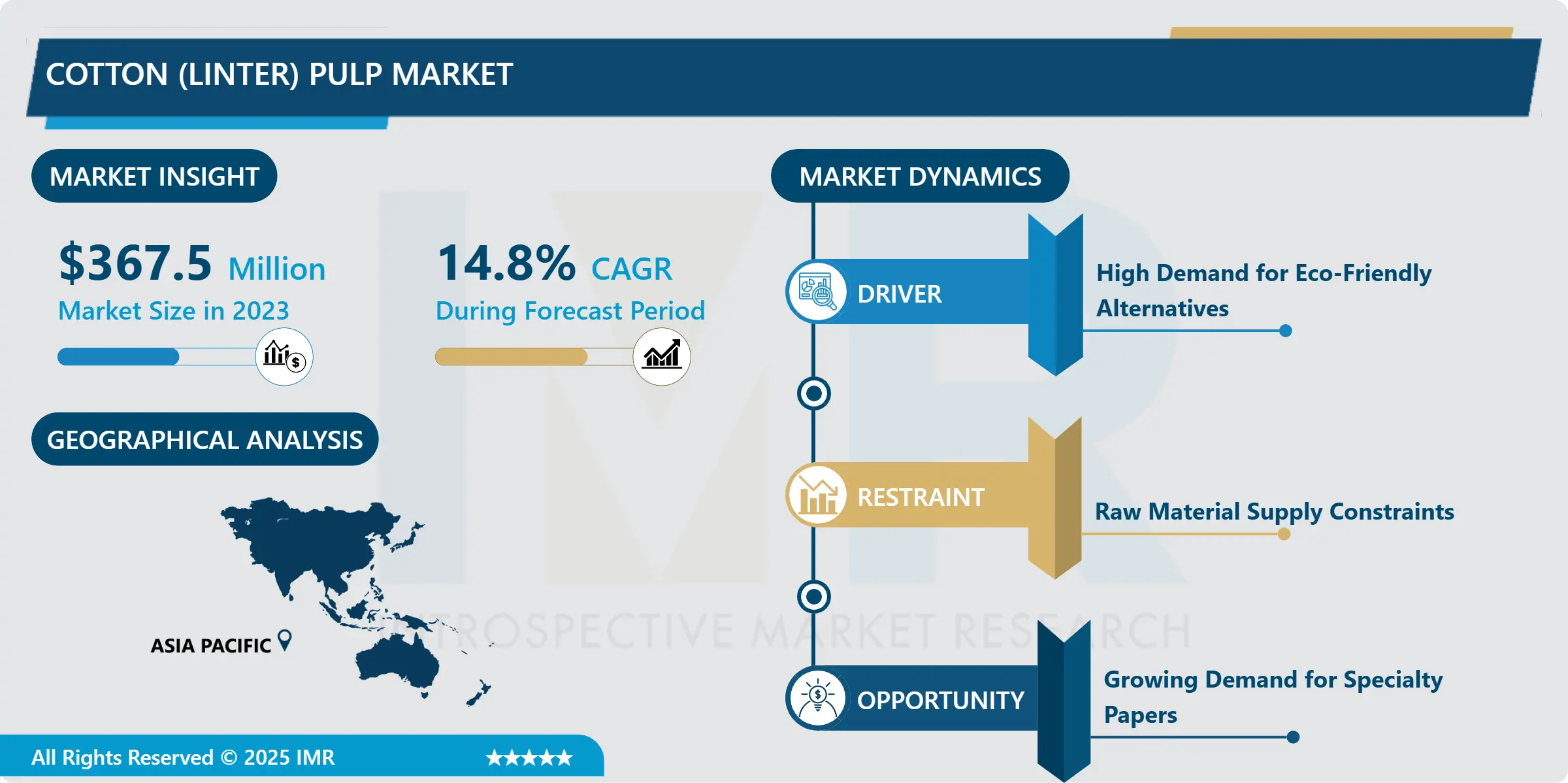
Cotton (Linter) Pulp Market Size Was Valued at USD 367.5 Million in 2023, and is Projected to Reach USD 1,272.7 Million by 2032, Growing at a CAGR of 14.8% From 2024-2032.
The market of cotton (linter) pulp concerns the industry connected with production and consumption of pulp obtained from the remains of cotton linters, which are short fibers remaining on the seeds after ginning. Cotton linter pulp is versatile and pure fiber which finds its application in products such as paper, chemicals, textiles, and articles with medical use.
The Cotton (Linter) Pulp Market has emerged critical since increased concern to use of environmentally sustainable products and materials among industries. Cotton linters have structure that derived, cellulose pulp with high alpha-cellulose for high performance and specialty nature. It provide its products to various segments such as paper manufacturing especially linter pulp is used for manufacturing of bank notes and security papers and in medical application for surgical dressings or filters etc.
The market driven is by the growing use of environmentally friendly and biodegradable products, as cotton linters are obtain from renewable resources. Technological improvement in the processing and the industrialization process across the world have made long-staple cotton linter pulp affordable to industries that call for hi-grade pulp. However, there is some inconvenience due to the specificities of supply chain and availability of the main material, which is cotton, and cyclical fluctuations in its production. Local factors also matter a great deal where Asia-Pacific has taken a commanding position because of the dominion of textile/paper industries.
Cotton (Linter) Pulp Market Trend Analysis:
Adoption of Sustainable Practices
By expanding consumers’ awareness of the environment, the organizations in the cotton linter pulp industry are now seeking to implement sustainable strategies that contribute to market development. They are emphasizing the low use of water during production, little utilization of chemicals and energy conservation during the pulping process. These measures meet the needs of consumers, who are increasingly interested in purchasing environmentally friendly products and meet the requirements of the legislation of countries which export products.
For instance, the transition in the packaging industry from plastics to biodegradable material has extended the market for linter pulp which is used in the production of paper. At the same time industries in developed territories are using closed loops for processing, thus minimizing the environmental footprint. Such trends evidence the fact that the cotton linter pulp market is in process of adapting sustainable development goals to pursue long-term market development.
Growing Demand for Specialty Papers
The increasing application of specialty papers could be an emerging market in the Cotton (Linter) Pulp Market. Filtering paper and banknote paper etc, applied cellulose pulp of high purity, cotton linter is one kind of source. This demand is driven by industries such as the financial industry, which requires hard to counterfeit banknotes, and the automotive industry that uses the filter paper in sophisticated equipments.
In the same manner, the opportunity to leverage specialty paper for eco-friendly packaging solutions has provided other opportunities for growth. Businesses wanting to support environmental objectives are seeking cotton linter-based paper products and here they are pointing out a new avenue which manufacturers could explore in the future.
Cotton (Linter) Pulp Market Segment Analysis:
Cotton (Linter) Pulp Market is Segmented on the basis of Type, Application, End User, and Region.
By Type, High-grade Pulp segment is expected to dominate the market during the forecast period
According to the type, the market is divided into a High-grade Pulp market and Ordinary-grade Pulp market. High grade pulp which is widely accepted for its high alpha cellulose content controls the market for higher grade uses such as medical and specialty papers. It is found in a wide range of applications such as pharmaceuticals and electronics due to its high-end properties which gives it sound market need.
While ordinary-grade pulp satisfies the needs of the chemical processing and textiles industries in cost-efficient paper pulp products. It is ideal in large-scale application industries due to its flexibility, affordability and functional dependability. These types’ positioning lets them meet various market demands properly due to their differences.
By Application, Paper Production segment expected to held the largest share
Based out of Market Resource Centre, the applications of cotton linter pulp are found in areas of Paper Production, Chemical Processing, Textile Industry, Medical Products, and Others. Excluding soda paper, paper manufacturing is still the largest segment given the rising need for premium specialty papers. Next is the healthcare industry where linter pulp is used in hygienic and sterile products.
In the chemical processing point of view, CPLP is used for manufacturing of cellulose derivatives such as nitrocellulose and carboxymethyl cellulose. At the same time, textile industry uses linter pulp for finishing of fabrics and for functional fiber. This is demonstrated in each application, as the material can be used in various domains.
Cotton (Linter) Pulp Market Regional Insights:
Asia-Pacific is Expected to Dominate the Market Over the Forecast period
The Asia-Pacific region is expected to be the leading consumer in the Cotton (Linter) Pulp Market due to the established textile and paper industries. China and India are among the largest producers and consumers of cotton linter pulp capitalizing on the large production of cotton and growing industrialization.
It is also established that the region has cheap production costs and high export demands. With demand for sustainable products growing globally, Asia-Pacific has a strong supply chain link that places it at vantage point in the market’s progression.
Active Key Players in the Cotton (Linter) Pulp Market
BASF SE (Germany)
Birla Cellulose (India)
Celanese Corporation (USA)
Georgia-Pacific (USA)
Global Nonwovens Ltd. (India)
Gujarat Linter Mill (India)
Hubei Golden Ring Co., Ltd. (China)
International Paper Company (USA)
Lenzing AG (Austria)
Shandong Silver Hawk Chemical Fibre Co., Ltd. (China)
Suzhou Silk Imp & Exp Corp. (China)
Weyerhaeuser Company (USA)
Other Active Players
Key Industry Developments in the Cotton (Linter) Pulp Market:
In October 2023, Birla Cellulose launches circular fiber blend. Birla Cellulose has come up with its new circular fiber blend that significantly enhances the proportion of mechanically recycled fibre to 50 per cent while maintaining high-strength yarn, thus making it ideal for fabric and garment production across diverse categories.
In March 2023, Aditya Birla Group’s Birla Cellulose launched a new range of cotton (linter) pulp products for the Indian market. The new products are designed to meet the growing demand for high-quality cotton-based products in the country.
In February 2023, Lenzing launched a new range of Tencel Lyocell fibers made from cotton (linter) pulp. The new fibers are designed to offer a more sustainable alternative to traditional cotton fibers.
In January 2023, Södra Cell launched a new range of dissolving pulp products made from cotton (linter) pulp. The new products are designed to meet the growing demand for dissolving pulp for the production of viscose fibers.
Chapter 1: Introduction
1.1 Scope and Coverage
Chapter 2:Executive Summary
Chapter 3: Market Landscape
3.1 Market Dynamics
3.1.1 Drivers
3.1.2 Restraints
3.1.3 Opportunities
3.1.4 Challenges
3.2 Market Trend Analysis
3.3 PESTLE Analysis
3.4 Porter’s Five Forces Analysis
3.5 Industry Value Chain Analysis
3.6 Ecosystem
3.7 Regulatory Landscape
3.8 Price Trend Analysis
3.9 Patent Analysis
3.10 Technology Evolution
3.11 Investment Pockets
3.12 Import-Export Analysis
Chapter 4: Cotton (Linter) Pulp Market by Type
4.1 Cotton (Linter) Pulp Market Snapshot and Growth Engine
4.2 Cotton (Linter) Pulp Market Overview
4.3 High-grade Pulp
4.3.1 Introduction and Market Overview
4.3.2 Historic and Forecasted Market Size in Value USD and Volume Units (2017-2032F)
4.3.3 Key Market Trends, Growth Factors and Opportunities
4.3.4 High-grade Pulp: Geographic Segmentation Analysis
4.4 Ordinary-grade Pulp
4.4.1 Introduction and Market Overview
4.4.2 Historic and Forecasted Market Size in Value USD and Volume Units (2017-2032F)
4.4.3 Key Market Trends, Growth Factors and Opportunities
4.4.4 Ordinary-grade Pulp: Geographic Segmentation Analysis
Chapter 5: Cotton (Linter) Pulp Market by Application
5.1 Cotton (Linter) Pulp Market Snapshot and Growth Engine
5.2 Cotton (Linter) Pulp Market Overview
5.3 Paper Production
5.3.1 Introduction and Market Overview
5.3.2 Historic and Forecasted Market Size in Value USD and Volume Units (2017-2032F)
5.3.3 Key Market Trends, Growth Factors and Opportunities
5.3.4 Paper Production: Geographic Segmentation Analysis
5.4 Chemical Processing
5.4.1 Introduction and Market Overview
5.4.2 Historic and Forecasted Market Size in Value USD and Volume Units (2017-2032F)
5.4.3 Key Market Trends, Growth Factors and Opportunities
5.4.4 Chemical Processing: Geographic Segmentation Analysis
5.5 Textile Industry
5.5.1 Introduction and Market Overview
5.5.2 Historic and Forecasted Market Size in Value USD and Volume Units (2017-2032F)
5.5.3 Key Market Trends, Growth Factors and Opportunities
5.5.4 Textile Industry: Geographic Segmentation Analysis
5.6 Medical Products
5.6.1 Introduction and Market Overview
5.6.2 Historic and Forecasted Market Size in Value USD and Volume Units (2017-2032F)
5.6.3 Key Market Trends, Growth Factors and Opportunities
5.6.4 Medical Products: Geographic Segmentation Analysis
5.7 Others
5.7.1 Introduction and Market Overview
5.7.2 Historic and Forecasted Market Size in Value USD and Volume Units (2017-2032F)
5.7.3 Key Market Trends, Growth Factors and Opportunities
5.7.4 Others: Geographic Segmentation Analysis
Chapter 6: Cotton (Linter) Pulp Market by End-User
6.1 Cotton (Linter) Pulp Market Snapshot and Growth Engine
6.2 Cotton (Linter) Pulp Market Overview
6.3 Paper and Packaging Industry
6.3.1 Introduction and Market Overview
6.3.2 Historic and Forecasted Market Size in Value USD and Volume Units (2017-2032F)
6.3.3 Key Market Trends, Growth Factors and Opportunities
6.3.4 Paper and Packaging Industry: Geographic Segmentation Analysis
6.4 Textile Manufacturers
6.4.1 Introduction and Market Overview
6.4.2 Historic and Forecasted Market Size in Value USD and Volume Units (2017-2032F)
6.4.3 Key Market Trends, Growth Factors and Opportunities
6.4.4 Textile Manufacturers: Geographic Segmentation Analysis
6.5 Pharmaceutical and Medical Sector
6.5.1 Introduction and Market Overview
6.5.2 Historic and Forecasted Market Size in Value USD and Volume Units (2017-2032F)
6.5.3 Key Market Trends, Growth Factors and Opportunities
6.5.4 Pharmaceutical and Medical Sector: Geographic Segmentation Analysis
6.6 Chemical Industry
6.6.1 Introduction and Market Overview
6.6.2 Historic and Forecasted Market Size in Value USD and Volume Units (2017-2032F)
6.6.3 Key Market Trends, Growth Factors and Opportunities
6.6.4 Chemical Industry: Geographic Segmentation Analysis
Chapter 7: Company Profiles and Competitive Analysis
7.1 Competitive Landscape
7.1.1 Competitive Benchmarking
7.1.2 Cotton (Linter) Pulp Market Share by Manufacturer (2023)
7.1.3 Industry BCG Matrix
7.1.4 Heat Map Analysis
7.1.5 Mergers and Acquisitions
7.2 GEORGIA-PACIFIC (USA)
7.2.1 Company Overview
7.2.2 Key Executives
7.2.3 Company Snapshot
7.2.4 Role of the Company in the Market
7.2.5 Sustainability and Social Responsibility
7.2.6 Operating Business Segments
7.2.7 Product Portfolio
7.2.8 Business Performance
7.2.9 Key Strategic Moves and Recent Developments
7.2.10 SWOT Analysis
7.3 GUJARAT LINTER MILL (INDIA)
7.4 SHANDONG SILVER HAWK CHEMICAL FIBRE CO. LTD. (CHINA)
7.5 INTERNATIONAL PAPER COMPANY (USA)
7.6 CELANESE CORPORATION (USA)
7.7 SUZHOU SILK IMP & EXP CORP. (CHINA)
7.8 GLOBAL NONWOVENS LTD. (INDIA)
7.9 WEYERHAEUSER COMPANY (USA)
7.10 BASF SE (GERMANY)
7.11 LENZING AG (AUSTRIA)
7.12 HUBEI GOLDEN RING CO. LTD. (CHINA)
7.13 BIRLA CELLULOSE (INDIA)
7.14 OTHER ACTIVE PLAYERS
Chapter 8: Global Cotton (Linter) Pulp Market By Region
8.1 Overview
8.2. North America Cotton (Linter) Pulp Market
8.2.1 Key Market Trends, Growth Factors and Opportunities
8.2.2 Top Key Companies
8.2.3 Historic and Forecasted Market Size by Segments
8.2.4 Historic and Forecasted Market Size By Type
8.2.4.1 High-grade Pulp
8.2.4.2 Ordinary-grade Pulp
8.2.5 Historic and Forecasted Market Size By Application
8.2.5.1 Paper Production
8.2.5.2 Chemical Processing
8.2.5.3 Textile Industry
8.2.5.4 Medical Products
8.2.5.5 Others
8.2.6 Historic and Forecasted Market Size By End-User
8.2.6.1 Paper and Packaging Industry
8.2.6.2 Textile Manufacturers
8.2.6.3 Pharmaceutical and Medical Sector
8.2.6.4 Chemical Industry
8.2.7 Historic and Forecast Market Size by Country
8.2.7.1 US
8.2.7.2 Canada
8.2.7.3 Mexico
8.3. Eastern Europe Cotton (Linter) Pulp Market
8.3.1 Key Market Trends, Growth Factors and Opportunities
8.3.2 Top Key Companies
8.3.3 Historic and Forecasted Market Size by Segments
8.3.4 Historic and Forecasted Market Size By Type
8.3.4.1 High-grade Pulp
8.3.4.2 Ordinary-grade Pulp
8.3.5 Historic and Forecasted Market Size By Application
8.3.5.1 Paper Production
8.3.5.2 Chemical Processing
8.3.5.3 Textile Industry
8.3.5.4 Medical Products
8.3.5.5 Others
8.3.6 Historic and Forecasted Market Size By End-User
8.3.6.1 Paper and Packaging Industry
8.3.6.2 Textile Manufacturers
8.3.6.3 Pharmaceutical and Medical Sector
8.3.6.4 Chemical Industry
8.3.7 Historic and Forecast Market Size by Country
8.3.7.1 Russia
8.3.7.2 Bulgaria
8.3.7.3 The Czech Republic
8.3.7.4 Hungary
8.3.7.5 Poland
8.3.7.6 Romania
8.3.7.7 Rest of Eastern Europe
8.4. Western Europe Cotton (Linter) Pulp Market
8.4.1 Key Market Trends, Growth Factors and Opportunities
8.4.2 Top Key Companies
8.4.3 Historic and Forecasted Market Size by Segments
8.4.4 Historic and Forecasted Market Size By Type
8.4.4.1 High-grade Pulp
8.4.4.2 Ordinary-grade Pulp
8.4.5 Historic and Forecasted Market Size By Application
8.4.5.1 Paper Production
8.4.5.2 Chemical Processing
8.4.5.3 Textile Industry
8.4.5.4 Medical Products
8.4.5.5 Others
8.4.6 Historic and Forecasted Market Size By End-User
8.4.6.1 Paper and Packaging Industry
8.4.6.2 Textile Manufacturers
8.4.6.3 Pharmaceutical and Medical Sector
8.4.6.4 Chemical Industry
8.4.7 Historic and Forecast Market Size by Country
8.4.7.1 Germany
8.4.7.2 UK
8.4.7.3 France
8.4.7.4 The Netherlands
8.4.7.5 Italy
8.4.7.6 Spain
8.4.7.7 Rest of Western Europe
8.5. Asia Pacific Cotton (Linter) Pulp Market
8.5.1 Key Market Trends, Growth Factors and Opportunities
8.5.2 Top Key Companies
8.5.3 Historic and Forecasted Market Size by Segments
8.5.4 Historic and Forecasted Market Size By Type
8.5.4.1 High-grade Pulp
8.5.4.2 Ordinary-grade Pulp
8.5.5 Historic and Forecasted Market Size By Application
8.5.5.1 Paper Production
8.5.5.2 Chemical Processing
8.5.5.3 Textile Industry
8.5.5.4 Medical Products
8.5.5.5 Others
8.5.6 Historic and Forecasted Market Size By End-User
8.5.6.1 Paper and Packaging Industry
8.5.6.2 Textile Manufacturers
8.5.6.3 Pharmaceutical and Medical Sector
8.5.6.4 Chemical Industry
8.5.7 Historic and Forecast Market Size by Country
8.5.7.1 China
8.5.7.2 India
8.5.7.3 Japan
8.5.7.4 South Korea
8.5.7.5 Malaysia
8.5.7.6 Thailand
8.5.7.7 Vietnam
8.5.7.8 The Philippines
8.5.7.9 Australia
8.5.7.10 New Zealand
8.5.7.11 Rest of APAC
8.6. Middle East & Africa Cotton (Linter) Pulp Market
8.6.1 Key Market Trends, Growth Factors and Opportunities
8.6.2 Top Key Companies
8.6.3 Historic and Forecasted Market Size by Segments
8.6.4 Historic and Forecasted Market Size By Type
8.6.4.1 High-grade Pulp
8.6.4.2 Ordinary-grade Pulp
8.6.5 Historic and Forecasted Market Size By Application
8.6.5.1 Paper Production
8.6.5.2 Chemical Processing
8.6.5.3 Textile Industry
8.6.5.4 Medical Products
8.6.5.5 Others
8.6.6 Historic and Forecasted Market Size By End-User
8.6.6.1 Paper and Packaging Industry
8.6.6.2 Textile Manufacturers
8.6.6.3 Pharmaceutical and Medical Sector
8.6.6.4 Chemical Industry
8.6.7 Historic and Forecast Market Size by Country
8.6.7.1 Turkiye
8.6.7.2 Bahrain
8.6.7.3 Kuwait
8.6.7.4 Saudi Arabia
8.6.7.5 Qatar
8.6.7.6 UAE
8.6.7.7 Israel
8.6.7.8 South Africa
8.7. South America Cotton (Linter) Pulp Market
8.7.1 Key Market Trends, Growth Factors and Opportunities
8.7.2 Top Key Companies
8.7.3 Historic and Forecasted Market Size by Segments
8.7.4 Historic and Forecasted Market Size By Type
8.7.4.1 High-grade Pulp
8.7.4.2 Ordinary-grade Pulp
8.7.5 Historic and Forecasted Market Size By Application
8.7.5.1 Paper Production
8.7.5.2 Chemical Processing
8.7.5.3 Textile Industry
8.7.5.4 Medical Products
8.7.5.5 Others
8.7.6 Historic and Forecasted Market Size By End-User
8.7.6.1 Paper and Packaging Industry
8.7.6.2 Textile Manufacturers
8.7.6.3 Pharmaceutical and Medical Sector
8.7.6.4 Chemical Industry
8.7.7 Historic and Forecast Market Size by Country
8.7.7.1 Brazil
8.7.7.2 Argentina
8.7.7.3 Rest of SA
Chapter 9 Analyst Viewpoint and Conclusion
9.1 Recommendations and Concluding Analysis
9.2 Potential Market Strategies
Chapter 10 Research Methodology
10.1 Research Process
10.2 Primary Research
10.3 Secondary Research
Q1: What would be the forecast period in the Cotton (Linter) Pulp Market research report?
A1: The forecast period in the Cotton (Linter) Pulp Market research report is 2024-2032.
Q2: Who are the key players in the Cotton (Linter) Pulp Market?
A2: Georgia-Pacific (USA), Gujarat Linter Mill (India), Shandong Silver Hawk Chemical Fibre Co., Ltd. (China), International Paper Company (USA), Celanese Corporation (USA), Suzhou Silk Imp & Exp Corp. (China), Global Nonwovens Ltd. (India), Weyerhaeuser Company (USA), and Other Active Players.
Q3: What are the segments of the Cotton (Linter) Pulp Market?
A3: The Cotton (Linter) Pulp Market is segmented into Type, Application, End User and region. By Type, the market is categorized into High-grade Pulp, Ordinary-grade Pulp. By Application, the market is categorized into Paper Production, Chemical Processing, Textile Industry, Medical Products, Others. By End-User, the market is categorized into Paper and Packaging Industry, Textile Manufacturers, Pharmaceutical and Medical Sector, Chemical Industry. By region, it is analyzed across North America (U.S., Canada, Mexico), Eastern Europe (Russia, Bulgaria, The Czech Republic, Hungary, Poland, Romania, Rest of Eastern Europe), Western Europe (Germany, UK, France, The Netherlands, Italy, Russia, Spain, Rest of Western Europe), Asia Pacific (China, India, Japan, South Korea, Malaysia, Thailand, Vietnam, The Philippines, Australia, New-Zealand, Rest of APAC), Middle East & Africa (Turkiye, Bahrain, Kuwait, Saudi Arabia, Qatar, UAE, Israel, South Africa), South America (Brazil, Argentina, Rest of SA).
Q4: What is the Cotton (Linter) Pulp Market?
A4: The market of cotton (linter) pulp concerns the industry connected with production and consumption of pulp obtained from the remains of cotton linters, which are short fibers remaining on the seeds after ginning. Cotton linter pulp is versatile and pure fiber which finds its application in products such as paper, chemicals, textiles, and articles with medical use.
Q5: How big is the Cotton (Linter) Pulp Market?
A5: Cotton (Linter) Pulp Market Size Was Valued at USD 367.5 Million in 2023, and is Projected to Reach USD 1,272.7 Million by 2032, Growing at a CAGR of 14.8% From 2024-2032.
How to Buy a Report from eminsights.jp
On the product page, choose the license you want: Single-User License, Multi-User License or Enterprise License.
If you required report in your native language, then you can click on Translated Report button and fill out the form with report name and language you want, then our team will contact you as soon as possible.
Click the Buy Now button.
You will be redirected to the checkout page. Enter your company details and payment information.
Click Place Order to complete the purchase.
Confirmation: You’ll receive an order confirmation and our team will contact you shortly with your ordered report.
If you have any questions, fill out the contact form below or email us at bizdev@eminsights.net.
Thank you for choosing eminsights.jp!