Stay Ahead in Fast-Growing Economies.
Browse Reports Now
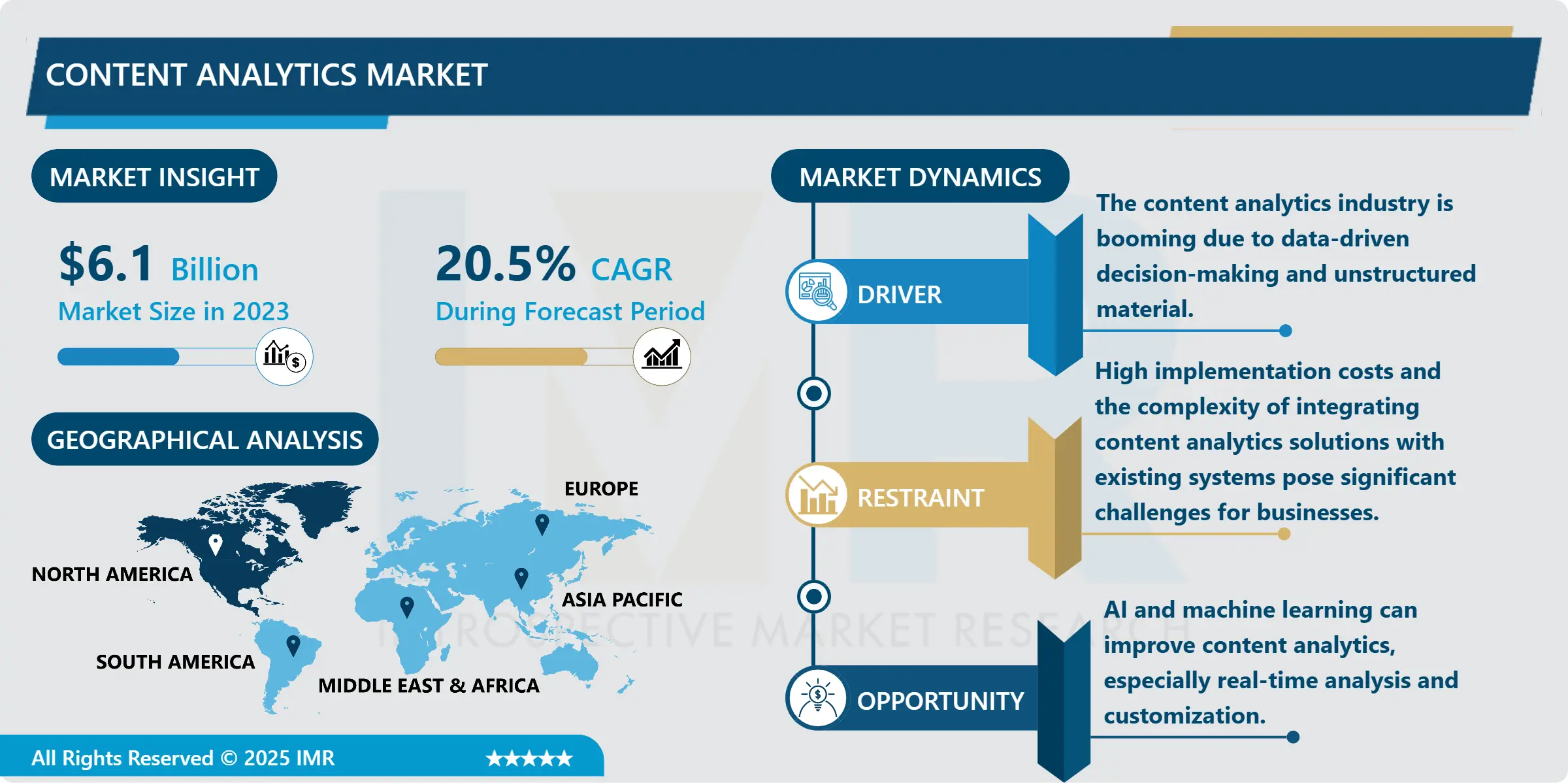
Content Analytics Market Size, Share, Growth & Forecast (2024-2032)
Content Analytics Market Size Was Valued at USD 6.10 Billion in 2023, and is Projected to Reach USD 34.8 Billion by 2032, Growing at a CAGR of 20.5% From 2024-2032.

IMR Group
Description
Content Analytics Market Synopsis:
Content Analytics Market Size Was Valued at USD 6.10 Billion in 2023, and is Projected to Reach USD 34.8 Billion by 2032, Growing at a CAGR of 20.5% From 2024-2032.
The content analytics market is experiencing rapid growth as organizations increasingly recognize the value of extracting insights from vast amounts of unstructured data. Content analytics involves the use of artificial intelligence (AI), natural language processing (NLP), and machine learning to analyze text, images, videos, and audio from a variety of sources such as social media, websites, and customer feedback. This technology enables businesses to improve decision-making, enhance customer experiences, and gain actionable insights that drive performance. As digital content generation continues to expand across industries, content analytics has become a key tool for organizations seeking to remain competitive in a data-driven world.
The demand for content analytics solutions is particularly strong across industries such as e-commerce, media and entertainment, healthcare, and finance. These sectors rely heavily on data from multiple channels and require robust analytics tools to make sense of complex and often fragmented content. By leveraging content analytics, companies can optimize their marketing strategies, enhance content personalization, and streamline operations. Additionally, the rise of big data and the increasing use of cloud computing have created new opportunities for organizations to access and deploy content analytics solutions more efficiently and at scale.
As the market continues to evolve, key trends driving the content analytics sector include advancements in AI and NLP technologies, which are improving the accuracy and capabilities of content analysis. The integration of content analytics with other enterprise software, such as customer relationship management (CRM) and business intelligence (BI) platforms, is also expanding its utility. Furthermore, the growing need for compliance with data privacy regulations is motivating businesses to adopt solutions that help them manage and secure sensitive content while deriving valuable insights. With these developments, the content analytics market is poised for significant growth in the coming years.
Content Analytics Market Trend Analysis:
Integration of AI and Machine Learning in Content Analytics
The integration of artificial intelligence (AI) and machine learning (ML) is transforming the content analytics market by enabling more accurate and efficient analysis of unstructured data. AI-powered tools can process vast amounts of text, images, and videos at high speed, extracting valuable insights that were previously difficult to obtain. Machine learning algorithms further enhance the capabilities of content analytics by learning from past interactions, adapting to new data trends, and improving the precision of insights. This trend is particularly beneficial for industries like e-commerce, media, and healthcare, where content personalization and data-driven decision-making are becoming increasingly critical.
Growing Adoption of Cloud-Based Content Analytics Solutions
Cloud-based content analytics solutions are gaining traction as businesses seek to improve flexibility, scalability, and cost-efficiency. By leveraging cloud platforms, organizations can access advanced analytics tools without the need for extensive on-premises infrastructure or specialized IT resources. Cloud solutions also enable better collaboration and real-time analytics across teams and departments. The ability to scale analytics capabilities as needed is crucial for companies handling large volumes of content and seeking to integrate content analytics into their broader business intelligence and data analytics strategies. This trend is particularly beneficial for small and medium-sized enterprises (SMEs) that may not have the resources to deploy on-premise solutions.
Content Analytics Market Segment Analysis:
Content Analytics Market Segmented on the basis of By Application, Deployment, Application, Vertical, and Region.
By Deployment, Cloud segment is expected to dominate the market during the forecast period
In the content analytics market, deployment options are primarily divided into cloud-based and on-premise solutions, each offering distinct advantages. Cloud-based content analytics solutions are gaining significant popularity due to their scalability, cost-effectiveness, and flexibility, allowing businesses to access advanced analytics tools without heavy upfront infrastructure costs. These solutions enable real-time collaboration and integration with other cloud-based platforms, making them ideal for companies with dynamic data needs and those that handle large volumes of content. On-premise deployments provide more control over data security and customization, making them a preferred choice for organizations with strict compliance requirements or those dealing with sensitive information. As businesses increasingly embrace digital transformation, the cloud deployment model is expected to dominate, although on-premise solutions will continue to be relevant for specific industries with high security or regulatory demands.
By Application, Web Analytics segment expected to held the largest share
The content analytics market is segmented by application into web analytics, text analytics, social media analytics, and speech analytics, each serving distinct needs for businesses. Web analytics focuses on tracking and analyzing user behavior on websites, helping organizations optimize user experience, improve content strategies, and increase conversion rates. Text analytics involves extracting insights from large volumes of textual data, such as customer reviews, emails, and reports, allowing businesses to identify trends, sentiment, and actionable insights. Social media analytics enables companies to monitor and analyze social media conversations, track brand sentiment, and improve customer engagement through targeted campaigns. Speech analytics involves the analysis of audio data from call centers and customer interactions to detect customer emotions, improve service quality, and streamline operations. These applications are driving the adoption of content analytics across various industries by helping organizations derive valuable insights from different types of unstructured content.
Content Analytics Market Regional Insights:
North America is Expected to Dominate the Market Over the Forecast period
North America is expected to dominate the content analytics market over the forecast period, driven by the region’s strong technological infrastructure, high adoption of advanced analytics solutions, and the presence of key players in the content analytics space. The increasing demand for data-driven insights across industries such as e-commerce, healthcare, and media, coupled with the growing reliance on AI and machine learning technologies, is fueling market growth in this region. Furthermore, North America’s mature regulatory environment and significant investments in digital transformation by enterprises are contributing to the widespread adoption of content analytics solutions. With a large number of organizations focused on improving operational efficiency and customer experience through data, North America is poised to maintain a leading position in the market.
Active Key Players in the Content Analytics Market
Adobe Systems, INC. (U.S.)
Clarabridge, INC. (U.S.)
Interactive Intelligence Group, INC. (U.S.)
International Business Machine Corporation (U.S.)
Nice Systems LTD. (Israel)
Opentext Corporation (Canada)
Oracle Corporation (U.S.)
SAP SE (Germany)
SAS Institute, INC. (U.S.)
Verint Systems (U.S.)
Other Active Players.
Chapter 1: Introduction
1.1 Scope and Coverage
Chapter 2:Executive Summary
Chapter 3: Market Landscape
3.1 Market Dynamics
3.1.1 Drivers
3.1.2 Restraints
3.1.3 Opportunities
3.1.4 Challenges
3.2 Market Trend Analysis
3.3 PESTLE Analysis
3.4 Porter’s Five Forces Analysis
3.5 Industry Value Chain Analysis
3.6 Ecosystem
3.7 Regulatory Landscape
3.8 Price Trend Analysis
3.9 Patent Analysis
3.10 Technology Evolution
3.11 Investment Pockets
3.12 Import-Export Analysis
Chapter 4: Content Analytics Market by Application
4.1 Content Analytics Market Snapshot and Growth Engine
4.2 Content Analytics Market Overview
4.3 Web Analytics
4.3.1 Introduction and Market Overview
4.3.2 Historic and Forecasted Market Size in Value USD and Volume Units (2017-2032F)
4.3.3 Key Market Trends, Growth Factors and Opportunities
4.3.4 Web Analytics: Geographic Segmentation Analysis
4.4 Text Analytics
4.4.1 Introduction and Market Overview
4.4.2 Historic and Forecasted Market Size in Value USD and Volume Units (2017-2032F)
4.4.3 Key Market Trends, Growth Factors and Opportunities
4.4.4 Text Analytics: Geographic Segmentation Analysis
4.5 Social Media Analytics
4.5.1 Introduction and Market Overview
4.5.2 Historic and Forecasted Market Size in Value USD and Volume Units (2017-2032F)
4.5.3 Key Market Trends, Growth Factors and Opportunities
4.5.4 Social Media Analytics: Geographic Segmentation Analysis
4.6 Speech Analytics
4.6.1 Introduction and Market Overview
4.6.2 Historic and Forecasted Market Size in Value USD and Volume Units (2017-2032F)
4.6.3 Key Market Trends, Growth Factors and Opportunities
4.6.4 Speech Analytics: Geographic Segmentation Analysis
Chapter 5: Content Analytics Market by Deployment
5.1 Content Analytics Market Snapshot and Growth Engine
5.2 Content Analytics Market Overview
5.3 Cloud
5.3.1 Introduction and Market Overview
5.3.2 Historic and Forecasted Market Size in Value USD and Volume Units (2017-2032F)
5.3.3 Key Market Trends, Growth Factors and Opportunities
5.3.4 Cloud: Geographic Segmentation Analysis
5.4 On-Premise
5.4.1 Introduction and Market Overview
5.4.2 Historic and Forecasted Market Size in Value USD and Volume Units (2017-2032F)
5.4.3 Key Market Trends, Growth Factors and Opportunities
5.4.4 On-Premise: Geographic Segmentation Analysis
Chapter 6: Content Analytics Market by Vertical
6.1 Content Analytics Market Snapshot and Growth Engine
6.2 Content Analytics Market Overview
6.3 Retail & Consumer Goods
6.3.1 Introduction and Market Overview
6.3.2 Historic and Forecasted Market Size in Value USD and Volume Units (2017-2032F)
6.3.3 Key Market Trends, Growth Factors and Opportunities
6.3.4 Retail & Consumer Goods: Geographic Segmentation Analysis
6.4 Travel & Hospitality
6.4.1 Introduction and Market Overview
6.4.2 Historic and Forecasted Market Size in Value USD and Volume Units (2017-2032F)
6.4.3 Key Market Trends, Growth Factors and Opportunities
6.4.4 Travel & Hospitality: Geographic Segmentation Analysis
6.5 IT & Telecommunication
6.5.1 Introduction and Market Overview
6.5.2 Historic and Forecasted Market Size in Value USD and Volume Units (2017-2032F)
6.5.3 Key Market Trends, Growth Factors and Opportunities
6.5.4 IT & Telecommunication: Geographic Segmentation Analysis
Chapter 7: Company Profiles and Competitive Analysis
7.1 Competitive Landscape
7.1.1 Competitive Benchmarking
7.1.2 Content Analytics Market Share by Manufacturer (2023)
7.1.3 Industry BCG Matrix
7.1.4 Heat Map Analysis
7.1.5 Mergers and Acquisitions
7.2 ORACLE CORPORATION (U.S.)
7.2.1 Company Overview
7.2.2 Key Executives
7.2.3 Company Snapshot
7.2.4 Role of the Company in the Market
7.2.5 Sustainability and Social Responsibility
7.2.6 Operating Business Segments
7.2.7 Product Portfolio
7.2.8 Business Performance
7.2.9 Key Strategic Moves and Recent Developments
7.2.10 SWOT Analysis
7.3 SAS INSTITUTE INC. (U.S.)
7.4 INTERNATIONAL BUSINESS MACHINE CORPORATION (U.S.)
7.5 SAP SE (GERMANY)
7.6 ADOBE SYSTEMS INC. (U.S.)
7.7 OPENTEXT CORPORATION (CANADA)
7.8 NICE SYSTEMS LTD. (ISRAEL)
7.9 CLARABRIDGE INC. (U.S.)
7.10 VERINT SYSTEMS (U.S.)
7.11 INTERACTIVE INTELLIGENCE GROUP INC. (U.S.)
7.12 OTHER ACTIVE PLAYERS
Chapter 8: Global Content Analytics Market By Region
8.1 Overview
8.2. North America Content Analytics Market
8.2.1 Key Market Trends, Growth Factors and Opportunities
8.2.2 Top Key Companies
8.2.3 Historic and Forecasted Market Size by Segments
8.2.4 Historic and Forecasted Market Size By Application
8.2.4.1 Web Analytics
8.2.4.2 Text Analytics
8.2.4.3 Social Media Analytics
8.2.4.4 Speech Analytics
8.2.5 Historic and Forecasted Market Size By Deployment
8.2.5.1 Cloud
8.2.5.2 On-Premise
8.2.6 Historic and Forecasted Market Size By Vertical
8.2.6.1 Retail & Consumer Goods
8.2.6.2 Travel & Hospitality
8.2.6.3 IT & Telecommunication
8.2.7 Historic and Forecast Market Size by Country
8.2.7.1 US
8.2.7.2 Canada
8.2.7.3 Mexico
8.3. Eastern Europe Content Analytics Market
8.3.1 Key Market Trends, Growth Factors and Opportunities
8.3.2 Top Key Companies
8.3.3 Historic and Forecasted Market Size by Segments
8.3.4 Historic and Forecasted Market Size By Application
8.3.4.1 Web Analytics
8.3.4.2 Text Analytics
8.3.4.3 Social Media Analytics
8.3.4.4 Speech Analytics
8.3.5 Historic and Forecasted Market Size By Deployment
8.3.5.1 Cloud
8.3.5.2 On-Premise
8.3.6 Historic and Forecasted Market Size By Vertical
8.3.6.1 Retail & Consumer Goods
8.3.6.2 Travel & Hospitality
8.3.6.3 IT & Telecommunication
8.3.7 Historic and Forecast Market Size by Country
8.3.7.1 Russia
8.3.7.2 Bulgaria
8.3.7.3 The Czech Republic
8.3.7.4 Hungary
8.3.7.5 Poland
8.3.7.6 Romania
8.3.7.7 Rest of Eastern Europe
8.4. Western Europe Content Analytics Market
8.4.1 Key Market Trends, Growth Factors and Opportunities
8.4.2 Top Key Companies
8.4.3 Historic and Forecasted Market Size by Segments
8.4.4 Historic and Forecasted Market Size By Application
8.4.4.1 Web Analytics
8.4.4.2 Text Analytics
8.4.4.3 Social Media Analytics
8.4.4.4 Speech Analytics
8.4.5 Historic and Forecasted Market Size By Deployment
8.4.5.1 Cloud
8.4.5.2 On-Premise
8.4.6 Historic and Forecasted Market Size By Vertical
8.4.6.1 Retail & Consumer Goods
8.4.6.2 Travel & Hospitality
8.4.6.3 IT & Telecommunication
8.4.7 Historic and Forecast Market Size by Country
8.4.7.1 Germany
8.4.7.2 UK
8.4.7.3 France
8.4.7.4 The Netherlands
8.4.7.5 Italy
8.4.7.6 Spain
8.4.7.7 Rest of Western Europe
8.5. Asia Pacific Content Analytics Market
8.5.1 Key Market Trends, Growth Factors and Opportunities
8.5.2 Top Key Companies
8.5.3 Historic and Forecasted Market Size by Segments
8.5.4 Historic and Forecasted Market Size By Application
8.5.4.1 Web Analytics
8.5.4.2 Text Analytics
8.5.4.3 Social Media Analytics
8.5.4.4 Speech Analytics
8.5.5 Historic and Forecasted Market Size By Deployment
8.5.5.1 Cloud
8.5.5.2 On-Premise
8.5.6 Historic and Forecasted Market Size By Vertical
8.5.6.1 Retail & Consumer Goods
8.5.6.2 Travel & Hospitality
8.5.6.3 IT & Telecommunication
8.5.7 Historic and Forecast Market Size by Country
8.5.7.1 China
8.5.7.2 India
8.5.7.3 Japan
8.5.7.4 South Korea
8.5.7.5 Malaysia
8.5.7.6 Thailand
8.5.7.7 Vietnam
8.5.7.8 The Philippines
8.5.7.9 Australia
8.5.7.10 New Zealand
8.5.7.11 Rest of APAC
8.6. Middle East & Africa Content Analytics Market
8.6.1 Key Market Trends, Growth Factors and Opportunities
8.6.2 Top Key Companies
8.6.3 Historic and Forecasted Market Size by Segments
8.6.4 Historic and Forecasted Market Size By Application
8.6.4.1 Web Analytics
8.6.4.2 Text Analytics
8.6.4.3 Social Media Analytics
8.6.4.4 Speech Analytics
8.6.5 Historic and Forecasted Market Size By Deployment
8.6.5.1 Cloud
8.6.5.2 On-Premise
8.6.6 Historic and Forecasted Market Size By Vertical
8.6.6.1 Retail & Consumer Goods
8.6.6.2 Travel & Hospitality
8.6.6.3 IT & Telecommunication
8.6.7 Historic and Forecast Market Size by Country
8.6.7.1 Turkiye
8.6.7.2 Bahrain
8.6.7.3 Kuwait
8.6.7.4 Saudi Arabia
8.6.7.5 Qatar
8.6.7.6 UAE
8.6.7.7 Israel
8.6.7.8 South Africa
8.7. South America Content Analytics Market
8.7.1 Key Market Trends, Growth Factors and Opportunities
8.7.2 Top Key Companies
8.7.3 Historic and Forecasted Market Size by Segments
8.7.4 Historic and Forecasted Market Size By Application
8.7.4.1 Web Analytics
8.7.4.2 Text Analytics
8.7.4.3 Social Media Analytics
8.7.4.4 Speech Analytics
8.7.5 Historic and Forecasted Market Size By Deployment
8.7.5.1 Cloud
8.7.5.2 On-Premise
8.7.6 Historic and Forecasted Market Size By Vertical
8.7.6.1 Retail & Consumer Goods
8.7.6.2 Travel & Hospitality
8.7.6.3 IT & Telecommunication
8.7.7 Historic and Forecast Market Size by Country
8.7.7.1 Brazil
8.7.7.2 Argentina
8.7.7.3 Rest of SA
Chapter 9 Analyst Viewpoint and Conclusion
9.1 Recommendations and Concluding Analysis
9.2 Potential Market Strategies
Chapter 10 Research Methodology
10.1 Research Process
10.2 Primary Research
10.3 Secondary Research
Q1: What would be the forecast period in the Content Analytics Market research report?
A1: The forecast period in the Content Analytics Market research report is 2024-2032.
Q2: Who are the key players in the Content Analytics Market?
A2: Oracle Corporation (U.S.), SAS Institute, INC. (U.S.), International Business Machine Corporation (U.S.), SAP SE (Germany), Adobe Systems, INC. (U.S.), Opentext Corporation (Canada), Nice Systems LTD. (Israel), Clarabridge, INC. (U.S.), Verint Systems (U.S.), Interactive Intelligence Group, INC. (U.S.), and other Active Players.
Q3: What are the segments of the Content Analytics Market?
A3: The Content Analytics Market is segmented into By Application, By Deployment, By Application, By Distribution Channel and region. By Application (Web Analytics, Text Analytics, Social Media Analytics, Speech Analytics), By Deployment (Cloud, On-Premise), By Vertical (Retail & Consumer Goods, Travel & Hospitality, IT & Telecommunication). By region, it is analyzed across North America (U.S., Canada, Mexico), Eastern Europe (Russia, Bulgaria, The Czech Republic, Hungary, Poland, Romania, Rest of Eastern Europe), Western Europe (Germany, UK, France, The Netherlands, Italy, Russia, Spain, Rest of Western Europe), Asia Pacific (China, India, Japan, South Korea, Malaysia, Thailand, Vietnam, The Philippines, Australia, New-Zealand, Rest of APAC), Middle East & Africa (Turkiye, Bahrain, Kuwait, Saudi Arabia, Qatar, UAE, Israel, South Africa), South America (Brazil, Argentina, Rest of SA).
Q4: What is the Content Analytics Market?
A4: Content analytics refers to the process of gathering, analyzing, and interpreting both structured and unstructured data from various content sources such as text, videos, images, and social media to extract meaningful insights. By utilizing advanced technologies like artificial intelligence (AI), machine learning, and natural language processing (NLP), content analytics helps organizations uncover patterns, trends, and customer sentiments. This enables businesses to make data-driven decisions, optimize customer experiences, improve operational efficiency, and gain a competitive edge. It is increasingly used in industries like marketing, healthcare, finance, and media to enhance decision-making, content personalization, and targeted strategies.
Q5: How big is the Content Analytics Market?
A5: Content Analytics Market Size Was Valued at USD 6.10 Billion in 2023, and is Projected to Reach USD 34.8 Billion by 2032, Growing at a CAGR of 20.5% From 2024-2032.
How to Buy a Report from eminsights.jp
On the product page, choose the license you want: Single-User License, Multi-User License or Enterprise License.
If you required report in your native language, then you can click on Translated Report button and fill out the form with report name and language you want, then our team will contact you as soon as possible.
Click the Buy Now button.
You will be redirected to the checkout page. Enter your company details and payment information.
Click Place Order to complete the purchase.
Confirmation: You’ll receive an order confirmation and our team will contact you shortly with your ordered report.
If you have any questions, fill out the contact form below or email us at bizdev@eminsights.net.
Thank you for choosing eminsights.jp!