Stay Ahead in Fast-Growing Economies.
Browse Reports Now
Contact Lenses Market-Overview and Outlook by Potential Growth
Contact lenses are thin and come in the shape of the lens prescribed for the curvature of the corneal layer of the person’s eyes and are worn directly on the tear film layer. Their main purpose is corrected vision and they act as the contact lenses which are not glasses.

IMR Group
Description
Contact Lenses Market Synopsis
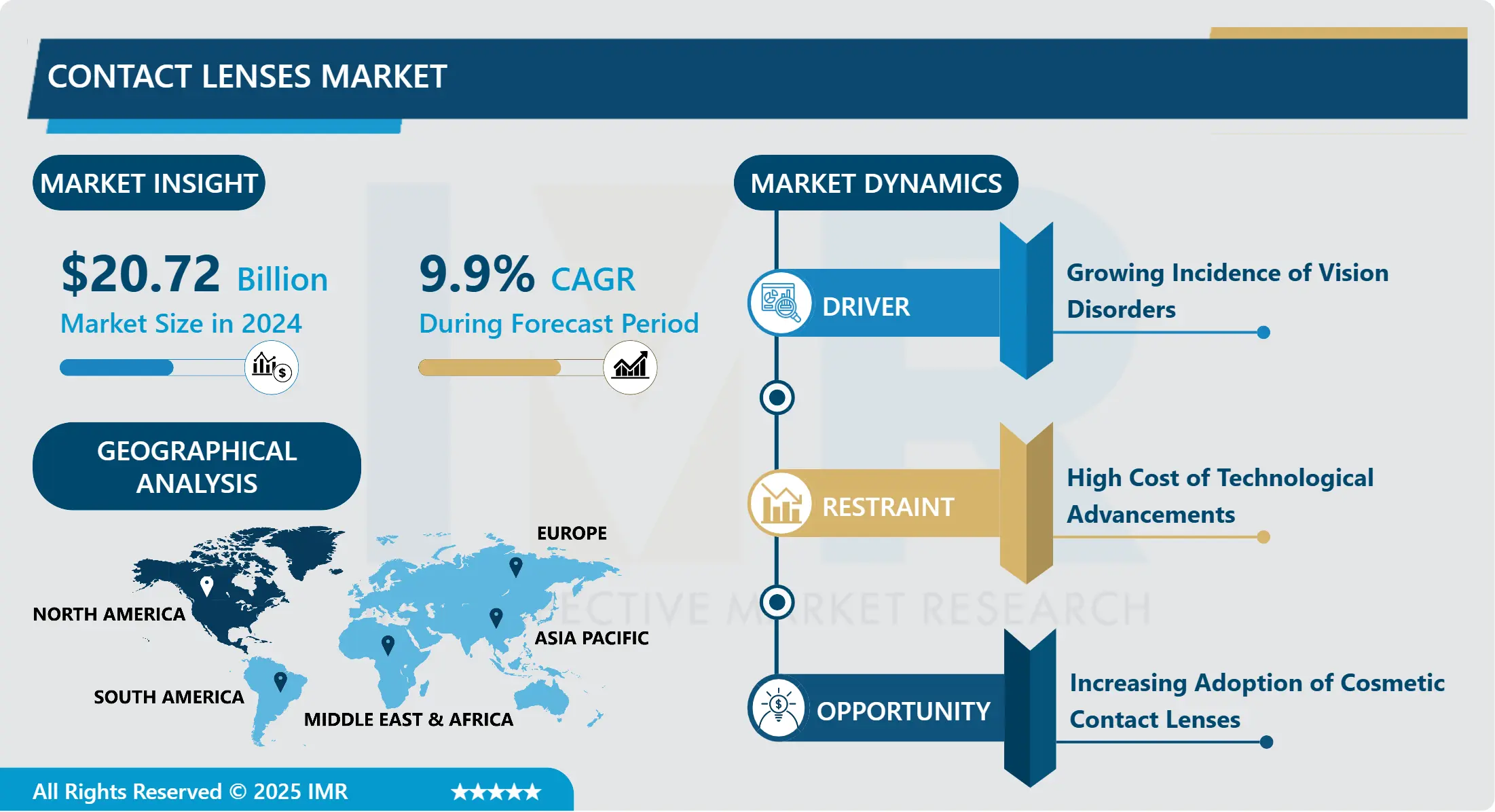
Contact Lenses Market Size Was Valued at USD 20.72 Billion in 2024 and is Projected to Reach USD 44.09 Billion by 2032, Growing at a CAGR of 9.90% From 2025-2032.
Contact lenses are thin and come in the shape of the lens prescribed for the curvature of the corneal layer of the person’s eyes and are worn directly on the tear film layer. Their main purpose is corrected vision and they act as the contact lenses which are not glasses. They work for myopia, hyperopia, astigmatism, and presbyopia which are a mode of refractive disorders. There are many types of contact lenses; flexible plastics lenses commonly referred to as soft lenses and rigid gas permeable lenses. Wearing of contact lenses needs proper hygiene and care to avoid complications to the eyes.
The global market for contact lenses has be expanding steadily, due to the rise in the vision correction products requirements and technological development. Being one of the critical segments in the eyewear market, contact lenses provide great comfort as well as the appearance that young consumers find appealing in comparison with regular glasses. The main drivers affecting market growth are the increasing rate of vision problems such as myopia and presbyopia, development in consciousness, and increasing purchasing power in the worldwide market.
Just like any other technologies, advances in technology has also been applied in the manufacturing of contacts lens and as a result, better and more comfortable lenses have been made available with increased breathability to the user thus making the contacts more safer to use. For instance, the silicone hydrogel lenses have been preferred from their high oxygen transmission that help in lowering chances of eye infections and can be worn for long periods. In addition, due to size and shape adjustments which target specific vision requirements, the market has been able to diversify across different ages and activities.
Among the regions, North America and Europe remain the largest consumers due to the increased demand for elaborated eyecare products and the availability of the high-quality healthcare services that encourage people to have their eyes checked regularly. On the other hand, Asia-Pacific market is steadily developing fast giving way to urbanization, changes in customers’ disposable income, and shift in their lifestyles that results to higher usage of contact lenses.
The overall competition within the market is moderate with market players – large conglomerates especially aiming at new product development, formation of new partnerships and acquisitions in the market. This implies that the leading manufacturers of eyeglasses never relent on research and development to release new frames and lens materials that would provide better vision and comfort. Another factor that defines the market activities includes legal requirements governing the quality and effectiveness of the products as well as the preservation of consumer confidence and the standards in place.
In the future, people will see more opportunities in contact lenses and is expected to have a bright future as the technology used in these products is improving every year, people awareness towards vision care is also improving and the population of elderly people is also increasing all over the world. The emergence of daily disposable lenses and the actualization of smart eyewear technology can likewise boost market growth and respond to the changing market trend with consumers’ demands, such as comfort, cleanliness, and personal improvements in vision problems.
Contact Lenses Market Trend Analysis
Contact Lenses Market Growth Driver- Rise of Disposable and Daily Wear Lenses
The demand for both disposable and the daily wear lens has been on the rise due to the shift in the population’s preference for the convenient, hygienic and comfortable lenses. There are daily, weekly, and monthly disposable lenses, and they let the wearer dispose of the lenses often and cut the probabilities of eye infections and overall maintenance. Daily use soft contact lenses especially daily disposables have become popular because of their convenience where a lens does not require re-wearing and does not require cleaning before storage, flexibility for busy people. Market expansion also consists of progressive improvements in lens types and producing processes, improving at the identical time comfort and oxygen transmission, which is vital for the health of the eyes.
Also, increased knowledge among consumers and other practitioners of the daily and disposable soft lenses also contributes to the development of the market. Regionally, North America and Europe have remained the leading markets, initiated by higher per capita income, improved healthcare facilities, and active concerning their eyes health. In the future, advancements in the lens construction and types of materials used will proceed to drive constant growth in the disposable and daily wear contact lenses business due to the growing cases of vision related disorders in the world.
Contact Lenses Market Expansion Opportunity- Increasing Adoption of Cosmetic Contact Lenses
Cosmetic contact lenses have especially received higher acceptance in the Contact Lenses Market owing to raising customer concern for improving their visual looks and change in eye appearance from time to time. Cosmetic lenses refer to colored lenses used to alter brown eye color or add a designs such as swirls or cat’s eyes; they can be either prescription or non-prescription, permanent or temporary use. This has been so because of attributes like the new developments in the lens material that promise to make them comfortable to wear and that let free flow of air and new processes in manufacturing.
In addition, people have higher disposable income and fashion has also shifted towards the use of cosmetic contact lenses worldwide. These lenses are frequently preferred for creating makeup aesthetics, suits or costumes which will be appropriate mainly for the young generation, especially those actively sharing content on social networks, where the focus is on aesthetics. Government approvals to determine safety and quality also add to the confidence of the buyers, thus contributing to the market’s development. As corporate giants continue to devise strategies on how to come up with lenses that are even more personalized and comfortable to wear, the wonder of the cosmetic segment of the contact lenses market should remain unending due to realized functionality and looks.
Contact Lenses Market Segment Analysis:
Contact Lenses Market Segmented based on Material, Design,Application ,Distribution Channel, Usage, and Region.
By Material, Silicone Hydrogel segment is expected to dominate the market during the forecast period
The given segmentation in the Contact Lenses Market shows that the choice of material has specific tendencies in it. Long-wearing options, along with precise vision correction coupled with the lenses’ durability makes gas permeable lenses an excellent choice. Silicone hydrogel lenses currently have the largest market share, because of their high oxygen permeability that makes them comfortable even when used for long hours without causing any harm to the eyes, a factor that makes them ideal especially to daily and extended use. One piece: Silicone hydrogel occupies the biggest market share since these lenses allow high oxygen permeability to the cornea thereby making them ideal for daily and extended use without causing any harm on the eyes. Here we have the best of both worlds, the benefits of gas permeable and soft contacts lenses.
Hybrid lenses therefore, are the product of early and later type contact lenses, which is good for people who value clear vision and at the same time value comfort of the soft contacts lenses. This makes it clear that the different materials available meet the particular needs of the consumer, whether it is in terms of the product’s capability to last longer or the comfort of the lens; this has the effect of making the adoption rates different across the various demographics in the global contact lenses market.
By Design, Spherical Lens segment held the largest share in 2024
In the Contact Lenses Market, lenses are divided mainly into spherical, toric, multifocal and other Fancy Patterned types. Two main types of contacts exist, spherical lenses, these are used in nearsightedness or farsightedness; they have a consistent curvature on the whole surface. Toric lenses are specifically designed for astigmatism and contains variable curvature in their different meridians as a result of the irregularity found in the eye.
Bifocals and trifocals are glasses that prescribe presbyopia by having different strengths of lenses in a single frame; this allows for clear vision regardless of the distance. Some of the other specific varieties are those tailored for irregular corneas, or for treating conditions like Keratoconus. Every segment of the design in the market demonstrates the technological development of material, precision in manufacturing technics, and the change in perception of comfort and durability, sharp vision among the consumers in the context of the competitive context in the contact lens market on the global level.
Contact Lenses Market Regional Insights:
North America is Expected to Dominate the Market Over the Forecast period
The current market status of contact lenses shows that North America holds the potential to lead the market over the forecast period due to the following: First of all, the rates of various vision disorders and eye diseases are higher in the region than in others, therefore, the need for the correction of vision is very high. However, technological innovation in materials used for contact lenses and lenses’ designs, consumer shift towards daily disposable and silicone hydrogel lens, are the factors that serve to spur the market further. The presence of majority of the manufacturers and extensive research and development activities in the region also supports this supremacy.
Also, well-developed healthcare services, increased consumer per capita income, and an improved attitude among people toward care of their vision are boosting the market. The contact lenses additionally have regulatory support while distribution networks also contribute to making the lenses easily available and hence, popular in North America. All these factors make North America as one of the leading markets for Contact lenses and future prospect looks even brighter.
Active Key Players in the Contact Lenses Market
Johnson & Johnson Vision Care (USA)
Alcon (Novartis) (Switzerland)
Bausch + Lomb (Valeant Pharmaceuticals) (USA)
CooperVision (The Cooper Companies) (USA)
Hoya Corporation (Japan)
Menicon (Japan)
Carl Zeiss Meditec (Germany)
Seed Co., Ltd. (Japan)
St.Shine Optical Co., Ltd. (Taiwan)
Contamac (UK)
Other Active Players.
Key Industry Developments in the Contact Lenses Market
InOctober 2023 – Alcon launched the TOTAL30 multifocal lenses for patients suffering from presbyopia. The lenses will be distributed in the U.S. and some international markets.
In June 2023 – Bausch + Lomb launched Multifocal Silicone Hydrogel lenses, Bausch + Lomb INFUSE, in the U.S. market. It is a daily disposable lens that provides clear vision for patients with presbyopia.
In March 2023 – The Cooper Companies Inc. launched its CooperVision MyDay Energys lenses in the U.S. market. The lens is for people with the symptoms of pervasive digital eye strain.
In February 2023 – Alcon launched a new total toric lens for astigmatic patients. This launch expands the company’s daily disposable and reusable lens portfolio with high-performing options designed explicitly for astigmatic patients.
Chapter 1: Introduction
1.1 Scope and Coverage
Chapter 2:Executive Summary
Chapter 3: Market Landscape
3.1 Market Dynamics
3.1.1 Drivers
3.1.2 Restraints
3.1.3 Opportunities
3.1.4 Challenges
3.2 Market Trend Analysis
3.3 PESTLE Analysis
3.4 Porter’s Five Forces Analysis
3.5 Industry Value Chain Analysis
3.6 Ecosystem
3.7 Regulatory Landscape
3.8 Price Trend Analysis
3.9 Patent Analysis
3.10 Technology Evolution
3.11 Investment Pockets
3.12 Import-Export Analysis
Chapter 4: Contact Lenses Market by Material (2018-2032)
4.1 Contact Lenses Market Snapshot and Growth Engine
4.2 Market Overview
4.3 Gas Permeable
4.3.1 Introduction and Market Overview
4.3.2 Historic and Forecasted Market Size in Value USD and Volume Units
4.3.3 Key Market Trends, Growth Factors, and Opportunities
4.3.4 Geographic Segmentation Analysis
4.4 Silicone Hydrogel
4.5 Hybrid
Chapter 5: Contact Lenses Market by Design (2018-2032)
5.1 Contact Lenses Market Snapshot and Growth Engine
5.2 Market Overview
5.3 Spherical Lens
5.3.1 Introduction and Market Overview
5.3.2 Historic and Forecasted Market Size in Value USD and Volume Units
5.3.3 Key Market Trends, Growth Factors, and Opportunities
5.3.4 Geographic Segmentation Analysis
5.4 Toric Lens
5.5 Multifocal Lens
5.6 Others Lens
Chapter 6: Contact Lenses Market by Application (2018-2032)
6.1 Contact Lenses Market Snapshot and Growth Engine
6.2 Market Overview
6.3 Corrective
6.3.1 Introduction and Market Overview
6.3.2 Historic and Forecasted Market Size in Value USD and Volume Units
6.3.3 Key Market Trends, Growth Factors, and Opportunities
6.3.4 Geographic Segmentation Analysis
6.4 Therapeutic
6.5 Cosmetic
6.6 Prosthetic
6.7 Lifestyle-oriented
Chapter 7: Contact Lenses Market by Distribution Channel (2018-2032)
7.1 Contact Lenses Market Snapshot and Growth Engine
7.2 Market Overview
7.3 E-commerce
7.3.1 Introduction and Market Overview
7.3.2 Historic and Forecasted Market Size in Value USD and Volume Units
7.3.3 Key Market Trends, Growth Factors, and Opportunities
7.3.4 Geographic Segmentation Analysis
7.4 Eye Care Professionals
7.5 Retail
Chapter 8: Contact Lenses Market by Usage (2018-2032)
8.1 Contact Lenses Market Snapshot and Growth Engine
8.2 Market Overview
8.3 Daily Disposable
8.3.1 Introduction and Market Overview
8.3.2 Historic and Forecasted Market Size in Value USD and Volume Units
8.3.3 Key Market Trends, Growth Factors, and Opportunities
8.3.4 Geographic Segmentation Analysis
8.4 Disposable
8.5 Frequently Disposable
8.6 Traditional (Reusable) Lenses
Chapter 9: Company Profiles and Competitive Analysis
9.1 Competitive Landscape
9.1.1 Competitive Benchmarking
9.1.2 Contact Lenses Market Share by Manufacturer (2024)
9.1.3 Industry BCG Matrix
9.1.4 Heat Map Analysis
9.1.5 Mergers and Acquisitions
9.2 JOHNSON & JOHNSON VISION CARE (USA)
9.2.1 Company Overview
9.2.2 Key Executives
9.2.3 Company Snapshot
9.2.4 Role of the Company in the Market
9.2.5 Sustainability and Social Responsibility
9.2.6 Operating Business Segments
9.2.7 Product Portfolio
9.2.8 Business Performance
9.2.9 Key Strategic Moves and Recent Developments
9.2.10 SWOT Analysis
9.3 ALCON (NOVARTIS) (SWITZERLAND)
9.4 BAUSCH + LOMB (VALEANT PHARMACEUTICALS) (USA)
9.5 COOPERVISION (THE COOPER COMPANIES) (USA)
9.6 HOYA CORPORATION (JAPAN)
9.7 MENICON (JAPAN)
9.8 CARL ZEISS MEDITEC (GERMANY)
9.9 SEED COLTD. (JAPAN)
9.10 ST.SHINE OPTICAL COLTD. (TAIWAN)
9.11 CONTAMAC (UK)
9.12 OTHER KEY PLAYERS.
Chapter 10: Global Contact Lenses Market By Region
10.1 Overview
10.2. North America Contact Lenses Market
10.2.1 Key Market Trends, Growth Factors and Opportunities
10.2.2 Top Key Companies
10.2.3 Historic and Forecasted Market Size by Segments
10.2.4 Historic and Forecasted Market Size by Material
10.2.4.1 Gas Permeable
10.2.4.2 Silicone Hydrogel
10.2.4.3 Hybrid
10.2.5 Historic and Forecasted Market Size by Design
10.2.5.1 Spherical Lens
10.2.5.2 Toric Lens
10.2.5.3 Multifocal Lens
10.2.5.4 Others Lens
10.2.6 Historic and Forecasted Market Size by Application
10.2.6.1 Corrective
10.2.6.2 Therapeutic
10.2.6.3 Cosmetic
10.2.6.4 Prosthetic
10.2.6.5 Lifestyle-oriented
10.2.7 Historic and Forecasted Market Size by Distribution Channel
10.2.7.1 E-commerce
10.2.7.2 Eye Care Professionals
10.2.7.3 Retail
10.2.8 Historic and Forecasted Market Size by Usage
10.2.8.1 Daily Disposable
10.2.8.2 Disposable
10.2.8.3 Frequently Disposable
10.2.8.4 Traditional (Reusable) Lenses
10.2.9 Historic and Forecast Market Size by Country
10.2.9.1 US
10.2.9.2 Canada
10.2.9.3 Mexico
10.3. Eastern Europe Contact Lenses Market
10.3.1 Key Market Trends, Growth Factors and Opportunities
10.3.2 Top Key Companies
10.3.3 Historic and Forecasted Market Size by Segments
10.3.4 Historic and Forecasted Market Size by Material
10.3.4.1 Gas Permeable
10.3.4.2 Silicone Hydrogel
10.3.4.3 Hybrid
10.3.5 Historic and Forecasted Market Size by Design
10.3.5.1 Spherical Lens
10.3.5.2 Toric Lens
10.3.5.3 Multifocal Lens
10.3.5.4 Others Lens
10.3.6 Historic and Forecasted Market Size by Application
10.3.6.1 Corrective
10.3.6.2 Therapeutic
10.3.6.3 Cosmetic
10.3.6.4 Prosthetic
10.3.6.5 Lifestyle-oriented
10.3.7 Historic and Forecasted Market Size by Distribution Channel
10.3.7.1 E-commerce
10.3.7.2 Eye Care Professionals
10.3.7.3 Retail
10.3.8 Historic and Forecasted Market Size by Usage
10.3.8.1 Daily Disposable
10.3.8.2 Disposable
10.3.8.3 Frequently Disposable
10.3.8.4 Traditional (Reusable) Lenses
10.3.9 Historic and Forecast Market Size by Country
10.3.9.1 Russia
10.3.9.2 Bulgaria
10.3.9.3 The Czech Republic
10.3.9.4 Hungary
10.3.9.5 Poland
10.3.9.6 Romania
10.3.9.7 Rest of Eastern Europe
10.4. Western Europe Contact Lenses Market
10.4.1 Key Market Trends, Growth Factors and Opportunities
10.4.2 Top Key Companies
10.4.3 Historic and Forecasted Market Size by Segments
10.4.4 Historic and Forecasted Market Size by Material
10.4.4.1 Gas Permeable
10.4.4.2 Silicone Hydrogel
10.4.4.3 Hybrid
10.4.5 Historic and Forecasted Market Size by Design
10.4.5.1 Spherical Lens
10.4.5.2 Toric Lens
10.4.5.3 Multifocal Lens
10.4.5.4 Others Lens
10.4.6 Historic and Forecasted Market Size by Application
10.4.6.1 Corrective
10.4.6.2 Therapeutic
10.4.6.3 Cosmetic
10.4.6.4 Prosthetic
10.4.6.5 Lifestyle-oriented
10.4.7 Historic and Forecasted Market Size by Distribution Channel
10.4.7.1 E-commerce
10.4.7.2 Eye Care Professionals
10.4.7.3 Retail
10.4.8 Historic and Forecasted Market Size by Usage
10.4.8.1 Daily Disposable
10.4.8.2 Disposable
10.4.8.3 Frequently Disposable
10.4.8.4 Traditional (Reusable) Lenses
10.4.9 Historic and Forecast Market Size by Country
10.4.9.1 Germany
10.4.9.2 UK
10.4.9.3 France
10.4.9.4 The Netherlands
10.4.9.5 Italy
10.4.9.6 Spain
10.4.9.7 Rest of Western Europe
10.5. Asia Pacific Contact Lenses Market
10.5.1 Key Market Trends, Growth Factors and Opportunities
10.5.2 Top Key Companies
10.5.3 Historic and Forecasted Market Size by Segments
10.5.4 Historic and Forecasted Market Size by Material
10.5.4.1 Gas Permeable
10.5.4.2 Silicone Hydrogel
10.5.4.3 Hybrid
10.5.5 Historic and Forecasted Market Size by Design
10.5.5.1 Spherical Lens
10.5.5.2 Toric Lens
10.5.5.3 Multifocal Lens
10.5.5.4 Others Lens
10.5.6 Historic and Forecasted Market Size by Application
10.5.6.1 Corrective
10.5.6.2 Therapeutic
10.5.6.3 Cosmetic
10.5.6.4 Prosthetic
10.5.6.5 Lifestyle-oriented
10.5.7 Historic and Forecasted Market Size by Distribution Channel
10.5.7.1 E-commerce
10.5.7.2 Eye Care Professionals
10.5.7.3 Retail
10.5.8 Historic and Forecasted Market Size by Usage
10.5.8.1 Daily Disposable
10.5.8.2 Disposable
10.5.8.3 Frequently Disposable
10.5.8.4 Traditional (Reusable) Lenses
10.5.9 Historic and Forecast Market Size by Country
10.5.9.1 China
10.5.9.2 India
10.5.9.3 Japan
10.5.9.4 South Korea
10.5.9.5 Malaysia
10.5.9.6 Thailand
10.5.9.7 Vietnam
10.5.9.8 The Philippines
10.5.9.9 Australia
10.5.9.10 New Zealand
10.5.9.11 Rest of APAC
10.6. Middle East & Africa Contact Lenses Market
10.6.1 Key Market Trends, Growth Factors and Opportunities
10.6.2 Top Key Companies
10.6.3 Historic and Forecasted Market Size by Segments
10.6.4 Historic and Forecasted Market Size by Material
10.6.4.1 Gas Permeable
10.6.4.2 Silicone Hydrogel
10.6.4.3 Hybrid
10.6.5 Historic and Forecasted Market Size by Design
10.6.5.1 Spherical Lens
10.6.5.2 Toric Lens
10.6.5.3 Multifocal Lens
10.6.5.4 Others Lens
10.6.6 Historic and Forecasted Market Size by Application
10.6.6.1 Corrective
10.6.6.2 Therapeutic
10.6.6.3 Cosmetic
10.6.6.4 Prosthetic
10.6.6.5 Lifestyle-oriented
10.6.7 Historic and Forecasted Market Size by Distribution Channel
10.6.7.1 E-commerce
10.6.7.2 Eye Care Professionals
10.6.7.3 Retail
10.6.8 Historic and Forecasted Market Size by Usage
10.6.8.1 Daily Disposable
10.6.8.2 Disposable
10.6.8.3 Frequently Disposable
10.6.8.4 Traditional (Reusable) Lenses
10.6.9 Historic and Forecast Market Size by Country
10.6.9.1 Turkiye
10.6.9.2 Bahrain
10.6.9.3 Kuwait
10.6.9.4 Saudi Arabia
10.6.9.5 Qatar
10.6.9.6 UAE
10.6.9.7 Israel
10.6.9.8 South Africa
10.7. South America Contact Lenses Market
10.7.1 Key Market Trends, Growth Factors and Opportunities
10.7.2 Top Key Companies
10.7.3 Historic and Forecasted Market Size by Segments
10.7.4 Historic and Forecasted Market Size by Material
10.7.4.1 Gas Permeable
10.7.4.2 Silicone Hydrogel
10.7.4.3 Hybrid
10.7.5 Historic and Forecasted Market Size by Design
10.7.5.1 Spherical Lens
10.7.5.2 Toric Lens
10.7.5.3 Multifocal Lens
10.7.5.4 Others Lens
10.7.6 Historic and Forecasted Market Size by Application
10.7.6.1 Corrective
10.7.6.2 Therapeutic
10.7.6.3 Cosmetic
10.7.6.4 Prosthetic
10.7.6.5 Lifestyle-oriented
10.7.7 Historic and Forecasted Market Size by Distribution Channel
10.7.7.1 E-commerce
10.7.7.2 Eye Care Professionals
10.7.7.3 Retail
10.7.8 Historic and Forecasted Market Size by Usage
10.7.8.1 Daily Disposable
10.7.8.2 Disposable
10.7.8.3 Frequently Disposable
10.7.8.4 Traditional (Reusable) Lenses
10.7.9 Historic and Forecast Market Size by Country
10.7.9.1 Brazil
10.7.9.2 Argentina
10.7.9.3 Rest of SA
Chapter 11 Analyst Viewpoint and Conclusion
11.1 Recommendations and Concluding Analysis
11.2 Potential Market Strategies
Chapter 12 Research Methodology
12.1 Research Process
12.2 Primary Research
12.3 Secondary Research
Q1: What would be the forecast period in the Contact Lenses Market research report?
A1: The forecast period in the Contact Lenses Market research report is 2025-2032.
Q2: Who are the key players in the Contact Lenses Market?
A2: Johnson & Johnson Vision Care (USA),Alcon (Novartis) (Switzerland),Bausch + Lomb (Valeant Pharmaceuticals) (USA), CooperVision (The Cooper Companies) (USA), Hoya Corporation (Japan), Menicon (Japan), Carl Zeiss Meditec (Germany),and Other Active Players.
Q3: What are the segments of the Contact Lenses Market?
A3: The Contact Lenses Market is segmented into Material, Design, Application, Distribution Channel, Usage and Region. By Material , the market is categorized into Gas Permeable,Silicone Hydrogel,Hybrid.By Design, the market is categorized into Spherical Lens, Toric Lens, Multifocal Lens, Others Lens.By Application, the market is categorized into Corrective,Therapeutic, Cosmetic, Prosthetic, Lifestyle-oriented. By Distribution Channel, the market is categorized into E-commerce, Eye Care Professionals, Retail.By Usage , the market is categorized into Daily Disposable,Disposable,Frequently Disposable, Traditional (Reusable) Lenses. By Region, it is analyzed across North America (U.S.; Canada; Mexico), Eastern Europe (Russia; Bulgaria; The Czech Republic; Hungary; Poland; Romania; Rest of Eastern Europe), Western Europe (Germany; UK; France; The Netherlands; Italy; Spain; Rest of Western Europe), Asia-Pacific (China; India; Japan; South Korea; Malaysia; Thailand; Vietnam; The Philippines; Australia; New Zealand; Rest of APAC), Middle East & Africa (Türkiye; Bahrain; Kuwait; Saudi Arabia; Qatar; UAE; Israel; South Africa), South America (Brazil; Argentina; Rest of SA.).
Q4: What is the Contact Lenses Market?
A4: Contact lenses are thin and come in the shape of the lens prescribed for the curvature of the corneal layer of the person’s eyes and are worn directly on the tear film layer. Their main purpose is corrected vision and they act as the contact lenses which are not glasses. They work for myopia, hyperopia, astigmatism, and presbyopia which are a mode of refractive disorders. There are many types of contact lenses; flexible plastics lenses commonly referred to as soft lenses and rigid gas permeable lenses. Wearing of contact lenses needs proper hygiene and care to avoid complications to the eyes.
Q5: How big is the Contact Lenses Market?
A5: Contact Lenses Market Size Was Valued at USD 20.72 Billion in 2024 and is Projected to Reach USD 44.09 Billion by 2032, Growing at a CAGR of 9.90% From 2025-2032.
How to Buy a Report from eminsights.jp
On the product page, choose the license you want: Single-User License, Multi-User License or Enterprise License.
If you required report in your native language, then you can click on Translated Report button and fill out the form with report name and language you want, then our team will contact you as soon as possible.
Click the Buy Now button.
You will be redirected to the checkout page. Enter your company details and payment information.
Click Place Order to complete the purchase.
Confirmation: You’ll receive an order confirmation and our team will contact you shortly with your ordered report.
If you have any questions, fill out the contact form below or email us at bizdev@eminsights.net.
Thank you for choosing eminsights.jp!