Stay Ahead in Fast-Growing Economies.
Browse Reports Now




Consumer Electronics Market Size, Share, Growth & Forecast (2024-2032)
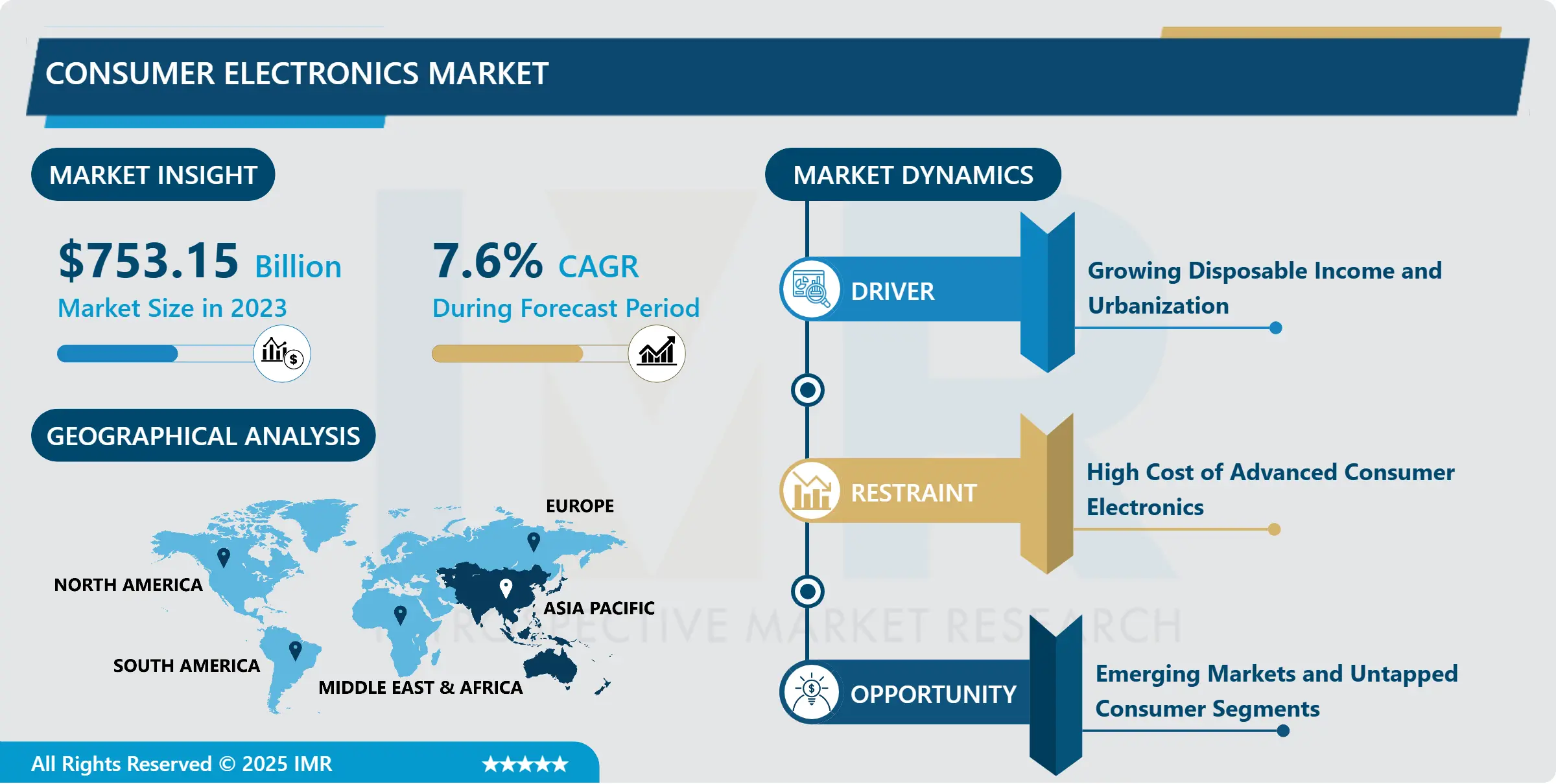
Consumer Electronics Market Size Was Valued at USD 753.15 Billion in 2023, and is Projected to Reach USD 1456.10 Billion by 2032, Growing at a CAGR of 7.60% From 2024-2032.

IMR Group
Description
Consumer Electronics Market Synopsis:
Consumer Electronics Market Size Was Valued at USD 753.15 Billion in 2023, and is Projected to Reach USD 1456.10 Billion by 2032, Growing at a CAGR of 7.60% From 2024-2032.
Consumer electronics can be defined as the group of products within the electronics industry for the creation, sale and distribution of electric equipment for home usage. Such devices can be home theaters, personal care gadgets and other smart home appliances, wearable devices, smart portable devices such as smart phones and tablets that contribute making people life easier.
The advancement in technology has remained the key driver of the growth of consumer electronics mainly the Artificial intelligence (AI), 5G and IoT. They have been realizing the development of smarter and more connected devices and therefore raising the expectations of the consumers for the products that provide more value-added services, convenience, and customization. There is increasing demand for high technology such as artificial intelligence and voices in devices and equipment, all of which help to grow the market.
Along the same side, the disposable income, as well as the change in the general consumer’s lifestyles, especially in the emergent markets are also encouraging the consumer electronics industry. With increased affordability from the consumers, it triggers the demand on high end products such as smart phones, smart TVs, smart and fashionable wearable and any other fashionable electronics. Furthermore, growing tendencies towards distant work, distance learning, using means of digital entertainment have increased sales in several segments of consumer electronics market.
Consumer Electronics Market Trend Analysis:
Rapid adoption of smart home technology
Most market players are now experimenting with smart home devices, which include smart speakers, thermostats, lighting, and security installations among others. The addition of different voice assistants such as amazon Alexa, Google Assistant and Apple siri is helping to increase the operability and interactivity of these item. Smart products such as smart locks, lights, thermostats and smart hubs that give consumers more control, automation and energy savings for smart homes that present product opportunities.
Another important trend can be singled out – the use of wearable electronics: sports’ trackers, smart wristbands, clothes with inserts, AR glasses, and others. Every year, these devices are getting smarter, some of the new add-ons include health, GPS among others and the ability to interconnect with other devices. With people concerned about their health and wellbeing, fitness and wellness becoming more and more popular, people are likely to turn to wearables and seek real-time biometric data making wearables a category of consumer electronics.
Expansion of 5G technology
Consumer electronics company have a good chance of creating new products that can take advantage of the advanced 5G internet connectivity. That includes likely improvements in the quality of games as well as movies and other video-based stuff, as well as the creation of new types of augmented reality (AR) and of virtual reality (VR) devices. Concerning areas of application, it is possible to note that today there is a constant growth in the demand for higher performance among consumers, both in the entertainment context and in the professional one.
Also, there is increase in green consciousness to aid the consumer electronics market in embracing green product and green technology. Environmentally friendly issues such as energy conservation, use of recyclable paper, and control of e-waste is a growing concern among the consumers and as such brands have shifted to ensuring they produce energy conserving devices, use of recyclable material in their products, and lastly reducing on e-waste production. Businesses that act sustainably might get an advantage, fulfilling the needs of the consumer who care about the environment.
Consumer Electronics Market Segment Analysis:
Consumer Electronics Market is Segmented on the basis of Product Type, Technology, Application, End User, and Region.
By Product Type, Audio & Video Devices segment is expected to dominate the market during the forecast period
Audio & video devices, home appliances, wearable electronics, gaming consoles, mobile telecommunications & tablets, personal care devices, and computer & office equipment. Home electronics consisting of smart TVs, sound systems are major appliance in entertainment while home appliances including refrigerators, washing machines are devices that make home living easier. Smart electronics apparel and wearable technology like smartwatches, fitness bands and other health monitoring devices meet the consumers need for health and fitness. Video games are still used in a social setting for entertainment & mobile tablets & smart phones keep on having the largest chunk of the mobile devices. , the personal care electronics such as electric shavers and hair straighteners enhances easy do it yourself grooming and the computer and office equipment are necessary for both individual and business use due to work from home culture.
By Application, Entertainment segment expected to held the largest share
There is no doubt that the best consumer electronics market fire at several areas of application some of the most important among them are entertainment, health and fitness, communication, education, home automation, and games. In entertainment, forms such as smart TVs, home audio systems and innovative streaming interfaces are very core to the consumer… The areas of application in Healthcare and fitness benefitted by the emergence of wearable products that monitor health parameters and fitness. In the area of communication, owners of smart and tablet devices can be connected to the network at any time, in the educational process, electronic devices carry out e-learning and remote classes. Within the smart home sector there is development of more connected devices and more control over spaces within the home while gaming continues to be a highly engaged sector with consoles, personal computers, and mobile devices reaching an almost unmeasurable amount of new users.
Consumer Electronics Market Regional Insights:
Asia Pacific is Expected to Dominate the Market Over the Forecast period
APAC paves its way to the largest consumer electronics market share in the global economy. The current inclination is basically caused by countries like China, Japan and South Korea with industry goliaths like Samsung, Sony, LG and others. Moreover, technology such as mobile electronics has been fast adopted in the region mainly in countries such as India and China and therefore Such factors have boosted the growth of the market in the region. The large manufacturing industry, lower costs of manufacturing, and high consumer market remain a major draw for consumer electronics market.
Furthermore, the supply chain of the APAC region is quite strong; and there is considerable R&D going on in this area. Large manufactures such as Apple, Samsung and other information technology companies, along with an increasing demand for new products in emerging markets within the APAC region confirms that the APAC will remain the leading consumer electronics industry in the near future.
Active Key Players in the Consumer Electronics Market
Apple Inc. (United States)
Dell Technologies (United States)
Huawei Technologies (China)
LG Electronics (South Korea)
Microsoft Corporation (United States)
Panasonic Corporation (Japan)
Samsung Electronics (South Korea)
Sony Corporation (Japan)
Toshiba Corporation (Japan)
Xiaomi Corporation (China)
Other Active Players.
Chapter 1: Introduction
1.1 Scope and Coverage
Chapter 2:Executive Summary
Chapter 3: Market Landscape
3.1 Market Dynamics
3.1.1 Drivers
3.1.2 Restraints
3.1.3 Opportunities
3.1.4 Challenges
3.2 Market Trend Analysis
3.3 PESTLE Analysis
3.4 Porter’s Five Forces Analysis
3.5 Industry Value Chain Analysis
3.6 Ecosystem
3.7 Regulatory Landscape
3.8 Price Trend Analysis
3.9 Patent Analysis
3.10 Technology Evolution
3.11 Investment Pockets
3.12 Import-Export Analysis
Chapter 4: Consumer Electronics Market by Product Type
4.1 Consumer Electronics Market Snapshot and Growth Engine
4.2 Consumer Electronics Market Overview
4.3 Audio & Video Devices
4.3.1 Introduction and Market Overview
4.3.2 Historic and Forecasted Market Size in Value USD and Volume Units (2017-2032F)
4.3.3 Key Market Trends, Growth Factors and Opportunities
4.3.4 Audio & Video Devices: Geographic Segmentation Analysis
4.4 Home Appliances
4.4.1 Introduction and Market Overview
4.4.2 Historic and Forecasted Market Size in Value USD and Volume Units (2017-2032F)
4.4.3 Key Market Trends, Growth Factors and Opportunities
4.4.4 Home Appliances: Geographic Segmentation Analysis
4.5 Wearable Electronics
4.5.1 Introduction and Market Overview
4.5.2 Historic and Forecasted Market Size in Value USD and Volume Units (2017-2032F)
4.5.3 Key Market Trends, Growth Factors and Opportunities
4.5.4 Wearable Electronics: Geographic Segmentation Analysis
4.6 Gaming Consoles
4.6.1 Introduction and Market Overview
4.6.2 Historic and Forecasted Market Size in Value USD and Volume Units (2017-2032F)
4.6.3 Key Market Trends, Growth Factors and Opportunities
4.6.4 Gaming Consoles: Geographic Segmentation Analysis
4.7 Smartphones & Tablets
4.7.1 Introduction and Market Overview
4.7.2 Historic and Forecasted Market Size in Value USD and Volume Units (2017-2032F)
4.7.3 Key Market Trends, Growth Factors and Opportunities
4.7.4 Smartphones & Tablets: Geographic Segmentation Analysis
4.8 Personal Care Electronics
4.8.1 Introduction and Market Overview
4.8.2 Historic and Forecasted Market Size in Value USD and Volume Units (2017-2032F)
4.8.3 Key Market Trends, Growth Factors and Opportunities
4.8.4 Personal Care Electronics: Geographic Segmentation Analysis
4.9 Computer & Office Equipment
4.9.1 Introduction and Market Overview
4.9.2 Historic and Forecasted Market Size in Value USD and Volume Units (2017-2032F)
4.9.3 Key Market Trends, Growth Factors and Opportunities
4.9.4 Computer & Office Equipment: Geographic Segmentation Analysis
Chapter 5: Consumer Electronics Market by Technology
5.1 Consumer Electronics Market Snapshot and Growth Engine
5.2 Consumer Electronics Market Overview
5.3 LCD/LED/OLED
5.3.1 Introduction and Market Overview
5.3.2 Historic and Forecasted Market Size in Value USD and Volume Units (2017-2032F)
5.3.3 Key Market Trends, Growth Factors and Opportunities
5.3.4 LCD/LED/OLED: Geographic Segmentation Analysis
5.4 Smart Technology
5.4.1 Introduction and Market Overview
5.4.2 Historic and Forecasted Market Size in Value USD and Volume Units (2017-2032F)
5.4.3 Key Market Trends, Growth Factors and Opportunities
5.4.4 Smart Technology: Geographic Segmentation Analysis
5.5 Touchscreen
5.5.1 Introduction and Market Overview
5.5.2 Historic and Forecasted Market Size in Value USD and Volume Units (2017-2032F)
5.5.3 Key Market Trends, Growth Factors and Opportunities
5.5.4 Touchscreen: Geographic Segmentation Analysis
5.6 Voice Control
5.6.1 Introduction and Market Overview
5.6.2 Historic and Forecasted Market Size in Value USD and Volume Units (2017-2032F)
5.6.3 Key Market Trends, Growth Factors and Opportunities
5.6.4 Voice Control: Geographic Segmentation Analysis
5.7 Artificial Intelligence (AI) Integration
5.7.1 Introduction and Market Overview
5.7.2 Historic and Forecasted Market Size in Value USD and Volume Units (2017-2032F)
5.7.3 Key Market Trends, Growth Factors and Opportunities
5.7.4 Artificial Intelligence (AI) Integration: Geographic Segmentation Analysis
Chapter 6: Consumer Electronics Market by Application
6.1 Consumer Electronics Market Snapshot and Growth Engine
6.2 Consumer Electronics Market Overview
6.3 Entertainment
6.3.1 Introduction and Market Overview
6.3.2 Historic and Forecasted Market Size in Value USD and Volume Units (2017-2032F)
6.3.3 Key Market Trends, Growth Factors and Opportunities
6.3.4 Entertainment: Geographic Segmentation Analysis
6.4 Healthcare & Fitness
6.4.1 Introduction and Market Overview
6.4.2 Historic and Forecasted Market Size in Value USD and Volume Units (2017-2032F)
6.4.3 Key Market Trends, Growth Factors and Opportunities
6.4.4 Healthcare & Fitness: Geographic Segmentation Analysis
6.5 Communication
6.5.1 Introduction and Market Overview
6.5.2 Historic and Forecasted Market Size in Value USD and Volume Units (2017-2032F)
6.5.3 Key Market Trends, Growth Factors and Opportunities
6.5.4 Communication: Geographic Segmentation Analysis
6.6 Education
6.6.1 Introduction and Market Overview
6.6.2 Historic and Forecasted Market Size in Value USD and Volume Units (2017-2032F)
6.6.3 Key Market Trends, Growth Factors and Opportunities
6.6.4 Education: Geographic Segmentation Analysis
6.7 Smart Homes
6.7.1 Introduction and Market Overview
6.7.2 Historic and Forecasted Market Size in Value USD and Volume Units (2017-2032F)
6.7.3 Key Market Trends, Growth Factors and Opportunities
6.7.4 Smart Homes: Geographic Segmentation Analysis
6.8 Gaming
6.8.1 Introduction and Market Overview
6.8.2 Historic and Forecasted Market Size in Value USD and Volume Units (2017-2032F)
6.8.3 Key Market Trends, Growth Factors and Opportunities
6.8.4 Gaming: Geographic Segmentation Analysis
Chapter 7: Consumer Electronics Market by End User
7.1 Consumer Electronics Market Snapshot and Growth Engine
7.2 Consumer Electronics Market Overview
7.3 Individual Consumers
7.3.1 Introduction and Market Overview
7.3.2 Historic and Forecasted Market Size in Value USD and Volume Units (2017-2032F)
7.3.3 Key Market Trends, Growth Factors and Opportunities
7.3.4 Individual Consumers: Geographic Segmentation Analysis
7.4 Commercial & Industrial
7.4.1 Introduction and Market Overview
7.4.2 Historic and Forecasted Market Size in Value USD and Volume Units (2017-2032F)
7.4.3 Key Market Trends, Growth Factors and Opportunities
7.4.4 Commercial & Industrial: Geographic Segmentation Analysis
7.5 Educational Institutions
7.5.1 Introduction and Market Overview
7.5.2 Historic and Forecasted Market Size in Value USD and Volume Units (2017-2032F)
7.5.3 Key Market Trends, Growth Factors and Opportunities
7.5.4 Educational Institutions: Geographic Segmentation Analysis
7.6 Healthcare Providers
7.6.1 Introduction and Market Overview
7.6.2 Historic and Forecasted Market Size in Value USD and Volume Units (2017-2032F)
7.6.3 Key Market Trends, Growth Factors and Opportunities
7.6.4 Healthcare Providers: Geographic Segmentation Analysis
Chapter 8: Company Profiles and Competitive Analysis
8.1 Competitive Landscape
8.1.1 Competitive Benchmarking
8.1.2 Consumer Electronics Market Share by Manufacturer (2023)
8.1.3 Industry BCG Matrix
8.1.4 Heat Map Analysis
8.1.5 Mergers and Acquisitions
8.2 SAMSUNG ELECTRONICS (SOUTH KOREA)
8.2.1 Company Overview
8.2.2 Key Executives
8.2.3 Company Snapshot
8.2.4 Role of the Company in the Market
8.2.5 Sustainability and Social Responsibility
8.2.6 Operating Business Segments
8.2.7 Product Portfolio
8.2.8 Business Performance
8.2.9 Key Strategic Moves and Recent Developments
8.2.10 SWOT Analysis
8.3 APPLE INC. (UNITED STATES)
8.4 SONY CORPORATION (JAPAN)
8.5 LG ELECTRONICS (SOUTH KOREA)
8.6 PANASONIC CORPORATION (JAPAN)
8.7 MICROSOFT CORPORATION (UNITED STATES)
8.8 HUAWEI TECHNOLOGIES (CHINA)
8.9 XIAOMI CORPORATION (CHINA)
8.10 DELL TECHNOLOGIES (UNITED STATES)
8.11 TOSHIBA CORPORATION (JAPAN)
8.12 OTHER ACTIVE PLAYERS
Chapter 9: Global Consumer Electronics Market By Region
9.1 Overview
9.2. North America Consumer Electronics Market
9.2.1 Key Market Trends, Growth Factors and Opportunities
9.2.2 Top Key Companies
9.2.3 Historic and Forecasted Market Size by Segments
9.2.4 Historic and Forecasted Market Size By Product Type
9.2.4.1 Audio & Video Devices
9.2.4.2 Home Appliances
9.2.4.3 Wearable Electronics
9.2.4.4 Gaming Consoles
9.2.4.5 Smartphones & Tablets
9.2.4.6 Personal Care Electronics
9.2.4.7 Computer & Office Equipment
9.2.5 Historic and Forecasted Market Size By Technology
9.2.5.1 LCD/LED/OLED
9.2.5.2 Smart Technology
9.2.5.3 Touchscreen
9.2.5.4 Voice Control
9.2.5.5 Artificial Intelligence (AI) Integration
9.2.6 Historic and Forecasted Market Size By Application
9.2.6.1 Entertainment
9.2.6.2 Healthcare & Fitness
9.2.6.3 Communication
9.2.6.4 Education
9.2.6.5 Smart Homes
9.2.6.6 Gaming
9.2.7 Historic and Forecasted Market Size By End User
9.2.7.1 Individual Consumers
9.2.7.2 Commercial & Industrial
9.2.7.3 Educational Institutions
9.2.7.4 Healthcare Providers
9.2.8 Historic and Forecast Market Size by Country
9.2.8.1 US
9.2.8.2 Canada
9.2.8.3 Mexico
9.3. Eastern Europe Consumer Electronics Market
9.3.1 Key Market Trends, Growth Factors and Opportunities
9.3.2 Top Key Companies
9.3.3 Historic and Forecasted Market Size by Segments
9.3.4 Historic and Forecasted Market Size By Product Type
9.3.4.1 Audio & Video Devices
9.3.4.2 Home Appliances
9.3.4.3 Wearable Electronics
9.3.4.4 Gaming Consoles
9.3.4.5 Smartphones & Tablets
9.3.4.6 Personal Care Electronics
9.3.4.7 Computer & Office Equipment
9.3.5 Historic and Forecasted Market Size By Technology
9.3.5.1 LCD/LED/OLED
9.3.5.2 Smart Technology
9.3.5.3 Touchscreen
9.3.5.4 Voice Control
9.3.5.5 Artificial Intelligence (AI) Integration
9.3.6 Historic and Forecasted Market Size By Application
9.3.6.1 Entertainment
9.3.6.2 Healthcare & Fitness
9.3.6.3 Communication
9.3.6.4 Education
9.3.6.5 Smart Homes
9.3.6.6 Gaming
9.3.7 Historic and Forecasted Market Size By End User
9.3.7.1 Individual Consumers
9.3.7.2 Commercial & Industrial
9.3.7.3 Educational Institutions
9.3.7.4 Healthcare Providers
9.3.8 Historic and Forecast Market Size by Country
9.3.8.1 Russia
9.3.8.2 Bulgaria
9.3.8.3 The Czech Republic
9.3.8.4 Hungary
9.3.8.5 Poland
9.3.8.6 Romania
9.3.8.7 Rest of Eastern Europe
9.4. Western Europe Consumer Electronics Market
9.4.1 Key Market Trends, Growth Factors and Opportunities
9.4.2 Top Key Companies
9.4.3 Historic and Forecasted Market Size by Segments
9.4.4 Historic and Forecasted Market Size By Product Type
9.4.4.1 Audio & Video Devices
9.4.4.2 Home Appliances
9.4.4.3 Wearable Electronics
9.4.4.4 Gaming Consoles
9.4.4.5 Smartphones & Tablets
9.4.4.6 Personal Care Electronics
9.4.4.7 Computer & Office Equipment
9.4.5 Historic and Forecasted Market Size By Technology
9.4.5.1 LCD/LED/OLED
9.4.5.2 Smart Technology
9.4.5.3 Touchscreen
9.4.5.4 Voice Control
9.4.5.5 Artificial Intelligence (AI) Integration
9.4.6 Historic and Forecasted Market Size By Application
9.4.6.1 Entertainment
9.4.6.2 Healthcare & Fitness
9.4.6.3 Communication
9.4.6.4 Education
9.4.6.5 Smart Homes
9.4.6.6 Gaming
9.4.7 Historic and Forecasted Market Size By End User
9.4.7.1 Individual Consumers
9.4.7.2 Commercial & Industrial
9.4.7.3 Educational Institutions
9.4.7.4 Healthcare Providers
9.4.8 Historic and Forecast Market Size by Country
9.4.8.1 Germany
9.4.8.2 UK
9.4.8.3 France
9.4.8.4 The Netherlands
9.4.8.5 Italy
9.4.8.6 Spain
9.4.8.7 Rest of Western Europe
9.5. Asia Pacific Consumer Electronics Market
9.5.1 Key Market Trends, Growth Factors and Opportunities
9.5.2 Top Key Companies
9.5.3 Historic and Forecasted Market Size by Segments
9.5.4 Historic and Forecasted Market Size By Product Type
9.5.4.1 Audio & Video Devices
9.5.4.2 Home Appliances
9.5.4.3 Wearable Electronics
9.5.4.4 Gaming Consoles
9.5.4.5 Smartphones & Tablets
9.5.4.6 Personal Care Electronics
9.5.4.7 Computer & Office Equipment
9.5.5 Historic and Forecasted Market Size By Technology
9.5.5.1 LCD/LED/OLED
9.5.5.2 Smart Technology
9.5.5.3 Touchscreen
9.5.5.4 Voice Control
9.5.5.5 Artificial Intelligence (AI) Integration
9.5.6 Historic and Forecasted Market Size By Application
9.5.6.1 Entertainment
9.5.6.2 Healthcare & Fitness
9.5.6.3 Communication
9.5.6.4 Education
9.5.6.5 Smart Homes
9.5.6.6 Gaming
9.5.7 Historic and Forecasted Market Size By End User
9.5.7.1 Individual Consumers
9.5.7.2 Commercial & Industrial
9.5.7.3 Educational Institutions
9.5.7.4 Healthcare Providers
9.5.8 Historic and Forecast Market Size by Country
9.5.8.1 China
9.5.8.2 India
9.5.8.3 Japan
9.5.8.4 South Korea
9.5.8.5 Malaysia
9.5.8.6 Thailand
9.5.8.7 Vietnam
9.5.8.8 The Philippines
9.5.8.9 Australia
9.5.8.10 New Zealand
9.5.8.11 Rest of APAC
9.6. Middle East & Africa Consumer Electronics Market
9.6.1 Key Market Trends, Growth Factors and Opportunities
9.6.2 Top Key Companies
9.6.3 Historic and Forecasted Market Size by Segments
9.6.4 Historic and Forecasted Market Size By Product Type
9.6.4.1 Audio & Video Devices
9.6.4.2 Home Appliances
9.6.4.3 Wearable Electronics
9.6.4.4 Gaming Consoles
9.6.4.5 Smartphones & Tablets
9.6.4.6 Personal Care Electronics
9.6.4.7 Computer & Office Equipment
9.6.5 Historic and Forecasted Market Size By Technology
9.6.5.1 LCD/LED/OLED
9.6.5.2 Smart Technology
9.6.5.3 Touchscreen
9.6.5.4 Voice Control
9.6.5.5 Artificial Intelligence (AI) Integration
9.6.6 Historic and Forecasted Market Size By Application
9.6.6.1 Entertainment
9.6.6.2 Healthcare & Fitness
9.6.6.3 Communication
9.6.6.4 Education
9.6.6.5 Smart Homes
9.6.6.6 Gaming
9.6.7 Historic and Forecasted Market Size By End User
9.6.7.1 Individual Consumers
9.6.7.2 Commercial & Industrial
9.6.7.3 Educational Institutions
9.6.7.4 Healthcare Providers
9.6.8 Historic and Forecast Market Size by Country
9.6.8.1 Turkiye
9.6.8.2 Bahrain
9.6.8.3 Kuwait
9.6.8.4 Saudi Arabia
9.6.8.5 Qatar
9.6.8.6 UAE
9.6.8.7 Israel
9.6.8.8 South Africa
9.7. South America Consumer Electronics Market
9.7.1 Key Market Trends, Growth Factors and Opportunities
9.7.2 Top Key Companies
9.7.3 Historic and Forecasted Market Size by Segments
9.7.4 Historic and Forecasted Market Size By Product Type
9.7.4.1 Audio & Video Devices
9.7.4.2 Home Appliances
9.7.4.3 Wearable Electronics
9.7.4.4 Gaming Consoles
9.7.4.5 Smartphones & Tablets
9.7.4.6 Personal Care Electronics
9.7.4.7 Computer & Office Equipment
9.7.5 Historic and Forecasted Market Size By Technology
9.7.5.1 LCD/LED/OLED
9.7.5.2 Smart Technology
9.7.5.3 Touchscreen
9.7.5.4 Voice Control
9.7.5.5 Artificial Intelligence (AI) Integration
9.7.6 Historic and Forecasted Market Size By Application
9.7.6.1 Entertainment
9.7.6.2 Healthcare & Fitness
9.7.6.3 Communication
9.7.6.4 Education
9.7.6.5 Smart Homes
9.7.6.6 Gaming
9.7.7 Historic and Forecasted Market Size By End User
9.7.7.1 Individual Consumers
9.7.7.2 Commercial & Industrial
9.7.7.3 Educational Institutions
9.7.7.4 Healthcare Providers
9.7.8 Historic and Forecast Market Size by Country
9.7.8.1 Brazil
9.7.8.2 Argentina
9.7.8.3 Rest of SA
Chapter 10 Analyst Viewpoint and Conclusion
10.1 Recommendations and Concluding Analysis
10.2 Potential Market Strategies
Chapter 11 Research Methodology
11.1 Research Process
11.2 Primary Research
11.3 Secondary Research
Q1: What would be the forecast period in the Consumer Electronics Market research report?
A1: The forecast period in the Consumer Electronics Market research report is 2024-2032.
Q2: Who are the key players in the Consumer Electronics Market?
A2: Samsung Electronics (South Korea), Apple Inc. (United States), Sony Corporation (Japan), LG Electronics (South Korea), Panasonic Corporation (Japan), Microsoft Corporation (United States), Huawei Technologies (China), Xiaomi Corporation (China), Dell Technologies (United States), Toshiba Corporation (Japan), and Other Active Players.
Q3: What are the segments of the Consumer Electronics Market?
A3: The Consumer Electronics Market is segmented into by Product Type (Audio & Video Devices, Home Appliances, Wearable Electronics, Gaming Consoles, Smartphones & Tablets, Personal Care Electronics, Computer & Office Equipment), By Technology (LCD/LED/OLED, Smart Technology, Touchscreen, Voice Control, Artificial Intelligence (AI) Integration), Application (Entertainment, Healthcare & Fitness, Communication, Education, Smart Homes, Gaming), End User (Individual Consumers, Commercial & Industrial, Educational Institutions, Healthcare Providers). By region, it is analyzed across North America (U.S., Canada, Mexico), Eastern Europe (Russia, Bulgaria, The Czech Republic, Hungary, Poland, Romania, Rest of Eastern Europe), Western Europe (Germany, UK, France, The Netherlands, Italy, Russia, Spain, Rest of Western Europe), Asia Pacific (China, India, Japan, South Korea, Malaysia, Thailand, Vietnam, The Philippines, Australia, New-Zealand, Rest of APAC), Middle East & Africa (Turkiye, Bahrain, Kuwait, Saudi Arabia, Qatar, UAE, Israel, South Africa), South America (Brazil, Argentina, Rest of SA).
Q4: What is the Consumer Electronics Market?
A4: Consumer electronics can be defined as the group of products within the electronics industry for the creation, sale and distribution of electric equipment for home usage. Such devices can be home theaters, personal care gadgets and other smart home appliances, wearable devices, smart portable devices such as smart phones and tablets that contribute making people life easier.
Q5: How big is the Consumer Electronics Market?
A5: Consumer Electronics Market Size Was Valued at USD 753.15 Billion in 2023, and is Projected to Reach USD 1456.10 Billion by 2032, Growing at a CAGR of 7.60% From 2024-2032.
How to Buy a Report from eminsights.jp
On the product page, choose the license you want: Single-User License, Multi-User License or Enterprise License.
If you required report in your native language, then you can click on Translated Report button and fill out the form with report name and language you want, then our team will contact you as soon as possible.
Click the Buy Now button.
You will be redirected to the checkout page. Enter your company details and payment information.
Click Place Order to complete the purchase.
Confirmation: You’ll receive an order confirmation and our team will contact you shortly with your ordered report.
If you have any questions, fill out the contact form below or email us at bizdev@eminsights.net.
Thank you for choosing eminsights.jp!