Stay Ahead in Fast-Growing Economies.
Browse Reports Now
Compressed Bio Gas (CBG) Market – Size & Outlook 2025-2032
Compressed Biogas or CBG is a purified version of the biogas, comparable to natural gas that comes from the processing of organic wastes such as agricultural wastes, food wastes, and animal manure.

IMR Group
Description
Compressed Bio Gas (CBG) Market Synopsis:
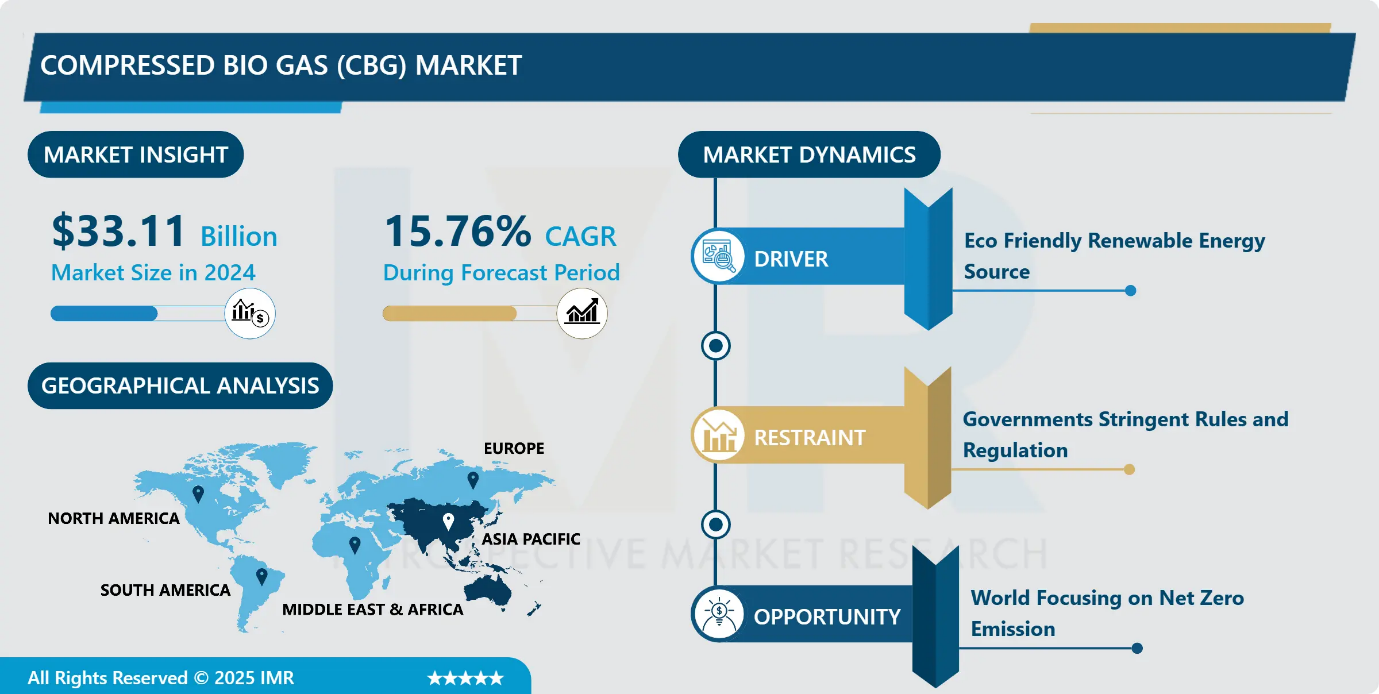
Compressed Bio Gas (CBG) Market Size Was Valued at USD 33.11 Billion in 2024, and is Projected to Reach USD 106.76 Billion by 2032, Growing at a CAGR of 15.76% From 2024-2032.
Compressed Biogas or CBG is a purified version of the biogas, comparable to natural gas that comes from the processing of organic wastes such as agricultural wastes, food wastes, and animal manure. Impurities such as carbon dioxide, hydrogen sulfide, and moisture are removed from the raw biogas, leaving behind the fuel rich in methane, usually over 90%. After purification, the gas is compressed up to high pressures, usually around 200-250 bar for easier storage, and transportation use.
CBG can be used as a clean fuel for vehicles, injected into gas pipelines, or utilized for electricity generation in gas engines or turbines. Since it is from renewable sources, it contributes to reducing greenhouse gas emissions and dependence on fossil fuels. The Compressed Biogas Market is being driven by the growing need for non-polluting, clean energy sources to address rising energy demands that are environmentally friendly. As biogas is a safer way to dispose of garbage and maintain a clean environment, the growing population and rising generation of solid waste are boosting the market growth of this product. The Compressed Biogas Market is also being greatly stimulated by the high cost and unavailability of non-renewable energy sources, such as fossil fuels.
Compressed Bio Gas (CBG) Market Growth and Trend Analysis:
Eco Friendly Renewable Energy Source
Compression of Biogas (CBG) demonstrates exceptional promise as an eco-friendly renewable energy that pursues better emission reduction capabilities and reduces dependence on fossil fuels. Biogas facilities depend on compressed air applications throughout their complete process due to it enables biogas collection as well as vehicle fueling. Biogas viability as an environmentally friendly fuel alternative depends on compressed air which makes possible the collection of biogases and its upgrading and storage and distribution processes. The ongoing sustainable energy revolution depends on the strategic partnership of compressed air technology with biogas production operations.
Refined biogas, also known as green gas, biomethane, or PNG, replaces conventional fossil fuels and can be used to generate power and heat as well as to be injected into the gas matrix. The primary renewable energy source that can be used to generate heat, force, gas, and fluid fills is biomass. The energy produced by biogas is both environmentally friendly and incredibly adaptable. In contrast to other renewable energy sources like wind or solar energy, the production of biogas is very slightly impacted by the weather.
Governments Stringent Rules and Regulation
The growth of the biogas compression industry stems from countries worldwide focusing on renewables as a replacement for traditional fossil fuel energy sources. Governments worldwide are introducing stricter emission restrictions and environmental legislation that forces industries to choose biogas alongside other environmentally friendly energy solutions. Biogas compression has become essential because current waste management requirements demand effective solutions for municipal and agricultural facilities. Energy diversification accepts biogas as an attractive choice due to its capability for diminishing dependence on imported fossil fuels. Compressed biogas together with its produced power represents a sustainable energy system which operators can use for revenue generation.
World Focusing on Net Zero Emission
Each nation’s journey toward achieving net zero demands its own tailored approach which requires balancing growing energy needs against affordable prices while securing stable power supplies. The majority of industries attempt emission reduction through emerging technologies which include renewable power and green hydrogen and carbon capture while also needing substantial financial investment and new operational models. The established technology coupled with attractive economic value of compressed biogas (CBG) makes it an optimal solution for reaching decarbonization targets. A major part of the commitments aimed at decarbonization within difficult-to-decarbonize sectors like manufacturing and process industries depends entirely on CBG.
High Capital Investment
The Compressed Bio Gas (CBG) market, while promising as a sustainable energy alternative, faces several significant challenges that hinder its large-scale implementation. High Capital Investment and Long Payback Periods are among the primary barriers, as setting up CBG plants requires substantial funding, making it less attractive for small and medium enterprises. Feedstock Availability and Seasonal Fluctuations.
Compressed Bio Gas (CBG) Market Segment Analysis:
Compressed Bio Gas (CBG) Market is segmented based on feedstock type, technology application, end-user, distribution channel and region
By Distribution Channel, Direct Supply segment is expected to dominate the market during the forecast period
Direct supply serves as the leading distribution method throughout the worldwide compressed biogas (CBG) market. Major end-user demand drives the active distribution of CBG because these customers need continual bulk quantities for power generation and heat applications. Strong supply chains with dedicated pipelines together with efficient infrastructure like biogas upgrading plants and transportation systems make the market sustainable and enable smooth delivery of products to major user groups.
Government bodies together with private businesses allocate funds for building infrastructure which enhances direct supply networks and sustains market expansion through the years. The direct supply method enhances satisfaction through its reliable and efficient operations which help reduce delivery losses and maintains superior gas quality needed by continuous power-dependent industries. The CBG market remains under the control of direct supply distribution which efficiently serves extensive consumers while strengthening the industry growth.
By Application, Electricity and Heat Generation segment held the largest share in projected period
Electricity and heat generation are the most common uses of biogas in Germany, Brazil, Canada, France and Finland. In Denmark and Switzerland, a large share of the produced biogas is upgraded into biomethane and injected into the gas grid
According to the IEA, Sustainable fuels such as biofuels, hydrogen and hydrogen-based fuels provide 85 EJ of energy in 2050 in NZE, equal to global electricity demand today. By 2050 they support one quarter of global energy consumption
In line with this shift towards cleaner energy, the Compressed Biogas (CBG) market is projected to see electricity generation as the largest application segment during the forecast period. This highlights the growing role of CBG in renewable power production, supporting the global transition towards sustainable and low-carbon energy solutions.
Compressed Bio Gas (CBG) Market Regional Insights:
Asia Pacific is Expected to Dominate the Market Over the Forecast period
The Asia Pacific region is expected to dominate the Compressed Biogas (CBG) market over the forecast period, driven by the strong presence of China and India, two key players in biogas production and utilization.
China leads the global biogas industry with the highest number of biogas plants among the IEA Bioenergy Task 37 member countries. It has over 100,000 biogas plants, significantly outpacing other nations. In comparison, Germany has more than 10,000 plants, while France has over 1,600. Other countries with notable biogas infrastructure include Brazil (800+ plants), the UK (700+ plants), and several others with fewer than 500. Except for China, these figures represent the total number of digesters across all sizes and technical configurations.
India also holds immense potential in the CBG market, with the capacity to generate around 62 million tonnes of compressed biogas annually. This production volume could replace nearly 7% of the country’s current fuel consumption, making CBG a key contributor to India’s energy security and sustainability goals. With strong government initiatives and an increasing focus on renewable energy solutions, both China and India are set to drive the growth and expansion of the CBG market in the coming years.
Compressed Bio Gas (CBG) Market Active Players:
Air Liquide (France)
Bharat Biogas Energy Ltd. (India)
BioKraft (Sweden)
Carbon Masters (India)
Carbotech Gas Systems (Germany)
China Everbright Greentech (China)
China New Energy (China)
Cosan (Brazil)
Drax Group (UK)
EnviTec Biogas (Germany)
Green Elephant (India)
Greenlane Biogas (Canada)
Henan BCCY Environmental Energy (China)
Malmberg Water (Sweden)
Morrow Energy (USA)
POET (USA)
Renewable Energy Group (USA)
Spectrum Renewable Energy Limited (India)
Wärtsilä (Finland)
Xebec Adsorption (Canada)
Other Active Players
Key Industry Developments in the Compressed Bio Gas (CBG) Market:
In September 2024, The Indian tractor manufacturing company Mahindra Tractors has unveiled its first CBG (Compressed Bio-Gas) run Yuvo Tech+ tractor. The launch event featured Shri Nitin Gadkari, Honourable Minister of Road Transport and Highways.
In July 2024, Gruner Renewable Energy, a leader in sustainable biogas solutions in India, announced that it has secured US$ 60 million in funding. This investment will enable Gruner Renewable Energy to further expand its presence in the green energy domain as it moves ahead to establish new Compressed BioGas (CBG) plants across the country.
Chapter 1: Introduction
1.1 Scope and Coverage
Chapter 2:Executive Summary
Chapter 3: Market Landscape
3.1 Market Dynamics
3.1.1 Drivers
3.1.2 Restraints
3.1.3 Opportunities
3.1.4 Challenges
3.2 Market Trend Analysis
3.3 PESTLE Analysis
3.4 Porter’s Five Forces Analysis
3.5 Industry Value Chain Analysis
3.6 Ecosystem
3.7 Regulatory Landscape
3.8 Price Trend Analysis
3.9 Patent Analysis
3.10 Technology Evolution
3.11 Investment Pockets
3.12 Import-Export Analysis
Chapter 4: Compressed Bio Gas (CBG) Market by Feedstock Type
4.1 Compressed Bio Gas (CBG) Market Snapshot and Growth Engine
4.2 Compressed Bio Gas (CBG) Market Overview
4.3 Agricultural Residues (Crop Waste
4.3.1 Introduction and Market Overview
4.3.2 Historic and Forecasted Market Size in Value USD and Volume Units (2017-2032F)
4.3.3 Key Market Trends, Growth Factors and Opportunities
4.3.4 Agricultural Residues (Crop Waste: Geographic Segmentation Analysis
4.4 Straw
4.4.1 Introduction and Market Overview
4.4.2 Historic and Forecasted Market Size in Value USD and Volume Units (2017-2032F)
4.4.3 Key Market Trends, Growth Factors and Opportunities
4.4.4 Straw: Geographic Segmentation Analysis
4.5 Husks
4.5.1 Introduction and Market Overview
4.5.2 Historic and Forecasted Market Size in Value USD and Volume Units (2017-2032F)
4.5.3 Key Market Trends, Growth Factors and Opportunities
4.5.4 Husks: Geographic Segmentation Analysis
4.6 etc.)
4.6.1 Introduction and Market Overview
4.6.2 Historic and Forecasted Market Size in Value USD and Volume Units (2017-2032F)
4.6.3 Key Market Trends, Growth Factors and Opportunities
4.6.4 etc.): Geographic Segmentation Analysis
4.7 Animal Manure
4.7.1 Introduction and Market Overview
4.7.2 Historic and Forecasted Market Size in Value USD and Volume Units (2017-2032F)
4.7.3 Key Market Trends, Growth Factors and Opportunities
4.7.4 Animal Manure: Geographic Segmentation Analysis
4.8 Municipal Solid Waste (MSW)
4.8.1 Introduction and Market Overview
4.8.2 Historic and Forecasted Market Size in Value USD and Volume Units (2017-2032F)
4.8.3 Key Market Trends, Growth Factors and Opportunities
4.8.4 Municipal Solid Waste (MSW): Geographic Segmentation Analysis
4.9 Industrial Waste (Food Processing
4.9.1 Introduction and Market Overview
4.9.2 Historic and Forecasted Market Size in Value USD and Volume Units (2017-2032F)
4.9.3 Key Market Trends, Growth Factors and Opportunities
4.9.4 Industrial Waste (Food Processing: Geographic Segmentation Analysis
4.10 Brewery Waste
4.10.1 Introduction and Market Overview
4.10.2 Historic and Forecasted Market Size in Value USD and Volume Units (2017-2032F)
4.10.3 Key Market Trends, Growth Factors and Opportunities
4.10.4 Brewery Waste: Geographic Segmentation Analysis
4.11 etc.)
4.11.1 Introduction and Market Overview
4.11.2 Historic and Forecasted Market Size in Value USD and Volume Units (2017-2032F)
4.11.3 Key Market Trends, Growth Factors and Opportunities
4.11.4 etc.): Geographic Segmentation Analysis
4.12 Sewage Sludge
4.12.1 Introduction and Market Overview
4.12.2 Historic and Forecasted Market Size in Value USD and Volume Units (2017-2032F)
4.12.3 Key Market Trends, Growth Factors and Opportunities
4.12.4 Sewage Sludge: Geographic Segmentation Analysis
4.13 and Energy Crops
4.13.1 Introduction and Market Overview
4.13.2 Historic and Forecasted Market Size in Value USD and Volume Units (2017-2032F)
4.13.3 Key Market Trends, Growth Factors and Opportunities
4.13.4 and Energy Crops: Geographic Segmentation Analysis
Chapter 5: Compressed Bio Gas (CBG) Market by Technology
5.1 Compressed Bio Gas (CBG) Market Snapshot and Growth Engine
5.2 Compressed Bio Gas (CBG) Market Overview
5.3 Water Scrubbing
5.3.1 Introduction and Market Overview
5.3.2 Historic and Forecasted Market Size in Value USD and Volume Units (2017-2032F)
5.3.3 Key Market Trends, Growth Factors and Opportunities
5.3.4 Water Scrubbing: Geographic Segmentation Analysis
5.4 Membrane Separation
5.4.1 Introduction and Market Overview
5.4.2 Historic and Forecasted Market Size in Value USD and Volume Units (2017-2032F)
5.4.3 Key Market Trends, Growth Factors and Opportunities
5.4.4 Membrane Separation: Geographic Segmentation Analysis
5.5 Pressure Swing Adsorption (PSA)
5.5.1 Introduction and Market Overview
5.5.2 Historic and Forecasted Market Size in Value USD and Volume Units (2017-2032F)
5.5.3 Key Market Trends, Growth Factors and Opportunities
5.5.4 Pressure Swing Adsorption (PSA): Geographic Segmentation Analysis
5.6 Chemical Absorption
5.6.1 Introduction and Market Overview
5.6.2 Historic and Forecasted Market Size in Value USD and Volume Units (2017-2032F)
5.6.3 Key Market Trends, Growth Factors and Opportunities
5.6.4 Chemical Absorption: Geographic Segmentation Analysis
5.7 and Others {Cryogenic Separation
5.7.1 Introduction and Market Overview
5.7.2 Historic and Forecasted Market Size in Value USD and Volume Units (2017-2032F)
5.7.3 Key Market Trends, Growth Factors and Opportunities
5.7.4 and Others {Cryogenic Separation: Geographic Segmentation Analysis
5.8 Biological Purification}
5.8.1 Introduction and Market Overview
5.8.2 Historic and Forecasted Market Size in Value USD and Volume Units (2017-2032F)
5.8.3 Key Market Trends, Growth Factors and Opportunities
5.8.4 Biological Purification}: Geographic Segmentation Analysis
Chapter 6: Compressed Bio Gas (CBG) Market by Application
6.1 Compressed Bio Gas (CBG) Market Snapshot and Growth Engine
6.2 Compressed Bio Gas (CBG) Market Overview
6.3 Vehicle Fuel
6.3.1 Introduction and Market Overview
6.3.2 Historic and Forecasted Market Size in Value USD and Volume Units (2017-2032F)
6.3.3 Key Market Trends, Growth Factors and Opportunities
6.3.4 Vehicle Fuel: Geographic Segmentation Analysis
6.4 Electricity & Heat Generation
6.4.1 Introduction and Market Overview
6.4.2 Historic and Forecasted Market Size in Value USD and Volume Units (2017-2032F)
6.4.3 Key Market Trends, Growth Factors and Opportunities
6.4.4 Electricity & Heat Generation: Geographic Segmentation Analysis
6.5 Industrial Applications
6.5.1 Introduction and Market Overview
6.5.2 Historic and Forecasted Market Size in Value USD and Volume Units (2017-2032F)
6.5.3 Key Market Trends, Growth Factors and Opportunities
6.5.4 Industrial Applications: Geographic Segmentation Analysis
6.6 Commercial Uses
6.6.1 Introduction and Market Overview
6.6.2 Historic and Forecasted Market Size in Value USD and Volume Units (2017-2032F)
6.6.3 Key Market Trends, Growth Factors and Opportunities
6.6.4 Commercial Uses: Geographic Segmentation Analysis
6.7 Cooking Gas
6.7.1 Introduction and Market Overview
6.7.2 Historic and Forecasted Market Size in Value USD and Volume Units (2017-2032F)
6.7.3 Key Market Trends, Growth Factors and Opportunities
6.7.4 Cooking Gas: Geographic Segmentation Analysis
6.8 Others
6.8.1 Introduction and Market Overview
6.8.2 Historic and Forecasted Market Size in Value USD and Volume Units (2017-2032F)
6.8.3 Key Market Trends, Growth Factors and Opportunities
6.8.4 Others: Geographic Segmentation Analysis
Chapter 7: Compressed Bio Gas (CBG) Market by End-User
7.1 Compressed Bio Gas (CBG) Market Snapshot and Growth Engine
7.2 Compressed Bio Gas (CBG) Market Overview
7.3 Transportation Sector
7.3.1 Introduction and Market Overview
7.3.2 Historic and Forecasted Market Size in Value USD and Volume Units (2017-2032F)
7.3.3 Key Market Trends, Growth Factors and Opportunities
7.3.4 Transportation Sector: Geographic Segmentation Analysis
7.4 Power Generation Companies
7.4.1 Introduction and Market Overview
7.4.2 Historic and Forecasted Market Size in Value USD and Volume Units (2017-2032F)
7.4.3 Key Market Trends, Growth Factors and Opportunities
7.4.4 Power Generation Companies: Geographic Segmentation Analysis
7.5 Industrial & Manufacturing Facilities
7.5.1 Introduction and Market Overview
7.5.2 Historic and Forecasted Market Size in Value USD and Volume Units (2017-2032F)
7.5.3 Key Market Trends, Growth Factors and Opportunities
7.5.4 Industrial & Manufacturing Facilities: Geographic Segmentation Analysis
7.6 Municipal & Waste Management Authorities
7.6.1 Introduction and Market Overview
7.6.2 Historic and Forecasted Market Size in Value USD and Volume Units (2017-2032F)
7.6.3 Key Market Trends, Growth Factors and Opportunities
7.6.4 Municipal & Waste Management Authorities: Geographic Segmentation Analysis
7.7 Agriculture Sector
7.7.1 Introduction and Market Overview
7.7.2 Historic and Forecasted Market Size in Value USD and Volume Units (2017-2032F)
7.7.3 Key Market Trends, Growth Factors and Opportunities
7.7.4 Agriculture Sector: Geographic Segmentation Analysis
7.8 and Residential
7.8.1 Introduction and Market Overview
7.8.2 Historic and Forecasted Market Size in Value USD and Volume Units (2017-2032F)
7.8.3 Key Market Trends, Growth Factors and Opportunities
7.8.4 and Residential: Geographic Segmentation Analysis
Chapter 8: Compressed Bio Gas (CBG) Market by Distribution Channel
8.1 Compressed Bio Gas (CBG) Market Snapshot and Growth Engine
8.2 Compressed Bio Gas (CBG) Market Overview
8.3 Direct Supply and Retail Distribution
8.3.1 Introduction and Market Overview
8.3.2 Historic and Forecasted Market Size in Value USD and Volume Units (2017-2032F)
8.3.3 Key Market Trends, Growth Factors and Opportunities
8.3.4 Direct Supply and Retail Distribution: Geographic Segmentation Analysis
Chapter 9: Company Profiles and Competitive Analysis
9.1 Competitive Landscape
9.1.1 Competitive Benchmarking
9.1.2 Compressed Bio Gas (CBG) Market Share by Manufacturer (2024)
9.1.3 Industry BCG Matrix
9.1.4 Heat Map Analysis
9.1.5 Mergers and Acquisitions
9.2 GREENLANE BIOGAS (CANADA)
9.2.1 Company Overview
9.2.2 Key Executives
9.2.3 Company Snapshot
9.2.4 Role of the Company in the Market
9.2.5 Sustainability and Social Responsibility
9.2.6 Operating Business Segments
9.2.7 Product Portfolio
9.2.8 Business Performance
9.2.9 Key Strategic Moves and Recent Developments
9.2.10 SWOT Analysis
9.3 MALMBERG WATER (SWEDEN)
9.4 AIR LIQUIDE (FRANCE)
9.5 XEBEC ADSORPTION (CANADA)
9.6 CARBOTECH GAS SYSTEMS (GERMANY)
9.7 MORROW ENERGY (USA)
9.8 WÄRTSILÄ (FINLAND)
9.9 ENVITEC BIOGAS (GERMANY)
9.10 BIOKRAFT (SWEDEN)
9.11 GREEN ELEPHANT (INDIA)
9.12 SPECTRUM RENEWABLE ENERGY LIMITED (INDIA)
9.13 CARBON MASTERS (INDIA)
9.14 HENAN BCCY ENVIRONMENTAL ENERGY (CHINA)
9.15 CHINA NEW ENERGY (CHINA)
9.16 CHINA EVERBRIGHT GREENTECH (CHINA)
9.17 BHARAT BIOGAS ENERGY LTD. (INDIA)
9.18 RENEWABLE ENERGY GROUP (USA)
9.19 POET (USA)
9.20 DRAX GROUP (UK)
9.21 COSAN (BRAZIL)
9.22 OTHER ACTIVE PLAYERS.
Chapter 10: Global Compressed Bio Gas (CBG) Market By Region
10.1 Overview
10.2. North America Compressed Bio Gas (CBG) Market
10.2.1 Key Market Trends, Growth Factors and Opportunities
10.2.2 Top Key Companies
10.2.3 Historic and Forecasted Market Size by Segments
10.2.4 Historic and Forecasted Market Size By Feedstock Type
10.2.4.1 Agricultural Residues (Crop Waste
10.2.4.2 Straw
10.2.4.3 Husks
10.2.4.4 etc.)
10.2.4.5 Animal Manure
10.2.4.6 Municipal Solid Waste (MSW)
10.2.4.7 Industrial Waste (Food Processing
10.2.4.8 Brewery Waste
10.2.4.9 etc.)
10.2.4.10 Sewage Sludge
10.2.4.11 and Energy Crops
10.2.5 Historic and Forecasted Market Size By Technology
10.2.5.1 Water Scrubbing
10.2.5.2 Membrane Separation
10.2.5.3 Pressure Swing Adsorption (PSA)
10.2.5.4 Chemical Absorption
10.2.5.5 and Others {Cryogenic Separation
10.2.5.6 Biological Purification}
10.2.6 Historic and Forecasted Market Size By Application
10.2.6.1 Vehicle Fuel
10.2.6.2 Electricity & Heat Generation
10.2.6.3 Industrial Applications
10.2.6.4 Commercial Uses
10.2.6.5 Cooking Gas
10.2.6.6 Others
10.2.7 Historic and Forecasted Market Size By End-User
10.2.7.1 Transportation Sector
10.2.7.2 Power Generation Companies
10.2.7.3 Industrial & Manufacturing Facilities
10.2.7.4 Municipal & Waste Management Authorities
10.2.7.5 Agriculture Sector
10.2.7.6 and Residential
10.2.8 Historic and Forecasted Market Size By Distribution Channel
10.2.8.1 Direct Supply and Retail Distribution
10.2.9 Historic and Forecast Market Size by Country
10.2.9.1 US
10.2.9.2 Canada
10.2.9.3 Mexico
10.3. Eastern Europe Compressed Bio Gas (CBG) Market
10.3.1 Key Market Trends, Growth Factors and Opportunities
10.3.2 Top Key Companies
10.3.3 Historic and Forecasted Market Size by Segments
10.3.4 Historic and Forecasted Market Size By Feedstock Type
10.3.4.1 Agricultural Residues (Crop Waste
10.3.4.2 Straw
10.3.4.3 Husks
10.3.4.4 etc.)
10.3.4.5 Animal Manure
10.3.4.6 Municipal Solid Waste (MSW)
10.3.4.7 Industrial Waste (Food Processing
10.3.4.8 Brewery Waste
10.3.4.9 etc.)
10.3.4.10 Sewage Sludge
10.3.4.11 and Energy Crops
10.3.5 Historic and Forecasted Market Size By Technology
10.3.5.1 Water Scrubbing
10.3.5.2 Membrane Separation
10.3.5.3 Pressure Swing Adsorption (PSA)
10.3.5.4 Chemical Absorption
10.3.5.5 and Others {Cryogenic Separation
10.3.5.6 Biological Purification}
10.3.6 Historic and Forecasted Market Size By Application
10.3.6.1 Vehicle Fuel
10.3.6.2 Electricity & Heat Generation
10.3.6.3 Industrial Applications
10.3.6.4 Commercial Uses
10.3.6.5 Cooking Gas
10.3.6.6 Others
10.3.7 Historic and Forecasted Market Size By End-User
10.3.7.1 Transportation Sector
10.3.7.2 Power Generation Companies
10.3.7.3 Industrial & Manufacturing Facilities
10.3.7.4 Municipal & Waste Management Authorities
10.3.7.5 Agriculture Sector
10.3.7.6 and Residential
10.3.8 Historic and Forecasted Market Size By Distribution Channel
10.3.8.1 Direct Supply and Retail Distribution
10.3.9 Historic and Forecast Market Size by Country
10.3.9.1 Russia
10.3.9.2 Bulgaria
10.3.9.3 The Czech Republic
10.3.9.4 Hungary
10.3.9.5 Poland
10.3.9.6 Romania
10.3.9.7 Rest of Eastern Europe
10.4. Western Europe Compressed Bio Gas (CBG) Market
10.4.1 Key Market Trends, Growth Factors and Opportunities
10.4.2 Top Key Companies
10.4.3 Historic and Forecasted Market Size by Segments
10.4.4 Historic and Forecasted Market Size By Feedstock Type
10.4.4.1 Agricultural Residues (Crop Waste
10.4.4.2 Straw
10.4.4.3 Husks
10.4.4.4 etc.)
10.4.4.5 Animal Manure
10.4.4.6 Municipal Solid Waste (MSW)
10.4.4.7 Industrial Waste (Food Processing
10.4.4.8 Brewery Waste
10.4.4.9 etc.)
10.4.4.10 Sewage Sludge
10.4.4.11 and Energy Crops
10.4.5 Historic and Forecasted Market Size By Technology
10.4.5.1 Water Scrubbing
10.4.5.2 Membrane Separation
10.4.5.3 Pressure Swing Adsorption (PSA)
10.4.5.4 Chemical Absorption
10.4.5.5 and Others {Cryogenic Separation
10.4.5.6 Biological Purification}
10.4.6 Historic and Forecasted Market Size By Application
10.4.6.1 Vehicle Fuel
10.4.6.2 Electricity & Heat Generation
10.4.6.3 Industrial Applications
10.4.6.4 Commercial Uses
10.4.6.5 Cooking Gas
10.4.6.6 Others
10.4.7 Historic and Forecasted Market Size By End-User
10.4.7.1 Transportation Sector
10.4.7.2 Power Generation Companies
10.4.7.3 Industrial & Manufacturing Facilities
10.4.7.4 Municipal & Waste Management Authorities
10.4.7.5 Agriculture Sector
10.4.7.6 and Residential
10.4.8 Historic and Forecasted Market Size By Distribution Channel
10.4.8.1 Direct Supply and Retail Distribution
10.4.9 Historic and Forecast Market Size by Country
10.4.9.1 Germany
10.4.9.2 UK
10.4.9.3 France
10.4.9.4 The Netherlands
10.4.9.5 Italy
10.4.9.6 Spain
10.4.9.7 Rest of Western Europe
10.5. Asia Pacific Compressed Bio Gas (CBG) Market
10.5.1 Key Market Trends, Growth Factors and Opportunities
10.5.2 Top Key Companies
10.5.3 Historic and Forecasted Market Size by Segments
10.5.4 Historic and Forecasted Market Size By Feedstock Type
10.5.4.1 Agricultural Residues (Crop Waste
10.5.4.2 Straw
10.5.4.3 Husks
10.5.4.4 etc.)
10.5.4.5 Animal Manure
10.5.4.6 Municipal Solid Waste (MSW)
10.5.4.7 Industrial Waste (Food Processing
10.5.4.8 Brewery Waste
10.5.4.9 etc.)
10.5.4.10 Sewage Sludge
10.5.4.11 and Energy Crops
10.5.5 Historic and Forecasted Market Size By Technology
10.5.5.1 Water Scrubbing
10.5.5.2 Membrane Separation
10.5.5.3 Pressure Swing Adsorption (PSA)
10.5.5.4 Chemical Absorption
10.5.5.5 and Others {Cryogenic Separation
10.5.5.6 Biological Purification}
10.5.6 Historic and Forecasted Market Size By Application
10.5.6.1 Vehicle Fuel
10.5.6.2 Electricity & Heat Generation
10.5.6.3 Industrial Applications
10.5.6.4 Commercial Uses
10.5.6.5 Cooking Gas
10.5.6.6 Others
10.5.7 Historic and Forecasted Market Size By End-User
10.5.7.1 Transportation Sector
10.5.7.2 Power Generation Companies
10.5.7.3 Industrial & Manufacturing Facilities
10.5.7.4 Municipal & Waste Management Authorities
10.5.7.5 Agriculture Sector
10.5.7.6 and Residential
10.5.8 Historic and Forecasted Market Size By Distribution Channel
10.5.8.1 Direct Supply and Retail Distribution
10.5.9 Historic and Forecast Market Size by Country
10.5.9.1 China
10.5.9.2 India
10.5.9.3 Japan
10.5.9.4 South Korea
10.5.9.5 Malaysia
10.5.9.6 Thailand
10.5.9.7 Vietnam
10.5.9.8 The Philippines
10.5.9.9 Australia
10.5.9.10 New Zealand
10.5.9.11 Rest of APAC
10.6. Middle East & Africa Compressed Bio Gas (CBG) Market
10.6.1 Key Market Trends, Growth Factors and Opportunities
10.6.2 Top Key Companies
10.6.3 Historic and Forecasted Market Size by Segments
10.6.4 Historic and Forecasted Market Size By Feedstock Type
10.6.4.1 Agricultural Residues (Crop Waste
10.6.4.2 Straw
10.6.4.3 Husks
10.6.4.4 etc.)
10.6.4.5 Animal Manure
10.6.4.6 Municipal Solid Waste (MSW)
10.6.4.7 Industrial Waste (Food Processing
10.6.4.8 Brewery Waste
10.6.4.9 etc.)
10.6.4.10 Sewage Sludge
10.6.4.11 and Energy Crops
10.6.5 Historic and Forecasted Market Size By Technology
10.6.5.1 Water Scrubbing
10.6.5.2 Membrane Separation
10.6.5.3 Pressure Swing Adsorption (PSA)
10.6.5.4 Chemical Absorption
10.6.5.5 and Others {Cryogenic Separation
10.6.5.6 Biological Purification}
10.6.6 Historic and Forecasted Market Size By Application
10.6.6.1 Vehicle Fuel
10.6.6.2 Electricity & Heat Generation
10.6.6.3 Industrial Applications
10.6.6.4 Commercial Uses
10.6.6.5 Cooking Gas
10.6.6.6 Others
10.6.7 Historic and Forecasted Market Size By End-User
10.6.7.1 Transportation Sector
10.6.7.2 Power Generation Companies
10.6.7.3 Industrial & Manufacturing Facilities
10.6.7.4 Municipal & Waste Management Authorities
10.6.7.5 Agriculture Sector
10.6.7.6 and Residential
10.6.8 Historic and Forecasted Market Size By Distribution Channel
10.6.8.1 Direct Supply and Retail Distribution
10.6.9 Historic and Forecast Market Size by Country
10.6.9.1 Turkiye
10.6.9.2 Bahrain
10.6.9.3 Kuwait
10.6.9.4 Saudi Arabia
10.6.9.5 Qatar
10.6.9.6 UAE
10.6.9.7 Israel
10.6.9.8 South Africa
10.7. South America Compressed Bio Gas (CBG) Market
10.7.1 Key Market Trends, Growth Factors and Opportunities
10.7.2 Top Key Companies
10.7.3 Historic and Forecasted Market Size by Segments
10.7.4 Historic and Forecasted Market Size By Feedstock Type
10.7.4.1 Agricultural Residues (Crop Waste
10.7.4.2 Straw
10.7.4.3 Husks
10.7.4.4 etc.)
10.7.4.5 Animal Manure
10.7.4.6 Municipal Solid Waste (MSW)
10.7.4.7 Industrial Waste (Food Processing
10.7.4.8 Brewery Waste
10.7.4.9 etc.)
10.7.4.10 Sewage Sludge
10.7.4.11 and Energy Crops
10.7.5 Historic and Forecasted Market Size By Technology
10.7.5.1 Water Scrubbing
10.7.5.2 Membrane Separation
10.7.5.3 Pressure Swing Adsorption (PSA)
10.7.5.4 Chemical Absorption
10.7.5.5 and Others {Cryogenic Separation
10.7.5.6 Biological Purification}
10.7.6 Historic and Forecasted Market Size By Application
10.7.6.1 Vehicle Fuel
10.7.6.2 Electricity & Heat Generation
10.7.6.3 Industrial Applications
10.7.6.4 Commercial Uses
10.7.6.5 Cooking Gas
10.7.6.6 Others
10.7.7 Historic and Forecasted Market Size By End-User
10.7.7.1 Transportation Sector
10.7.7.2 Power Generation Companies
10.7.7.3 Industrial & Manufacturing Facilities
10.7.7.4 Municipal & Waste Management Authorities
10.7.7.5 Agriculture Sector
10.7.7.6 and Residential
10.7.8 Historic and Forecasted Market Size By Distribution Channel
10.7.8.1 Direct Supply and Retail Distribution
10.7.9 Historic and Forecast Market Size by Country
10.7.9.1 Brazil
10.7.9.2 Argentina
10.7.9.3 Rest of SA
Chapter 11 Analyst Viewpoint and Conclusion
11.1 Recommendations and Concluding Analysis
11.2 Potential Market Strategies
Chapter 12 Research Methodology
12.1 Research Process
12.2 Primary Research
12.3 Secondary Research
Q1: What would be the forecast period in the Compressed Bio Gas (CBG) Market research report?
A1: The forecast period in the Compressed Bio Gas (CBG) Market research report is 2024-2032.
Q2: Who are the key players in the Compressed Bio Gas (CBG) Market?
A2: Greenlane Biogas (Canada), Malmberg Water (Sweden), Air Liquide (France), Xebec Adsorption (Canada), Carbotech Gas Systems (Germany), Morrow Energy (USA), Wärtsilä (Finland), EnviTec Biogas (Germany), BioKraft (Sweden), Green Elephant (India), Spectrum Renewable Energy Limited (India), Carbon Masters (India), Henan BCCY Environmental Energy (China), China New Energy (China), China Everbright Greentech (China), Bharat Biogas Energy Ltd. (India), Renewable Energy Group (USA), POET (USA), Drax Group (UK), Cosan (Brazil), and Other Active Players.
Q3: What are the segments of the Compressed Bio Gas (CBG) Market?
A3: The Compressed Bio Gas (CBG) Market is segmented into Feedstock Type, Technology, Application, End-User, Distribution Channel, and region. By Feedstock Type, it is categorized into Agricultural Residues (Crop Waste, Straw, Husks, etc.), Animal Manure, Municipal Solid Waste (MSW), Industrial Waste (Food Processing, Brewery Waste, etc.), Sewage Sludge, and Energy Crops. By Technology, it is categorized into Water Scrubbing, Membrane Separation, Pressure Swing Adsorption (PSA), Chemical Absorption, and Others (Cryogenic Separation, Biological Purification. By Application, it is categorized into Vehicle Fuel, Electricity & Heat Generation, Industrial Applications, Commercial Uses, Cooking Gas, and Others. By End-User it is categorized into Transportation Sector, Power Generation Companies, Industrial & Manufacturing Facilities, Municipal & Waste Management Authorities, Agriculture Sector, and Residential. By Distribution Channel it is categorized into Direct Supply and Retail Distribution. By Region, it is analyzed across North America (U.S.; Canada; Mexico), Eastern Europe (Bulgaria; The Czech Republic; Hungary; Poland; Romania; Rest of Eastern Europe), Western Europe (Germany; UK; France; Netherlands; Italy; Russia; Spain; Rest of Western Europe), Asia-Pacific (China; India; Japan; Southeast Asia, etc.), South America (Brazil; Argentina, etc.), Middle East & Africa (Saudi Arabia; South Africa, etc.).
Q4: What is the Compressed Bio Gas (CBG) Market?
A4: Compressed Biogas or CBG is a purified version of the biogas, comparable to natural gas that comes from the processing of organic wastes such as agricultural wastes, food wastes, and animal manure. Impurities such as carbon dioxide, hydrogen sulfide, and moisture are removed from the raw biogas, leaving behind the fuel rich in methane, usually over 90%.After purification, the gas is compressed up to high pressures, usually around 200-250 bar for easier storage, and transportation use.
Q5: How big is the Compressed Bio Gas (CBG) Market?
A5: Compressed Bio Gas (CBG) Market Size Was Valued at USD 33.11 Billion in 2024, and is Projected to Reach USD 106.76 Billion by 2032, Growing at a CAGR of 15.76% From 2024-2032.
How to Buy a Report from eminsights.jp
On the product page, choose the license you want: Single-User License, Multi-User License or Enterprise License.
If you required report in your native language, then you can click on Translated Report button and fill out the form with report name and language you want, then our team will contact you as soon as possible.
Click the Buy Now button.
You will be redirected to the checkout page. Enter your company details and payment information.
Click Place Order to complete the purchase.
Confirmation: You’ll receive an order confirmation and our team will contact you shortly with your ordered report.
If you have any questions, fill out the contact form below or email us at bizdev@eminsights.net.
Thank you for choosing eminsights.jp!