Stay Ahead in Fast-Growing Economies.
Browse Reports Now
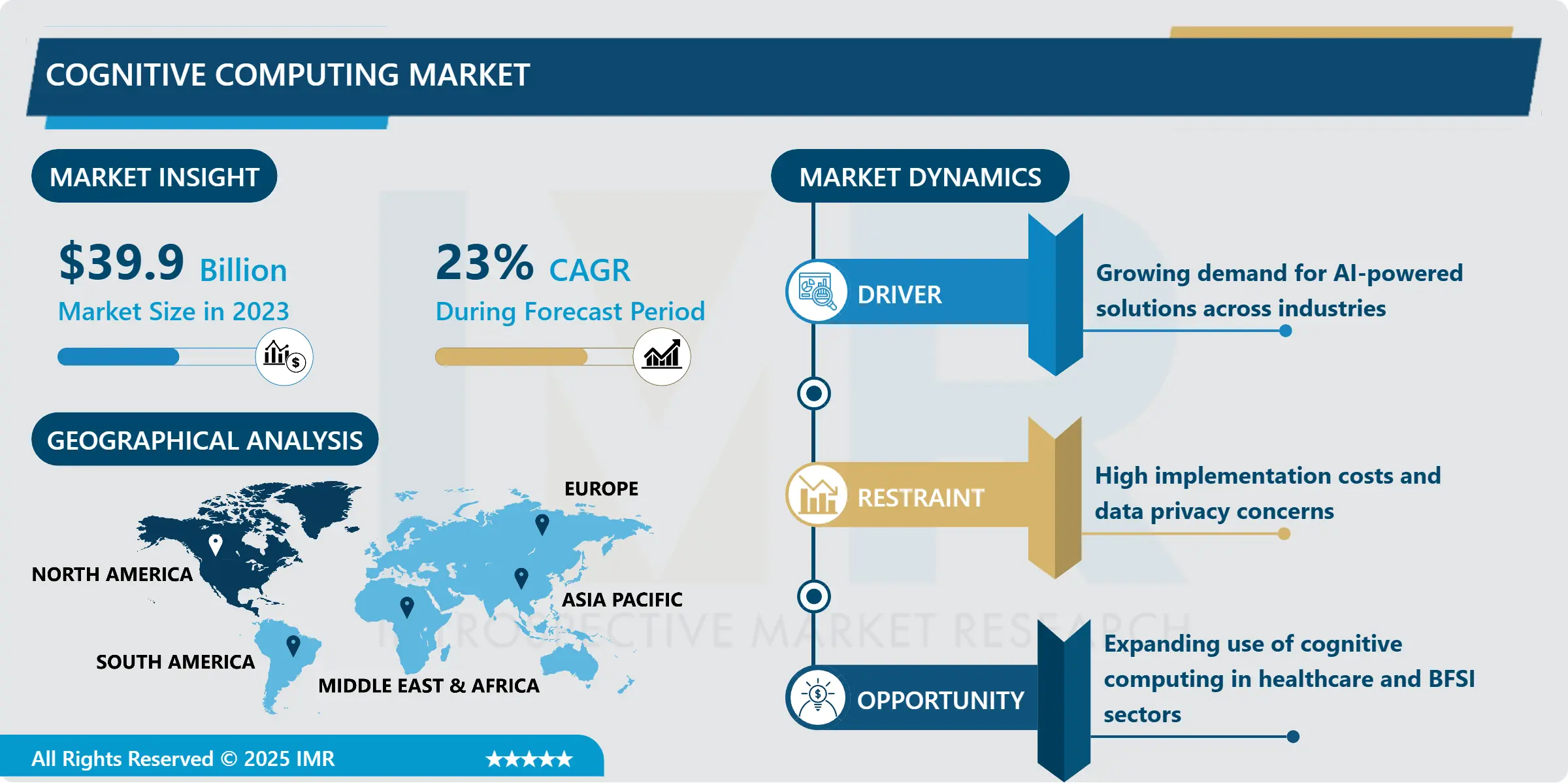
Cognitive Computing Market Comprehensive Analysis & Market Outlook (2024-2032)
Cognitive Computing Market Size Was Valued at USD 39.9 Billion in 2023, and is Projected to Reach USD 255.25 Billion by 2032, Growing at a CAGR of 23% From 2024-2032.

IMR Group
Description
Cognitive Computing Market Synopsis:
Cognitive Computing Market Size Was Valued at USD 39.9 Billion in 2023, and is Projected to Reach USD 255.25 Billion by 2032, Growing at a CAGR of 23% From 2024-2032.
Cognitive computing deals with systems that use artificial intelligence, machine learning, natural language processing, and others to fashion decision making of a human like character. These systems are intended to process large volumes of three types of data: unstructured, semi-structured, and structured data, and identify context to make appropriate recommendations. The market consists of software platforms, services as well as tools typically for automating usually difficult to handle business processes, for improving customer experiences, and for solving problems at a speed and with an accuracy that even the most advanced computing systems would not be capable of accomplishing. Common uses for cognitive computing are in healthcare, retail, banking, financial services, and insurance, IT and many others, wherein companies can augment their business processes, enable better customer experience and unleash creativity.
The market niche of cognitive computing has been rapidly expanding over the last few years due to the rising production of data and the demand for AI systems to work through this data. Many businesses regardless of the industry start to incorporate cognitive computing solutions into their workflows and decision-making processes. The strengths of the cognitive computing systems in natural language processing, sentiment analysis of the current status of the client and Identification of visual and audio inputs have especially been massive and valuable in customer service, predictive maintainance, fraud detection and drug discovery among others. Currently, the market has encouraged slow adoption due to the weak economy; however, with the emergence of extraordinary technologies such as AI, deep learning, and cloud computing, the market will have a boost in both developed and developing countries.
Also, an obvious trend is increased popularity of cognitive computing solutions in the sphere of healthcare. From identifying highly complicated diseases, to recommending customized treatment schedules, cognitive computing systems are changing the face of medicine. Likewise, in financial industry, cognitive systems are supporting the measurement of risk, the improvement of compliance and the identification of fraud. AI technology is also being funded by several governments and enterprises at a high level, which increases the market’s growth rate. Due to global industries’ appetites for drive enhancement to increase productivity as well as minimize expenses, the cognitive computing market remains to expand as one of the most crucial factors in technology advancement.
Cognitive Computing Market Trend Analysis:
Integration of AI with IoT (AIoT)
Great integration between AI as well as IoT is termed as the AIoT which has become identified as a crucial trend in the cognitive computing market. Cognitive systems are used with IoT systems to facilitate real-time processing of data as well as utilization of smart data. For example, in smart factories, cognitive computing is used to analyze data collected from sensors in IoT connected equipment, to forecast equipment failures, and improve the manufacturing system. This is similar to the healthcare sector where IoT wearable technologies characterized by cognitive computing help monitor patient health and intervene minimally. Besides, this trend enhances sectors and organizational operations’ effectiveness while creating new ways of generating income and driving unparalleled technological progression.
Growing Adoption in Healthcare
The cognitive computing market is expected to post exponential growth in demand from the healthcare sector, since artificial intelligence is a rapidly-growing trend in diagnostics, treatment planning and patient management. CS are fit for storing, assessing the medical information, discerning relationships between them, and finding the grounded recommendations to help health care specialists make effective decisions. As a result of telemedicine and remote patient monitoring new cognitive computing solutions are being incorporated into digital health solutions. Furthermore, these systems are being used by the pharmaceutical industries in order to enhance the process of drug discovery. Given the increasing demands for affordable and effective health care measures, cognitive computing systems in the health care sector will soon experience extraordinary growth in their integration.
Cognitive Computing Market Segment Analysis:
Cognitive Computing Market is Segmented on the basis of Technology, Deployment, Application, and Region.
By Technology, Natural Language Processing segment is expected to dominate the market during the forecast period
NLP technology accounted for the largest share in the cognitive computing market during the forecast period due to its capability to process, understand, and answer to human language. Based on NLP, systems are included in chatbots and smart assistants, as well as in determining the sentiment of customers’ behavior, which will be helpful for companies to improve the quality of cooperation. Growing voice interface application and AI based conversational agents are adding to the demand for NLP solutions.
NLP is serving as a key technology in enterprises that rely on consuming and analyzing huge quantities of non-relational information, ranging from the financial sector to healthcare. According to the field of application, NLP analyzes medical records, research papers, and clinical data in healthcare, and markets, customer feedback, and compliance documents in finance. The increasing priority given to enhancing customers’ experience and decision making will result in maintaining NLP’s large share in the cognitive computing market.
By Deployment, On-premises segment expected to held the largest share
On-premises deployment model is expected to dominate the cognitive computing market share due to improved security, control, and customization opportunities. Large enterprises more than SMBs adopt on premise solutions especially in organizations in the banking, healthcare sectors and government organizations because of security and regulatory compliant demands. These solutions allow the companies to implement systems optimally for their organisational demands and keep entire sovereignty over their data environment.
Even though it’s more popular now to have cloud solutions, on-premise still plays a significant role for organizations dealing with big amounts of sensitive information or in countries where personal data protection is highly regulated. In addition, recent developments in the on-premise environment where these solutions are being implemented have made enhancements in the solutions in elements like the introduction of edge computing. Thus, the on-premise cognitive computing systems remain popular and enterprise by companies from all over the world.
Cognitive Computing Market Regional Insights:
North America is Expected to Dominate the Market Over the Forecast period
North America held the largest cognitive computing market share in the year 2023 with a global share of nearly 38 percent. The presence of key technology providers with extensive technological infrastructures, strong technological development, and faster incorporation of various optimal AI solutions in different sectors are mainly responsible for the strong regional leadership. Hitherto, new technology particularly the Artificial Intelligence has been pioneered by the U.S under increased spending on AI research by both state and private institutions. The industries including healthcare, retail, and BFSI in North America are among the most demanding cognitive computing solutions to provide competitive advantage and boost existing business processes. Furthermore, governments’ approval and financial support for AI projects have worked in the favor of the market’s development in the region.
Active Key Players in the Cognitive Computing Market
Accenture (Ireland)
Alphabet Inc. (United States)
Amazon Web Services (United States)
Baidu, Inc. (China)
CognitiveScale (United States)
Dell Technologies (United States)
HPE (United States)
IBM Corporation (United States)
Microsoft Corporation (United States)
Nuance Communications (United States)
Oracle Corporation (United States)
Salesforce, Inc. (United States)
SAP SE (Germany)
Other Active Players.
Chapter 1: Introduction
1.1 Scope and Coverage
Chapter 2:Executive Summary
Chapter 3: Market Landscape
3.1 Market Dynamics
3.1.1 Drivers
3.1.2 Restraints
3.1.3 Opportunities
3.1.4 Challenges
3.2 Market Trend Analysis
3.3 PESTLE Analysis
3.4 Porter’s Five Forces Analysis
3.5 Industry Value Chain Analysis
3.6 Ecosystem
3.7 Regulatory Landscape
3.8 Price Trend Analysis
3.9 Patent Analysis
3.10 Technology Evolution
3.11 Investment Pockets
3.12 Import-Export Analysis
Chapter 4: Cognitive Computing Market by Technology
4.1 Cognitive Computing Market Snapshot and Growth Engine
4.2 Cognitive Computing Market Overview
4.3 Natural Language Processing
4.3.1 Introduction and Market Overview
4.3.2 Historic and Forecasted Market Size in Value USD and Volume Units (2017-2032F)
4.3.3 Key Market Trends, Growth Factors and Opportunities
4.3.4 Natural Language Processing: Geographic Segmentation Analysis
4.4 Machine Learning
4.4.1 Introduction and Market Overview
4.4.2 Historic and Forecasted Market Size in Value USD and Volume Units (2017-2032F)
4.4.3 Key Market Trends, Growth Factors and Opportunities
4.4.4 Machine Learning: Geographic Segmentation Analysis
4.5 Automated Reasoning
4.5.1 Introduction and Market Overview
4.5.2 Historic and Forecasted Market Size in Value USD and Volume Units (2017-2032F)
4.5.3 Key Market Trends, Growth Factors and Opportunities
4.5.4 Automated Reasoning: Geographic Segmentation Analysis
4.6 Information Retrieval
4.6.1 Introduction and Market Overview
4.6.2 Historic and Forecasted Market Size in Value USD and Volume Units (2017-2032F)
4.6.3 Key Market Trends, Growth Factors and Opportunities
4.6.4 Information Retrieval: Geographic Segmentation Analysis
Chapter 5: Cognitive Computing Market by Deployment
5.1 Cognitive Computing Market Snapshot and Growth Engine
5.2 Cognitive Computing Market Overview
5.3 On-premises
5.3.1 Introduction and Market Overview
5.3.2 Historic and Forecasted Market Size in Value USD and Volume Units (2017-2032F)
5.3.3 Key Market Trends, Growth Factors and Opportunities
5.3.4 On-premises: Geographic Segmentation Analysis
5.4 Cloud
5.4.1 Introduction and Market Overview
5.4.2 Historic and Forecasted Market Size in Value USD and Volume Units (2017-2032F)
5.4.3 Key Market Trends, Growth Factors and Opportunities
5.4.4 Cloud: Geographic Segmentation Analysis
Chapter 6: Cognitive Computing Market by Application
6.1 Cognitive Computing Market Snapshot and Growth Engine
6.2 Cognitive Computing Market Overview
6.3 BFSI
6.3.1 Introduction and Market Overview
6.3.2 Historic and Forecasted Market Size in Value USD and Volume Units (2017-2032F)
6.3.3 Key Market Trends, Growth Factors and Opportunities
6.3.4 BFSI: Geographic Segmentation Analysis
6.4 Healthcare
6.4.1 Introduction and Market Overview
6.4.2 Historic and Forecasted Market Size in Value USD and Volume Units (2017-2032F)
6.4.3 Key Market Trends, Growth Factors and Opportunities
6.4.4 Healthcare: Geographic Segmentation Analysis
6.5 Security
6.5.1 Introduction and Market Overview
6.5.2 Historic and Forecasted Market Size in Value USD and Volume Units (2017-2032F)
6.5.3 Key Market Trends, Growth Factors and Opportunities
6.5.4 Security: Geographic Segmentation Analysis
6.6 Retail
6.6.1 Introduction and Market Overview
6.6.2 Historic and Forecasted Market Size in Value USD and Volume Units (2017-2032F)
6.6.3 Key Market Trends, Growth Factors and Opportunities
6.6.4 Retail: Geographic Segmentation Analysis
6.7 IT & Telecom
6.7.1 Introduction and Market Overview
6.7.2 Historic and Forecasted Market Size in Value USD and Volume Units (2017-2032F)
6.7.3 Key Market Trends, Growth Factors and Opportunities
6.7.4 IT & Telecom: Geographic Segmentation Analysis
6.8 Aerospace & Defense
6.8.1 Introduction and Market Overview
6.8.2 Historic and Forecasted Market Size in Value USD and Volume Units (2017-2032F)
6.8.3 Key Market Trends, Growth Factors and Opportunities
6.8.4 Aerospace & Defense: Geographic Segmentation Analysis
6.9 Others
6.9.1 Introduction and Market Overview
6.9.2 Historic and Forecasted Market Size in Value USD and Volume Units (2017-2032F)
6.9.3 Key Market Trends, Growth Factors and Opportunities
6.9.4 Others: Geographic Segmentation Analysis
Chapter 7: Company Profiles and Competitive Analysis
7.1 Competitive Landscape
7.1.1 Competitive Benchmarking
7.1.2 Cognitive Computing Market Share by Manufacturer (2023)
7.1.3 Industry BCG Matrix
7.1.4 Heat Map Analysis
7.1.5 Mergers and Acquisitions
7.2 ACCENTURE (IRELAND)
7.2.1 Company Overview
7.2.2 Key Executives
7.2.3 Company Snapshot
7.2.4 Role of the Company in the Market
7.2.5 Sustainability and Social Responsibility
7.2.6 Operating Business Segments
7.2.7 Product Portfolio
7.2.8 Business Performance
7.2.9 Key Strategic Moves and Recent Developments
7.2.10 SWOT Analysis
7.3 ALPHABET INC. (UNITED STATES)
7.4 AMAZON WEB SERVICES (UNITED STATES)
7.5 BAIDU INC. (CHINA)
7.6 COGNITIVESCALE (UNITED STATES)
7.7 DELL TECHNOLOGIES (UNITED STATES)
7.8 HPE (UNITED STATES)
7.9 IBM CORPORATION (UNITED STATES)
7.10 INTEL CORPORATION (UNITED STATES)
7.11 IPSOFT INC. (UNITED STATES)
7.12 MICROSOFT CORPORATION (UNITED STATES)
7.13 NUANCE COMMUNICATIONS (UNITED STATES)
7.14 ORACLE CORPORATION (UNITED STATES)
7.15 SALESFORCE INC. (UNITED STATES)
7.16 SAP SE (GERMANY)
7.17 OTHER ACTIVE PLAYERS
Chapter 8: Global Cognitive Computing Market By Region
8.1 Overview
8.2. North America Cognitive Computing Market
8.2.1 Key Market Trends, Growth Factors and Opportunities
8.2.2 Top Key Companies
8.2.3 Historic and Forecasted Market Size by Segments
8.2.4 Historic and Forecasted Market Size By Technology
8.2.4.1 Natural Language Processing
8.2.4.2 Machine Learning
8.2.4.3 Automated Reasoning
8.2.4.4 Information Retrieval
8.2.5 Historic and Forecasted Market Size By Deployment
8.2.5.1 On-premises
8.2.5.2 Cloud
8.2.6 Historic and Forecasted Market Size By Application
8.2.6.1 BFSI
8.2.6.2 Healthcare
8.2.6.3 Security
8.2.6.4 Retail
8.2.6.5 IT & Telecom
8.2.6.6 Aerospace & Defense
8.2.6.7 Others
8.2.7 Historic and Forecast Market Size by Country
8.2.7.1 US
8.2.7.2 Canada
8.2.7.3 Mexico
8.3. Eastern Europe Cognitive Computing Market
8.3.1 Key Market Trends, Growth Factors and Opportunities
8.3.2 Top Key Companies
8.3.3 Historic and Forecasted Market Size by Segments
8.3.4 Historic and Forecasted Market Size By Technology
8.3.4.1 Natural Language Processing
8.3.4.2 Machine Learning
8.3.4.3 Automated Reasoning
8.3.4.4 Information Retrieval
8.3.5 Historic and Forecasted Market Size By Deployment
8.3.5.1 On-premises
8.3.5.2 Cloud
8.3.6 Historic and Forecasted Market Size By Application
8.3.6.1 BFSI
8.3.6.2 Healthcare
8.3.6.3 Security
8.3.6.4 Retail
8.3.6.5 IT & Telecom
8.3.6.6 Aerospace & Defense
8.3.6.7 Others
8.3.7 Historic and Forecast Market Size by Country
8.3.7.1 Russia
8.3.7.2 Bulgaria
8.3.7.3 The Czech Republic
8.3.7.4 Hungary
8.3.7.5 Poland
8.3.7.6 Romania
8.3.7.7 Rest of Eastern Europe
8.4. Western Europe Cognitive Computing Market
8.4.1 Key Market Trends, Growth Factors and Opportunities
8.4.2 Top Key Companies
8.4.3 Historic and Forecasted Market Size by Segments
8.4.4 Historic and Forecasted Market Size By Technology
8.4.4.1 Natural Language Processing
8.4.4.2 Machine Learning
8.4.4.3 Automated Reasoning
8.4.4.4 Information Retrieval
8.4.5 Historic and Forecasted Market Size By Deployment
8.4.5.1 On-premises
8.4.5.2 Cloud
8.4.6 Historic and Forecasted Market Size By Application
8.4.6.1 BFSI
8.4.6.2 Healthcare
8.4.6.3 Security
8.4.6.4 Retail
8.4.6.5 IT & Telecom
8.4.6.6 Aerospace & Defense
8.4.6.7 Others
8.4.7 Historic and Forecast Market Size by Country
8.4.7.1 Germany
8.4.7.2 UK
8.4.7.3 France
8.4.7.4 The Netherlands
8.4.7.5 Italy
8.4.7.6 Spain
8.4.7.7 Rest of Western Europe
8.5. Asia Pacific Cognitive Computing Market
8.5.1 Key Market Trends, Growth Factors and Opportunities
8.5.2 Top Key Companies
8.5.3 Historic and Forecasted Market Size by Segments
8.5.4 Historic and Forecasted Market Size By Technology
8.5.4.1 Natural Language Processing
8.5.4.2 Machine Learning
8.5.4.3 Automated Reasoning
8.5.4.4 Information Retrieval
8.5.5 Historic and Forecasted Market Size By Deployment
8.5.5.1 On-premises
8.5.5.2 Cloud
8.5.6 Historic and Forecasted Market Size By Application
8.5.6.1 BFSI
8.5.6.2 Healthcare
8.5.6.3 Security
8.5.6.4 Retail
8.5.6.5 IT & Telecom
8.5.6.6 Aerospace & Defense
8.5.6.7 Others
8.5.7 Historic and Forecast Market Size by Country
8.5.7.1 China
8.5.7.2 India
8.5.7.3 Japan
8.5.7.4 South Korea
8.5.7.5 Malaysia
8.5.7.6 Thailand
8.5.7.7 Vietnam
8.5.7.8 The Philippines
8.5.7.9 Australia
8.5.7.10 New Zealand
8.5.7.11 Rest of APAC
8.6. Middle East & Africa Cognitive Computing Market
8.6.1 Key Market Trends, Growth Factors and Opportunities
8.6.2 Top Key Companies
8.6.3 Historic and Forecasted Market Size by Segments
8.6.4 Historic and Forecasted Market Size By Technology
8.6.4.1 Natural Language Processing
8.6.4.2 Machine Learning
8.6.4.3 Automated Reasoning
8.6.4.4 Information Retrieval
8.6.5 Historic and Forecasted Market Size By Deployment
8.6.5.1 On-premises
8.6.5.2 Cloud
8.6.6 Historic and Forecasted Market Size By Application
8.6.6.1 BFSI
8.6.6.2 Healthcare
8.6.6.3 Security
8.6.6.4 Retail
8.6.6.5 IT & Telecom
8.6.6.6 Aerospace & Defense
8.6.6.7 Others
8.6.7 Historic and Forecast Market Size by Country
8.6.7.1 Turkiye
8.6.7.2 Bahrain
8.6.7.3 Kuwait
8.6.7.4 Saudi Arabia
8.6.7.5 Qatar
8.6.7.6 UAE
8.6.7.7 Israel
8.6.7.8 South Africa
8.7. South America Cognitive Computing Market
8.7.1 Key Market Trends, Growth Factors and Opportunities
8.7.2 Top Key Companies
8.7.3 Historic and Forecasted Market Size by Segments
8.7.4 Historic and Forecasted Market Size By Technology
8.7.4.1 Natural Language Processing
8.7.4.2 Machine Learning
8.7.4.3 Automated Reasoning
8.7.4.4 Information Retrieval
8.7.5 Historic and Forecasted Market Size By Deployment
8.7.5.1 On-premises
8.7.5.2 Cloud
8.7.6 Historic and Forecasted Market Size By Application
8.7.6.1 BFSI
8.7.6.2 Healthcare
8.7.6.3 Security
8.7.6.4 Retail
8.7.6.5 IT & Telecom
8.7.6.6 Aerospace & Defense
8.7.6.7 Others
8.7.7 Historic and Forecast Market Size by Country
8.7.7.1 Brazil
8.7.7.2 Argentina
8.7.7.3 Rest of SA
Chapter 9 Analyst Viewpoint and Conclusion
9.1 Recommendations and Concluding Analysis
9.2 Potential Market Strategies
Chapter 10 Research Methodology
10.1 Research Process
10.2 Primary Research
10.3 Secondary Research
Q1: What would be the forecast period in the Cognitive Computing Market research report?
A1: The forecast period in the Cognitive Computing Market research report is 2024-2032.
Q2: Who are the key players in the Cognitive Computing Market?
A2: Accenture (Ireland), Alphabet Inc. (United States), Amazon Web Services (United States), Baidu, Inc. (China), CognitiveScale (United States), Dell Technologies (United States) and Other Active Players.
Q3: What are the segments of the Cognitive Computing Market?
A3: The Cognitive Computing Market is segmented into Technology, Deployment, Application and region. By Technology, the market is categorized into Natural Language Processing, Machine Learning, Automated Reasoning, Information Retrieval. By Deployment, the market is categorized into On-premises, Cloud. By Application, the market is categorized into BFSI, Healthcare, Security, Retail, IT & Telecom, Aerospace & Defense, Others. By region, it is analyzed across North America (U.S., Canada, Mexico), Eastern Europe (Russia, Bulgaria, The Czech Republic, Hungary, Poland, Romania, Rest of Eastern Europe), Western Europe (Germany, UK, France, The Netherlands, Italy, Russia, Spain, Rest of Western Europe), Asia Pacific (China, India, Japan, South Korea, Malaysia, Thailand, Vietnam, The Philippines, Australia, New-Zealand, Rest of APAC), Middle East & Africa (Turkiye, Bahrain, Kuwait, Saudi Arabia, Qatar, UAE, Israel, South Africa), South America (Brazil, Argentina, Rest of SA).
Q4: What is the Cognitive Computing Market?
A4: Cognitive computing deals with systems that use artificial intelligence, machine learning, natural language processing, and others to fashion decision making of a human like character. These systems are intended to process large volumes of three types of data: unstructured, semi-structured, and structured data, and identify context to make appropriate recommendations. The market consists of software platforms, services as well as tools typically for automating usually difficult to handle business processes, for improving customer experiences, and for solving problems at a speed and with an accuracy that even the most advanced computing systems would not be capable of accomplishing. Common uses for cognitive computing are in healthcare, retail, banking, financial services, and insurance, IT and many others, wherein companies can augment their business processes, enable better customer experience and unleash creativity.
Q5: How big is the Cognitive Computing Market?
A5: Cognitive Computing Market Size Was Valued at USD 39.9 Billion in 2023, and is Projected to Reach USD 255.25 Billion by 2032, Growing at a CAGR of 23% From 2024-2032.
How to Buy a Report from eminsights.jp
On the product page, choose the license you want: Single-User License, Multi-User License or Enterprise License.
If you required report in your native language, then you can click on Translated Report button and fill out the form with report name and language you want, then our team will contact you as soon as possible.
Click the Buy Now button.
You will be redirected to the checkout page. Enter your company details and payment information.
Click Place Order to complete the purchase.
Confirmation: You’ll receive an order confirmation and our team will contact you shortly with your ordered report.
If you have any questions, fill out the contact form below or email us at bizdev@eminsights.net.
Thank you for choosing eminsights.jp!