Stay Ahead in Fast-Growing Economies.
Browse Reports Now
Cocopeat Market -Latest Advancement And Industry Analysis (2024- 2032)
Coco peat is a natural, organic growing medium made from the fibrous husk of the coconut. It has a high water retention capacity making it ideal to use as a growing medium.

IMR Group
Description
Cocopeat Market Synopsis
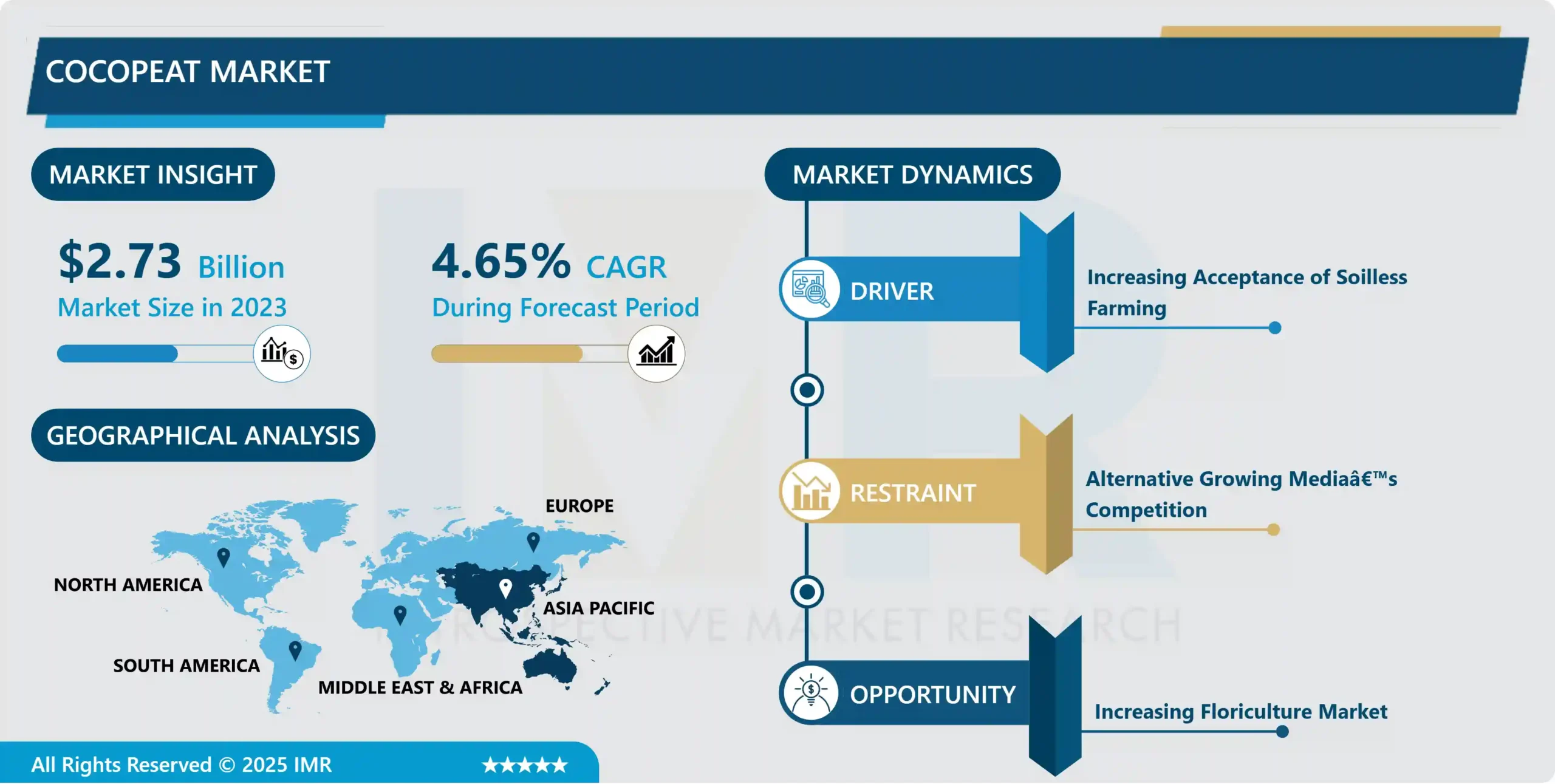
Cocopeat Market Size Was Valued at USD 2.73 Billion in 2023 and is Projected to Reach USD 4.11 Billion by 2032, Growing at a CAGR of 4.65% From 2024-2032.
Coco peat is a natural, organic growing medium made from the fibrous husk of the coconut. It has a high water retention capacity making it ideal to use as a growing medium.
It is a 100% natural, spongy cellulose organic plant growing medium. It is available both in loose form and as compressed bricks. Coco peat is dried and processed to produce compressed blocks and bricks. These bricks can expand to 4–5 times their volume when water is added after loosening. It is a commonly utilized substrate due to its affordability, aeration, drainage, and durability. Cocopeat has a high-water retention capacity which makes it an ideal option for hydroponic systems, where water and nutrients are constantly circulated through the growing medium.
It can be used as a soil substitute and soil conditioning in potting mixers, landscaping, seed generation, home gardening, and mushroom farming. It can also be used as a mulching material to retain moisture and regulate temperature in the soil. Cocopeat is sterile, free of weeds, and resistant to fungal growth. Its fibrous and spongy texture allows excess water to drain easily.
Cocopeat Market Trend Analysis
Increasing Acceptance of Soilless Farming
Soilless farming is a method of growing plants without using soil where instead of soil growing mediums such as cocopeat, perlite, vermiculite, and rock wool are used. This farming is gaining popularity in the world. It offers better control over growing conditions, including temperature, humidity, and lighting resulting in better yields and faster growth rates. Cocopeat provides excellent water-holding capacity, good air porosity, and high nutrient retention which ensures that plants grow efficiently and healthily.
Cocopeat offers a sterile growing medium that is free from pests, diseases, and weed seeds making it an ideal option for soilless farming. Soilless farming is considered more sustainable than traditional farming and cocopeat is also a 100% natural and renewable resource. Vertical farming, hydroponics, and aquaponics used cocopeat due to its easy manageability and lightweight properties. These techniques maximize land use and increase the yield capacity. Governments often provide subsidies and financial assistance to farmers to adopt soilless farming practices.
Opportunity
Increasing Floriculture Market
Floriculture involves the cultivation of flowers, plants, and ornamental crops for decorative purposes requiring a high-quality growing medium that provides optimal conditions for plant growth and blooms. Cocopeat is an ideal substrate choice for floriculture due to its excellent water retention, aeration, and nutrient-holding capabilities. Cocopeat is an organic and renewable resource made from coconut husks making it suitable for organic farming. . This helps to align with the growing global trend towards sustainable agriculture and drives the adoption of cocopeat in the floriculture market.
Floriculture crops often require precise irrigation and moisture control to achieve optimal growth and prevent waterlogging and cocopeat can hold moisture while still providing adequate drainage. Cocopeat can retain essential nutrients and release them to plants as needed which ensures a balanced and steady nutrient supply. can be easily mixed with other growing media or used as a standalone substrate in various floral applications to suit the specific requirements of different flower varieties. The floriculture market is global, with flowers and ornamental plants being traded internationally which drives the demand for cocopeat.
Cocopeat Market Segment Analysis:
Cocopeat Market Segmented based on Type, Form, Application, End-Users, And Distribution Channel.
By Type, Block Segment Is Expected to Dominate the Market During the Forecast Period
By type, there are three segments, block, briquette, and loose. Among these, the block segment is expected to dominate the market during the forecast period.
Cocopeat blocks are made by compressing and dehydrating cocopeat fibres into brick-like structures, which can later be rehydrated and used as a growing medium. It offers several advantages such as easy handling, storage, and transportation with good water retention capacity, excellent aeration properties. It helps to provide a consistent moisture level to the plants and reduce excess water.
Cocopeat ensures optimal oxygen supply to the plants helping to promote robust root development and reduce the risk of root diseases. The fibrous nature of cocopeat enhances soil porosity, creating a conducive environment for beneficial microbial activity. hey are also a preferred choice for mushroom cultivation offering as a suitable substrate for mushroom growth. Their versatility and effectiveness make them a preferred choice for many applications in the agricultural, horticultural, greenhouse, and livestock industries.
By Application, Agriculture and Horticulture Segment Held the Largest Share In 2023
By end-user, there are three segments, agriculture and horticulture, greenhouse and nursery, and livestock industry. Among these, the agriculture and horticulture segment held the largest share in 2023.
Cocopeat has emerged as a versatile and effective growing medium in agricultural and horticultural practices with the ability to retain moisture while providing good aeration. This makes it suitable for a wide range of crops, including vegetables, fruits, and flowers. It benefits in terms of water management, nutrient retention, and improved plant growth. Cocopeat, being a natural by-product of coconut husks, aligns well with a shift towards sustainable practices, and the demand for organic and eco-friendly alternatives in agriculture and horticulture.
Government initiatives promoting sustainable agriculture and environmental conservation play a role in driving the demand for cocopeat in the agriculture and horticulture sector. The modern farming techniques such as hydroponics, aeroponics, and soilless cultivation systems are currently being widely adopted in worldwide. These techniques rely on alternative growing mediums like cocopeat for superior water retention, aeration, and nutrient-holding capacities.
Cocopeat Market Regional Insights:
Asia Pacific is Expected to Dominate the Market Over the Forecast Period
The Asia Pacific region is rich in coconut plantations, which are the primary source of coco peat. Countries like Indonesia, India, Sri Lanka, Thailand, and the Philippines are major coconut producers which ensures a steady supply of coco peat. The region’s geographically diverse landscapes also allow for a variety of coco peat production methods. Asia Pacific region’s large-scale agricultural activities across various crops have fuelled the demand for coco peat.
Governments in many Asian countries are implementing policies and regulations that encourage the adoption of eco-friendly practices and products. This supportive environment creates opportunities for the coco peat market. There is a significant shift in consumer preferences towards organic and eco-friendly products and cocopeat is a natural and sustainable resource. Its nutrient-rich properties make it an ideal choice for organic farming practices.
Cocopeat Market Active Players
Dutch Plantin Coir Pvt. Ltd. (India)
Samarasinghe Brothers International (Sri Lanka)
Coco Agro (Mexico)
Sai Coco Peat Export Private Limited (India)
Primex Coco Products Inc. (Philippines)
Kumaran Coir (India)
Ceyhinz Link International (United States)
Fibre family (India)
CoirGreen coco Solution (Sri Lanka)
Dynamic International (India)
Cocovina (Vietnam)
Nature’s Bounty PLC (United Kingdom)
HortGrow Solution LLC (United States)
Vietcoco International Co. Ltd. (Vietnam)
Ceylon Coir Fibre Industries (Sri Lanka)
Allwin Coir (India)
Green Field Co. Ltd. (Thailand)
Primex Coco Products Inc. (Philippines)
Eco Coir Products (Malaysia)
AgroMix LLC (Russia)
Slim Grow Supplies (Canada)
PT. Coco Bliss Indonesia (Indonesia)
Growrite Substrates Ltd. (Ireland)
Cocosys (Germany)
Good-Will Coir Products (India)
Key Industry Developments in the Cocopeat Market:
In Feb 2024, Dutch Plantin, a global leader in the production of coconut products located in Boekel, renewed its partnership with Tomatoworld for the year 2024. Tomatoworld partners with leading international companies in the greenhouse horticulture sector, providing high-quality knowledge and technologies to cultivate healthy products in an advanced environment in a sustainable, efficient, and natural way.
In Jan 2024, The National Coir Research and Management Institute in Thiruvananthapuram announced the new products are Coco Aura, Digital Coir Runnage Meter, Coir Divider, Trichopith, and Coconurture. The specialty of Coir Divider is to be used in road construction, Coco Aura is to be used as an air freshener made of coir pith and essential oil extracted from plants.
Chapter 1: Introduction
1.1 Scope and Coverage
Chapter 2:Executive Summary
Chapter 3: Market Landscape
3.1 Market Dynamics
3.1.1 Drivers
3.1.2 Restraints
3.1.3 Opportunities
3.1.4 Challenges
3.2 Market Trend Analysis
3.3 PESTLE Analysis
3.4 Porter’s Five Forces Analysis
3.5 Industry Value Chain Analysis
3.6 Ecosystem
3.7 Regulatory Landscape
3.8 Price Trend Analysis
3.9 Patent Analysis
3.10 Technology Evolution
3.11 Investment Pockets
3.12 Import-Export Analysis
Chapter 4: Cocopeat Market by Type (2018-2032)
4.1 Cocopeat Market Snapshot and Growth Engine
4.2 Market Overview
4.3 Cocopeat Block
4.3.1 Introduction and Market Overview
4.3.2 Historic and Forecasted Market Size in Value USD and Volume Units
4.3.3 Key Market Trends, Growth Factors, and Opportunities
4.3.4 Geographic Segmentation Analysis
4.4 Cocopeat Briquette
4.5 Loose Cocopeat
Chapter 5: Cocopeat Market by Form (2018-2032)
5.1 Cocopeat Market Snapshot and Growth Engine
5.2 Market Overview
5.3 Powdered
5.3.1 Introduction and Market Overview
5.3.2 Historic and Forecasted Market Size in Value USD and Volume Units
5.3.3 Key Market Trends, Growth Factors, and Opportunities
5.3.4 Geographic Segmentation Analysis
5.4 Coarse
Chapter 6: Cocopeat Market by Application (2018-2032)
6.1 Cocopeat Market Snapshot and Growth Engine
6.2 Market Overview
6.3 Horticulture and Gardening
6.3.1 Introduction and Market Overview
6.3.2 Historic and Forecasted Market Size in Value USD and Volume Units
6.3.3 Key Market Trends, Growth Factors, and Opportunities
6.3.4 Geographic Segmentation Analysis
6.4 Agriculture
6.5 Mushroom Cultivation
6.6 Animal Bedding
Chapter 7: Cocopeat Market by End-user (2018-2032)
7.1 Cocopeat Market Snapshot and Growth Engine
7.2 Market Overview
7.3 Agriculture and Horticulture
7.3.1 Introduction and Market Overview
7.3.2 Historic and Forecasted Market Size in Value USD and Volume Units
7.3.3 Key Market Trends, Growth Factors, and Opportunities
7.3.4 Geographic Segmentation Analysis
7.4 Greenhouse and Nursery
7.5 Livestock Industry
Chapter 8: Cocopeat Market by Distribution Channel (2018-2032)
8.1 Cocopeat Market Snapshot and Growth Engine
8.2 Market Overview
8.3 Online
8.3.1 Introduction and Market Overview
8.3.2 Historic and Forecasted Market Size in Value USD and Volume Units
8.3.3 Key Market Trends, Growth Factors, and Opportunities
8.3.4 Geographic Segmentation Analysis
8.4 Offline
Chapter 9: Company Profiles and Competitive Analysis
9.1 Competitive Landscape
9.1.1 Competitive Benchmarking
9.1.2 Cocopeat Market Share by Manufacturer (2024)
9.1.3 Industry BCG Matrix
9.1.4 Heat Map Analysis
9.1.5 Mergers and Acquisitions
9.2 DUTCH PLANTIN COIR PVT. LTD. (INDIA)
9.2.1 Company Overview
9.2.2 Key Executives
9.2.3 Company Snapshot
9.2.4 Role of the Company in the Market
9.2.5 Sustainability and Social Responsibility
9.2.6 Operating Business Segments
9.2.7 Product Portfolio
9.2.8 Business Performance
9.2.9 Key Strategic Moves and Recent Developments
9.2.10 SWOT Analysis
9.3 SAMARASINGHE BROTHERS INTERNATIONAL (SRI LANKA)
9.4 COCO AGRO (MEXICO)
9.5 SAI COCO PEAT EXPORT PRIVATE LIMITED (INDIA)
9.6 PRIMEX COCO PRODUCTS INC. (PHILIPPINES)
9.7 KUMARAN COIR (INDIA)
9.8 CEYHINZ LINK INTERNATIONAL (UNITED STATES)
9.9 FIBRE FAMILY (INDIA)
9.10 COIRGREEN COCO SOLUTION (SRI LANKA)
9.11 DYNAMIC INTERNATIONAL (INDIA)
9.12 COCOVINA (VIETNAM)
9.13 NATURE’S BOUNTY PLC (UNITED KINGDOM)
9.14 HORTGROW SOLUTION LLC (UNITED STATES)
9.15 VIETCOCO INTERNATIONAL CO. LTD. (VIETNAM)
9.16 CEYLON COIR FIBRE INDUSTRIES (SRI LANKA)
9.17 ALLWIN COIR (INDIA)
9.18 GREEN FIELD CO. LTD. (THAILAND)
9.19 PRIMEX COCO PRODUCTS INC. (PHILIPPINES)
9.20 ECO COIR PRODUCTS (MALAYSIA)
9.21 AGROMIX LLC (RUSSIA)
9.22 SLIM GROW SUPPLIES (CANADA)
9.23 PT. COCO BLISS INDONESIA (INDONESIA)
9.24 GROWRITE SUBSTRATES LTD. (IRELAND)
9.25 COCOSYS (GERMANY)
9.26 GOOD-WILL COIR PRODUCTS (INDIA)
Chapter 10: Global Cocopeat Market By Region
10.1 Overview
10.2. North America Cocopeat Market
10.2.1 Key Market Trends, Growth Factors and Opportunities
10.2.2 Top Key Companies
10.2.3 Historic and Forecasted Market Size by Segments
10.2.4 Historic and Forecasted Market Size by Type
10.2.4.1 Cocopeat Block
10.2.4.2 Cocopeat Briquette
10.2.4.3 Loose Cocopeat
10.2.5 Historic and Forecasted Market Size by Form
10.2.5.1 Powdered
10.2.5.2 Coarse
10.2.6 Historic and Forecasted Market Size by Application
10.2.6.1 Horticulture and Gardening
10.2.6.2 Agriculture
10.2.6.3 Mushroom Cultivation
10.2.6.4 Animal Bedding
10.2.7 Historic and Forecasted Market Size by End-user
10.2.7.1 Agriculture and Horticulture
10.2.7.2 Greenhouse and Nursery
10.2.7.3 Livestock Industry
10.2.8 Historic and Forecasted Market Size by Distribution Channel
10.2.8.1 Online
10.2.8.2 Offline
10.2.9 Historic and Forecast Market Size by Country
10.2.9.1 US
10.2.9.2 Canada
10.2.9.3 Mexico
10.3. Eastern Europe Cocopeat Market
10.3.1 Key Market Trends, Growth Factors and Opportunities
10.3.2 Top Key Companies
10.3.3 Historic and Forecasted Market Size by Segments
10.3.4 Historic and Forecasted Market Size by Type
10.3.4.1 Cocopeat Block
10.3.4.2 Cocopeat Briquette
10.3.4.3 Loose Cocopeat
10.3.5 Historic and Forecasted Market Size by Form
10.3.5.1 Powdered
10.3.5.2 Coarse
10.3.6 Historic and Forecasted Market Size by Application
10.3.6.1 Horticulture and Gardening
10.3.6.2 Agriculture
10.3.6.3 Mushroom Cultivation
10.3.6.4 Animal Bedding
10.3.7 Historic and Forecasted Market Size by End-user
10.3.7.1 Agriculture and Horticulture
10.3.7.2 Greenhouse and Nursery
10.3.7.3 Livestock Industry
10.3.8 Historic and Forecasted Market Size by Distribution Channel
10.3.8.1 Online
10.3.8.2 Offline
10.3.9 Historic and Forecast Market Size by Country
10.3.9.1 Russia
10.3.9.2 Bulgaria
10.3.9.3 The Czech Republic
10.3.9.4 Hungary
10.3.9.5 Poland
10.3.9.6 Romania
10.3.9.7 Rest of Eastern Europe
10.4. Western Europe Cocopeat Market
10.4.1 Key Market Trends, Growth Factors and Opportunities
10.4.2 Top Key Companies
10.4.3 Historic and Forecasted Market Size by Segments
10.4.4 Historic and Forecasted Market Size by Type
10.4.4.1 Cocopeat Block
10.4.4.2 Cocopeat Briquette
10.4.4.3 Loose Cocopeat
10.4.5 Historic and Forecasted Market Size by Form
10.4.5.1 Powdered
10.4.5.2 Coarse
10.4.6 Historic and Forecasted Market Size by Application
10.4.6.1 Horticulture and Gardening
10.4.6.2 Agriculture
10.4.6.3 Mushroom Cultivation
10.4.6.4 Animal Bedding
10.4.7 Historic and Forecasted Market Size by End-user
10.4.7.1 Agriculture and Horticulture
10.4.7.2 Greenhouse and Nursery
10.4.7.3 Livestock Industry
10.4.8 Historic and Forecasted Market Size by Distribution Channel
10.4.8.1 Online
10.4.8.2 Offline
10.4.9 Historic and Forecast Market Size by Country
10.4.9.1 Germany
10.4.9.2 UK
10.4.9.3 France
10.4.9.4 The Netherlands
10.4.9.5 Italy
10.4.9.6 Spain
10.4.9.7 Rest of Western Europe
10.5. Asia Pacific Cocopeat Market
10.5.1 Key Market Trends, Growth Factors and Opportunities
10.5.2 Top Key Companies
10.5.3 Historic and Forecasted Market Size by Segments
10.5.4 Historic and Forecasted Market Size by Type
10.5.4.1 Cocopeat Block
10.5.4.2 Cocopeat Briquette
10.5.4.3 Loose Cocopeat
10.5.5 Historic and Forecasted Market Size by Form
10.5.5.1 Powdered
10.5.5.2 Coarse
10.5.6 Historic and Forecasted Market Size by Application
10.5.6.1 Horticulture and Gardening
10.5.6.2 Agriculture
10.5.6.3 Mushroom Cultivation
10.5.6.4 Animal Bedding
10.5.7 Historic and Forecasted Market Size by End-user
10.5.7.1 Agriculture and Horticulture
10.5.7.2 Greenhouse and Nursery
10.5.7.3 Livestock Industry
10.5.8 Historic and Forecasted Market Size by Distribution Channel
10.5.8.1 Online
10.5.8.2 Offline
10.5.9 Historic and Forecast Market Size by Country
10.5.9.1 China
10.5.9.2 India
10.5.9.3 Japan
10.5.9.4 South Korea
10.5.9.5 Malaysia
10.5.9.6 Thailand
10.5.9.7 Vietnam
10.5.9.8 The Philippines
10.5.9.9 Australia
10.5.9.10 New Zealand
10.5.9.11 Rest of APAC
10.6. Middle East & Africa Cocopeat Market
10.6.1 Key Market Trends, Growth Factors and Opportunities
10.6.2 Top Key Companies
10.6.3 Historic and Forecasted Market Size by Segments
10.6.4 Historic and Forecasted Market Size by Type
10.6.4.1 Cocopeat Block
10.6.4.2 Cocopeat Briquette
10.6.4.3 Loose Cocopeat
10.6.5 Historic and Forecasted Market Size by Form
10.6.5.1 Powdered
10.6.5.2 Coarse
10.6.6 Historic and Forecasted Market Size by Application
10.6.6.1 Horticulture and Gardening
10.6.6.2 Agriculture
10.6.6.3 Mushroom Cultivation
10.6.6.4 Animal Bedding
10.6.7 Historic and Forecasted Market Size by End-user
10.6.7.1 Agriculture and Horticulture
10.6.7.2 Greenhouse and Nursery
10.6.7.3 Livestock Industry
10.6.8 Historic and Forecasted Market Size by Distribution Channel
10.6.8.1 Online
10.6.8.2 Offline
10.6.9 Historic and Forecast Market Size by Country
10.6.9.1 Turkiye
10.6.9.2 Bahrain
10.6.9.3 Kuwait
10.6.9.4 Saudi Arabia
10.6.9.5 Qatar
10.6.9.6 UAE
10.6.9.7 Israel
10.6.9.8 South Africa
10.7. South America Cocopeat Market
10.7.1 Key Market Trends, Growth Factors and Opportunities
10.7.2 Top Key Companies
10.7.3 Historic and Forecasted Market Size by Segments
10.7.4 Historic and Forecasted Market Size by Type
10.7.4.1 Cocopeat Block
10.7.4.2 Cocopeat Briquette
10.7.4.3 Loose Cocopeat
10.7.5 Historic and Forecasted Market Size by Form
10.7.5.1 Powdered
10.7.5.2 Coarse
10.7.6 Historic and Forecasted Market Size by Application
10.7.6.1 Horticulture and Gardening
10.7.6.2 Agriculture
10.7.6.3 Mushroom Cultivation
10.7.6.4 Animal Bedding
10.7.7 Historic and Forecasted Market Size by End-user
10.7.7.1 Agriculture and Horticulture
10.7.7.2 Greenhouse and Nursery
10.7.7.3 Livestock Industry
10.7.8 Historic and Forecasted Market Size by Distribution Channel
10.7.8.1 Online
10.7.8.2 Offline
10.7.9 Historic and Forecast Market Size by Country
10.7.9.1 Brazil
10.7.9.2 Argentina
10.7.9.3 Rest of SA
Chapter 11 Analyst Viewpoint and Conclusion
11.1 Recommendations and Concluding Analysis
11.2 Potential Market Strategies
Chapter 12 Research Methodology
12.1 Research Process
12.2 Primary Research
12.3 Secondary Research
Q1: What would be the forecast period in the Cocopeat Market research report?
A1: The forecast period in the Cocopeat Market research report is 2024-2032.
Q2: Who are the key players in the Cocopeat Market?
A2: Dutch Plantin Coir Pvt. Ltd. (India), Samarasinghe Brothers International (Sri Lanka), Coco Agro (Mexico), Sai Coco Peat Export Private Limited (India), Primex Coco Products Inc. (Philippines), and Other Active Players. and Other Major Players.
Q3: What are the segments of the Cocopeat Market?
A3: The Cocopeat Market is segmented into Type, Form, Application, End-user, Distribution Channel and region. By Type, the market is categorized into Block, Briquette, Loose. By Form, the market is categorized into Powdered, Coarse. By Application, the market is categorized into Horticulture and Gardening, Agriculture, Mushroom Cultivation, and Animal Bedding. By End-user, the market is categorized into Agriculture and Horticulture, Greenhouse and Nursery, and Livestock Industry. By Distribution Channel, the market is categorized into Online and offline. By region, it is analyzed across North America (U.S.; Canada; Mexico), Eastern Europe (Bulgaria; The Czech Republic; Hungary; Poland; Romania; Rest of Eastern Europe), Western Europe (Germany; UK; France; Netherlands; Italy; Russia; Spain; Rest of Western Europe), Asia-Pacific (China; India; Japan; Southeast Asia, etc.), South America (Brazil; Argentina, etc.), Middle East & Africa (Saudi Arabia; South Africa, etc.).
Q4: What is the Cocopeat Market?
A4: Coco peat is a natural, organic growing medium made from the fibrous husk of the coconut. It has a high-water retention capacity making it ideal to use as a growing medium.
Q5: How big is the Cocopeat Market?
A5: Cocopeat Market Size Was Valued at USD 2.73 Billion in 2023 and is Projected to Reach USD 4.11 Billion by 2032, Growing at a CAGR of 4.65% From 2024-2032.
How to Buy a Report from eminsights.jp
On the product page, choose the license you want: Single-User License, Multi-User License or Enterprise License.
If you required report in your native language, then you can click on Translated Report button and fill out the form with report name and language you want, then our team will contact you as soon as possible.
Click the Buy Now button.
You will be redirected to the checkout page. Enter your company details and payment information.
Click Place Order to complete the purchase.
Confirmation: You’ll receive an order confirmation and our team will contact you shortly with your ordered report.
If you have any questions, fill out the contact form below or email us at bizdev@eminsights.net.
Thank you for choosing eminsights.jp!