Stay Ahead in Fast-Growing Economies.
Browse Reports Now




Cloud Backup Market Current Scenario & Forecast Growth Report (2024-2032)
The Cloud Backup Market is the market dealing with the provision of cloud services for data backup and data recovery for different market players.

IMR Group
Description
Cloud Backup Market Synopsis:
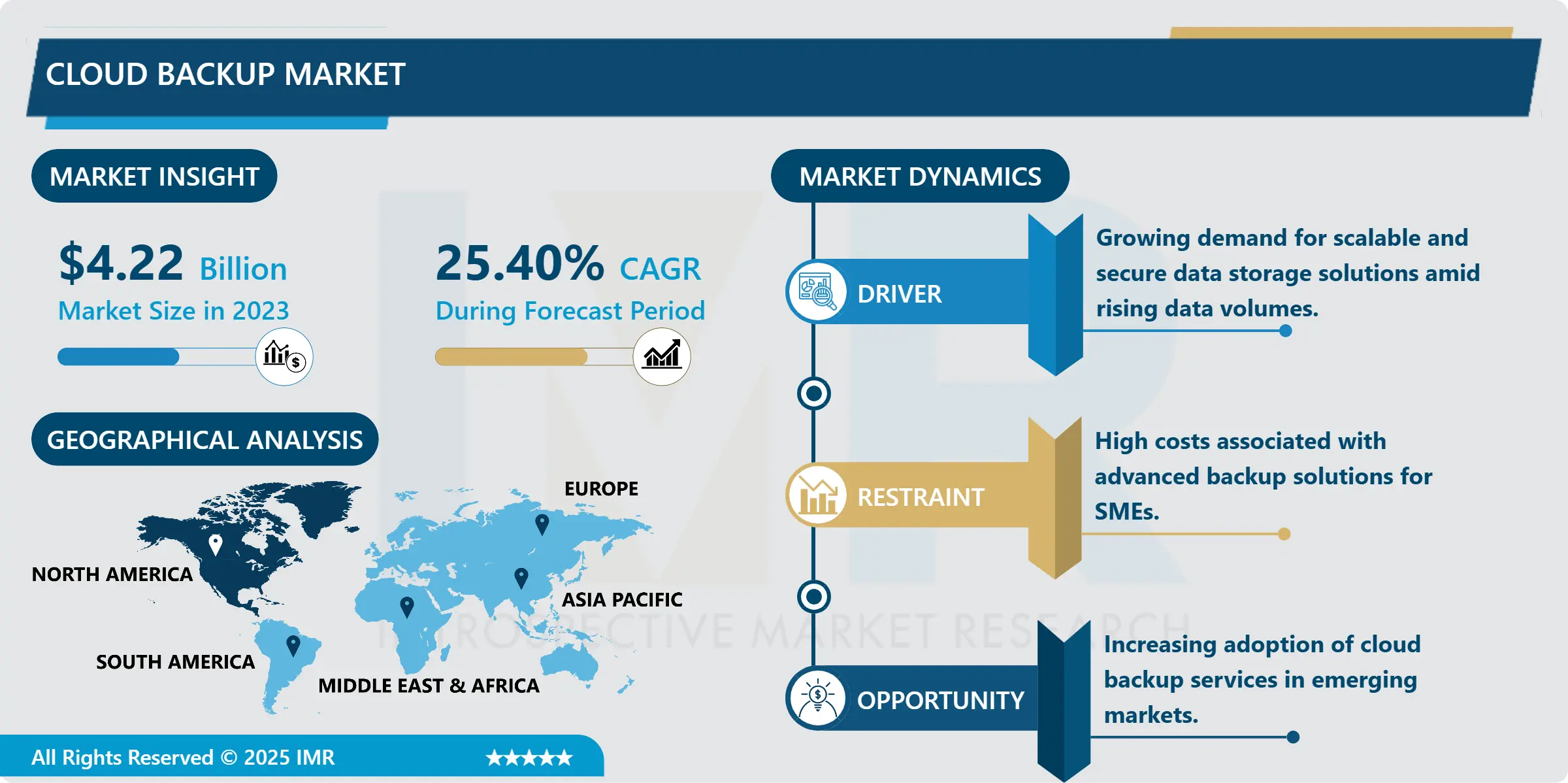
Cloud Backup Market Size Was Valued at USD 4.22 Billion in 2023, and is Projected to Reach USD 34.60 Billion by 2032, Growing at a CAGR of 25.40% From 2024-2032.
The Cloud Backup Market is the market dealing with the provision of cloud services for data backup and data recovery for different market players. These services allow users to store files on computers located at other places which can be accessed through the internet that comes a back-up in case of hardware failure, virus attacks and other mishaps. Some benefits of cloud backup solutions are usually the ability to scale, security, and cost management that can reach organizations of all types and across industries.
The Cloud Backup Market has showed considerable growth in the recent past mainly due to growth in adoption of cloud computing, increase in cyber threats and need for secure data management solutions. This has necessitated the adoption of cloud backup services as an efficient substitute to conventional back-up systems, which are characterized by hardware breakdowns, expensive maintenance and poor expansibility. Main features of cloud backup solutions – increased reliability due to the use of remote servers and reduced number of backups that do not occur due to professional software and automation, real-time data synchronization, and compatibility with multiple devices. SMEs in particular are drawn towards these solutions because of their inherent cost optimized characteristics and the ability of a scale up data management despite the surge in the volume of data being generated.
Further, the advancement in New all-hybrid work model, coupled with enhanced data privacy laws, such as GDPR and CCPA, spurred the need for cloud backup services that are secure and compliant. Finally, since organisations are transiting from single, to hybrid and multi-cloud models, there is a demand for high-quality cloud backup services for data protection and recovery, business continuity and compliance. The market is also experiencing shifts in artificial intelligence and machine learning to improve protocols in the backup marketplace as well as identifying anomalies and refining analytical results within cloud backup infrastructures.
Cloud Backup Market Trend Analysis:
Rising Integration of AI and Automation
AI and automation technology in the Cloud Backup Market is further advancing as a social shift of the market. Graphics processors backed by AI are also disrupting traditional backup operations while making it possible to use predictive analytics for probable data failure and lower RTOs. These systems check data patterns, look for trends, and cover data integrity, making the issues of back up more reliable. Another level of efficiency is reached when automation is self-synchronized with no human interference, with scheduled backup routines, and with recognition of data most important for backup. Combinedly, both the technologies are solving problems like repetition of laboriously manual work or inefficient space management to make the cloud backup solutions better or perfectionist.
As these technologies mature further, cloud backup providers are proceeding to design enhanced solutions to cater to a rapidly evolving business environment. Machine learning self-healing systems are emerging as a preferred solution providing automatic resolution of problems and ability to recover from possible interruptions. These advancements do not only ease outcomes but also enhance data safeguard and protection by effectively checking for risks and mending them instantly. As computing environments become more heterogeneous and as data security becomes a key issue, the incorporation of AI and automation to cloud backup is to expand and diversify, providing new forms of value to customers through improved experiences.
Expansion in Emerging Markets
Among the clouds and regions, Asia-Pacific, Latin America, and the Middle East are projected to be emerging markets within the Cloud Backup Market because of the escalating pace of digitalization. These are the regions that are characterized by a very high increase of internet usage, the increased usage of mobility technologies, and a rapidly growing Cloud computing market. This situation makes cloud backup providers to search for more areas to cover on this market. SMEs based in these regions especially want cost-effective solutions for designing a small-scale backup framework in a rapidly evolving technological environment in order to safeguard their data from being stolen or lost due to various external threats.
Another driver is also from the government in emerging economy where policy and support measure such as the promotion of industrial upgrade are encouraging the adoption and usage of cloud-based services. Such programs help organizations to implement technology-driven solutions, which in return drive the need for a reliable cloud backup systems. The companies that invest considerable efforts in establishing a wide network of regional partnerships and in providing appropriate localized presences, adapted to the needs of these markets, will be truly able to fill this gap with growing profits. If the cloud backup providers achieve the higher growth by identifying the localized issues and fulfilling the opportunities in those regions, then there will be a vast growth in the near future.
Cloud Backup Market Segment Analysis:
Cloud Backup Market is Segmented on the basis of Deployment Type, Component, Industry Vertical.
By Deployment Type, Public cloud deployment segment is expected to dominate the market during the forecast period
The Cloud Backup market based on deployment type includes public deployment, private deployment, and hybrid deployment for different business requirements and preferences. Form of deployment widely deployed due to affordability and; flexibility, ideal to SMEs and thus considered the most common mode. This model provides backup services from shared frame enabling business to cut on investments for hardware and cost of maintenance. Public cloud backup is especially suitable for organizations that require rapid deployment to support rapidly changing storage requirements with no large capital commitment.
The private cloud deployment is preferred by companies that have compliance concerns, and accent on the security of the platform. It provides dedicated resources for its infrastructure which is more secure and fulfilling the compliance of demands of specific industries like finance and healthcare. On the other hand, there is a growing demand for the hybrid cloud model since they find that they can store valuable data in private clouds while at the same time take advantage of public clouds since they are cheap and scalable for the rest of the operations. This flexibility has led organizations adopt hybrid cloud since; they are cheaper to implement besides satisfying their security and performance needs.
By component, Solutions segment expected to held the largest share
The Cloud Backup Market is divided into two key components: solutions and services, both of which are important components in the organisational solutions portfolio. Solutions encompass solutions in the firm that encompasses software and platforms for purpose of data backup and recovery, data management. Such solutions include correct cloud backup application, disaster recovery equipment that guarantees business sustainability, and records storage systems. Many organizations have embraced software solutions aligned with their requirements and architecture; they are also seeking versatile, enhanced-security software solutions that can easily interface with their current systems and protect against data theft to cyber threats. The growth of AI and automated technologies is continuing to improve the attractiveness of this segment through real-time monitoring and prediction for data security.
Principal services in the cloud backup market include managed services and professional services and support and maintenance. Managed services are on the rise because companies hire backup and recovery services from outside, thereby freeing up their own internal resources while making sure that the data is secured. Consulting, implementation, and training services provide organizations with theoretical or practical backup solutions that may be tailored to suit various organizational needs. The other is continuous support and maintenance which guarantees utilization of the backup systems without hitches, any complications arising out of their use are worked on and firmly prevented from affecting the primary systems. The solutions and services segment cover the needs of organizations according to the type of activity and serve as a complete backup of data.
Cloud Backup Market Regional Insights:
North America is Expected to Dominate the Market Over the Forecast period
Continental analysis revealed that North America trailed behind only the global market in the Cloud Backup Market claimant in 2023 with a commanding market share. This dominance is even partly due to the higher development of IT and high usage of innovative technologies such as cloud in some of the countries in the region. Companies in different industries ranging from healthcare to finance and retail are using cloud backup solutions to guard against data loss while conforming with increased regulatory rules by using cloud back solutions that are compliant with intended rules like HIPAA and SOX. The focus on data protection and conformity has made the region advance guard when it comes to new generation backup solutions entrenching the market lead.
For instance, the United States has propelled growth within North America region more than any other region. It comes as no surprised, then that the United States has particularly bright prospects for cloud backup services due to its concentrated technology industry and reliance on cloud service providers. Ransomware attacks and other cyber threats have continued to rise, making business cloud data backup and security crucial factors causing organizations to increase their spending on CLB. This is further supported by new products and services being developed by key players within this market to ensure that their business assets are protected and their operations much more secure.
Active Key Players in the Cloud Backup Market:
Acronis (Switzerland)
Amazon Web Services (AWS) (USA)
Arcserve (USA)
Barracuda Networks (USA)
Carbonite (USA)
Datto (USA)
Dell Technologies (USA)
Google (USA)
IBM (USA)
Microsoft (USA)
Oracle (USA)
Rubrik (USA)
SolarWinds (USA)
Veeam Software (Switzerland)
Zerto (USA), and Other Active Players
Chapter 1: Introduction
1.1 Scope and Coverage
Chapter 2:Executive Summary
Chapter 3: Market Landscape
3.1 Market Dynamics
3.1.1 Drivers
3.1.2 Restraints
3.1.3 Opportunities
3.1.4 Challenges
3.2 Market Trend Analysis
3.3 PESTLE Analysis
3.4 Porter’s Five Forces Analysis
3.5 Industry Value Chain Analysis
3.6 Ecosystem
3.7 Regulatory Landscape
3.8 Price Trend Analysis
3.9 Patent Analysis
3.10 Technology Evolution
3.11 Investment Pockets
3.12 Import-Export Analysis
Chapter 4: Cloud Backup Market by Deployment Type
4.1 Cloud Backup Market Snapshot and Growth Engine
4.2 Cloud Backup Market Overview
4.3 Public Cloud
4.3.1 Introduction and Market Overview
4.3.2 Historic and Forecasted Market Size in Value USD and Volume Units (2017-2032F)
4.3.3 Key Market Trends, Growth Factors and Opportunities
4.3.4 Public Cloud: Geographic Segmentation Analysis
4.4 Private Cloud
4.4.1 Introduction and Market Overview
4.4.2 Historic and Forecasted Market Size in Value USD and Volume Units (2017-2032F)
4.4.3 Key Market Trends, Growth Factors and Opportunities
4.4.4 Private Cloud: Geographic Segmentation Analysis
4.5 Hybrid Cloud
4.5.1 Introduction and Market Overview
4.5.2 Historic and Forecasted Market Size in Value USD and Volume Units (2017-2032F)
4.5.3 Key Market Trends, Growth Factors and Opportunities
4.5.4 Hybrid Cloud: Geographic Segmentation Analysis
Chapter 5: Cloud Backup Market by Component Type
5.1 Cloud Backup Market Snapshot and Growth Engine
5.2 Cloud Backup Market Overview
5.3 Solutions
5.3.1 Introduction and Market Overview
5.3.2 Historic and Forecasted Market Size in Value USD and Volume Units (2017-2032F)
5.3.3 Key Market Trends, Growth Factors and Opportunities
5.3.4 Solutions: Geographic Segmentation Analysis
5.4 Services
5.4.1 Introduction and Market Overview
5.4.2 Historic and Forecasted Market Size in Value USD and Volume Units (2017-2032F)
5.4.3 Key Market Trends, Growth Factors and Opportunities
5.4.4 Services: Geographic Segmentation Analysis
Chapter 6: Cloud Backup Market by Industry Vertical
6.1 Cloud Backup Market Snapshot and Growth Engine
6.2 Cloud Backup Market Overview
6.3 BFSI
6.3.1 Introduction and Market Overview
6.3.2 Historic and Forecasted Market Size in Value USD and Volume Units (2017-2032F)
6.3.3 Key Market Trends, Growth Factors and Opportunities
6.3.4 BFSI: Geographic Segmentation Analysis
6.4 Healthcare
6.4.1 Introduction and Market Overview
6.4.2 Historic and Forecasted Market Size in Value USD and Volume Units (2017-2032F)
6.4.3 Key Market Trends, Growth Factors and Opportunities
6.4.4 Healthcare: Geographic Segmentation Analysis
6.5 Retail
6.5.1 Introduction and Market Overview
6.5.2 Historic and Forecasted Market Size in Value USD and Volume Units (2017-2032F)
6.5.3 Key Market Trends, Growth Factors and Opportunities
6.5.4 Retail: Geographic Segmentation Analysis
6.6 IT and Telecommunications
6.6.1 Introduction and Market Overview
6.6.2 Historic and Forecasted Market Size in Value USD and Volume Units (2017-2032F)
6.6.3 Key Market Trends, Growth Factors and Opportunities
6.6.4 IT and Telecommunications: Geographic Segmentation Analysis
6.7 Government
6.7.1 Introduction and Market Overview
6.7.2 Historic and Forecasted Market Size in Value USD and Volume Units (2017-2032F)
6.7.3 Key Market Trends, Growth Factors and Opportunities
6.7.4 Government: Geographic Segmentation Analysis
6.8 Education
6.8.1 Introduction and Market Overview
6.8.2 Historic and Forecasted Market Size in Value USD and Volume Units (2017-2032F)
6.8.3 Key Market Trends, Growth Factors and Opportunities
6.8.4 Education: Geographic Segmentation Analysis
6.9 Manufacturing
6.9.1 Introduction and Market Overview
6.9.2 Historic and Forecasted Market Size in Value USD and Volume Units (2017-2032F)
6.9.3 Key Market Trends, Growth Factors and Opportunities
6.9.4 Manufacturing: Geographic Segmentation Analysis
6.10 Others
6.10.1 Introduction and Market Overview
6.10.2 Historic and Forecasted Market Size in Value USD and Volume Units (2017-2032F)
6.10.3 Key Market Trends, Growth Factors and Opportunities
6.10.4 Others: Geographic Segmentation Analysis
Chapter 7: Company Profiles and Competitive Analysis
7.1 Competitive Landscape
7.1.1 Competitive Benchmarking
7.1.2 Cloud Backup Market Share by Manufacturer (2023)
7.1.3 Industry BCG Matrix
7.1.4 Heat Map Analysis
7.1.5 Mergers and Acquisitions
7.2 ACRONIS (SWITZERLAND)
7.2.1 Company Overview
7.2.2 Key Executives
7.2.3 Company Snapshot
7.2.4 Role of the Company in the Market
7.2.5 Sustainability and Social Responsibility
7.2.6 Operating Business Segments
7.2.7 Product Portfolio
7.2.8 Business Performance
7.2.9 Key Strategic Moves and Recent Developments
7.2.10 SWOT Analysis
7.3 AMAZON WEB SERVICES (AWS) (USA)
7.4 ARCSERVE (USA)
7.5 BARRACUDA NETWORKS (USA)
7.6 CARBONITE (USA)
7.7 DATTO (USA)
7.8 DELL TECHNOLOGIES (USA)
7.9 GOOGLE (USA)
7.10 IBM (USA)
7.11 MICROSOFT (USA)
7.12 ORACLE (USA)
7.13 RUBRIK (USA)
7.14 SOLARWINDS (USA)
7.15 VEEAM SOFTWARE (SWITZERLAND)
7.16 ZERO (USA)
7.17 OTHER ACTIVE PLAYERS
Chapter 8: Global Cloud Backup Market By Region
8.1 Overview
8.2. North America Cloud Backup Market
8.2.1 Key Market Trends, Growth Factors and Opportunities
8.2.2 Top Key Companies
8.2.3 Historic and Forecasted Market Size by Segments
8.2.4 Historic and Forecasted Market Size By Deployment Type
8.2.4.1 Public Cloud
8.2.4.2 Private Cloud
8.2.4.3 Hybrid Cloud
8.2.5 Historic and Forecasted Market Size By Component Type
8.2.5.1 Solutions
8.2.5.2 Services
8.2.6 Historic and Forecasted Market Size By Industry Vertical
8.2.6.1 BFSI
8.2.6.2 Healthcare
8.2.6.3 Retail
8.2.6.4 IT and Telecommunications
8.2.6.5 Government
8.2.6.6 Education
8.2.6.7 Manufacturing
8.2.6.8 Others
8.2.7 Historic and Forecast Market Size by Country
8.2.7.1 US
8.2.7.2 Canada
8.2.7.3 Mexico
8.3. Eastern Europe Cloud Backup Market
8.3.1 Key Market Trends, Growth Factors and Opportunities
8.3.2 Top Key Companies
8.3.3 Historic and Forecasted Market Size by Segments
8.3.4 Historic and Forecasted Market Size By Deployment Type
8.3.4.1 Public Cloud
8.3.4.2 Private Cloud
8.3.4.3 Hybrid Cloud
8.3.5 Historic and Forecasted Market Size By Component Type
8.3.5.1 Solutions
8.3.5.2 Services
8.3.6 Historic and Forecasted Market Size By Industry Vertical
8.3.6.1 BFSI
8.3.6.2 Healthcare
8.3.6.3 Retail
8.3.6.4 IT and Telecommunications
8.3.6.5 Government
8.3.6.6 Education
8.3.6.7 Manufacturing
8.3.6.8 Others
8.3.7 Historic and Forecast Market Size by Country
8.3.7.1 Russia
8.3.7.2 Bulgaria
8.3.7.3 The Czech Republic
8.3.7.4 Hungary
8.3.7.5 Poland
8.3.7.6 Romania
8.3.7.7 Rest of Eastern Europe
8.4. Western Europe Cloud Backup Market
8.4.1 Key Market Trends, Growth Factors and Opportunities
8.4.2 Top Key Companies
8.4.3 Historic and Forecasted Market Size by Segments
8.4.4 Historic and Forecasted Market Size By Deployment Type
8.4.4.1 Public Cloud
8.4.4.2 Private Cloud
8.4.4.3 Hybrid Cloud
8.4.5 Historic and Forecasted Market Size By Component Type
8.4.5.1 Solutions
8.4.5.2 Services
8.4.6 Historic and Forecasted Market Size By Industry Vertical
8.4.6.1 BFSI
8.4.6.2 Healthcare
8.4.6.3 Retail
8.4.6.4 IT and Telecommunications
8.4.6.5 Government
8.4.6.6 Education
8.4.6.7 Manufacturing
8.4.6.8 Others
8.4.7 Historic and Forecast Market Size by Country
8.4.7.1 Germany
8.4.7.2 UK
8.4.7.3 France
8.4.7.4 The Netherlands
8.4.7.5 Italy
8.4.7.6 Spain
8.4.7.7 Rest of Western Europe
8.5. Asia Pacific Cloud Backup Market
8.5.1 Key Market Trends, Growth Factors and Opportunities
8.5.2 Top Key Companies
8.5.3 Historic and Forecasted Market Size by Segments
8.5.4 Historic and Forecasted Market Size By Deployment Type
8.5.4.1 Public Cloud
8.5.4.2 Private Cloud
8.5.4.3 Hybrid Cloud
8.5.5 Historic and Forecasted Market Size By Component Type
8.5.5.1 Solutions
8.5.5.2 Services
8.5.6 Historic and Forecasted Market Size By Industry Vertical
8.5.6.1 BFSI
8.5.6.2 Healthcare
8.5.6.3 Retail
8.5.6.4 IT and Telecommunications
8.5.6.5 Government
8.5.6.6 Education
8.5.6.7 Manufacturing
8.5.6.8 Others
8.5.7 Historic and Forecast Market Size by Country
8.5.7.1 China
8.5.7.2 India
8.5.7.3 Japan
8.5.7.4 South Korea
8.5.7.5 Malaysia
8.5.7.6 Thailand
8.5.7.7 Vietnam
8.5.7.8 The Philippines
8.5.7.9 Australia
8.5.7.10 New Zealand
8.5.7.11 Rest of APAC
8.6. Middle East & Africa Cloud Backup Market
8.6.1 Key Market Trends, Growth Factors and Opportunities
8.6.2 Top Key Companies
8.6.3 Historic and Forecasted Market Size by Segments
8.6.4 Historic and Forecasted Market Size By Deployment Type
8.6.4.1 Public Cloud
8.6.4.2 Private Cloud
8.6.4.3 Hybrid Cloud
8.6.5 Historic and Forecasted Market Size By Component Type
8.6.5.1 Solutions
8.6.5.2 Services
8.6.6 Historic and Forecasted Market Size By Industry Vertical
8.6.6.1 BFSI
8.6.6.2 Healthcare
8.6.6.3 Retail
8.6.6.4 IT and Telecommunications
8.6.6.5 Government
8.6.6.6 Education
8.6.6.7 Manufacturing
8.6.6.8 Others
8.6.7 Historic and Forecast Market Size by Country
8.6.7.1 Turkiye
8.6.7.2 Bahrain
8.6.7.3 Kuwait
8.6.7.4 Saudi Arabia
8.6.7.5 Qatar
8.6.7.6 UAE
8.6.7.7 Israel
8.6.7.8 South Africa
8.7. South America Cloud Backup Market
8.7.1 Key Market Trends, Growth Factors and Opportunities
8.7.2 Top Key Companies
8.7.3 Historic and Forecasted Market Size by Segments
8.7.4 Historic and Forecasted Market Size By Deployment Type
8.7.4.1 Public Cloud
8.7.4.2 Private Cloud
8.7.4.3 Hybrid Cloud
8.7.5 Historic and Forecasted Market Size By Component Type
8.7.5.1 Solutions
8.7.5.2 Services
8.7.6 Historic and Forecasted Market Size By Industry Vertical
8.7.6.1 BFSI
8.7.6.2 Healthcare
8.7.6.3 Retail
8.7.6.4 IT and Telecommunications
8.7.6.5 Government
8.7.6.6 Education
8.7.6.7 Manufacturing
8.7.6.8 Others
8.7.7 Historic and Forecast Market Size by Country
8.7.7.1 Brazil
8.7.7.2 Argentina
8.7.7.3 Rest of SA
Chapter 9 Analyst Viewpoint and Conclusion
9.1 Recommendations and Concluding Analysis
9.2 Potential Market Strategies
Chapter 10 Research Methodology
10.1 Research Process
10.2 Primary Research
10.3 Secondary Research
Q1: What would be the forecast period in the Cloud Backup Market research report?
A1: The forecast period in the Cloud Backup Market research report is 2024-2032.
Q2: Who are the key players in the Cloud Backup Market?
A2: Acronis (Switzerland), Amazon Web Services (AWS) (USA), Arcserve (USA), Barracuda Networks (USA), Carbonite (USA), Datto (USA), Dell Technologies (USA), Google (USA), IBM (USA), Microsoft (USA), Oracle (USA), Rubrik (USA), SolarWinds (USA), Veeam Software (Switzerland), Zerto (USA), and Other Active Players.
Q3: What are the segments of the Cloud Backup Market?
A3: The Cloud Backup Market is segmented into Deployment Type, Component Type, By Industry Vertical, and region. By Deployment Type, the market is categorized into Public Cloud, Private Cloud, and Hybrid Cloud. Component Type, the market is categorized into Solutions, Services. By Industry Vertical, the market is categorized into BFSI, Healthcare, Retail, IT and Telecommunications, Government, and Others. By region, it is analyzed across North America (U.S., Canada, Mexico), Eastern Europe (Russia, Bulgaria, The Czech Republic, Hungary, Poland, Romania, Rest of Eastern Europe), Western Europe (Germany, UK, France, Netherlands, Italy, Spain, Rest of Western Europe), Asia Pacific (China, India, Japan, South Korea, Malaysia, Thailand, Vietnam, The Philippines, Australia, New Zealand, Rest of APAC), Middle East & Africa (Turkiye, Bahrain, Kuwait, Saudi Arabia, Qatar, UAE, Israel, South Africa), South America (Brazil, Argentina, Rest of SA).
Q4: What is the Cloud Backup Market?
A4: The Cloud Backup Market is the market dealing with the provision of cloud services for data backup and data recovery for different market players. These services allow users to store files on computers located at other places which can be accessed through the internet that comes a back-up in case of hardware failure, virus attacks and other mishaps. Some benefits of cloud backup solutions are usually the ability to scale, security, and cost management that can reach organizations of all types and across industries.
Q5: How big is the Cloud Backup Market?
A5: Cloud Backup Market Size Was Valued at USD 4.22 Billion in 2023, and is Projected to Reach USD 34.60 Billion by 2032, Growing at a CAGR of 25.40% From 2024-2032.
How to Buy a Report from eminsights.jp
On the product page, choose the license you want: Single-User License, Multi-User License or Enterprise License.
If you required report in your native language, then you can click on Translated Report button and fill out the form with report name and language you want, then our team will contact you as soon as possible.
Click the Buy Now button.
You will be redirected to the checkout page. Enter your company details and payment information.
Click Place Order to complete the purchase.
Confirmation: You’ll receive an order confirmation and our team will contact you shortly with your ordered report.
If you have any questions, fill out the contact form below or email us at bizdev@eminsights.net.
Thank you for choosing eminsights.jp!