Stay Ahead in Fast-Growing Economies.
Browse Reports Now
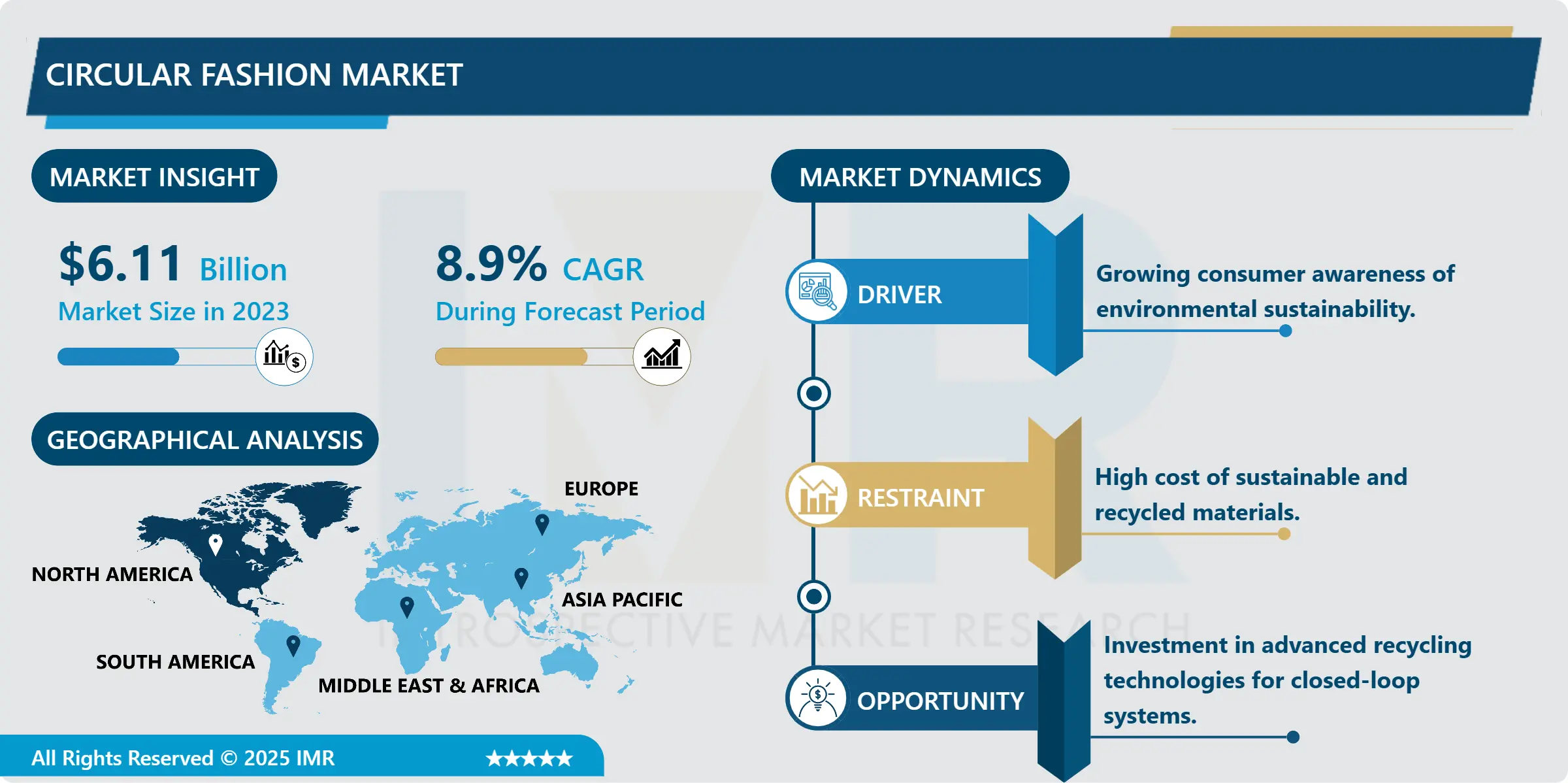
Circular Fashion Market Size, Share, Growth & Forecast (2024-2032)
Circular Fashion Market Size Was Valued at USD 6.11 Billion in 2023, and is Projected to Reach USD 13.16 Billion by 2032, Growing at a CAGR of 8.9 % From 2024-2032.

IMR Group
Description
Circular Fashion Market Synopsis:
Circular Fashion Market Size Was Valued at USD 6.11 Billion in 2023, and is Projected to Reach USD 13.16 Billion by 2032, Growing at a CAGR of 8.9 % From 2024-2032.
Emphasis has been placed on the fashion industry while the development of the Circular Fashion Market discusses the need for an optimal clothing and accessories market that will generate less waste. This kind focuses on the recycle, reuse, and up-cycle model, replacing the ‘take-make-dispose’ model, with the application of the circular model. It aims to prove that the negative impact of the environment in the fashion industry can be combated by making everyone follow appropriate, durable, and eco-friendly manufacturing and consumer practices and shared Economy ideas of business such as renting clothes and reselling them.
Circular fashion market has been the market trend in the last few years mainly due to higher consciousness towards environment and perceptions towards sustainability among the consumers. The governments and international organisation have worked to put stringent laws to mitigate the environmental effects central to the fast-fashion business model. After embracing the reality of climate changes, most consumers in the current generation are in a hurry looking for more appropriate solutions that are sustainable, ethical and durable from the fashion industry brands.
Fabrics are also being developed in new ranges, new technology in fabric manufacturing and dismantling and recycling technology are providing right push to the market. They are also involving other stakeholders in supply chain in adoption of circular business models like leasing, resale and refurbishment services. It is this kind that has helped to expand availability and cost of circular fashion that has boosted the fast-growing market.
Circular Fashion Market Trend Analysis:
Second-Hand Revolution
Second-hand fashion has rapidly become one of the largest contributors to promoting circularity within the fashion industry. As younger generations become increasingly conscious of their environmental impact, they are turning to thrift stores, online resale platforms, and vintage markets to purchase pre-loved items. Platforms such as ThredUp, Depop, and Poshmark are leading this movement, offering a convenient way to buy and sell second-hand clothing. These digital marketplaces resonate with a society that is becoming more aware of the importance of waste reduction and sustainability, as they offer an alternative to the fast-fashion model that has long been known for contributing to pollution.
This shift towards resale models is reducing the demand for new clothing, thus promoting a circular economy where products are reused, repurposed, and kept in circulation longer. Second-hand fashion addresses the affordability barrier by providing environmentally friendly clothing options at lower prices, making sustainable fashion accessible to a broader audience. As the resale market continues to grow, it transforms consumer behaviour and also supports the reduction of textile waste, helping to create a more sustainable and equitable future for fashion.
Innovative Recycling Technologies
New trends in recycling have significantly advanced the circular transition in the fashion industry. Innovative techniques like chemical recycling and fiber recycling are enabling the production of high-quality raw materials from old clothing. These methods involve extracting and reusing fibers from worn-out garments, allowing brands to create new collections without compromising fabric quality. The continued rise in investments in research and development has resulted in major improvements in recycling facilities, enhancing both innovation and efficiency in the sector.
Recycling technologies are also being enhanced by the integration of blockchain and artificial intelligence. AI-powered sorting systems make it easier to manage waste and recycle materials accurately, helping brands streamline their sustainability efforts. The combination of these cutting-edge technologies offers a promising future for fashion companies striving to reduce their environmental impact while maintaining product quality.
Circular Fashion Market Segment Analysis:
Circular Fashion Market is Segmented on the basis of Product Type, Distribution Channel, End User, and Region.
By Product Type, the Apparel segment is expected to dominate the market during the forecast period
The apparel segment is expected to capture the largest market share, driven by the increasing popularity of circular fashion. This shift comes in response to the growing issue of apparel waste, which is significantly contributing to global pollution. The fashion industry, recognizing the urgent need for sustainable practices, is adopting circular design strategies. Brands are focusing on creating multi-functional, innovative, and environmentally friendly collections to meet the demand for more sustainable clothing.
Consumers are becoming more conscious of their environmental impact and are actively seeking eco-friendly products. This shift in consumer behavior has created a favorable market for recycled and upcycled clothing. In this landscape, partnerships between brands and reuse platforms are playing a key role in extending the lifespan of garments, ensuring that clothing is reused and remains in circulation for longer.
By Distribution Channel, the Online segment is expected to hold the largest share
The online category is expected to have the largest share in the circular fashion market owing to increasing demand for online purchases. People who are buying or selling second-hand and upcycled products are discovering this online marketplace as an innovative way of selling and buying since it is easy to access, there are many options and it’s cheap.
Digital media also help brands in creating take-back activities as well as constructing product history files for applications to enable creating confidence in brands for consumers. Hence, it is fair to say that digital storefront sales have also received a boost from social media marketing/ endorsement, which is an important entrance for the circular fashion market.
Circular Fashion Market Regional Insights:
North America is Expected to Dominate the Market Over the Forecast period
North America’s dominance can be attributed to the following facts such as higher consumer awareness of the company, growing demand for products that meet and satisfy environmental legislation requirements, and key market players. The United States and Canada started taking the mantle in Sustainable Fashion with the support of government and non-governmental institutions. This has made the development of technology in the region to higher levels of commercial trading and efficiency in the recycling processes.
What North American consumers prefer using second-hand fashion has increased because of trends from celebrities and social media activism. The companies are now launching circular campaigns and offering repair or recycling products in the region and this makes them as market leaders. Also, the demands for CSR and the effort to emphasize ESG factors that in turn drive the business encouragement of circular approaches has been led by the top business entities. Combined with this assertive approach, and sustained emphasis on increasing the value of innovation, this should help to sustain North American dominance of the circular fashion market.
Active Key Players in the Circular Fashion Market:
Adidas AG (Germany)
Amour Vert (USA)
Eileen Fisher (USA)
For Days (USA)
H&M Group (Sweden)
Levi Strauss & Co. (USA)
Mud Jeans (Netherlands)
Outerknown (USA)
Patagonia, Inc. (USA)
Rent the Runway (USA)
RePack (Finland)
Stella McCartney (UK)
ThredUp (USA)
VEJA (France)
Vestiaire Collective (France)
Other Active Players
Chapter 1: Introduction
1.1 Scope and Coverage
Chapter 2:Executive Summary
Chapter 3: Market Landscape
3.1 Market Dynamics
3.1.1 Drivers
3.1.2 Restraints
3.1.3 Opportunities
3.1.4 Challenges
3.2 Market Trend Analysis
3.3 PESTLE Analysis
3.4 Porter’s Five Forces Analysis
3.5 Industry Value Chain Analysis
3.6 Ecosystem
3.7 Regulatory Landscape
3.8 Price Trend Analysis
3.9 Patent Analysis
3.10 Technology Evolution
3.11 Investment Pockets
3.12 Import-Export Analysis
Chapter 4: Circular Fashion Market by Product Type
4.1 Circular Fashion Market Snapshot and Growth Engine
4.2 Circular Fashion Market Overview
4.3 Apparel Accessories Footwear Others
4.3.1 Introduction and Market Overview
4.3.2 Historic and Forecasted Market Size in Value USD and Volume Units (2017-2032F)
4.3.3 Key Market Trends, Growth Factors and Opportunities
4.3.4 Apparel Accessories Footwear Others: Geographic Segmentation Analysis
Chapter 5: Circular Fashion Market by Distribution Channel
5.1 Circular Fashion Market Snapshot and Growth Engine
5.2 Circular Fashion Market Overview
5.3 Online Offline Other
5.3.1 Introduction and Market Overview
5.3.2 Historic and Forecasted Market Size in Value USD and Volume Units (2017-2032F)
5.3.3 Key Market Trends, Growth Factors and Opportunities
5.3.4 Online Offline Other: Geographic Segmentation Analysis
Chapter 6: Circular Fashion Market by End User
6.1 Circular Fashion Market Snapshot and Growth Engine
6.2 Circular Fashion Market Overview
6.3 Men Women Kids Unisex Others
6.3.1 Introduction and Market Overview
6.3.2 Historic and Forecasted Market Size in Value USD and Volume Units (2017-2032F)
6.3.3 Key Market Trends, Growth Factors and Opportunities
6.3.4 Men Women Kids Unisex Others: Geographic Segmentation Analysis
Chapter 7: Company Profiles and Competitive Analysis
7.1 Competitive Landscape
7.1.1 Competitive Benchmarking
7.1.2 Circular Fashion Market Share by Manufacturer (2023)
7.1.3 Industry BCG Matrix
7.1.4 Heat Map Analysis
7.1.5 Mergers and Acquisitions
7.2 ADIDAS AG (GERMANY)
7.2.1 Company Overview
7.2.2 Key Executives
7.2.3 Company Snapshot
7.2.4 Role of the Company in the Market
7.2.5 Sustainability and Social Responsibility
7.2.6 Operating Business Segments
7.2.7 Product Portfolio
7.2.8 Business Performance
7.2.9 Key Strategic Moves and Recent Developments
7.2.10 SWOT Analysis
7.3 AMOUR VERT (USA)
7.4 EILEEN FISHER (USA)
7.5 FOR DAYS (USA)
7.6 H&M GROUP (SWEDEN)
7.7 LEVI STRAUSS & CO. (USA)
7.8 MUD JEANS (NETHERLANDS)
7.9 OUTERKNOWN (USA)
7.10 PATAGONIA INC. (USA)
7.11 RENT THE RUNWAY (USA)
7.12 REPACK (FINLAND)
7.13 STELLA MCCARTNEY (UK)
7.14 THREDUP (USA)
7.15 VEJA (FRANCE)
7.16 VESTIAIRE COLLECTIVE (FRANCE)
7.17 OTHER ACTIVE PLAYERS
Chapter 8: Global Circular Fashion Market By Region
8.1 Overview
8.2. North America Circular Fashion Market
8.2.1 Key Market Trends, Growth Factors and Opportunities
8.2.2 Top Key Companies
8.2.3 Historic and Forecasted Market Size by Segments
8.2.4 Historic and Forecasted Market Size By Product Type
8.2.4.1 Apparel Accessories Footwear Others
8.2.5 Historic and Forecasted Market Size By Distribution Channel
8.2.5.1 Online Offline Other
8.2.6 Historic and Forecasted Market Size By End User
8.2.6.1 Men Women Kids Unisex Others
8.2.7 Historic and Forecast Market Size by Country
8.2.7.1 US
8.2.7.2 Canada
8.2.7.3 Mexico
8.3. Eastern Europe Circular Fashion Market
8.3.1 Key Market Trends, Growth Factors and Opportunities
8.3.2 Top Key Companies
8.3.3 Historic and Forecasted Market Size by Segments
8.3.4 Historic and Forecasted Market Size By Product Type
8.3.4.1 Apparel Accessories Footwear Others
8.3.5 Historic and Forecasted Market Size By Distribution Channel
8.3.5.1 Online Offline Other
8.3.6 Historic and Forecasted Market Size By End User
8.3.6.1 Men Women Kids Unisex Others
8.3.7 Historic and Forecast Market Size by Country
8.3.7.1 Russia
8.3.7.2 Bulgaria
8.3.7.3 The Czech Republic
8.3.7.4 Hungary
8.3.7.5 Poland
8.3.7.6 Romania
8.3.7.7 Rest of Eastern Europe
8.4. Western Europe Circular Fashion Market
8.4.1 Key Market Trends, Growth Factors and Opportunities
8.4.2 Top Key Companies
8.4.3 Historic and Forecasted Market Size by Segments
8.4.4 Historic and Forecasted Market Size By Product Type
8.4.4.1 Apparel Accessories Footwear Others
8.4.5 Historic and Forecasted Market Size By Distribution Channel
8.4.5.1 Online Offline Other
8.4.6 Historic and Forecasted Market Size By End User
8.4.6.1 Men Women Kids Unisex Others
8.4.7 Historic and Forecast Market Size by Country
8.4.7.1 Germany
8.4.7.2 UK
8.4.7.3 France
8.4.7.4 The Netherlands
8.4.7.5 Italy
8.4.7.6 Spain
8.4.7.7 Rest of Western Europe
8.5. Asia Pacific Circular Fashion Market
8.5.1 Key Market Trends, Growth Factors and Opportunities
8.5.2 Top Key Companies
8.5.3 Historic and Forecasted Market Size by Segments
8.5.4 Historic and Forecasted Market Size By Product Type
8.5.4.1 Apparel Accessories Footwear Others
8.5.5 Historic and Forecasted Market Size By Distribution Channel
8.5.5.1 Online Offline Other
8.5.6 Historic and Forecasted Market Size By End User
8.5.6.1 Men Women Kids Unisex Others
8.5.7 Historic and Forecast Market Size by Country
8.5.7.1 China
8.5.7.2 India
8.5.7.3 Japan
8.5.7.4 South Korea
8.5.7.5 Malaysia
8.5.7.6 Thailand
8.5.7.7 Vietnam
8.5.7.8 The Philippines
8.5.7.9 Australia
8.5.7.10 New Zealand
8.5.7.11 Rest of APAC
8.6. Middle East & Africa Circular Fashion Market
8.6.1 Key Market Trends, Growth Factors and Opportunities
8.6.2 Top Key Companies
8.6.3 Historic and Forecasted Market Size by Segments
8.6.4 Historic and Forecasted Market Size By Product Type
8.6.4.1 Apparel Accessories Footwear Others
8.6.5 Historic and Forecasted Market Size By Distribution Channel
8.6.5.1 Online Offline Other
8.6.6 Historic and Forecasted Market Size By End User
8.6.6.1 Men Women Kids Unisex Others
8.6.7 Historic and Forecast Market Size by Country
8.6.7.1 Turkiye
8.6.7.2 Bahrain
8.6.7.3 Kuwait
8.6.7.4 Saudi Arabia
8.6.7.5 Qatar
8.6.7.6 UAE
8.6.7.7 Israel
8.6.7.8 South Africa
8.7. South America Circular Fashion Market
8.7.1 Key Market Trends, Growth Factors and Opportunities
8.7.2 Top Key Companies
8.7.3 Historic and Forecasted Market Size by Segments
8.7.4 Historic and Forecasted Market Size By Product Type
8.7.4.1 Apparel Accessories Footwear Others
8.7.5 Historic and Forecasted Market Size By Distribution Channel
8.7.5.1 Online Offline Other
8.7.6 Historic and Forecasted Market Size By End User
8.7.6.1 Men Women Kids Unisex Others
8.7.7 Historic and Forecast Market Size by Country
8.7.7.1 Brazil
8.7.7.2 Argentina
8.7.7.3 Rest of SA
Chapter 9 Analyst Viewpoint and Conclusion
9.1 Recommendations and Concluding Analysis
9.2 Potential Market Strategies
Chapter 10 Research Methodology
10.1 Research Process
10.2 Primary Research
10.3 Secondary Research
Q1: What would be the forecast period in the Circular Fashion Market research report?
A1: The forecast period in the Circular Fashion Market research report is 2024-2032.
Q2: Who are the key players in the Circular Fashion Market?
A2: Adidas AG (Germany), Amour Vert (USA), Eileen Fisher (USA), For Days (USA), H&M Group (Sweden), Levi Strauss & Co. (USA), Mud Jeans (Netherlands), Outerknown (USA), Patagonia, Inc. (USA), Rent the Runway (USA), RePack (Finland), Stella McCartney (UK), ThredUp (USA), VEJA (France), Vestiaire Collective (France), and Other Active Players.
Q3: What are the segments of the Circular Fashion Market?
A3: The Circular Fashion market is segmented into Product Type, Distribution Channel, End User, and Region. By Product Type, the market is categorized into Apparel, Accessories, Footwear, Others. By Distribution channel, the market is categorized into Online, Offline, and Other. By End User, the market is categorized into Men, Women, Kids Unisex, and Others. By region, it is analyzed across North America (U.S., Canada, Mexico), Eastern Europe (Russia, Bulgaria, The Czech Republic, Hungary, Poland, Romania, Rest of Eastern Europe), Western Europe (Germany, UK, France, Netherlands, Italy, Spain, Rest of Western Europe), Asia Pacific (China, India, Japan, South Korea, Malaysia, Thailand, Vietnam, The Philippines, Australia, New Zealand, Rest of APAC), Middle East & Africa (Turkiye, Bahrain, Kuwait, Saudi Arabia, Qatar, UAE, Israel, South Africa), South America (Brazil, Argentina, Rest of SA).
Q4: What is the Circular Fashion Market?
A4: More emphasis has been placed on the fashion industry while the development of the Circular Fashion Market discusses the need for an optimal clothing and accessories market that will generate less waste. This kind focuses on the recycle, reuse, and up-cycle model, replacing the ‘take-make-dispose’ model, with the application of the circular model. It aims to prove that the negative impact of the environment in the fashion industry can be combated by making everyone follow appropriate, durable, and eco-friendly manufacturing and consumer practices and shared economic ideas of business such as renting clothes and reselling them
Q5: How big is the Circular Fashion Market?
A5: Circular Fashion Market Size Was Valued at USD 6.11 Billion in 2023, and is Projected to Reach USD 13.16 Billion by 2032, Growing at a CAGR of 8.9 % From 2024-2032.
How to Buy a Report from eminsights.jp
On the product page, choose the license you want: Single-User License, Multi-User License or Enterprise License.
If you required report in your native language, then you can click on Translated Report button and fill out the form with report name and language you want, then our team will contact you as soon as possible.
Click the Buy Now button.
You will be redirected to the checkout page. Enter your company details and payment information.
Click Place Order to complete the purchase.
Confirmation: You’ll receive an order confirmation and our team will contact you shortly with your ordered report.
If you have any questions, fill out the contact form below or email us at bizdev@eminsights.net.
Thank you for choosing eminsights.jp!