Stay Ahead in Fast-Growing Economies.
Browse Reports Now
Central Precocious Puberty Market Industry Overview, Key Insights & Forecast to 2032
CPP is defined as early onset puberty caused by the activation of the hypothalamic-pituitary-gonadal axis. This condition results in children exhibiting secondary sexual characteristics before the age of 8 years in girls and 9 years in boys.

IMR Group
Description
Central Precocious Puberty Market Synopsis:
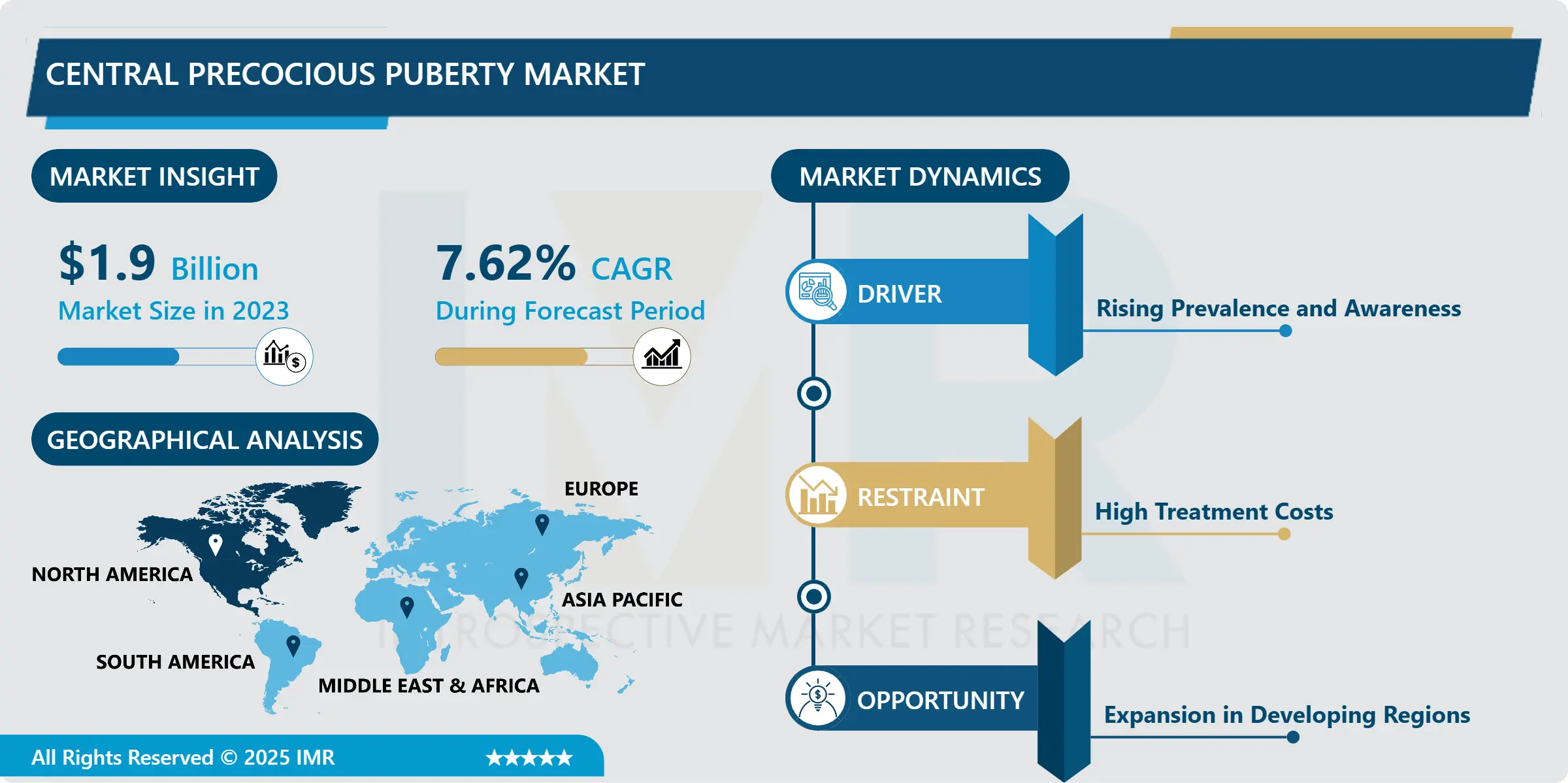
Central Precocious Puberty Market Size Was Valued at USD 1.90 Billion in 2023, and is Projected to Reach USD 3.68 Billion by 2032, Growing at a CAGR of 7.62% From 2024-2032.
CPP is defined as early onset puberty caused by the activation of the hypothalamic-pituitary-gonadal axis. This condition results in children exhibiting secondary sexual characteristics before the age of 8 years in girls and 9 years in boys. CPP can sometimes lead to increased growth rate, early sexual maturity, and some other related programmings. The main mode of management is aimed at trying to minimize sexual development so that the child can attain the right height before reaching sexual maturity.
The market for the Central Precocious Puberty is on the rise due to the growing knowledge about the early diagnosis and the treatment. Central precocious puberty is mainly diagnosed in children during instances when they develop signs of sexual development such as breast development or menstruation for the girls earlier than they should. The condition occurs as results of several factors such as genetics, neurological disorders or hormonal imbalance. As the number of children diagnosed with CPP increases, health care professionals are concentrating on the best treatment type that will help arrest development of the disease like hormone treatment.
There is a tendency in the Global Central Precocious Puberty market toward more progressive medications such as GnRH agonists and antagonists that interfere with the hormonal messages that cause early puberty. This is important in managing the disease process and the complications of the disease including growth failure and emotional difficulties arising from early sexual maturation. Similarly, advancement in the techniques of diagnosis and enhanced access to health care has played a role in the growth of market.
The specifications to the type of CPP expanding rapidly, increasing health awareness and higher per capita income particularly in the developing countries have helped the market grow. Furthermore, the browsers in future research haveprovided better understanding of CPP has helped in developing the correct treatment plan. He noted that market players are converging on getting new drugs and therapies to the market, which would continue to fuel such growth. However, cost implications of the therapies remain a hurdle together with side effects that may be associated with long term treatments.
Based on geographies, the CPP market is highly concentrated in North America because of better health care facilities, more spending on health care, and better ratios of early diagnosis. On the other hand, the Asia pacific region will post a higher growth rate because of increasing awareness of the condition as well as advancement in healthcare facilities. In the same regard, there is raise in disposable income and health care consciousness in the part of the world such as Latin America and Middle East that are factors that boosts the growth of the market in these regions.
Central Precocious Puberty Market Trend Analysis:
Hormonal Therapy Advancements in Treatment
The Central Precocious Puberty treatment market has a notable tendency towards the constant research, development and application of hormonal therapies including GnRH agonist and antagonist therapy. These treatments are sought in order to slow down the child’s sexual development so that they may grow at a normal rate and also in order to reduce the long-term consequences of early maturing children. The availability of injectable and implantable types of GnRH agonists is more comfortable for the patients and adherent to the therapies.
Research emphasizing the new treatments such as oral forms of the medicaments as well as the biologicals to solve the problem. Future clinical trials and researches are expected to lead to increase the efficacy of drugs with reduced side effects thus expand the market proportions. If hormonal therapy is used, better results are also expected to be achieved through genetic and clinical individualization of treatments for children with CPP.
Expansion in Developing Regions
There is a great potential in the Central Precocious Puberty market since developing countries have enhanced their knowledge in health care and infrastructure. As most countries in Asia Pacific, Latin America, and the Middle East improve their economic status, there is growth in the demand for quality health care services especially for kids. This brings in the aspect of market exposure of pharmaceutical firms in these regions to make available accessible and cheap means for treatment of CPP.
Similarly, engaging healthcare providers as well as both state and federal government agencies mean that awareness campaigns will have increased effectiveness in popularizing CPP and early detection/ treatment. There is enormous potential in these regions due to increase in health care and increase in disposable income whereby families can afford the best treatment for these children once diagnosed with central precocious puberty.
Central Precocious Puberty Market Segment Analysis:
Central Precocious Puberty Market is Segmented on the basis of Treatment Type, Age Group, Gender, Application, End User, and Region.
By Treatment Type, GnRH Agonists segment is expected to dominate the market during the forecast period
Currently, the major treatment for Central Precocious Puberty is by the use of GnRH agonists, which have proved to be very effective in halting progression of pubertal development. As this, they operate through inhibition of gonadotropin hormones that are responsible for stimulating the synthesis of sex hormones. Such drugs are normally administered through injections but there are some that are implantable and thus ideal for long term use. With CPP, GnRH agonists are considered the first-line treatment for the market is anticipated to remain relatively healthy.
GnRH antagonists are a more recent kind of drugs possessing high affinity to GnRH receptors and inhibiting the further reaction. It can be used in place of agonists because it suppresses the release of sex hormones. The advantage of GnRH antagonists is that they can bring the hormone levels down much quicker than agonists that might take time before showing results. This class is appearing in the CPP market as research in their effectiveness and safety for the pediatric population most of the time in young children, persists. Other forms of treatment in Central Precocious Puberty are aromatase inhibitors or even growth kinase therapy. These treatments are normally employed in combination with GnRH agonists or antagonists for short stature or other bone growth problems. The other treatment category is expected to be smaller compared to GnRH based therapies but it is useful in managing the disease in some patients
By End User, Hospitals segment expected to held the largest share
Hospitals stand as an important type of end user in the management ofs Central Precocious Puberty as they can perform diagnosis, treatment and follow up of patients. Hospitals usually put patients in touch with recommendable specialists including the pediatric endocrinologist, critical in the management of CPP. Indeed, persistent requirement for frequent monitoring and management of various administered therapies including use of GnRH agonist means that paediatric CPP patients still require to be managed in hospital settings.
Clincs are also important in the management of Central Precocious Puberty especially clinic specialists in pediatric endocrinology are part of the management of this condition. Most parents take their children to clinics when they require general checkups and treatment review since clinics are likely to provide a narrower range of treatments than huge hospitals. The relatively cheap services in clinics make them good options for families with children who have been diagnosed with CPP. Homecare is still a novel end user in the CPP market, especially for products such as GnRH agonists for treatment administration. This service lets children have their shot or the hormone treatment in the familiar surroundings of their own home, thus, they do not have to make many trips to the hospital. This trend is becoming popular as the homecare services develop, which will be cheaper, effective, and convenient for families that are struggling with this condition.
Central Precocious Puberty Market Regional Insights:
North America is Expected to Dominate the Market Over the Forecast period
North America is occupying the largest share in the Central Precocious Puberty market presently because of the advanced healthcare facilities, enhanced spending on healthcare, and early identification of diseases. This paper also identifies that the presence of experienced pediatric endocrinologists especially in the region’s medical facilities and availability of facilities that handle comprehensive care of CPP patients has been a boost to the region dominating the disease. Additionally, the increased awareness of research and development of new therapeutic products especially in the United States has fuelled the market growth in the region.
As with many developed countries in technologically advanced North America, the large population base suffering from CPP along with the awareness and access to such treatments fuels the market. Also, there is a good legal framework in place and acknowledges the application of unconventional therapies including use of GnRH agonists and antagonists for treatment of CPP. The well organized insurance system in United States in particular assures timely treatments to more children; adding up to fact that North America is the biggest market for CPP therapeutics.
Active Key Players in the Central Precocious Puberty Market:
AbbVie (U.S.)
Ferring Pharmaceuticals (Switzerland)
Ipsen (France)
Novartis (Switzerland)
Bayer AG (Germany)
Astellas Pharma (Japan)
Mylan Pharmaceuticals (U.S.)
Merck & Co. (U.S.)
Eli Lilly (U.S.)
Pfizer (U.S.)
Endo International (Ireland)
Teva Pharmaceutical Industries Ltd. (Israel)
Other Actve Players
Chapter 1: Introduction
1.1 Scope and Coverage
Chapter 2:Executive Summary
Chapter 3: Market Landscape
3.1 Market Dynamics
3.1.1 Drivers
3.1.2 Restraints
3.1.3 Opportunities
3.1.4 Challenges
3.2 Market Trend Analysis
3.3 PESTLE Analysis
3.4 Porter’s Five Forces Analysis
3.5 Industry Value Chain Analysis
3.6 Ecosystem
3.7 Regulatory Landscape
3.8 Price Trend Analysis
3.9 Patent Analysis
3.10 Technology Evolution
3.11 Investment Pockets
3.12 Import-Export Analysis
Chapter 4: Central Precocious Puberty Market by Treatment Type
4.1 Central Precocious Puberty Market Snapshot and Growth Engine
4.2 Central Precocious Puberty Market Overview
4.3 GnRH Agonists
4.3.1 Introduction and Market Overview
4.3.2 Historic and Forecasted Market Size in Value USD and Volume Units (2017-2032F)
4.3.3 Key Market Trends, Growth Factors and Opportunities
4.3.4 GnRH Agonists: Geographic Segmentation Analysis
4.4 GnRH Antagonists
4.4.1 Introduction and Market Overview
4.4.2 Historic and Forecasted Market Size in Value USD and Volume Units (2017-2032F)
4.4.3 Key Market Trends, Growth Factors and Opportunities
4.4.4 GnRH Antagonists: Geographic Segmentation Analysis
4.5 Others
4.5.1 Introduction and Market Overview
4.5.2 Historic and Forecasted Market Size in Value USD and Volume Units (2017-2032F)
4.5.3 Key Market Trends, Growth Factors and Opportunities
4.5.4 Others: Geographic Segmentation Analysis
Chapter 5: Central Precocious Puberty Market by End-User
5.1 Central Precocious Puberty Market Snapshot and Growth Engine
5.2 Central Precocious Puberty Market Overview
5.3 Hospitals
5.3.1 Introduction and Market Overview
5.3.2 Historic and Forecasted Market Size in Value USD and Volume Units (2017-2032F)
5.3.3 Key Market Trends, Growth Factors and Opportunities
5.3.4 Hospitals: Geographic Segmentation Analysis
5.4 Clinics
5.4.1 Introduction and Market Overview
5.4.2 Historic and Forecasted Market Size in Value USD and Volume Units (2017-2032F)
5.4.3 Key Market Trends, Growth Factors and Opportunities
5.4.4 Clinics: Geographic Segmentation Analysis
5.5 Homecare
5.5.1 Introduction and Market Overview
5.5.2 Historic and Forecasted Market Size in Value USD and Volume Units (2017-2032F)
5.5.3 Key Market Trends, Growth Factors and Opportunities
5.5.4 Homecare: Geographic Segmentation Analysis
Chapter 6: Central Precocious Puberty Market by Gender
6.1 Central Precocious Puberty Market Snapshot and Growth Engine
6.2 Central Precocious Puberty Market Overview
6.3 Male
6.3.1 Introduction and Market Overview
6.3.2 Historic and Forecasted Market Size in Value USD and Volume Units (2017-2032F)
6.3.3 Key Market Trends, Growth Factors and Opportunities
6.3.4 Male: Geographic Segmentation Analysis
6.4 Female
6.4.1 Introduction and Market Overview
6.4.2 Historic and Forecasted Market Size in Value USD and Volume Units (2017-2032F)
6.4.3 Key Market Trends, Growth Factors and Opportunities
6.4.4 Female: Geographic Segmentation Analysis
Chapter 7: Central Precocious Puberty Market by Age Group
7.1 Central Precocious Puberty Market Snapshot and Growth Engine
7.2 Central Precocious Puberty Market Overview
7.3 Pediatric
7.3.1 Introduction and Market Overview
7.3.2 Historic and Forecasted Market Size in Value USD and Volume Units (2017-2032F)
7.3.3 Key Market Trends, Growth Factors and Opportunities
7.3.4 Pediatric: Geographic Segmentation Analysis
7.4 Adolescent
7.4.1 Introduction and Market Overview
7.4.2 Historic and Forecasted Market Size in Value USD and Volume Units (2017-2032F)
7.4.3 Key Market Trends, Growth Factors and Opportunities
7.4.4 Adolescent: Geographic Segmentation Analysis
Chapter 8: Company Profiles and Competitive Analysis
8.1 Competitive Landscape
8.1.1 Competitive Benchmarking
8.1.2 Central Precocious Puberty Market Share by Manufacturer (2023)
8.1.3 Industry BCG Matrix
8.1.4 Heat Map Analysis
8.1.5 Mergers and Acquisitions
8.2 ABBVIE (U.S.)
8.2.1 Company Overview
8.2.2 Key Executives
8.2.3 Company Snapshot
8.2.4 Role of the Company in the Market
8.2.5 Sustainability and Social Responsibility
8.2.6 Operating Business Segments
8.2.7 Product Portfolio
8.2.8 Business Performance
8.2.9 Key Strategic Moves and Recent Developments
8.2.10 SWOT Analysis
8.3 FERRING PHARMACEUTICALS (SWITZERLAND)
8.4 IPSEN (FRANCE)
8.5 NOVARTIS (SWITZERLAND)
8.6 BAYER AG (GERMANY)
8.7 ASTELLAS PHARMA (JAPAN)
8.8 MYLAN PHARMACEUTICALS (U.S.)
8.9 MERCK & CO. (U.S.)
8.10 ELI LILLY (U.S.)
8.11 PFIZER (U.S.)
8.12 ENDO INTERNATIONAL (IRELAND)
8.13 TEVA PHARMACEUTICAL INDUSTRIES LTD. (ISRAEL)
8.14 OTHER ACTIVE PLAYERS
Chapter 9: Global Central Precocious Puberty Market By Region
9.1 Overview
9.2. North America Central Precocious Puberty Market
9.2.1 Key Market Trends, Growth Factors and Opportunities
9.2.2 Top Key Companies
9.2.3 Historic and Forecasted Market Size by Segments
9.2.4 Historic and Forecasted Market Size By Treatment Type
9.2.4.1 GnRH Agonists
9.2.4.2 GnRH Antagonists
9.2.4.3 Others
9.2.5 Historic and Forecasted Market Size By End-User
9.2.5.1 Hospitals
9.2.5.2 Clinics
9.2.5.3 Homecare
9.2.6 Historic and Forecasted Market Size By Gender
9.2.6.1 Male
9.2.6.2 Female
9.2.7 Historic and Forecasted Market Size By Age Group
9.2.7.1 Pediatric
9.2.7.2 Adolescent
9.2.8 Historic and Forecast Market Size by Country
9.2.8.1 US
9.2.8.2 Canada
9.2.8.3 Mexico
9.3. Eastern Europe Central Precocious Puberty Market
9.3.1 Key Market Trends, Growth Factors and Opportunities
9.3.2 Top Key Companies
9.3.3 Historic and Forecasted Market Size by Segments
9.3.4 Historic and Forecasted Market Size By Treatment Type
9.3.4.1 GnRH Agonists
9.3.4.2 GnRH Antagonists
9.3.4.3 Others
9.3.5 Historic and Forecasted Market Size By End-User
9.3.5.1 Hospitals
9.3.5.2 Clinics
9.3.5.3 Homecare
9.3.6 Historic and Forecasted Market Size By Gender
9.3.6.1 Male
9.3.6.2 Female
9.3.7 Historic and Forecasted Market Size By Age Group
9.3.7.1 Pediatric
9.3.7.2 Adolescent
9.3.8 Historic and Forecast Market Size by Country
9.3.8.1 Russia
9.3.8.2 Bulgaria
9.3.8.3 The Czech Republic
9.3.8.4 Hungary
9.3.8.5 Poland
9.3.8.6 Romania
9.3.8.7 Rest of Eastern Europe
9.4. Western Europe Central Precocious Puberty Market
9.4.1 Key Market Trends, Growth Factors and Opportunities
9.4.2 Top Key Companies
9.4.3 Historic and Forecasted Market Size by Segments
9.4.4 Historic and Forecasted Market Size By Treatment Type
9.4.4.1 GnRH Agonists
9.4.4.2 GnRH Antagonists
9.4.4.3 Others
9.4.5 Historic and Forecasted Market Size By End-User
9.4.5.1 Hospitals
9.4.5.2 Clinics
9.4.5.3 Homecare
9.4.6 Historic and Forecasted Market Size By Gender
9.4.6.1 Male
9.4.6.2 Female
9.4.7 Historic and Forecasted Market Size By Age Group
9.4.7.1 Pediatric
9.4.7.2 Adolescent
9.4.8 Historic and Forecast Market Size by Country
9.4.8.1 Germany
9.4.8.2 UK
9.4.8.3 France
9.4.8.4 The Netherlands
9.4.8.5 Italy
9.4.8.6 Spain
9.4.8.7 Rest of Western Europe
9.5. Asia Pacific Central Precocious Puberty Market
9.5.1 Key Market Trends, Growth Factors and Opportunities
9.5.2 Top Key Companies
9.5.3 Historic and Forecasted Market Size by Segments
9.5.4 Historic and Forecasted Market Size By Treatment Type
9.5.4.1 GnRH Agonists
9.5.4.2 GnRH Antagonists
9.5.4.3 Others
9.5.5 Historic and Forecasted Market Size By End-User
9.5.5.1 Hospitals
9.5.5.2 Clinics
9.5.5.3 Homecare
9.5.6 Historic and Forecasted Market Size By Gender
9.5.6.1 Male
9.5.6.2 Female
9.5.7 Historic and Forecasted Market Size By Age Group
9.5.7.1 Pediatric
9.5.7.2 Adolescent
9.5.8 Historic and Forecast Market Size by Country
9.5.8.1 China
9.5.8.2 India
9.5.8.3 Japan
9.5.8.4 South Korea
9.5.8.5 Malaysia
9.5.8.6 Thailand
9.5.8.7 Vietnam
9.5.8.8 The Philippines
9.5.8.9 Australia
9.5.8.10 New Zealand
9.5.8.11 Rest of APAC
9.6. Middle East & Africa Central Precocious Puberty Market
9.6.1 Key Market Trends, Growth Factors and Opportunities
9.6.2 Top Key Companies
9.6.3 Historic and Forecasted Market Size by Segments
9.6.4 Historic and Forecasted Market Size By Treatment Type
9.6.4.1 GnRH Agonists
9.6.4.2 GnRH Antagonists
9.6.4.3 Others
9.6.5 Historic and Forecasted Market Size By End-User
9.6.5.1 Hospitals
9.6.5.2 Clinics
9.6.5.3 Homecare
9.6.6 Historic and Forecasted Market Size By Gender
9.6.6.1 Male
9.6.6.2 Female
9.6.7 Historic and Forecasted Market Size By Age Group
9.6.7.1 Pediatric
9.6.7.2 Adolescent
9.6.8 Historic and Forecast Market Size by Country
9.6.8.1 Turkiye
9.6.8.2 Bahrain
9.6.8.3 Kuwait
9.6.8.4 Saudi Arabia
9.6.8.5 Qatar
9.6.8.6 UAE
9.6.8.7 Israel
9.6.8.8 South Africa
9.7. South America Central Precocious Puberty Market
9.7.1 Key Market Trends, Growth Factors and Opportunities
9.7.2 Top Key Companies
9.7.3 Historic and Forecasted Market Size by Segments
9.7.4 Historic and Forecasted Market Size By Treatment Type
9.7.4.1 GnRH Agonists
9.7.4.2 GnRH Antagonists
9.7.4.3 Others
9.7.5 Historic and Forecasted Market Size By End-User
9.7.5.1 Hospitals
9.7.5.2 Clinics
9.7.5.3 Homecare
9.7.6 Historic and Forecasted Market Size By Gender
9.7.6.1 Male
9.7.6.2 Female
9.7.7 Historic and Forecasted Market Size By Age Group
9.7.7.1 Pediatric
9.7.7.2 Adolescent
9.7.8 Historic and Forecast Market Size by Country
9.7.8.1 Brazil
9.7.8.2 Argentina
9.7.8.3 Rest of SA
Chapter 10 Analyst Viewpoint and Conclusion
10.1 Recommendations and Concluding Analysis
10.2 Potential Market Strategies
Chapter 11 Research Methodology
11.1 Research Process
11.2 Primary Research
11.3 Secondary Research
Q1: What would be the forecast period in the Central Precocious Puberty Market research report?
A1: The forecast period in the Central Precocious Puberty Market research report is 2024-2032.
Q2: Who are the key players in the Central Precocious Puberty Market?
A2: AbbVie (U.S.), Ferring Pharmaceuticals (Switzerland), Ipsen (France), Novartis (Switzerland), Bayer AG (Germany), Astellas Pharma (Japan), Mylan Pharmaceuticals (U.S.), Merck & Co. (U.S.), Eli Lilly (U.S.), Pfizer (U.S.), Endo International (Ireland), Teva Pharmaceutical Industries Ltd. (Israel), and Other Active Players.
Q3: What are the segments of the Central Precocious Puberty Market?
A3: The Central Precocious Puberty Market is segmented into Treatment Type, Gender, Age Group, End User and region. By Treatment Type, the market is categorized into GnRH Agonists, GnRH Antagonists, Others. By End-User, the market is categorized into Hospitals, Clinics, Homecare. By Gender, the market is categorized into Male, Female. By Age Group, the market is categorized into Pediatric, Adolescent. By region, it is analyzed across North America (U.S.; Canada; Mexico), Eastern Europe (Bulgaria; The Czech Republic; Hungary; Poland; Romania; Rest of Eastern Europe), Western Europe (Germany; UK; France; Netherlands; Italy; Russia; Spain; Rest of Western Europe), Asia-Pacific (China; India; Japan; Southeast Asia, etc.), South America (Brazil; Argentina, etc.), Middle East & Africa (Saudi Arabia; South Africa, etc.).
Q4: What is the Central Precocious Puberty Market?
A4: CPP is defined as early onset puberty caused by the activation of the hypothalamic-pituitary-gonadal axis. This condition results in children exhibiting secondary sexual characteristics before the age of 8 years in girls and 9 years in boys. CPP can some times lead to increased growth rate, early sexual maturity, and some other related programmings. The main mode of management is aimed at trying to minimize sexual development so that the child can attain the right height before reaching sexual maturity.
Q5: How big is the Central Precocious Puberty Market?
A5: Central Precocious Puberty Market Size Was Valued at USD 1.90 Billion in 2023, and is Projected to Reach USD 3.68 Billion by 2032, Growing at a CAGR of 7.62% From 2024-2032.
How to Buy a Report from eminsights.jp
On the product page, choose the license you want: Single-User License, Multi-User License or Enterprise License.
If you required report in your native language, then you can click on Translated Report button and fill out the form with report name and language you want, then our team will contact you as soon as possible.
Click the Buy Now button.
You will be redirected to the checkout page. Enter your company details and payment information.
Click Place Order to complete the purchase.
Confirmation: You’ll receive an order confirmation and our team will contact you shortly with your ordered report.
If you have any questions, fill out the contact form below or email us at bizdev@eminsights.net.
Thank you for choosing eminsights.jp!