Stay Ahead in Fast-Growing Economies.
Browse Reports Now
Cattle Healthcare Market Size, Share, Growth Opportunities & Forecast Report (2024-2032)
Cattle Healthcare Market is a market containing those products and services that can enhance the health of cattle. This includes vaccines formulated for animals, anti-parasitic agents, antibiotics, feeds and supplements for the animals consumed by farmers, those bought in the clinics and animal health care centers, other supplements and feeds consumed by both farmers and researchers.

IMR Group
Description
Cattle Healthcare Market Synopsis:
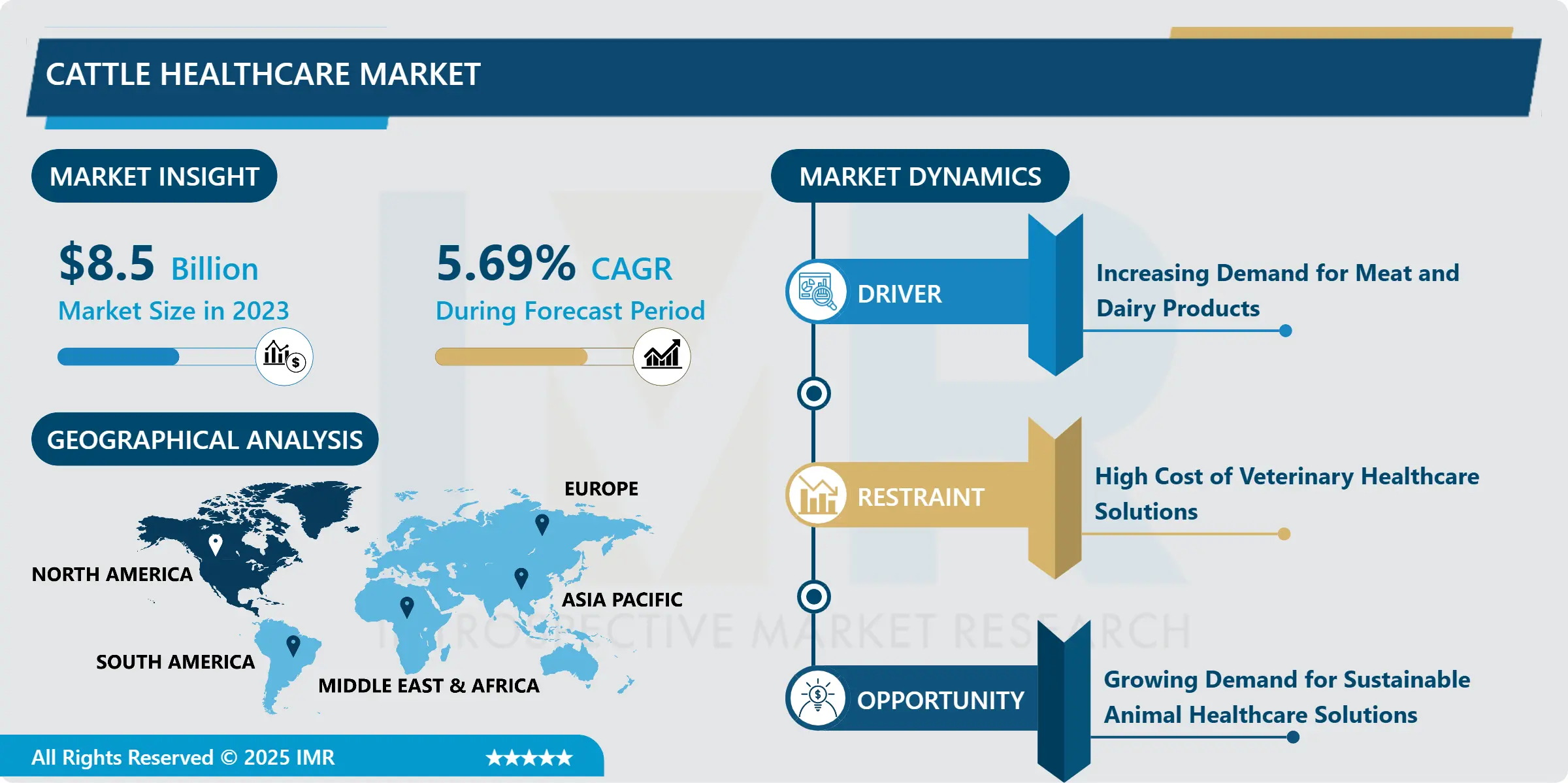
Cattle Healthcare Market Size Was Valued at USD 8.50 Billion in 2023, and is Projected to Reach USD 13.99 Billion by 2032, Growing at a CAGR of 5.69% From 2024-2032.
Cattle Healthcare Market is a market containing those products and services that can enhance the health of cattle. This includes vaccines formulated for animals, anti-parasitic agents, antibiotics, feeds and supplements for the animals consumed by farmers, those bought in the clinics and animal health care centers, other supplements and feeds consumed by both farmers and researchers. The market is to provide cattle productivity increase, to avoid diseases and to make the food safer and more sustainable in the sphere of agriculture.
The cattle healthcare market is a sub-sector of animal healthcare business mainly directed at prevention, management and treatment of diseases in cattle. Development in the global population and change in eating habits showing demand for dairy and meat products make it so essential to have proper cattle health care. To back this up, the increasing consciousness across the global society on livestock animal health and hygiene issues also known as bio security have led the livestock farmers to spend more money on the improved health care products. Infections, parasitic infestations, various forms of metabolic diseases affecting cattle are amongst diseases that will reduce productivity and profitability. Herd health and quality meat and dairy production also require effective healthcare solutions thus making healthcare solutions very central to healthcare delivery in livestock farming.
Cattle health care products comprise of vaccines, which are an important product in the livestock health management in order to protect the animals against different diseases. These vaccines have been produced to put an end to disasters such as the foot-and-mouth diseases, bovine tuberculosis and brucellosis. Similarly important is the use of veterinary parasiticides and antimicrobial agents in controlling diseases caused by internal and external parasites such as worms, ticks and flies affecting health of cattle. Besides having health benefits on the animals, these treatments also increase farm output in terms of reduced animal death rate and better growth. Minerals and vitamins are used to feed cattle to compliment their diet needs in order to enhance their growth, milk yield and breeding.
Progress in methods of treatment, prevention, and control of diseases affecting cattle have also received equal progress in vaccine production, diagnostics, and precision livestock farming. SMART health monitoring devices centered on the IoT, the use of monitoring wearables sensors for cattle are helping in early disease diagnosis, tracking the cattle’s individual health indicators, and allowing inputs for better proaction. More development in the use of intelligent tools in this field is likely to improve diagnosis and treatment of cattle illnesses. Another area of concern is that the regulatory agencies are putting much emphasis on the safe and quality animal health care products, encouraging resource efficiency and minimizing on the use of antibiotics in animal production.
Cattle Healthcare Market Trend Analysis:
Growing Adoption of Digital Health Solutions in Cattle Healthcare
The cattle healthcare market is also seeing the application of the digital health solutions like IoT-based monitoring solutions, wearable animal healthcare gadgets, diagnostic solutions backed with artificial intelligence. These technologies allow live tracking of health of cattle, thus presenting farmers with enhanced information about the health of their stock. By the use of special sensors in animal behavior, temperature, and movement, farmers can note early signs of illness as to enable quick management. The transition towards the digital health solutions in this aspect enhances the herd management practises, limits the outbreaks of diseases, and reduces the frequent resort to non-proactive farm treatments hence increasing productivity.
Digital technology supports not only health to track but generates outcome data through feeding, breeding, and even entire herds beneficial to everyday management. AI-derived insights can help to forecast the direction of the health status and give the farmers’ advisances for improving animal comfort and productivity. Furthermore, these technologies are helping toward sustainable practices since the use of antibiotics and other chemicals is decreased in farming, while sustainable farming is becoming a global trend. The rise in investment in the agriculture technology segment and the ready availability of interfaces for the implementation of the digital health solutions will build momentum in the cattle healthcare niche.
Growing Demand for Sustainable Animal Healthcare Solutions
Global market trends that point to increased adoption of various sustainable practices especially in the agricultural field pose a great opportunity to the cattle healthcare market. Owing to the concern of consumers about the environmental and ethical effects of their diets, there is a rising wanting for cattle raised sustainably. This comprises activities that reduce the application of antibiotics, hormones and other toxic substances in the feeding of cattle. Businesses that deal with antonymous healthcare products like organic feed additives and vaccines are on the rise since the push toward sustainable farming.
Concerned by this chance, cattle healthcare providers are shifting their efforts towards the creation of items that are environmentally friendly for livestock farming. This consists of increasing cattle disease resistance through the administration of vaccines, increasing feed conversion ratio through additives, and encouraging the utilization of other natural measures against diseases. Due to the rising government and regulatory agency actions against AMR and for environmental conservation, the demand for such products is projected to rise in the future. This is an excellent opportunity for various market players that will be able to design environmentally friendly and efficient health-care solutions.
Cattle Healthcare Market Segment Analysis:
Cattle Healthcare Market is Segmented on the basis of Product Type, Type of Care, Disease Type, Administration Route, End User, and Region.
By Product Type, Veterinary Vaccines segment is expected to dominate the market during the forecast period
The cattle healthcare market has been classified based on the type of product that targets unique requirements in the cattle healthcare industry. Poutlry vaccines help in controling certain diseases such as the foot-and-mouth disease, bovine tuberculosis an brucellosis which have severe effects on the economy of a given country due to their attacks on the animal industry. As mentioned previous immunization is the ultimate tool for controlling or preventing the spread of infectious diseases in herds.
Veterinary parasiticides, antimicrobials, nutritional supplements, and feed additives are among the major constituents of the market. An effective treatment towards external parasites is parasiticides and for internal parasites it is very essential since they are effective sources of diseases, while antimicrobials are effective sources of bacterial infections and are also very important. Feed supplements aid in facilitating growth of cattle, digestion, and immunity of cattle, and feed enhancers. The potential to growth all these product categories is supplemented by the rising concern with disease prevention and call for healthier stock.
By End User, Livestock Farmers segment expected to held the largest share
Some of the livestock farmers, veterinary clinics, animal healthcare firms, and research institutions are the major consuming places of cattle healthcare products. Bovine health care products directly end users are the livestock farmers because they are charge with responsibility of health of their cattle. Veterinary clinics prescribe medicine to sick animals and diagnose diseases; animal healthcare companies treat and prevent diseases in animals; while research organizations discover better solutions for the health of cattle.
Since the intake of better meat and dairy stocks increases, livestock growers are expanding on advanced health care package to their cattle herds. Care centers and health care industries are now adding services to address this rising demand that drives the cattle health market.
Cattle Healthcare Market Regional Insights:
North America is Expected to Dominate the Market Over the Forecast period
North America emerges as the largest market for cattle healthcare due to the large scale cattle farming business in the United States of America and Canada. The two countries have elaborate livestock health management regimes as well as fully developed institutional/legal framework for veterinary products. Further, North America market emphasis meat and dairy, alongside investing greatly in innovations in animal health care helping to augment its market share.
They include market incumbents in developed countries such as the United States and Canada, presence of prominent veterinary product manufacturers, research institutions, and healthcare services providers all station in North America. In addition, there is favorable consumer demand of quality meat and dairy products on American markets, which spur the necessity of efficient healthcare of cattle.
Active Key Players in the Cattle Healthcare Market:
Zoetis Inc. (USA)
Merck & Co., Inc. (USA)
Elanco Animal Health (USA)
Bayer AG (Germany)
Boehringer Ingelheim GmbH (Germany)
Virbac (France)
IDEXX Laboratories, Inc. (USA)
Ceva Santé Animale (France)
Huvepharma (Bulgaria)
Vetoquinol (France)
AgriLabs (USA)
Nutreco (Netherlands),
Other Active Players
Chapter 1: Introduction
1.1 Scope and Coverage
Chapter 2:Executive Summary
Chapter 3: Market Landscape
3.1 Market Dynamics
3.1.1 Drivers
3.1.2 Restraints
3.1.3 Opportunities
3.1.4 Challenges
3.2 Market Trend Analysis
3.3 PESTLE Analysis
3.4 Porter’s Five Forces Analysis
3.5 Industry Value Chain Analysis
3.6 Ecosystem
3.7 Regulatory Landscape
3.8 Price Trend Analysis
3.9 Patent Analysis
3.10 Technology Evolution
3.11 Investment Pockets
3.12 Import-Export Analysis
Chapter 4: Cattle Healthcare Market by Product Type
4.1 Cattle Healthcare Market Snapshot and Growth Engine
4.2 Cattle Healthcare Market Overview
4.3 Veterinary Vaccines
4.3.1 Introduction and Market Overview
4.3.2 Historic and Forecasted Market Size in Value USD and Volume Units (2017-2032F)
4.3.3 Key Market Trends, Growth Factors and Opportunities
4.3.4 Veterinary Vaccines: Geographic Segmentation Analysis
4.4 Veterinary Parasiticides
4.4.1 Introduction and Market Overview
4.4.2 Historic and Forecasted Market Size in Value USD and Volume Units (2017-2032F)
4.4.3 Key Market Trends, Growth Factors and Opportunities
4.4.4 Veterinary Parasiticides: Geographic Segmentation Analysis
4.5 Antimicrobials
4.5.1 Introduction and Market Overview
4.5.2 Historic and Forecasted Market Size in Value USD and Volume Units (2017-2032F)
4.5.3 Key Market Trends, Growth Factors and Opportunities
4.5.4 Antimicrobials: Geographic Segmentation Analysis
4.6 Nutritional Supplements
4.6.1 Introduction and Market Overview
4.6.2 Historic and Forecasted Market Size in Value USD and Volume Units (2017-2032F)
4.6.3 Key Market Trends, Growth Factors and Opportunities
4.6.4 Nutritional Supplements: Geographic Segmentation Analysis
4.7 Feed Additives
4.7.1 Introduction and Market Overview
4.7.2 Historic and Forecasted Market Size in Value USD and Volume Units (2017-2032F)
4.7.3 Key Market Trends, Growth Factors and Opportunities
4.7.4 Feed Additives: Geographic Segmentation Analysis
Chapter 5: Cattle Healthcare Market by Type of Care
5.1 Cattle Healthcare Market Snapshot and Growth Engine
5.2 Cattle Healthcare Market Overview
5.3 Preventive Healthcare
5.3.1 Introduction and Market Overview
5.3.2 Historic and Forecasted Market Size in Value USD and Volume Units (2017-2032F)
5.3.3 Key Market Trends, Growth Factors and Opportunities
5.3.4 Preventive Healthcare: Geographic Segmentation Analysis
5.4 Therapeutic
5.4.1 Introduction and Market Overview
5.4.2 Historic and Forecasted Market Size in Value USD and Volume Units (2017-2032F)
5.4.3 Key Market Trends, Growth Factors and Opportunities
5.4.4 Therapeutic: Geographic Segmentation Analysis
5.5 Healthcare
5.5.1 Introduction and Market Overview
5.5.2 Historic and Forecasted Market Size in Value USD and Volume Units (2017-2032F)
5.5.3 Key Market Trends, Growth Factors and Opportunities
5.5.4 Healthcare: Geographic Segmentation Analysis
Chapter 6: Cattle Healthcare Market by Disease Type
6.1 Cattle Healthcare Market Snapshot and Growth Engine
6.2 Cattle Healthcare Market Overview
6.3 Respiratory Diseases
6.3.1 Introduction and Market Overview
6.3.2 Historic and Forecasted Market Size in Value USD and Volume Units (2017-2032F)
6.3.3 Key Market Trends, Growth Factors and Opportunities
6.3.4 Respiratory Diseases: Geographic Segmentation Analysis
6.4 Digestive Disorders
6.4.1 Introduction and Market Overview
6.4.2 Historic and Forecasted Market Size in Value USD and Volume Units (2017-2032F)
6.4.3 Key Market Trends, Growth Factors and Opportunities
6.4.4 Digestive Disorders: Geographic Segmentation Analysis
6.5 Mastitis
6.5.1 Introduction and Market Overview
6.5.2 Historic and Forecasted Market Size in Value USD and Volume Units (2017-2032F)
6.5.3 Key Market Trends, Growth Factors and Opportunities
6.5.4 Mastitis: Geographic Segmentation Analysis
6.6 Reproductive Disorders
6.6.1 Introduction and Market Overview
6.6.2 Historic and Forecasted Market Size in Value USD and Volume Units (2017-2032F)
6.6.3 Key Market Trends, Growth Factors and Opportunities
6.6.4 Reproductive Disorders: Geographic Segmentation Analysis
6.7 Parasitic Infections
6.7.1 Introduction and Market Overview
6.7.2 Historic and Forecasted Market Size in Value USD and Volume Units (2017-2032F)
6.7.3 Key Market Trends, Growth Factors and Opportunities
6.7.4 Parasitic Infections: Geographic Segmentation Analysis
6.8 Others
6.8.1 Introduction and Market Overview
6.8.2 Historic and Forecasted Market Size in Value USD and Volume Units (2017-2032F)
6.8.3 Key Market Trends, Growth Factors and Opportunities
6.8.4 Others: Geographic Segmentation Analysis
Chapter 7: Cattle Healthcare Market by Administration Route
7.1 Cattle Healthcare Market Snapshot and Growth Engine
7.2 Cattle Healthcare Market Overview
7.3 Oral
7.3.1 Introduction and Market Overview
7.3.2 Historic and Forecasted Market Size in Value USD and Volume Units (2017-2032F)
7.3.3 Key Market Trends, Growth Factors and Opportunities
7.3.4 Oral: Geographic Segmentation Analysis
7.4 Injectable
7.4.1 Introduction and Market Overview
7.4.2 Historic and Forecasted Market Size in Value USD and Volume Units (2017-2032F)
7.4.3 Key Market Trends, Growth Factors and Opportunities
7.4.4 Injectable: Geographic Segmentation Analysis
7.5 Topical
7.5.1 Introduction and Market Overview
7.5.2 Historic and Forecasted Market Size in Value USD and Volume Units (2017-2032F)
7.5.3 Key Market Trends, Growth Factors and Opportunities
7.5.4 Topical: Geographic Segmentation Analysis
Chapter 8: Cattle Healthcare Market by End User
8.1 Cattle Healthcare Market Snapshot and Growth Engine
8.2 Cattle Healthcare Market Overview
8.3 Livestock Farmers
8.3.1 Introduction and Market Overview
8.3.2 Historic and Forecasted Market Size in Value USD and Volume Units (2017-2032F)
8.3.3 Key Market Trends, Growth Factors and Opportunities
8.3.4 Livestock Farmers: Geographic Segmentation Analysis
8.4 Veterinary Clinics
8.4.1 Introduction and Market Overview
8.4.2 Historic and Forecasted Market Size in Value USD and Volume Units (2017-2032F)
8.4.3 Key Market Trends, Growth Factors and Opportunities
8.4.4 Veterinary Clinics: Geographic Segmentation Analysis
8.5 Animal Healthcare Companies
8.5.1 Introduction and Market Overview
8.5.2 Historic and Forecasted Market Size in Value USD and Volume Units (2017-2032F)
8.5.3 Key Market Trends, Growth Factors and Opportunities
8.5.4 Animal Healthcare Companies: Geographic Segmentation Analysis
8.6 Research Organizations
8.6.1 Introduction and Market Overview
8.6.2 Historic and Forecasted Market Size in Value USD and Volume Units (2017-2032F)
8.6.3 Key Market Trends, Growth Factors and Opportunities
8.6.4 Research Organizations: Geographic Segmentation Analysis
Chapter 9: Company Profiles and Competitive Analysis
9.1 Competitive Landscape
9.1.1 Competitive Benchmarking
9.1.2 Cattle Healthcare Market Share by Manufacturer (2023)
9.1.3 Industry BCG Matrix
9.1.4 Heat Map Analysis
9.1.5 Mergers and Acquisitions
9.2 ZOETIS INC. (USA)
9.2.1 Company Overview
9.2.2 Key Executives
9.2.3 Company Snapshot
9.2.4 Role of the Company in the Market
9.2.5 Sustainability and Social Responsibility
9.2.6 Operating Business Segments
9.2.7 Product Portfolio
9.2.8 Business Performance
9.2.9 Key Strategic Moves and Recent Developments
9.2.10 SWOT Analysis
9.3 MERCK & CO. INC. (USA)
9.4 ELANCO ANIMAL HEALTH (USA)
9.5 BAYER AG (GERMANY)
9.6 BOEHRINGER INGELHEIM GMBH (GERMANY)
9.7 VIRBAC (FRANCE)
9.8 IDEXX LABORATORIES INC. (USA)
9.9 CEVA SANTÉ ANIMALE (FRANCE)
9.10 HUVEPHARMA (BULGARIA)
9.11 VETOQUINOL (FRANCE)
9.12 AGRILABS (USA)
9.13 NUTRECO (NETHERLANDS)
9.14 OTHER ACTIVE PLAYERS
Chapter 10: Global Cattle Healthcare Market By Region
10.1 Overview
10.2. North America Cattle Healthcare Market
10.2.1 Key Market Trends, Growth Factors and Opportunities
10.2.2 Top Key Companies
10.2.3 Historic and Forecasted Market Size by Segments
10.2.4 Historic and Forecasted Market Size By Product Type
10.2.4.1 Veterinary Vaccines
10.2.4.2 Veterinary Parasiticides
10.2.4.3 Antimicrobials
10.2.4.4 Nutritional Supplements
10.2.4.5 Feed Additives
10.2.5 Historic and Forecasted Market Size By Type of Care
10.2.5.1 Preventive Healthcare
10.2.5.2 Therapeutic
10.2.5.3 Healthcare
10.2.6 Historic and Forecasted Market Size By Disease Type
10.2.6.1 Respiratory Diseases
10.2.6.2 Digestive Disorders
10.2.6.3 Mastitis
10.2.6.4 Reproductive Disorders
10.2.6.5 Parasitic Infections
10.2.6.6 Others
10.2.7 Historic and Forecasted Market Size By Administration Route
10.2.7.1 Oral
10.2.7.2 Injectable
10.2.7.3 Topical
10.2.8 Historic and Forecasted Market Size By End User
10.2.8.1 Livestock Farmers
10.2.8.2 Veterinary Clinics
10.2.8.3 Animal Healthcare Companies
10.2.8.4 Research Organizations
10.2.9 Historic and Forecast Market Size by Country
10.2.9.1 US
10.2.9.2 Canada
10.2.9.3 Mexico
10.3. Eastern Europe Cattle Healthcare Market
10.3.1 Key Market Trends, Growth Factors and Opportunities
10.3.2 Top Key Companies
10.3.3 Historic and Forecasted Market Size by Segments
10.3.4 Historic and Forecasted Market Size By Product Type
10.3.4.1 Veterinary Vaccines
10.3.4.2 Veterinary Parasiticides
10.3.4.3 Antimicrobials
10.3.4.4 Nutritional Supplements
10.3.4.5 Feed Additives
10.3.5 Historic and Forecasted Market Size By Type of Care
10.3.5.1 Preventive Healthcare
10.3.5.2 Therapeutic
10.3.5.3 Healthcare
10.3.6 Historic and Forecasted Market Size By Disease Type
10.3.6.1 Respiratory Diseases
10.3.6.2 Digestive Disorders
10.3.6.3 Mastitis
10.3.6.4 Reproductive Disorders
10.3.6.5 Parasitic Infections
10.3.6.6 Others
10.3.7 Historic and Forecasted Market Size By Administration Route
10.3.7.1 Oral
10.3.7.2 Injectable
10.3.7.3 Topical
10.3.8 Historic and Forecasted Market Size By End User
10.3.8.1 Livestock Farmers
10.3.8.2 Veterinary Clinics
10.3.8.3 Animal Healthcare Companies
10.3.8.4 Research Organizations
10.3.9 Historic and Forecast Market Size by Country
10.3.9.1 Russia
10.3.9.2 Bulgaria
10.3.9.3 The Czech Republic
10.3.9.4 Hungary
10.3.9.5 Poland
10.3.9.6 Romania
10.3.9.7 Rest of Eastern Europe
10.4. Western Europe Cattle Healthcare Market
10.4.1 Key Market Trends, Growth Factors and Opportunities
10.4.2 Top Key Companies
10.4.3 Historic and Forecasted Market Size by Segments
10.4.4 Historic and Forecasted Market Size By Product Type
10.4.4.1 Veterinary Vaccines
10.4.4.2 Veterinary Parasiticides
10.4.4.3 Antimicrobials
10.4.4.4 Nutritional Supplements
10.4.4.5 Feed Additives
10.4.5 Historic and Forecasted Market Size By Type of Care
10.4.5.1 Preventive Healthcare
10.4.5.2 Therapeutic
10.4.5.3 Healthcare
10.4.6 Historic and Forecasted Market Size By Disease Type
10.4.6.1 Respiratory Diseases
10.4.6.2 Digestive Disorders
10.4.6.3 Mastitis
10.4.6.4 Reproductive Disorders
10.4.6.5 Parasitic Infections
10.4.6.6 Others
10.4.7 Historic and Forecasted Market Size By Administration Route
10.4.7.1 Oral
10.4.7.2 Injectable
10.4.7.3 Topical
10.4.8 Historic and Forecasted Market Size By End User
10.4.8.1 Livestock Farmers
10.4.8.2 Veterinary Clinics
10.4.8.3 Animal Healthcare Companies
10.4.8.4 Research Organizations
10.4.9 Historic and Forecast Market Size by Country
10.4.9.1 Germany
10.4.9.2 UK
10.4.9.3 France
10.4.9.4 The Netherlands
10.4.9.5 Italy
10.4.9.6 Spain
10.4.9.7 Rest of Western Europe
10.5. Asia Pacific Cattle Healthcare Market
10.5.1 Key Market Trends, Growth Factors and Opportunities
10.5.2 Top Key Companies
10.5.3 Historic and Forecasted Market Size by Segments
10.5.4 Historic and Forecasted Market Size By Product Type
10.5.4.1 Veterinary Vaccines
10.5.4.2 Veterinary Parasiticides
10.5.4.3 Antimicrobials
10.5.4.4 Nutritional Supplements
10.5.4.5 Feed Additives
10.5.5 Historic and Forecasted Market Size By Type of Care
10.5.5.1 Preventive Healthcare
10.5.5.2 Therapeutic
10.5.5.3 Healthcare
10.5.6 Historic and Forecasted Market Size By Disease Type
10.5.6.1 Respiratory Diseases
10.5.6.2 Digestive Disorders
10.5.6.3 Mastitis
10.5.6.4 Reproductive Disorders
10.5.6.5 Parasitic Infections
10.5.6.6 Others
10.5.7 Historic and Forecasted Market Size By Administration Route
10.5.7.1 Oral
10.5.7.2 Injectable
10.5.7.3 Topical
10.5.8 Historic and Forecasted Market Size By End User
10.5.8.1 Livestock Farmers
10.5.8.2 Veterinary Clinics
10.5.8.3 Animal Healthcare Companies
10.5.8.4 Research Organizations
10.5.9 Historic and Forecast Market Size by Country
10.5.9.1 China
10.5.9.2 India
10.5.9.3 Japan
10.5.9.4 South Korea
10.5.9.5 Malaysia
10.5.9.6 Thailand
10.5.9.7 Vietnam
10.5.9.8 The Philippines
10.5.9.9 Australia
10.5.9.10 New Zealand
10.5.9.11 Rest of APAC
10.6. Middle East & Africa Cattle Healthcare Market
10.6.1 Key Market Trends, Growth Factors and Opportunities
10.6.2 Top Key Companies
10.6.3 Historic and Forecasted Market Size by Segments
10.6.4 Historic and Forecasted Market Size By Product Type
10.6.4.1 Veterinary Vaccines
10.6.4.2 Veterinary Parasiticides
10.6.4.3 Antimicrobials
10.6.4.4 Nutritional Supplements
10.6.4.5 Feed Additives
10.6.5 Historic and Forecasted Market Size By Type of Care
10.6.5.1 Preventive Healthcare
10.6.5.2 Therapeutic
10.6.5.3 Healthcare
10.6.6 Historic and Forecasted Market Size By Disease Type
10.6.6.1 Respiratory Diseases
10.6.6.2 Digestive Disorders
10.6.6.3 Mastitis
10.6.6.4 Reproductive Disorders
10.6.6.5 Parasitic Infections
10.6.6.6 Others
10.6.7 Historic and Forecasted Market Size By Administration Route
10.6.7.1 Oral
10.6.7.2 Injectable
10.6.7.3 Topical
10.6.8 Historic and Forecasted Market Size By End User
10.6.8.1 Livestock Farmers
10.6.8.2 Veterinary Clinics
10.6.8.3 Animal Healthcare Companies
10.6.8.4 Research Organizations
10.6.9 Historic and Forecast Market Size by Country
10.6.9.1 Turkiye
10.6.9.2 Bahrain
10.6.9.3 Kuwait
10.6.9.4 Saudi Arabia
10.6.9.5 Qatar
10.6.9.6 UAE
10.6.9.7 Israel
10.6.9.8 South Africa
10.7. South America Cattle Healthcare Market
10.7.1 Key Market Trends, Growth Factors and Opportunities
10.7.2 Top Key Companies
10.7.3 Historic and Forecasted Market Size by Segments
10.7.4 Historic and Forecasted Market Size By Product Type
10.7.4.1 Veterinary Vaccines
10.7.4.2 Veterinary Parasiticides
10.7.4.3 Antimicrobials
10.7.4.4 Nutritional Supplements
10.7.4.5 Feed Additives
10.7.5 Historic and Forecasted Market Size By Type of Care
10.7.5.1 Preventive Healthcare
10.7.5.2 Therapeutic
10.7.5.3 Healthcare
10.7.6 Historic and Forecasted Market Size By Disease Type
10.7.6.1 Respiratory Diseases
10.7.6.2 Digestive Disorders
10.7.6.3 Mastitis
10.7.6.4 Reproductive Disorders
10.7.6.5 Parasitic Infections
10.7.6.6 Others
10.7.7 Historic and Forecasted Market Size By Administration Route
10.7.7.1 Oral
10.7.7.2 Injectable
10.7.7.3 Topical
10.7.8 Historic and Forecasted Market Size By End User
10.7.8.1 Livestock Farmers
10.7.8.2 Veterinary Clinics
10.7.8.3 Animal Healthcare Companies
10.7.8.4 Research Organizations
10.7.9 Historic and Forecast Market Size by Country
10.7.9.1 Brazil
10.7.9.2 Argentina
10.7.9.3 Rest of SA
Chapter 11 Analyst Viewpoint and Conclusion
11.1 Recommendations and Concluding Analysis
11.2 Potential Market Strategies
Chapter 12 Research Methodology
12.1 Research Process
12.2 Primary Research
12.3 Secondary Research
Q1: What would be the forecast period in the Cattle Healthcare Market research report?
A1: The forecast period in the Cattle Healthcare Market research report is 2024-2032.
Q2: Who are the key players in the Cattle Healthcare Market?
A2: Zoetis Inc. (USA), Merck & Co., Inc. (USA), Elanco Animal Health (USA), Bayer AG (Germany), Boehringer Ingelheim GmbH (Germany), Virbac (France), IDEXX Laboratories, Inc. (USA), Ceva Santé Animale (France), Huvepharma (Bulgaria), Vetoquinol (France), AgriLabs (USA), Nutreco (Netherlands), and Other Active Players.
Q3: What are the segments of the Cattle Healthcare Market?
A3: The Cattle Healthcare Market is segmented into Product Type, Type of Care, Disease Type, Administration Route, End User, and Region. By Product Type, the market is categorized into Veterinary Vaccines, Veterinary Parasiticides, Antimicrobials, Nutritional Supplements, and Feed Additives. By Type of Care, the market is categorized into Preventive Healthcare, Therapeutic, and Healthcare. By Disease Type, the market is categorized into Respiratory Diseases, Digestive Disorders, Mastitis, Reproductive Disorders, Parasitic Infections, and Others. By Administration Route, the market is categorized into Oral, Injectable, and Topical. By End User, the market is categorized into Livestock Farmers, Veterinary Clinics, Animal Healthcare Companies, and Research Organizations. By region, it is analyzed across North America (U.S., Canada, Mexico), Eastern Europe (Russia, Bulgaria, The Czech Republic, Hungary, Poland, Romania, Rest of Eastern Europe), Western Europe (Germany, UK, France, Netherlands, Italy, Spain, Rest of Western Europe), Asia Pacific (China, India, Japan, South Korea, Malaysia, Thailand, Vietnam, The Philippines, Australia, New Zealand, Rest of APAC), Middle East & Africa (Turkiye, Bahrain, Kuwait, Saudi Arabia, Qatar, UAE, Israel, South Africa), South America (Brazil, Argentina, Rest of SA).
Q4: What is the Cattle Healthcare Market?
A4: Cattle Healthcare Market is a market containing those products and services that can enhance the health of cattle. This includes vaccines formulated for animals, anti-parasitic agents, antibiotics, feeds and supplements for the animals consumed by farmers, those bought in the clinics and animal health care centers, other supplements and feeds consumed by both farmers and researchers. The market is to provide cattle productivity increase, to avoid diseases and to make the food safer and more sustainable in the sphere of agriculture.
Q5: How big is the Cattle Healthcare Market?
A5: Cattle Healthcare Market Size Was Valued at USD 8.50 Billion in 2023, and is Projected to Reach USD 13.99 Billion by 2032, Growing at a CAGR of 5.69% From 2024-2032
How to Buy a Report from eminsights.jp
On the product page, choose the license you want: Single-User License, Multi-User License or Enterprise License.
If you required report in your native language, then you can click on Translated Report button and fill out the form with report name and language you want, then our team will contact you as soon as possible.
Click the Buy Now button.
You will be redirected to the checkout page. Enter your company details and payment information.
Click Place Order to complete the purchase.
Confirmation: You’ll receive an order confirmation and our team will contact you shortly with your ordered report.
If you have any questions, fill out the contact form below or email us at bizdev@eminsights.net.
Thank you for choosing eminsights.jp!