Stay Ahead in Fast-Growing Economies.
Browse Reports Now




Category Management Software Market Size, Share, Growth & Forecast (2024-2032)
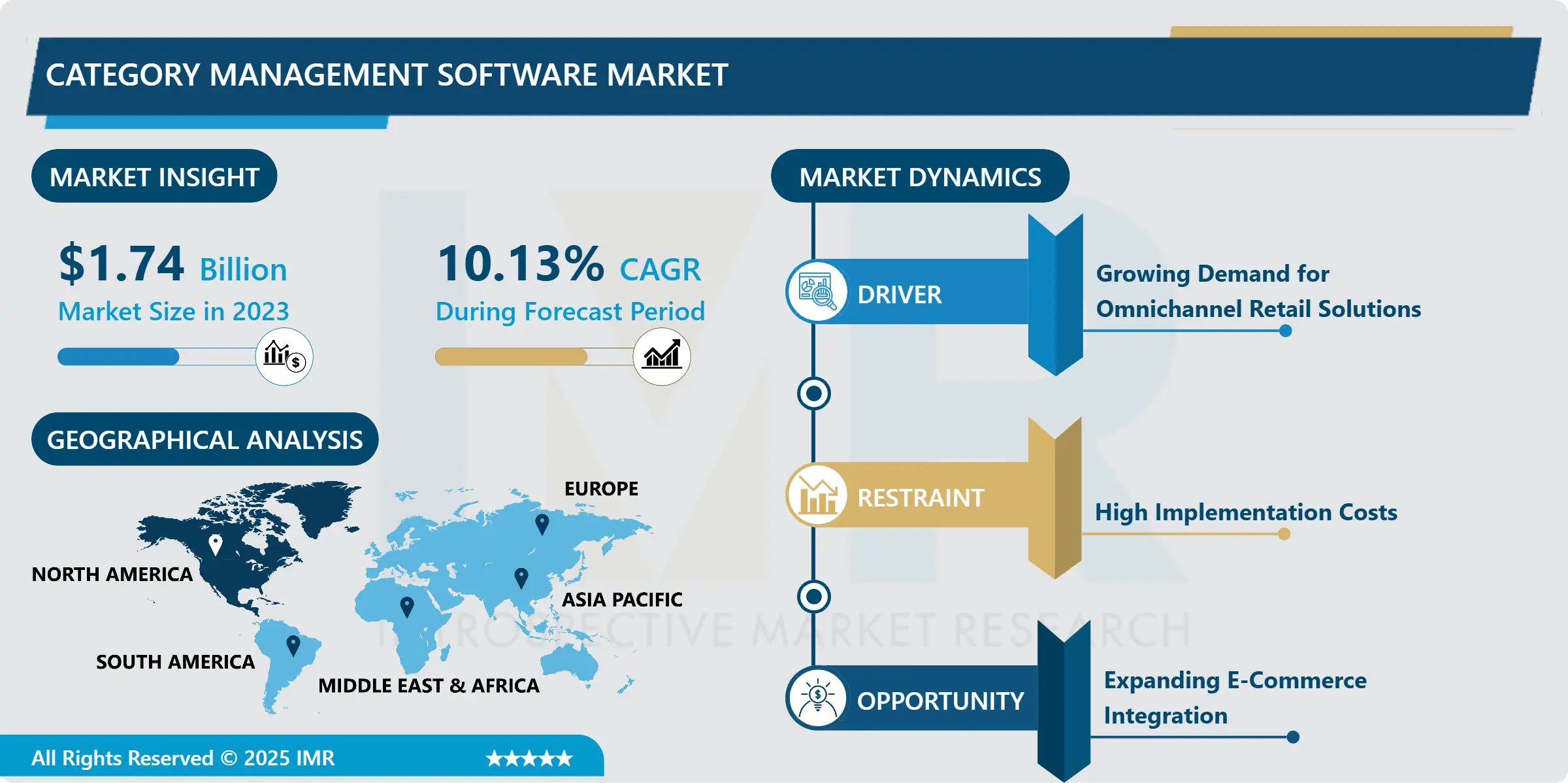
Category Management Software Market Size Was Valued at USD 1.74 Billion in 2023, and is Projected to Reach USD 4.15 Billion by 2032, Growing at a CAGR of 10.13% From 2024-2032.

IMR Group
Description
Category Management Software Market Synopsis:
Category Management Software Market Size Was Valued at USD 1.74 Billion in 2023, and is Projected to Reach USD 4.15 Billion by 2032, Growing at a CAGR of 10.13% From 2024-2032.
Category management is an application implemented in business, especially in the field of retail and manufacturing, to help manage a set of products, increase product availability, better manage the pricing policy, and increase customer satisfaction. It offers a comprehensive solution plan, analyzing and controlling of the assortment and shelf vitality, promotions, merchandising and sales.
Category management software is used at critical the heart of managing product categories within a retail or distribution network. The above tools’ objectives are to enhance sales and supply chain management by analyzing the consumer buying behavior, volume of sales and rate of Turn over of stock. Using analytics helps organizations determine the right products to offer, how to price them and where to promote them, all in an effort to boost revenues and profitability.
Common applications found in the software include sales and operations forecasting, inventory management, price optimization, and supplier information management. It complements other software systems common in organizations such as the ERP and CRM systems hence affording a complete view of the organization. Such an approach has proven useful especially for big-scale store owners or manufacturers who have to manage thousands of products in so many categories. Therefore, the software can be configured to work within different types of retail businesses with physical locations, as well as online stores, and companies that operate in both worlds.
Category management software is considered critical because businesses are concerned with operation effectiveness, increasing expenses control and satisfying customer demand on timely and relevant product and solution availability. The changing nature of retail and manufacturing retail has prompted retailers and manufacturers to look for flexible solutions that would aptly address change that define demand, supply and competition. For this reason, this market is experiencing large growth as more companies pursue the use of cloud-based and on-premise software for their category management initiatives.
Category Management Software Market Trend Analysis:
Integration with Artificial Intelligence and Machine Learning
Some of the fresh new features to implement in CMS MRM systems are the AI and ML features embedded in the systems. AI and ML algorithms help to process large amounts of data, and therefore helps to predict consumer behavior, set optimal prices and develop forecasts for demand. Although enlisted technologies are more sophisticated, they hold the potential for bringing in higher levels of customer understanding and market dynamism into the category management software.
AI and ML are progressing with time and they are actually enabling the businesses make a more customized and dynamic product range, better management of inventory and effective space on the shelves. This trend can be rather significant in sectors like retail and e-commerce, where the consumer demand is rather volatile, and only a fast reaction can help retain competitive advantage. There is also anticipated that category management systems’ markets will also continue to grow with the addition of AI and ML installations for smarter and more informed decisions.
Expanding E-Commerce Integration
Since the market for e-commerce is constantly expanding, category management software can be viewed as a possibility for businesses to adapt their online stores together with the physical ones. The software provides an opportunity for retailers to effectively manage product assortment, pricing strategies, and inventories for both, store and online formats. When utilising the category management tools, companies are able to enhance the visibility of products and improve product recommendations, hence offer a better shopping experience to clients by leveraging on their e-commerce websites.
This opportunity is most appropriate for multiple-channel establishments that require a centralized way of managing their stock, price and offer on both web and physical storefronts. Category management software is highly relevant where increasing numbers of consumers purchase products through the Internet as effective implementation of the concept in e-commerce activities guarantees definite competitive advantages. Business can benefit from real time data and the insights of the consumer in terms of sales, customers satisfaction and operations.
Category Management Software Market Segment Analysis:
Category Management Software Market is Segmented on the basis of Deployment Type, Application, Component, End User, and Region.
By Deployment Type, Cloud-based segment is expected to dominate the market during the forecast period
Cloud based category management software is adopted by many organizations because it is scalable, flexible and cheaper. Cloud deployment model provides organizations an ability to use the software over the cloud hence eliminating the inactivity physical infrastructures for the IT department as data can be updated in real-time. Cloud solutions are also more easily integrated with other cloud applications, and this is very important for organizations which use various software applications for inventory, sales, customers relationship, and other needs.
On the hand, on-premise software deployment provides more flexibility in terms of control and security of data which can be a problem for the business that operate in highly sensitive fields, such as healthcare and finance. It means that such software can be easily adapted to specific organization’s requirements as well as navigate through data protection legislation. However, this model has its disadvantages as well: it requires higher investments at the beginning (the acquisition of the physical hardware, the establishment of the infrastructure, the compulsory presence of IT departments responsible for the functioning of the system). Each deployment type is beneficial and suitable for firms and organizational structures depending on their requirements.
By Application, Retail segment expected to held the largest share
CM solutions are implemented in a wide range of industries for the purpose of managing product categories, actualizing supply chains, and increasing customer value. For the retail-sector particularly, the software is used for handling vast numbers of products in terms of inventory and pricing. Category management tools can also be employed to help retailers to understand the needs of the customers, provide the necessary incentives and optimize the stock-making process.
In manufacturing context, the role of category management software is protecting and improving manufacturing planning and scheduling, suppliers, and deliveries. Category management software is a system that can be used by e-commerce companies to help them monitor their online stock or merchandize and price them as well as help them provide relevant product recommendations to customers. Category management software is employed in the health sector to control the kind of products that are taken to hospitals and other clinics by making sure that they stock enough of a particular product at any one time.
Category Management Software Market Regional Insights:
North America is Expected to Dominate the Market Over the Forecast period
North America occupies a particularly large share in the category management software market now, thanks to the well-developed technical platform, and a high level of IT penetration, and generally strong representatives of various industries, including retail, e-commerce, and manufacturing. Class A retailers and manufacturing companies from the United States and Canada have been among the pioneers in the control and implementation of the category management software designed for supply chain and product positioning.
Beside high demand from well-developed industries, North America has a well-supported IT environment that will complement the category management solutions with other systems. Moreover, the region’s favourable regulatory requirements and huge availability of skilled workforce add to the growth of the category management software market.
Active Key Players in the Category Management Software Market:
SAP (Germany)
Oracle Corporation (USA)
IBM Corporation (USA)
Infor (USA)
Manhattan Associates (USA)
JDA Software (USA)
Microsoft Corporation (USA)
SAS Institute (USA)
Accenture (Ireland)
Symphony RetailAI (USA)
Katanacorp (Canada)
Zebra Technologies (USA), and Other Active Players
Key Industry Developments in the Category Management Software Market:
In June 2023, Unicommerce, an e-commerce enablement Software-as-a-Service (SaaS) platform, launched an advanced inventory management solution, allowing for the automated rerouting of unfulfilled orders based on real-time inventory availability across various stores and warehouses. This enhancement enables more efficient order allocation and fulfillment processes, enhancing the overall inventory management capabilities of businesses using Unicommerce’s platform.
Chapter 1: Introduction
1.1 Scope and Coverage
Chapter 2:Executive Summary
Chapter 3: Market Landscape
3.1 Market Dynamics
3.1.1 Drivers
3.1.2 Restraints
3.1.3 Opportunities
3.1.4 Challenges
3.2 Market Trend Analysis
3.3 PESTLE Analysis
3.4 Porter’s Five Forces Analysis
3.5 Industry Value Chain Analysis
3.6 Ecosystem
3.7 Regulatory Landscape
3.8 Price Trend Analysis
3.9 Patent Analysis
3.10 Technology Evolution
3.11 Investment Pockets
3.12 Import-Export Analysis
Chapter 4: Category Management Software Market by Deployment Type
4.1 Category Management Software Market Snapshot and Growth Engine
4.2 Category Management Software Market Overview
4.3 Cloud-based
4.3.1 Introduction and Market Overview
4.3.2 Historic and Forecasted Market Size in Value USD and Volume Units (2017-2032F)
4.3.3 Key Market Trends, Growth Factors and Opportunities
4.3.4 Cloud-based: Geographic Segmentation Analysis
4.4 On-premise
4.4.1 Introduction and Market Overview
4.4.2 Historic and Forecasted Market Size in Value USD and Volume Units (2017-2032F)
4.4.3 Key Market Trends, Growth Factors and Opportunities
4.4.4 On-premise : Geographic Segmentation Analysis
Chapter 5: Category Management Software Market by Application
5.1 Category Management Software Market Snapshot and Growth Engine
5.2 Category Management Software Market Overview
5.3 Retail
5.3.1 Introduction and Market Overview
5.3.2 Historic and Forecasted Market Size in Value USD and Volume Units (2017-2032F)
5.3.3 Key Market Trends, Growth Factors and Opportunities
5.3.4 Retail: Geographic Segmentation Analysis
5.4 Manufacturing
5.4.1 Introduction and Market Overview
5.4.2 Historic and Forecasted Market Size in Value USD and Volume Units (2017-2032F)
5.4.3 Key Market Trends, Growth Factors and Opportunities
5.4.4 Manufacturing: Geographic Segmentation Analysis
5.5 E-commerce
5.5.1 Introduction and Market Overview
5.5.2 Historic and Forecasted Market Size in Value USD and Volume Units (2017-2032F)
5.5.3 Key Market Trends, Growth Factors and Opportunities
5.5.4 E-commerce: Geographic Segmentation Analysis
5.6 Healthcare
5.6.1 Introduction and Market Overview
5.6.2 Historic and Forecasted Market Size in Value USD and Volume Units (2017-2032F)
5.6.3 Key Market Trends, Growth Factors and Opportunities
5.6.4 Healthcare: Geographic Segmentation Analysis
5.7 Others
5.7.1 Introduction and Market Overview
5.7.2 Historic and Forecasted Market Size in Value USD and Volume Units (2017-2032F)
5.7.3 Key Market Trends, Growth Factors and Opportunities
5.7.4 Others: Geographic Segmentation Analysis
Chapter 6: Category Management Software Market by End-user
6.1 Category Management Software Market Snapshot and Growth Engine
6.2 Category Management Software Market Overview
6.3 Large Enterprises
6.3.1 Introduction and Market Overview
6.3.2 Historic and Forecasted Market Size in Value USD and Volume Units (2017-2032F)
6.3.3 Key Market Trends, Growth Factors and Opportunities
6.3.4 Large Enterprises: Geographic Segmentation Analysis
6.4 Small & Medium-sized Enterprises (SMEs)
6.4.1 Introduction and Market Overview
6.4.2 Historic and Forecasted Market Size in Value USD and Volume Units (2017-2032F)
6.4.3 Key Market Trends, Growth Factors and Opportunities
6.4.4 Small & Medium-sized Enterprises (SMEs): Geographic Segmentation Analysis
Chapter 7: Category Management Software Market by Component
7.1 Category Management Software Market Snapshot and Growth Engine
7.2 Category Management Software Market Overview
7.3 Software
7.3.1 Introduction and Market Overview
7.3.2 Historic and Forecasted Market Size in Value USD and Volume Units (2017-2032F)
7.3.3 Key Market Trends, Growth Factors and Opportunities
7.3.4 Software: Geographic Segmentation Analysis
7.4 Services
7.4.1 Introduction and Market Overview
7.4.2 Historic and Forecasted Market Size in Value USD and Volume Units (2017-2032F)
7.4.3 Key Market Trends, Growth Factors and Opportunities
7.4.4 Services: Geographic Segmentation Analysis
Chapter 8: Company Profiles and Competitive Analysis
8.1 Competitive Landscape
8.1.1 Competitive Benchmarking
8.1.2 Category Management Software Market Share by Manufacturer (2023)
8.1.3 Industry BCG Matrix
8.1.4 Heat Map Analysis
8.1.5 Mergers and Acquisitions
8.2 SAP (GERMANY)
8.2.1 Company Overview
8.2.2 Key Executives
8.2.3 Company Snapshot
8.2.4 Role of the Company in the Market
8.2.5 Sustainability and Social Responsibility
8.2.6 Operating Business Segments
8.2.7 Product Portfolio
8.2.8 Business Performance
8.2.9 Key Strategic Moves and Recent Developments
8.2.10 SWOT Analysis
8.3 ORACLE CORPORATION (USA)
8.4 IBM CORPORATION (USA)
8.5 INFOR (USA)
8.6 MANHATTAN ASSOCIATES (USA)
8.7 JDA SOFTWARE (USA)
8.8 MICROSOFT CORPORATION (USA)
8.9 SAS INSTITUTE (USA)
8.10 ACCENTURE (IRELAND)
8.11 SYMPHONY RETAILAI (USA)
8.12 KATANACORP (CANADA)
8.13 ZEBRA TECHNOLOGIES (USA)
8.14 OTHER ACTIVE PLAYERS
Chapter 9: Global Category Management Software Market By Region
9.1 Overview
9.2. North America Category Management Software Market
9.2.1 Key Market Trends, Growth Factors and Opportunities
9.2.2 Top Key Companies
9.2.3 Historic and Forecasted Market Size by Segments
9.2.4 Historic and Forecasted Market Size By Deployment Type
9.2.4.1 Cloud-based
9.2.4.2 On-premise
9.2.5 Historic and Forecasted Market Size By Application
9.2.5.1 Retail
9.2.5.2 Manufacturing
9.2.5.3 E-commerce
9.2.5.4 Healthcare
9.2.5.5 Others
9.2.6 Historic and Forecasted Market Size By End-user
9.2.6.1 Large Enterprises
9.2.6.2 Small & Medium-sized Enterprises (SMEs)
9.2.7 Historic and Forecasted Market Size By Component
9.2.7.1 Software
9.2.7.2 Services
9.2.8 Historic and Forecast Market Size by Country
9.2.8.1 US
9.2.8.2 Canada
9.2.8.3 Mexico
9.3. Eastern Europe Category Management Software Market
9.3.1 Key Market Trends, Growth Factors and Opportunities
9.3.2 Top Key Companies
9.3.3 Historic and Forecasted Market Size by Segments
9.3.4 Historic and Forecasted Market Size By Deployment Type
9.3.4.1 Cloud-based
9.3.4.2 On-premise
9.3.5 Historic and Forecasted Market Size By Application
9.3.5.1 Retail
9.3.5.2 Manufacturing
9.3.5.3 E-commerce
9.3.5.4 Healthcare
9.3.5.5 Others
9.3.6 Historic and Forecasted Market Size By End-user
9.3.6.1 Large Enterprises
9.3.6.2 Small & Medium-sized Enterprises (SMEs)
9.3.7 Historic and Forecasted Market Size By Component
9.3.7.1 Software
9.3.7.2 Services
9.3.8 Historic and Forecast Market Size by Country
9.3.8.1 Russia
9.3.8.2 Bulgaria
9.3.8.3 The Czech Republic
9.3.8.4 Hungary
9.3.8.5 Poland
9.3.8.6 Romania
9.3.8.7 Rest of Eastern Europe
9.4. Western Europe Category Management Software Market
9.4.1 Key Market Trends, Growth Factors and Opportunities
9.4.2 Top Key Companies
9.4.3 Historic and Forecasted Market Size by Segments
9.4.4 Historic and Forecasted Market Size By Deployment Type
9.4.4.1 Cloud-based
9.4.4.2 On-premise
9.4.5 Historic and Forecasted Market Size By Application
9.4.5.1 Retail
9.4.5.2 Manufacturing
9.4.5.3 E-commerce
9.4.5.4 Healthcare
9.4.5.5 Others
9.4.6 Historic and Forecasted Market Size By End-user
9.4.6.1 Large Enterprises
9.4.6.2 Small & Medium-sized Enterprises (SMEs)
9.4.7 Historic and Forecasted Market Size By Component
9.4.7.1 Software
9.4.7.2 Services
9.4.8 Historic and Forecast Market Size by Country
9.4.8.1 Germany
9.4.8.2 UK
9.4.8.3 France
9.4.8.4 The Netherlands
9.4.8.5 Italy
9.4.8.6 Spain
9.4.8.7 Rest of Western Europe
9.5. Asia Pacific Category Management Software Market
9.5.1 Key Market Trends, Growth Factors and Opportunities
9.5.2 Top Key Companies
9.5.3 Historic and Forecasted Market Size by Segments
9.5.4 Historic and Forecasted Market Size By Deployment Type
9.5.4.1 Cloud-based
9.5.4.2 On-premise
9.5.5 Historic and Forecasted Market Size By Application
9.5.5.1 Retail
9.5.5.2 Manufacturing
9.5.5.3 E-commerce
9.5.5.4 Healthcare
9.5.5.5 Others
9.5.6 Historic and Forecasted Market Size By End-user
9.5.6.1 Large Enterprises
9.5.6.2 Small & Medium-sized Enterprises (SMEs)
9.5.7 Historic and Forecasted Market Size By Component
9.5.7.1 Software
9.5.7.2 Services
9.5.8 Historic and Forecast Market Size by Country
9.5.8.1 China
9.5.8.2 India
9.5.8.3 Japan
9.5.8.4 South Korea
9.5.8.5 Malaysia
9.5.8.6 Thailand
9.5.8.7 Vietnam
9.5.8.8 The Philippines
9.5.8.9 Australia
9.5.8.10 New Zealand
9.5.8.11 Rest of APAC
9.6. Middle East & Africa Category Management Software Market
9.6.1 Key Market Trends, Growth Factors and Opportunities
9.6.2 Top Key Companies
9.6.3 Historic and Forecasted Market Size by Segments
9.6.4 Historic and Forecasted Market Size By Deployment Type
9.6.4.1 Cloud-based
9.6.4.2 On-premise
9.6.5 Historic and Forecasted Market Size By Application
9.6.5.1 Retail
9.6.5.2 Manufacturing
9.6.5.3 E-commerce
9.6.5.4 Healthcare
9.6.5.5 Others
9.6.6 Historic and Forecasted Market Size By End-user
9.6.6.1 Large Enterprises
9.6.6.2 Small & Medium-sized Enterprises (SMEs)
9.6.7 Historic and Forecasted Market Size By Component
9.6.7.1 Software
9.6.7.2 Services
9.6.8 Historic and Forecast Market Size by Country
9.6.8.1 Turkiye
9.6.8.2 Bahrain
9.6.8.3 Kuwait
9.6.8.4 Saudi Arabia
9.6.8.5 Qatar
9.6.8.6 UAE
9.6.8.7 Israel
9.6.8.8 South Africa
9.7. South America Category Management Software Market
9.7.1 Key Market Trends, Growth Factors and Opportunities
9.7.2 Top Key Companies
9.7.3 Historic and Forecasted Market Size by Segments
9.7.4 Historic and Forecasted Market Size By Deployment Type
9.7.4.1 Cloud-based
9.7.4.2 On-premise
9.7.5 Historic and Forecasted Market Size By Application
9.7.5.1 Retail
9.7.5.2 Manufacturing
9.7.5.3 E-commerce
9.7.5.4 Healthcare
9.7.5.5 Others
9.7.6 Historic and Forecasted Market Size By End-user
9.7.6.1 Large Enterprises
9.7.6.2 Small & Medium-sized Enterprises (SMEs)
9.7.7 Historic and Forecasted Market Size By Component
9.7.7.1 Software
9.7.7.2 Services
9.7.8 Historic and Forecast Market Size by Country
9.7.8.1 Brazil
9.7.8.2 Argentina
9.7.8.3 Rest of SA
Chapter 10 Analyst Viewpoint and Conclusion
10.1 Recommendations and Concluding Analysis
10.2 Potential Market Strategies
Chapter 11 Research Methodology
11.1 Research Process
11.2 Primary Research
11.3 Secondary Research
Q1: What would be the forecast period in the Category Management Software Market research report?
A1: The forecast period in the Category Management Software Market research report is 2024-2032.
Q2: Who are the key players in the Category Management Software Market?
A2: SAP (Germany), Oracle Corporation (USA), IBM Corporation (USA), Infor (USA), Manhattan Associates (USA), JDA Software (USA), Microsoft Corporation (USA), SAS Institute (USA), Accenture (Ireland), Symphony RetailAI (USA), Katanacorp (Canada), Zebra Technologies (USA), and Other Active Players.
Q3: What are the segments of the Category Management Software Market?
A3: The Category Management Software Market is segmented into Deployment Type, Application, End User, Component, and Region. By Deployment Type, the market is categorized into Cloud-based, On-premise. By Application, the market is categorized into Retail, Manufacturing, E-commerce, Healthcare, and Others. By End-user, the market is categorized into Large Enterprises, Small & Medium-sized Enterprises (SMEs). By Component, the market is categorized into Software, Services. By region, it is analyzed across North America (U.S., Canada, Mexico), Eastern Europe (Russia, Bulgaria, The Czech Republic, Hungary, Poland, Romania, Rest of Eastern Europe), Western Europe (Germany, UK, France, Netherlands, Italy, Spain, Rest of Western Europe), Asia Pacific (China, India, Japan, South Korea, Malaysia, Thailand, Vietnam, The Philippines, Australia, New Zealand, Rest of APAC), Middle East & Africa (Turkiye, Bahrain, Kuwait, Saudi Arabia, Qatar, UAE, Israel, South Africa), South America (Brazil, Argentina, Rest of SA).
Q4: What is the Category Management Software Market?
A4: Category management is an application implemented in business, especially in the field of retail and manufacturing, to help manage a set of products, increase product availability, better manage the pricing policy, and increase customer satisfaction. It offers a comprehensive solution plan, analyzing and controlling of the assortment and shelf vitality, promotions, merchandising and sales.
Q5: How big is the Category Management Software Market?
A5: Category Management Software Market Size Was Valued at USD 1.74 Billion in 2023, and is Projected to Reach USD 4.15 Billion by 2032, Growing at a CAGR of 10.13% From 2024-2032
How to Buy a Report from eminsights.jp
On the product page, choose the license you want: Single-User License, Multi-User License or Enterprise License.
If you required report in your native language, then you can click on Translated Report button and fill out the form with report name and language you want, then our team will contact you as soon as possible.
Click the Buy Now button.
You will be redirected to the checkout page. Enter your company details and payment information.
Click Place Order to complete the purchase.
Confirmation: You’ll receive an order confirmation and our team will contact you shortly with your ordered report.
If you have any questions, fill out the contact form below or email us at bizdev@eminsights.net.
Thank you for choosing eminsights.jp!