Stay Ahead in Fast-Growing Economies.
Browse Reports Now
Catamarans Market Share, Trends & Market Forecast (2024-2032)
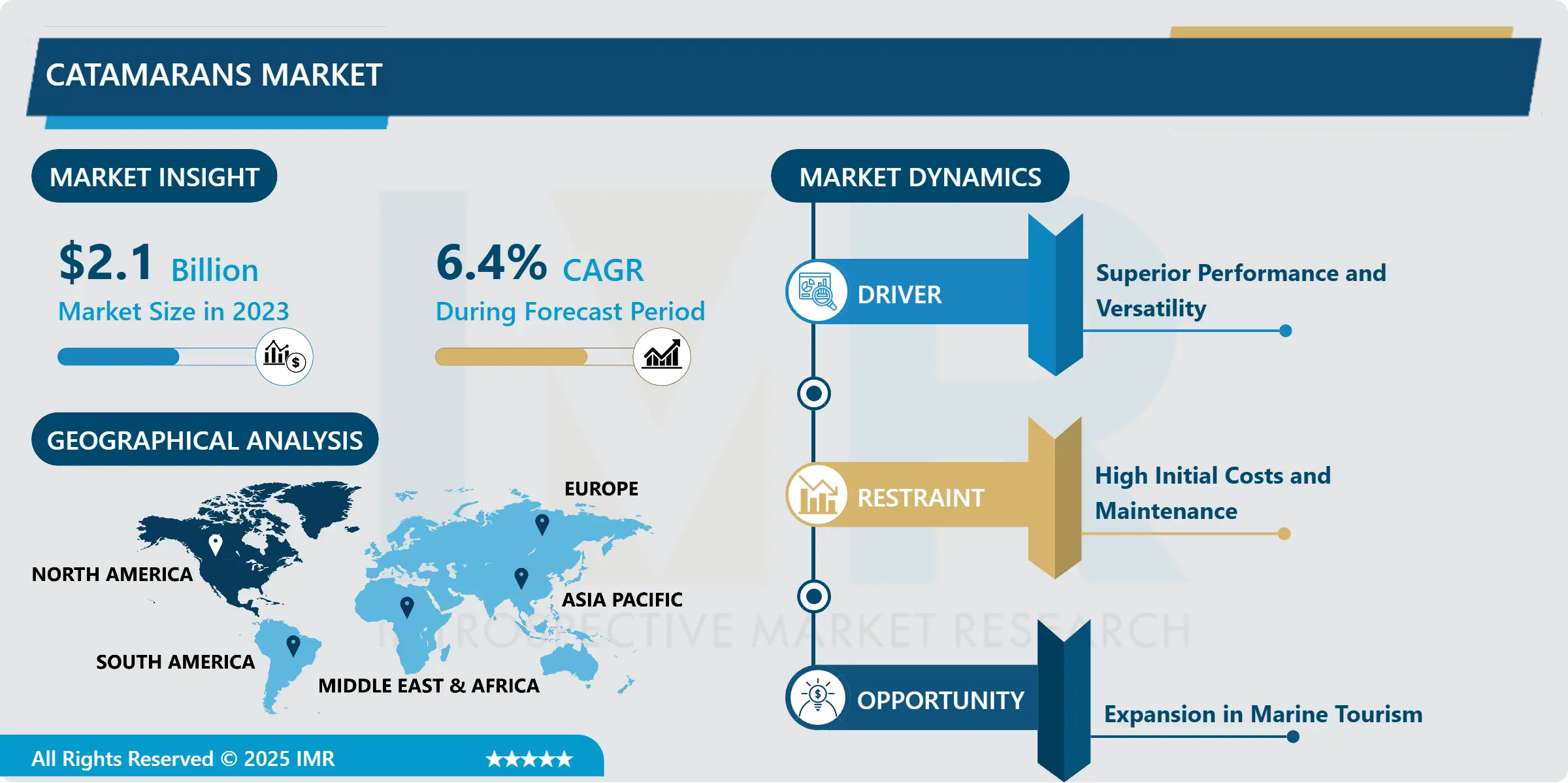
Catamarans Market Size Was Valued at USD 2.10 Billion in 2023, and is Projected to Reach USD 3.67 Billion by 2032, Growing at a CAGR of 6.4% From 2024-2032. The Catamarans Market spans across physical and digital markets of floating vessels with two side-by-side hulls held by an intersecting beam or frame. Catamarans are appreciated for their laminar flow, peace, and moderate high-speed utility and are used in recreational, professional, and military services.

IMR Group
Description
Catamarans Market Synopsis:
Catamarans Market Size Was Valued at USD 2.10 Billion in 2023, and is Projected to Reach USD 3.67 Billion by 2032, Growing at a CAGR of 6.4% From 2024-2032.
The Catamarans Market spans across physical and digital markets of floating vessels with two side-by-side hulls held by an intersecting beam or frame. Catamarans are appreciated for their laminar flow, peace, and moderate high-speed utility and are used in recreational, professional, and military services.
Catamarans are fairly widely used and preferred nowadays because of its design and usability. The market is fueled by increasing demand for marine tourism, recreational boating and recognized efficiency of catamaran design. The benefits of these vessels include speed compared to conventional single hull boats and space and fuel efficiency. Following recent developments in terms of material technology and power plant, catamarans are available in a large spectrum of possibilities for various purposes, ranging from pure leisure to functionality.
A major segment in the market is the leisure segment spurred by the need for personal watercrafts and chartered services. Furthermore, specifically, catamarans with power have been embraced in commercial and defense with high load-carrying capacities and stability in rough sea conditions. Geographical preferences of catamarans differ wherein North America and European countries are tops since they hold better maritime facilities, higher purchasing power per capita and water recreation sports are standard here. As for the emerging market in Asia-Pacific, the same is developing owing to the growth of tourism and the construction of coastal regions.
Catamarans Market Trend Analysis:
Increasing Adoption of Electric and Hybrid Propulsion Systems
Catamarans are gradually adding electric and hybrid systems, while following the trend that is widespread around the world. These systems lower the profiles’ fuel demands, and as a result the catamarans are eco-friendly in marine transit. The low noise produced by electric engines also levels up the boating experience especially for recreational and nature tourism. Automakers are committing significant amounts of resources for the production of materials that will enable electric propulsion systems that offer better range and shorter recharge time.
This statement is coupled with government supporting policies in green technology in maritime transportation. There are indications that ports and coastal areas are extending their policies for emission standards to accommodate low emission vessels for hybrid and electric catamarans. This is a clear progress toward sustainable boating, because of developments in batteries and their charging systems.
Expansion in Marine Tourism
The promise of growth for catamarans market lies in the rapidly developing field of marine tourism. Tours of recreation and vacation or adventure tourism continue to grow more popular in the coastal, island, and tropical sea areas. This kind of boat is usually large enough, comfortable and stable being perfect for private cruise ship hires, snorkeling around, as well as, sunset sails.
Particularly emerging markets including those in Southeast Asia, the Caribbean, the Mediterranean continue to experience tremendous growth. These governments and private entities realize that the construction of marinas and support of activities that take place on water are key attractions for tourists. With an increase in the global disposable per capita income, there will be increased demand for such products and services as catamaran cruises— an indication of a potentials for manufacturers and service providers.
Catamarans Market Segment Analysis:
Catamarans Market is Segmented on the basis of Type, Size, Application, Material, and Region.
By Type, Sailing Catamarans segment is expected to dominate the market during the forecast period
Sailing Catamarans are used majorly in the recreational marine industry. Its obedience to wind power makes them environmentally friendly and affordable thus fitting the green customer market for boating. These vessels are selected for cruising, charter, and personal usage, with business generated by the local adventure tourists.
Powered Catamarans are freer from design constraints than sailing catamarans and are used for commercial and defense aside from leisure use. These have better speed and higher capacities as are used in ferrying 0persons and goods, as well as in patrol services. The growth in popularity of hybrid propulsion systems is further improving their attractiveness in markets focusing on energy and environmental efficiency.
By Application, Leisure segment expected to held the largest share
The Leisure segment holds the absolute share of the international market because of the emerging trend of recreational boating and luxury charter services. Catamarans being stable, comfortable, and spacious, are well suited for tourists as well as for private use of marine pecularities.
The Commercial segment can be further divided as ferry services, passenger and cargo services. Powered catamarans are preferred here because of the efficiency and the carrying capacity. In the Defense sector catamarans are employed for patrol, surveillance and as troop carriers because catamarans are easy to maneuver and they are pretty stable boats. The Others includes research vessels and rescue operations are covered in this category, especially because catamarans are highly versatile.
Catamarans Market Regional Insights:
North America is Expected to Dominate the Market Over the Forecast period
North America holds the largest share of the catamarans market because it has superior facilities for maritime industry and there is large demand for merchant marine amenities especially water toys/routines. Coastal tourism and tours to lakes are very popular all over the year in the U.S andCanadian owing to many coastal places and lakes. Further, they also boast a large amount of high net worth citizens, which make them interested in luxury catamarans.
The commercial and defense sectors in North America also play the significant role in the market. Catamarans for ferries, patrols and research are environmentally friendly and embrace superior technology due to financial investments. As attention to hybrid and electrical catamarans rises, the region will be equipped to sustain that position.
Active Key Players in the Catamarans Market:
Lagoon Catamarans (France)
Fountaine Pajot (France)
Sunreef Yachts (Poland)
Leopard Catamarans (South Africa)
Nautitech Catamarans (France)
Seawind Catamarans (Australia)
Bavaria Yachts (Germany)
Privilege Marine (France)
Outremer Yachting (France)
Gunboat (France)
Robertson and Caine (South Africa)
HH Catamarans (China), and Other Active Players
Key Industry Developments in the Catamarans Market:
In November 2023, Sunreef Yachts, a renowned manufacturer of luxury catamarans, introduced the Sunreef 80, a spacious and sophisticated catamaran designed for long-distance cruising. In addition to the Sunreef 80, the company offers a diverse range of catamaran models, including the Sunreef 50, Sunreef 60, and Sunreef 70.
Chapter 1: Introduction
1.1 Scope and Coverage
Chapter 2:Executive Summary
Chapter 3: Market Landscape
3.1 Market Dynamics
3.1.1 Drivers
3.1.2 Restraints
3.1.3 Opportunities
3.1.4 Challenges
3.2 Market Trend Analysis
3.3 PESTLE Analysis
3.4 Porter’s Five Forces Analysis
3.5 Industry Value Chain Analysis
3.6 Ecosystem
3.7 Regulatory Landscape
3.8 Price Trend Analysis
3.9 Patent Analysis
3.10 Technology Evolution
3.11 Investment Pockets
3.12 Import-Export Analysis
Chapter 4: Catamarans Market by Type
4.1 Catamarans Market Snapshot and Growth Engine
4.2 Catamarans Market Overview
4.3 Sailing Catamarans
4.3.1 Introduction and Market Overview
4.3.2 Historic and Forecasted Market Size in Value USD and Volume Units (2017-2032F)
4.3.3 Key Market Trends, Growth Factors and Opportunities
4.3.4 Sailing Catamarans: Geographic Segmentation Analysis
4.4 Powered Catamarans
4.4.1 Introduction and Market Overview
4.4.2 Historic and Forecasted Market Size in Value USD and Volume Units (2017-2032F)
4.4.3 Key Market Trends, Growth Factors and Opportunities
4.4.4 Powered Catamarans: Geographic Segmentation Analysis
Chapter 5: Catamarans Market by Size
5.1 Catamarans Market Snapshot and Growth Engine
5.2 Catamarans Market Overview
5.3 Small (up to 30 feet
5.3.1 Introduction and Market Overview
5.3.2 Historic and Forecasted Market Size in Value USD and Volume Units (2017-2032F)
5.3.3 Key Market Trends, Growth Factors and Opportunities
5.3.4 Small (up to 30 feet: Geographic Segmentation Analysis
5.4 Medium (31–50 feet)
5.4.1 Introduction and Market Overview
5.4.2 Historic and Forecasted Market Size in Value USD and Volume Units (2017-2032F)
5.4.3 Key Market Trends, Growth Factors and Opportunities
5.4.4 Medium (31–50 feet): Geographic Segmentation Analysis
5.5 Large (51–100 feet)
5.5.1 Introduction and Market Overview
5.5.2 Historic and Forecasted Market Size in Value USD and Volume Units (2017-2032F)
5.5.3 Key Market Trends, Growth Factors and Opportunities
5.5.4 Large (51–100 feet): Geographic Segmentation Analysis
5.6 Extra-large (Above 100 feet)
5.6.1 Introduction and Market Overview
5.6.2 Historic and Forecasted Market Size in Value USD and Volume Units (2017-2032F)
5.6.3 Key Market Trends, Growth Factors and Opportunities
5.6.4 Extra-large (Above 100 feet): Geographic Segmentation Analysis
Chapter 6: Catamarans Market by Application
6.1 Catamarans Market Snapshot and Growth Engine
6.2 Catamarans Market Overview
6.3 Leisure
6.3.1 Introduction and Market Overview
6.3.2 Historic and Forecasted Market Size in Value USD and Volume Units (2017-2032F)
6.3.3 Key Market Trends, Growth Factors and Opportunities
6.3.4 Leisure: Geographic Segmentation Analysis
6.4 Commercial
6.4.1 Introduction and Market Overview
6.4.2 Historic and Forecasted Market Size in Value USD and Volume Units (2017-2032F)
6.4.3 Key Market Trends, Growth Factors and Opportunities
6.4.4 Commercial: Geographic Segmentation Analysis
6.5 Defense
6.5.1 Introduction and Market Overview
6.5.2 Historic and Forecasted Market Size in Value USD and Volume Units (2017-2032F)
6.5.3 Key Market Trends, Growth Factors and Opportunities
6.5.4 Defense: Geographic Segmentation Analysis
6.6 Others
6.6.1 Introduction and Market Overview
6.6.2 Historic and Forecasted Market Size in Value USD and Volume Units (2017-2032F)
6.6.3 Key Market Trends, Growth Factors and Opportunities
6.6.4 Others: Geographic Segmentation Analysis
Chapter 7: Catamarans Market by Material
7.1 Catamarans Market Snapshot and Growth Engine
7.2 Catamarans Market Overview
7.3 Aluminum
7.3.1 Introduction and Market Overview
7.3.2 Historic and Forecasted Market Size in Value USD and Volume Units (2017-2032F)
7.3.3 Key Market Trends, Growth Factors and Opportunities
7.3.4 Aluminum: Geographic Segmentation Analysis
7.4 Carbon Fiber
7.4.1 Introduction and Market Overview
7.4.2 Historic and Forecasted Market Size in Value USD and Volume Units (2017-2032F)
7.4.3 Key Market Trends, Growth Factors and Opportunities
7.4.4 Carbon Fiber: Geographic Segmentation Analysis
7.5 Fiberglass
7.5.1 Introduction and Market Overview
7.5.2 Historic and Forecasted Market Size in Value USD and Volume Units (2017-2032F)
7.5.3 Key Market Trends, Growth Factors and Opportunities
7.5.4 Fiberglass: Geographic Segmentation Analysis
7.6 Others
7.6.1 Introduction and Market Overview
7.6.2 Historic and Forecasted Market Size in Value USD and Volume Units (2017-2032F)
7.6.3 Key Market Trends, Growth Factors and Opportunities
7.6.4 Others: Geographic Segmentation Analysis
Chapter 8: Company Profiles and Competitive Analysis
8.1 Competitive Landscape
8.1.1 Competitive Benchmarking
8.1.2 Catamarans Market Share by Manufacturer (2023)
8.1.3 Industry BCG Matrix
8.1.4 Heat Map Analysis
8.1.5 Mergers and Acquisitions
8.2 LAGOON CATAMARANS (FRANCE)
8.2.1 Company Overview
8.2.2 Key Executives
8.2.3 Company Snapshot
8.2.4 Role of the Company in the Market
8.2.5 Sustainability and Social Responsibility
8.2.6 Operating Business Segments
8.2.7 Product Portfolio
8.2.8 Business Performance
8.2.9 Key Strategic Moves and Recent Developments
8.2.10 SWOT Analysis
8.3 FOUNTAINE PAJOT (FRANCE)
8.4 SUNREEF YACHTS (POLAND)
8.5 LEOPARD CATAMARANS (SOUTH AFRICA)
8.6 NAUTITECH CATAMARANS (FRANCE)
8.7 SEAWIND CATAMARANS (AUSTRALIA)
8.8 BAVARIA YACHTS (GERMANY)
8.9 PRIVILEGE MARINE (FRANCE)
8.10 OUTREMER YACHTING (FRANCE)
8.11 GUNBOAT (FRANCE)
8.12 ROBERTSON AND CAINE (SOUTH AFRICA)
8.13 HH CATAMARANS (CHINA)
8.14 OTHER ACTIVE PLAYERS
Chapter 9: Global Catamarans Market By Region
9.1 Overview
9.2. North America Catamarans Market
9.2.1 Key Market Trends, Growth Factors and Opportunities
9.2.2 Top Key Companies
9.2.3 Historic and Forecasted Market Size by Segments
9.2.4 Historic and Forecasted Market Size By Type
9.2.4.1 Sailing Catamarans
9.2.4.2 Powered Catamarans
9.2.5 Historic and Forecasted Market Size By Size
9.2.5.1 Small (up to 30 feet
9.2.5.2 Medium (31–50 feet)
9.2.5.3 Large (51–100 feet)
9.2.5.4 Extra-large (Above 100 feet)
9.2.6 Historic and Forecasted Market Size By Application
9.2.6.1 Leisure
9.2.6.2 Commercial
9.2.6.3 Defense
9.2.6.4 Others
9.2.7 Historic and Forecasted Market Size By Material
9.2.7.1 Aluminum
9.2.7.2 Carbon Fiber
9.2.7.3 Fiberglass
9.2.7.4 Others
9.2.8 Historic and Forecast Market Size by Country
9.2.8.1 US
9.2.8.2 Canada
9.2.8.3 Mexico
9.3. Eastern Europe Catamarans Market
9.3.1 Key Market Trends, Growth Factors and Opportunities
9.3.2 Top Key Companies
9.3.3 Historic and Forecasted Market Size by Segments
9.3.4 Historic and Forecasted Market Size By Type
9.3.4.1 Sailing Catamarans
9.3.4.2 Powered Catamarans
9.3.5 Historic and Forecasted Market Size By Size
9.3.5.1 Small (up to 30 feet
9.3.5.2 Medium (31–50 feet)
9.3.5.3 Large (51–100 feet)
9.3.5.4 Extra-large (Above 100 feet)
9.3.6 Historic and Forecasted Market Size By Application
9.3.6.1 Leisure
9.3.6.2 Commercial
9.3.6.3 Defense
9.3.6.4 Others
9.3.7 Historic and Forecasted Market Size By Material
9.3.7.1 Aluminum
9.3.7.2 Carbon Fiber
9.3.7.3 Fiberglass
9.3.7.4 Others
9.3.8 Historic and Forecast Market Size by Country
9.3.8.1 Russia
9.3.8.2 Bulgaria
9.3.8.3 The Czech Republic
9.3.8.4 Hungary
9.3.8.5 Poland
9.3.8.6 Romania
9.3.8.7 Rest of Eastern Europe
9.4. Western Europe Catamarans Market
9.4.1 Key Market Trends, Growth Factors and Opportunities
9.4.2 Top Key Companies
9.4.3 Historic and Forecasted Market Size by Segments
9.4.4 Historic and Forecasted Market Size By Type
9.4.4.1 Sailing Catamarans
9.4.4.2 Powered Catamarans
9.4.5 Historic and Forecasted Market Size By Size
9.4.5.1 Small (up to 30 feet
9.4.5.2 Medium (31–50 feet)
9.4.5.3 Large (51–100 feet)
9.4.5.4 Extra-large (Above 100 feet)
9.4.6 Historic and Forecasted Market Size By Application
9.4.6.1 Leisure
9.4.6.2 Commercial
9.4.6.3 Defense
9.4.6.4 Others
9.4.7 Historic and Forecasted Market Size By Material
9.4.7.1 Aluminum
9.4.7.2 Carbon Fiber
9.4.7.3 Fiberglass
9.4.7.4 Others
9.4.8 Historic and Forecast Market Size by Country
9.4.8.1 Germany
9.4.8.2 UK
9.4.8.3 France
9.4.8.4 The Netherlands
9.4.8.5 Italy
9.4.8.6 Spain
9.4.8.7 Rest of Western Europe
9.5. Asia Pacific Catamarans Market
9.5.1 Key Market Trends, Growth Factors and Opportunities
9.5.2 Top Key Companies
9.5.3 Historic and Forecasted Market Size by Segments
9.5.4 Historic and Forecasted Market Size By Type
9.5.4.1 Sailing Catamarans
9.5.4.2 Powered Catamarans
9.5.5 Historic and Forecasted Market Size By Size
9.5.5.1 Small (up to 30 feet
9.5.5.2 Medium (31–50 feet)
9.5.5.3 Large (51–100 feet)
9.5.5.4 Extra-large (Above 100 feet)
9.5.6 Historic and Forecasted Market Size By Application
9.5.6.1 Leisure
9.5.6.2 Commercial
9.5.6.3 Defense
9.5.6.4 Others
9.5.7 Historic and Forecasted Market Size By Material
9.5.7.1 Aluminum
9.5.7.2 Carbon Fiber
9.5.7.3 Fiberglass
9.5.7.4 Others
9.5.8 Historic and Forecast Market Size by Country
9.5.8.1 China
9.5.8.2 India
9.5.8.3 Japan
9.5.8.4 South Korea
9.5.8.5 Malaysia
9.5.8.6 Thailand
9.5.8.7 Vietnam
9.5.8.8 The Philippines
9.5.8.9 Australia
9.5.8.10 New Zealand
9.5.8.11 Rest of APAC
9.6. Middle East & Africa Catamarans Market
9.6.1 Key Market Trends, Growth Factors and Opportunities
9.6.2 Top Key Companies
9.6.3 Historic and Forecasted Market Size by Segments
9.6.4 Historic and Forecasted Market Size By Type
9.6.4.1 Sailing Catamarans
9.6.4.2 Powered Catamarans
9.6.5 Historic and Forecasted Market Size By Size
9.6.5.1 Small (up to 30 feet
9.6.5.2 Medium (31–50 feet)
9.6.5.3 Large (51–100 feet)
9.6.5.4 Extra-large (Above 100 feet)
9.6.6 Historic and Forecasted Market Size By Application
9.6.6.1 Leisure
9.6.6.2 Commercial
9.6.6.3 Defense
9.6.6.4 Others
9.6.7 Historic and Forecasted Market Size By Material
9.6.7.1 Aluminum
9.6.7.2 Carbon Fiber
9.6.7.3 Fiberglass
9.6.7.4 Others
9.6.8 Historic and Forecast Market Size by Country
9.6.8.1 Turkiye
9.6.8.2 Bahrain
9.6.8.3 Kuwait
9.6.8.4 Saudi Arabia
9.6.8.5 Qatar
9.6.8.6 UAE
9.6.8.7 Israel
9.6.8.8 South Africa
9.7. South America Catamarans Market
9.7.1 Key Market Trends, Growth Factors and Opportunities
9.7.2 Top Key Companies
9.7.3 Historic and Forecasted Market Size by Segments
9.7.4 Historic and Forecasted Market Size By Type
9.7.4.1 Sailing Catamarans
9.7.4.2 Powered Catamarans
9.7.5 Historic and Forecasted Market Size By Size
9.7.5.1 Small (up to 30 feet
9.7.5.2 Medium (31–50 feet)
9.7.5.3 Large (51–100 feet)
9.7.5.4 Extra-large (Above 100 feet)
9.7.6 Historic and Forecasted Market Size By Application
9.7.6.1 Leisure
9.7.6.2 Commercial
9.7.6.3 Defense
9.7.6.4 Others
9.7.7 Historic and Forecasted Market Size By Material
9.7.7.1 Aluminum
9.7.7.2 Carbon Fiber
9.7.7.3 Fiberglass
9.7.7.4 Others
9.7.8 Historic and Forecast Market Size by Country
9.7.8.1 Brazil
9.7.8.2 Argentina
9.7.8.3 Rest of SA
Chapter 10 Analyst Viewpoint and Conclusion
10.1 Recommendations and Concluding Analysis
10.2 Potential Market Strategies
Chapter 11 Research Methodology
11.1 Research Process
11.2 Primary Research
11.3 Secondary Research
Q1: What would be the forecast period in the Catamarans Market research report?
A1: The forecast period in the Catamarans Market research report is 2024-2032.
Q2: Who are the key players in the Catamarans Market?
A2: Lagoon Catamarans (France), Fountaine Pajot (France), Sunreef Yachts (Poland), Leopard Catamarans (South Africa), Nautitech Catamarans (France), Seawind Catamarans (Australia), Bavaria Yachts (Germany), Privilege Marine (France), Outremer Yachting (France), Gunboat (France), Robertson and Caine (South Africa), HH Catamarans (China), and Other Active Players.
Q3: What are the segments of the Catamarans Market?
A3: The Catamarans Market is segmented into Type, Size, Application, Material, and Region. By Type, the market is categorized into Sailing Catamarans, Powered Catamarans. By Size, the market is categorized into Small, Medium, Large, and Extra-large. By Application, the market is categorized into Leisure, Commercial, Defense, Others. By Material, the market is categorized into Aluminum, Carbon Fiber, Fiberglass, and Others. By region, it is analyzed across North America (U.S., Canada, Mexico), Eastern Europe (Russia, Bulgaria, The Czech Republic, Hungary, Poland, Romania, Rest of Eastern Europe), Western Europe (Germany, UK, France, Netherlands, Italy, Spain, Rest of Western Europe), Asia Pacific (China, India, Japan, South Korea, Malaysia, Thailand, Vietnam, The Philippines, Australia, New Zealand, Rest of APAC), Middle East & Africa (Turkiye, Bahrain, Kuwait, Saudi Arabia, Qatar, UAE, Israel, South Africa), South America (Brazil, Argentina, Rest of SA).
Q4: What is the Catamarans Market?
A4: The Catamarans Market spans across physical and digital markets of floating vessels with two side-by-side hulls held by an intersecting beam or frame. Catamarans are appreciated for their laminar flow, peace, and moderate high-speed utility and are used in recreational, professional, and military services.
Q5: How big is the Catamarans Market?
A5: Catamarans Market Size Was Valued at USD 2.10 Billion in 2023, and is Projected to Reach USD 3.67 Billion by 2032, Growing at a CAGR of 6.4% From 2024-2032.
How to Buy a Report from eminsights.jp
On the product page, choose the license you want: Single-User License, Multi-User License or Enterprise License.
If you required report in your native language, then you can click on Translated Report button and fill out the form with report name and language you want, then our team will contact you as soon as possible.
Click the Buy Now button.
You will be redirected to the checkout page. Enter your company details and payment information.
Click Place Order to complete the purchase.
Confirmation: You’ll receive an order confirmation and our team will contact you shortly with your ordered report.
If you have any questions, fill out the contact form below or email us at bizdev@eminsights.net.
Thank you for choosing eminsights.jp!