Stay Ahead in Fast-Growing Economies.
Browse Reports Now




Car Safety Market Size, Share, Growth & Forecast (2024-2032)
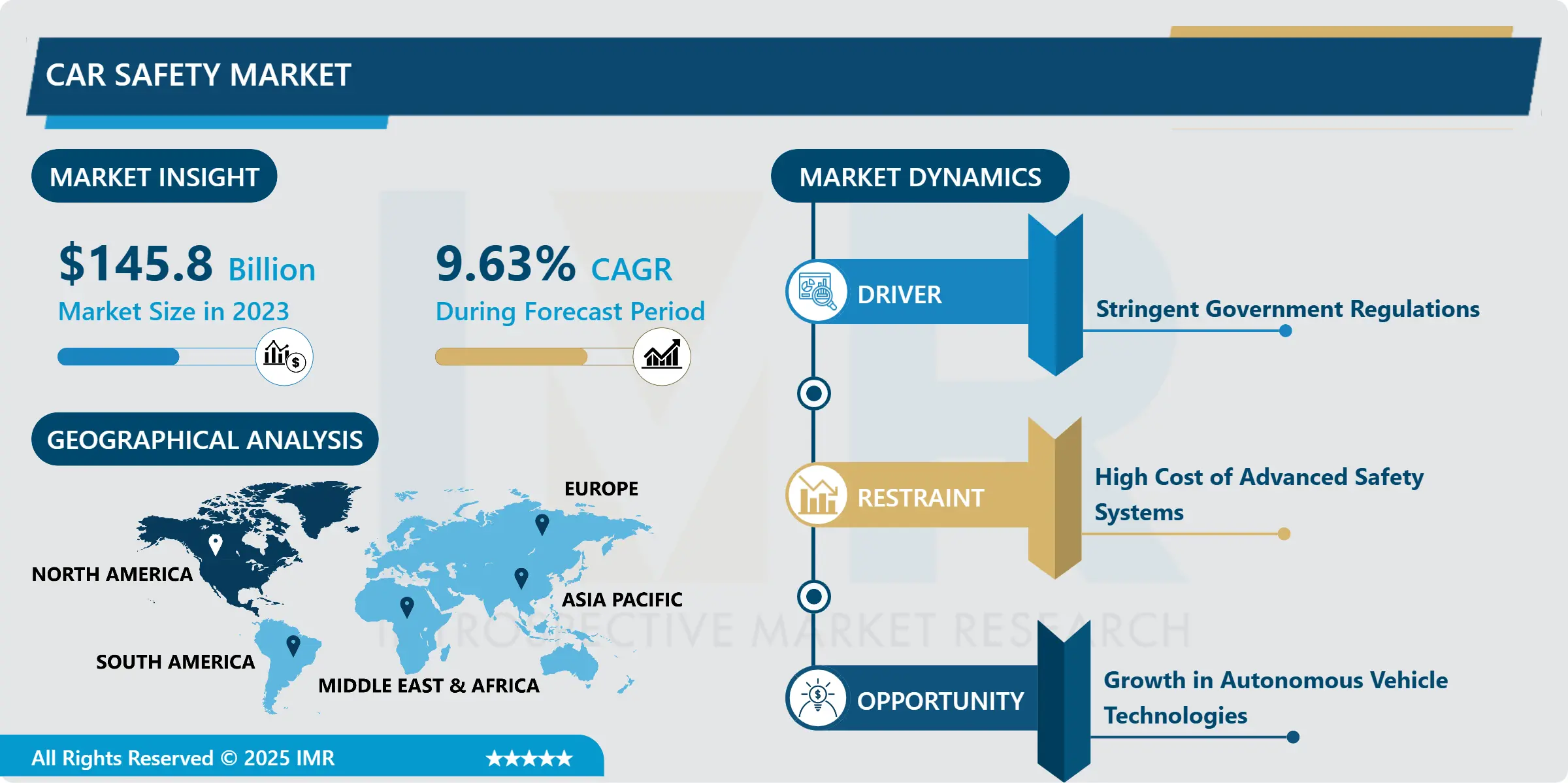
Car Safety Market Size Was Valued at USD 145.80 Billion in 2023, and is Projected to Reach USD 333.52 Billion by 2032, Growing at a CAGR of 9.63% From 2024-2032.

IMR Group
Description
Car Safety Market Synopsis:
Car Safety Market Size Was Valued at USD 145.80 Billion in 2023, and is Projected to Reach USD 333.52 Billion by 2032, Growing at a CAGR of 9.63% From 2024-2032.
Car safety market encompasses any technology, system or product that helps offer better safety to the users of the car, the pedestrians and other users of the road. This market encompasses traditional and integral safety systems applied in cars as well as ADAS whose purpose is to prevent accidents and limit the severity of an onset accident.
There has been market growth in car safety likely because of enhanced consumers’ awareness, higher safety standards, and more technological innovations. Road safety still requires important attention while safety systems’ demand remains high for advancement. The market consists of safety systems which help occupants to remain safe in the event of an accident and safety systems intended to avoid an accident altogether.
Self-driving is also on its way and so is Artificial Intelligence (AI) with many today’s cars featuring lane assistance, adaptive cruise control, and emergency braking. Moreover, regulatory authorities in nations around the globe are raising the bar for vehicle safety standards; auto makers have no option other than to adopt these advanced technologies. Therefore, car safety technologies are not mere components that enhance comfort, but,” essential parts of car assembly that contribute to occupant safety and world standard norms.
The latest trend of electric vehicles and the connectivity of these cars with the intelligent transport system have enhanced new realizations in this market. Because these cars tend to use Complex ECUs and have advanced electrical systems it is possible that they have improved safety features such as, emergency electric braking, and collision mitigation. Given that important advances are being made and with more people expressing concern over road accidents, car safety systems are likely to advance further with sensors, machine learning, and real data processing for better perception of the hazard on the road.
Car Safety Market Trend Analysis:
Advancement in Active Safety Systems
Predictive safety systems are among the key trends in the car safety market since more and more technologies aimed at preventing road accidents are in high demand. Other components like warning for lane change, autonomous slowing down, adjusting speed to match the road traffic, as well as collision identification are uniquely merged into multiple road cars. These systems utilize the elements such as a sensor, camera, as well as radar to observe the environment and provide the signal to the driver or to steer the car automatically whenever the need arises.
It is only in the future that active safety systems will be integrated with more artificial intelligence and machine learning. Using ‘Big Data’ and analytics that also occurs in real-time, these systems must be able to determine the likelihood of an accident occurring, and take necessary action to avoid it. The move from today’s more simple active safety features to more intelligent ones is not only about the addition of new functions but also at increasing the precision and reliability of existing systems. Future advancements in this sector are sure to be of great importance to improve highway safety, diminish fatalities, and contribute to the development of self-driving cars.
Growth in Autonomous Vehicle Technologies
Self-Car is one of the key megatrends in the car safety market as it will bring new opportunities for the growth of vehicle safety. Self-driving cars, that are also known as driverless cars need little or no input from the driver and hence depend on safety features like ADAS, collision avoidance, and driving itself technologies for safety of the people inside the car and those outside. The risk of improving the car safety grows proportionally to the advancement of the technology, and, basically, the modern vehicles have specific algorithms and real time decision making capabilities that allows to predict and possibly avoid the accidents.
Today’s market for autonomous vehicles is still emerging, however, we predict that it will expand notably over the years with the governments and automakers’ participation in the development, and progress of self-driving vehicles. Given that human has been considered culpable of distorting the traffic patterns the incorporation of such smart sensors, machine learning, and AI in the production of the self-driving cars will be advantageous. When these technologies evolve further, the safety technologies used in self-driving automobiles will become benchmarks across the car safety market segment coupled with the wider transport sector. This market is thus unique in that it offers possibilities for OEM automakers and technology firms to work together in the advancement of their technological products.
Car Safety Market Segment Analysis:
Car Safety Market is Segmented on the basis of Safety System Type, Vehicle Type, Component, Technology, and Region.
By Safety System Type, Active Safety Systems segment is expected to dominate the market during the forecast period
Active Safety Systems: A systems approach to active safety distinguishes them from passive ones which are those that come into play once an accident has taken place. These are aspects like semantic advanced systems, automatic braking systems, lane departure systems, blind spot informants, and intelligent speed control. Such systems employ variety of devices including sensors, cameras and radar aimed at detecting environment and rendering immediate support to the driver. Being able to identify risks scenarios that may cause danger and act when required, efficient active safety systems are minimizing chances of impacts and are preventing fatalities.
Passive Safety Systems: whereas passive safety structures are meant to safeguard the occupants of the vehicle in the case of an accident. These systems are such as air bags, seat belts, advanced crush zones and reinforced structures. Active safety systems tend to avoid accidents while passive safety systems are designed with a view to shedding off force impact in the unfortunate event of an accident.
By Technology, Advanced Driver Assistance Systems (ADAS) segment expected to held the largest share
ADAS technologies includes various systems essentially aimed at the driver helping him/her and improving safety of the vehicle. These are makes such as automatic emergency braking system, lane departure warning systems as well as adaptive cruise control. ASDR technologies function in real-time to support the driver to control the vehicle and prevent accidents. These systems employ tachoud; sensors; cameras; and radar to sense the environment of the vehicle and convey it to the driver.
Self-driving cars are the future of car safety technology commonly referred to as autonomous vehicles. A number of these vehicles are endowed with sensors, cameras and Artificial Intelligence facilitated systems that enables them to move and act independently. Self-driving cars are intended to contain far fewer human factors that are known to contribute to a large measure of collisions. Current advances in artificial intelligence, machine learning as well as the enhancement of the sensor systems have made it possible to enhance fully autonomous vehicles.
Car Safety Market Regional Insights:
North America is Expected to Dominate the Market Over the Forecast period
North America is at present the largest market for car safety due to well-developed automotive market and tough safety standards in the regulating authority in the area. Among the leading players in the field of vehicle safety technologies, it is possible to name the United States as this market has numerous key market players and technology suppliers located there. The US government, for example, has its National Highway Traffic Safety Administration or NHTSA that mandates the adoption of features in new cars.
The North America has received the highest market share exposure due to multiple reasons including; demand for ADAS, push for self-driving cars, and the consumers’ desire to acquire safer cars. Vehicle makers in the region have shifted a gear up to incorporate car safety features in their products and most of the products are being exported. However, North American consumers are very concerned about the safety aspects relating to automobiles especially when making their choice on cars to purchase, this has spurred continued development of advanced safety technologies in cars.
Active Key Players in the Car Safety Market:
Toyota Motor Corporation (Japan)
Volkswagen Group (Germany)
Ford Motor Company (USA)
General Motors (USA)
Daimler AG (Germany)
BMW AG (Germany)
Honda Motor Co. (Japan)
Hyundai Motor Company (South Korea)
Tesla, Inc. (USA)
Audi AG (Germany)
Nissan Motor Co. (Japan)
Fujitsu Ten Limited (Japan), and Other Active Players
Key Industry Developments in the Car Safety Market:
In September 2023, Mercedes’ Driver Pilot ADAS achieved level 3 autonomy, enhancing safety. IoT integration by various companies revolutionizes connectivity and data management, while e-fuels promise carbon neutrality, led by industry-wide efforts.
In May 2023, Autoliv showcased an integrated cockpit, zero-gravity seat, and Star steering wheel at the Shanghai Automobile Industry Exhibition 2023, aiming to enhance safety and comfort in vehicles. Over 35,000 visitors witnessed Autoliv’s innovations.
Chapter 1: Introduction
1.1 Scope and Coverage
Chapter 2:Executive Summary
Chapter 3: Market Landscape
3.1 Market Dynamics
3.1.1 Drivers
3.1.2 Restraints
3.1.3 Opportunities
3.1.4 Challenges
3.2 Market Trend Analysis
3.3 PESTLE Analysis
3.4 Porter’s Five Forces Analysis
3.5 Industry Value Chain Analysis
3.6 Ecosystem
3.7 Regulatory Landscape
3.8 Price Trend Analysis
3.9 Patent Analysis
3.10 Technology Evolution
3.11 Investment Pockets
3.12 Import-Export Analysis
Chapter 4: Car Safety Market by Safety System Type
4.1 Car Safety Market Snapshot and Growth Engine
4.2 Car Safety Market Overview
4.3 Active Safety Systems
4.3.1 Introduction and Market Overview
4.3.2 Historic and Forecasted Market Size in Value USD and Volume Units (2017-2032F)
4.3.3 Key Market Trends, Growth Factors and Opportunities
4.3.4 Active Safety Systems: Geographic Segmentation Analysis
4.4 Passive Safety Systems.
4.4.1 Introduction and Market Overview
4.4.2 Historic and Forecasted Market Size in Value USD and Volume Units (2017-2032F)
4.4.3 Key Market Trends, Growth Factors and Opportunities
4.4.4 Passive Safety Systems.: Geographic Segmentation Analysis
Chapter 5: Car Safety Market by Vehicle Type
5.1 Car Safety Market Snapshot and Growth Engine
5.2 Car Safety Market Overview
5.3 Passenger Cars
5.3.1 Introduction and Market Overview
5.3.2 Historic and Forecasted Market Size in Value USD and Volume Units (2017-2032F)
5.3.3 Key Market Trends, Growth Factors and Opportunities
5.3.4 Passenger Cars: Geographic Segmentation Analysis
5.4 Commercial Vehicles
5.4.1 Introduction and Market Overview
5.4.2 Historic and Forecasted Market Size in Value USD and Volume Units (2017-2032F)
5.4.3 Key Market Trends, Growth Factors and Opportunities
5.4.4 Commercial Vehicles: Geographic Segmentation Analysis
Chapter 6: Car Safety Market by Component
6.1 Car Safety Market Snapshot and Growth Engine
6.2 Car Safety Market Overview
6.3 Airbags
6.3.1 Introduction and Market Overview
6.3.2 Historic and Forecasted Market Size in Value USD and Volume Units (2017-2032F)
6.3.3 Key Market Trends, Growth Factors and Opportunities
6.3.4 Airbags: Geographic Segmentation Analysis
6.4 Seatbelts
6.4.1 Introduction and Market Overview
6.4.2 Historic and Forecasted Market Size in Value USD and Volume Units (2017-2032F)
6.4.3 Key Market Trends, Growth Factors and Opportunities
6.4.4 Seatbelts: Geographic Segmentation Analysis
6.5 Braking Systems
6.5.1 Introduction and Market Overview
6.5.2 Historic and Forecasted Market Size in Value USD and Volume Units (2017-2032F)
6.5.3 Key Market Trends, Growth Factors and Opportunities
6.5.4 Braking Systems: Geographic Segmentation Analysis
6.6 Lighting Systems
6.6.1 Introduction and Market Overview
6.6.2 Historic and Forecasted Market Size in Value USD and Volume Units (2017-2032F)
6.6.3 Key Market Trends, Growth Factors and Opportunities
6.6.4 Lighting Systems: Geographic Segmentation Analysis
6.7 Others
6.7.1 Introduction and Market Overview
6.7.2 Historic and Forecasted Market Size in Value USD and Volume Units (2017-2032F)
6.7.3 Key Market Trends, Growth Factors and Opportunities
6.7.4 Others: Geographic Segmentation Analysis
Chapter 7: Car Safety Market by Technology
7.1 Car Safety Market Snapshot and Growth Engine
7.2 Car Safety Market Overview
7.3 Advanced Driver Assistance Systems
7.3.1 Introduction and Market Overview
7.3.2 Historic and Forecasted Market Size in Value USD and Volume Units (2017-2032F)
7.3.3 Key Market Trends, Growth Factors and Opportunities
7.3.4 Advanced Driver Assistance Systems: Geographic Segmentation Analysis
7.4 Autonomous Vehicles
7.4.1 Introduction and Market Overview
7.4.2 Historic and Forecasted Market Size in Value USD and Volume Units (2017-2032F)
7.4.3 Key Market Trends, Growth Factors and Opportunities
7.4.4 Autonomous Vehicles: Geographic Segmentation Analysis
7.5 Collision Avoidance Systems
7.5.1 Introduction and Market Overview
7.5.2 Historic and Forecasted Market Size in Value USD and Volume Units (2017-2032F)
7.5.3 Key Market Trends, Growth Factors and Opportunities
7.5.4 Collision Avoidance Systems: Geographic Segmentation Analysis
7.6 Others
7.6.1 Introduction and Market Overview
7.6.2 Historic and Forecasted Market Size in Value USD and Volume Units (2017-2032F)
7.6.3 Key Market Trends, Growth Factors and Opportunities
7.6.4 Others: Geographic Segmentation Analysis
Chapter 8: Company Profiles and Competitive Analysis
8.1 Competitive Landscape
8.1.1 Competitive Benchmarking
8.1.2 Car Safety Market Share by Manufacturer (2023)
8.1.3 Industry BCG Matrix
8.1.4 Heat Map Analysis
8.1.5 Mergers and Acquisitions
8.2 TOYOTA MOTOR CORPORATION (JAPAN)
8.2.1 Company Overview
8.2.2 Key Executives
8.2.3 Company Snapshot
8.2.4 Role of the Company in the Market
8.2.5 Sustainability and Social Responsibility
8.2.6 Operating Business Segments
8.2.7 Product Portfolio
8.2.8 Business Performance
8.2.9 Key Strategic Moves and Recent Developments
8.2.10 SWOT Analysis
8.3 VOLKSWAGEN GROUP (GERMANY)
8.4 FORD MOTOR COMPANY (USA)
8.5 GENERAL MOTORS (USA)
DAIMLER AG (GERMANY)
8.6 BMW AG (GERMANY)
8.7 HONDA MOTOR CO. (JAPAN)
8.8 HYUNDAI MOTOR COMPANY (SOUTH KOREA)
8.9 TESLA INC. (USA)
8.10 AUDI AG (GERMANY)
8.11 NISSAN MOTOR CO. (JAPAN)
8.12 FUJITSU TEN LIMITED (JAPAN)
8.13 OTHER ACTIVE PLAYERS
Chapter 9: Global Car Safety Market By Region
9.1 Overview
9.2. North America Car Safety Market
9.2.1 Key Market Trends, Growth Factors and Opportunities
9.2.2 Top Key Companies
9.2.3 Historic and Forecasted Market Size by Segments
9.2.4 Historic and Forecasted Market Size By Safety System Type
9.2.4.1 Active Safety Systems
9.2.4.2 Passive Safety Systems.
9.2.5 Historic and Forecasted Market Size By Vehicle Type
9.2.5.1 Passenger Cars
9.2.5.2 Commercial Vehicles
9.2.6 Historic and Forecasted Market Size By Component
9.2.6.1 Airbags
9.2.6.2 Seatbelts
9.2.6.3 Braking Systems
9.2.6.4 Lighting Systems
9.2.6.5 Others
9.2.7 Historic and Forecasted Market Size By Technology
9.2.7.1 Advanced Driver Assistance Systems
9.2.7.2 Autonomous Vehicles
9.2.7.3 Collision Avoidance Systems
9.2.7.4 Others
9.2.8 Historic and Forecast Market Size by Country
9.2.8.1 US
9.2.8.2 Canada
9.2.8.3 Mexico
9.3. Eastern Europe Car Safety Market
9.3.1 Key Market Trends, Growth Factors and Opportunities
9.3.2 Top Key Companies
9.3.3 Historic and Forecasted Market Size by Segments
9.3.4 Historic and Forecasted Market Size By Safety System Type
9.3.4.1 Active Safety Systems
9.3.4.2 Passive Safety Systems.
9.3.5 Historic and Forecasted Market Size By Vehicle Type
9.3.5.1 Passenger Cars
9.3.5.2 Commercial Vehicles
9.3.6 Historic and Forecasted Market Size By Component
9.3.6.1 Airbags
9.3.6.2 Seatbelts
9.3.6.3 Braking Systems
9.3.6.4 Lighting Systems
9.3.6.5 Others
9.3.7 Historic and Forecasted Market Size By Technology
9.3.7.1 Advanced Driver Assistance Systems
9.3.7.2 Autonomous Vehicles
9.3.7.3 Collision Avoidance Systems
9.3.7.4 Others
9.3.8 Historic and Forecast Market Size by Country
9.3.8.1 Russia
9.3.8.2 Bulgaria
9.3.8.3 The Czech Republic
9.3.8.4 Hungary
9.3.8.5 Poland
9.3.8.6 Romania
9.3.8.7 Rest of Eastern Europe
9.4. Western Europe Car Safety Market
9.4.1 Key Market Trends, Growth Factors and Opportunities
9.4.2 Top Key Companies
9.4.3 Historic and Forecasted Market Size by Segments
9.4.4 Historic and Forecasted Market Size By Safety System Type
9.4.4.1 Active Safety Systems
9.4.4.2 Passive Safety Systems.
9.4.5 Historic and Forecasted Market Size By Vehicle Type
9.4.5.1 Passenger Cars
9.4.5.2 Commercial Vehicles
9.4.6 Historic and Forecasted Market Size By Component
9.4.6.1 Airbags
9.4.6.2 Seatbelts
9.4.6.3 Braking Systems
9.4.6.4 Lighting Systems
9.4.6.5 Others
9.4.7 Historic and Forecasted Market Size By Technology
9.4.7.1 Advanced Driver Assistance Systems
9.4.7.2 Autonomous Vehicles
9.4.7.3 Collision Avoidance Systems
9.4.7.4 Others
9.4.8 Historic and Forecast Market Size by Country
9.4.8.1 Germany
9.4.8.2 UK
9.4.8.3 France
9.4.8.4 The Netherlands
9.4.8.5 Italy
9.4.8.6 Spain
9.4.8.7 Rest of Western Europe
9.5. Asia Pacific Car Safety Market
9.5.1 Key Market Trends, Growth Factors and Opportunities
9.5.2 Top Key Companies
9.5.3 Historic and Forecasted Market Size by Segments
9.5.4 Historic and Forecasted Market Size By Safety System Type
9.5.4.1 Active Safety Systems
9.5.4.2 Passive Safety Systems.
9.5.5 Historic and Forecasted Market Size By Vehicle Type
9.5.5.1 Passenger Cars
9.5.5.2 Commercial Vehicles
9.5.6 Historic and Forecasted Market Size By Component
9.5.6.1 Airbags
9.5.6.2 Seatbelts
9.5.6.3 Braking Systems
9.5.6.4 Lighting Systems
9.5.6.5 Others
9.5.7 Historic and Forecasted Market Size By Technology
9.5.7.1 Advanced Driver Assistance Systems
9.5.7.2 Autonomous Vehicles
9.5.7.3 Collision Avoidance Systems
9.5.7.4 Others
9.5.8 Historic and Forecast Market Size by Country
9.5.8.1 China
9.5.8.2 India
9.5.8.3 Japan
9.5.8.4 South Korea
9.5.8.5 Malaysia
9.5.8.6 Thailand
9.5.8.7 Vietnam
9.5.8.8 The Philippines
9.5.8.9 Australia
9.5.8.10 New Zealand
9.5.8.11 Rest of APAC
9.6. Middle East & Africa Car Safety Market
9.6.1 Key Market Trends, Growth Factors and Opportunities
9.6.2 Top Key Companies
9.6.3 Historic and Forecasted Market Size by Segments
9.6.4 Historic and Forecasted Market Size By Safety System Type
9.6.4.1 Active Safety Systems
9.6.4.2 Passive Safety Systems.
9.6.5 Historic and Forecasted Market Size By Vehicle Type
9.6.5.1 Passenger Cars
9.6.5.2 Commercial Vehicles
9.6.6 Historic and Forecasted Market Size By Component
9.6.6.1 Airbags
9.6.6.2 Seatbelts
9.6.6.3 Braking Systems
9.6.6.4 Lighting Systems
9.6.6.5 Others
9.6.7 Historic and Forecasted Market Size By Technology
9.6.7.1 Advanced Driver Assistance Systems
9.6.7.2 Autonomous Vehicles
9.6.7.3 Collision Avoidance Systems
9.6.7.4 Others
9.6.8 Historic and Forecast Market Size by Country
9.6.8.1 Turkiye
9.6.8.2 Bahrain
9.6.8.3 Kuwait
9.6.8.4 Saudi Arabia
9.6.8.5 Qatar
9.6.8.6 UAE
9.6.8.7 Israel
9.6.8.8 South Africa
9.7. South America Car Safety Market
9.7.1 Key Market Trends, Growth Factors and Opportunities
9.7.2 Top Key Companies
9.7.3 Historic and Forecasted Market Size by Segments
9.7.4 Historic and Forecasted Market Size By Safety System Type
9.7.4.1 Active Safety Systems
9.7.4.2 Passive Safety Systems.
9.7.5 Historic and Forecasted Market Size By Vehicle Type
9.7.5.1 Passenger Cars
9.7.5.2 Commercial Vehicles
9.7.6 Historic and Forecasted Market Size By Component
9.7.6.1 Airbags
9.7.6.2 Seatbelts
9.7.6.3 Braking Systems
9.7.6.4 Lighting Systems
9.7.6.5 Others
9.7.7 Historic and Forecasted Market Size By Technology
9.7.7.1 Advanced Driver Assistance Systems
9.7.7.2 Autonomous Vehicles
9.7.7.3 Collision Avoidance Systems
9.7.7.4 Others
9.7.8 Historic and Forecast Market Size by Country
9.7.8.1 Brazil
9.7.8.2 Argentina
9.7.8.3 Rest of SA
Chapter 10 Analyst Viewpoint and Conclusion
10.1 Recommendations and Concluding Analysis
10.2 Potential Market Strategies
Chapter 11 Research Methodology
11.1 Research Process
11.2 Primary Research
11.3 Secondary Research
Q1: What would be the forecast period in the Car Safety Market research report?
A1: The forecast period in the Car Safety Market research report is 2024-2032.
Q2: Who are the key players in the Car Safety Market?
A2: Toyota Motor Corporation (Japan), Volkswagen Group (Germany), Ford Motor Company (USA), General Motors (USA), Daimler AG (Germany), BMW AG (Germany), Honda Motor Co. (Japan), Hyundai Motor Company (South Korea), Tesla, Inc. (USA), Audi AG (Germany), Nissan Motor Co. (Japan), Fujitsu Ten Limited (Japan), Other Active Players.
Q3: What are the segments of the Car Safety Market?
A3: The Car Safety Market is segmented into Safety System Type, Vehicle Type, Component, Technology, and Region. By Safety System Type, the market is categorized into Active Safety Systems, Passive Safety Systems. By Vehicle Type, the market is categorized into Passenger Cars, Commercial Vehicles. By Component, the market is categorized into Airbags, Seatbelts, Braking Systems, Lighting Systems, and Others. By Technology, the market is categorized into Advanced Driver Assistance Systems (ADAS), Autonomous Vehicles, Collision Avoidance Systems, and Others. By region, it is analyzed across North America (U.S., Canada, Mexico), Eastern Europe (Russia, Bulgaria, The Czech Republic, Hungary, Poland, Romania, Rest of Eastern Europe), Western Europe (Germany, UK, France, Netherlands, Italy, Spain, Rest of Western Europe), Asia Pacific (China, India, Japan, South Korea, Malaysia, Thailand, Vietnam, The Philippines, Australia, New Zealand, Rest of APAC), Middle East & Africa (Turkiye, Bahrain, Kuwait, Saudi Arabia, Qatar, UAE, Israel, South Africa), South America (Brazil, Argentina, Rest of SA).
Q4: What is the Car Safety Market?
A4: Car safety market encompasses any technology, system or product that helps offer better safety to the users of the car, the pedestrians and other users of the road. This market encompasses traditional and integral safety systems applied in cars as well as ADAS whose purpose is to prevent accidents and limit the severity of an onset accident.
Q5: How big is the Car Safety Market?
A5: Car Safety Market Size Was Valued at USD 145.80 Billion in 2023, and is Projected to Reach USD 333.52 Billion by 2032, Growing at a CAGR of 9.63% From 2024-2032.
How to Buy a Report from eminsights.jp
On the product page, choose the license you want: Single-User License, Multi-User License or Enterprise License.
If you required report in your native language, then you can click on Translated Report button and fill out the form with report name and language you want, then our team will contact you as soon as possible.
Click the Buy Now button.
You will be redirected to the checkout page. Enter your company details and payment information.
Click Place Order to complete the purchase.
Confirmation: You’ll receive an order confirmation and our team will contact you shortly with your ordered report.
If you have any questions, fill out the contact form below or email us at bizdev@eminsights.net.
Thank you for choosing eminsights.jp!