Stay Ahead in Fast-Growing Economies.
Browse Reports Now
Business Intelligence Market – Latest Advancement And Analysis
Business intelligence (BI) is a set of tools and techniques that combines business analytics, data mining, data visualization, data tools and infrastructure, and best practices to help businesses make better data-driven decisions. Business intelligence may assist companies to make better decisions by providing current and historical data in the context of their business.

IMR Group
Description
Business Intelligence Market Synopsis
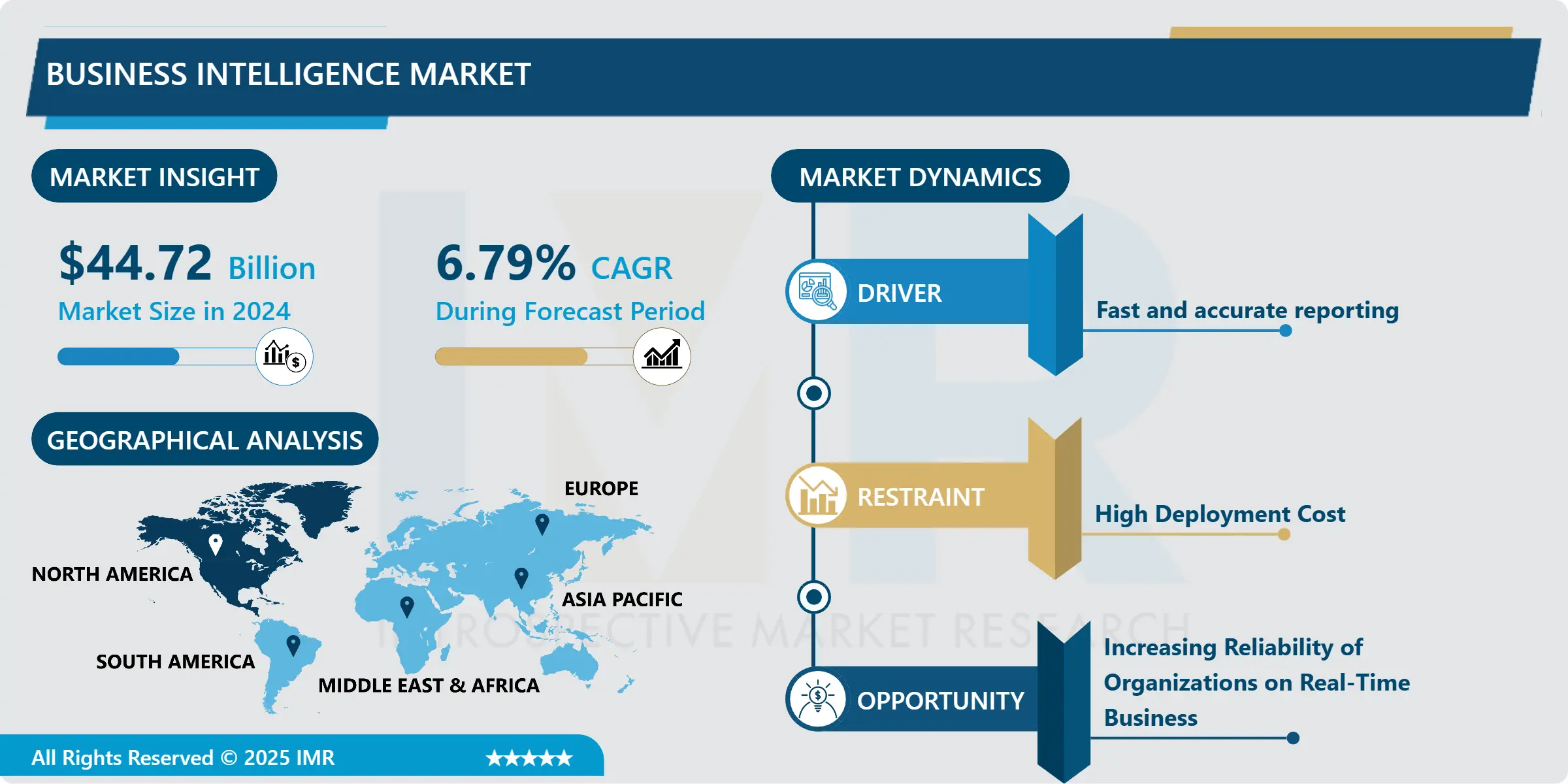
The Global Business Intelligence Market size is expected to grow from USD 44.72 billion in 2024 to USD 75.65 billion by 2030, at a CAGR of 6.79% during the forecast period (2025-2032).
Business intelligence (BI) is a set of tools and techniques that combines business analytics, data mining, data visualization, data tools and infrastructure, and best practices to help businesses make better data-driven decisions. Business intelligence may assist companies to make better decisions by providing current and historical data in the context of their business.
The Business Intelligence (BI) market was experiencing rapid growth and transformation. BI refers to technologies, applications, and processes for the collection, analysis, and presentation of business information to support decision-making. BI market was characterized by an increasing demand for advanced analytics, data visualization tools, and self-service BI solutions.
Key trends included the integration of artificial intelligence and machine learning into BI tools, enabling more predictive and prescriptive analytics. Cloud-based BI solutions were gaining popularity due to their scalability and accessibility, allowing organizations to analyze data from anywhere. Mobile BI applications were also on the rise, providing users with real-time insights on the go.
Major players in the BI market, such as Microsoft, Tableau, and Qlik, were continually innovating to enhance their offerings. The market was driven by a growing awareness of the value of data-driven decision-making across various industries, including finance, healthcare, and retail.
Business Intelligence Market Trend Analysis
Business Intelligence Market Growth Drivers- Fast and accurate reporting
Businesses increasingly rely on real-time insights to make informed decisions and gain a competitive edge. Rapid access to precise data enables organizations to respond swiftly to market changes, identify emerging trends, and capitalize on opportunities.
The demand for business intelligence solutions is propelled by the need for streamlined and automated reporting processes. As technology advances, BI tools offer sophisticated analytics, allowing companies to extract actionable intelligence from vast datasets promptly. This not only enhances operational efficiency but also facilitates strategic planning and performance evaluation.
In a data-driven era, where information is a critical asset, businesses prioritize solutions that ensure not only speed but also accuracy in reporting. The convergence of data analytics, machine learning, and cloud computing further amplifies the role of fast and accurate reporting in shaping the landscape of the Business Intelligence Market, fostering a culture of data-driven decision-making.
Business Intelligence Market Opportunities- Increasing Reliability of Organizations on Real-Time Business creates an Opportunity
The increasing reliance of organizations on real-time business operations has created a significant opportunity for the growth of the Business Intelligence (BI) market. In today’s fast-paced business environment, organizations seek timely and accurate insights to make informed decisions. Business Intelligence plays a crucial role in this scenario by providing advanced analytics, data visualization, and reporting tools that enable businesses to extract actionable intelligence from their data.
Real-time BI allows organizations to monitor and analyze data as it is generated, providing immediate insights that can drive quick decision-making. This capability is essential for staying competitive, adapting to market changes, and identifying new opportunities. The BI market has witnessed substantial growth as businesses recognize the value of harnessing data for strategic decision-making.
Key components of the BI market include data integration, data warehousing, dashboards, and self-service analytics. The demand for BI solutions continues to rise as organizations across various industries strive to enhance their operational efficiency and gain a competitive edge in the dynamic business landscape. The Business Intelligence market is poised for further expansion as businesses increasingly prioritize real-time data analytics to navigate the complexities of the modern market.
Business Intelligence Market Segment Analysis:
Business Intelligence Market Segmented on the basis of Component, Deployment, Enterprise Size, Application, Industry.
By Component, the solution segment is expected to dominate the market during the forecast period
Business Intelligence (BI) market, the solution segment is poised to assert dominance. As organizations increasingly recognize the critical role of data-driven decision-making, the demand for comprehensive BI solutions has surged. These solutions encompass a spectrum of tools and technologies designed to gather, analyze, and visualize data, empowering businesses to derive actionable insights.
The solution segment encompasses a wide array of BI offerings, including data visualization tools, reporting software, advanced analytics platforms, and dashboard applications. These components seamlessly integrate into organizational workflows, providing a holistic approach to data management and analysis. The versatility of BI solutions makes them indispensable for enterprises across various industries, fostering a data-centric culture.
Factors contributing to the ascendancy of the solution segment include the growing complexity of data sources, the need for real-time analytics, and an emphasis on user-friendly interfaces. As organizations navigate the challenges of a data-rich environment, robust BI solutions become a linchpin for strategic decision-making.
By Deployment, the cloud segment held the largest share in 2024
As organizations increasingly recognize the advantages of cloud-based BI solutions, a significant shift in deployment preferences is observed. The cloud offers unparalleled flexibility, scalability, and accessibility, allowing businesses to efficiently manage and analyze vast amounts of data.
The ascendancy of the cloud segment in the BI market is underpinned by several factors. First and foremost is the agility it provides, enabling rapid deployment and updates without the need for extensive on-premises infrastructure. This fosters a dynamic and responsive BI environment, crucial for decision-making in today’s fast-paced business landscape. Additionally, the cost-effectiveness of cloud-based BI solutions appeals to organizations seeking efficient ways to manage their data analytics needs without hefty upfront investments.
Business Intelligence Market Regional Insights:
North America is Expected to Dominate the Market Over the Forecast period
North America is poised to maintain its dominance in the Business Intelligence (BI) market. The region’s supremacy can be attributed to several factors that contribute to its robust BI landscape. The presence of major industry players, technological advancements, and a well-established infrastructure are key drivers. The United States, in particular, hosts a significant number of leading BI vendors and is a hub for innovation in analytics and data-driven decision-making.
The increasing adoption of cloud-based BI solutions, coupled with a growing emphasis on data-driven strategies across various industries, further propels North America’s stronghold in the market. The region benefits from a mature ecosystem that fosters collaboration between businesses and technology providers, fostering a conducive environment for BI development and implementation.
Moreover, a high awareness and understanding of the importance of BI among enterprises in North America contribute to the widespread adoption of these solutions. With a dynamic business landscape and a focus on leveraging data for competitive advantage, North America is likely to continue leading the way in the evolving realm of Business Intelligence.
Business Intelligence Market Top Key Players:
Microsoft(USA)
Tableau Software (USA)
SAP (Germany)
Oracle Corporation (USA)
Qlik Technologies (USA)
Sisense (Israel)
Looker (USA)
Domo (USA)
Mode Analytics (USA)
Zoho Analytics (India)
Alteryx (USA)
Qualtrics (USA)
Yellowfin BI (Australia)
Birst (USA)
ThoughtSpot (USA)
Domino Data Science (USA)
Trifacta (Canada)
Gtmhub (USA)
Chartio (USA)
Metabase (USA) and Other Active Players
Key Industry Developments in the Business Intelligence Market:
In June 2023, Thoma Bravo acquired Coupa Software for $8 billion, This major acquisition expanded Thoma Bravo’s portfolio in the enterprise software space and strengthened Coupa’s position in the Business Spend Management market.
In May 2023, GoodData announced the release of its new Last Mile ETL feature, which helps customers streamline their data management processes, enabling more effective use of time and resources and maximized data velocity. It fully supports changes made to the logical data model (LDM) within the GoodData interface without affecting the data and data structure in a user’s database.
Chapter 1: Introduction
1.1 Scope and Coverage
Chapter 2:Executive Summary
Chapter 3: Market Landscape
3.1 Market Dynamics
3.1.1 Drivers
3.1.2 Restraints
3.1.3 Opportunities
3.1.4 Challenges
3.2 Market Trend Analysis
3.3 PESTLE Analysis
3.4 Porter’s Five Forces Analysis
3.5 Industry Value Chain Analysis
3.6 Ecosystem
3.7 Regulatory Landscape
3.8 Price Trend Analysis
3.9 Patent Analysis
3.10 Technology Evolution
3.11 Investment Pockets
3.12 Import-Export Analysis
Chapter 4: Business Intelligence Market by Component (2018-2032)
4.1 Business Intelligence Market Snapshot and Growth Engine
4.2 Market Overview
4.3 Solutions
4.3.1 Introduction and Market Overview
4.3.2 Historic and Forecasted Market Size in Value USD and Volume Units
4.3.3 Key Market Trends, Growth Factors, and Opportunities
4.3.4 Geographic Segmentation Analysis
4.4 Services
Chapter 5: Business Intelligence Market by Deployment (2018-2032)
5.1 Business Intelligence Market Snapshot and Growth Engine
5.2 Market Overview
5.3 Cloud
5.3.1 Introduction and Market Overview
5.3.2 Historic and Forecasted Market Size in Value USD and Volume Units
5.3.3 Key Market Trends, Growth Factors, and Opportunities
5.3.4 Geographic Segmentation Analysis
5.4 On-Premise
Chapter 6: Business Intelligence Market by Enterprise Size (2018-2032)
6.1 Business Intelligence Market Snapshot and Growth Engine
6.2 Market Overview
6.3 Large Enterprises
6.3.1 Introduction and Market Overview
6.3.2 Historic and Forecasted Market Size in Value USD and Volume Units
6.3.3 Key Market Trends, Growth Factors, and Opportunities
6.3.4 Geographic Segmentation Analysis
6.4 SMEs
Chapter 7: Business Intelligence Market by Application (2018-2032)
7.1 Business Intelligence Market Snapshot and Growth Engine
7.2 Market Overview
7.3 Supply Chain Analytic Applications
7.3.1 Introduction and Market Overview
7.3.2 Historic and Forecasted Market Size in Value USD and Volume Units
7.3.3 Key Market Trends, Growth Factors, and Opportunities
7.3.4 Geographic Segmentation Analysis
7.4 CRM Analytic Applications
7.5 Financial Performance
7.6 Strategy Management
7.7 Production Planning Analytic Operations
Chapter 8: Business Intelligence Market by Industry (2018-2032)
8.1 Business Intelligence Market Snapshot and Growth Engine
8.2 Market Overview
8.3 IT and Telecommunications
8.3.1 Introduction and Market Overview
8.3.2 Historic and Forecasted Market Size in Value USD and Volume Units
8.3.3 Key Market Trends, Growth Factors, and Opportunities
8.3.4 Geographic Segmentation Analysis
8.4 Banking
8.5 Finance
8.6 Security and Insurance (BFSI)
8.7 Healthcare
8.8 Manufacturing
8.9 Retail
Chapter 9: Company Profiles and Competitive Analysis
9.1 Competitive Landscape
9.1.1 Competitive Benchmarking
9.1.2 Business Intelligence Market Share by Manufacturer (2024)
9.1.3 Industry BCG Matrix
9.1.4 Heat Map Analysis
9.1.5 Mergers and Acquisitions
9.2 GARDNER DENVER (US)
9.2.1 Company Overview
9.2.2 Key Executives
9.2.3 Company Snapshot
9.2.4 Role of the Company in the Market
9.2.5 Sustainability and Social Responsibility
9.2.6 Operating Business Segments
9.2.7 Product Portfolio
9.2.8 Business Performance
9.2.9 Key Strategic Moves and Recent Developments
9.2.10 SWOT Analysis
9.3 INGERSOLL RAND (US)
9.4 KAESER COMPRESSORS (US)
9.5 SULLAIR (US)
9.6 ATLAS COPCO(SWEDEN)
9.7 KAESER KOMPRESSOREN (GERMANY)
9.8 BOGE KOMPRESSOREN (GERMANY)
9.9 ALMIG KOMPRESSOREN (GERMANY)
9.10 COMPAIR (UK)
9.11 INGERSOLL RAND (IRELAND)
9.12 FUSHENG (CHINA)
9.13 QINHUANGDAO YONGJIE COMPRESSOR (CHINA)
9.14 SHANGHAI LINGKE COMPRESSOR (CHINA)
9.15 SHENYANG YUANDA COMPRESSOR (CHINA)
9.16 HITACHI (JAPAN)
9.17 MITSUI SEIKI (JAPAN)
9.18 KOBE STEEL (JAPAN)
9.19 ELGI EQUIPMENTS (INDIA)
9.20 KIRLOSKAR BROTHERS (INDIA)
9.21 HWANG SUNG MACHINERY (SOUTH KOREA)
9.22 SAMHWA INDUSTRIAL (SOUTH KOREA)
9.23 TAIWAN AIR COMPRESSOR (TAIWAN)
9.24 TUNG YU COMPRESSOR (TAIWAN)
Chapter 10: Global Business Intelligence Market By Region
10.1 Overview
10.2. North America Business Intelligence Market
10.2.1 Key Market Trends, Growth Factors and Opportunities
10.2.2 Top Key Companies
10.2.3 Historic and Forecasted Market Size by Segments
10.2.4 Historic and Forecasted Market Size by Component
10.2.4.1 Solutions
10.2.4.2 Services
10.2.5 Historic and Forecasted Market Size by Deployment
10.2.5.1 Cloud
10.2.5.2 On-Premise
10.2.6 Historic and Forecasted Market Size by Enterprise Size
10.2.6.1 Large Enterprises
10.2.6.2 SMEs
10.2.7 Historic and Forecasted Market Size by Application
10.2.7.1 Supply Chain Analytic Applications
10.2.7.2 CRM Analytic Applications
10.2.7.3 Financial Performance
10.2.7.4 Strategy Management
10.2.7.5 Production Planning Analytic Operations
10.2.8 Historic and Forecasted Market Size by Industry
10.2.8.1 IT and Telecommunications
10.2.8.2 Banking
10.2.8.3 Finance
10.2.8.4 Security and Insurance (BFSI)
10.2.8.5 Healthcare
10.2.8.6 Manufacturing
10.2.8.7 Retail
10.2.9 Historic and Forecast Market Size by Country
10.2.9.1 US
10.2.9.2 Canada
10.2.9.3 Mexico
10.3. Eastern Europe Business Intelligence Market
10.3.1 Key Market Trends, Growth Factors and Opportunities
10.3.2 Top Key Companies
10.3.3 Historic and Forecasted Market Size by Segments
10.3.4 Historic and Forecasted Market Size by Component
10.3.4.1 Solutions
10.3.4.2 Services
10.3.5 Historic and Forecasted Market Size by Deployment
10.3.5.1 Cloud
10.3.5.2 On-Premise
10.3.6 Historic and Forecasted Market Size by Enterprise Size
10.3.6.1 Large Enterprises
10.3.6.2 SMEs
10.3.7 Historic and Forecasted Market Size by Application
10.3.7.1 Supply Chain Analytic Applications
10.3.7.2 CRM Analytic Applications
10.3.7.3 Financial Performance
10.3.7.4 Strategy Management
10.3.7.5 Production Planning Analytic Operations
10.3.8 Historic and Forecasted Market Size by Industry
10.3.8.1 IT and Telecommunications
10.3.8.2 Banking
10.3.8.3 Finance
10.3.8.4 Security and Insurance (BFSI)
10.3.8.5 Healthcare
10.3.8.6 Manufacturing
10.3.8.7 Retail
10.3.9 Historic and Forecast Market Size by Country
10.3.9.1 Russia
10.3.9.2 Bulgaria
10.3.9.3 The Czech Republic
10.3.9.4 Hungary
10.3.9.5 Poland
10.3.9.6 Romania
10.3.9.7 Rest of Eastern Europe
10.4. Western Europe Business Intelligence Market
10.4.1 Key Market Trends, Growth Factors and Opportunities
10.4.2 Top Key Companies
10.4.3 Historic and Forecasted Market Size by Segments
10.4.4 Historic and Forecasted Market Size by Component
10.4.4.1 Solutions
10.4.4.2 Services
10.4.5 Historic and Forecasted Market Size by Deployment
10.4.5.1 Cloud
10.4.5.2 On-Premise
10.4.6 Historic and Forecasted Market Size by Enterprise Size
10.4.6.1 Large Enterprises
10.4.6.2 SMEs
10.4.7 Historic and Forecasted Market Size by Application
10.4.7.1 Supply Chain Analytic Applications
10.4.7.2 CRM Analytic Applications
10.4.7.3 Financial Performance
10.4.7.4 Strategy Management
10.4.7.5 Production Planning Analytic Operations
10.4.8 Historic and Forecasted Market Size by Industry
10.4.8.1 IT and Telecommunications
10.4.8.2 Banking
10.4.8.3 Finance
10.4.8.4 Security and Insurance (BFSI)
10.4.8.5 Healthcare
10.4.8.6 Manufacturing
10.4.8.7 Retail
10.4.9 Historic and Forecast Market Size by Country
10.4.9.1 Germany
10.4.9.2 UK
10.4.9.3 France
10.4.9.4 The Netherlands
10.4.9.5 Italy
10.4.9.6 Spain
10.4.9.7 Rest of Western Europe
10.5. Asia Pacific Business Intelligence Market
10.5.1 Key Market Trends, Growth Factors and Opportunities
10.5.2 Top Key Companies
10.5.3 Historic and Forecasted Market Size by Segments
10.5.4 Historic and Forecasted Market Size by Component
10.5.4.1 Solutions
10.5.4.2 Services
10.5.5 Historic and Forecasted Market Size by Deployment
10.5.5.1 Cloud
10.5.5.2 On-Premise
10.5.6 Historic and Forecasted Market Size by Enterprise Size
10.5.6.1 Large Enterprises
10.5.6.2 SMEs
10.5.7 Historic and Forecasted Market Size by Application
10.5.7.1 Supply Chain Analytic Applications
10.5.7.2 CRM Analytic Applications
10.5.7.3 Financial Performance
10.5.7.4 Strategy Management
10.5.7.5 Production Planning Analytic Operations
10.5.8 Historic and Forecasted Market Size by Industry
10.5.8.1 IT and Telecommunications
10.5.8.2 Banking
10.5.8.3 Finance
10.5.8.4 Security and Insurance (BFSI)
10.5.8.5 Healthcare
10.5.8.6 Manufacturing
10.5.8.7 Retail
10.5.9 Historic and Forecast Market Size by Country
10.5.9.1 China
10.5.9.2 India
10.5.9.3 Japan
10.5.9.4 South Korea
10.5.9.5 Malaysia
10.5.9.6 Thailand
10.5.9.7 Vietnam
10.5.9.8 The Philippines
10.5.9.9 Australia
10.5.9.10 New Zealand
10.5.9.11 Rest of APAC
10.6. Middle East & Africa Business Intelligence Market
10.6.1 Key Market Trends, Growth Factors and Opportunities
10.6.2 Top Key Companies
10.6.3 Historic and Forecasted Market Size by Segments
10.6.4 Historic and Forecasted Market Size by Component
10.6.4.1 Solutions
10.6.4.2 Services
10.6.5 Historic and Forecasted Market Size by Deployment
10.6.5.1 Cloud
10.6.5.2 On-Premise
10.6.6 Historic and Forecasted Market Size by Enterprise Size
10.6.6.1 Large Enterprises
10.6.6.2 SMEs
10.6.7 Historic and Forecasted Market Size by Application
10.6.7.1 Supply Chain Analytic Applications
10.6.7.2 CRM Analytic Applications
10.6.7.3 Financial Performance
10.6.7.4 Strategy Management
10.6.7.5 Production Planning Analytic Operations
10.6.8 Historic and Forecasted Market Size by Industry
10.6.8.1 IT and Telecommunications
10.6.8.2 Banking
10.6.8.3 Finance
10.6.8.4 Security and Insurance (BFSI)
10.6.8.5 Healthcare
10.6.8.6 Manufacturing
10.6.8.7 Retail
10.6.9 Historic and Forecast Market Size by Country
10.6.9.1 Turkiye
10.6.9.2 Bahrain
10.6.9.3 Kuwait
10.6.9.4 Saudi Arabia
10.6.9.5 Qatar
10.6.9.6 UAE
10.6.9.7 Israel
10.6.9.8 South Africa
10.7. South America Business Intelligence Market
10.7.1 Key Market Trends, Growth Factors and Opportunities
10.7.2 Top Key Companies
10.7.3 Historic and Forecasted Market Size by Segments
10.7.4 Historic and Forecasted Market Size by Component
10.7.4.1 Solutions
10.7.4.2 Services
10.7.5 Historic and Forecasted Market Size by Deployment
10.7.5.1 Cloud
10.7.5.2 On-Premise
10.7.6 Historic and Forecasted Market Size by Enterprise Size
10.7.6.1 Large Enterprises
10.7.6.2 SMEs
10.7.7 Historic and Forecasted Market Size by Application
10.7.7.1 Supply Chain Analytic Applications
10.7.7.2 CRM Analytic Applications
10.7.7.3 Financial Performance
10.7.7.4 Strategy Management
10.7.7.5 Production Planning Analytic Operations
10.7.8 Historic and Forecasted Market Size by Industry
10.7.8.1 IT and Telecommunications
10.7.8.2 Banking
10.7.8.3 Finance
10.7.8.4 Security and Insurance (BFSI)
10.7.8.5 Healthcare
10.7.8.6 Manufacturing
10.7.8.7 Retail
10.7.9 Historic and Forecast Market Size by Country
10.7.9.1 Brazil
10.7.9.2 Argentina
10.7.9.3 Rest of SA
Chapter 11 Analyst Viewpoint and Conclusion
11.1 Recommendations and Concluding Analysis
11.2 Potential Market Strategies
Chapter 12 Research Methodology
12.1 Research Process
12.2 Primary Research
12.3 Secondary Research
Q1: What would be the forecast period in the Business Intelligence Market research report?
A1: The forecast period in the Business Intelligence Market research report is 2025-2032.
Q2: Who are the key players in the Business Intelligence Market?
A2: Microsoft (USA), Tableau Software (USA), SAP (Germany), Oracle Corporation (USA), Qlik Technologies (USA), Sisense (Israel), Looker (USA), Domo (USA), Mode Analytics (USA), Zoho Analytics (India), Alteryx (USA), Qualtrics (USA), Yellowfin BI (Australia), Birst (USA), ThoughtSpot (USA), Domino Data Science (USA), Trifacta (Canada), Gtmhub (USA), Chartio (USA), Metabase (USA) and Other Major Players.
Q3: What are the segments of the Business Intelligence Market?
A3: The Business Intelligence Market is segmented into Component, Deployment, Enterprise Size, Application, Industry, and region. By Component, the market is categorized into Solutions, Services. By Deployment, the market is categorized into Cloud, On-Premise. By Enterprise Size, the market is categorized into Large Enterprises, Small and Medium-Sized Enterprises. By Application, the market is categorized into Supply Chain Analytic Applications, CRM Analytic Applications, Financial Performance & Strategy Management, Production Planning Analytic Operations, and Others. By End-User Industry, the market is categorized into IT & Telecommunications, BFSI, Healthcare, Manufacturing, Retail, and Others. By region, it is analyzed across • North America (U.S., Canada, Mexico) • Eastern Europe (Russia, Bulgaria, The Czech Republic, Hungary, Poland, Romania, Rest of Eastern Europe) • Western Europe (Germany, UK, France, The Netherlands, Italy, Spain, Rest of Western Europe) • Asia Pacific (China, India, Japan, South Korea, Malaysia, Thailand, Vietnam, The Philippines, Australia, New Zealand, Rest of APAC) • Middle East & Africa (Türkiye, Bahrain, Kuwait, Saudi Arabia, Qatar, UAE, Israel, South Africa) • South America (Brazil, Argentina, Rest of SA)
Q4: What is the Business Intelligence Market?
A4: Business intelligence (BI) is a set of tools and techniques that combines business analytics, data mining, data visualization, data tools and infrastructure, and best practices to help businesses make better data-driven decisions. Business intelligence may assist companies to make better decisions by providing current and historical data in the context of their business.
Q5: How big is the Business Intelligence Market?
A5: The Global Business Intelligence Market size is expected to grow from USD 44.72 billion in 2024 to USD 75.65 billion by 2030, at a CAGR of 6.79% during the forecast period (2025-2032).
How to Buy a Report from eminsights.jp
On the product page, choose the license you want: Single-User License, Multi-User License or Enterprise License.
If you required report in your native language, then you can click on Translated Report button and fill out the form with report name and language you want, then our team will contact you as soon as possible.
Click the Buy Now button.
You will be redirected to the checkout page. Enter your company details and payment information.
Click Place Order to complete the purchase.
Confirmation: You’ll receive an order confirmation and our team will contact you shortly with your ordered report.
If you have any questions, fill out the contact form below or email us at bizdev@eminsights.net.
Thank you for choosing eminsights.jp!