Stay Ahead in Fast-Growing Economies.
Browse Reports Now




Bus Seat Market – Global Analysis and Forecast (2024-2032)
The bus seat market is defined as the part of the transportation industry that deals with the production of bus seats as well as their distribution to different applications. They come in many types of materials such as fabric, leather and vinyl and can accommodate the different types of buses ranging from the city buses, intercity, tourist, and school buses. Market has factors like the following aspects as Urbanization, Passenger Comfort, and Technological by way of materials and design.

IMR Group
Description
Bus Seat Market Synopsis:
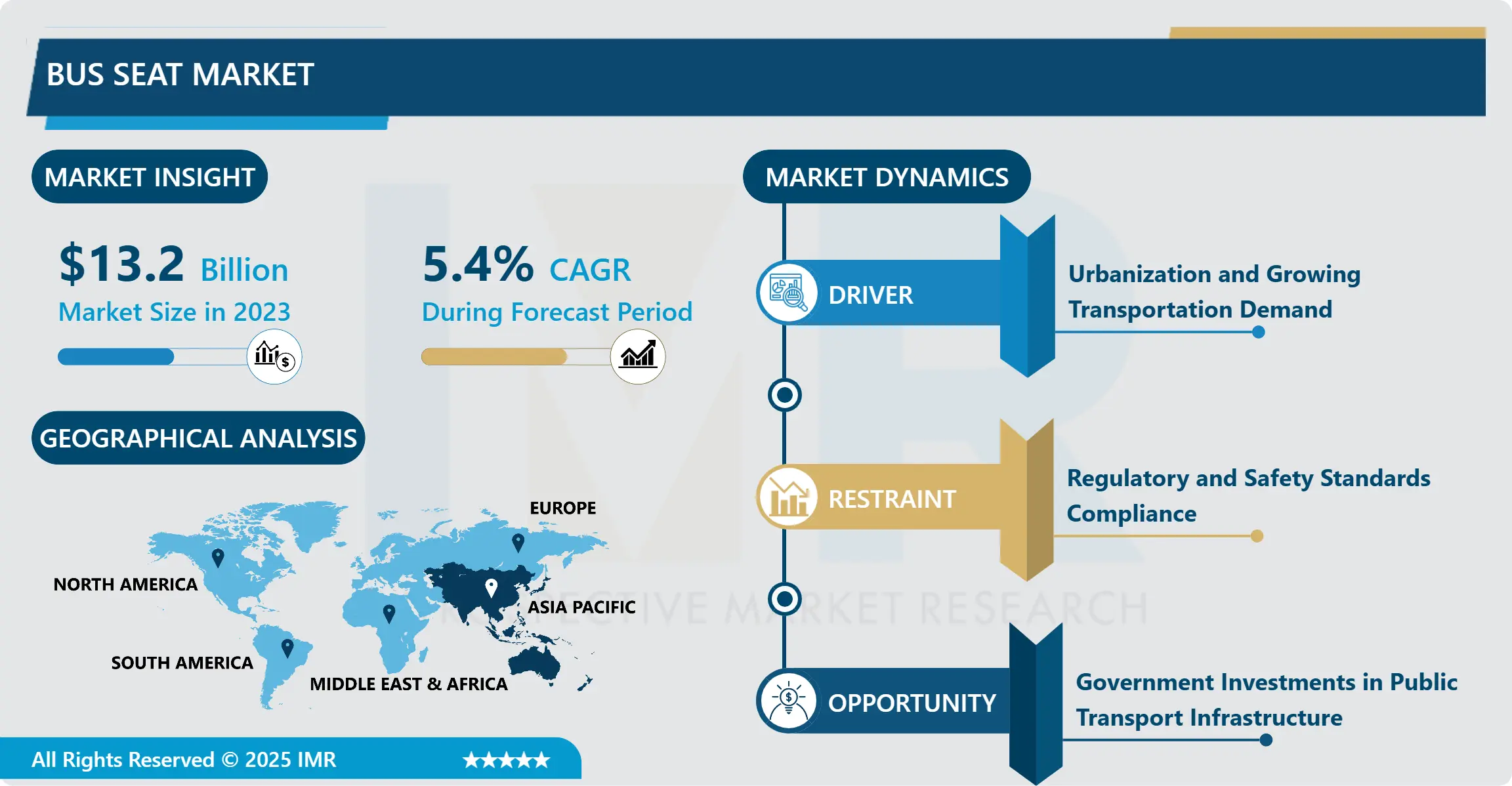
Bus Seat Market Size Was Valued at USD 13.20 Billion in 2023, and is Projected to Reach USD 21.19 Billion by 2032, Growing at a CAGR of 5.40% From 2024-2032.
The bus seat market is defined as the part of the transportation industry that deals with the production of bus seats as well as their distribution to different applications. They come in many types of materials such as fabric, leather and vinyl and can accommodate the different types of buses ranging from the city buses, intercity, tourist, and school buses. Market has factors like the following aspects as Urbanization, Passenger Comfort, and Technological by way of materials and design.
The bus seat market majorly focuses on the increasing trends for public and private transportation in developing countries. In modern lives, as more people are shifted to the urban settings more people resort to the use of buses given the affordability as compared to other forms of transport hence with increased usage buses need to be upgraded to better, more comfortable, and more durable seating systems. Also, the increasing, population of intercity and tourist buses around the world also increases the demand for advanced, comfortable and ergonomically designed seating systems. This trend is expected to push the market ahead in the future, especially in the Asia-Pacific and Latin America where systems of public transportation are rapidly growing.
The other major factor is increased concern on passenger comfort to safety and security aspects. As more people become aware of the consequences of good ergonomics and safety requirements in transportation, bus operators are moving to acquire and install more comfortable and safe seats. This comprises of factors such as powered reclining seat feature of the recliner seats in case of long-distance travel and enhanced safety feature seats to entice the consumers to use buses.
Bus Seat Market Trend Analysis:
Increasing demand for eco-friendly materials
Another remarkable shift in the bus seat market is that the population is paying much attention to environment-friendliness of the bus seat material. To ensure they meet the environmental conservation concerns of the society, manufacturers are now featuring on the production of seats with recycled fabrics and eco-friend leather. This trend is especially widely practiced in Europe as the requirements for sustainability and decrease of waste production are continuously raised. This change has been prompted by the growing number of environmental-savvy consumers and continuing regulatory pressures.
Other topical trend that would like to point out is the use of smart technologies in bus seating. Even things like charging ports with USB interfaces, Wi-Fi, and opposed-to-reclining type of seating are now emerging new trends in premium and luxury buses. These smart seats meet modern needs of the passengers, especially the intercity and tourism ones who expect a certain level of comfort during a trip. This trend is also leading to expansion of a certain segment of the luxury transport in the bus seat market.
Increasing demand for luxury bus services
The growing demand for luxury buses. With the flow of luxury tourism, and superior and premium intercity transport, there exists a significant demand for luxury seat solutions that go far beyond comfort. From this area, product differentiation is likely to emerge within the manufacturer’s industry in the form of memory foam, added massage functionality, and reclining technologies for passengers seeking a more luxurious travel experience. A market for luxury transport is quickly emerging, especially in countries and areas such as North America and Europe where per capita income is high.
The other opportunity relates to the enhanced plans to invest in the public transportation system, particularly in the emerging markets. Currently, large populace countries such as India, China and Brazil are spending significantly to upgrade their public transport stock and new bus seats form part of development. Based on the principle of a stepped up focus on public transport quality and efficiency, it is conceivable that governments will equally upgrade the characteristics of bus seating to further the cause of comfort and safety for the passangers. Key benefits Conclusively, manufacturers who meet the needed requirements of cost, durability and ergonomics in producing the seats will stand to gain from these developments.
Bus Seat Market Segment Analysis:
Bus Seat Market Segmented on the basis of Seat Type, Material, Application, End User, and Region
By Seat Type, Standard Seats segment is expected to dominate the market during the forecast period
The Standard Seats segment is projected to hold the dominant position in the Bus Seat Market throughout the forecast period. This dominance can be attributed to their cost-effectiveness, ease of maintenance, and wide applicability across various bus types, including city buses, intercity coaches, and school buses. As public transportation systems expand globally, particularly in emerging economies, the demand for durable and affordable seating solutions continues to rise, reinforcing the Standard Seats segment’s leading market share.
Industry analysts also note that fleet operators prioritize functionality and passenger capacity over luxury features for most mass transit operations. Standard Seats offer an optimal balance between comfort, durability, and cost, making them the preferred choice for large-scale procurement projects. Additionally, ongoing innovations in materials and ergonomic designs are further enhancing the value proposition of standard seating solutions, enabling market players to meet evolving regulatory and passenger comfort requirements while maintaining competitive pricing.
By Application, Public Transport segment expected to held the largest share
Bus seat market is also classified on the basis of the application it has in the transport facilities like public transports, private transports and luxury transports. Standard seats mainly prevail in PSB because such vehicles entail significantly higher passenger traffic and lower affordability. Inter-city or charter buses that are usually in the private sector need to combine between normal and luxury respectively, there are longer distances it needs to cover. There are tourist buses or buses meant for high end commuter transport these come with features like; luxury and reclining seats among others.
Bus Seat Market Regional Insights:
Asia Pacific is Expected to Dominate the Market Over the Forecast period
The Bus Seat market in the Asia Pacific area is also seen as the largest market in the global market. The drastic change in population density in China, India and Southeast Asia through increased urbanization is a key reason that there is an ever-increasing demand for buses and therefore high-quality bus seating solutions. The increased population of middle-income earners as well as the general increase in disposable income within these countries has bolstered the demand for intercity bus services, luxury transport and other related tourism services that are adopting Premium and Recliner bus seats. The governments in the region are also investing heavily in improving public transport in their countries which include buying new and more comfortable seating for buses.
Not only the growth is visible in public transport, but there is also a growing trend in Private Transport the world over, especially in the new developing economy such as India & china. Global tourism that has received a boost in countries like Japan, South Korea, Thailand has also presented a demand for luxury buses with comfortable seating. It is therefore anticipated that the market for bus seat in the Asia Pacific will keep on growing founded on the growth in infrastructure and the increased demand for higher comfort when traveling. In this integral growing part of the world, manufacturers are now more concerned with coming up with low cost but quality products to suit various urban as well as intercity transport requirements.
Active Key Players in the Bus Seat Market
Adient (USA)
Daimler AG (Germany)
Fainsa (Spain)
Irizar (Spain)
Lear Corporation (USA)
Recaro (Germany)
Tata Motors (India)
The Freedman Group (USA)
Volvo Buses (Sweden)
Yutong Bus (China)
Other Active Players
Chapter 1: Introduction
1.1 Scope and Coverage
Chapter 2:Executive Summary
Chapter 3: Market Landscape
3.1 Market Dynamics
3.1.1 Drivers
3.1.2 Restraints
3.1.3 Opportunities
3.1.4 Challenges
3.2 Market Trend Analysis
3.3 PESTLE Analysis
3.4 Porter’s Five Forces Analysis
3.5 Industry Value Chain Analysis
3.6 Ecosystem
3.7 Regulatory Landscape
3.8 Price Trend Analysis
3.9 Patent Analysis
3.10 Technology Evolution
3.11 Investment Pockets
3.12 Import-Export Analysis
Chapter 4: Bus Seat Market by Seat Type
4.1 Bus Seat Market Snapshot and Growth Engine
4.2 Bus Seat Market Overview
4.3 Standard Seats
4.3.1 Introduction and Market Overview
4.3.2 Historic and Forecasted Market Size in Value USD and Volume Units (2017-2032F)
4.3.3 Key Market Trends, Growth Factors and Opportunities
4.3.4 Standard Seats: Geographic Segmentation Analysis
4.4 Premium Seats
4.4.1 Introduction and Market Overview
4.4.2 Historic and Forecasted Market Size in Value USD and Volume Units (2017-2032F)
4.4.3 Key Market Trends, Growth Factors and Opportunities
4.4.4 Premium Seats: Geographic Segmentation Analysis
4.5 Recliner Seats
4.5.1 Introduction and Market Overview
4.5.2 Historic and Forecasted Market Size in Value USD and Volume Units (2017-2032F)
4.5.3 Key Market Trends, Growth Factors and Opportunities
4.5.4 Recliner Seats: Geographic Segmentation Analysis
4.6 Foldable Seats
4.6.1 Introduction and Market Overview
4.6.2 Historic and Forecasted Market Size in Value USD and Volume Units (2017-2032F)
4.6.3 Key Market Trends, Growth Factors and Opportunities
4.6.4 Foldable Seats: Geographic Segmentation Analysis
Chapter 5: Bus Seat Market by Material
5.1 Bus Seat Market Snapshot and Growth Engine
5.2 Bus Seat Market Overview
5.3 Fabric Seats
5.3.1 Introduction and Market Overview
5.3.2 Historic and Forecasted Market Size in Value USD and Volume Units (2017-2032F)
5.3.3 Key Market Trends, Growth Factors and Opportunities
5.3.4 Fabric Seats: Geographic Segmentation Analysis
5.4 Leather Seats
5.4.1 Introduction and Market Overview
5.4.2 Historic and Forecasted Market Size in Value USD and Volume Units (2017-2032F)
5.4.3 Key Market Trends, Growth Factors and Opportunities
5.4.4 Leather Seats: Geographic Segmentation Analysis
5.5 PVC Seats
5.5.1 Introduction and Market Overview
5.5.2 Historic and Forecasted Market Size in Value USD and Volume Units (2017-2032F)
5.5.3 Key Market Trends, Growth Factors and Opportunities
5.5.4 PVC Seats: Geographic Segmentation Analysis
5.6 Vinyl Seats
5.6.1 Introduction and Market Overview
5.6.2 Historic and Forecasted Market Size in Value USD and Volume Units (2017-2032F)
5.6.3 Key Market Trends, Growth Factors and Opportunities
5.6.4 Vinyl Seats: Geographic Segmentation Analysis
Chapter 6: Bus Seat Market by Application
6.1 Bus Seat Market Snapshot and Growth Engine
6.2 Bus Seat Market Overview
6.3 Public Transport
6.3.1 Introduction and Market Overview
6.3.2 Historic and Forecasted Market Size in Value USD and Volume Units (2017-2032F)
6.3.3 Key Market Trends, Growth Factors and Opportunities
6.3.4 Public Transport: Geographic Segmentation Analysis
6.4 Private Transport
6.4.1 Introduction and Market Overview
6.4.2 Historic and Forecasted Market Size in Value USD and Volume Units (2017-2032F)
6.4.3 Key Market Trends, Growth Factors and Opportunities
6.4.4 Private Transport: Geographic Segmentation Analysis
6.5 Luxury Transport
6.5.1 Introduction and Market Overview
6.5.2 Historic and Forecasted Market Size in Value USD and Volume Units (2017-2032F)
6.5.3 Key Market Trends, Growth Factors and Opportunities
6.5.4 Luxury Transport: Geographic Segmentation Analysis
Chapter 7: Bus Seat Market by End User
7.1 Bus Seat Market Snapshot and Growth Engine
7.2 Bus Seat Market Overview
7.3 Government
7.3.1 Introduction and Market Overview
7.3.2 Historic and Forecasted Market Size in Value USD and Volume Units (2017-2032F)
7.3.3 Key Market Trends, Growth Factors and Opportunities
7.3.4 Government: Geographic Segmentation Analysis
7.4 Private Operators
7.4.1 Introduction and Market Overview
7.4.2 Historic and Forecasted Market Size in Value USD and Volume Units (2017-2032F)
7.4.3 Key Market Trends, Growth Factors and Opportunities
7.4.4 Private Operators: Geographic Segmentation Analysis
7.5 Tour Operators
7.5.1 Introduction and Market Overview
7.5.2 Historic and Forecasted Market Size in Value USD and Volume Units (2017-2032F)
7.5.3 Key Market Trends, Growth Factors and Opportunities
7.5.4 Tour Operators: Geographic Segmentation Analysis
Chapter 8: Company Profiles and Competitive Analysis
8.1 Competitive Landscape
8.1.1 Competitive Benchmarking
8.1.2 Bus Seat Market Share by Manufacturer (2023)
8.1.3 Industry BCG Matrix
8.1.4 Heat Map Analysis
8.1.5 Mergers and Acquisitions
8.2 ADIENT (USA)
8.2.1 Company Overview
8.2.2 Key Executives
8.2.3 Company Snapshot
8.2.4 Role of the Company in the Market
8.2.5 Sustainability and Social Responsibility
8.2.6 Operating Business Segments
8.2.7 Product Portfolio
8.2.8 Business Performance
8.2.9 Key Strategic Moves and Recent Developments
8.2.10 SWOT Analysis
8.3 IRIZAR (SPAIN)
8.4 FAINSA (SPAIN)
8.5 THE FREEDMAN GROUP (USA)
8.6 LEAR CORPORATION (USA) RECARO (GERMANY)
8.7 TATA MOTORS (INDIA)
8.8 DAIMLER AG (GERMANY)
8.9 YUTONG BUS (CHINA)
8.10 VOLVO BUSES (SWEDEN)
8.11 OTHER ACTIVE PLAYERS
Chapter 9: Global Bus Seat Market By Region
9.1 Overview
9.2. North America Bus Seat Market
9.2.1 Key Market Trends, Growth Factors and Opportunities
9.2.2 Top Key Companies
9.2.3 Historic and Forecasted Market Size by Segments
9.2.4 Historic and Forecasted Market Size By Seat Type
9.2.4.1 Standard Seats
9.2.4.2 Premium Seats
9.2.4.3 Recliner Seats
9.2.4.4 Foldable Seats
9.2.5 Historic and Forecasted Market Size By Material
9.2.5.1 Fabric Seats
9.2.5.2 Leather Seats
9.2.5.3 PVC Seats
9.2.5.4 Vinyl Seats
9.2.6 Historic and Forecasted Market Size By Application
9.2.6.1 Public Transport
9.2.6.2 Private Transport
9.2.6.3 Luxury Transport
9.2.7 Historic and Forecasted Market Size By End User
9.2.7.1 Government
9.2.7.2 Private Operators
9.2.7.3 Tour Operators
9.2.8 Historic and Forecast Market Size by Country
9.2.8.1 US
9.2.8.2 Canada
9.2.8.3 Mexico
9.3. Eastern Europe Bus Seat Market
9.3.1 Key Market Trends, Growth Factors and Opportunities
9.3.2 Top Key Companies
9.3.3 Historic and Forecasted Market Size by Segments
9.3.4 Historic and Forecasted Market Size By Seat Type
9.3.4.1 Standard Seats
9.3.4.2 Premium Seats
9.3.4.3 Recliner Seats
9.3.4.4 Foldable Seats
9.3.5 Historic and Forecasted Market Size By Material
9.3.5.1 Fabric Seats
9.3.5.2 Leather Seats
9.3.5.3 PVC Seats
9.3.5.4 Vinyl Seats
9.3.6 Historic and Forecasted Market Size By Application
9.3.6.1 Public Transport
9.3.6.2 Private Transport
9.3.6.3 Luxury Transport
9.3.7 Historic and Forecasted Market Size By End User
9.3.7.1 Government
9.3.7.2 Private Operators
9.3.7.3 Tour Operators
9.3.8 Historic and Forecast Market Size by Country
9.3.8.1 Russia
9.3.8.2 Bulgaria
9.3.8.3 The Czech Republic
9.3.8.4 Hungary
9.3.8.5 Poland
9.3.8.6 Romania
9.3.8.7 Rest of Eastern Europe
9.4. Western Europe Bus Seat Market
9.4.1 Key Market Trends, Growth Factors and Opportunities
9.4.2 Top Key Companies
9.4.3 Historic and Forecasted Market Size by Segments
9.4.4 Historic and Forecasted Market Size By Seat Type
9.4.4.1 Standard Seats
9.4.4.2 Premium Seats
9.4.4.3 Recliner Seats
9.4.4.4 Foldable Seats
9.4.5 Historic and Forecasted Market Size By Material
9.4.5.1 Fabric Seats
9.4.5.2 Leather Seats
9.4.5.3 PVC Seats
9.4.5.4 Vinyl Seats
9.4.6 Historic and Forecasted Market Size By Application
9.4.6.1 Public Transport
9.4.6.2 Private Transport
9.4.6.3 Luxury Transport
9.4.7 Historic and Forecasted Market Size By End User
9.4.7.1 Government
9.4.7.2 Private Operators
9.4.7.3 Tour Operators
9.4.8 Historic and Forecast Market Size by Country
9.4.8.1 Germany
9.4.8.2 UK
9.4.8.3 France
9.4.8.4 The Netherlands
9.4.8.5 Italy
9.4.8.6 Spain
9.4.8.7 Rest of Western Europe
9.5. Asia Pacific Bus Seat Market
9.5.1 Key Market Trends, Growth Factors and Opportunities
9.5.2 Top Key Companies
9.5.3 Historic and Forecasted Market Size by Segments
9.5.4 Historic and Forecasted Market Size By Seat Type
9.5.4.1 Standard Seats
9.5.4.2 Premium Seats
9.5.4.3 Recliner Seats
9.5.4.4 Foldable Seats
9.5.5 Historic and Forecasted Market Size By Material
9.5.5.1 Fabric Seats
9.5.5.2 Leather Seats
9.5.5.3 PVC Seats
9.5.5.4 Vinyl Seats
9.5.6 Historic and Forecasted Market Size By Application
9.5.6.1 Public Transport
9.5.6.2 Private Transport
9.5.6.3 Luxury Transport
9.5.7 Historic and Forecasted Market Size By End User
9.5.7.1 Government
9.5.7.2 Private Operators
9.5.7.3 Tour Operators
9.5.8 Historic and Forecast Market Size by Country
9.5.8.1 China
9.5.8.2 India
9.5.8.3 Japan
9.5.8.4 South Korea
9.5.8.5 Malaysia
9.5.8.6 Thailand
9.5.8.7 Vietnam
9.5.8.8 The Philippines
9.5.8.9 Australia
9.5.8.10 New Zealand
9.5.8.11 Rest of APAC
9.6. Middle East & Africa Bus Seat Market
9.6.1 Key Market Trends, Growth Factors and Opportunities
9.6.2 Top Key Companies
9.6.3 Historic and Forecasted Market Size by Segments
9.6.4 Historic and Forecasted Market Size By Seat Type
9.6.4.1 Standard Seats
9.6.4.2 Premium Seats
9.6.4.3 Recliner Seats
9.6.4.4 Foldable Seats
9.6.5 Historic and Forecasted Market Size By Material
9.6.5.1 Fabric Seats
9.6.5.2 Leather Seats
9.6.5.3 PVC Seats
9.6.5.4 Vinyl Seats
9.6.6 Historic and Forecasted Market Size By Application
9.6.6.1 Public Transport
9.6.6.2 Private Transport
9.6.6.3 Luxury Transport
9.6.7 Historic and Forecasted Market Size By End User
9.6.7.1 Government
9.6.7.2 Private Operators
9.6.7.3 Tour Operators
9.6.8 Historic and Forecast Market Size by Country
9.6.8.1 Turkiye
9.6.8.2 Bahrain
9.6.8.3 Kuwait
9.6.8.4 Saudi Arabia
9.6.8.5 Qatar
9.6.8.6 UAE
9.6.8.7 Israel
9.6.8.8 South Africa
9.7. South America Bus Seat Market
9.7.1 Key Market Trends, Growth Factors and Opportunities
9.7.2 Top Key Companies
9.7.3 Historic and Forecasted Market Size by Segments
9.7.4 Historic and Forecasted Market Size By Seat Type
9.7.4.1 Standard Seats
9.7.4.2 Premium Seats
9.7.4.3 Recliner Seats
9.7.4.4 Foldable Seats
9.7.5 Historic and Forecasted Market Size By Material
9.7.5.1 Fabric Seats
9.7.5.2 Leather Seats
9.7.5.3 PVC Seats
9.7.5.4 Vinyl Seats
9.7.6 Historic and Forecasted Market Size By Application
9.7.6.1 Public Transport
9.7.6.2 Private Transport
9.7.6.3 Luxury Transport
9.7.7 Historic and Forecasted Market Size By End User
9.7.7.1 Government
9.7.7.2 Private Operators
9.7.7.3 Tour Operators
9.7.8 Historic and Forecast Market Size by Country
9.7.8.1 Brazil
9.7.8.2 Argentina
9.7.8.3 Rest of SA
Chapter 10 Analyst Viewpoint and Conclusion
10.1 Recommendations and Concluding Analysis
10.2 Potential Market Strategies
Chapter 11 Research Methodology
11.1 Research Process
11.2 Primary Research
11.3 Secondary Research
Q1: What would be the forecast period in the Bus Seat Market research report?
A1: The forecast period in the Bus Seat Market research report is 2024-2032.
Q2: Who are the key players in the Bus Seat Market?
A2: Adient (USA), Daimler AG (Germany),Fainsa (Spain),Irizar (Spain),Lear Corporation (USA),Recaro (Germany),Tata Motors (India),The Freedman Group (USA),Volvo Buses (Sweden),Yutong Bus (China), and Other Active Players.
Q3: What are the segments of the Bus Seat Market?
A3: The Bus Seat Market is segmented into by Seat Type (Standard Seats, Premium Seats, Recliner Seats, Foldable Seats), By Material (Fabric Seats, Leather Seats, PVC Seats, Vinyl Seats), Application (Public Transport, Private Transport, Luxury Transport), End User (Government, Private Operators, Tour Operators). By region, it is analyzed across North America (U.S., Canada, Mexico),Eastern Europe (Russia, Bulgaria, The Czech Republic, Hungary, Poland, Romania, Rest of Eastern Europe),Western Europe (Germany, UK, France, Netherlands, Italy, Spain, Rest of Western Europe),Asia Pacific (China, India, Japan, South Korea, Malaysia, Thailand, Vietnam, The Philippines, Australia, New-Zealand, Rest of APAC),Middle East & Africa (Turkiye, Bahrain, Kuwait, Saudi Arabia, Qatar, UAE, Israel, South Africa),South America (Brazil, Argentina, Rest of SA).
Q4: What is the Bus Seat Market?
A4: The bus seat market is defined as the part of the transportation industry that deals with the production of bus seats as well as their distribution to different applications. They come in many types of materials such as fabric, leather and vinyl and can accommodate the different types of buses ranging from the city buses, intercity, tourist, and school buses. Market has factors like the following aspects as Urbanization, Passenger Comfort, and Technological by way of materials and design.
Q5: How big is the Bus Seat Market?
A5: Bus Seat Market Size Was Valued at USD 13.20 Billion in 2023, and is Projected to Reach USD 21.19 Billion by 2032, Growing at a CAGR of 5.40% From 2024-2032.
How to Buy a Report from eminsights.jp
On the product page, choose the license you want: Single-User License, Multi-User License or Enterprise License.
If you required report in your native language, then you can click on Translated Report button and fill out the form with report name and language you want, then our team will contact you as soon as possible.
Click the Buy Now button.
You will be redirected to the checkout page. Enter your company details and payment information.
Click Place Order to complete the purchase.
Confirmation: You’ll receive an order confirmation and our team will contact you shortly with your ordered report.
If you have any questions, fill out the contact form below or email us at bizdev@eminsights.net.
Thank you for choosing eminsights.jp!