Stay Ahead in Fast-Growing Economies.
Browse Reports Now




Big Data Analytics Market | Research by Potential Growth
Data Analytics based on Big Data is in essence the process of setting the actual pattern of extensive and differentiated data to to get the feedback for the current decision-making. By applying old technologies including the likes of machine learning and data mining, organizations, can therefore come up will meaningful information from humongous volumes of structured and unstructured data. These interpretations not only help to use the resources more effectively, but also, provide already indicated by the examples of different fields, an opportunity to conduct studies on large volumes of data, discover and explore new trends, and promote innovation.

IMR Group
Description
Big Data Analytics Market Synopsis
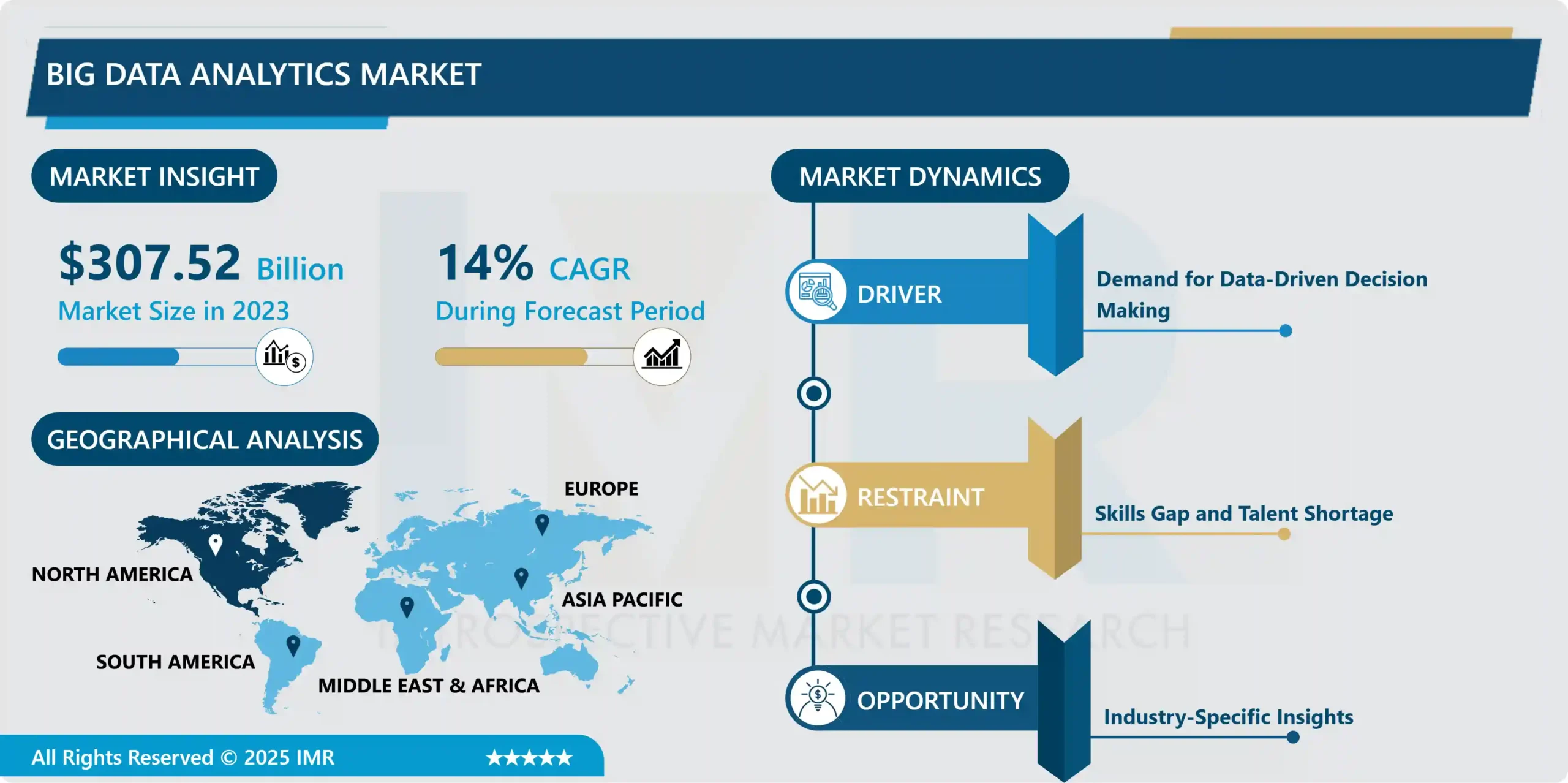
Big Data Analytics Market Size Was Valued at USD 307.52 Billion in 2023 and is Projected to Reach USD 1,000.04 Billion by 2032, Growing at a CAGR of 14 % From 2024-2032.
Data Analytics based on Big Data is in essence the process of setting the actual pattern of extensive and differentiated data to to get the feedback for the current decision-making. By applying old technologies including the likes of machine learning and data mining, organizations, can therefore come up will meaningful information from humongous volumes of structured and unstructured data. These interpretations not only help to use the resources more effectively, but also, provide already indicated by the examples of different fields, an opportunity to conduct studies on large volumes of data, discover and explore new trends, and promote innovation.
The Big Data Analytics market has witnessed the most rapid growth in recent years because of the progressive development of digital technologies, the rising quantity of data generation, and the vital factor that data-driven analyses are required across all sectors. These emerging markets provide a range of technology and services focusing on utilizing big data (vast and diverse datasets) to inform business decisions, help in improving operational efficiency, and create competitiveness.
The classic factor contributing to the Big Data Analytics market is the ruthless increase in the volume, velocity, and variety of the data. With the development of the so-called Internet of Things, i.e., social media systems, hand-held devices, and other relevant digital technologies, organizations are drowning in structured and unstructured data. In the face of this tsunami of data, a new consideration is born – how to change challenges into opportunities in a way of turning data analytics into such actions and insights that will wildly open new sources of value.
Surrounding the growing trend of using sophisticated techniques of analysis, such as machine learning, artificial intelligence as well as prognostic analytics, the Big Data Analytics market is driven. These technologies help organizations to discover such data with patterns, trends, and correlations that until now apparently were non-existent and therefore make more enlightened decisions and predict the outcomes of the future. Additionally, cloud computing and storage tech innovations are what enable organizations to easily and at a lower cost save, calculate, and analyze the vast amount of data in real-time.
It is no surprise that the Big Data Analytics market is also witnessing significant growth in demand since the more data-driven decision-making organizations have the better they take action. To stay afloat in the current cut-throat business world, organizations are looking more and more at data analysis as a tool that can offer them an in-depth understanding of customer behavior, market trends, and competitive dynamics. From retail and healthcare to finance and manufacturing, both small and big-sized companies in all sectors are pouring in money bigger than ever before to Big Data Analytics solutions to drive innovation, optimize processes, and deliver superb customer experience.
Big Data Analytics Market Trend Analysis
AI Integration Driving Actionable Insights
With the advent of AI, the use of big data analytics is now transforming into an efficient method through which large corporates get intelligence reports and understand the big picture behind the world of numbers. Through the use of the latest machine learning algorithms and natural language processing, AI can catch the various structured and unstructured data that might not be found with simple means. It can then uncover hidden patterns and connections across multiple data sets. This will help companies make better and more informed decisions, in as much as making them better in their processes in their respective industries to come up tops in their competitors. The efficiency of AI technologies isn’t limited only to automating routine tasks but also provides analytical models that improve precision and speed of evaluation, as a result, organizations have an opportunity to react to new demands of consumers and unexpected market conditions immediately.
In addition AI integration in big data analytics leads to forecasting and prescriptive capability which in turn enables businesses to predict future outcomes and act accordingly to prevent the issue. Using predictive analytics, the companies can predict the trends, uncover impediments, and consequently avail themselves of chances that haven’t occurred yet. This approach is in the lightness of descriptive analytics which is capable of picking out essential insights from the available data that would guide in decision-making and lay down the risk mitigation approaches. The transcendence of AI and big data analytics has been reshaping the decision-making arena, availing organizations of new ways to create value and fostering innovation across the cutouts of society, from healthcare to commerce to manufacturing to finance.
Technological advancements, increasing data volumes across various industries
The fast-growing market of Big Data Analytics is becoming more and more highlighted nowadays through several technological advancements, increasing data size, and information needs of different sectors. The second item that I will be mentioning is the healthcare sector which through Big Data is fundamentally changing patients’ lives, drug development, and operational efficiency. With help from predictive analytics, healthcare professionals may apply numerous data sets to find patterns, forecast disease outbreaks, personalize treatment, and optimize resource distribution. Moreover, Big Data in the Financial arena is also used for fraud detection, risk management, and Customer Relationship Management. By employing big data technology, banks, and financial institutions can continuously monitor the flows of financial data in real-time, which enables them to more effectively detect financial anomalies, identify credit risks, and provide personalized financial products to their customers.
While at the same time, Big Data Analytics in the manufacturing sector would be used to enhance productivity, to cut costs down, and to improve product quality. Through incorporating data sensors, machines, and supply chain manufacturers can design more efficient production processes, predict demand more precisely, and identify potential maintenance issues that would halt the processes to be preemptively fixed. In relation, Big Data Analytics facilitates enterprises to comprehend customer behavior, create custom marketing campaigns, and set up pricing strategies. Through customer purchase history analysis, coupled with social media interactions and demographic data, the retailers can offer personalized product recommendations, direct customers to the things they may be interested in, and facilitate sales.
Big Data Analytics Market Segment Analysis:
Big Data Analytics Market is Segmented based on Component, Deployment model, Analytics tool, End-user, and Application.
The analytics tool, Dashboard & Data Visualization Tools segment is expected to dominate the market during the forecast period
Dashboard & Data Visualization Tools: A most used data visualization tool appreciated for the simplicity of utilization and powerful nature of the visualization bringing forth. Microsoft has access to business analytics services which are capable of forming interactive visualizations and reports. Qlik offers some helpful solutions for data visualization and business intelligence, in which it is possible to use associative data indexing and powerful analytics tools.
Data Mining Tools: An open-source data science framework that provides data cleaning, machine learning, and forecasting capabilities. An open-source data analytics platform, which both visualizes and allows users to build connections between different data resources for data mining and machine learning.
Self-Service Tools: An analysis platform that does not require coding and allows the users to overcome all the difficulties during the data preparation, blending, and analysis processes. A cloud-based SaaS that enables building and deploying self-service BI/analysis regardless of IT resources inside your organization. The data mining and analytics platform provides options for end users to share the results obtained from data and come up with new insights.
Reporting Tools: A toolkit consisting of business intel tools for reporting, querying as well as analyzing the large data amounts of an enterprise. The performance management tool with reporting and analytics is a corporate product. A multi-faceted system delivering such tools as reporting, analytics, and mobile access.
Others: With a form of distributed storage and processing, commonly used in the world of big data analytics, an open-source framework for distributed storage and processing of large datasets is one of the most useful. An open-source distributed computing system for working with big data and analytics; that provides the highest speed on data processing. AWS delivers many analytics services such as Amazon Redshift for data warehousing systems, Amazon EMR for employing significant data processing, and Amazon Athena for query analysis of the data stored in Amazon S3.
By End User, Banking & Finance segment held the largest share in 2023
Banking & Finance: The data management sector processes a vast volume of data for fraud recognition, risk forecasting, customer segmentation, and personalized marketing through big data analytics.
Telecommunication: Telecom companies use big data analysis for network optimization, customer churn prediction, targeted marketing, and even for service quality improvisation.
Web: E-commerce firms such as platforms, social networking websites, and online providers seek to use big data analytics to detect user behavior, animalize the content, recommend stuff, or even advertise to people depending on their tastes and preferences.
Retail: Retailers obtain big data analytics for inventory management, demand forecasting, customer segmentation, pricing optimization, and customer scenario polishing by creating a better shopping experience with personalized recommendations.
Others: These entities may possess distinct industries which include healthcare, manufacturing, energy, transportation, and government agencies, as well as use big data for various aspects such as predictive maintenance, supply chain optimization, healthcare analytics, smart cities, and public services development.
Big Data Analytics Market Regional Insights:
North America is Expected to Dominate the Market Over the Forecast period
North America is considered to be content to continue its lead in the customary big data analytics market owing to different factors during the next several years. Among the most outstanding features of the region’s tech ecosystem is its top-notch tech infrastructure and wide diffusion of digital-centered industries in the market that gives rise to large datasets. There are dominant players that have an experienced and powerful ecosystem for data analytics in North American businesses. In consequence, these companies are in a position of leverage which allows them to efficiently use big data to inform critical business decisions. Moreover, an established thriving ecosystem of technology companies and research providers ensures that the technological innovation in analytics tools and methods progresses without problem, undergirding the region being in the cutting-edge of the industry.
In North America, there is the presence of regulations that are keen on identifying and managing data privacy and security issues that make the business world thrive in the use of big data analytics and still be compliant. The stability of regulations enlarges consumers’ trust and contributes to businesses’ expenditures in state-of-the-art analytics. Moreover, many industries of the region which are given as examples are also related to big data, and the main of this is Finance but it includes also Healthcare, Retail, and Manufacturing which in turn drive the growth of the market. On this basis, North America is predicted to retain its market dominance in the world big data analytics market and be at the forefront in the developments and adoption of these innovations within the forecast period.
Active Key Players in the Big Data Analytics Market
Google(US)
Facebook(US)
IBM(US)
Linkedin(US)
Oracle(US)
Netflix(US)
Alibaba(China)
Tecent(China)
Airbnb(US)
Huawei(China)
Baidu(China)
Amazon(US)
Other Key Players
Key Industry Developments in the Big Data Analytics Market
In April 2022 – Wipro collaborated with DataRobot, an augmented intelligence business, to boost the business impact of consumers by offering augmented intelligence at scale and assisting them in becoming an Al-powered company. Further, this collaboration will guarantee that the Al approach is adopted quickly and businesses receive their data to value more efficiently.
In March 2022 – Microsoft released Azure Health Data Services, a Platform as a Service (PaaS) designed to support transactional and analytical workloads. It powers Artificial Intelligence (AI) and combines health data in the cloud, supporting Protected Health Information (PHI).
Chapter 1: Introduction
1.1 Scope and Coverage
Chapter 2:Executive Summary
Chapter 3: Market Landscape
3.1 Market Dynamics
3.1.1 Drivers
3.1.2 Restraints
3.1.3 Opportunities
3.1.4 Challenges
3.2 Market Trend Analysis
3.3 PESTLE Analysis
3.4 Porter’s Five Forces Analysis
3.5 Industry Value Chain Analysis
3.6 Ecosystem
3.7 Regulatory Landscape
3.8 Price Trend Analysis
3.9 Patent Analysis
3.10 Technology Evolution
3.11 Investment Pockets
3.12 Import-Export Analysis
Chapter 4: Big Data Analytics Market by Component (2018-2032)
4.1 Big Data Analytics Market Snapshot and Growth Engine
4.2 Market Overview
4.3 Software
4.3.1 Introduction and Market Overview
4.3.2 Historic and Forecasted Market Size in Value USD and Volume Units
4.3.3 Key Market Trends, Growth Factors, and Opportunities
4.3.4 Geographic Segmentation Analysis
4.4 Hardware
4.5 Services
Chapter 5: Big Data Analytics Market by Deployment model (2018-2032)
5.1 Big Data Analytics Market Snapshot and Growth Engine
5.2 Market Overview
5.3 On-premise
5.3.1 Introduction and Market Overview
5.3.2 Historic and Forecasted Market Size in Value USD and Volume Units
5.3.3 Key Market Trends, Growth Factors, and Opportunities
5.3.4 Geographic Segmentation Analysis
5.4 Cloud-based
Chapter 6: Big Data Analytics Market by Analytics tool (2018-2032)
6.1 Big Data Analytics Market Snapshot and Growth Engine
6.2 Market Overview
6.3 Dashboard & Data Visualization
6.3.1 Introduction and Market Overview
6.3.2 Historic and Forecasted Market Size in Value USD and Volume Units
6.3.3 Key Market Trends, Growth Factors, and Opportunities
6.3.4 Geographic Segmentation Analysis
6.4 Data Mining
6.5 Self Service Tools
6.6 Reporting
6.7 Others
Chapter 7: Big Data Analytics Market by End-user (2018-2032)
7.1 Big Data Analytics Market Snapshot and Growth Engine
7.2 Market Overview
7.3 Banking & Finance
7.3.1 Introduction and Market Overview
7.3.2 Historic and Forecasted Market Size in Value USD and Volume Units
7.3.3 Key Market Trends, Growth Factors, and Opportunities
7.3.4 Geographic Segmentation Analysis
7.4 Telecommunication
7.5 Web
7.6 Retail
7.7 Others
Chapter 8: Company Profiles and Competitive Analysis
8.1 Competitive Landscape
8.1.1 Competitive Benchmarking
8.1.2 Big Data Analytics Market Share by Manufacturer (2024)
8.1.3 Industry BCG Matrix
8.1.4 Heat Map Analysis
8.1.5 Mergers and Acquisitions
8.2 INTEL (US)
8.2.1 Company Overview
8.2.2 Key Executives
8.2.3 Company Snapshot
8.2.4 Role of the Company in the Market
8.2.5 Sustainability and Social Responsibility
8.2.6 Operating Business Segments
8.2.7 Product Portfolio
8.2.8 Business Performance
8.2.9 Key Strategic Moves and Recent Developments
8.2.10 SWOT Analysis
8.3 MICROSOFT (US)
8.4 CISCO (US)
8.5 GOOGLE (US)
8.6 IBM (US)
8.7 SAMSUNG (SOUTH KOREA)
8.8 APPLE (US)
8.9 SAP (GERMANY)
8.10 GARTNER (US)
8.11 ORACLE (US)
8.12 ARM (UK)
8.13 GENERAL ELECTRIC (US)
8.14 ACCENTURE (IRELAND)
8.15 AMAZON (US)
8.16 HP (US)
8.17 ARDUINO (US)
8.18 IDC (US)
8.19 BLACKBERRY (CANADA)
8.20 PTC (US)
8.21 VERIZON (US)
8.22
Chapter 9: Global Big Data Analytics Market By Region
9.1 Overview
9.2. North America Big Data Analytics Market
9.2.1 Key Market Trends, Growth Factors and Opportunities
9.2.2 Top Key Companies
9.2.3 Historic and Forecasted Market Size by Segments
9.2.4 Historic and Forecasted Market Size by Component
9.2.4.1 Software
9.2.4.2 Hardware
9.2.4.3 Services
9.2.5 Historic and Forecasted Market Size by Deployment model
9.2.5.1 On-premise
9.2.5.2 Cloud-based
9.2.6 Historic and Forecasted Market Size by Analytics tool
9.2.6.1 Dashboard & Data Visualization
9.2.6.2 Data Mining
9.2.6.3 Self Service Tools
9.2.6.4 Reporting
9.2.6.5 Others
9.2.7 Historic and Forecasted Market Size by End-user
9.2.7.1 Banking & Finance
9.2.7.2 Telecommunication
9.2.7.3 Web
9.2.7.4 Retail
9.2.7.5 Others
9.2.8 Historic and Forecast Market Size by Country
9.2.8.1 US
9.2.8.2 Canada
9.2.8.3 Mexico
9.3. Eastern Europe Big Data Analytics Market
9.3.1 Key Market Trends, Growth Factors and Opportunities
9.3.2 Top Key Companies
9.3.3 Historic and Forecasted Market Size by Segments
9.3.4 Historic and Forecasted Market Size by Component
9.3.4.1 Software
9.3.4.2 Hardware
9.3.4.3 Services
9.3.5 Historic and Forecasted Market Size by Deployment model
9.3.5.1 On-premise
9.3.5.2 Cloud-based
9.3.6 Historic and Forecasted Market Size by Analytics tool
9.3.6.1 Dashboard & Data Visualization
9.3.6.2 Data Mining
9.3.6.3 Self Service Tools
9.3.6.4 Reporting
9.3.6.5 Others
9.3.7 Historic and Forecasted Market Size by End-user
9.3.7.1 Banking & Finance
9.3.7.2 Telecommunication
9.3.7.3 Web
9.3.7.4 Retail
9.3.7.5 Others
9.3.8 Historic and Forecast Market Size by Country
9.3.8.1 Russia
9.3.8.2 Bulgaria
9.3.8.3 The Czech Republic
9.3.8.4 Hungary
9.3.8.5 Poland
9.3.8.6 Romania
9.3.8.7 Rest of Eastern Europe
9.4. Western Europe Big Data Analytics Market
9.4.1 Key Market Trends, Growth Factors and Opportunities
9.4.2 Top Key Companies
9.4.3 Historic and Forecasted Market Size by Segments
9.4.4 Historic and Forecasted Market Size by Component
9.4.4.1 Software
9.4.4.2 Hardware
9.4.4.3 Services
9.4.5 Historic and Forecasted Market Size by Deployment model
9.4.5.1 On-premise
9.4.5.2 Cloud-based
9.4.6 Historic and Forecasted Market Size by Analytics tool
9.4.6.1 Dashboard & Data Visualization
9.4.6.2 Data Mining
9.4.6.3 Self Service Tools
9.4.6.4 Reporting
9.4.6.5 Others
9.4.7 Historic and Forecasted Market Size by End-user
9.4.7.1 Banking & Finance
9.4.7.2 Telecommunication
9.4.7.3 Web
9.4.7.4 Retail
9.4.7.5 Others
9.4.8 Historic and Forecast Market Size by Country
9.4.8.1 Germany
9.4.8.2 UK
9.4.8.3 France
9.4.8.4 The Netherlands
9.4.8.5 Italy
9.4.8.6 Spain
9.4.8.7 Rest of Western Europe
9.5. Asia Pacific Big Data Analytics Market
9.5.1 Key Market Trends, Growth Factors and Opportunities
9.5.2 Top Key Companies
9.5.3 Historic and Forecasted Market Size by Segments
9.5.4 Historic and Forecasted Market Size by Component
9.5.4.1 Software
9.5.4.2 Hardware
9.5.4.3 Services
9.5.5 Historic and Forecasted Market Size by Deployment model
9.5.5.1 On-premise
9.5.5.2 Cloud-based
9.5.6 Historic and Forecasted Market Size by Analytics tool
9.5.6.1 Dashboard & Data Visualization
9.5.6.2 Data Mining
9.5.6.3 Self Service Tools
9.5.6.4 Reporting
9.5.6.5 Others
9.5.7 Historic and Forecasted Market Size by End-user
9.5.7.1 Banking & Finance
9.5.7.2 Telecommunication
9.5.7.3 Web
9.5.7.4 Retail
9.5.7.5 Others
9.5.8 Historic and Forecast Market Size by Country
9.5.8.1 China
9.5.8.2 India
9.5.8.3 Japan
9.5.8.4 South Korea
9.5.8.5 Malaysia
9.5.8.6 Thailand
9.5.8.7 Vietnam
9.5.8.8 The Philippines
9.5.8.9 Australia
9.5.8.10 New Zealand
9.5.8.11 Rest of APAC
9.6. Middle East & Africa Big Data Analytics Market
9.6.1 Key Market Trends, Growth Factors and Opportunities
9.6.2 Top Key Companies
9.6.3 Historic and Forecasted Market Size by Segments
9.6.4 Historic and Forecasted Market Size by Component
9.6.4.1 Software
9.6.4.2 Hardware
9.6.4.3 Services
9.6.5 Historic and Forecasted Market Size by Deployment model
9.6.5.1 On-premise
9.6.5.2 Cloud-based
9.6.6 Historic and Forecasted Market Size by Analytics tool
9.6.6.1 Dashboard & Data Visualization
9.6.6.2 Data Mining
9.6.6.3 Self Service Tools
9.6.6.4 Reporting
9.6.6.5 Others
9.6.7 Historic and Forecasted Market Size by End-user
9.6.7.1 Banking & Finance
9.6.7.2 Telecommunication
9.6.7.3 Web
9.6.7.4 Retail
9.6.7.5 Others
9.6.8 Historic and Forecast Market Size by Country
9.6.8.1 Turkiye
9.6.8.2 Bahrain
9.6.8.3 Kuwait
9.6.8.4 Saudi Arabia
9.6.8.5 Qatar
9.6.8.6 UAE
9.6.8.7 Israel
9.6.8.8 South Africa
9.7. South America Big Data Analytics Market
9.7.1 Key Market Trends, Growth Factors and Opportunities
9.7.2 Top Key Companies
9.7.3 Historic and Forecasted Market Size by Segments
9.7.4 Historic and Forecasted Market Size by Component
9.7.4.1 Software
9.7.4.2 Hardware
9.7.4.3 Services
9.7.5 Historic and Forecasted Market Size by Deployment model
9.7.5.1 On-premise
9.7.5.2 Cloud-based
9.7.6 Historic and Forecasted Market Size by Analytics tool
9.7.6.1 Dashboard & Data Visualization
9.7.6.2 Data Mining
9.7.6.3 Self Service Tools
9.7.6.4 Reporting
9.7.6.5 Others
9.7.7 Historic and Forecasted Market Size by End-user
9.7.7.1 Banking & Finance
9.7.7.2 Telecommunication
9.7.7.3 Web
9.7.7.4 Retail
9.7.7.5 Others
9.7.8 Historic and Forecast Market Size by Country
9.7.8.1 Brazil
9.7.8.2 Argentina
9.7.8.3 Rest of SA
Chapter 10 Analyst Viewpoint and Conclusion
10.1 Recommendations and Concluding Analysis
10.2 Potential Market Strategies
Chapter 11 Research Methodology
11.1 Research Process
11.2 Primary Research
11.3 Secondary Research
Q1: What would be the forecast period in the Big Data Analytics Market research report?
A1: The forecast period in the Big Data Analytics Market research report is 2024-2032.
Q2: Who are the key players in the Big Data Analytics Market?
A2: Google(US), Facebook(US), IBM(US) , Linkedin(US) , Oracle(US) , Netflix(US) , Alibaba(China), Tecent(China),and Other Major Players.
Q3: What are the segments of the Big Data Analytics Market?
A3: The Big Data Analytics Market is segmented into Components, Deployment models, Analytics tools, End-users, Applications, and Regions. By Component, the market is categorized into Software, Hardware, and Services. By Deployment model, the market is categorized into On-premise and cloud-based. By Analytics Tool, the market is categorized into Dashboard & Data Visualization, Data Mining, Self Service Tools, Reporting, and Others. By End User, the market is categorized into Banking & Finance, Telecommunication, Web, Retail, and Others. By region, it is analyzed across North America (U.S.; Canada; Mexico), Europe (Germany; U.K.; France; Italy; Russia; Spain, etc.), Asia-Pacific (China; India; Japan; Southeast Asia, etc.), South America (Brazil; Argentina, etc.), Middle East & Africa (Saudi Arabia; South Africa, etc.).
Q4: What is the Big Data Analytics Market?
A4: Big Data Analytics is the practice of examining large and diverse data sets to uncover valuable insights and patterns that can inform decision-making processes. By utilizing advanced analytical techniques and technologies, such as machine learning and data mining, organizations can extract meaningful information from vast amounts of structured and unstructured data. These insights enable businesses to optimize operations, enhance customer experiences, identify trends, and drive innovation across various industries.
Q5: How big is the Big Data Analytics Market?
A5: Big Data Analytics Market Size Was Valued at USD 307.52 Billion in 2023 and is Projected to Reach USD 1,000.04 Billion by 2032, Growing at a CAGR of 14 % From 2024-2032.
How to Buy a Report from eminsights.jp
On the product page, choose the license you want: Single-User License, Multi-User License or Enterprise License.
If you required report in your native language, then you can click on Translated Report button and fill out the form with report name and language you want, then our team will contact you as soon as possible.
Click the Buy Now button.
You will be redirected to the checkout page. Enter your company details and payment information.
Click Place Order to complete the purchase.
Confirmation: You’ll receive an order confirmation and our team will contact you shortly with your ordered report.
If you have any questions, fill out the contact form below or email us at bizdev@eminsights.net.
Thank you for choosing eminsights.jp!