Stay Ahead in Fast-Growing Economies.
Browse Reports Now




Beer Market – Size, Share, Trend & Global Industry Analysis
Beer, a fermented drink made from malted barley, hops, water, and yeast, goes through a brewing procedure, producing various styles and tastes. Apart from its invigorating qualities, beer acts as a social facilitator, promoting companionship and enhancing dining experiences.

IMR Group
Description
Beer Market Synopsis
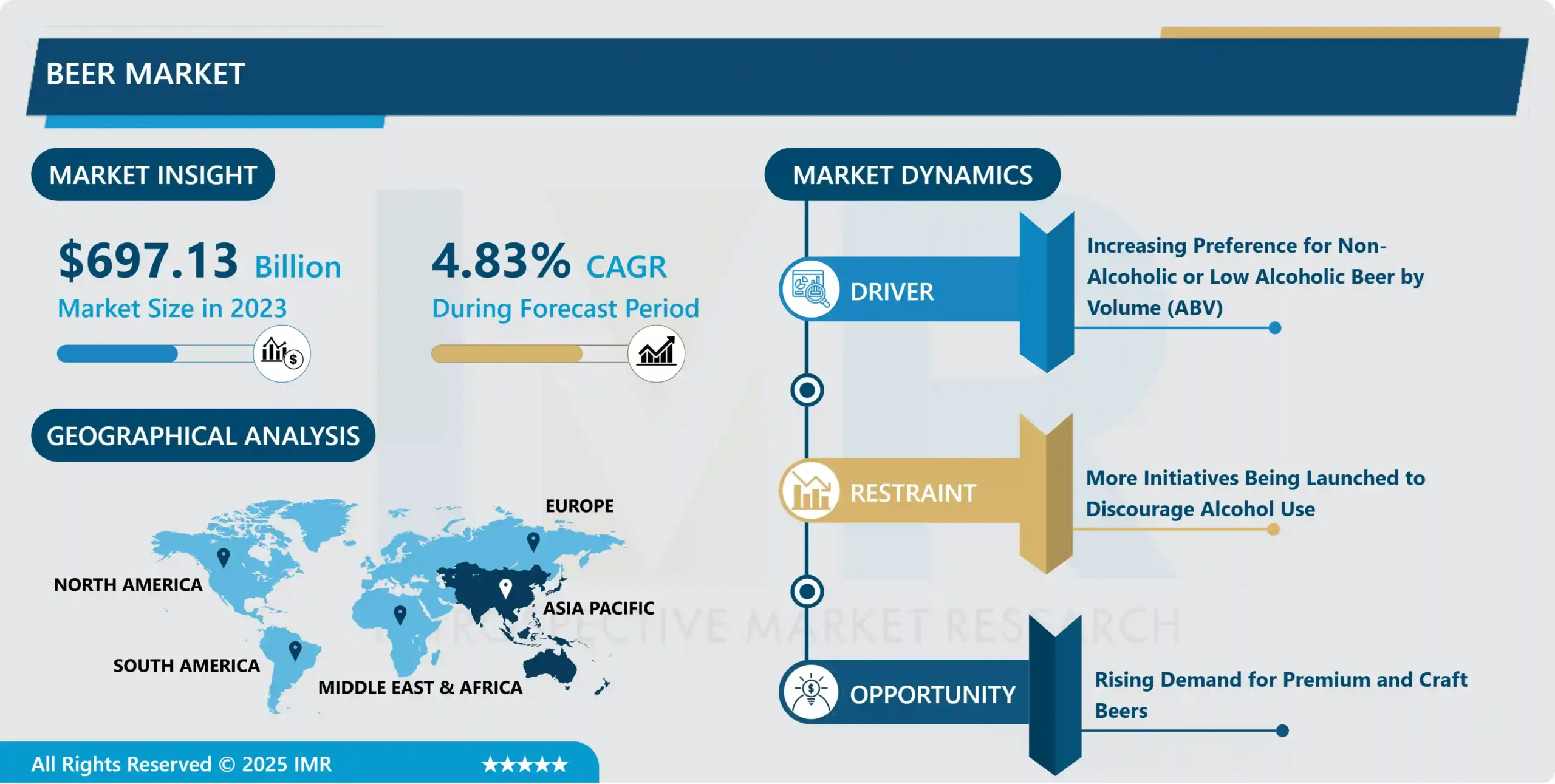
The Global Beer Market Size Was Valued at USD 697.13 Billion in 2023 and is Projected to Reach USD 1065.82 Billion by 2032, Growing at a CAGR of 4.83 % From 2024-2032.
Beer, a fermented drink made from malted barley, hops, water, and yeast, goes through a brewing procedure, producing various styles and tastes. Apart from its invigorating qualities, beer acts as a social facilitator, promoting companionship and enhancing dining experiences.
Beer, a widely enjoyed beverage globally, has entered a new digital era with innovative applications that enhance the beer-drinking experience. Platforms like Untappd and BeerAdvocate have emerged as virtual hubs for beer enthusiasts, offering a space to discover, rate, and share favorite brews. These apps provide a comprehensive database of beers, breweries, and user-generated reviews, empowering consumers to make informed choices based on personal preferences. Social elements are often integrated, allowing users to connect with fellow beer lovers, join communities, and participate in events.
Beyond exploration and social interaction, beer applications offer the advantage of tracking individual tasting histories, enabling users to revisit and remember their beer experiences. Additionally, breweries benefit from direct consumer feedback, gaining insights into market trends and refining their offerings. In summary, beer applications seamlessly blend technology with the age-old tradition of beer consumption, creating a dynamic and interconnected community while providing enthusiasts with tools to enhance their appreciation of this timeless beverage.
Beer Market Trend Analysis:
Increasing Preference for Non-Alcoholic or Low Alcoholic Beer by Volume (ABV)
The global beer market is undergoing a significant transformation, fueled by a notable increase in consumer preference for non-alcoholic or low-alcoholic beer by volume (ABV). This shift is driven by a rising health-conscious consumer base seeking a balance between social enjoyment and a healthier lifestyle. The demand for non-alcoholic or low-ABV beer is particularly prominent among millennials and health-conscious individuals who are mindful of their alcohol intake. This trend is not confined to mature markets but is also gaining momentum in emerging economies.
Consumers are attracted to the varied options of non-alcoholic and low-alcohol beer available in the market, offering the taste and experience of traditional beers without the associated high alcohol content. The growing awareness of health and wellness, coupled with changing social norms, has created a thriving market for alternatives that cater to those seeking moderation in alcohol consumption. Consequently, breweries are investing in research and development to create high-quality, flavorful non-alcoholic, and low-ABV beers, capitalizing on this evolving consumer preference.
The expansion of this segment not only widens the consumer base for the beer industry but also aligns with broader societal trends emphasizing moderation and well-being. It provides a unique opportunity for breweries to diversify their product portfolios, tap into new demographics, and stay abreast of evolving consumer preferences, thereby reshaping the landscape of the global beer market. As the demand for non-alcoholic and low-ABV beer continues to grow, it is poised to play a crucial role in shaping the future trajectory of the beer industry.
Rising Demand for Premium and Craft Beers
Consumers are now seeking unique and high-quality beer experiences, moving away from traditional mass-produced options. This shift in preferences is propelled by a growing appreciation for diverse flavor profiles, innovative brewing techniques, and a desire to explore a broader range of beer styles. Craft breweries, in particular, have leveraged this trend by producing small batches of distinctive beers, often experimenting with unconventional ingredients to create novel and exciting flavors.
Premium and craft beers cater to a more discerning consumer base that values authenticity, craftsmanship, and individuality in their beverage choices. This trend is further supported by a cultural shift towards endorsing local and independent businesses, as many craft breweries operate on a smaller scale, emphasizing community connections. The rise of beer connoisseurship and the pursuit of a more elevated drinking experience contribute to the increasing demand for premium and craft options.
This shift also provides an opportunity for brewers to diversify their product portfolios, stand out in a competitive market, and appeal to a broader demographic of consumers willing to pay a premium for a unique and superior beer experience. As the demand for premium and craft beers continues to rise, breweries that embrace innovation, quality, and a strong brand identity are well-positioned to take advantage of this growing market and shape the future of the beer industry.
Beer Market Segment Analysis:
Beer Market Segmented on the basis of Type, Packaging, Category, Production and Distribution Channel.
By Production, Macro-brewery segment is expected to dominate the market during the forecast period
The macro-brewery segment is positioned to establish dominance in the beer market, holding a significant share due to its large-scale production and widespread distribution. Characterized by their capacity to produce beer on a massive scale, macro-breweries can meet the high demand of mainstream consumers globally. These breweries often produce well-known and widely recognized beer brands, contributing to their market leadership. The efficiency of production, extensive marketing, and established brand presence provide macro-breweries with a competitive edge. Additionally, they benefit from economies of scale, allowing for cost-effective production and competitive pricing. Despite the traction gained by the craft beer movement, the sheer volume and accessibility of beers from macro-breweries ensure their continued dominance, appealing to a broad consumer base seeking familiarity, consistency, and affordability in their beer choices.
By Distribution Channel, Off-trade segment held the largest share of 34.50% in 2022
Ales cover a diverse range of styles, including pale ales, India pale ales (IPAs), stouts, porters, and more, catering to a wide spectrum of flavor preferences. The growth of the Ale segment has been significantly influenced by the craft beer movement, which often focuses on ale styles, encouraging innovation and introducing consumers to unique and distinctive brews. The increasing demand for craft and artisanal beers has propelled the Ale segment to the forefront, as consumers seek bold and complex flavors. With its rich history and continual adaptation to changing consumer tastes, the Ale segment has established itself as a leader in the beer market, showcasing the dynamic and diverse nature of the global brewing industry.
Beer Market Regional Insights:
Asia Pacific is Expected to Dominate the Market Over the Forecast period
Asia Pacific is a significantly growing beer market in the world. China is the largest beer-consuming country in Asia. Significant changes in the social lifestyle of the working population are the major region for the growth of the Asia-Pacific beer market. The rise in disposable income has led to high demand for premium and expensive beer among consumers. Countries like Vietnam China, Singapore, Australia, Thailand Japan, and India are the highest consuming beer in Asia.
Non-alcoholic beers have risen its popularity among the young generation. Non-alcoholic beer benefits your cardiovascular health. It has vitamins and minerals including folic acid, potassium, iron, and zinc which help reduce inflammation in the body. Craft beers have also been popular in recent years. It contains natural ingredients and is made naturally. Due to Western culture Craft beers and Premium beers are gaining popularity in this young Population. Government regulations and trade agreements have made it easier for international beer brands to enter and compete in Asian markets. A variety of beer options are available to consumers. Effective marketing and advertising strategies can help in brand building and will help in getting more target customers.
Beer Market Top Key Players:
Molson Coors (US)
Stone Brewing (US)
Matt Brewing Co. (US)
The Boston Beer Company Inc (US)
Constellation Brands, Inc (US)
Stella Artois (US)
Great Lakes Brewing Company (US)
Abita Brewing Co. (US)
Dogfish Head (US)
Groupo Modelo (Mexico)
Diageo (UK)
Heineken NV (Netherland)
Bogota Beer Company (Colombia)
Patagonia Brewery (Belgium)
Anheuser-Busch InBev SA/NV (Belguim)
Bitburger Brewery (Germany)
Mohan Meakin (India)
United Breweries Ltd. (India)
Gateway Brewing Co. LLP (India)
Feral Brewing Company (Australia)
DB Breweries Limited (New Zealand)
Beijing Yanjing Brewery Company Limited (China), and Other Major players.
Key Industry Developments in the Beer Market:
In August 2023, Innis & Gunn, the brewery based in Edinburgh, introduced 12 Moons Lager. This fresh brew was bottled in August 2022 during a full moon and matured for a full year in 75 bottles. With a 5.8% alcohol content, this bottle-conditioned and unpasteurized lager marks the fourth addition to Innis & Gunn’s limited edition lineup for 2023.
In March 2024, Heineken’s United Breweries Limited (UBL) has introduced Queenfisher, a new beer under the renowned Kingfisher brand, in the Indian market. This latest offering reflects Heineken’s commitment to innovation and catering to the evolving tastes of Indian consumers. Queenfisher blends premium quality with Kingfisher’s rich legacy, delivering a refreshing and delightful beer experience. With this launch, UBL strengthens its position as a leader in the Indian beer industry.
Chapter 1: Introduction
1.1 Scope and Coverage
Chapter 2:Executive Summary
Chapter 3: Market Landscape
3.1 Market Dynamics
3.1.1 Drivers
3.1.2 Restraints
3.1.3 Opportunities
3.1.4 Challenges
3.2 Market Trend Analysis
3.3 PESTLE Analysis
3.4 Porter’s Five Forces Analysis
3.5 Industry Value Chain Analysis
3.6 Ecosystem
3.7 Regulatory Landscape
3.8 Price Trend Analysis
3.9 Patent Analysis
3.10 Technology Evolution
3.11 Investment Pockets
3.12 Import-Export Analysis
Chapter 4: Beer Market by Type (2018-2032)
4.1 Beer Market Snapshot and Growth Engine
4.2 Market Overview
4.3 Lager
4.3.1 Introduction and Market Overview
4.3.2 Historic and Forecasted Market Size in Value USD and Volume Units
4.3.3 Key Market Trends, Growth Factors, and Opportunities
4.3.4 Geographic Segmentation Analysis
4.4 Ale
4.5 Stout & Porter
4.6 Malt
Chapter 5: Beer Market by Packaging (2018-2032)
5.1 Beer Market Snapshot and Growth Engine
5.2 Market Overview
5.3 Glass
5.3.1 Introduction and Market Overview
5.3.2 Historic and Forecasted Market Size in Value USD and Volume Units
5.3.3 Key Market Trends, Growth Factors, and Opportunities
5.3.4 Geographic Segmentation Analysis
5.4 Metal Can
5.5 PET Bottle
Chapter 6: Beer Market by Category (2018-2032)
6.1 Beer Market Snapshot and Growth Engine
6.2 Market Overview
6.3 Premium
6.3.1 Introduction and Market Overview
6.3.2 Historic and Forecasted Market Size in Value USD and Volume Units
6.3.3 Key Market Trends, Growth Factors, and Opportunities
6.3.4 Geographic Segmentation Analysis
6.4 Super Premium
6.5 Popular Price
Chapter 7: Beer Market by Production (2018-2032)
7.1 Beer Market Snapshot and Growth Engine
7.2 Market Overview
7.3 Macro-brewery
7.3.1 Introduction and Market Overview
7.3.2 Historic and Forecasted Market Size in Value USD and Volume Units
7.3.3 Key Market Trends, Growth Factors, and Opportunities
7.3.4 Geographic Segmentation Analysis
7.4 Microbrewery
7.5 Craft Brewery
Chapter 8: Beer Market by Distribution Channel (2018-2032)
8.1 Beer Market Snapshot and Growth Engine
8.2 Market Overview
8.3 On-trade and Off-trade
8.3.1 Introduction and Market Overview
8.3.2 Historic and Forecasted Market Size in Value USD and Volume Units
8.3.3 Key Market Trends, Growth Factors, and Opportunities
8.3.4 Geographic Segmentation Analysis
Chapter 9: Company Profiles and Competitive Analysis
9.1 Competitive Landscape
9.1.1 Competitive Benchmarking
9.1.2 Beer Market Share by Manufacturer (2024)
9.1.3 Industry BCG Matrix
9.1.4 Heat Map Analysis
9.1.5 Mergers and Acquisitions
9.2 INCREDIBLE TECHNOLOGIES INC. (U.S.)
9.2.1 Company Overview
9.2.2 Key Executives
9.2.3 Company Snapshot
9.2.4 Role of the Company in the Market
9.2.5 Sustainability and Social Responsibility
9.2.6 Operating Business Segments
9.2.7 Product Portfolio
9.2.8 Business Performance
9.2.9 Key Strategic Moves and Recent Developments
9.2.10 SWOT Analysis
9.3 GAMING PARTNERS INTERNATIONAL INC. (U.S.)
9.4 CAESARS ENTERTAINMENT INC. (U.S.)
9.5 PLAYAGS (U.S.)
9.6 CTC HOLDINGS(U.S.)
9.7 INTERBLOCK (U.S.)
9.8 AGS (U.S.)
9.9 JACKPOT DIGITAL INC (CANADA)
9.10 EVERI HOLDINGS INC (NEVADA)
9.11 NOVOMATIC (AUSTRIA)
9.12 IGT (UK)
9.13 CAMMEGH (UK)
9.14 TCSJOHNHUXLEY (UK)
9.15 GAMEBRIDGE CASINO EQUIPMENT (UKRAINE)
9.16 ABBIATI CASINO EQUIPMENT S.R.L. (ITALY)
9.17 APEX GAMING TECHNOLOGY (AUSTRIA)
9.18 AMATIC INDUSTRIES (AUSTRIA)
9.19 KONAMI GROUP CORPORATION (JAPAN)
9.20 AINSWORTH GAME TECHNOLOGY LIMITED (AUSTRALIA)
9.21 HANXIN INDUSTRY COLTD (CHINA)
9.22 GAMEBRIDGE CASINO EQUIPMENT (UKRAINE)
9.23 ATOMIC GAMING (SOUTH AFRICA)
9.24 GAME SMART (PTY) LTD (SOUTH AFRICA)
9.25 MERKUR GAMING AFRICA (PTY)LTD (SOUTH AFRICA)
9.26 3 POINT GAMING (PTY) LTD (SOUTH AFRICA)
9.27
Chapter 10: Global Beer Market By Region
10.1 Overview
10.2. North America Beer Market
10.2.1 Key Market Trends, Growth Factors and Opportunities
10.2.2 Top Key Companies
10.2.3 Historic and Forecasted Market Size by Segments
10.2.4 Historic and Forecasted Market Size by Type
10.2.4.1 Lager
10.2.4.2 Ale
10.2.4.3 Stout & Porter
10.2.4.4 Malt
10.2.5 Historic and Forecasted Market Size by Packaging
10.2.5.1 Glass
10.2.5.2 Metal Can
10.2.5.3 PET Bottle
10.2.6 Historic and Forecasted Market Size by Category
10.2.6.1 Premium
10.2.6.2 Super Premium
10.2.6.3 Popular Price
10.2.7 Historic and Forecasted Market Size by Production
10.2.7.1 Macro-brewery
10.2.7.2 Microbrewery
10.2.7.3 Craft Brewery
10.2.8 Historic and Forecasted Market Size by Distribution Channel
10.2.8.1 On-trade and Off-trade
10.2.9 Historic and Forecast Market Size by Country
10.2.9.1 US
10.2.9.2 Canada
10.2.9.3 Mexico
10.3. Eastern Europe Beer Market
10.3.1 Key Market Trends, Growth Factors and Opportunities
10.3.2 Top Key Companies
10.3.3 Historic and Forecasted Market Size by Segments
10.3.4 Historic and Forecasted Market Size by Type
10.3.4.1 Lager
10.3.4.2 Ale
10.3.4.3 Stout & Porter
10.3.4.4 Malt
10.3.5 Historic and Forecasted Market Size by Packaging
10.3.5.1 Glass
10.3.5.2 Metal Can
10.3.5.3 PET Bottle
10.3.6 Historic and Forecasted Market Size by Category
10.3.6.1 Premium
10.3.6.2 Super Premium
10.3.6.3 Popular Price
10.3.7 Historic and Forecasted Market Size by Production
10.3.7.1 Macro-brewery
10.3.7.2 Microbrewery
10.3.7.3 Craft Brewery
10.3.8 Historic and Forecasted Market Size by Distribution Channel
10.3.8.1 On-trade and Off-trade
10.3.9 Historic and Forecast Market Size by Country
10.3.9.1 Russia
10.3.9.2 Bulgaria
10.3.9.3 The Czech Republic
10.3.9.4 Hungary
10.3.9.5 Poland
10.3.9.6 Romania
10.3.9.7 Rest of Eastern Europe
10.4. Western Europe Beer Market
10.4.1 Key Market Trends, Growth Factors and Opportunities
10.4.2 Top Key Companies
10.4.3 Historic and Forecasted Market Size by Segments
10.4.4 Historic and Forecasted Market Size by Type
10.4.4.1 Lager
10.4.4.2 Ale
10.4.4.3 Stout & Porter
10.4.4.4 Malt
10.4.5 Historic and Forecasted Market Size by Packaging
10.4.5.1 Glass
10.4.5.2 Metal Can
10.4.5.3 PET Bottle
10.4.6 Historic and Forecasted Market Size by Category
10.4.6.1 Premium
10.4.6.2 Super Premium
10.4.6.3 Popular Price
10.4.7 Historic and Forecasted Market Size by Production
10.4.7.1 Macro-brewery
10.4.7.2 Microbrewery
10.4.7.3 Craft Brewery
10.4.8 Historic and Forecasted Market Size by Distribution Channel
10.4.8.1 On-trade and Off-trade
10.4.9 Historic and Forecast Market Size by Country
10.4.9.1 Germany
10.4.9.2 UK
10.4.9.3 France
10.4.9.4 The Netherlands
10.4.9.5 Italy
10.4.9.6 Spain
10.4.9.7 Rest of Western Europe
10.5. Asia Pacific Beer Market
10.5.1 Key Market Trends, Growth Factors and Opportunities
10.5.2 Top Key Companies
10.5.3 Historic and Forecasted Market Size by Segments
10.5.4 Historic and Forecasted Market Size by Type
10.5.4.1 Lager
10.5.4.2 Ale
10.5.4.3 Stout & Porter
10.5.4.4 Malt
10.5.5 Historic and Forecasted Market Size by Packaging
10.5.5.1 Glass
10.5.5.2 Metal Can
10.5.5.3 PET Bottle
10.5.6 Historic and Forecasted Market Size by Category
10.5.6.1 Premium
10.5.6.2 Super Premium
10.5.6.3 Popular Price
10.5.7 Historic and Forecasted Market Size by Production
10.5.7.1 Macro-brewery
10.5.7.2 Microbrewery
10.5.7.3 Craft Brewery
10.5.8 Historic and Forecasted Market Size by Distribution Channel
10.5.8.1 On-trade and Off-trade
10.5.9 Historic and Forecast Market Size by Country
10.5.9.1 China
10.5.9.2 India
10.5.9.3 Japan
10.5.9.4 South Korea
10.5.9.5 Malaysia
10.5.9.6 Thailand
10.5.9.7 Vietnam
10.5.9.8 The Philippines
10.5.9.9 Australia
10.5.9.10 New Zealand
10.5.9.11 Rest of APAC
10.6. Middle East & Africa Beer Market
10.6.1 Key Market Trends, Growth Factors and Opportunities
10.6.2 Top Key Companies
10.6.3 Historic and Forecasted Market Size by Segments
10.6.4 Historic and Forecasted Market Size by Type
10.6.4.1 Lager
10.6.4.2 Ale
10.6.4.3 Stout & Porter
10.6.4.4 Malt
10.6.5 Historic and Forecasted Market Size by Packaging
10.6.5.1 Glass
10.6.5.2 Metal Can
10.6.5.3 PET Bottle
10.6.6 Historic and Forecasted Market Size by Category
10.6.6.1 Premium
10.6.6.2 Super Premium
10.6.6.3 Popular Price
10.6.7 Historic and Forecasted Market Size by Production
10.6.7.1 Macro-brewery
10.6.7.2 Microbrewery
10.6.7.3 Craft Brewery
10.6.8 Historic and Forecasted Market Size by Distribution Channel
10.6.8.1 On-trade and Off-trade
10.6.9 Historic and Forecast Market Size by Country
10.6.9.1 Turkiye
10.6.9.2 Bahrain
10.6.9.3 Kuwait
10.6.9.4 Saudi Arabia
10.6.9.5 Qatar
10.6.9.6 UAE
10.6.9.7 Israel
10.6.9.8 South Africa
10.7. South America Beer Market
10.7.1 Key Market Trends, Growth Factors and Opportunities
10.7.2 Top Key Companies
10.7.3 Historic and Forecasted Market Size by Segments
10.7.4 Historic and Forecasted Market Size by Type
10.7.4.1 Lager
10.7.4.2 Ale
10.7.4.3 Stout & Porter
10.7.4.4 Malt
10.7.5 Historic and Forecasted Market Size by Packaging
10.7.5.1 Glass
10.7.5.2 Metal Can
10.7.5.3 PET Bottle
10.7.6 Historic and Forecasted Market Size by Category
10.7.6.1 Premium
10.7.6.2 Super Premium
10.7.6.3 Popular Price
10.7.7 Historic and Forecasted Market Size by Production
10.7.7.1 Macro-brewery
10.7.7.2 Microbrewery
10.7.7.3 Craft Brewery
10.7.8 Historic and Forecasted Market Size by Distribution Channel
10.7.8.1 On-trade and Off-trade
10.7.9 Historic and Forecast Market Size by Country
10.7.9.1 Brazil
10.7.9.2 Argentina
10.7.9.3 Rest of SA
Chapter 11 Analyst Viewpoint and Conclusion
11.1 Recommendations and Concluding Analysis
11.2 Potential Market Strategies
Chapter 12 Research Methodology
12.1 Research Process
12.2 Primary Research
12.3 Secondary Research
Q1: What would be the forecast period in the Beer Market research report?
A1: The forecast period in the Beer Market research report is 2024-2032
Q2: Who are the key players in the Beer Market?
A2: Molson Coors (US), Stone Brewing (US), Matt Brewing Co. (US), The Boston Beer Company Inc (US), Constellation Brands, Inc (US), Stella Artois (US), Great Lakes Brewing Company (US), Abita Brewing Co. (US), Dogfish Head (US), Groupo Modelo (Mexico), Diageo (UK), Heineken NV (Netherland), Bogota Beer Company (Colombia), Patagonia Brewery (Belgium), Bitburger Brewery (Germany), Anheuser-Busch InBev SA/NV (Belguim), Mohan Meakin (India), United Breweries Ltd. (India), Gateway Brewing Co. LLP (India), Feral Brewing Company (Australia), DB Breweries Limited (New Zealand), Beijing Yanjing Brewery Company Limited (China), and Other Major players and Other Major Players
Q3: What are the segments of the Beer Market?
A3: The Beer Market is segmented into Type, Packaging, Category, Production, Distribution Channel and region. By Type, the market is categorized into Lager, Ale, Stout & Porter, and Malt. By Packaging, the market is categorized into Glass, Metal Can, and PET Bottle. By Category, the market is categorized into Premium, Super Premium, and Popular Price. By Production, the market is categorized into Macro-brewery, Microbrewery, and Craft Brewery. By Distribution Channel, the market is categorized into On-trade and Off-trade. By region, it is analyzed across North America (U.S.; Canada; Mexico), Eastern Europe (Bulgaria; The Czech Republic; Hungary; Poland; Romania; Rest of Eastern Europe), Western Europe (Germany; UK; France; Netherlands; Italy; Russia; Spain; Rest of Western Europe), Asia-Pacific (China; India; Japan; Southeast Asia, etc.), South America (Brazil; Argentina, etc.), Middle East & Africa (Saudi Arabia; South Africa, etc.).
Q4: What is the Beer Market?
A4: Beer, a fermented drink made from malted barley, hops, water, and yeast, goes through a brewing procedure, producing various styles and tastes. Apart from its invigorating qualities, beer acts as a social facilitator, promoting companionship and enhancing dining experiences
Q5: How big is the Beer Market?
A5: The Global Beer Market Size Was Valued at USD 697.13 Billion in 2023 and is Projected to Reach USD 1065.82 Billion by 2032, Growing at a CAGR of 4.83 % From 2024-2032.
How to Buy a Report from eminsights.jp
On the product page, choose the license you want: Single-User License, Multi-User License or Enterprise License.
If you required report in your native language, then you can click on Translated Report button and fill out the form with report name and language you want, then our team will contact you as soon as possible.
Click the Buy Now button.
You will be redirected to the checkout page. Enter your company details and payment information.
Click Place Order to complete the purchase.
Confirmation: You’ll receive an order confirmation and our team will contact you shortly with your ordered report.
If you have any questions, fill out the contact form below or email us at bizdev@eminsights.net.
Thank you for choosing eminsights.jp!