Stay Ahead in Fast-Growing Economies.
Browse Reports Now
Battery Separator Market: Global Outlook & Market Dynamics
A battery separator is a permeable membrane that’s placed between a battery’s positively charged anode and negatively charged cathode to prevent electrical short circuits. It also allows the transport of ionic charge carriers that are needed to close the circuit during the passage of current.

IMR Group
Description
Battery Separator Market Synopsis
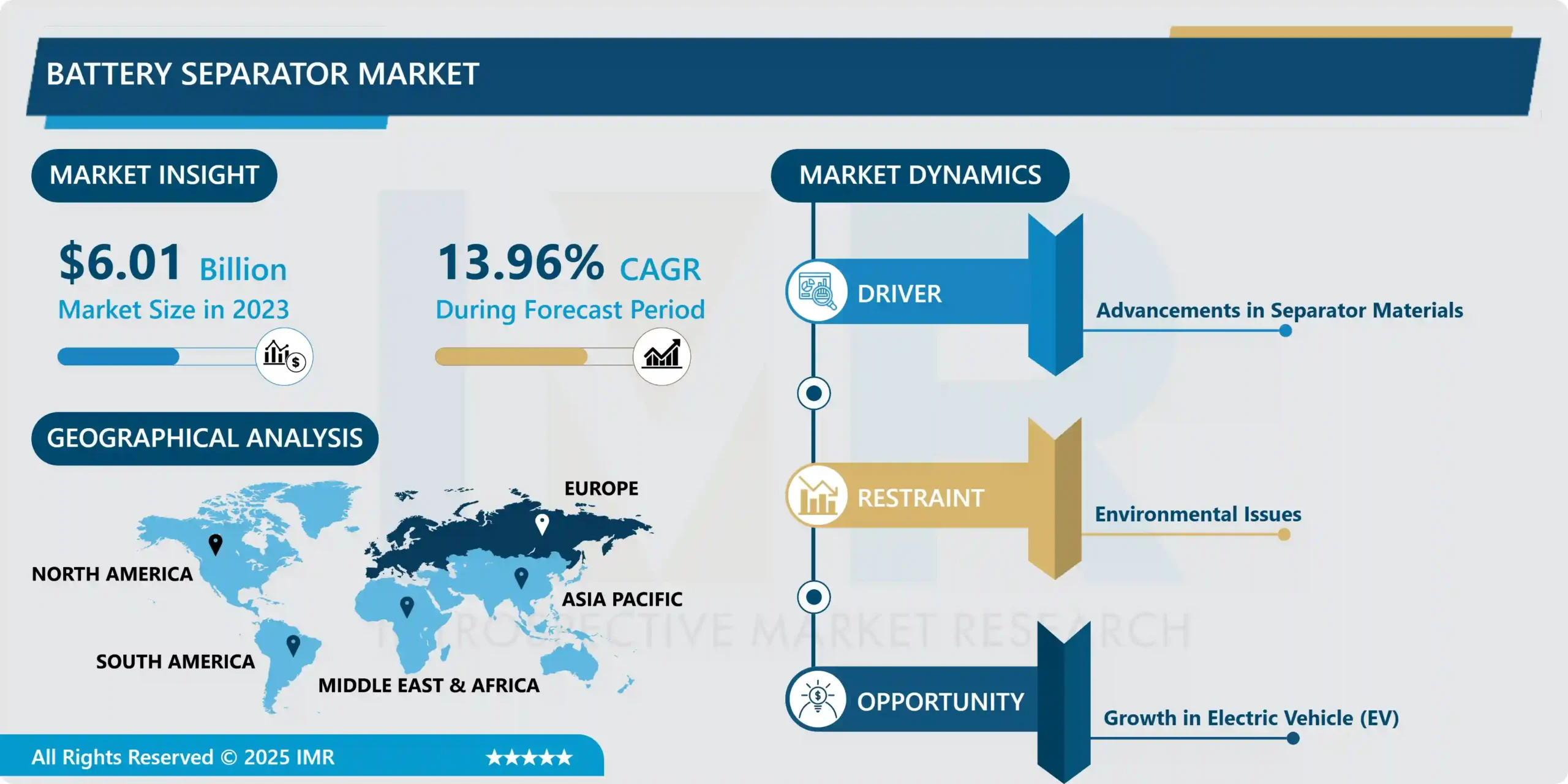
Battery Separator Market Size Was Valued at USD 6.01 Billion in 2023, and is Projected to Reach USD 19.48 Billion by 2032, Growing at a CAGR of 13.96% From 2024-2032.
A battery separator is a permeable membrane that’s placed between a battery’s positively charged anode and negatively charged cathode to prevent electrical short circuits. It also allows the transport of ionic charge carriers that are needed to close the circuit during the passage of current. The increase in electric vehicle (EV) use is fuelled by the expanding demand for EVs, requiring advanced battery technologies with high-performance separators to ensure safety, efficiency, and durability. Governments are bolstering this trend by providing incentives and regulations, which are also driving up the demand for battery separators. Progress in battery technology, like lithium-ion and solid-state batteries, demand improved separators to boost performance and safety, particularly as energy density and battery life cycles rise. The growth of the consumer electronics industry, specifically in smaller and more efficient batteries, also increases the demand for superior separators. Moreover, the expansion of energy storage systems, specifically for incorporating renewable energy and grid storage, depends on cutting-edge battery separators to provide effective and dependable storage options.
The need for dependable backup power systems and UPS is increasing in industries, leading to a high demand for durable battery separators. The market demand is fueled by the telecom sector’s need for batteries for backup power and data centres. Advancements in technology, such as new materials and production methods, are improving the performance and safety of batteries, driving market expansion. Increasing regulatory standards for battery safety and quality are driving a greater need for advanced separators. The shift towards sustainability and ecological issues is driving the adoption of environmentally friendly materials in battery separators to support sustainability objectives and initiatives for enhancing recycling and minimizing the environmental footprint in battery manufacturing.
The growth of battery production worldwide results in the opening of new manufacturing plants in areas such as Asia-Pacific, North America, and Europe, driving up the need for battery separators. Producing batteries locally to satisfy regional needs also increases the demand for separators. The rise of hybrid and plug-in hybrid cars, powered by advanced battery technologies, is driving up the need for specialized separators, improving vehicle efficiency and safety. Higher funding in research and development from battery makers and material providers promotes advancements in separator technology, leading to market expansion. Consumer knowledge about battery performance and safety impacts the need for advanced separators for different uses.
Battery Separator Market Trend Analysis
Advancements in Separator Materials
Enhancing battery performance and safety requires improved ion conductivity, increased energy density, thermal stability, and flame retardancy. Sophisticated separator materials like high-performance polymers and nanocomposites enhance ionic conductivity, effective ion transport, and steady electrochemical reactions. These materials also provide enhanced thermal stability, decreasing the possibility of thermal runaway in batteries with high energy density. Moreover, the use of new materials that have built-in flame-resistant qualities or coatings can aid in the prevention or containment of fires caused by short circuits or thermal events, ultimately enhancing the safety of battery systems.
Advancements in separator technologies are being developed to ensure compatibility with future batteries. Solid-state batteries, which use solid electrolytes, need separators that have particular characteristics such as strong mechanical properties and stable chemistry. Recent types of batteries, such as lithium-sulphur, need separator materials that can handle issues like resistance to polysulfide dissolution. To accommodate the needs of smaller and more versatile electronic devices, separators must be thinner, lighter, and more flexible. Advances in materials are allowing for the creation of flexible and stretchable separators for wearable electronics and flexible displays.
There is a growing emphasis on sustainability and environmental impact in battery separator materials. There is a focus on using environmentally friendly materials to decrease the environmental impact and adhere to the principles of the circular economy. Fresh materials are being created to make it simpler to recycle battery parts. Breakthroughs in separator materials are resulting in manufacturing processes that are more economical, and with increased throughput and efficiency. Enhanced separator materials can extend battery lifespan and boost performance, leading to reduced costs over time in sectors such as electric vehicles and electronic devices.
Growth in Electric Vehicle (EV)
Rising market demand for advanced battery technologies in Electric Vehicles (EVs) is fuelled by the necessity for high-performance batteries capable of attaining greater driving distances, quicker charging durations, and enhanced efficiency. This requirement results in a necessity for improved battery separators that boost performance, safety, and longevity. Stringent safety regulations for EV batteries are in place to avoid incidents such as thermal runaway and fires, emphasizing the importance of premium separators for insulation and avoiding short circuits. Moreover, enhanced separators assist in controlling battery heat, guaranteeing safety and dependability for electric vehicles.
The rise in battery manufacturing due to the increasing demand from the expanding EV industry has caused a sharp increase in the requirement for battery separators. Manufacturers are increasing the size of their plants in order to increase production and are researching different types of batteries such as pouch cells and cylindrical cells. These advancements, combined with progress in technologies such as solid-state batteries, are fueling the need for specialized separators with improved characteristics. This offers chances for separator providers to offer customized solutions and for the industry to grow alongside upcoming battery technologies.
Government measures such as subsidies, tax breaks, and emission regulations are fueling the expansion of the EV sector. This has led to a need for battery separators that meet safety and performance regulatory standards. Battery producers are concentrating on enhancing energy density for longer driving distances and quicker charging, necessitating upgraded separators to uphold effectiveness and safety throughout rapid charge-discharge rotations. In general, support in the form of regulations and incentives plays a vital role in the advancement and acceptance of electric vehicles and essential parts like battery separators.
Battery Separator Market Segment Analysis:
Battery Separator Market Segmented on the basis of Type, Material, Technology, Application, End-User, Distribution channels, and Region
By Material, Polypropylene Segment Is Expected to Dominate the Market During the Forecast Period
The polypropylene separators equally offer excellent chemical withstand to guarantee battery stability and longevity. They are ideally suited for improving the thermal performance of the next-generation batteries for automobiles and energy storage applications. Polypropylene is relatively cheaper and thus can be used extensively, particularly in car manufacture and consumer electronics, where products including large quantities are produced. Finally, manufacturers get to enjoy the advantages of production cost being lower than that of retail cost.
Polypropylene (PP) exhibits a lightweight feel, which contributes to the reduction of weight where it is desirable, such as electric vehicles for better energy consumption. Thus, the efficiency of the PP separators makes batteries more appropriate for portable and automotive power sources. In addition, they exhibit excellent electrical insulation properties, which avoid short-circuiting and guarantee the efficiency of the battery. This efficient insulation benefits battery health by reducing energy loss. Polypropylene can be recycled, helping the battery industry meet sustainability targets and reduce environmental impact.
PP separators are very flexible and have a variety of uses in lithium-ion, lead-acid, and NiMH batteries. Their increasing market influence in the automotive, consumer electronics, and industrial sectors is propelled by their adaptability. Recent technological progress has improved PP separator characteristics such as strength, thermal stability, and porosity. Ongoing advancements in processing and formulation continue to enhance their acceptance in high-performance battery technologies. The increase in popularity of electric vehicles requires effective battery separators. PP separators are perfect for high-capacity batteries in electric vehicles. As the automotive industry moves towards electrification, there will be a higher demand for PP separators.
By End-User, Automotive Segment Held the Largest Share In 2023
Electric cars are quickly gaining the market and will soon become the major reason for demand for high-performance battery separators due to more car sales. Governments across the world are offering purchase incentives to influence the shift towards electric cars from traditional vehicles, thus hastening market growth, as consumers seek better batteries for these vehicles. Newer, more efficient separators are required as solid-state and high-energy-density lithium-ion batteries possess new characteristics in terms of performance and safety. This is due to the need to achieve greater ranges and increased charging rates in electric vehicles, which in turn, demand better battery separators.
The focus on battery safety is increasing due to the enhancement of safety standards on car batteries. Thus, high-performance separators with higher thermal stability and fire resistance are needed to prevent both short-circuits and thermal runaway. The need for charging infrastructure for EVs, particularly in rapid chargers necessitates separators that withstand cycles of charging and heat.
Manufacturers of automobiles have realized the importance of batteries in electric cars, and hence, have been investing intensely in the development of batteries, thus creating a demand for high-quality battery separators. The battery separator market is growing exponentially due to the rising number of electric vehicle battery manufacturing facilities. High emission standards and trends in durability for the auto industry are pulling manufacturing towards electric and hybrids raising the need for advanced battery separators that are environmentally sound and efficient.
Battery Separator Market Regional Insights:
Europe is Expected to Dominate the Market Over the Forecast Period
European nations are promoting the widespread use of electric vehicles (EVs) by implementing strict regulations and providing incentives such as subsidies and tax benefits. European car manufacturers are making significant investments in electric vehicle manufacturing and battery technology, which is driving up the need for high-quality battery separators. The emphasis on wind and solar power in Europe is increasing the demand for advanced battery separators in energy storage systems, as the need for efficient energy storage solutions continues to grow. The upgrade of energy grids is also boosting the need for battery separators.
Europe’s focus on research and development in battery technologies encourages innovation in separator technology, to meet high-performance standards. The rise of electric and hybrid vehicles in the European automotive industry is fueling the need for advanced battery separators to satisfy safety and performance standards. EU rules on emissions and fuel efficiency are increasingly pushing the use of advanced battery technologies, which in turn is boosting market expansion in the area.
Europe is giving more importance to sustainability and environmental conservation, causing a rise in the request for eco-friendly battery separators. Strategies within the circular economy promote the recycling and reduction of waste in the production of batteries. Battery production is growing in Europe through the establishment of additional facilities and collaborations to meet the increasing need for electric cars and energy storage solutions. Local production is intended to decrease reliance on imports and boost the regional market for sustainable separators.
Battery Separator Market Active Players
Asahi Kasei Corporation (Japan)
Celgard LLC (USA)
Mitsubishi Chemical Holdings Corporation (Japan)
Sumitomo Chemical Co., Ltd. (Japan)
Toray Industries, Inc. (Japan)
Entek International LLC (USA)
Ube Industries, Ltd. (Japan)
W. L. Gore & Associates, Inc. (USA)
LG Chem Ltd. (South Korea)
SK Innovation Co., Ltd. (South Korea)
Freudenberg Performance Materials (Germany)
Jiangxi Ganfeng Lithium Co., Ltd. (China)
Tianjin Cangxin New Energy Technology Co., Ltd. (China)
Cangzhou Mingzhu Plastic Co., Ltd. (China)
Shenzhen Senior Technology Material Co., Ltd. (China)
Mitsubishi Gas Chemical Company, Inc. (Japan)
Eastman Chemical Company (USA)
Ningbo Shanshan Co., Ltd. (China)
China Jangho Group Co., Ltd. (China)
Hubei Nanhua New Material Technology Co., Ltd. (China)
Suzhou Green Power New Energy Co., Ltd. (China)
Zhongke Yaxiang New Material Co., Ltd. (China)
Nippon Sheet Glass Co., Ltd. (Japan)
Parker Hannifin Corporation (USA)
LG Energy Solution Ltd. (South Korea), and Other Active Players
Chapter 1: Introduction
1.1 Scope and Coverage
Chapter 2:Executive Summary
Chapter 3: Market Landscape
3.1 Market Dynamics
3.1.1 Drivers
3.1.2 Restraints
3.1.3 Opportunities
3.1.4 Challenges
3.2 Market Trend Analysis
3.3 PESTLE Analysis
3.4 Porter’s Five Forces Analysis
3.5 Industry Value Chain Analysis
3.6 Ecosystem
3.7 Regulatory Landscape
3.8 Price Trend Analysis
3.9 Patent Analysis
3.10 Technology Evolution
3.11 Investment Pockets
3.12 Import-Export Analysis
Chapter 4: Battery Separator Market by Type (2018-2032)
4.1 Battery Separator Market Snapshot and Growth Engine
4.2 Market Overview
4.3 Lead-acid
4.3.1 Introduction and Market Overview
4.3.2 Historic and Forecasted Market Size in Value USD and Volume Units
4.3.3 Key Market Trends, Growth Factors, and Opportunities
4.3.4 Geographic Segmentation Analysis
4.4 Li-ion
Chapter 5: Battery Separator Market by Material (2018-2032)
5.1 Battery Separator Market Snapshot and Growth Engine
5.2 Market Overview
5.3 Polyethylene
5.3.1 Introduction and Market Overview
5.3.2 Historic and Forecasted Market Size in Value USD and Volume Units
5.3.3 Key Market Trends, Growth Factors, and Opportunities
5.3.4 Geographic Segmentation Analysis
5.4 Polypropylene
Chapter 6: Battery Separator Market by Technology (2018-2032)
6.1 Battery Separator Market Snapshot and Growth Engine
6.2 Market Overview
6.3 Dry
6.3.1 Introduction and Market Overview
6.3.2 Historic and Forecasted Market Size in Value USD and Volume Units
6.3.3 Key Market Trends, Growth Factors, and Opportunities
6.3.4 Geographic Segmentation Analysis
6.4 Wet
Chapter 7: Battery Separator Market by Application (2018-2032)
7.1 Battery Separator Market Snapshot and Growth Engine
7.2 Market Overview
7.3 Consumer Electronics
7.3.1 Introduction and Market Overview
7.3.2 Historic and Forecasted Market Size in Value USD and Volume Units
7.3.3 Key Market Trends, Growth Factors, and Opportunities
7.3.4 Geographic Segmentation Analysis
7.4 Automotive
7.5 Energy Storage Systems
7.6 Industrial Applications
7.7 Medical Devices
Chapter 8: Battery Separator Market by End-User (2018-2032)
8.1 Battery Separator Market Snapshot and Growth Engine
8.2 Market Overview
8.3 Automotive
8.3.1 Introduction and Market Overview
8.3.2 Historic and Forecasted Market Size in Value USD and Volume Units
8.3.3 Key Market Trends, Growth Factors, and Opportunities
8.3.4 Geographic Segmentation Analysis
8.4 Consumer electronics
8.5 Industrial
Chapter 9: Battery Separator Market by Distribution channels (2018-2032)
9.1 Battery Separator Market Snapshot and Growth Engine
9.2 Market Overview
9.3 Direct Sales
9.3.1 Introduction and Market Overview
9.3.2 Historic and Forecasted Market Size in Value USD and Volume Units
9.3.3 Key Market Trends, Growth Factors, and Opportunities
9.3.4 Geographic Segmentation Analysis
9.4 Online Sales
9.5 Retail Sales
9.6 Distributors and Wholesalers
9.7 Original Equipment Manufacturer
Chapter 10: Company Profiles and Competitive Analysis
10.1 Competitive Landscape
10.1.1 Competitive Benchmarking
10.1.2 Battery Separator Market Share by Manufacturer (2024)
10.1.3 Industry BCG Matrix
10.1.4 Heat Map Analysis
10.1.5 Mergers and Acquisitions
10.2 ASAHI KASEI CORPORATION (JAPAN)
10.2.1 Company Overview
10.2.2 Key Executives
10.2.3 Company Snapshot
10.2.4 Role of the Company in the Market
10.2.5 Sustainability and Social Responsibility
10.2.6 Operating Business Segments
10.2.7 Product Portfolio
10.2.8 Business Performance
10.2.9 Key Strategic Moves and Recent Developments
10.2.10 SWOT Analysis
10.3 CELGARD LLC (USA)
10.4 MITSUBISHI CHEMICAL HOLDINGS CORPORATION (JAPAN)
10.5 SUMITOMO CHEMICAL COLTD. (JAPAN)
10.6 TORAY INDUSTRIES INC. (JAPAN)
10.7 ENTEK INTERNATIONAL LLC (USA)
10.8 UBE INDUSTRIES LTD. (JAPAN)
10.9 W. L. GORE & ASSOCIATES INC. (USA)
10.10 LG CHEM LTD. (SOUTH KOREA)
10.11 SK INNOVATION COLTD. (SOUTH KOREA)
10.12 FREUDENBERG PERFORMANCE MATERIALS (GERMANY)
10.13 JIANGXI GANFENG LITHIUM COLTD. (CHINA)
10.14 TIANJIN CANGXIN NEW ENERGY TECHNOLOGY COLTD. (CHINA)
10.15 CANGZHOU MINGZHU PLASTIC COLTD. (CHINA)
10.16 SHENZHEN SENIOR TECHNOLOGY MATERIAL COLTD. (CHINA)
10.17 MITSUBISHI GAS CHEMICAL COMPANY INC. (JAPAN)
10.18 EASTMAN CHEMICAL COMPANY (USA)
10.19 NINGBO SHANSHAN COLTD. (CHINA)
10.20 CHINA JANGHO GROUP COLTD. (CHINA)
10.21 HUBEI NANHUA NEW MATERIAL TECHNOLOGY COLTD. (CHINA)
10.22 SUZHOU GREEN POWER NEW ENERGY COLTD. (CHINA)
10.23 ZHONGKE YAXIANG NEW MATERIAL COLTD. (CHINA)
10.24 NIPPON SHEET GLASS COLTD. (JAPAN)
10.25 PARKER HANNIFIN CORPORATION (USA)
10.26 LG ENERGY SOLUTION LTD. (SOUTH KOREA)
10.27 AND
Chapter 11: Global Battery Separator Market By Region
11.1 Overview
11.2. North America Battery Separator Market
11.2.1 Key Market Trends, Growth Factors and Opportunities
11.2.2 Top Key Companies
11.2.3 Historic and Forecasted Market Size by Segments
11.2.4 Historic and Forecasted Market Size by Type
11.2.4.1 Lead-acid
11.2.4.2 Li-ion
11.2.5 Historic and Forecasted Market Size by Material
11.2.5.1 Polyethylene
11.2.5.2 Polypropylene
11.2.6 Historic and Forecasted Market Size by Technology
11.2.6.1 Dry
11.2.6.2 Wet
11.2.7 Historic and Forecasted Market Size by Application
11.2.7.1 Consumer Electronics
11.2.7.2 Automotive
11.2.7.3 Energy Storage Systems
11.2.7.4 Industrial Applications
11.2.7.5 Medical Devices
11.2.8 Historic and Forecasted Market Size by End-User
11.2.8.1 Automotive
11.2.8.2 Consumer electronics
11.2.8.3 Industrial
11.2.9 Historic and Forecasted Market Size by Distribution channels
11.2.9.1 Direct Sales
11.2.9.2 Online Sales
11.2.9.3 Retail Sales
11.2.9.4 Distributors and Wholesalers
11.2.9.5 Original Equipment Manufacturer
11.2.10 Historic and Forecast Market Size by Country
11.2.10.1 US
11.2.10.2 Canada
11.2.10.3 Mexico
11.3. Eastern Europe Battery Separator Market
11.3.1 Key Market Trends, Growth Factors and Opportunities
11.3.2 Top Key Companies
11.3.3 Historic and Forecasted Market Size by Segments
11.3.4 Historic and Forecasted Market Size by Type
11.3.4.1 Lead-acid
11.3.4.2 Li-ion
11.3.5 Historic and Forecasted Market Size by Material
11.3.5.1 Polyethylene
11.3.5.2 Polypropylene
11.3.6 Historic and Forecasted Market Size by Technology
11.3.6.1 Dry
11.3.6.2 Wet
11.3.7 Historic and Forecasted Market Size by Application
11.3.7.1 Consumer Electronics
11.3.7.2 Automotive
11.3.7.3 Energy Storage Systems
11.3.7.4 Industrial Applications
11.3.7.5 Medical Devices
11.3.8 Historic and Forecasted Market Size by End-User
11.3.8.1 Automotive
11.3.8.2 Consumer electronics
11.3.8.3 Industrial
11.3.9 Historic and Forecasted Market Size by Distribution channels
11.3.9.1 Direct Sales
11.3.9.2 Online Sales
11.3.9.3 Retail Sales
11.3.9.4 Distributors and Wholesalers
11.3.9.5 Original Equipment Manufacturer
11.3.10 Historic and Forecast Market Size by Country
11.3.10.1 Russia
11.3.10.2 Bulgaria
11.3.10.3 The Czech Republic
11.3.10.4 Hungary
11.3.10.5 Poland
11.3.10.6 Romania
11.3.10.7 Rest of Eastern Europe
11.4. Western Europe Battery Separator Market
11.4.1 Key Market Trends, Growth Factors and Opportunities
11.4.2 Top Key Companies
11.4.3 Historic and Forecasted Market Size by Segments
11.4.4 Historic and Forecasted Market Size by Type
11.4.4.1 Lead-acid
11.4.4.2 Li-ion
11.4.5 Historic and Forecasted Market Size by Material
11.4.5.1 Polyethylene
11.4.5.2 Polypropylene
11.4.6 Historic and Forecasted Market Size by Technology
11.4.6.1 Dry
11.4.6.2 Wet
11.4.7 Historic and Forecasted Market Size by Application
11.4.7.1 Consumer Electronics
11.4.7.2 Automotive
11.4.7.3 Energy Storage Systems
11.4.7.4 Industrial Applications
11.4.7.5 Medical Devices
11.4.8 Historic and Forecasted Market Size by End-User
11.4.8.1 Automotive
11.4.8.2 Consumer electronics
11.4.8.3 Industrial
11.4.9 Historic and Forecasted Market Size by Distribution channels
11.4.9.1 Direct Sales
11.4.9.2 Online Sales
11.4.9.3 Retail Sales
11.4.9.4 Distributors and Wholesalers
11.4.9.5 Original Equipment Manufacturer
11.4.10 Historic and Forecast Market Size by Country
11.4.10.1 Germany
11.4.10.2 UK
11.4.10.3 France
11.4.10.4 The Netherlands
11.4.10.5 Italy
11.4.10.6 Spain
11.4.10.7 Rest of Western Europe
11.5. Asia Pacific Battery Separator Market
11.5.1 Key Market Trends, Growth Factors and Opportunities
11.5.2 Top Key Companies
11.5.3 Historic and Forecasted Market Size by Segments
11.5.4 Historic and Forecasted Market Size by Type
11.5.4.1 Lead-acid
11.5.4.2 Li-ion
11.5.5 Historic and Forecasted Market Size by Material
11.5.5.1 Polyethylene
11.5.5.2 Polypropylene
11.5.6 Historic and Forecasted Market Size by Technology
11.5.6.1 Dry
11.5.6.2 Wet
11.5.7 Historic and Forecasted Market Size by Application
11.5.7.1 Consumer Electronics
11.5.7.2 Automotive
11.5.7.3 Energy Storage Systems
11.5.7.4 Industrial Applications
11.5.7.5 Medical Devices
11.5.8 Historic and Forecasted Market Size by End-User
11.5.8.1 Automotive
11.5.8.2 Consumer electronics
11.5.8.3 Industrial
11.5.9 Historic and Forecasted Market Size by Distribution channels
11.5.9.1 Direct Sales
11.5.9.2 Online Sales
11.5.9.3 Retail Sales
11.5.9.4 Distributors and Wholesalers
11.5.9.5 Original Equipment Manufacturer
11.5.10 Historic and Forecast Market Size by Country
11.5.10.1 China
11.5.10.2 India
11.5.10.3 Japan
11.5.10.4 South Korea
11.5.10.5 Malaysia
11.5.10.6 Thailand
11.5.10.7 Vietnam
11.5.10.8 The Philippines
11.5.10.9 Australia
11.5.10.10 New Zealand
11.5.10.11 Rest of APAC
11.6. Middle East & Africa Battery Separator Market
11.6.1 Key Market Trends, Growth Factors and Opportunities
11.6.2 Top Key Companies
11.6.3 Historic and Forecasted Market Size by Segments
11.6.4 Historic and Forecasted Market Size by Type
11.6.4.1 Lead-acid
11.6.4.2 Li-ion
11.6.5 Historic and Forecasted Market Size by Material
11.6.5.1 Polyethylene
11.6.5.2 Polypropylene
11.6.6 Historic and Forecasted Market Size by Technology
11.6.6.1 Dry
11.6.6.2 Wet
11.6.7 Historic and Forecasted Market Size by Application
11.6.7.1 Consumer Electronics
11.6.7.2 Automotive
11.6.7.3 Energy Storage Systems
11.6.7.4 Industrial Applications
11.6.7.5 Medical Devices
11.6.8 Historic and Forecasted Market Size by End-User
11.6.8.1 Automotive
11.6.8.2 Consumer electronics
11.6.8.3 Industrial
11.6.9 Historic and Forecasted Market Size by Distribution channels
11.6.9.1 Direct Sales
11.6.9.2 Online Sales
11.6.9.3 Retail Sales
11.6.9.4 Distributors and Wholesalers
11.6.9.5 Original Equipment Manufacturer
11.6.10 Historic and Forecast Market Size by Country
11.6.10.1 Turkiye
11.6.10.2 Bahrain
11.6.10.3 Kuwait
11.6.10.4 Saudi Arabia
11.6.10.5 Qatar
11.6.10.6 UAE
11.6.10.7 Israel
11.6.10.8 South Africa
11.7. South America Battery Separator Market
11.7.1 Key Market Trends, Growth Factors and Opportunities
11.7.2 Top Key Companies
11.7.3 Historic and Forecasted Market Size by Segments
11.7.4 Historic and Forecasted Market Size by Type
11.7.4.1 Lead-acid
11.7.4.2 Li-ion
11.7.5 Historic and Forecasted Market Size by Material
11.7.5.1 Polyethylene
11.7.5.2 Polypropylene
11.7.6 Historic and Forecasted Market Size by Technology
11.7.6.1 Dry
11.7.6.2 Wet
11.7.7 Historic and Forecasted Market Size by Application
11.7.7.1 Consumer Electronics
11.7.7.2 Automotive
11.7.7.3 Energy Storage Systems
11.7.7.4 Industrial Applications
11.7.7.5 Medical Devices
11.7.8 Historic and Forecasted Market Size by End-User
11.7.8.1 Automotive
11.7.8.2 Consumer electronics
11.7.8.3 Industrial
11.7.9 Historic and Forecasted Market Size by Distribution channels
11.7.9.1 Direct Sales
11.7.9.2 Online Sales
11.7.9.3 Retail Sales
11.7.9.4 Distributors and Wholesalers
11.7.9.5 Original Equipment Manufacturer
11.7.10 Historic and Forecast Market Size by Country
11.7.10.1 Brazil
11.7.10.2 Argentina
11.7.10.3 Rest of SA
Chapter 12 Analyst Viewpoint and Conclusion
12.1 Recommendations and Concluding Analysis
12.2 Potential Market Strategies
Chapter 13 Research Methodology
13.1 Research Process
13.2 Primary Research
13.3 Secondary Research
Q1: What would be the forecast period in the Battery Separator Market research report?
A1: The forecast period in the Battery Separator Market research report is 2024-2032.
Q2: Who are the key players in the Battery Separator Market?
A2: Asahi Kasei Corporation (Japan), Celgard LLC (USA), Mitsubishi Chemical Holdings Corporation (Japan), Sumitomo Chemical Co., Ltd. (Japan), Toray Industries, Inc. (Japan), Entek International LLC (USA), Ube Industries, Ltd. (Japan), W. L. Gore & Associates, Inc. (USA), LG Chem Ltd. (South Korea), SK Innovation Co., Ltd. (South Korea), Freudenberg Performance Materials (Germany), Jiangxi Ganfeng Lithium Co., Ltd. (China), Tianjin Cangxin New Energy Technology Co., Ltd. (China), Cangzhou Mingzhu Plastic Co., Ltd. (China), Shenzhen Senior Technology Material Co., Ltd. (China), Mitsubishi Gas Chemical Company, Inc. (Japan), Eastman Chemical Company (USA), Ningbo Shanshan Co., Ltd. (China), China Jangho Group Co., Ltd. (China), Hubei Nanhua New Material Technology Co., Ltd. (China), Suzhou Green Power New Energy Co., Ltd. (China), Zhongke Yaxiang New Material Co., Ltd. (China), Nippon Sheet Glass Co., Ltd. (Japan), Parker Hannifin Corporation (USA), LG Energy Solution Ltd. (South Korea) and Other Active Players.
Q3: What are the segments of the Battery Separator Market?
A3: The Battery Separator Market is segmented into Type, Material, Technology, Application, End-User, Distribution channels, and region. By Type, the market is categorized into Lead-acid, Li-ion, and Lithium-ion Batteries. By Material, the market is categorized into Polyethylene and Polypropylene. By Technology, the market is categorized into Dry and wet. By Application, the market is categorized into Consumer Electronics, Automotive, Energy Storage Systems, Industrial Applications, and Medical Devices. By End-User, The Market Is Categorized into Automotive, Consumer Electronics, and Industrial. By Distribution channels, the market is categorized into Direct Sales, Online Sales, Retail Sales, Distributors and Wholesalers OEM (Original Equipment Manufacturer) Partnerships. By region, it is analyzed across North America (U.S.; Canada; Mexico), Eastern Europe (Bulgaria; The Czech Republic; Hungary; Poland; Romania; Rest of Eastern Europe), Western Europe (Germany; UK; France; Netherlands; Italy; Russia; Spain; Rest of Western Europe), Asia-Pacific (China; India; Japan; Southeast Asia, etc.), South America (Brazil; Argentina, etc.), Middle East & Africa (Saudi Arabia; South Africa, etc.).
Q4: What is the Battery Separator Market?
A4: A battery separator is a permeable membrane that's placed between a battery's positively charged anode and negatively charged cathode to prevent electrical short circuits. It also allows the transport of ionic charge carriers that are needed to close the circuit during the passage of current.
Q5: How big is the Battery Separator Market?
A5: Battery Separator Market Size Was Valued at USD 6.01 Billion in 2023, and is Projected to Reach USD 19.48 Billion by 2032, Growing at a CAGR of 13.96% From 2024-2032.
How to Buy a Report from eminsights.jp
On the product page, choose the license you want: Single-User License, Multi-User License or Enterprise License.
If you required report in your native language, then you can click on Translated Report button and fill out the form with report name and language you want, then our team will contact you as soon as possible.
Click the Buy Now button.
You will be redirected to the checkout page. Enter your company details and payment information.
Click Place Order to complete the purchase.
Confirmation: You’ll receive an order confirmation and our team will contact you shortly with your ordered report.
If you have any questions, fill out the contact form below or email us at bizdev@eminsights.net.
Thank you for choosing eminsights.jp!