Stay Ahead in Fast-Growing Economies.
Browse Reports Now
Baby Food Market Share, Industry Trends & Growth Analysis By 2032
Baby food refers to specially created nourishment tailored to meet the dietary requirements of infants and young children. It’s primarily intended for little ones aged between 4 months and 36 months, and it comes in various forms such as purees, cereals, snacks, and formulas. These products are specifically designed to supply vital nutrients essential for healthy growth and development during early childhood. The uses of baby food are diverse. Initially, it acts as a supplement to breast milk or formula as babies’ transition to solid foods, usually starting around 4 to 6 months.

IMR Group
Description
Baby Food Market Synopsis
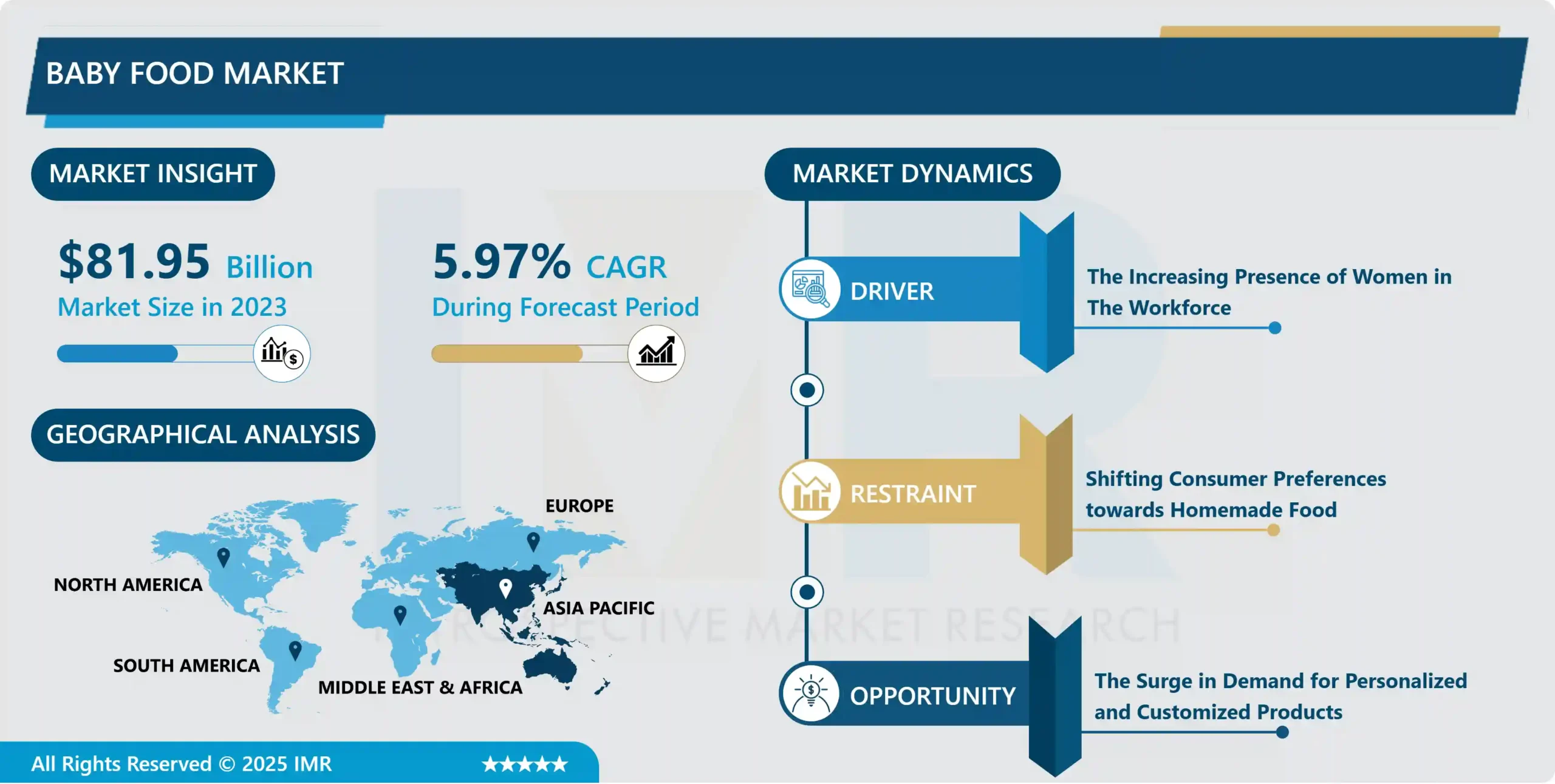
Baby Food Market size is expected to grow from USD 81.95 Billion in 2023 to USD 138.1 Billion by 2032, at a CAGR of 5.97% during the forecast period 2024-2032.
Baby food refers to specially created nourishment tailored to meet the dietary requirements of infants and young children. It’s primarily intended for little ones aged between 4 months and 36 months, and it comes in various forms such as purees, cereals, snacks, and formulas. These products are specifically designed to supply vital nutrients essential for healthy growth and development during early childhood.
The uses of baby food are diverse. Initially, it acts as a supplement to breast milk or formula as babies’ transition to solid foods, usually starting around 4 to 6 months. Introducing different tastes and textures through baby food helps in developing chewing and swallowing abilities. Moreover, these foods are carefully crafted with suitable textures and a balanced nutritional profile to support the rapid growth and milestones of infants.
The benefits of baby food include its convenience, nutritional richness, and safety. These products are meticulously prepared to provide the necessary vitamins, minerals, and nutrients crucial for a baby’s growth. Additionally, they are often packaged in user-friendly formats, making feeding easier for parents. Rigorous quality checks ensure that baby food is safe and suitable for sensitive digestive systems. Overall, baby food plays a crucial role in delivering essential nutrients required for healthy development during a child’s early years.
Baby Food Market Trend Analysis
The Increasing Presence of Women in The Workforce
The increasing presence of women in the workforce is significantly influencing the growth of the baby food market. As more women globally pursue professional careers, it’s reshaping family dynamics and approaches to child-rearing. Balancing work and childcare, working mothers often grapple with time limitations, leading them to seek convenient solutions, particularly when it comes to feeding their infants and toddlers.
This shift in demographics has resulted in a higher reliance on easily prepared and ready-to-use baby food products. The demands of busy work schedules leave little time for meal preparation, making packaged baby food a practical option for many working mothers. These products offer convenience by eliminating the need for extensive planning and cooking, catering well to the fast-paced lifestyles of working professionals.
Furthermore, the financial independence of working women gives them greater purchasing power, enabling them to afford premium and specialized baby food choices. Consequently, the market experiences a surge in demand for a wider variety of high-quality baby food products that cater to different nutritional requirements and preferences. This trend isn’t just about convenience; it’s also about ensuring that infants and toddlers receive adequate and nutritious meals despite their parents’ hectic schedules. This drive both the expansion and diversification of the baby food market.
The Surge in Demand for Personalized and Customized Products
Parents today are increasingly particular about their child’s nutrition, seeking tailored solutions that fit specific dietary needs, preferences, and developmental stages. This shift toward personalized options goes beyond standard baby food products, encompassing choices that precisely match individual requirements, like organic, allergen-free, or culturally relevant offerings.
Companies have an opportunity to capitalize on this trend by providing customizable baby food solutions. This allows parents to handpick ingredients, flavors, and nutritional compositions that best suit their child’s needs. This not only addresses concerns related to allergies or intolerances but also empowers parents to actively shape their children’s diet, giving them a sense of control and satisfaction.
Technology stands as a crucial tool in personalizing baby food. Advancements in data analytics and AI enable companies to analyze consumer preferences, nutritional needs, and buying habits to offer personalized recommendations. This could involve subscription-based services or apps suggesting customized meal plans based on a child’s age, dietary restrictions, and developmental milestones.
Embracing personalization and customization allows baby food manufacturers to build stronger connections with consumers, foster brand loyalty, and cater to the diverse and evolving needs of modern parents. These parents seek tailored, individualized solutions for their children’s nutrition and overall well-being.
Baby Food Market Segment Analysis
Baby Food Market is Segmented on the basis of product type, nature, age group, and distribution channel.
By Product Type, Infant Formula segment is expected to dominate the market during the forecast period
First and foremost, infant formula plays a vital role in providing essential nutrition for babies who are not breastfed or need additional supplementation while breastfeeding. Its widespread necessity creates a consistent and enduring global demand.
Continual advancements in infant formula formulations, including tailored variations designed for specific dietary requirements like lactose intolerance or allergies, have propelled its prominence in the market. These innovations address diverse nutritional needs, ensuring optimal growth and development for infants. Moreover, the convenience it offers remains a significant factor for busy parents and caregivers, further cementing its sustained dominance in the market.
The persistent dedication to creating high-quality, nutrient-packed formulas and the growing preference for specialized and premium options are anticipated to strengthen the dominance of infant formula within the baby food market for the foreseeable future.
By Nature, the Organic segment held the largest market share of 55.6% in 2022
Organic baby food is poised to be the predominant segment in the baby food market due to the increasing demand for natural and wholesome nutrition for infants. Parents are increasingly drawn to organic options, as they prioritize the well-being of their children and seek products free from synthetic pesticides, hormones, and genetically modified ingredients. The rising awareness of the potential health benefits associated with organic foods, such as reduced exposure to harmful chemicals and enhanced nutritional content, further fuels this trend.
Additionally, the growing emphasis on sustainable and environmentally friendly practices resonates with consumers, contributing to the popularity of organic baby food. As more parents seek transparency in food sources and production methods, the organic segment is expected to continue its ascent, reflecting a broader societal shift towards healthier and eco-conscious choices for the youngest consumers.
Global Baby Food Market Regional Insights
Asia-Pacific is Expected to Dominate the Market Over the Forecast period
The Asia-Pacific region experiences significant market growth due to rapid urbanization, expanding populations, and increased incomes in countries like China, India, Japan, and Southeast Asian nations. These factors drive shifts in lifestyles, eating habits, and a preference for convenient baby food products.
Furthermore, changing consumer tastes and a growing understanding of the significance of proper infant nutrition contribute to a rising demand for baby food in this region. Concerns regarding child health and development among parents lead to a higher adoption of commercially produced baby foods, such as infant formula, baby cereals, snacks, and prepared meals.
Moreover, government efforts aimed at enhancing child health and nutrition, coupled with the expansion of distribution channels and major market players investing in innovative products and marketing strategies, reinforce the Asia-Pacific region’s leadership in the global baby food market throughout the projected period.
Global Baby Food Market Top Key Players:
Abbott (U.S.)
The Kraft Heinz Company (U.S.)
Cargill Inc. (U.S.)
Mead Johnson & Company, LLC. (U.S.)
Sun-Maid Growers of California (U.S.)
Hipp Gmbh & Co. Vertrieb Kg (Germany)
Pz Cussons (U.K.)
Reckitt Benckiser Group Plc (U.K)
Bledina Sa (France)
Danone Sa (France)
Nestle S.A. (Switzerland)
Hero Group (Switzerland)
Alter S.L. (Italy)
Frieslandcampina (Netherlands)
Perrigo Company Plc (Ireland)
Semper AB (Sweden)
Feihe International Inc. (China)
Asahi Group Holdings, Ltd. (Japan)
Kewpie Corporation (Japan)
Morinaga Milk Industry Co. Ltd. (Japan)
Bellamy’s Organic (Australia)
Key Industry Development: –
In November 2023, Nestlé announced that it has developed N3 milk with new nutritional values, the first to be launched in China. Made from cow’s milk, it contains all the essential nutrients found in milk, such as proteins, vitamins, and minerals. In addition, it contains prebiotic fiber, is low in lactose, and has more than 15% fewer calories.
In June 2023, Nature’s Path Organic Foods, a privately held family business, acquired certified organic food manufacturer Love Child Organics, a Canadian organic baby food and children’s snack brand. The deal would allow Nature’s Path Organic Foods to expand Love Child Organics baby foods into the US market.
Chapter 1: Introduction
1.1 Scope and Coverage
Chapter 2:Executive Summary
Chapter 3: Market Landscape
3.1 Market Dynamics
3.1.1 Drivers
3.1.2 Restraints
3.1.3 Opportunities
3.1.4 Challenges
3.2 Market Trend Analysis
3.3 PESTLE Analysis
3.4 Porter’s Five Forces Analysis
3.5 Industry Value Chain Analysis
3.6 Ecosystem
3.7 Regulatory Landscape
3.8 Price Trend Analysis
3.9 Patent Analysis
3.10 Technology Evolution
3.11 Investment Pockets
3.12 Import-Export Analysis
Chapter 4: Baby Food Market by Product Type (2018-2032)
4.1 Baby Food Market Snapshot and Growth Engine
4.2 Market Overview
4.3 Infant Formula
4.3.1 Introduction and Market Overview
4.3.2 Historic and Forecasted Market Size in Value USD and Volume Units
4.3.3 Key Market Trends, Growth Factors, and Opportunities
4.3.4 Geographic Segmentation Analysis
4.4 Ba
Chapter 5: Baby Food Market by Cereals (2018-2032)
5.1 Baby Food Market Snapshot and Growth Engine
5.2 Market Overview
5.3 Ba
5.3.1 Introduction and Market Overview
5.3.2 Historic and Forecasted Market Size in Value USD and Volume Units
5.3.3 Key Market Trends, Growth Factors, and Opportunities
5.3.4 Geographic Segmentation Analysis
Chapter 6: Baby Food Market by Snacks (2018-2032)
6.1 Baby Food Market Snapshot and Growth Engine
6.2 Market Overview
6.3 Prepared Ba
6.3.1 Introduction and Market Overview
6.3.2 Historic and Forecasted Market Size in Value USD and Volume Units
6.3.3 Key Market Trends, Growth Factors, and Opportunities
6.3.4 Geographic Segmentation Analysis
Chapter 7: Baby Food Market by Food (2018-2032)
7.1 Baby Food Market Snapshot and Growth Engine
7.2 Market Overview
7.3
7.3.1 Introduction and Market Overview
7.3.2 Historic and Forecasted Market Size in Value USD and Volume Units
7.3.3 Key Market Trends, Growth Factors, and Opportunities
7.3.4 Geographic Segmentation Analysis
Chapter 8: Baby Food Market by Nature (2018-2032)
8.1 Baby Food Market Snapshot and Growth Engine
8.2 Market Overview
8.3 Organic
8.3.1 Introduction and Market Overview
8.3.2 Historic and Forecasted Market Size in Value USD and Volume Units
8.3.3 Key Market Trends, Growth Factors, and Opportunities
8.3.4 Geographic Segmentation Analysis
8.4 Inorganic
Chapter 9: Baby Food Market by Age-Group (2018-2032)
9.1 Baby Food Market Snapshot and Growth Engine
9.2 Market Overview
9.3 Infant
9.3.1 Introduction and Market Overview
9.3.2 Historic and Forecasted Market Size in Value USD and Volume Units
9.3.3 Key Market Trends, Growth Factors, and Opportunities
9.3.4 Geographic Segmentation Analysis
9.4 Toddler
9.5 Pre-school
Chapter 10: Company Profiles and Competitive Analysis
10.1 Competitive Landscape
10.1.1 Competitive Benchmarking
10.1.2 Baby Food Market Share by Manufacturer (2024)
10.1.3 Industry BCG Matrix
10.1.4 Heat Map Analysis
10.1.5 Mergers and Acquisitions
10.2 CASIO COMPUTER CO. LTDVASCO ELECTRONICS
10.2.1 Company Overview
10.2.2 Key Executives
10.2.3 Company Snapshot
10.2.4 Role of the Company in the Market
10.2.5 Sustainability and Social Responsibility
10.2.6 Operating Business Segments
10.2.7 Product Portfolio
10.2.8 Business Performance
10.2.9 Key Strategic Moves and Recent Developments
10.2.10 SWOT Analysis
10.3 SHARP CORPORATION
10.4 IFLYTEK CORPORATION
10.5 HANVON TECHNOLOGY CO. LTDCANON ELECTRONIC BUSINESS MACHINES (H.K.) CO. LTDECTACO INCELLTON ENTERPRISE PTE LTD
10.6 APKPURE
10.7 MERRIAM-WEBSTER INCORPORATED
10.8 AND OTHER KEY PLAYERS
Chapter 11: Global Baby Food Market By Region
11.1 Overview
11.2. North America Baby Food Market
11.2.1 Key Market Trends, Growth Factors and Opportunities
11.2.2 Top Key Companies
11.2.3 Historic and Forecasted Market Size by Segments
11.2.4 Historic and Forecasted Market Size by Product Type
11.2.4.1 Infant Formula
11.2.4.2 Ba
11.2.5 Historic and Forecasted Market Size by Cereals
11.2.5.1 Ba
11.2.6 Historic and Forecasted Market Size by Snacks
11.2.6.1 Prepared Ba
11.2.7 Historic and Forecasted Market Size by Food
11.2.7.1
11.2.8 Historic and Forecasted Market Size by Nature
11.2.8.1 Organic
11.2.8.2 Inorganic
11.2.9 Historic and Forecasted Market Size by Age-Group
11.2.9.1 Infant
11.2.9.2 Toddler
11.2.9.3 Pre-school
11.2.10 Historic and Forecast Market Size by Country
11.2.10.1 US
11.2.10.2 Canada
11.2.10.3 Mexico
11.3. Eastern Europe Baby Food Market
11.3.1 Key Market Trends, Growth Factors and Opportunities
11.3.2 Top Key Companies
11.3.3 Historic and Forecasted Market Size by Segments
11.3.4 Historic and Forecasted Market Size by Product Type
11.3.4.1 Infant Formula
11.3.4.2 Ba
11.3.5 Historic and Forecasted Market Size by Cereals
11.3.5.1 Ba
11.3.6 Historic and Forecasted Market Size by Snacks
11.3.6.1 Prepared Ba
11.3.7 Historic and Forecasted Market Size by Food
11.3.7.1
11.3.8 Historic and Forecasted Market Size by Nature
11.3.8.1 Organic
11.3.8.2 Inorganic
11.3.9 Historic and Forecasted Market Size by Age-Group
11.3.9.1 Infant
11.3.9.2 Toddler
11.3.9.3 Pre-school
11.3.10 Historic and Forecast Market Size by Country
11.3.10.1 Russia
11.3.10.2 Bulgaria
11.3.10.3 The Czech Republic
11.3.10.4 Hungary
11.3.10.5 Poland
11.3.10.6 Romania
11.3.10.7 Rest of Eastern Europe
11.4. Western Europe Baby Food Market
11.4.1 Key Market Trends, Growth Factors and Opportunities
11.4.2 Top Key Companies
11.4.3 Historic and Forecasted Market Size by Segments
11.4.4 Historic and Forecasted Market Size by Product Type
11.4.4.1 Infant Formula
11.4.4.2 Ba
11.4.5 Historic and Forecasted Market Size by Cereals
11.4.5.1 Ba
11.4.6 Historic and Forecasted Market Size by Snacks
11.4.6.1 Prepared Ba
11.4.7 Historic and Forecasted Market Size by Food
11.4.7.1
11.4.8 Historic and Forecasted Market Size by Nature
11.4.8.1 Organic
11.4.8.2 Inorganic
11.4.9 Historic and Forecasted Market Size by Age-Group
11.4.9.1 Infant
11.4.9.2 Toddler
11.4.9.3 Pre-school
11.4.10 Historic and Forecast Market Size by Country
11.4.10.1 Germany
11.4.10.2 UK
11.4.10.3 France
11.4.10.4 The Netherlands
11.4.10.5 Italy
11.4.10.6 Spain
11.4.10.7 Rest of Western Europe
11.5. Asia Pacific Baby Food Market
11.5.1 Key Market Trends, Growth Factors and Opportunities
11.5.2 Top Key Companies
11.5.3 Historic and Forecasted Market Size by Segments
11.5.4 Historic and Forecasted Market Size by Product Type
11.5.4.1 Infant Formula
11.5.4.2 Ba
11.5.5 Historic and Forecasted Market Size by Cereals
11.5.5.1 Ba
11.5.6 Historic and Forecasted Market Size by Snacks
11.5.6.1 Prepared Ba
11.5.7 Historic and Forecasted Market Size by Food
11.5.7.1
11.5.8 Historic and Forecasted Market Size by Nature
11.5.8.1 Organic
11.5.8.2 Inorganic
11.5.9 Historic and Forecasted Market Size by Age-Group
11.5.9.1 Infant
11.5.9.2 Toddler
11.5.9.3 Pre-school
11.5.10 Historic and Forecast Market Size by Country
11.5.10.1 China
11.5.10.2 India
11.5.10.3 Japan
11.5.10.4 South Korea
11.5.10.5 Malaysia
11.5.10.6 Thailand
11.5.10.7 Vietnam
11.5.10.8 The Philippines
11.5.10.9 Australia
11.5.10.10 New Zealand
11.5.10.11 Rest of APAC
11.6. Middle East & Africa Baby Food Market
11.6.1 Key Market Trends, Growth Factors and Opportunities
11.6.2 Top Key Companies
11.6.3 Historic and Forecasted Market Size by Segments
11.6.4 Historic and Forecasted Market Size by Product Type
11.6.4.1 Infant Formula
11.6.4.2 Ba
11.6.5 Historic and Forecasted Market Size by Cereals
11.6.5.1 Ba
11.6.6 Historic and Forecasted Market Size by Snacks
11.6.6.1 Prepared Ba
11.6.7 Historic and Forecasted Market Size by Food
11.6.7.1
11.6.8 Historic and Forecasted Market Size by Nature
11.6.8.1 Organic
11.6.8.2 Inorganic
11.6.9 Historic and Forecasted Market Size by Age-Group
11.6.9.1 Infant
11.6.9.2 Toddler
11.6.9.3 Pre-school
11.6.10 Historic and Forecast Market Size by Country
11.6.10.1 Turkiye
11.6.10.2 Bahrain
11.6.10.3 Kuwait
11.6.10.4 Saudi Arabia
11.6.10.5 Qatar
11.6.10.6 UAE
11.6.10.7 Israel
11.6.10.8 South Africa
11.7. South America Baby Food Market
11.7.1 Key Market Trends, Growth Factors and Opportunities
11.7.2 Top Key Companies
11.7.3 Historic and Forecasted Market Size by Segments
11.7.4 Historic and Forecasted Market Size by Product Type
11.7.4.1 Infant Formula
11.7.4.2 Ba
11.7.5 Historic and Forecasted Market Size by Cereals
11.7.5.1 Ba
11.7.6 Historic and Forecasted Market Size by Snacks
11.7.6.1 Prepared Ba
11.7.7 Historic and Forecasted Market Size by Food
11.7.7.1
11.7.8 Historic and Forecasted Market Size by Nature
11.7.8.1 Organic
11.7.8.2 Inorganic
11.7.9 Historic and Forecasted Market Size by Age-Group
11.7.9.1 Infant
11.7.9.2 Toddler
11.7.9.3 Pre-school
11.7.10 Historic and Forecast Market Size by Country
11.7.10.1 Brazil
11.7.10.2 Argentina
11.7.10.3 Rest of SA
Chapter 12 Analyst Viewpoint and Conclusion
12.1 Recommendations and Concluding Analysis
12.2 Potential Market Strategies
Chapter 13 Research Methodology
13.1 Research Process
13.2 Primary Research
13.3 Secondary Research
Q1: What would be the forecast period in the Baby Food Market research report?
A1: The forecast period in the Global Baby Food Market research report is 2024-2032.
Q2: Who are the key players in the Baby Food Market?
A2: Abbott (U.S.), The Kraft Heinz Company (U.S.), Cargill Inc. (U.S.), Mead Johnson & Company, LLC. (U.S.), Sun-Maid Growers of California (U.S.), Hipp Gmbh & Co. Vertrieb Kg (Germany), Pz Cussons (U.K.), Reckitt Benckiser Group Plc (U.K), Bledina Sa (France), Danone Sa (France), Nestle S.A. (Switzerland), Hero Group (Switzerland), Alter S.L. (Italy), Frieslandcampina (Netherlands), Perrigo Company Plc (Ireland), Semper Ab (Sweden), Feihe International Inc. (China), Asahi Group Holdings, Ltd. (Japan), Kewpie Corporation (Japan), Morinaga Milk Industry Co. Ltd. (Japan), Bellamy’s Organic (Australia)and Other Major Players.
Q3: What are the segments of the Baby Food Market?
A3: Baby Food Market is segmented into Product Type, Nature, Age Group, Distribution Channel and Region. By Product Type, the market is categorized into Infant Formula, Baby Cereals, Baby Snacks, and Prepared Baby Food. By Nature, the market is categorized into Organic and Inorganic. By Age Group, the market is categorized into Infant, Toddler, and Pre-school. By Distribution Channel, the market is categorized into Supermarkets/Hypermarkets, Grocery Stores and pharmacy Stores, and Online Stores. By region, it is analyzed across North America (U.S.; Canada; Mexico), Eastern Europe (Bulgaria; The Czech Republic; Hungary; Poland; Romania; Rest of Eastern Europe), Western Europe (Germany; UK; France; Netherlands; Italy; Russia; Spain; Rest of Western Europe), Asia-Pacific (China; India; Japan; Southeast Asia, etc.), South America (Brazil; Argentina, etc.), Middle East & Africa (Saudi Arabia; South Africa, etc.).
Q4: What is the Baby Food Market?
A4: Baby food refers to specially created nourishment tailored to meet the dietary requirements of infants and young children. It's primarily intended for little ones aged between 4 months and 36 months, and it comes in various forms such as purees, cereals, snacks, and formulas. These products are specifically designed to supply vital nutrients essential for healthy growth and development during early childhood.
Q5: How big is the Baby Food Market?
A5: Global Baby Food Market size is expected to grow from USD 81.95 Billion in 2023 to USD 138.1 Billion by 2032, at a CAGR of 5.97% during the forecast period 2024-2032.
How to Buy a Report from eminsights.jp
On the product page, choose the license you want: Single-User License, Multi-User License or Enterprise License.
If you required report in your native language, then you can click on Translated Report button and fill out the form with report name and language you want, then our team will contact you as soon as possible.
Click the Buy Now button.
You will be redirected to the checkout page. Enter your company details and payment information.
Click Place Order to complete the purchase.
Confirmation: You’ll receive an order confirmation and our team will contact you shortly with your ordered report.
If you have any questions, fill out the contact form below or email us at bizdev@eminsights.net.
Thank you for choosing eminsights.jp!