Stay Ahead in Fast-Growing Economies.
Browse Reports Now




Automotive Window Regulator Market | Global Analysis and Forecast ( 2024-2032 )
An automotive window regulator is a mechanism installed within car doors to facilitate the raising and lowering of windows. It typically consists of a motor, cables, and gears that enable controlled movement of the window glass. When activated by the driver or passenger, the regulator translates electrical signals into mechanical motion, allowing for precise adjustment of window position. This component enhances comfort, convenience, and safety by regulating airflow and visibility within the vehicle.

IMR Group
Description
Global Automotive Window Regulator Market Overview
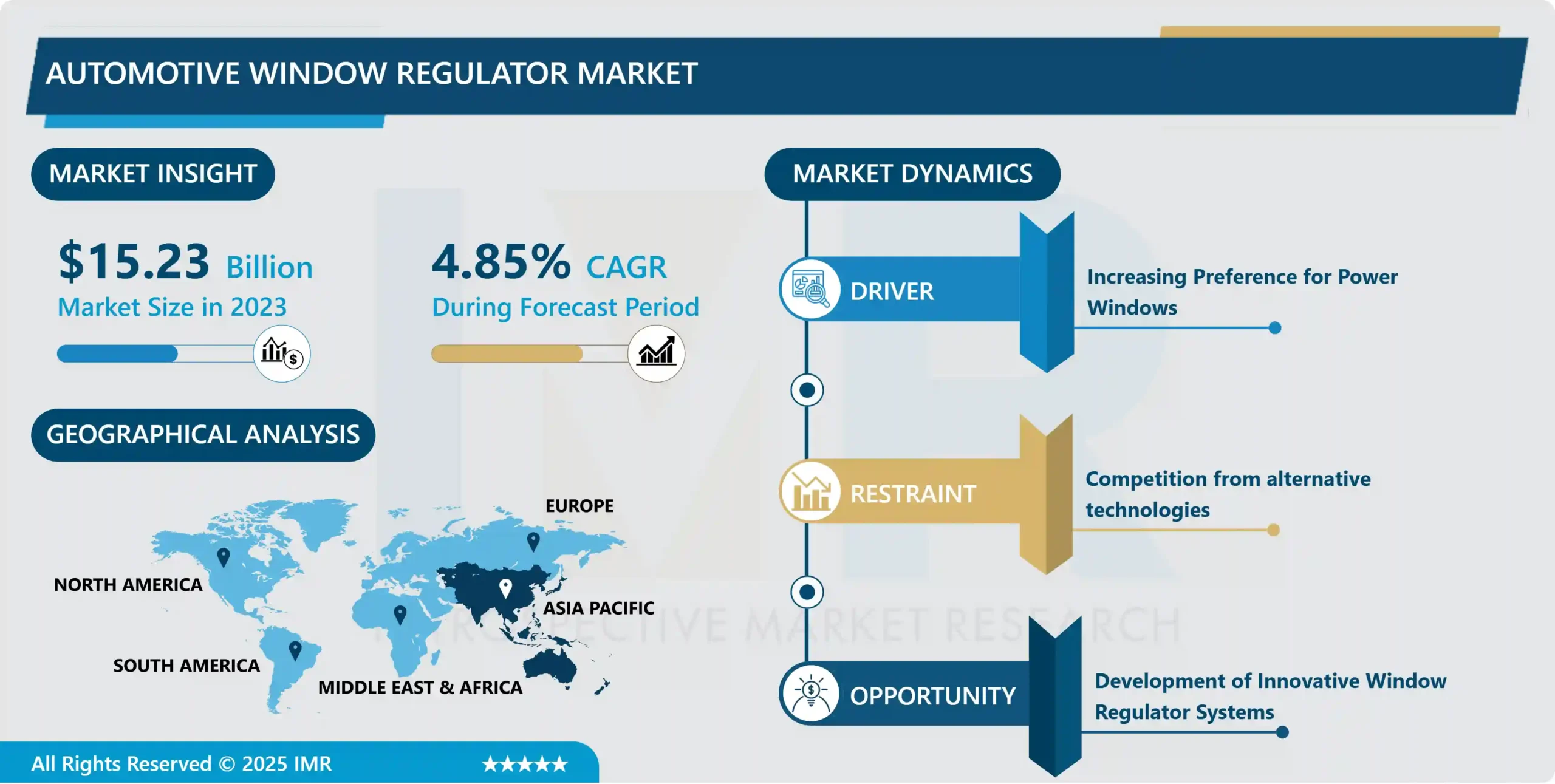
Automotive Window Regulator Market Size Was Valued at USD 15.23 Billion in 2023, and is Projected to Reach USD 23.32 Billion by 2032, Growing at a CAGR of 4.85% From 2024-2032.
An automotive window regulator is a mechanism installed within car doors to facilitate the raising and lowering of windows. It typically consists of a motor, cables, and gears that enable controlled movement of the window glass. When activated by the driver or passenger, the regulator translates electrical signals into mechanical motion, allowing for precise adjustment of window position. This component enhances comfort, convenience, and safety by regulating airflow and visibility within the vehicle.
The Automotive Window Regulator Market refers to the industry segment focused on the production, distribution, and sale of window regulators for vehicles. A window regulator is a mechanical component that enables the raising and lowering of windows in automobiles, including cars, trucks, and buses. It is an essential part of a vehicle’s power window system, allowing occupants to control the opening and closing of windows conveniently.
The market for automotive window regulators is increasing by various factors, including the growing automotive industry worldwide, technological advancements in window regulator designs, and increasing demand for comfort and convenience features in vehicles. As consumers pursue more sophisticated and user-friendly features in their vehicles, there’s a corresponding demand for advanced window regulator systems that offer smoother operation, improved durability, and enhanced safety features.
Market players in the automotive window regulator segment include manufacturers, suppliers, distributors, and aftermarket retailers. These entities collaborate to design, produce, and distribute window regulators to automotive OEMs (Original Equipment Manufacturers) and aftermarket channels. Additionally, market dynamics such as regulatory standards, consumer preferences, and industry competition influence product development and market strategies.
The automotive window regulator market is also influenced by factors such as vehicle production trends, economic conditions, and technological innovations in the automotive sector. The growing adoption of electric vehicles (EVs) and autonomous vehicles (AVs) may lead to the development of specialized window regulator systems tailored to the unique requirements of these vehicle types. The automotive window regulator market is a dynamic sector driven by innovation, consumer demand, and technological advancements, playing a crucial role in enhancing the functionality and comfort of modern vehicles.
Automotive Window Regulator Market Trend Analysis:
Increasing Preference for Power Windows
The increasing preference for power windows in vehicles has become a key catalyst driving the expansion of the global automotive window regulator market. Several compelling factors propel this shift. Firstly, the unparalleled convenience of power windows, allowing effortless control with the push of a button or switch, has significantly elevated their appeal. Particularly noteworthy is their capability to adjust multiple windows simultaneously, enhancing ease of use for drivers and passengers alike.
Moreover, the integration of advanced safety features, such as auto-reverse mechanisms, in power window regulators has substantially bolstered their attractiveness. These safety features detect obstructions in the window’s path, automatically reversing its movement to prevent potential injuries or damage, thereby enhancing overall vehicle occupant safety. Additionally, technological advancements have markedly improved power window systems, rendering them more reliable, quieter, and smoother in operation. This evolution has aligned power windows with consumers’ preferences for a sophisticated and luxurious driving experience, especially in upscale vehicle models.
The widespread standardization of power window systems across various vehicle segments, combined with evolving consumer preferences seeking modern conveniences and amenities, has further fueled the surge in demand. As automakers prioritize power windows in their designs and integrate them into vehicles’ electrical systems, offering customization options and seamless integration with other features, the momentum behind the preference for power windows is anticipated to continue driving the growth and adoption of automotive window regulator systems on a global scale.
Development of Innovative Window Regulator Systems
The integration of smart technologies into window regulator systems represents a crucial avenue for advancement. This integration fosters connectivity with vehicle networks, enabling features like remote operation via smartphone apps and seamless integration with vehicle control systems. Such intelligent and connected functionalities not only heighten user convenience but also afford users greater control, aligning with the burgeoning trend of connected vehicle technologies. Moreover, emerging developments in gesture and voice control mechanisms for window operation hold the potential to revolutionize user interaction, introducing hands-free convenience and reshaping how users engage with vehicle windows.
Additionally, opportunities arise from advancements targeting enhanced energy efficiency within window regulator systems. Efforts to optimize power management systems, reducing energy consumption while sustaining peak performance, resonate with the automotive industry’s growing emphasis on sustainability and eco-friendly solutions. Moreover, the ongoing evolution of safety features, extending beyond auto-reverse mechanisms to encompass advanced sensors and obstacle detection technologies, offers promise in significantly bolstering safety, and mitigating potential accidents or injuries associated with window operations.
Further innovations focusing on noise reduction, bolstered durability via smoother mechanisms and robust materials, alongside the prospect of tailored window regulator systems for electric and autonomous vehicles, collectively contribute to the market’s growth potential. Manufacturers’ capacity to customize vehicles through unique window regulator features not only aids in strengthening brand identity but also aligns with evolving consumer preferences. Lastly, leveraging these innovations in the aftermarket sector to meet the demands of vehicle owners seeking upgraded or specialized window regulator functionalities augments market prospects, catering comprehensively to diverse consumer needs.
Automotive Window Regulator Market Segment Analysis:
The Automotive Windows Regulator Market is segmented on the basis of Type, Technology, Propulsion, Sales Channel, and Vehicle Type.
By Type, the Automatic segment dominates the global automotive window regulator market during the forecast period
The automatic sector holds significant sway in the global automotive window regulator market, primarily due to growing consumer demands for convenience, safety, and technological advancements in vehicles. They are powered by electric motors, and automatic window regulators offer unparalleled ease, allowing effortless control of multiple windows with a simple button or switch. Integration of advanced safety measures, like auto-reverse functions, enhances security by promptly detecting obstructions and averting potential injuries or damage.
Furthermore, continuous advancements in smart technologies and connectivity reinforce the automatic segment’s dominance. Integration with vehicle networks facilitates remote operation via smartphones and seamless connectivity with vehicle control systems, aligning with the evolving preferences for sophisticated, interconnected vehicles. Consequently, the automatic segment emerges as the favored and dominant category in the global automotive window regulator market.
Automotive Window Regulator Market Regional Insights:
Asia Pacific is Expected to Dominate the Market Over the Forecast Period
The Asia Pacific region stands as a significant force in the global automotive window regulator market due to various influential factors. A key driver is the region’s thriving automotive sector found in countries like China, Japan, India, and South Korea, where escalating vehicle production and sales fuel the demand for advanced window regulator systems. This surge is notably fueled by the increasing adoption of luxury and premium vehicles, which commonly incorporate classy power window systems, heightening comfort and convenience for consumers.
Furthermore, the Asia Pacific area showcases rapid technological advancements and substantial investments in research and development. This focus on innovation has spurred the introduction of smart and interconnected window regulator systems, aligning seamlessly with the preferences of tech-savvy consumers prevalent in this region.
China emerges prominently in this market due to its significant automotive manufacturing base and escalating demand for high-quality vehicles loaded with advanced features. Japanese automakers are recognized for their prowess in automotive technologies, showcasing innovations in window regulator systems that integrate safety and convenience features.
Moreover, the increasing automotive aftermarket in Asia Pacific countries offers opportunities for the window regulator market, driven by the increasing need for upgrades and replacements. In summary, the region’s robust automotive industry, technological advancements, and consumer preferences significantly underpin its dominance in the global automotive window regulator market.
Key Player Covered in Automotive Windows Regulator Market:
Crown Automotive (US)
Standard Motor Products, Inc. (US)
Inteva Products (US)
Dorman Products, Inc. (US)
Acdelco (US)
Brose Fahrzeugteile Se & Co. Kg (Germany)
Küster Holding Gmbh (Germany)
Valeo (France)
Grupo Antolin (Spain)
Sontian Automotive Co., Ltd. (China)
Wonh Industries Co, Ltd. (China)
Shiroki Corporation (Japan)
Hi-Lex Corporation (Japan)
Johnan Manufacturing Inc. (Japan)
Aisin Corporation (Japan)
Ci Car International Pvt Ltd. (India)
Tyc Brother Industrial Co., Ltd. (Taiwan)
I Yuan Precision Industrial Co., Ltd. (Taiwan), And Other Major Players
Key Industry Developments in the Automotive Window Regulator Market:
In February 2024, Crown Worldwide Group, the parent company of Crown Relocations and Crown World Mobility, announced a tech collaboration with Move4U. This partnership aims to streamline international relocation services through Move4U’s innovative SurveyPro and SurveyVideo tools. Joggie Taute highlighted that these solutions revolutionize the process, offering transparency from initial customer contact, and enhancing Crown’s ability to grasp shipping requirements swiftly.
In April 2024, Sandvik announced its acquisition of a majority stake in Suzhou Ahno Precision Cutting Tool Technology Co., Ltd. from Ningbo Baosi Energy Equipment Co., Ltd. Ahno, a leading Chinese company in precision cutting tools, will join Sandvik Machining Solutions, strengthening its position in China’s market. This move aligns with Sandvik’s strategy, leveraging Ahno’s focus on growing sectors like electric vehicles. The acquisition forms a new China-based division, ensuring continued growth and customer service excellence.
Chapter 1: Introduction
1.1 Scope and Coverage
Chapter 2:Executive Summary
Chapter 3: Market Landscape
3.1 Market Dynamics
3.1.1 Drivers
3.1.2 Restraints
3.1.3 Opportunities
3.1.4 Challenges
3.2 Market Trend Analysis
3.3 PESTLE Analysis
3.4 Porter’s Five Forces Analysis
3.5 Industry Value Chain Analysis
3.6 Ecosystem
3.7 Regulatory Landscape
3.8 Price Trend Analysis
3.9 Patent Analysis
3.10 Technology Evolution
3.11 Investment Pockets
3.12 Import-Export Analysis
Chapter 4: Automotive Window Regulator Market by Type (2018-2032)
4.1 Automotive Window Regulator Market Snapshot and Growth Engine
4.2 Market Overview
4.3 Automatic
4.3.1 Introduction and Market Overview
4.3.2 Historic and Forecasted Market Size in Value USD and Volume Units
4.3.3 Key Market Trends, Growth Factors, and Opportunities
4.3.4 Geographic Segmentation Analysis
4.4 Semi-automatic
4.5 Manual
Chapter 5: Automotive Window Regulator Market by Technology (2018-2032)
5.1 Automotive Window Regulator Market Snapshot and Growth Engine
5.2 Market Overview
5.3 Single-arm
5.3.1 Introduction and Market Overview
5.3.2 Historic and Forecasted Market Size in Value USD and Volume Units
5.3.3 Key Market Trends, Growth Factors, and Opportunities
5.3.4 Geographic Segmentation Analysis
5.4 X-arm
Chapter 6: Automotive Window Regulator Market by Propulsion (2018-2032)
6.1 Automotive Window Regulator Market Snapshot and Growth Engine
6.2 Market Overview
6.3 ICE vehicle
6.3.1 Introduction and Market Overview
6.3.2 Historic and Forecasted Market Size in Value USD and Volume Units
6.3.3 Key Market Trends, Growth Factors, and Opportunities
6.3.4 Geographic Segmentation Analysis
6.4 Electric vehicle
Chapter 7: Automotive Window Regulator Market by Sales Channel (2018-2032)
7.1 Automotive Window Regulator Market Snapshot and Growth Engine
7.2 Market Overview
7.3 OEM
7.3.1 Introduction and Market Overview
7.3.2 Historic and Forecasted Market Size in Value USD and Volume Units
7.3.3 Key Market Trends, Growth Factors, and Opportunities
7.3.4 Geographic Segmentation Analysis
7.4 Aftermarket
Chapter 8: Automotive Window Regulator Market by Vehicle Type (2018-2032)
8.1 Automotive Window Regulator Market Snapshot and Growth Engine
8.2 Market Overview
8.3 Passenger car
8.3.1 Introduction and Market Overview
8.3.2 Historic and Forecasted Market Size in Value USD and Volume Units
8.3.3 Key Market Trends, Growth Factors, and Opportunities
8.3.4 Geographic Segmentation Analysis
8.4 Commercial vehicle
Chapter 9: Company Profiles and Competitive Analysis
9.1 Competitive Landscape
9.1.1 Competitive Benchmarking
9.1.2 Automotive Window Regulator Market Share by Manufacturer (2024)
9.1.3 Industry BCG Matrix
9.1.4 Heat Map Analysis
9.1.5 Mergers and Acquisitions
9.2 REFRACTORY SPECIALTIES (USA)
9.2.1 Company Overview
9.2.2 Key Executives
9.2.3 Company Snapshot
9.2.4 Role of the Company in the Market
9.2.5 Sustainability and Social Responsibility
9.2.6 Operating Business Segments
9.2.7 Product Portfolio
9.2.8 Business Performance
9.2.9 Key Strategic Moves and Recent Developments
9.2.10 SWOT Analysis
9.3 MORGAN ADVANCED MATERIALS (USA)
9.4 HARBISONWALKER INTERNATIONAL (USA)
9.5 PYROTEK (USA)
9.6 OWENS CORNING (USA)
9.7 UNIFRAX (USA)
9.8 HARWICK GROUP (USA)
9.9 THERMAL CERAMICS (USA)
9.10 GUARDIAN INDUSTRIES (USA)
9.11 JCP MINERALS (USA)
9.12 3M(USA)
9.13 BASF SE (GERMANY)
9.14 KNAUF INSULATION (GERMANY)
9.15 SCHUNDLER GROUP (GERMANY)
9.16 TECHNOBASALT INVEST (UKRAINE)
9.17 IMERYS (FRANCE)
9.18 FAVIER GROUP (FRANCE)
9.19 SAINT-GOBAIN (FRANCE)
9.20 ROCKWOOL (DENMARK)
9.21 AEROSPACE TUOXIN (CHINA)
9.22 JIANGSU TIANLONG (CHINA)
9.23 TORAY INDUSTRIES (JAPAN)
9.24 BASALT FIBER INDIA (INDIA)
9.25 LOTTE CHEMICAL (SOUTH KOREA)
9.26
Chapter 10: Global Automotive Window Regulator Market By Region
10.1 Overview
10.2. North America Automotive Window Regulator Market
10.2.1 Key Market Trends, Growth Factors and Opportunities
10.2.2 Top Key Companies
10.2.3 Historic and Forecasted Market Size by Segments
10.2.4 Historic and Forecasted Market Size by Type
10.2.4.1 Automatic
10.2.4.2 Semi-automatic
10.2.4.3 Manual
10.2.5 Historic and Forecasted Market Size by Technology
10.2.5.1 Single-arm
10.2.5.2 X-arm
10.2.6 Historic and Forecasted Market Size by Propulsion
10.2.6.1 ICE vehicle
10.2.6.2 Electric vehicle
10.2.7 Historic and Forecasted Market Size by Sales Channel
10.2.7.1 OEM
10.2.7.2 Aftermarket
10.2.8 Historic and Forecasted Market Size by Vehicle Type
10.2.8.1 Passenger car
10.2.8.2 Commercial vehicle
10.2.9 Historic and Forecast Market Size by Country
10.2.9.1 US
10.2.9.2 Canada
10.2.9.3 Mexico
10.3. Eastern Europe Automotive Window Regulator Market
10.3.1 Key Market Trends, Growth Factors and Opportunities
10.3.2 Top Key Companies
10.3.3 Historic and Forecasted Market Size by Segments
10.3.4 Historic and Forecasted Market Size by Type
10.3.4.1 Automatic
10.3.4.2 Semi-automatic
10.3.4.3 Manual
10.3.5 Historic and Forecasted Market Size by Technology
10.3.5.1 Single-arm
10.3.5.2 X-arm
10.3.6 Historic and Forecasted Market Size by Propulsion
10.3.6.1 ICE vehicle
10.3.6.2 Electric vehicle
10.3.7 Historic and Forecasted Market Size by Sales Channel
10.3.7.1 OEM
10.3.7.2 Aftermarket
10.3.8 Historic and Forecasted Market Size by Vehicle Type
10.3.8.1 Passenger car
10.3.8.2 Commercial vehicle
10.3.9 Historic and Forecast Market Size by Country
10.3.9.1 Russia
10.3.9.2 Bulgaria
10.3.9.3 The Czech Republic
10.3.9.4 Hungary
10.3.9.5 Poland
10.3.9.6 Romania
10.3.9.7 Rest of Eastern Europe
10.4. Western Europe Automotive Window Regulator Market
10.4.1 Key Market Trends, Growth Factors and Opportunities
10.4.2 Top Key Companies
10.4.3 Historic and Forecasted Market Size by Segments
10.4.4 Historic and Forecasted Market Size by Type
10.4.4.1 Automatic
10.4.4.2 Semi-automatic
10.4.4.3 Manual
10.4.5 Historic and Forecasted Market Size by Technology
10.4.5.1 Single-arm
10.4.5.2 X-arm
10.4.6 Historic and Forecasted Market Size by Propulsion
10.4.6.1 ICE vehicle
10.4.6.2 Electric vehicle
10.4.7 Historic and Forecasted Market Size by Sales Channel
10.4.7.1 OEM
10.4.7.2 Aftermarket
10.4.8 Historic and Forecasted Market Size by Vehicle Type
10.4.8.1 Passenger car
10.4.8.2 Commercial vehicle
10.4.9 Historic and Forecast Market Size by Country
10.4.9.1 Germany
10.4.9.2 UK
10.4.9.3 France
10.4.9.4 The Netherlands
10.4.9.5 Italy
10.4.9.6 Spain
10.4.9.7 Rest of Western Europe
10.5. Asia Pacific Automotive Window Regulator Market
10.5.1 Key Market Trends, Growth Factors and Opportunities
10.5.2 Top Key Companies
10.5.3 Historic and Forecasted Market Size by Segments
10.5.4 Historic and Forecasted Market Size by Type
10.5.4.1 Automatic
10.5.4.2 Semi-automatic
10.5.4.3 Manual
10.5.5 Historic and Forecasted Market Size by Technology
10.5.5.1 Single-arm
10.5.5.2 X-arm
10.5.6 Historic and Forecasted Market Size by Propulsion
10.5.6.1 ICE vehicle
10.5.6.2 Electric vehicle
10.5.7 Historic and Forecasted Market Size by Sales Channel
10.5.7.1 OEM
10.5.7.2 Aftermarket
10.5.8 Historic and Forecasted Market Size by Vehicle Type
10.5.8.1 Passenger car
10.5.8.2 Commercial vehicle
10.5.9 Historic and Forecast Market Size by Country
10.5.9.1 China
10.5.9.2 India
10.5.9.3 Japan
10.5.9.4 South Korea
10.5.9.5 Malaysia
10.5.9.6 Thailand
10.5.9.7 Vietnam
10.5.9.8 The Philippines
10.5.9.9 Australia
10.5.9.10 New Zealand
10.5.9.11 Rest of APAC
10.6. Middle East & Africa Automotive Window Regulator Market
10.6.1 Key Market Trends, Growth Factors and Opportunities
10.6.2 Top Key Companies
10.6.3 Historic and Forecasted Market Size by Segments
10.6.4 Historic and Forecasted Market Size by Type
10.6.4.1 Automatic
10.6.4.2 Semi-automatic
10.6.4.3 Manual
10.6.5 Historic and Forecasted Market Size by Technology
10.6.5.1 Single-arm
10.6.5.2 X-arm
10.6.6 Historic and Forecasted Market Size by Propulsion
10.6.6.1 ICE vehicle
10.6.6.2 Electric vehicle
10.6.7 Historic and Forecasted Market Size by Sales Channel
10.6.7.1 OEM
10.6.7.2 Aftermarket
10.6.8 Historic and Forecasted Market Size by Vehicle Type
10.6.8.1 Passenger car
10.6.8.2 Commercial vehicle
10.6.9 Historic and Forecast Market Size by Country
10.6.9.1 Turkiye
10.6.9.2 Bahrain
10.6.9.3 Kuwait
10.6.9.4 Saudi Arabia
10.6.9.5 Qatar
10.6.9.6 UAE
10.6.9.7 Israel
10.6.9.8 South Africa
10.7. South America Automotive Window Regulator Market
10.7.1 Key Market Trends, Growth Factors and Opportunities
10.7.2 Top Key Companies
10.7.3 Historic and Forecasted Market Size by Segments
10.7.4 Historic and Forecasted Market Size by Type
10.7.4.1 Automatic
10.7.4.2 Semi-automatic
10.7.4.3 Manual
10.7.5 Historic and Forecasted Market Size by Technology
10.7.5.1 Single-arm
10.7.5.2 X-arm
10.7.6 Historic and Forecasted Market Size by Propulsion
10.7.6.1 ICE vehicle
10.7.6.2 Electric vehicle
10.7.7 Historic and Forecasted Market Size by Sales Channel
10.7.7.1 OEM
10.7.7.2 Aftermarket
10.7.8 Historic and Forecasted Market Size by Vehicle Type
10.7.8.1 Passenger car
10.7.8.2 Commercial vehicle
10.7.9 Historic and Forecast Market Size by Country
10.7.9.1 Brazil
10.7.9.2 Argentina
10.7.9.3 Rest of SA
Chapter 11 Analyst Viewpoint and Conclusion
11.1 Recommendations and Concluding Analysis
11.2 Potential Market Strategies
Chapter 12 Research Methodology
12.1 Research Process
12.2 Primary Research
12.3 Secondary Research
Q1: What would be forecast period in the Automotive Window Regulator Market research report?
A1: The forecast period in the Automotive Window Regulator Market research report is 2024–2032.
Q2: Who are the key players in Automotive Window Regulator market?
A2: The key players mentioned are Brose, Valeo, Magna Closures, Aisin, Hi-Lex, Lames, Bosch, ANTOLIN, SHIROKI, Chongqing HI-LEX Group, Shanghai SIIC, Aisin Tianjin.
Q3: What are the segments of Automotive Window Regulator market?
A3: The Automotive Window Regulator Market is segmented into Type, Technology, Propulsion, Sales Channel, Vehicle Type and region. By Type, the market is categorized into Automatic, Semi-automatic, and Manual. By Technology, the market is categorized into Single-arm and X-arm. By Propulsion, the market is categorized into ICE vehicle and Electric vehicle. By Sales Channel, the market is categorized into OEM and Aftermarket. By Vehicle Type, the market is categorized into Passenger car and Commercial vehicle. By region, it is analyzed across North America (U.S.; Canada; Mexico), Eastern Europe (Bulgaria; The Czech Republic; Hungary; Poland; Romania; Rest of Eastern Europe), Western Europe (Germany; UK; France; Netherlands; Italy; Russia; Spain; Rest of Western Europe), Asia-Pacific (China; India; Japan; Southeast Asia, etc.), South America (Brazil; Argentina, etc.), Middle East & Africa (Saudi Arabia; South Africa, etc.).
Q4: What is the Automotive Window Regulator market?
A4: An automotive window regulator is a mechanical component within a vehicle that controls the up-and-down movement of the windows. It is responsible for raising or lowering the windows in an automobile. Window regulators can be operated manually using a hand crank or powered electronically with an electric motor
Q5: How big is the Automotive Window Regulator market?
A5: Automotive Window Regulator Market Size Was Valued at USD 15.23 Billion in 2023, and is Projected to Reach USD 23.32 Billion by 2032, Growing at a CAGR of 4.85% From 2024-2032.
How to Buy a Report from eminsights.jp
On the product page, choose the license you want: Single-User License, Multi-User License or Enterprise License.
If you required report in your native language, then you can click on Translated Report button and fill out the form with report name and language you want, then our team will contact you as soon as possible.
Click the Buy Now button.
You will be redirected to the checkout page. Enter your company details and payment information.
Click Place Order to complete the purchase.
Confirmation: You’ll receive an order confirmation and our team will contact you shortly with your ordered report.
If you have any questions, fill out the contact form below or email us at bizdev@eminsights.net.
Thank you for choosing eminsights.jp!