Stay Ahead in Fast-Growing Economies.
Browse Reports Now
Automotive Transmission Gears Market – Opportunities & Growth Forecast
Automotive Transmission Gears is a segment of the manufacturing of gears employed in the automotive transmission systems to enhance efficiency, power utilization and other related impacts on vehicle performance.

IMR Group
Description
Automotive Transmission Gears Market Synopsis:
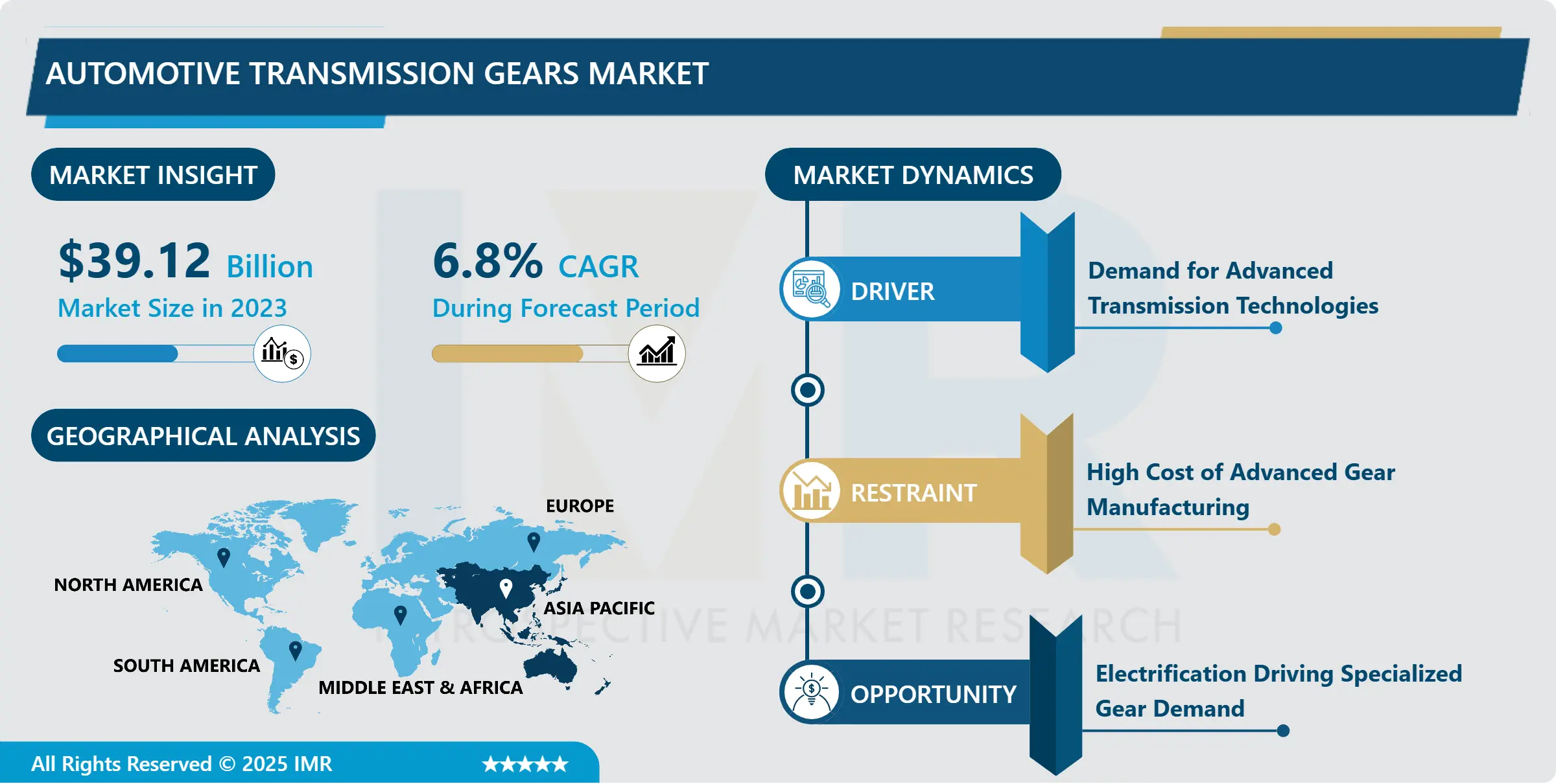
Automotive Transmission Gears Market Size Was Valued at USD 39.12 Billion in 2023, and is Projected to Reach USD 70.72 Billion by 2032, Growing at a CAGR of 6.8% From 2024-2032.
Automotive Transmission Gears is a segment of the manufacturing of gears employed in the automotive transmission systems to enhance efficiency, power utilization and other related impacts on vehicle performance. These gears are vital for altering away torque as well as the speed conditions in order to achieve optimal functionality of automobiles comprehensively across the drive train.
Automotive Transmission Gears is one of the most important and rapidly growing market segments in current global auto mobile industry due to the technological enhancement in automotive transmission systems and increasing buyer demand for proficient, daunting and classy cars. Transmission gears are part and parcel of the automatic transmission system that ensures that vehicle engines stay within their maximum power range and deliver applicable torque to vehicles. The market comprises different types of gears for specific transmittance including manual, automatic, and semi-automatic transmittance with specific vehicles and performance characteristics.
Although the primary factor affecting the transmission gears market is the increasing automotive industry prominence, the recent trend that has impacted this sector most in the last few years has been electrification. The use of electrified powertrains, which needs a specialist gear system, is on the rise today because of tightening emissions standards and the surging environmental concern among individuals and organizations alike. In the same manner, another requirement for better transmission systems in cars raised by manufacturers of luxury and premium class cars has stimulated more changes in gear profiles construction and components. Other dynamics that influence the competitive rivalry include evolutions like lightweight materials and the use various manufacturing processes including the newly developed three dimension printing among others.
There are however certain constrains that the market experience due to high cost of raw materials in the development of the highly durable, light weight gear systems. Yet, constant improvement of this technology underpinned by strong demand in international markets especially from growing economies is a positive sign for the market. Some New technologies are expected to appear in the coming years, such as dual-clutch transmissions (DCT) and continuously variable transmissions (CVT), which are expected to unlock powerful opportunities.
Automotive Transmission Gears Market Trend Analysis:
Adoption of Lightweight Transmission Gears
The market trend identified in this market is the rising use of lightweight transmission gears attributed to higher demand for fuel efficiency and lower emission. They are employing materials like HSS, Aluminum alloys, and composite in order to achieve high strength to weight ratio gears.
This tendency is observed especially in electric and hybrid vehicles where weight loss is mission critical because of battery capacity and energy use. Relatively lighter gears also help reduce inertia allowing smooth shifting with enhanced driveability. Thus, the use of superior materials and progressive production technologies such as the 3D printing and surface treatment technologies are largely expected to increase governing the automotive sector’s sustainability interests forward.
Electrification Driving Specialized Gear Demand
The changing nature of vehicular technology, particularly the shift to electric vehicles also constitutes a major growth opportunity for the automotive transmission gears market. As distinguished from commonly used internal combustion engine (ICE) cars, EVs necessitate appropriate gear systems for handling high torques together with fostering the efficiency of electric motors. As a result, the transmission gears with enhanced features that are suitable for the electrified drivetrain have gained high demands in the market.
Besides this, as governments across the globe are putting forward measures to promote EVs, the expenditure on research and development of gear of higher technology is increasing. One trend among manufacturers is to reduce the gear system cost by improving efficiency, reducing noise level, and improving thermal characteristics of electric vehicles. This shift benefits gear makers and their ability to diversify their offerings to include product options to fill the rising EV market niche.
Automotive Transmission Gears Market Segment Analysis:
Automotive Transmission Gears Market is Segmented on the basis of Type, Material, Vehicle Type, Gear Type, Application, and Region.
By Type, Manual Transmission Gears segment is expected to dominate the market during the forecast period
The automotive transmission gears market may be categorized according to its type into manual, automatic and semi-automatic transmission gears. Manual transmission gears prevail in cost-sensitive areas because manual transmission is cheaper and less complicated than the automatic one, so many entry vehicles and commercial cars are equipped with it. On the other hand, automatic transmission gears have started penetrating the developed markets and due to ease of use and convenience especially in urban traffic, they have become the most sought for mechanisms.
Semi-automatic transmission gears find a middle ground between racecar engineering and addressing the cost-consumer divide through targeting consumers with performance sensitivity and vehicle special uses. The increasing shift from conventional vehicles to hybrid electrical vehicles also increase the request for automatic or semi-automatic gear systems since such vehicles necessitate high quality transmission systems.
By Application, Conventional Transmission segment expected to held the largest share
The market by application divides into conventional transmission, CVT, DCT, and electrified transmission. Conventional transmission is still employed on ICE vehicles, largely due to its efficiency and relatively cheap solution introduced in newly industrialized countries. Yet, the improvement in CVT and DCT technologies has changed the preference of the consumers in the developed countries.
Electrified transmission is closely following the continuous increase in the number of electric and hybrid cars produced. These applications require specific gear systems that can generate much torque; however, the noise and energy consumption should be minimal. With the shift in the type of application coupled with the regulatory requirements, this market is likely to experience major change.
Automotive Transmission Gears Market Regional Insights:
Aisa Pacific is Expected to Dominate the Market Over the Forecast period
The Asia-Pacific region is the largest consumer in the automotive transmission gears market due to a high per capita car manufacturing in China, Japan, and India. The conference is led by the region’s well-developed manufacturing industry coupled with the increased demand for passenger and commercial vehicles.
Besides, the increasing sales of electric vehicle in China and the efforts being made by government towards establishing a green automobile industry also support the market. As more research and development efforts are devoted to developing the next generation of transmission systems, Asia-Pacific should continue to lead the way in the ensuing years.
Active Key Players in the Automotive Transmission Gears Market:
Aisin Seiki Co., Ltd. (Japan)
Allison Transmission Inc. (USA)
AVL List GmbH (Austria)
BorgWarner Inc. (USA)
Dana Incorporated (USA)
Eaton Corporation (Ireland)
GKN Automotive (UK)
Hyundai Transys (South Korea)
Linamar Corporation (Canada)
Schaeffler AG (Germany)
Valeo SA (France)
ZF Friedrichshafen AG (Germany)
Other Active Players
Key Industry Developments in the Automotive Transmission Gears Market:
In January 2023, Inmotive teamed up with Suzuki to create a new Ingear 2-speed transmission for electric cars. The Ingear tech is a special kind of transmission made just for electric vehicles, aimed at making them more efficient. It swaps out the second helical reduction gear with a chain drive morphing sprocket, which changes size during gear shifts.
In February 2023, Toyota rolled out its GR Corolla, featuring an eight-speed automatic transmission. They designed this transmission with an eight-speed torque-converter automatic system, using a planetary gear set.
Chapter 1: Introduction
1.1 Scope and Coverage
Chapter 2:Executive Summary
Chapter 3: Market Landscape
3.1 Market Dynamics
3.1.1 Drivers
3.1.2 Restraints
3.1.3 Opportunities
3.1.4 Challenges
3.2 Market Trend Analysis
3.3 PESTLE Analysis
3.4 Porter’s Five Forces Analysis
3.5 Industry Value Chain Analysis
3.6 Ecosystem
3.7 Regulatory Landscape
3.8 Price Trend Analysis
3.9 Patent Analysis
3.10 Technology Evolution
3.11 Investment Pockets
3.12 Import-Export Analysis
Chapter 4: Automotive Transmission Gears Market by Type
4.1 Automotive Transmission Gears Market Snapshot and Growth Engine
4.2 Automotive Transmission Gears Market Overview
4.3 Manual Transmission Gears
4.3.1 Introduction and Market Overview
4.3.2 Historic and Forecasted Market Size in Value USD and Volume Units (2017-2032F)
4.3.3 Key Market Trends, Growth Factors and Opportunities
4.3.4 Manual Transmission Gears: Geographic Segmentation Analysis
4.4 Automatic Transmission Gears
4.4.1 Introduction and Market Overview
4.4.2 Historic and Forecasted Market Size in Value USD and Volume Units (2017-2032F)
4.4.3 Key Market Trends, Growth Factors and Opportunities
4.4.4 Automatic Transmission Gears: Geographic Segmentation Analysis
4.5 Semi-Automatic Transmission Gears
4.5.1 Introduction and Market Overview
4.5.2 Historic and Forecasted Market Size in Value USD and Volume Units (2017-2032F)
4.5.3 Key Market Trends, Growth Factors and Opportunities
4.5.4 Semi-Automatic Transmission Gears: Geographic Segmentation Analysis
Chapter 5: Automotive Transmission Gears Market by Material
5.1 Automotive Transmission Gears Market Snapshot and Growth Engine
5.2 Automotive Transmission Gears Market Overview
5.3 Steel
5.3.1 Introduction and Market Overview
5.3.2 Historic and Forecasted Market Size in Value USD and Volume Units (2017-2032F)
5.3.3 Key Market Trends, Growth Factors and Opportunities
5.3.4 Steel: Geographic Segmentation Analysis
5.4 Aluminum
5.4.1 Introduction and Market Overview
5.4.2 Historic and Forecasted Market Size in Value USD and Volume Units (2017-2032F)
5.4.3 Key Market Trends, Growth Factors and Opportunities
5.4.4 Aluminum: Geographic Segmentation Analysis
5.5 Brass
5.5.1 Introduction and Market Overview
5.5.2 Historic and Forecasted Market Size in Value USD and Volume Units (2017-2032F)
5.5.3 Key Market Trends, Growth Factors and Opportunities
5.5.4 Brass: Geographic Segmentation Analysis
5.6 Composite
5.6.1 Introduction and Market Overview
5.6.2 Historic and Forecasted Market Size in Value USD and Volume Units (2017-2032F)
5.6.3 Key Market Trends, Growth Factors and Opportunities
5.6.4 Composite: Geographic Segmentation Analysis
Chapter 6: Automotive Transmission Gears Market by Vehicle Type
6.1 Automotive Transmission Gears Market Snapshot and Growth Engine
6.2 Automotive Transmission Gears Market Overview
6.3 Passenger Cars
6.3.1 Introduction and Market Overview
6.3.2 Historic and Forecasted Market Size in Value USD and Volume Units (2017-2032F)
6.3.3 Key Market Trends, Growth Factors and Opportunities
6.3.4 Passenger Cars: Geographic Segmentation Analysis
6.4 Light Commercial Vehicles (LCVs)
6.4.1 Introduction and Market Overview
6.4.2 Historic and Forecasted Market Size in Value USD and Volume Units (2017-2032F)
6.4.3 Key Market Trends, Growth Factors and Opportunities
6.4.4 Light Commercial Vehicles (LCVs): Geographic Segmentation Analysis
6.5 Heavy Commercial Vehicles (HCVs)
6.5.1 Introduction and Market Overview
6.5.2 Historic and Forecasted Market Size in Value USD and Volume Units (2017-2032F)
6.5.3 Key Market Trends, Growth Factors and Opportunities
6.5.4 Heavy Commercial Vehicles (HCVs): Geographic Segmentation Analysis
Chapter 7: Automotive Transmission Gears Market by Gear Type
7.1 Automotive Transmission Gears Market Snapshot and Growth Engine
7.2 Automotive Transmission Gears Market Overview
7.3 Bevel Gear
7.3.1 Introduction and Market Overview
7.3.2 Historic and Forecasted Market Size in Value USD and Volume Units (2017-2032F)
7.3.3 Key Market Trends, Growth Factors and Opportunities
7.3.4 Bevel Gear: Geographic Segmentation Analysis
7.4 Helical Gear
7.4.1 Introduction and Market Overview
7.4.2 Historic and Forecasted Market Size in Value USD and Volume Units (2017-2032F)
7.4.3 Key Market Trends, Growth Factors and Opportunities
7.4.4 Helical Gear: Geographic Segmentation Analysis
7.5 Spur Gear
7.5.1 Introduction and Market Overview
7.5.2 Historic and Forecasted Market Size in Value USD and Volume Units (2017-2032F)
7.5.3 Key Market Trends, Growth Factors and Opportunities
7.5.4 Spur Gear: Geographic Segmentation Analysis
7.6 Worm Gear
7.6.1 Introduction and Market Overview
7.6.2 Historic and Forecasted Market Size in Value USD and Volume Units (2017-2032F)
7.6.3 Key Market Trends, Growth Factors and Opportunities
7.6.4 Worm Gear: Geographic Segmentation Analysis
7.7 Planetary Gear
7.7.1 Introduction and Market Overview
7.7.2 Historic and Forecasted Market Size in Value USD and Volume Units (2017-2032F)
7.7.3 Key Market Trends, Growth Factors and Opportunities
7.7.4 Planetary Gear: Geographic Segmentation Analysis
Chapter 8: Automotive Transmission Gears Market by Application
8.1 Automotive Transmission Gears Market Snapshot and Growth Engine
8.2 Automotive Transmission Gears Market Overview
8.3 Conventional Transmission
8.3.1 Introduction and Market Overview
8.3.2 Historic and Forecasted Market Size in Value USD and Volume Units (2017-2032F)
8.3.3 Key Market Trends, Growth Factors and Opportunities
8.3.4 Conventional Transmission: Geographic Segmentation Analysis
8.4 Continuous Variable Transmission (CVT)
8.4.1 Introduction and Market Overview
8.4.2 Historic and Forecasted Market Size in Value USD and Volume Units (2017-2032F)
8.4.3 Key Market Trends, Growth Factors and Opportunities
8.4.4 Continuous Variable Transmission (CVT): Geographic Segmentation Analysis
8.5 Dual-Clutch Transmission (DCT)
8.5.1 Introduction and Market Overview
8.5.2 Historic and Forecasted Market Size in Value USD and Volume Units (2017-2032F)
8.5.3 Key Market Trends, Growth Factors and Opportunities
8.5.4 Dual-Clutch Transmission (DCT): Geographic Segmentation Analysis
8.6 Electrified Transmission
8.6.1 Introduction and Market Overview
8.6.2 Historic and Forecasted Market Size in Value USD and Volume Units (2017-2032F)
8.6.3 Key Market Trends, Growth Factors and Opportunities
8.6.4 Electrified Transmission: Geographic Segmentation Analysis
Chapter 9: Company Profiles and Competitive Analysis
9.1 Competitive Landscape
9.1.1 Competitive Benchmarking
9.1.2 Automotive Transmission Gears Market Share by Manufacturer (2023)
9.1.3 Industry BCG Matrix
9.1.4 Heat Map Analysis
9.1.5 Mergers and Acquisitions
9.2 ZF FRIEDRICHSHAFEN AG (GERMANY)
9.2.1 Company Overview
9.2.2 Key Executives
9.2.3 Company Snapshot
9.2.4 Role of the Company in the Market
9.2.5 Sustainability and Social Responsibility
9.2.6 Operating Business Segments
9.2.7 Product Portfolio
9.2.8 Business Performance
9.2.9 Key Strategic Moves and Recent Developments
9.2.10 SWOT Analysis
9.3 BORGWARNER INC. (USA)
9.4 AISIN SEIKI CO. LTD. (JAPAN)
9.5 DANA INCORPORATED (USA)
9.6 GKN AUTOMOTIVE (UK)
9.7 VALEO SA (FRANCE)
9.8 SCHAEFFLER AG (GERMANY)
9.9 EATON CORPORATION (IRELAND)
9.10 HYUNDAI TRANSYS (SOUTH KOREA)
9.11 ALLISON TRANSMISSION INC. (USA)
9.12 AVL LIST GMBH (AUSTRIA)
9.13 LINAMAR CORPORATION (CANADA)
9.14 OTHER ACTIVE PLAYERS
Chapter 10: Global Automotive Transmission Gears Market By Region
10.1 Overview
10.2. North America Automotive Transmission Gears Market
10.2.1 Key Market Trends, Growth Factors and Opportunities
10.2.2 Top Key Companies
10.2.3 Historic and Forecasted Market Size by Segments
10.2.4 Historic and Forecasted Market Size By Type
10.2.4.1 Manual Transmission Gears
10.2.4.2 Automatic Transmission Gears
10.2.4.3 Semi-Automatic Transmission Gears
10.2.5 Historic and Forecasted Market Size By Material
10.2.5.1 Steel
10.2.5.2 Aluminum
10.2.5.3 Brass
10.2.5.4 Composite
10.2.6 Historic and Forecasted Market Size By Vehicle Type
10.2.6.1 Passenger Cars
10.2.6.2 Light Commercial Vehicles (LCVs)
10.2.6.3 Heavy Commercial Vehicles (HCVs)
10.2.7 Historic and Forecasted Market Size By Gear Type
10.2.7.1 Bevel Gear
10.2.7.2 Helical Gear
10.2.7.3 Spur Gear
10.2.7.4 Worm Gear
10.2.7.5 Planetary Gear
10.2.8 Historic and Forecasted Market Size By Application
10.2.8.1 Conventional Transmission
10.2.8.2 Continuous Variable Transmission (CVT)
10.2.8.3 Dual-Clutch Transmission (DCT)
10.2.8.4 Electrified Transmission
10.2.9 Historic and Forecast Market Size by Country
10.2.9.1 US
10.2.9.2 Canada
10.2.9.3 Mexico
10.3. Eastern Europe Automotive Transmission Gears Market
10.3.1 Key Market Trends, Growth Factors and Opportunities
10.3.2 Top Key Companies
10.3.3 Historic and Forecasted Market Size by Segments
10.3.4 Historic and Forecasted Market Size By Type
10.3.4.1 Manual Transmission Gears
10.3.4.2 Automatic Transmission Gears
10.3.4.3 Semi-Automatic Transmission Gears
10.3.5 Historic and Forecasted Market Size By Material
10.3.5.1 Steel
10.3.5.2 Aluminum
10.3.5.3 Brass
10.3.5.4 Composite
10.3.6 Historic and Forecasted Market Size By Vehicle Type
10.3.6.1 Passenger Cars
10.3.6.2 Light Commercial Vehicles (LCVs)
10.3.6.3 Heavy Commercial Vehicles (HCVs)
10.3.7 Historic and Forecasted Market Size By Gear Type
10.3.7.1 Bevel Gear
10.3.7.2 Helical Gear
10.3.7.3 Spur Gear
10.3.7.4 Worm Gear
10.3.7.5 Planetary Gear
10.3.8 Historic and Forecasted Market Size By Application
10.3.8.1 Conventional Transmission
10.3.8.2 Continuous Variable Transmission (CVT)
10.3.8.3 Dual-Clutch Transmission (DCT)
10.3.8.4 Electrified Transmission
10.3.9 Historic and Forecast Market Size by Country
10.3.9.1 Russia
10.3.9.2 Bulgaria
10.3.9.3 The Czech Republic
10.3.9.4 Hungary
10.3.9.5 Poland
10.3.9.6 Romania
10.3.9.7 Rest of Eastern Europe
10.4. Western Europe Automotive Transmission Gears Market
10.4.1 Key Market Trends, Growth Factors and Opportunities
10.4.2 Top Key Companies
10.4.3 Historic and Forecasted Market Size by Segments
10.4.4 Historic and Forecasted Market Size By Type
10.4.4.1 Manual Transmission Gears
10.4.4.2 Automatic Transmission Gears
10.4.4.3 Semi-Automatic Transmission Gears
10.4.5 Historic and Forecasted Market Size By Material
10.4.5.1 Steel
10.4.5.2 Aluminum
10.4.5.3 Brass
10.4.5.4 Composite
10.4.6 Historic and Forecasted Market Size By Vehicle Type
10.4.6.1 Passenger Cars
10.4.6.2 Light Commercial Vehicles (LCVs)
10.4.6.3 Heavy Commercial Vehicles (HCVs)
10.4.7 Historic and Forecasted Market Size By Gear Type
10.4.7.1 Bevel Gear
10.4.7.2 Helical Gear
10.4.7.3 Spur Gear
10.4.7.4 Worm Gear
10.4.7.5 Planetary Gear
10.4.8 Historic and Forecasted Market Size By Application
10.4.8.1 Conventional Transmission
10.4.8.2 Continuous Variable Transmission (CVT)
10.4.8.3 Dual-Clutch Transmission (DCT)
10.4.8.4 Electrified Transmission
10.4.9 Historic and Forecast Market Size by Country
10.4.9.1 Germany
10.4.9.2 UK
10.4.9.3 France
10.4.9.4 The Netherlands
10.4.9.5 Italy
10.4.9.6 Spain
10.4.9.7 Rest of Western Europe
10.5. Asia Pacific Automotive Transmission Gears Market
10.5.1 Key Market Trends, Growth Factors and Opportunities
10.5.2 Top Key Companies
10.5.3 Historic and Forecasted Market Size by Segments
10.5.4 Historic and Forecasted Market Size By Type
10.5.4.1 Manual Transmission Gears
10.5.4.2 Automatic Transmission Gears
10.5.4.3 Semi-Automatic Transmission Gears
10.5.5 Historic and Forecasted Market Size By Material
10.5.5.1 Steel
10.5.5.2 Aluminum
10.5.5.3 Brass
10.5.5.4 Composite
10.5.6 Historic and Forecasted Market Size By Vehicle Type
10.5.6.1 Passenger Cars
10.5.6.2 Light Commercial Vehicles (LCVs)
10.5.6.3 Heavy Commercial Vehicles (HCVs)
10.5.7 Historic and Forecasted Market Size By Gear Type
10.5.7.1 Bevel Gear
10.5.7.2 Helical Gear
10.5.7.3 Spur Gear
10.5.7.4 Worm Gear
10.5.7.5 Planetary Gear
10.5.8 Historic and Forecasted Market Size By Application
10.5.8.1 Conventional Transmission
10.5.8.2 Continuous Variable Transmission (CVT)
10.5.8.3 Dual-Clutch Transmission (DCT)
10.5.8.4 Electrified Transmission
10.5.9 Historic and Forecast Market Size by Country
10.5.9.1 China
10.5.9.2 India
10.5.9.3 Japan
10.5.9.4 South Korea
10.5.9.5 Malaysia
10.5.9.6 Thailand
10.5.9.7 Vietnam
10.5.9.8 The Philippines
10.5.9.9 Australia
10.5.9.10 New Zealand
10.5.9.11 Rest of APAC
10.6. Middle East & Africa Automotive Transmission Gears Market
10.6.1 Key Market Trends, Growth Factors and Opportunities
10.6.2 Top Key Companies
10.6.3 Historic and Forecasted Market Size by Segments
10.6.4 Historic and Forecasted Market Size By Type
10.6.4.1 Manual Transmission Gears
10.6.4.2 Automatic Transmission Gears
10.6.4.3 Semi-Automatic Transmission Gears
10.6.5 Historic and Forecasted Market Size By Material
10.6.5.1 Steel
10.6.5.2 Aluminum
10.6.5.3 Brass
10.6.5.4 Composite
10.6.6 Historic and Forecasted Market Size By Vehicle Type
10.6.6.1 Passenger Cars
10.6.6.2 Light Commercial Vehicles (LCVs)
10.6.6.3 Heavy Commercial Vehicles (HCVs)
10.6.7 Historic and Forecasted Market Size By Gear Type
10.6.7.1 Bevel Gear
10.6.7.2 Helical Gear
10.6.7.3 Spur Gear
10.6.7.4 Worm Gear
10.6.7.5 Planetary Gear
10.6.8 Historic and Forecasted Market Size By Application
10.6.8.1 Conventional Transmission
10.6.8.2 Continuous Variable Transmission (CVT)
10.6.8.3 Dual-Clutch Transmission (DCT)
10.6.8.4 Electrified Transmission
10.6.9 Historic and Forecast Market Size by Country
10.6.9.1 Turkiye
10.6.9.2 Bahrain
10.6.9.3 Kuwait
10.6.9.4 Saudi Arabia
10.6.9.5 Qatar
10.6.9.6 UAE
10.6.9.7 Israel
10.6.9.8 South Africa
10.7. South America Automotive Transmission Gears Market
10.7.1 Key Market Trends, Growth Factors and Opportunities
10.7.2 Top Key Companies
10.7.3 Historic and Forecasted Market Size by Segments
10.7.4 Historic and Forecasted Market Size By Type
10.7.4.1 Manual Transmission Gears
10.7.4.2 Automatic Transmission Gears
10.7.4.3 Semi-Automatic Transmission Gears
10.7.5 Historic and Forecasted Market Size By Material
10.7.5.1 Steel
10.7.5.2 Aluminum
10.7.5.3 Brass
10.7.5.4 Composite
10.7.6 Historic and Forecasted Market Size By Vehicle Type
10.7.6.1 Passenger Cars
10.7.6.2 Light Commercial Vehicles (LCVs)
10.7.6.3 Heavy Commercial Vehicles (HCVs)
10.7.7 Historic and Forecasted Market Size By Gear Type
10.7.7.1 Bevel Gear
10.7.7.2 Helical Gear
10.7.7.3 Spur Gear
10.7.7.4 Worm Gear
10.7.7.5 Planetary Gear
10.7.8 Historic and Forecasted Market Size By Application
10.7.8.1 Conventional Transmission
10.7.8.2 Continuous Variable Transmission (CVT)
10.7.8.3 Dual-Clutch Transmission (DCT)
10.7.8.4 Electrified Transmission
10.7.9 Historic and Forecast Market Size by Country
10.7.9.1 Brazil
10.7.9.2 Argentina
10.7.9.3 Rest of SA
Chapter 11 Analyst Viewpoint and Conclusion
11.1 Recommendations and Concluding Analysis
11.2 Potential Market Strategies
Chapter 12 Research Methodology
12.1 Research Process
12.2 Primary Research
12.3 Secondary Research
Q1: What would be the forecast period in the Automotive Transmission Gears Market research report?
A1: The forecast period in the Automotive Transmission Gears Market research report is 2024-2032.
Q2: Who are the key players in the Automotive Transmission Gears Market?
A2: ZF Friedrichshafen AG (Germany), BorgWarner Inc. (USA), Aisin Seiki Co., Ltd. (Japan), Dana Incorporated (USA), GKN Automotive (UK), Valeo SA (France), Schaeffler AG (Germany), Eaton Corporation (Ireland), Hyundai Transys (South Korea), Allison Transmission Inc. (USA), AVL List GmbH (Austria), Linamar Corporation (Canada), and Other Active Players.
Q3: What are the segments of the Automotive Transmission Gears Market?
A3: The Automotive Transmission Gears Market is segmented into Type, Material ,vehicle Type, gear Type, Application and region. By Type, the market is categorized into Manual Transmission Gears, Automatic Transmission Gears, Semi-Automatic Transmission Gears. By Material, the market is categorized into Steel, Aluminum, Brass, Composite. By Vehicle Type, the market is categorized into Passenger Cars, Light Commercial Vehicles (LCVs), Heavy Commercial Vehicles (HCVs). By Gear Type, the market is categorized into Bevel Gear, Helical Gear, Spur Gear, Worm Gear, Planetary Gear. By Application, the market is categorized into Conventional Transmission, Continuous Variable Transmission (CVT), Dual-Clutch Transmission (DCT), Electrified Transmission. By region, it is analyzed across North America (U.S., Canada, Mexico), Eastern Europe (Russia, Bulgaria, The Czech Republic, Hungary, Poland, Romania, Rest of Eastern Europe), Western Europe (Germany, UK, France, The Netherlands, Italy, Russia, Spain, Rest of Western Europe), Asia Pacific (China, India, Japan, South Korea, Malaysia, Thailand, Vietnam, The Philippines, Australia, New-Zealand, Rest of APAC), Middle East & Africa (Turkiye, Bahrain, Kuwait, Saudi Arabia, Qatar, UAE, Israel, South Africa), South America (Brazil, Argentina, Rest of SA).
Q4: What is the Automotive Transmission Gears Market?
A4: Automotive Transmission Gears is a segment of the manufacturing of gears employed in the automotive transmission systems to enhance efficiency, power utilization and other related impacts on vehicle performance. These gears are vital for altering away torque as well as the speed conditions in order to achieve optimal functionality of automobiles comprehensively across the drive train.
Q5: How big is the Automotive Transmission Gears Market?
A5: Automotive Transmission Gears Market Size Was Valued at USD 39.12 Billion in 2023, and is Projected to Reach USD 70.72 Billion by 2032, Growing at a CAGR of 6.8% From 2024-2032.
How to Buy a Report from eminsights.jp
On the product page, choose the license you want: Single-User License, Multi-User License or Enterprise License.
If you required report in your native language, then you can click on Translated Report button and fill out the form with report name and language you want, then our team will contact you as soon as possible.
Click the Buy Now button.
You will be redirected to the checkout page. Enter your company details and payment information.
Click Place Order to complete the purchase.
Confirmation: You’ll receive an order confirmation and our team will contact you shortly with your ordered report.
If you have any questions, fill out the contact form below or email us at bizdev@eminsights.net.
Thank you for choosing eminsights.jp!