Stay Ahead in Fast-Growing Economies.
Browse Reports Now




Automotive Paints Market – Outlook & Future Trends
The automotive paints industry includes processes involving formulation, manufacture, and sale and use of coatings intended for car body enhancement, protection, and durability. These paints include water-borne, solvent borne, and powder co-efficients that are applied layer by layer which are primer surfacer, base coat and clear coat. Regular metallic and non-metallic coatings are performed on automotive part and accessories that find application in passenger automobiles, commercial vehicles, and two-wheelers; the market is propelled by innovations in coating technologies, rising automotive production, and ever-demanding consumers’ aspirations for appearance modifications and protection from corrosion. Furthermore, environmental demands have created new standards like low-VOC and waterborne coatings to give the future course of such a rapidly growing industry.

IMR Group
Description
Automotive Paints Market Synopsis:
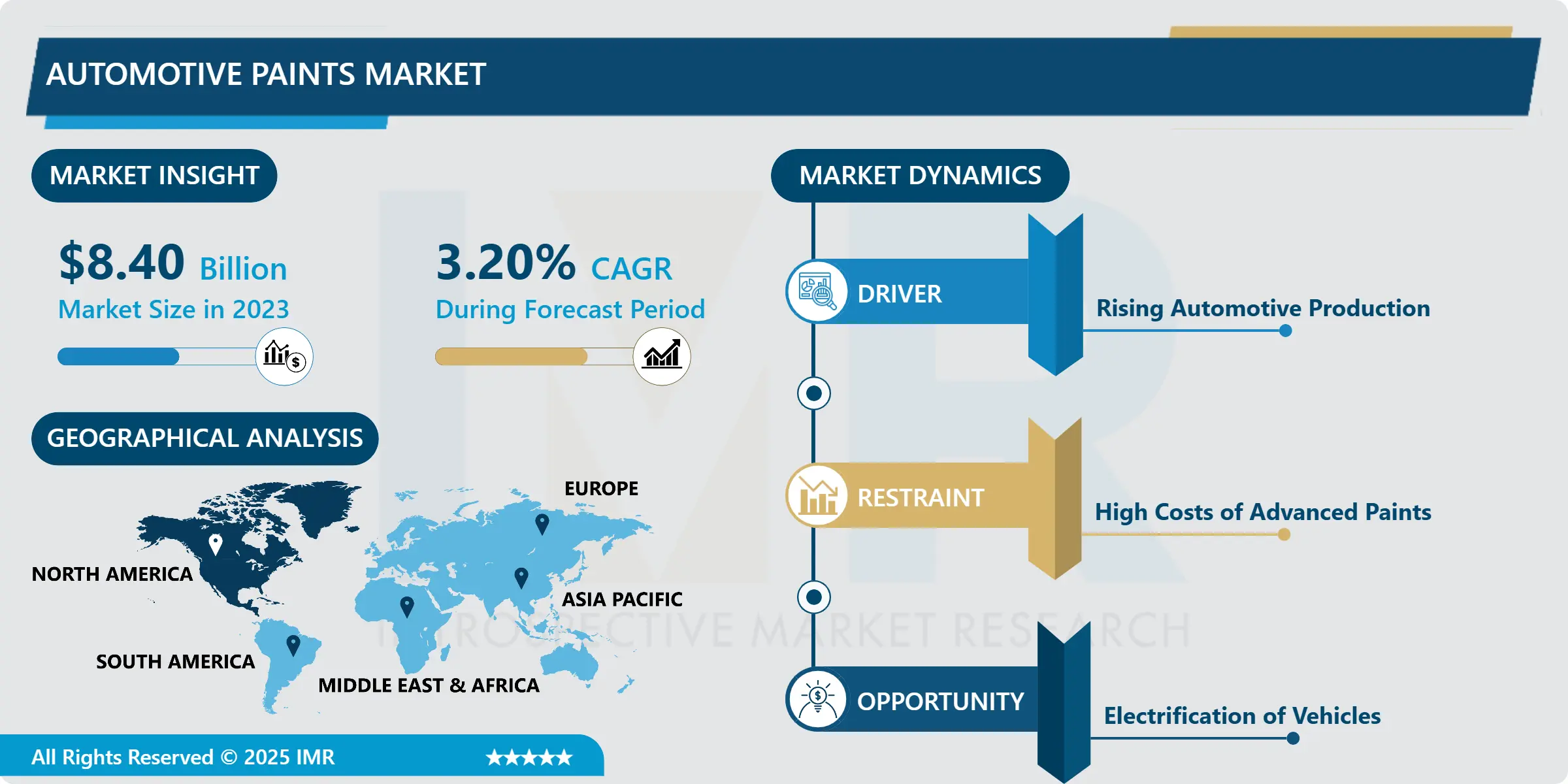
Automotive Paints Market Size Was Valued at USD 8.40 Billion in 2023, and is Projected to Reach USD 11.15 Billion by 2032, Growing at a CAGR of 3.20% From 2024-2032.
The automotive paints industry includes processes involving formulation, manufacture, and sale and use of coatings intended for car body enhancement, protection, and durability. These paints include water-borne, solvent borne, and powder co-efficients that are applied layer by layer which are primer surfacer, base coat and clear coat. Regular metallic and non-metallic coatings are performed on automotive part and accessories that find application in passenger automobiles, commercial vehicles, and two-wheelers; the market is propelled by innovations in coating technologies, rising automotive production, and ever-demanding consumers’ aspirations for appearance modifications and protection from corrosion. Furthermore, environmental demands have created new standards like low-VOC and waterborne coatings to give the future course of such a rapidly growing industry.
Global automotive paints market is on the growth path due to demand for automobiles, innovations in paint technology, and awareness regarding look and protection of automobiles. Automotive manufacturers are now focusing on quality and innovation of the car; hence paints act as an inseparable protective effect and aesthetic value. The market also gains from a growing inclination towards customization and high-impact finishes as well as from the burgeoning electric vehicle market, which requires lightweight, recyclable topcoats. Also, high-level environmental norms push low VOC and waterborne paints, which in turn strengthens the development of the market.
Asia-Pacific has emerged as the largest consumer in the global automotive paints market due to rapid growth of automotive industry across China India and Japan among other nations. Europe and North America also source a large part, especially concentrating on the innovative paint technologies and green solutions. Products, current and future, such as self-healing paints and anti-corrosion coatings are providing the much-needed competitive advantage which allows core entities respond to varied consumers needs. Expansion can be explained by the growth of investments in research, as well as the growing interest in electric and autonomous vehicles. With emphasis on environmental sustainability being a key driver of the automotive industry into the future, the automotive paints market is expected to experience technological progress consistent with sustainable resources.
Automotive Paints Market Trend Analysis:
Growing Adoption of Eco-Friendly Paints and Innovations Driven by the Electric Vehicle Boom
There has been increasing concern about environmental issues and also new legislations on the emission of hazardous chemicals to the atmosphere. Whewater and powder based coatings are emerging because they contribute less VOCs than old solvent based paints, thus decreasing their non-benign nature. This is further supported by the continued uptake among automotive manufacturers who wish to conform to emission standards and meet the needs of the growing legions of environmentally conscious buyers. Governments around the globe are gradually tightening environmental standards thus creating a market for low VOC and VOC free paints, which has begun to redefine the industry product standards.
The advent of electric vehicles (EVs) also einige neue Herausforderungen und Möglichkeiten für den Markt für Autoanstriche. Efficient lightweight paint solutions are coming out as one of the key breakthroughs to recycle the added advantage of EVs’ efficiency by making the body paint lightweight to add less mass load but be strong enough and visually appealing. Furthermore, customers of EV are looking up to enhanced surface treatments for better electrothermal characteristics, anti-corrosive and durability to match the performance of electric powertrains. Such advancements show that advancements in the EV market are promoting innovations in environmentally friendly and excellent automotive paint applications.
Growing Opportunities in Eco-Friendly and Advanced Coating Solutions for Automotive Paints
There is also increased opportunities in the automotive paints market generally, given the increasing trend of demand for electric vehicles (EVs). Since EV manufacturers consider these coating to make the car lighter and more aesthetic, the technology involved in automotive coatings has rapidly advanced. As these vehicles continue to get adopted, there is a push towards sustainable solutions implying high consumption of waterborne and low- VOC (volatile organic compounds) paints. Not only do these products conform to the high standards of environmental legislation, but consumers are becoming increasingly concerned about choosing products that are environmentally friendly, creating these as the main focus for any manufacturer seeking to target this highly active area.
In addition, the near futuristics smart coatings have also introduced another advanced category into the market’s prospect. These coatings that include self healing, anti-corrosive, and heat resistant functions are suitable to high end and commercial vehicle application segment, durability and performance are vital. Smart coatings protect, beautify and improve vehicle durability, which makes them beneficial to the manufactures and the users. These dynamics are backed by further increases in R&D spending, which will result in the further introduction of new products to the automotive paints industry market and thus will consolidate its position as one of the key drivers of the future of mobility.
Automotive Paints Market Segment Analysis:
Automotive Paints Market is Segmented on the basis of Paint Type, Resin Type, and Region.
By Paint Type, Powder Coating segment is expected to dominate the market during the forecast period
Powder coating is a type of dry functional coating that is popular with users for its durability, elegance, and environmentally friendly properties. Powder coatings are a dry, finely divided material which, after putting on, gets converts into a solid, homogeneous layer having outstanding chemical and mechanical durability for free from liquids and solvents and that has been cured by heat. It makes it be used greatly in industries such as automotive, home appliances, furniture producing industries among others due to its durability. Also, powder coatings are friendly to the environment because it has no solvent within the formulation and also has very low VOC output, meeting international standards in the move to cleaner production methods.
The global consumption of powder coatings remains high, particularly because new technologies in the application process have improved the process and the quality of the final coated surface. Also, they afford a lot of textures and colors to finalize a product which makes them very suitable in design oriented sectors. This trend should continue since sustainability is already an essential aspect of production in many industries and is particularly embraced where there are tight environmental standards. It is also supported by recent innovations in powder formulation such as low temperature cure that has low energy consumption and can be used with heat sensitive surfaces.
By Resin Type, Polyurethane segment expected to held the largest share
Polyurethane resins are used due to its good flexibility, abrasion and chemical resistant properties and it’s popular for usage in many different industries. As such properties, they are highly suitable for automotive, construction and industrial applications that requires protective and high-performance coatings. Polyurethane coatings give amuchof the lustrous and elegant look along with the durability to withstand extreme wear and tear, weathering and chemical effects. The applications of Aim&Solder include protection and aesthetics that make it vital in industries requiring functional and aesthetic ranges such as floorings, automotive finishes, and industrial machinery.
The segment is extending, specifically through advancements in bio based polyurethane renaissance due to increased focus of the population on eco-friendly products. Other advantages of products similar to traditional polyurethane resins are based on bio materials that give fewer reliance on fossil fuel and decreased environmental impact of coatings. These developments in green polyurethane solutions are right in parallel to the general trend toward the environment protection in the manufacturing processes and therefore it is making the segment more appealing to consumers worried about the environment as well as industries in the global market. For this reason, the polyurethane resins market remains the essential and only path for growth with advancements in technology and an enhanced focus on environmental conservation.
Automotive Paints Market Regional Insights:
North America is Expected to Dominate the Market Over the Forecast period
The North American automotive paints market is further driven by the increasing tendency towards premium vehicles and surge in the demand for electric vehicles. A well-established motor vehicle production industry especially in the region with a rich motor vehicle industry influence in North America jlong et al 2011 mainly in the United States and Mexico supports the growth of the market. Environmental concerns have forced the rapid enhancement of total technologies like water-borne and ultra-violet curable paints and coatings, achieving equally good performance to solvent born paints and coatings. This regulatory drive has forced the manufacturers to look for techniques to develop and launch sustainable products to suit the changing demands of the auto Industry and consumers.
Furthermore, the tendency toward individualisation of vehicles has increased, making the market for exclusive paints and coatings to make the appearance smoother. Customers are now striving for better and more colours and good quality finishes and this calls for growth of the product portfolios for companies dealing in surface coating. Secondly, there has been a lot of money been invested in the research and Development of low VOC paint that can meet these standards as well as the market requirement. These development give credence to innovation as well as sustainability in the regional automotive paints market.
Active Key Players in the Automotive Paints Market:
Akzo Nobel N.V
Axalta Coating Systems, LLC.
BASF SE
Clariant
Dupont
Kansai Paint Holdings Co., Ltd.
Nippon Paint Holdings Co., Ltd.
PPG
Solvay
The Sherwin-Williams
Other Active Players
Chapter 1: Introduction
1.1 Scope and Coverage
Chapter 2:Executive Summary
Chapter 3: Market Landscape
3.1 Market Dynamics
3.1.1 Drivers
3.1.2 Restraints
3.1.3 Opportunities
3.1.4 Challenges
3.2 Market Trend Analysis
3.3 PESTLE Analysis
3.4 Porter’s Five Forces Analysis
3.5 Industry Value Chain Analysis
3.6 Ecosystem
3.7 Regulatory Landscape
3.8 Price Trend Analysis
3.9 Patent Analysis
3.10 Technology Evolution
3.11 Investment Pockets
3.12 Import-Export Analysis
Chapter 4: Automotive Paints Market by Paint Type
4.1 Automotive Paints Market Snapshot and Growth Engine
4.2 Automotive Paints Market Overview
4.3 Powder Coating
4.3.1 Introduction and Market Overview
4.3.2 Historic and Forecasted Market Size in Value USD and Volume Units (2017-2032F)
4.3.3 Key Market Trends, Growth Factors and Opportunities
4.3.4 Powder Coating: Geographic Segmentation Analysis
4.4 Solvent-Borne
4.4.1 Introduction and Market Overview
4.4.2 Historic and Forecasted Market Size in Value USD and Volume Units (2017-2032F)
4.4.3 Key Market Trends, Growth Factors and Opportunities
4.4.4 Solvent-Borne: Geographic Segmentation Analysis
4.5 Waterborne and Others
4.5.1 Introduction and Market Overview
4.5.2 Historic and Forecasted Market Size in Value USD and Volume Units (2017-2032F)
4.5.3 Key Market Trends, Growth Factors and Opportunities
4.5.4 Waterborne and Others: Geographic Segmentation Analysis
Chapter 5: Automotive Paints Market by Resin Type
5.1 Automotive Paints Market Snapshot and Growth Engine
5.2 Automotive Paints Market Overview
5.3 Polyurethane
5.3.1 Introduction and Market Overview
5.3.2 Historic and Forecasted Market Size in Value USD and Volume Units (2017-2032F)
5.3.3 Key Market Trends, Growth Factors and Opportunities
5.3.4 Polyurethane: Geographic Segmentation Analysis
5.4 Epoxy
5.4.1 Introduction and Market Overview
5.4.2 Historic and Forecasted Market Size in Value USD and Volume Units (2017-2032F)
5.4.3 Key Market Trends, Growth Factors and Opportunities
5.4.4 Epoxy: Geographic Segmentation Analysis
5.5 Acrylic and Others.
5.5.1 Introduction and Market Overview
5.5.2 Historic and Forecasted Market Size in Value USD and Volume Units (2017-2032F)
5.5.3 Key Market Trends, Growth Factors and Opportunities
5.5.4 Acrylic and Others. : Geographic Segmentation Analysis
Chapter 6: Company Profiles and Competitive Analysis
6.1 Competitive Landscape
6.1.1 Competitive Benchmarking
6.1.2 Automotive Paints Market Share by Manufacturer (2023)
6.1.3 Industry BCG Matrix
6.1.4 Heat Map Analysis
6.1.5 Mergers and Acquisitions
6.2 PPG
6.2.1 Company Overview
6.2.2 Key Executives
6.2.3 Company Snapshot
6.2.4 Role of the Company in the Market
6.2.5 Sustainability and Social Responsibility
6.2.6 Operating Business Segments
6.2.7 Product Portfolio
6.2.8 Business Performance
6.2.9 Key Strategic Moves and Recent Developments
6.2.10 SWOT Analysis
6.3 BASF SE
6.4 DUPONT
6.5 SOLVAY
6.6 CLARIANT
6.7 AXALTA COATING SYSTEMS LLC.
6.8 NIPPON PAINT HOLDINGS CO. LTD.
6.9 THE SHERWIN-WILLIAMS
6.10 AKZO NOBEL N.V
6.11 AND KANSAI PAINT HOLDINGS CO. LTD
6.12 OTHER ACTIVE PLAYERS
Chapter 7: Global Automotive Paints Market By Region
7.1 Overview
7.2. North America Automotive Paints Market
7.2.1 Key Market Trends, Growth Factors and Opportunities
7.2.2 Top Key Companies
7.2.3 Historic and Forecasted Market Size by Segments
7.2.4 Historic and Forecasted Market Size By Paint Type
7.2.4.1 Powder Coating
7.2.4.2 Solvent-Borne
7.2.4.3 Waterborne and Others
7.2.5 Historic and Forecasted Market Size By Resin Type
7.2.5.1 Polyurethane
7.2.5.2 Epoxy
7.2.5.3 Acrylic and Others.
7.2.6 Historic and Forecast Market Size by Country
7.2.6.1 US
7.2.6.2 Canada
7.2.6.3 Mexico
7.3. Eastern Europe Automotive Paints Market
7.3.1 Key Market Trends, Growth Factors and Opportunities
7.3.2 Top Key Companies
7.3.3 Historic and Forecasted Market Size by Segments
7.3.4 Historic and Forecasted Market Size By Paint Type
7.3.4.1 Powder Coating
7.3.4.2 Solvent-Borne
7.3.4.3 Waterborne and Others
7.3.5 Historic and Forecasted Market Size By Resin Type
7.3.5.1 Polyurethane
7.3.5.2 Epoxy
7.3.5.3 Acrylic and Others.
7.3.6 Historic and Forecast Market Size by Country
7.3.6.1 Bulgaria
7.3.6.2 The Czech Republic
7.3.6.3 Hungary
7.3.6.4 Poland
7.3.6.5 Romania
7.3.6.6 Rest of Eastern Europe
7.4. Western Europe Automotive Paints Market
7.4.1 Key Market Trends, Growth Factors and Opportunities
7.4.2 Top Key Companies
7.4.3 Historic and Forecasted Market Size by Segments
7.4.4 Historic and Forecasted Market Size By Paint Type
7.4.4.1 Powder Coating
7.4.4.2 Solvent-Borne
7.4.4.3 Waterborne and Others
7.4.5 Historic and Forecasted Market Size By Resin Type
7.4.5.1 Polyurethane
7.4.5.2 Epoxy
7.4.5.3 Acrylic and Others.
7.4.6 Historic and Forecast Market Size by Country
7.4.6.1 Germany
7.4.6.2 UK
7.4.6.3 France
7.4.6.4 Netherlands
7.4.6.5 Italy
7.4.6.6 Russia
7.4.6.7 Spain
7.4.6.8 Rest of Western Europe
7.5. Asia Pacific Automotive Paints Market
7.5.1 Key Market Trends, Growth Factors and Opportunities
7.5.2 Top Key Companies
7.5.3 Historic and Forecasted Market Size by Segments
7.5.4 Historic and Forecasted Market Size By Paint Type
7.5.4.1 Powder Coating
7.5.4.2 Solvent-Borne
7.5.4.3 Waterborne and Others
7.5.5 Historic and Forecasted Market Size By Resin Type
7.5.5.1 Polyurethane
7.5.5.2 Epoxy
7.5.5.3 Acrylic and Others.
7.5.6 Historic and Forecast Market Size by Country
7.5.6.1 China
7.5.6.2 India
7.5.6.3 Japan
7.5.6.4 South Korea
7.5.6.5 Malaysia
7.5.6.6 Thailand
7.5.6.7 Vietnam
7.5.6.8 The Philippines
7.5.6.9 Australia
7.5.6.10 New Zealand
7.5.6.11 Rest of APAC
7.6. Middle East & Africa Automotive Paints Market
7.6.1 Key Market Trends, Growth Factors and Opportunities
7.6.2 Top Key Companies
7.6.3 Historic and Forecasted Market Size by Segments
7.6.4 Historic and Forecasted Market Size By Paint Type
7.6.4.1 Powder Coating
7.6.4.2 Solvent-Borne
7.6.4.3 Waterborne and Others
7.6.5 Historic and Forecasted Market Size By Resin Type
7.6.5.1 Polyurethane
7.6.5.2 Epoxy
7.6.5.3 Acrylic and Others.
7.6.6 Historic and Forecast Market Size by Country
7.6.6.1 Turkey
7.6.6.2 Bahrain
7.6.6.3 Kuwait
7.6.6.4 Saudi Arabia
7.6.6.5 Qatar
7.6.6.6 UAE
7.6.6.7 Israel
7.6.6.8 South Africa
7.7. South America Automotive Paints Market
7.7.1 Key Market Trends, Growth Factors and Opportunities
7.7.2 Top Key Companies
7.7.3 Historic and Forecasted Market Size by Segments
7.7.4 Historic and Forecasted Market Size By Paint Type
7.7.4.1 Powder Coating
7.7.4.2 Solvent-Borne
7.7.4.3 Waterborne and Others
7.7.5 Historic and Forecasted Market Size By Resin Type
7.7.5.1 Polyurethane
7.7.5.2 Epoxy
7.7.5.3 Acrylic and Others.
7.7.6 Historic and Forecast Market Size by Country
7.7.6.1 Brazil
7.7.6.2 Argentina
7.7.6.3 Rest of SA
Chapter 8 Analyst Viewpoint and Conclusion
8.1 Recommendations and Concluding Analysis
8.2 Potential Market Strategies
Chapter 9 Research Methodology
9.1 Research Process
9.2 Primary Research
9.3 Secondary Research
Q1: What would be the forecast period in the Automotive Paints Market research report?
A1: The forecast period in the Automotive Paints Market research report is 2024-2032.
Q2: Who are the key players in the Automotive Paints Market?
A2: Akzo Nobel N.V, Axalta Coating Systems, LLC., BASF SE, Clariant, Dupont, Kansai Paint Holdings Co., Ltd., Nippon Paint Holdings Co., Ltd., PPG, Solvay, The Sherwin-Williams, and Other Active Players.
Q3: What are the segments of the Automotive Paints Market?
A3: The Automotive Paints Market is segmented into By Paint Type, By Resin Type and region. By Paint Type, the market is categorized into Powder Coating, Solvent-Borne, Waterborne and Others. By Resin Type, the market is categorized into Polyurethane, Epoxy, Acrylic and Others. By region, it is analyzed across North America (U.S., Canada, Mexico), Eastern Europe (Russia, Bulgaria, The Czech Republic, Hungary, Poland, Romania, Rest of Eastern Europe), Western Europe (Germany, UK, France, The Netherlands, Italy, Russia, Spain, Rest of Western Europe), Asia Pacific (China, India, Japan, South Korea, Malaysia, Thailand, Vietnam, The Philippines, Australia, New-Zealand, Rest of APAC), Middle East & Africa (Turkiye, Bahrain, Kuwait, Saudi Arabia, Qatar, UAE, Israel, South Africa), South America (Brazil, Argentina, Rest of SA).
Q4: What is the Automotive Paints Market?
A4: The automotive paints market encompasses the production, distribution, and application of coatings designed to enhance the appearance, protect the surface, and improve the durability of vehicles. These paints include a variety of types such as water-based, solvent-based, and powder coatings, which are applied in multiple layers, including primers, basecoats, and clearcoats. The market serves diverse vehicle segments, including passenger cars, commercial vehicles, and two-wheelers, and is driven by advancements in coating technologies, growing automotive production, and increasing consumer demand for aesthetic customizations and corrosion resistance. Additionally, environmental concerns have spurred innovation in eco-friendly formulations, such as low-VOC and waterborne coatings, shaping the future of this dynamic industry.
Q5: How big is the Automotive Paints Market?
A5: Automotive Paints Market Size Was Valued at USD 8.40 Billion in 2023, and is Projected to Reach USD 11.15 Billion by 2032, Growing at a CAGR of 3.20% From 2024-2032.
How to Buy a Report from eminsights.jp
On the product page, choose the license you want: Single-User License, Multi-User License or Enterprise License.
If you required report in your native language, then you can click on Translated Report button and fill out the form with report name and language you want, then our team will contact you as soon as possible.
Click the Buy Now button.
You will be redirected to the checkout page. Enter your company details and payment information.
Click Place Order to complete the purchase.
Confirmation: You’ll receive an order confirmation and our team will contact you shortly with your ordered report.
If you have any questions, fill out the contact form below or email us at bizdev@eminsights.net.
Thank you for choosing eminsights.jp!