Stay Ahead in Fast-Growing Economies.
Browse Reports Now
Automotive Driving Simulator Market – Trend, Growth, Forecast 2024–2032
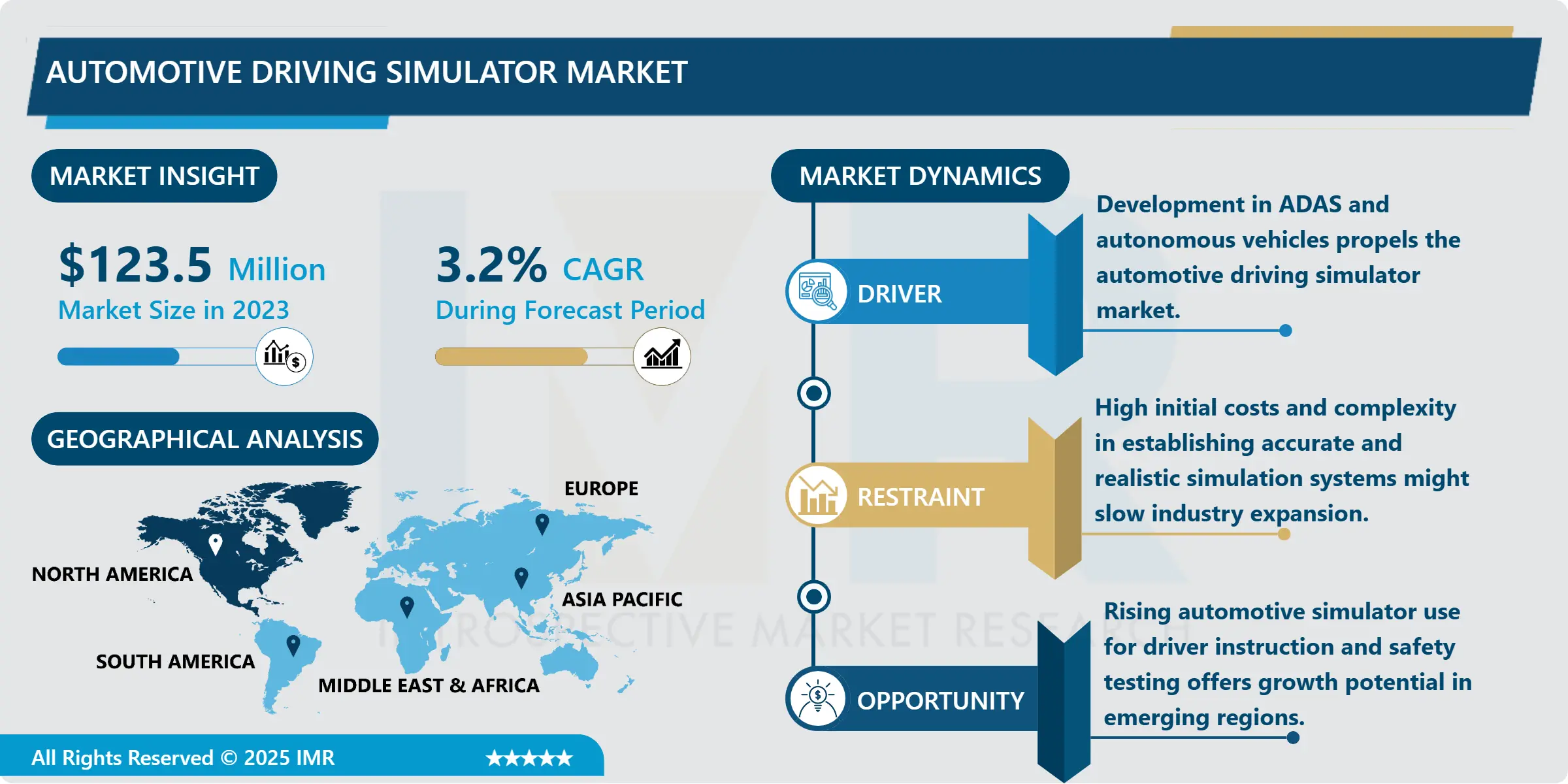
Automotive Driving Simulator Market Size Was Valued at USD 123.5 million in 2023, and is Projected to Reach USD 155.1 million by 2032, Growing at a CAGR of 3.2% From 2024-2032.

IMR Group
Description
Automotive Driving Simulator Market Synopsis:
Automotive Driving Simulator Market Size Was Valued at USD 123.5 million in 2023, and is Projected to Reach USD 155.1 million by 2032, Growing at a CAGR of 3.2% From 2024-2032.
The Automotive Driving Simulator Market is defined as the nascent market in which firms develop and implement driving simulator technologies that are employed to examine vehicle behavior, driver-vessel interfaces, and driving conditions in a safe environment. They are employed in the car making process to model and evaluate actions of the motorist, the efficiency of the car and the working of entities such as ABS and ESC. Several customers utilize the market, including automotive OEMs, tier 1 and tier 2 suppliers, universities, and research organizations as well as government bodies concerned with transportation security.
High-quality graphics, VR, real-time physics for automotive simulation, are the factors pushing the maturity of the automotive driving simulator market. These innovations make simulator more realistic to model real driving environment whereby engineers and researchers can emulate actual drive conditions as well as testing the newest automotive inventions like self-driving cars and electric machinery. Furthermore, the increasing trend in raising safety benchmarks for cars and evaluating new designs of vehicles, including electric and connected automobiles, is increasing the demand for complex driving simulators.
North America and Europe dominate the market due to their huge spending on automotive research and development, safety policies and additional incentives for automakers and technology industries. However, Asia-Pacific, especially China and India, is expected to grow at a faster pace as the automotive industry is growing at a very fast pace, automotive research activities are on the rise and automotive AS testimonials are gaining credibility for safety valuation and cars’ performance.
Automotive Driving Simulator Market Trend Analysis:
Shift Towards Cloud-Based Driving Simulators
Another interesting trend, which has emerged on the market of automotive driving simulators, is the use of cloud learning of driving simulation systems. Through cloud solutions, complex simulation data as well as others can be stored and processed, and shared almost in real-time, breaking the need for investing in expensive on premise infrastructure. This change is making advanced driving simulators more affordable for the automotive industry while still giving SMEs and other companies a way to introduce this kind of technology by offering affordable, modular systems that are easy to upgrade in the future if necessary.
Another advantage of cloud platforms is that big data, machine learning, as well as artificial intelligence, seamlessly can be introduced in the cloud environment through integration which in turn improves the simulation quality and car testing.
Enhanced Focus on Driver Behavior and Safety Simulations
The growing adoption of electric vehicles (EVs) and hybrid vehicles is driving the development of innovative drive shaft designs tailored to meet the unique demands of these high-power, high-torque vehicles. Traditional drive shafts were primarily designed to focus on power output and efficiency, but the rise of electric powertrains introduces new challenges due to significantly enhanced torque loads and diverse driveline requirements.
As electric and hybrid vehicles rely on advanced motors with high torque capabilities, drive shafts must be re-engineered to handle these increased stresses while maintaining efficiency and performance. This shift is particularly critical for EVs, where the electric motor’s torque characteristics and power density necessitate specialized drive shaft technologies. As the global market for electric vehicles continues to expand, there will be significant opportunities for the development of next-generation drive shafts, leading to further innovations that align with the needs of electric and hybrid drivetrains.
Automotive Driving Simulator Market Segment Analysis:
Automotive Driving Simulator Market is Segmented on the basis of Product Type, Application, and Region.
By Product Type, Car Simulator segment is expected to dominate the market during the forecast period
Automotive Driving Simulator Market by product type can be categorized into Car Simulators, Truck Simulators along with other products. Car simulators are the market leader because they are used in testing a wide range of passenger cars that may include, performance, safety and driver behavior tests.
Truck simulators are growing popular, especially for training and evaluation among logistics and commercial vehicle Industry where maneuverability, safety and fuel efficiency are important. Furthermore, the other category includes the bike, bus and off-road vehicle simulators, which are specially designed for certain specifications regarding vehicle design and driver education. Such a segmentation makes it possible to apply it in automotive research, driver training processes, and testing and validation through simulation.
By Application, Research segment expected to held the largest share
The market for automotive driving simulators is rapidly growing due to research activities, educational uses as well as entertainment. In the research field, Simulation rigs for assessment of vehicle dynamics, experimental evaluations of driver behaviour and for the creation of Forward looking ADAS systems are common. In training, they present an ideal place for learning all about driving, sharpens or hones some of the skills and at the same time, they reduce risk.
The entertainment industry, and especially gaming and virtual reality, use driving simulators to build realistic scenarios of actual car driving. With these applications, the market for automotive driving simulators expands as the demand rises; innovation in technologies and heightened investments in such simulation equipment are the primary catalysts for this market’s development.
Automotive Driving Simulator Market Regional Insights:
North America is Expected to Dominate the Market Over the Forecast period
North American region is likely to hold a larger share of the Automotive Driving Simulator Market, primarily due to growing customer demand for such simulation systems for automotive applications in the near future. Due to the presence of prime automotive industries and significant R & D spending for these Self-Driving cars and advanced driver assistance systems (ADAS), this market is fast growing in this region.
Also, the increasing regulatory standards for training drivers and the need to affordably and safely assess realistic testing environments also enhances the need for driving simulators. Because of the development of key automotive giants and or advanced technologies in North America, the market has got the prospects for increasing year on year throughout the projection period.
Active Key Players in the Automotive Driving Simulator Market:
AutoSim AS (Norway)
Teknotrove Simulator System Pvt. Ltd (India)
OKTAL (France), Cruden B.V. (Netherlands)
Mechanical Simulation Corporation (USA)
Dallara (Italy), Moog, Inc. (USA)
IPG Automotive (Germany)
ECA-Group (France)
Ansible Motion (UK)
Other Active Players.
Chapter 1: Introduction
1.1 Scope and Coverage
Chapter 2:Executive Summary
Chapter 3: Market Landscape
3.1 Market Dynamics
3.1.1 Drivers
3.1.2 Restraints
3.1.3 Opportunities
3.1.4 Challenges
3.2 Market Trend Analysis
3.3 PESTLE Analysis
3.4 Porter’s Five Forces Analysis
3.5 Industry Value Chain Analysis
3.6 Ecosystem
3.7 Regulatory Landscape
3.8 Price Trend Analysis
3.9 Patent Analysis
3.10 Technology Evolution
3.11 Investment Pockets
3.12 Import-Export Analysis
Chapter 4: Automotive Driving Simulator Market by Product Type
4.1 Automotive Driving Simulator Market Snapshot and Growth Engine
4.2 Automotive Driving Simulator Market Overview
4.3 Car Simulator
4.3.1 Introduction and Market Overview
4.3.2 Historic and Forecasted Market Size in Value USD and Volume Units (2017-2032F)
4.3.3 Key Market Trends, Growth Factors and Opportunities
4.3.4 Car Simulator: Geographic Segmentation Analysis
4.4 Truck Simulator
4.4.1 Introduction and Market Overview
4.4.2 Historic and Forecasted Market Size in Value USD and Volume Units (2017-2032F)
4.4.3 Key Market Trends, Growth Factors and Opportunities
4.4.4 Truck Simulator: Geographic Segmentation Analysis
4.5 and Others
4.5.1 Introduction and Market Overview
4.5.2 Historic and Forecasted Market Size in Value USD and Volume Units (2017-2032F)
4.5.3 Key Market Trends, Growth Factors and Opportunities
4.5.4 and Others: Geographic Segmentation Analysis
Chapter 5: Automotive Driving Simulator Market by Application
5.1 Automotive Driving Simulator Market Snapshot and Growth Engine
5.2 Automotive Driving Simulator Market Overview
5.3 Research
5.3.1 Introduction and Market Overview
5.3.2 Historic and Forecasted Market Size in Value USD and Volume Units (2017-2032F)
5.3.3 Key Market Trends, Growth Factors and Opportunities
5.3.4 Research: Geographic Segmentation Analysis
5.4 Training
5.4.1 Introduction and Market Overview
5.4.2 Historic and Forecasted Market Size in Value USD and Volume Units (2017-2032F)
5.4.3 Key Market Trends, Growth Factors and Opportunities
5.4.4 Training: Geographic Segmentation Analysis
5.5 and Entertainment
5.5.1 Introduction and Market Overview
5.5.2 Historic and Forecasted Market Size in Value USD and Volume Units (2017-2032F)
5.5.3 Key Market Trends, Growth Factors and Opportunities
5.5.4 and Entertainment: Geographic Segmentation Analysis
Chapter 6: Company Profiles and Competitive Analysis
6.1 Competitive Landscape
6.1.1 Competitive Benchmarking
6.1.2 Automotive Driving Simulator Market Share by Manufacturer (2023)
6.1.3 Industry BCG Matrix
6.1.4 Heat Map Analysis
6.1.5 Mergers and Acquisitions
6.2 AUTOSIM AS (NORWAY)
6.2.1 Company Overview
6.2.2 Key Executives
6.2.3 Company Snapshot
6.2.4 Role of the Company in the Market
6.2.5 Sustainability and Social Responsibility
6.2.6 Operating Business Segments
6.2.7 Product Portfolio
6.2.8 Business Performance
6.2.9 Key Strategic Moves and Recent Developments
6.2.10 SWOT Analysis
6.3 TEKNOTROVE SIMULATOR SYSTEM PVT. LTD (INDIA)
6.4 OKTAL (FRANCE)
6.5 CRUDEN B.V. (NETHERLANDS)
6.6 MECHANICAL SIMULATION CORPORATION (USA)
6.7 DALLARA (ITALY)
6.8 MOOG INC. (USA)
6.9 IPG AUTOMOTIVE (GERMANY)
6.10 ECA-GROUP (FRANCE)
6.11 ANSIBLE MOTION (UK)
6.12 OTHER ACTIVE PLAYERS
Chapter 7: Global Automotive Driving Simulator Market By Region
7.1 Overview
7.2. North America Automotive Driving Simulator Market
7.2.1 Key Market Trends, Growth Factors and Opportunities
7.2.2 Top Key Companies
7.2.3 Historic and Forecasted Market Size by Segments
7.2.4 Historic and Forecasted Market Size By Product Type
7.2.4.1 Car Simulator
7.2.4.2 Truck Simulator
7.2.4.3 and Others
7.2.5 Historic and Forecasted Market Size By Application
7.2.5.1 Research
7.2.5.2 Training
7.2.5.3 and Entertainment
7.2.6 Historic and Forecast Market Size by Country
7.2.6.1 US
7.2.6.2 Canada
7.2.6.3 Mexico
7.3. Eastern Europe Automotive Driving Simulator Market
7.3.1 Key Market Trends, Growth Factors and Opportunities
7.3.2 Top Key Companies
7.3.3 Historic and Forecasted Market Size by Segments
7.3.4 Historic and Forecasted Market Size By Product Type
7.3.4.1 Car Simulator
7.3.4.2 Truck Simulator
7.3.4.3 and Others
7.3.5 Historic and Forecasted Market Size By Application
7.3.5.1 Research
7.3.5.2 Training
7.3.5.3 and Entertainment
7.3.6 Historic and Forecast Market Size by Country
7.3.6.1 Russia
7.3.6.2 Bulgaria
7.3.6.3 The Czech Republic
7.3.6.4 Hungary
7.3.6.5 Poland
7.3.6.6 Romania
7.3.6.7 Rest of Eastern Europe
7.4. Western Europe Automotive Driving Simulator Market
7.4.1 Key Market Trends, Growth Factors and Opportunities
7.4.2 Top Key Companies
7.4.3 Historic and Forecasted Market Size by Segments
7.4.4 Historic and Forecasted Market Size By Product Type
7.4.4.1 Car Simulator
7.4.4.2 Truck Simulator
7.4.4.3 and Others
7.4.5 Historic and Forecasted Market Size By Application
7.4.5.1 Research
7.4.5.2 Training
7.4.5.3 and Entertainment
7.4.6 Historic and Forecast Market Size by Country
7.4.6.1 Germany
7.4.6.2 UK
7.4.6.3 France
7.4.6.4 The Netherlands
7.4.6.5 Italy
7.4.6.6 Spain
7.4.6.7 Rest of Western Europe
7.5. Asia Pacific Automotive Driving Simulator Market
7.5.1 Key Market Trends, Growth Factors and Opportunities
7.5.2 Top Key Companies
7.5.3 Historic and Forecasted Market Size by Segments
7.5.4 Historic and Forecasted Market Size By Product Type
7.5.4.1 Car Simulator
7.5.4.2 Truck Simulator
7.5.4.3 and Others
7.5.5 Historic and Forecasted Market Size By Application
7.5.5.1 Research
7.5.5.2 Training
7.5.5.3 and Entertainment
7.5.6 Historic and Forecast Market Size by Country
7.5.6.1 China
7.5.6.2 India
7.5.6.3 Japan
7.5.6.4 South Korea
7.5.6.5 Malaysia
7.5.6.6 Thailand
7.5.6.7 Vietnam
7.5.6.8 The Philippines
7.5.6.9 Australia
7.5.6.10 New Zealand
7.5.6.11 Rest of APAC
7.6. Middle East & Africa Automotive Driving Simulator Market
7.6.1 Key Market Trends, Growth Factors and Opportunities
7.6.2 Top Key Companies
7.6.3 Historic and Forecasted Market Size by Segments
7.6.4 Historic and Forecasted Market Size By Product Type
7.6.4.1 Car Simulator
7.6.4.2 Truck Simulator
7.6.4.3 and Others
7.6.5 Historic and Forecasted Market Size By Application
7.6.5.1 Research
7.6.5.2 Training
7.6.5.3 and Entertainment
7.6.6 Historic and Forecast Market Size by Country
7.6.6.1 Turkiye
7.6.6.2 Bahrain
7.6.6.3 Kuwait
7.6.6.4 Saudi Arabia
7.6.6.5 Qatar
7.6.6.6 UAE
7.6.6.7 Israel
7.6.6.8 South Africa
7.7. South America Automotive Driving Simulator Market
7.7.1 Key Market Trends, Growth Factors and Opportunities
7.7.2 Top Key Companies
7.7.3 Historic and Forecasted Market Size by Segments
7.7.4 Historic and Forecasted Market Size By Product Type
7.7.4.1 Car Simulator
7.7.4.2 Truck Simulator
7.7.4.3 and Others
7.7.5 Historic and Forecasted Market Size By Application
7.7.5.1 Research
7.7.5.2 Training
7.7.5.3 and Entertainment
7.7.6 Historic and Forecast Market Size by Country
7.7.6.1 Brazil
7.7.6.2 Argentina
7.7.6.3 Rest of SA
Chapter 8 Analyst Viewpoint and Conclusion
8.1 Recommendations and Concluding Analysis
8.2 Potential Market Strategies
Chapter 9 Research Methodology
9.1 Research Process
9.2 Primary Research
9.3 Secondary Research
Q1: What would be the forecast period in the Automotive Driving Simulator Market research report?
A1: The forecast period in the Automotive Driving Simulator Market research report is 2024-2032.
Q2: Who are the key players in the Automotive Driving Simulator Market?
A2: AutoSim AS (Norway), Teknotrove Simulator System Pvt. Ltd (India), OKTAL (France), Cruden B.V. (Netherlands), Mechanical Simulation Corporation (USA), Dallara (Italy), Moog, Inc. (USA), IPG Automotive (Germany), ECA-Group (France), Ansible Motion (UK), and Other Active Players.
Q3: What are the segments of the Automotive Driving Simulator Market?
A3: The Automotive Driving Simulator Market is segmented into Product Type, Application, and Region. By Product Type, the market is categorized into Car Simulator, Truck Simulator, and Others. By Application, the market is categorized into Research, Training, and Entertainment. By region, it is analyzed across North America (U.S., Canada, Mexico), Eastern Europe (Russia, Bulgaria, The Czech Republic, Hungary, Poland, Romania, Rest of Eastern Europe), Western Europe (Germany, UK, France, Netherlands, Italy, Spain, Rest of Western Europe), Asia Pacific (China, India, Japan, South Korea, Malaysia, Thailand, Vietnam, The Philippines, Australia, New Zealand, Rest of APAC), Middle East & Africa (Turkiye, Bahrain, Kuwait, Saudi Arabia, Qatar, UAE, Israel, South Africa), South America (Brazil, Argentina, Rest of SA).
Q4: What is the Automotive Driving Simulator Market?
A4: An automotive driving simulator is a system or platform designed to replicate real-world driving experiences for various purposes, such as training, research, development, and testing. It typically consists of a virtual environment, motion platforms, and controls that mimic a vehicle’s behavior, allowing users to interact with realistic scenarios. These simulators are widely used by automotive manufacturers, research institutions, and driving schools to test and improve vehicle designs, autonomous driving systems, driver assistance technologies, and to train drivers in a controlled and safe environment without the risks associated with real-world driving.
Q5: How big is the Automotive Driving Simulator Market?
A5: Automotive Driving Simulator Market Size Was Valued at USD 123.5 million in 2023, and is Projected to Reach USD 155.1 million by 2032, Growing at a CAGR of 3.2% From 2024-2032.
How to Buy a Report from eminsights.jp
On the product page, choose the license you want: Single-User License, Multi-User License or Enterprise License.
If you required report in your native language, then you can click on Translated Report button and fill out the form with report name and language you want, then our team will contact you as soon as possible.
Click the Buy Now button.
You will be redirected to the checkout page. Enter your company details and payment information.
Click Place Order to complete the purchase.
Confirmation: You’ll receive an order confirmation and our team will contact you shortly with your ordered report.
If you have any questions, fill out the contact form below or email us at bizdev@eminsights.net.
Thank you for choosing eminsights.jp!