Stay Ahead in Fast-Growing Economies.
Browse Reports Now
Automotive Air Intake Manifold Market – Size & Emerging Trends (2024–2032)
Automotive Air Intake Manifold is involved in an engine’s air intake system and provides air through the manifold to the cylinders of an automobile engine. It links the air filter to the intake valves and its objectives include ventilation, combustion, and performance objectives among the engines. Usually constructed of aluminium, plastic or composite material, intake manifold is one of those components that can improve fuel efficacies and emissions in internal combustion engines as for electric vehicles (EVs).

IMR Group
Description
Automotive Air Intake Manifold Market Synopsis:
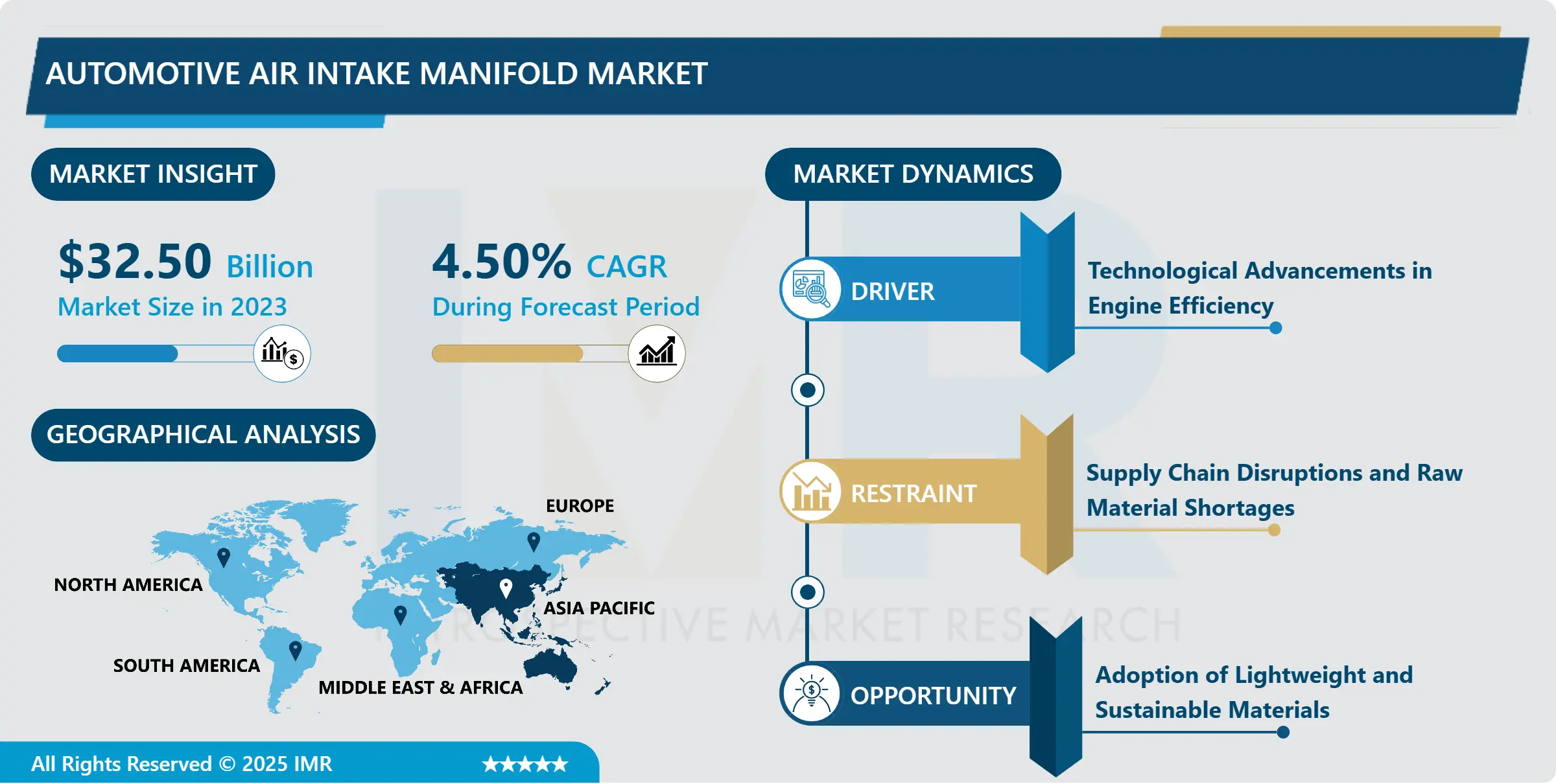
Automotive Air Intake Manifold Market Size Was Valued at USD 32.50 Billion in 2023, and is Projected to Reach USD 48.29 Billion by 2032, Growing at a CAGR of 4.50% From 2024-2032.
Automotive Air Intake Manifold is involved in an engine’s air intake system and provides air through the manifold to the cylinders of an automobile engine. It links the air filter to the intake valves and its objectives include ventilation, combustion, and performance objectives among the engines. Usually constructed of aluminium, plastic or composite material, intake manifold is one of those components that can improve fuel efficacies and emissions in internal combustion engines as for electric vehicles (EVs).
The emerging consumption of fuel-efficient automobiles is one that has greatly boosted the progress of the Automated Air Intake Manifold market. As automotive sources approach higher levels of emission control and incorporating ecology-friendly features, air intake manifolds play a major role in improving the combustion process, thereby improving fuel efficiency and reducing emissions. Also, current trends in reducing engine size and the need for lighter materials exerting pressure on companies to enhance the functionality of the air intake system.
Another driver relates to facilities, in that electric vehicles (EVs) are gradually being adopted because they are environmentally friendly. While EVs using internal combustion engines may no longer be a thing, the parts that go into this new kind of vehicles such as air intake manifolds are emerging. Automotive manufacturers are coming up with lightweight, durable and cost-effective intake manifolds that are enabling the emerging generation of EVs.
Automotive Air Intake Manifold Market Trend Analysis:
Statures and Current Patterns of Automotive Air Intake Manifold Market
An emerging market trend is thus switched towards the higher utilization of lighter plastics as well as composites, primarily for the reduction of the car’s weight. This is in harmony with the currently adopted strategies in the industry where (Output, quality) companies are aiming at producing lighter vehicles in order to be environmentally efficient as well as exhaust less and consume less fuel than the heavier ones. They are also being designed to provide more robust and durable parts, for the associated complications of high-temperature and corrosive atmospheres found in the engine compartment.
Other trend is the usage of new advanced manufacturing technologies like 3D printing and injection molding which helps to design advanced form of air intake manifold. These technologies allow a more accurate coupling of the flow features into the combustion chamber thus enhancing the performance of the engine and decreasing the fabrication costs. These innovations are important in attaining increased potentials of demand for high-performance and cost-efficient automotive parts.
The increasing popularity for EV
The increasing popularity for EVs leads to considerable opportunities in the market for automotive air intake manifold. EVS do not need conventional air intake systems; nonetheless, air management needs rise due to electric powertrains’ expanding utilization. For instance, air intake manifold design may be used in electric vehicles whose components are being developed by manufacturers as other elements such as thermal management systems and air-cooling systems.
There is a large potential in the aftermarket sector because car owners are becoming more into tuning their cars today. Opportunities exist for aftermarket suppliers to sell high-performance intake manifolds that offer better performance and fuel efficiency than standard parts, especially in markets of growing tuner and customization niches.
Automotive Air Intake Manifold Market Segment Analysis:
Automotive Air Intake Manifold Market is Segmented on the basis of Material type, Vehicle Type, Engine Type, Fuel Type, and Region.
By Material Type, Aluminum segment is expected to dominate the market during the forecast period
Automotive Air Intake Manifold market is mainly classified by the material type such as aluminum, plastic, composites and others. Aluminum is strong, heat resistant, and lightweight, and manifolds made from this material are quite common; newer, less expensive materials such as plastics are also being used because they allow for unique designs. Due to the influence and impact that composites make between weight and strength, they are gradually being used in high-performance vehicles.
The “others” part may contain different extended miscellaneous materials for separate usage, for example, belonging to the polymer group or combined composite elements that have several benefits, as compared to the basic material types.
By Vehicle Type, Passenger Cars segment expected to held the largest share
The air intake manifold market is segmented cross-sectionally by type of transport into passenger cars, light and heavy trucks, and electric vehicles (EVs). Among these, passenger cars represent the largest share of the market, largely due to the extensive use of conventional internal combustion engine (ICE) automobiles, which continue to dominate global vehicle sales despite the rise of alternative powertrains.
Light trucks, buses, and other commercial vehicles also contribute significantly to market demand, as their engines typically require more robust and durable intake systems to support high levels of utilization and extended operating lifespans. Meanwhile, although still representing a relatively small portion of the overall market, the sales of electric vehicles are steadily increasing. This trend is gradually putting new pressures on automobile manufacturers, encouraging the exploration and development of innovative air intake concepts designed specifically to meet the needs of electric drivetrains and their associated components.
Automotive Air Intake Manifold Market Regional Insights:
Asia Pacific is Expected to Dominate the Market Over the Forecast period
Asia Pacific is by far the most prominent market for Automotive Air Intake Manifold, owing to increased projector sales imperative automotive industries some big player of automotive in China, Japan, and India. With a large number of autos produced in the region, and rising wages due to the increasing population’s middle-class status, the market for both passenger and light commercial vehicles is set to rise. Also, the upswing in the demand to produce electric vehicles in the Asia Pacific is also playing a role in defying the region’s market as well. Since many of the leading companies have strategically leveraged manufacturing in this area, APAC is likely to emerge as the market leader in the near future.
Asia Pacific is considered to be another vital region for the global automotive supply chain too due to the type of manufacturing facilities and automotive exports numbers from countries like China. The steady appearance of emergent markets in the region, particularly India, also contributes to increasing demand for both ICE vehicles and EVs and will also foster the need for automotive air intake manifolds for the next few years.
Active Key Players in the Automotive Air Intake Manifold Market:
Aisin Seiki Co., Ltd. (Japan)
Delphi Technologies (USA)
Denso Corporation (Japan)
Hyundai Mobis (South Korea)
Magna International (Canada)
MANN+HUMMEL (Germany)
Rheinmetall Automotive (Germany)
TI Fluid Systems (UK)
Valeo (France)
Woodward, Inc. (USA), and Other Active Players
Chapter 1: Introduction
1.1 Scope and Coverage
Chapter 2:Executive Summary
Chapter 3: Market Landscape
3.1 Market Dynamics
3.1.1 Drivers
3.1.2 Restraints
3.1.3 Opportunities
3.1.4 Challenges
3.2 Market Trend Analysis
3.3 PESTLE Analysis
3.4 Porter’s Five Forces Analysis
3.5 Industry Value Chain Analysis
3.6 Ecosystem
3.7 Regulatory Landscape
3.8 Price Trend Analysis
3.9 Patent Analysis
3.10 Technology Evolution
3.11 Investment Pockets
3.12 Import-Export Analysis
Chapter 4: Automotive Air Intake Manifold Market by Material Type
4.1 Automotive Air Intake Manifold Market Snapshot and Growth Engine
4.2 Automotive Air Intake Manifold Market Overview
4.3 Aluminum
4.3.1 Introduction and Market Overview
4.3.2 Historic and Forecasted Market Size in Value USD and Volume Units (2017-2032F)
4.3.3 Key Market Trends, Growth Factors and Opportunities
4.3.4 Aluminum: Geographic Segmentation Analysis
4.4 Plastic
4.4.1 Introduction and Market Overview
4.4.2 Historic and Forecasted Market Size in Value USD and Volume Units (2017-2032F)
4.4.3 Key Market Trends, Growth Factors and Opportunities
4.4.4 Plastic: Geographic Segmentation Analysis
4.5 Composites
4.5.1 Introduction and Market Overview
4.5.2 Historic and Forecasted Market Size in Value USD and Volume Units (2017-2032F)
4.5.3 Key Market Trends, Growth Factors and Opportunities
4.5.4 Composites: Geographic Segmentation Analysis
4.6 Others
4.6.1 Introduction and Market Overview
4.6.2 Historic and Forecasted Market Size in Value USD and Volume Units (2017-2032F)
4.6.3 Key Market Trends, Growth Factors and Opportunities
4.6.4 Others: Geographic Segmentation Analysis
Chapter 5: Automotive Air Intake Manifold Market by Vehicle Type
5.1 Automotive Air Intake Manifold Market Snapshot and Growth Engine
5.2 Automotive Air Intake Manifold Market Overview
5.3 Passenger Cars
5.3.1 Introduction and Market Overview
5.3.2 Historic and Forecasted Market Size in Value USD and Volume Units (2017-2032F)
5.3.3 Key Market Trends, Growth Factors and Opportunities
5.3.4 Passenger Cars: Geographic Segmentation Analysis
5.4 Commercial Vehicles
5.4.1 Introduction and Market Overview
5.4.2 Historic and Forecasted Market Size in Value USD and Volume Units (2017-2032F)
5.4.3 Key Market Trends, Growth Factors and Opportunities
5.4.4 Commercial Vehicles: Geographic Segmentation Analysis
5.5 Electric Vehicles (EVs)
5.5.1 Introduction and Market Overview
5.5.2 Historic and Forecasted Market Size in Value USD and Volume Units (2017-2032F)
5.5.3 Key Market Trends, Growth Factors and Opportunities
5.5.4 Electric Vehicles (EVs): Geographic Segmentation Analysis
Chapter 6: Automotive Air Intake Manifold Market by Engine Type
6.1 Automotive Air Intake Manifold Market Snapshot and Growth Engine
6.2 Automotive Air Intake Manifold Market Overview
6.3 Internal Combustion Engine (ICE)
6.3.1 Introduction and Market Overview
6.3.2 Historic and Forecasted Market Size in Value USD and Volume Units (2017-2032F)
6.3.3 Key Market Trends, Growth Factors and Opportunities
6.3.4 Internal Combustion Engine (ICE): Geographic Segmentation Analysis
6.4 Electric Motor
6.4.1 Introduction and Market Overview
6.4.2 Historic and Forecasted Market Size in Value USD and Volume Units (2017-2032F)
6.4.3 Key Market Trends, Growth Factors and Opportunities
6.4.4 Electric Motor: Geographic Segmentation Analysis
Chapter 7: Automotive Air Intake Manifold Market by Fuel Type
7.1 Automotive Air Intake Manifold Market Snapshot and Growth Engine
7.2 Automotive Air Intake Manifold Market Overview
7.3 Gasoline
7.3.1 Introduction and Market Overview
7.3.2 Historic and Forecasted Market Size in Value USD and Volume Units (2017-2032F)
7.3.3 Key Market Trends, Growth Factors and Opportunities
7.3.4 Gasoline: Geographic Segmentation Analysis
7.4 Diesel
7.4.1 Introduction and Market Overview
7.4.2 Historic and Forecasted Market Size in Value USD and Volume Units (2017-2032F)
7.4.3 Key Market Trends, Growth Factors and Opportunities
7.4.4 Diesel: Geographic Segmentation Analysis
7.5 Alternative Fuels
7.5.1 Introduction and Market Overview
7.5.2 Historic and Forecasted Market Size in Value USD and Volume Units (2017-2032F)
7.5.3 Key Market Trends, Growth Factors and Opportunities
7.5.4 Alternative Fuels: Geographic Segmentation Analysis
Chapter 8: Company Profiles and Competitive Analysis
8.1 Competitive Landscape
8.1.1 Competitive Benchmarking
8.1.2 Automotive Air Intake Manifold Market Share by Manufacturer (2023)
8.1.3 Industry BCG Matrix
8.1.4 Heat Map Analysis
8.1.5 Mergers and Acquisitions
8.2 MAGNA INTERNATIONAL (CANADA)
8.2.1 Company Overview
8.2.2 Key Executives
8.2.3 Company Snapshot
8.2.4 Role of the Company in the Market
8.2.5 Sustainability and Social Responsibility
8.2.6 Operating Business Segments
8.2.7 Product Portfolio
8.2.8 Business Performance
8.2.9 Key Strategic Moves and Recent Developments
8.2.10 SWOT Analysis
8.3 DENSO CORPORATION (JAPAN)
8.4 MANN+HUMMEL (GERMANY)
8.5 VALEO (FRANCE)
8.6 HYUNDAI MOBIS (SOUTH KOREA)
8.7 AISIN SEIKI CO. LTD. (JAPAN)
8.8 WOODWARD INC. (USA)
8.9 DELPHI TECHNOLOGIES (USA)
8.10 RHEINMETALL AUTOMOTIVE (GERMANY)
8.11 TI FLUID SYSTEMS (UK)
8.12 OTHER ACTIVE PLAYERS
Chapter 9: Global Automotive Air Intake Manifold Market By Region
9.1 Overview
9.2. North America Automotive Air Intake Manifold Market
9.2.1 Key Market Trends, Growth Factors and Opportunities
9.2.2 Top Key Companies
9.2.3 Historic and Forecasted Market Size by Segments
9.2.4 Historic and Forecasted Market Size By Material Type
9.2.4.1 Aluminum
9.2.4.2 Plastic
9.2.4.3 Composites
9.2.4.4 Others
9.2.5 Historic and Forecasted Market Size By Vehicle Type
9.2.5.1 Passenger Cars
9.2.5.2 Commercial Vehicles
9.2.5.3 Electric Vehicles (EVs)
9.2.6 Historic and Forecasted Market Size By Engine Type
9.2.6.1 Internal Combustion Engine (ICE)
9.2.6.2 Electric Motor
9.2.7 Historic and Forecasted Market Size By Fuel Type
9.2.7.1 Gasoline
9.2.7.2 Diesel
9.2.7.3 Alternative Fuels
9.2.8 Historic and Forecast Market Size by Country
9.2.8.1 US
9.2.8.2 Canada
9.2.8.3 Mexico
9.3. Eastern Europe Automotive Air Intake Manifold Market
9.3.1 Key Market Trends, Growth Factors and Opportunities
9.3.2 Top Key Companies
9.3.3 Historic and Forecasted Market Size by Segments
9.3.4 Historic and Forecasted Market Size By Material Type
9.3.4.1 Aluminum
9.3.4.2 Plastic
9.3.4.3 Composites
9.3.4.4 Others
9.3.5 Historic and Forecasted Market Size By Vehicle Type
9.3.5.1 Passenger Cars
9.3.5.2 Commercial Vehicles
9.3.5.3 Electric Vehicles (EVs)
9.3.6 Historic and Forecasted Market Size By Engine Type
9.3.6.1 Internal Combustion Engine (ICE)
9.3.6.2 Electric Motor
9.3.7 Historic and Forecasted Market Size By Fuel Type
9.3.7.1 Gasoline
9.3.7.2 Diesel
9.3.7.3 Alternative Fuels
9.3.8 Historic and Forecast Market Size by Country
9.3.8.1 Bulgaria
9.3.8.2 The Czech Republic
9.3.8.3 Hungary
9.3.8.4 Poland
9.3.8.5 Romania
9.3.8.6 Rest of Eastern Europe
9.4. Western Europe Automotive Air Intake Manifold Market
9.4.1 Key Market Trends, Growth Factors and Opportunities
9.4.2 Top Key Companies
9.4.3 Historic and Forecasted Market Size by Segments
9.4.4 Historic and Forecasted Market Size By Material Type
9.4.4.1 Aluminum
9.4.4.2 Plastic
9.4.4.3 Composites
9.4.4.4 Others
9.4.5 Historic and Forecasted Market Size By Vehicle Type
9.4.5.1 Passenger Cars
9.4.5.2 Commercial Vehicles
9.4.5.3 Electric Vehicles (EVs)
9.4.6 Historic and Forecasted Market Size By Engine Type
9.4.6.1 Internal Combustion Engine (ICE)
9.4.6.2 Electric Motor
9.4.7 Historic and Forecasted Market Size By Fuel Type
9.4.7.1 Gasoline
9.4.7.2 Diesel
9.4.7.3 Alternative Fuels
9.4.8 Historic and Forecast Market Size by Country
9.4.8.1 Germany
9.4.8.2 UK
9.4.8.3 France
9.4.8.4 Netherlands
9.4.8.5 Italy
9.4.8.6 Russia
9.4.8.7 Spain
9.4.8.8 Rest of Western Europe
9.5. Asia Pacific Automotive Air Intake Manifold Market
9.5.1 Key Market Trends, Growth Factors and Opportunities
9.5.2 Top Key Companies
9.5.3 Historic and Forecasted Market Size by Segments
9.5.4 Historic and Forecasted Market Size By Material Type
9.5.4.1 Aluminum
9.5.4.2 Plastic
9.5.4.3 Composites
9.5.4.4 Others
9.5.5 Historic and Forecasted Market Size By Vehicle Type
9.5.5.1 Passenger Cars
9.5.5.2 Commercial Vehicles
9.5.5.3 Electric Vehicles (EVs)
9.5.6 Historic and Forecasted Market Size By Engine Type
9.5.6.1 Internal Combustion Engine (ICE)
9.5.6.2 Electric Motor
9.5.7 Historic and Forecasted Market Size By Fuel Type
9.5.7.1 Gasoline
9.5.7.2 Diesel
9.5.7.3 Alternative Fuels
9.5.8 Historic and Forecast Market Size by Country
9.5.8.1 China
9.5.8.2 India
9.5.8.3 Japan
9.5.8.4 South Korea
9.5.8.5 Malaysia
9.5.8.6 Thailand
9.5.8.7 Vietnam
9.5.8.8 The Philippines
9.5.8.9 Australia
9.5.8.10 New Zealand
9.5.8.11 Rest of APAC
9.6. Middle East & Africa Automotive Air Intake Manifold Market
9.6.1 Key Market Trends, Growth Factors and Opportunities
9.6.2 Top Key Companies
9.6.3 Historic and Forecasted Market Size by Segments
9.6.4 Historic and Forecasted Market Size By Material Type
9.6.4.1 Aluminum
9.6.4.2 Plastic
9.6.4.3 Composites
9.6.4.4 Others
9.6.5 Historic and Forecasted Market Size By Vehicle Type
9.6.5.1 Passenger Cars
9.6.5.2 Commercial Vehicles
9.6.5.3 Electric Vehicles (EVs)
9.6.6 Historic and Forecasted Market Size By Engine Type
9.6.6.1 Internal Combustion Engine (ICE)
9.6.6.2 Electric Motor
9.6.7 Historic and Forecasted Market Size By Fuel Type
9.6.7.1 Gasoline
9.6.7.2 Diesel
9.6.7.3 Alternative Fuels
9.6.8 Historic and Forecast Market Size by Country
9.6.8.1 Turkey
9.6.8.2 Bahrain
9.6.8.3 Kuwait
9.6.8.4 Saudi Arabia
9.6.8.5 Qatar
9.6.8.6 UAE
9.6.8.7 Israel
9.6.8.8 South Africa
9.7. South America Automotive Air Intake Manifold Market
9.7.1 Key Market Trends, Growth Factors and Opportunities
9.7.2 Top Key Companies
9.7.3 Historic and Forecasted Market Size by Segments
9.7.4 Historic and Forecasted Market Size By Material Type
9.7.4.1 Aluminum
9.7.4.2 Plastic
9.7.4.3 Composites
9.7.4.4 Others
9.7.5 Historic and Forecasted Market Size By Vehicle Type
9.7.5.1 Passenger Cars
9.7.5.2 Commercial Vehicles
9.7.5.3 Electric Vehicles (EVs)
9.7.6 Historic and Forecasted Market Size By Engine Type
9.7.6.1 Internal Combustion Engine (ICE)
9.7.6.2 Electric Motor
9.7.7 Historic and Forecasted Market Size By Fuel Type
9.7.7.1 Gasoline
9.7.7.2 Diesel
9.7.7.3 Alternative Fuels
9.7.8 Historic and Forecast Market Size by Country
9.7.8.1 Brazil
9.7.8.2 Argentina
9.7.8.3 Rest of SA
Chapter 10 Analyst Viewpoint and Conclusion
10.1 Recommendations and Concluding Analysis
10.2 Potential Market Strategies
Chapter 11 Research Methodology
11.1 Research Process
11.2 Primary Research
11.3 Secondary Research
Q1: What would be the forecast period in the Automotive Air Intake Manifold Market research report?
A1: The forecast period in the Automotive Air Intake Manifold Market research report is 2024-2032.
Q2: Who are the key players in the Automotive Air Intake Manifold Market?
A2: Aisin Seiki Co., Ltd. (Japan), Delphi Technologies (USA), Denso Corporation (Japan), Hyundai Mobis (South Korea), Magna International (Canada), MANN+HUMMEL (Germany), Rheinmetall Automotive (Germany), TI Fluid Systems (UK), Valeo (France), Woodward, Inc. (USA), and Other Active Players.
Q3: What are the segments of the Automotive Air Intake Manifold Market?
A3: The Automotive Air Intake Manifold Market is segmented into Material type, Vehicle Type, Engine Type, Fuel Type, and Region. By Material Type, the market is categorized into Aluminum, Plastic, Composites, Others. By Vehicle Type, the market is categorized into Passenger Cars, Commercial Vehicles, Electric Vehicles (EVs). By Engine Type, the market is categorized into Internal Combustion Engine (ICE), Electric Motor). By Fuel Type, the market is categorized into Gasoline, Diesel, Alternative Fuels. By region, it is analyzed across North America (U.S., Canada, Mexico), Eastern Europe (Russia, Bulgaria, The Czech Republic, Hungary, Poland, Romania, Rest of Eastern Europe), Western Europe (Germany, UK, France, Netherlands, Italy, Spain, Rest of Western Europe), Asia Pacific (China, India, Japan, South Korea, Malaysia, Thailand, Vietnam, The Philippines, Australia, New Zealand, Rest of APAC), Middle East & Africa (Turkiye, Bahrain, Kuwait, Saudi Arabia, Qatar, UAE, Israel, South Africa), South America (Brazil, Argentina, Rest of SA).
Q4: What is the Automotive Air Intake Manifold Market?
A4: Automotive Air Intake Manifold is involved in an engine’s air intake system and provides air through the manifold to the cylinders of an automobile engine. It links the air filter to the intake valves and its objectives include ventilation, combustion, and performance objectives among the engines. Usually constructed of aluminium, plastic or composite material, intake manifold is one of those components that can improve fuel efficacies and emissions in internal combustion engines as for electric vehicles (EVs).
Q5: How big is the Automotive Air Intake Manifold Market?
A5: Automotive Air Intake Manifold Market Size Was Valued at USD 32.50 Billion in 2023, and is Projected to Reach USD 48.29 Billion by 2032, Growing at a CAGR of 4.50% From 2024-2032.
How to Buy a Report from eminsights.jp
On the product page, choose the license you want: Single-User License, Multi-User License or Enterprise License.
If you required report in your native language, then you can click on Translated Report button and fill out the form with report name and language you want, then our team will contact you as soon as possible.
Click the Buy Now button.
You will be redirected to the checkout page. Enter your company details and payment information.
Click Place Order to complete the purchase.
Confirmation: You’ll receive an order confirmation and our team will contact you shortly with your ordered report.
If you have any questions, fill out the contact form below or email us at bizdev@eminsights.net.
Thank you for choosing eminsights.jp!