Stay Ahead in Fast-Growing Economies.
Browse Reports Now
Aspheric Lens Market – Global Size, Share & Industry Trends
An aspheric lens is an optical design with a non-spherical, curved surface, allowing for the correction of optical aberrations and distortions. This design enhances image quality, reduces spherical aberrations, and minimizes visual distortions in applications like cameras, eyeglasses, and medical devices. Aspheric lenses contribute to improved performance, light-gathering efficiency, and compact optical systems.

IMR Group
Description
Aspheric Lens Market Synopsis
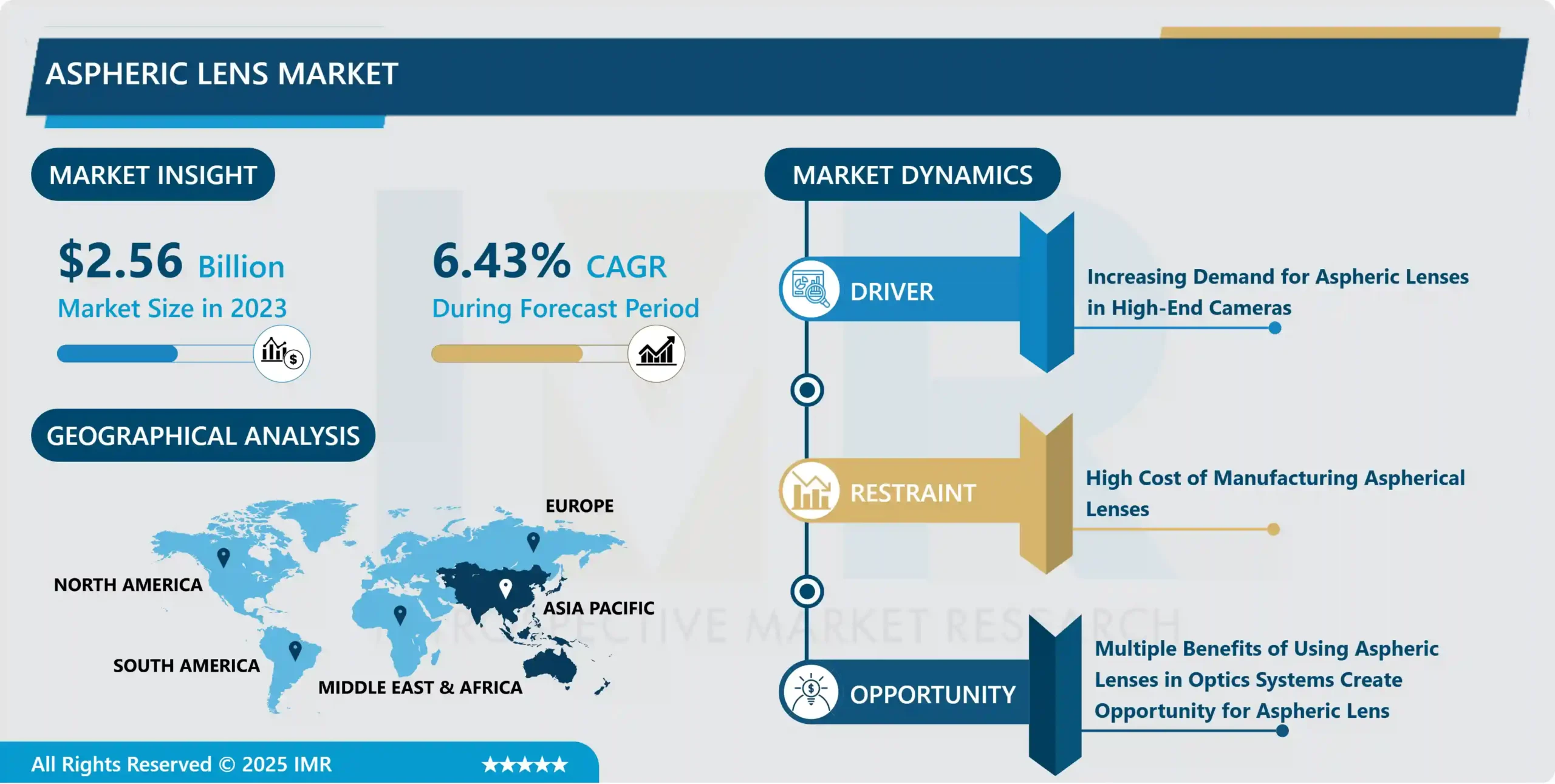
Global Aspheric Lens Market Size Was Valued at USD 2.56 Billion in 2023 and is Projected to Reach USD 4.49 Billion by 2032, Growing at a CAGR of 6.43% From 2024-2032.
An aspheric lens is an optical design with a non-spherical, curved surface, allowing for the correction of optical aberrations and distortions. This design enhances image quality, reduces spherical aberrations, and minimizes visual distortions in applications like cameras, eyeglasses, and medical devices. Aspheric lenses contribute to improved performance, light-gathering efficiency, and compact optical systems.
Aspheric lenses have become increasingly prominent in optical technology, presenting notable advantages compared to traditional spherical lenses. Distinguished by their non-uniform curvature across the surface, aspheric lenses effectively mitigate optical aberrations such as spherical aberration, coma, and distortion. This results in superior image quality, reduced glare, and enhanced peripheral vision. Moreover, the innovative design facilitates the creation of lighter and more compact optical systems, making them particularly valuable in industries such as cameras, eyewear, and medical devices.
The market trend for aspheric lenses reflects rising demand for top-tier optics across diverse applications. Sectors like automotive, with a reliance on head-up displays and advanced driver-assistance systems, as well as consumer electronics, where compact camera modules are essential, are driving the increasing need for aspheric lenses.
The healthcare industry, benefiting from aspheric lenses in medical imaging devices and ophthalmic applications, is also contributing to this surge in demand. As technological advancements continue, the quest for precision optics with enhanced performance is anticipated to propel the market for aspheric lenses, positioning them as pivotal components in the evolving landscape of optical technology.
Aspheric Lens Market Trend Analysis
Increasing Demand for aspheric lenses in High-End Cameras
The escalating desire for aspheric lenses in premium cameras stems from a relentless quest for superior optical performance in professional photography and videography. Aspheric lenses, characterized by their non-uniform curvature design, effectively minimize optical aberrations like spherical aberration and distortion, resulting in unmatched image quality. Discerning photographers and content creators, in search of precision and clarity in their visual compositions, gravitate towards these lenses for their capability to capture sharp, distortion-free images even in challenging conditions.
The compact and lightweight attributes of aspheric lenses seamlessly align with the portability needs of high-end camera systems, ensuring photographers can effortlessly carry and maneuver advanced equipment. This surge in demand is further fuelled by technological advancements, as aspheric lenses empower manufacturers to achieve greater compactness without compromising optical excellence, addressing the evolving requirements of professionals who demand unwavering performance from their imaging tools.
Multiple benefits of using aspheric lenses in optics systems Create Opportunities for Aspheric Lens
The utilization of aspheric lenses in optical systems presents a multitude of benefits, creating significant opportunities for their widespread adoption. Firstly, aspheric lenses mitigate optical aberrations like spherical aberration and distortion, ensuring superior image quality and clarity. This improvement in optical performance makes them indispensable in industries like photography, where precision is paramount. Secondly, their ability to reduce glare enhances visibility, making them ideal for applications such as automotive head-up displays and cameras.
Moreover, the compact and lightweight design of aspheric lenses allows for more portable and streamlined optical systems, contributing to advancements in consumer electronics and medical devices. As the demand for high-quality optics continues to rise across diverse sectors, the versatility, improved performance, and customized applications of aspheric lenses position them as key components, opening doors to opportunities in automotive, healthcare, consumer electronics, and beyond.
Aspheric Lens Market Segment Analysis:
Aspheric Lens Market Segmented on the basis of Type, Technology, Coating Type, Application, and Distribution Channel.
By Type, Glass Aspherical Lens segment is expected to dominate the market during the forecast period
The Glass Aspherical Lens segment is anticipated to lead the market throughout the forecast period, driven by several key factors. This dominance is primarily attributed to the superior optical characteristics of glass, including higher refractive indices and lower dispersion compared to plastic alternatives. These attributes result in elevated image quality, diminished chromatic aberration, and overall enhanced optical performance. The capacity of glass to achieve intricate and precise shapes makes it the material of choice for crafting high-quality aspherical lenses, meeting the exacting standards of diverse industries.
Moreover, glass demonstrates superior thermal stability and resilience to environmental factors, ensuring the longevity and robustness of optical systems. This resilience is particularly vital in applications such as automotive, aerospace, and medical devices, where sustained performance is critical.
The prevalence of the Glass Aspherical Lens segment is also influenced by the industry’s preference for materials offering excellent transparency and minimal light dispersion qualities that are inherent to glass. As industries increasingly seek optical components with uncompromised performance, glass aspherical lenses emerge as the favored option, sustaining their market dominance. Ongoing advancements in glass manufacturing processes further solidify the segment’s lead, promising continuous enhancements in optical quality and adaptability.
By Coating Type, Anti-reflective Coatings segment is expected to dominate the market during the forecast period
The Anti-Reflective Coatings (AR coatings) segment is anticipated to maintain its market leadership during the forecast period, primarily due to its pivotal role in augmenting optical performance and reducing unwanted reflections. AR coatings are meticulously crafted to diminish surface reflections, enabling a greater influx of light through the lens for improved image clarity, diminished glare, and heightened contrast. This makes lenses with AR coatings highly desirable in a multitude of applications, including eyewear, cameras, and optical instruments.
In sectors where, top-notch visual experiences and image quality are imperative, such as high-tech devices, automotive displays, and precision optical systems, the demand for AR-coated lenses remains robust.
The increasing recognition of the advantages offered by AR coatings, both among consumers and industries, further solidifies its prominence in the market. As ongoing technological advancements continue to push the boundaries of coating innovation, the AR segment is poised to sustain its market dominance, meeting the escalating need for superior optical performance across various industries.
Aspheric Lens Market Regional Insights:
Asia Pacific is Expected to Dominate the Market Over the Forecast period
The forecasted dominance of Asia-Pacific in the aspheric lens market is underpinned by various compelling factors. The region is currently experiencing rapid industrialization, economic expansion, and technological progress, particularly evident in countries such as China, Japan, and South Korea. This growth surge propels an increased demand for cutting-edge optical solutions, with aspheric lenses emerging as a pivotal component across diverse industries.
The flourishing consumer electronics industry, combined with the widespread adoption of advanced imaging technologies in automotive contexts, positions Asia-Pacific as a primary catalyst for market growth. Furthermore, the region’s robust manufacturing capabilities establish it as a key hub for the production of precision optical components. The escalating population and rising disposable incomes amplify the need for products like cameras, smartphones, and medical devices, all of which heavily rely on the functionality of aspheric lenses.
Government-led initiatives supporting innovation and technological advancements further contribute to Asia-Pacific’s prominence in the aspheric lens market. With sustained economic and technological leadership, the region is poised to maintain its dominance, providing lucrative prospects for industry stakeholders.
Aspheric Lens Market Top Key Players:
SCHOTT AG (Germany)
ZEISS Group (Germany)
AGC Inc. (Japan)
Panasonic Corporation (Japan)
Kantatsu (Japan)
Kinko (Japan)
SEIKO OPTICAL PRODUCTS CO.LTD (Japan)
Sekonix (Japan)
Canon India Pvt Ltd. (India)
CoAsia Optics (China)
Huaxin Optical Tech (China)
Aoet (China)
Sunny Optical Technology (China)
Newmax (China)
Ofilm (China)
Genius Electronic Optical (GSEO) (Taiwan)
Asia Optical (Taiwan)
Largan Precision Co.Ltd. (Taiwan)
HOYA VISION CARE COMPANY (Thailand)
aac technologies (South Korea)
Key Industry Developments in the Aspheric Lens Market:
In October 2023, Hoya Corporation announced its acquisition of Gentec Electro-Optics. This strategic acquisition marks a significant expansion for Hoya into the industrial and scientific aspheric lens market. By incorporating Gentec’s proficiency in high-precision laser beam measurement and calibration systems, Hoya aims to further strengthen its position in these specialized sectors, emphasizing a strategic move toward diversification and technological advancement.
In September 2023, Canon introduced the RF 15-30mm F/2.8L IS USM lens. Designed for professionals in photography and videography, this high-quality wide-angle lens incorporates advanced aspheric elements to achieve outstanding sharpness and minimal distortion. The release caters to the discerning needs of photographers and videographers who demand precision and excellence in their equipment.
Chapter 1: Introduction
1.1 Scope and Coverage
Chapter 2:Executive Summary
Chapter 3: Market Landscape
3.1 Market Dynamics
3.1.1 Drivers
3.1.2 Restraints
3.1.3 Opportunities
3.1.4 Challenges
3.2 Market Trend Analysis
3.3 PESTLE Analysis
3.4 Porter’s Five Forces Analysis
3.5 Industry Value Chain Analysis
3.6 Ecosystem
3.7 Regulatory Landscape
3.8 Price Trend Analysis
3.9 Patent Analysis
3.10 Technology Evolution
3.11 Investment Pockets
3.12 Import-Export Analysis
Chapter 4: Aspheric Lens Market by Type (2018-2032)
4.1 Aspheric Lens Market Snapshot and Growth Engine
4.2 Market Overview
4.3 Glass Aspherical Lens
4.3.1 Introduction and Market Overview
4.3.2 Historic and Forecasted Market Size in Value USD and Volume Units
4.3.3 Key Market Trends, Growth Factors, and Opportunities
4.3.4 Geographic Segmentation Analysis
4.4 Plastic Aspherical lens
Chapter 5: Aspheric Lens Market by Technology (2018-2032)
5.1 Aspheric Lens Market Snapshot and Growth Engine
5.2 Market Overview
5.3 Precision Glass Molding
5.3.1 Introduction and Market Overview
5.3.2 Historic and Forecasted Market Size in Value USD and Volume Units
5.3.3 Key Market Trends, Growth Factors, and Opportunities
5.3.4 Geographic Segmentation Analysis
5.4 Hybrid Molding
5.5 Diamond Turning
Chapter 6: Aspheric Lens Market by Coating Type (2018-2032)
6.1 Aspheric Lens Market Snapshot and Growth Engine
6.2 Market Overview
6.3 Anti-reflective Coatings
6.3.1 Introduction and Market Overview
6.3.2 Historic and Forecasted Market Size in Value USD and Volume Units
6.3.3 Key Market Trends, Growth Factors, and Opportunities
6.3.4 Geographic Segmentation Analysis
6.4 Hydrophobic Coatings
6.5 Oleophobic Coatings
Chapter 7: Aspheric Lens Market by Application (2018-2032)
7.1 Aspheric Lens Market Snapshot and Growth Engine
7.2 Market Overview
7.3 Cameras and Photography
7.3.1 Introduction and Market Overview
7.3.2 Historic and Forecasted Market Size in Value USD and Volume Units
7.3.3 Key Market Trends, Growth Factors, and Opportunities
7.3.4 Geographic Segmentation Analysis
7.4 Medical Devices
7.5 Optical Instruments
7.6 Automotive
Chapter 8: Aspheric Lens Market by Distribution Channel (2018-2032)
8.1 Aspheric Lens Market Snapshot and Growth Engine
8.2 Market Overview
8.3 Direct Sales
8.3.1 Introduction and Market Overview
8.3.2 Historic and Forecasted Market Size in Value USD and Volume Units
8.3.3 Key Market Trends, Growth Factors, and Opportunities
8.3.4 Geographic Segmentation Analysis
8.4 Distributors
8.5 Online Retailers
Chapter 9: Company Profiles and Competitive Analysis
9.1 Competitive Landscape
9.1.1 Competitive Benchmarking
9.1.2 Aspheric Lens Market Share by Manufacturer (2024)
9.1.3 Industry BCG Matrix
9.1.4 Heat Map Analysis
9.1.5 Mergers and Acquisitions
9.2 ANKER INNOVATIONS (UNITED STATES)
9.2.1 Company Overview
9.2.2 Key Executives
9.2.3 Company Snapshot
9.2.4 Role of the Company in the Market
9.2.5 Sustainability and Social Responsibility
9.2.6 Operating Business Segments
9.2.7 Product Portfolio
9.2.8 Business Performance
9.2.9 Key Strategic Moves and Recent Developments
9.2.10 SWOT Analysis
9.3 AUKEY (CHINA)
9.4 BELKIN INTERNATIONAL INC. (UNITED STATES)
9.5 EASYACC (HONG KONG)
9.6 EC TECHNOLOGY (CHINA)
9.7 GOAL ZERO (UNITED STATES)
9.8 IWALK (UNITED STATES)
9.9 JACKERY (UNITED STATES)
9.10 LIMEFUEL (UNITED STATES)
9.11 MAXOAK (UNITED STATES)
9.12 MOPHIE INC. (UNITED STATES)
9.13 POWERADD (UNITED STATES)
9.14 RAVPOWER (UNITED STATES)
9.15 RAVPOWER (UNITED STATES)
9.16 SAMSUNG ELECTRONICS COLTD. (SOUTH KOREA)
9.17 TRONSMART (CHINA)
9.18 XIAOMI CORPORATION (CHINA)
9.19 YOOBAO (CHINA)
9.20 ZENDURE (UNITED STATES)
9.21 ZMI CORPORATION (CHINA)
9.22 AND OTHER KEY PLAYERS
Chapter 10: Global Aspheric Lens Market By Region
10.1 Overview
10.2. North America Aspheric Lens Market
10.2.1 Key Market Trends, Growth Factors and Opportunities
10.2.2 Top Key Companies
10.2.3 Historic and Forecasted Market Size by Segments
10.2.4 Historic and Forecasted Market Size by Type
10.2.4.1 Glass Aspherical Lens
10.2.4.2 Plastic Aspherical lens
10.2.5 Historic and Forecasted Market Size by Technology
10.2.5.1 Precision Glass Molding
10.2.5.2 Hybrid Molding
10.2.5.3 Diamond Turning
10.2.6 Historic and Forecasted Market Size by Coating Type
10.2.6.1 Anti-reflective Coatings
10.2.6.2 Hydrophobic Coatings
10.2.6.3 Oleophobic Coatings
10.2.7 Historic and Forecasted Market Size by Application
10.2.7.1 Cameras and Photography
10.2.7.2 Medical Devices
10.2.7.3 Optical Instruments
10.2.7.4 Automotive
10.2.8 Historic and Forecasted Market Size by Distribution Channel
10.2.8.1 Direct Sales
10.2.8.2 Distributors
10.2.8.3 Online Retailers
10.2.9 Historic and Forecast Market Size by Country
10.2.9.1 US
10.2.9.2 Canada
10.2.9.3 Mexico
10.3. Eastern Europe Aspheric Lens Market
10.3.1 Key Market Trends, Growth Factors and Opportunities
10.3.2 Top Key Companies
10.3.3 Historic and Forecasted Market Size by Segments
10.3.4 Historic and Forecasted Market Size by Type
10.3.4.1 Glass Aspherical Lens
10.3.4.2 Plastic Aspherical lens
10.3.5 Historic and Forecasted Market Size by Technology
10.3.5.1 Precision Glass Molding
10.3.5.2 Hybrid Molding
10.3.5.3 Diamond Turning
10.3.6 Historic and Forecasted Market Size by Coating Type
10.3.6.1 Anti-reflective Coatings
10.3.6.2 Hydrophobic Coatings
10.3.6.3 Oleophobic Coatings
10.3.7 Historic and Forecasted Market Size by Application
10.3.7.1 Cameras and Photography
10.3.7.2 Medical Devices
10.3.7.3 Optical Instruments
10.3.7.4 Automotive
10.3.8 Historic and Forecasted Market Size by Distribution Channel
10.3.8.1 Direct Sales
10.3.8.2 Distributors
10.3.8.3 Online Retailers
10.3.9 Historic and Forecast Market Size by Country
10.3.9.1 Russia
10.3.9.2 Bulgaria
10.3.9.3 The Czech Republic
10.3.9.4 Hungary
10.3.9.5 Poland
10.3.9.6 Romania
10.3.9.7 Rest of Eastern Europe
10.4. Western Europe Aspheric Lens Market
10.4.1 Key Market Trends, Growth Factors and Opportunities
10.4.2 Top Key Companies
10.4.3 Historic and Forecasted Market Size by Segments
10.4.4 Historic and Forecasted Market Size by Type
10.4.4.1 Glass Aspherical Lens
10.4.4.2 Plastic Aspherical lens
10.4.5 Historic and Forecasted Market Size by Technology
10.4.5.1 Precision Glass Molding
10.4.5.2 Hybrid Molding
10.4.5.3 Diamond Turning
10.4.6 Historic and Forecasted Market Size by Coating Type
10.4.6.1 Anti-reflective Coatings
10.4.6.2 Hydrophobic Coatings
10.4.6.3 Oleophobic Coatings
10.4.7 Historic and Forecasted Market Size by Application
10.4.7.1 Cameras and Photography
10.4.7.2 Medical Devices
10.4.7.3 Optical Instruments
10.4.7.4 Automotive
10.4.8 Historic and Forecasted Market Size by Distribution Channel
10.4.8.1 Direct Sales
10.4.8.2 Distributors
10.4.8.3 Online Retailers
10.4.9 Historic and Forecast Market Size by Country
10.4.9.1 Germany
10.4.9.2 UK
10.4.9.3 France
10.4.9.4 The Netherlands
10.4.9.5 Italy
10.4.9.6 Spain
10.4.9.7 Rest of Western Europe
10.5. Asia Pacific Aspheric Lens Market
10.5.1 Key Market Trends, Growth Factors and Opportunities
10.5.2 Top Key Companies
10.5.3 Historic and Forecasted Market Size by Segments
10.5.4 Historic and Forecasted Market Size by Type
10.5.4.1 Glass Aspherical Lens
10.5.4.2 Plastic Aspherical lens
10.5.5 Historic and Forecasted Market Size by Technology
10.5.5.1 Precision Glass Molding
10.5.5.2 Hybrid Molding
10.5.5.3 Diamond Turning
10.5.6 Historic and Forecasted Market Size by Coating Type
10.5.6.1 Anti-reflective Coatings
10.5.6.2 Hydrophobic Coatings
10.5.6.3 Oleophobic Coatings
10.5.7 Historic and Forecasted Market Size by Application
10.5.7.1 Cameras and Photography
10.5.7.2 Medical Devices
10.5.7.3 Optical Instruments
10.5.7.4 Automotive
10.5.8 Historic and Forecasted Market Size by Distribution Channel
10.5.8.1 Direct Sales
10.5.8.2 Distributors
10.5.8.3 Online Retailers
10.5.9 Historic and Forecast Market Size by Country
10.5.9.1 China
10.5.9.2 India
10.5.9.3 Japan
10.5.9.4 South Korea
10.5.9.5 Malaysia
10.5.9.6 Thailand
10.5.9.7 Vietnam
10.5.9.8 The Philippines
10.5.9.9 Australia
10.5.9.10 New Zealand
10.5.9.11 Rest of APAC
10.6. Middle East & Africa Aspheric Lens Market
10.6.1 Key Market Trends, Growth Factors and Opportunities
10.6.2 Top Key Companies
10.6.3 Historic and Forecasted Market Size by Segments
10.6.4 Historic and Forecasted Market Size by Type
10.6.4.1 Glass Aspherical Lens
10.6.4.2 Plastic Aspherical lens
10.6.5 Historic and Forecasted Market Size by Technology
10.6.5.1 Precision Glass Molding
10.6.5.2 Hybrid Molding
10.6.5.3 Diamond Turning
10.6.6 Historic and Forecasted Market Size by Coating Type
10.6.6.1 Anti-reflective Coatings
10.6.6.2 Hydrophobic Coatings
10.6.6.3 Oleophobic Coatings
10.6.7 Historic and Forecasted Market Size by Application
10.6.7.1 Cameras and Photography
10.6.7.2 Medical Devices
10.6.7.3 Optical Instruments
10.6.7.4 Automotive
10.6.8 Historic and Forecasted Market Size by Distribution Channel
10.6.8.1 Direct Sales
10.6.8.2 Distributors
10.6.8.3 Online Retailers
10.6.9 Historic and Forecast Market Size by Country
10.6.9.1 Turkiye
10.6.9.2 Bahrain
10.6.9.3 Kuwait
10.6.9.4 Saudi Arabia
10.6.9.5 Qatar
10.6.9.6 UAE
10.6.9.7 Israel
10.6.9.8 South Africa
10.7. South America Aspheric Lens Market
10.7.1 Key Market Trends, Growth Factors and Opportunities
10.7.2 Top Key Companies
10.7.3 Historic and Forecasted Market Size by Segments
10.7.4 Historic and Forecasted Market Size by Type
10.7.4.1 Glass Aspherical Lens
10.7.4.2 Plastic Aspherical lens
10.7.5 Historic and Forecasted Market Size by Technology
10.7.5.1 Precision Glass Molding
10.7.5.2 Hybrid Molding
10.7.5.3 Diamond Turning
10.7.6 Historic and Forecasted Market Size by Coating Type
10.7.6.1 Anti-reflective Coatings
10.7.6.2 Hydrophobic Coatings
10.7.6.3 Oleophobic Coatings
10.7.7 Historic and Forecasted Market Size by Application
10.7.7.1 Cameras and Photography
10.7.7.2 Medical Devices
10.7.7.3 Optical Instruments
10.7.7.4 Automotive
10.7.8 Historic and Forecasted Market Size by Distribution Channel
10.7.8.1 Direct Sales
10.7.8.2 Distributors
10.7.8.3 Online Retailers
10.7.9 Historic and Forecast Market Size by Country
10.7.9.1 Brazil
10.7.9.2 Argentina
10.7.9.3 Rest of SA
Chapter 11 Analyst Viewpoint and Conclusion
11.1 Recommendations and Concluding Analysis
11.2 Potential Market Strategies
Chapter 12 Research Methodology
12.1 Research Process
12.2 Primary Research
12.3 Secondary Research
Q1: What would be the forecast period in the Aspheric Lens Market research report?
A1: The forecast period in the Aspheric Lens Market research report is 2024-2032.
Q2: Who are the key players in the Aspheric Lens Market?
A2: SCHOTT AG (Germany), ZEISS Group (Germany), AGC Inc. (Japan), Panasonic Corporation (Japan), Kantatsu (Japan), Kinko (Japan), SEIKO OPTICAL PRODUCTS CO.LTD (Japan), Sekonix (Japan), Canon India Pvt Ltd. (India), CoAsia Optics (China), Huaxin Optical Tech (China), Aoet (China), Sunny Optical Technology (China), Newmax (China), Ofilm (China), Genius Electronic Optical (GSEO) (Taiwan), Asia Optical (Taiwan), Largan Precision Co.Ltd. (Taiwan), HOYA VISION CARE COMPANY (Thailand), aac technologies (South Korea) and Other Major Players.
Q3: What are the segments of the Aspheric Lens Market?
A3: The Aspheric Lens Market is segmented into Type, Technology, Coating Type, Application, Distribution Channel, and region. By Type, the market is categorized into Glass Aspherical Lens and Plastic Aspherical Lens. By Technology, the market is categorized into Precision Glass Molding, Hybrid Molding, and Diamond Turning. By Coating Type, the market is categorized into Anti-reflective Coatings, Hydrophobic Coatings, and Oleophobic Coatings. By Application, the market is categorized into Cameras and Photography, Medical Devices, Optical Instruments and Automotive. By Distribution Channel, the market is categorized into Direct Sales, Distributors, and Online Retailers. By region, it is analyzed across North America (U.S.; Canada; Mexico), Eastern Europe (Bulgaria; The Czech Republic; Hungary; Poland; Romania; Rest of Eastern Europe), Western Europe (Germany; UK; France; Netherlands; Italy; Russia; Spain; Rest of Western Europe), Asia-Pacific (China; India; Japan; Southeast Asia, etc.), South America (Brazil; Argentina, etc.), Middle East & Africa (Saudi Arabia; South Africa, etc.).
Q4: What is the Aspheric Lens Market?
A4: An aspheric lens is an optical design with a non-spherical, curved surface, allowing for the correction of optical aberrations and distortions. This design enhances image quality, reduces spherical aberrations, and minimizes visual distortions in applications like cameras, eyeglasses, and medical devices. Aspheric lenses contribute to improved performance, light-gathering efficiency, and compact optical systems.
Q5: How big is the Aspheric Lens Market?
A5: Global Aspheric Lens Market Size Was Valued at USD 2.56 Billion in 2023 and is Projected to Reach USD 4.49 Billion by 2032, Growing at a CAGR of 6.43% From 2024-2032.
How to Buy a Report from eminsights.jp
On the product page, choose the license you want: Single-User License, Multi-User License or Enterprise License.
If you required report in your native language, then you can click on Translated Report button and fill out the form with report name and language you want, then our team will contact you as soon as possible.
Click the Buy Now button.
You will be redirected to the checkout page. Enter your company details and payment information.
Click Place Order to complete the purchase.
Confirmation: You’ll receive an order confirmation and our team will contact you shortly with your ordered report.
If you have any questions, fill out the contact form below or email us at bizdev@eminsights.net.
Thank you for choosing eminsights.jp!